A voltage drop calculator is one of the most-used tools in a solar designer’s workflow, and one of the easiest to misuse. Enter the wrong current, forget the round-trip factor, or ignore temperature, and the result looks fine while the installed system loses 2–4% of its annual production. On a 500 kWp rooftop, that is thousands of dollars per year left on the table.
This guide shows how to use a voltage drop calculator for solar projects in 2026. It covers the inputs that matter, the formulas running behind the tool, the limits you should target, and worked examples for residential, commercial, and utility-scale systems. If you want to speed up this work, solar design software like SurgePV runs voltage drop checks automatically as you size strings and homeruns.
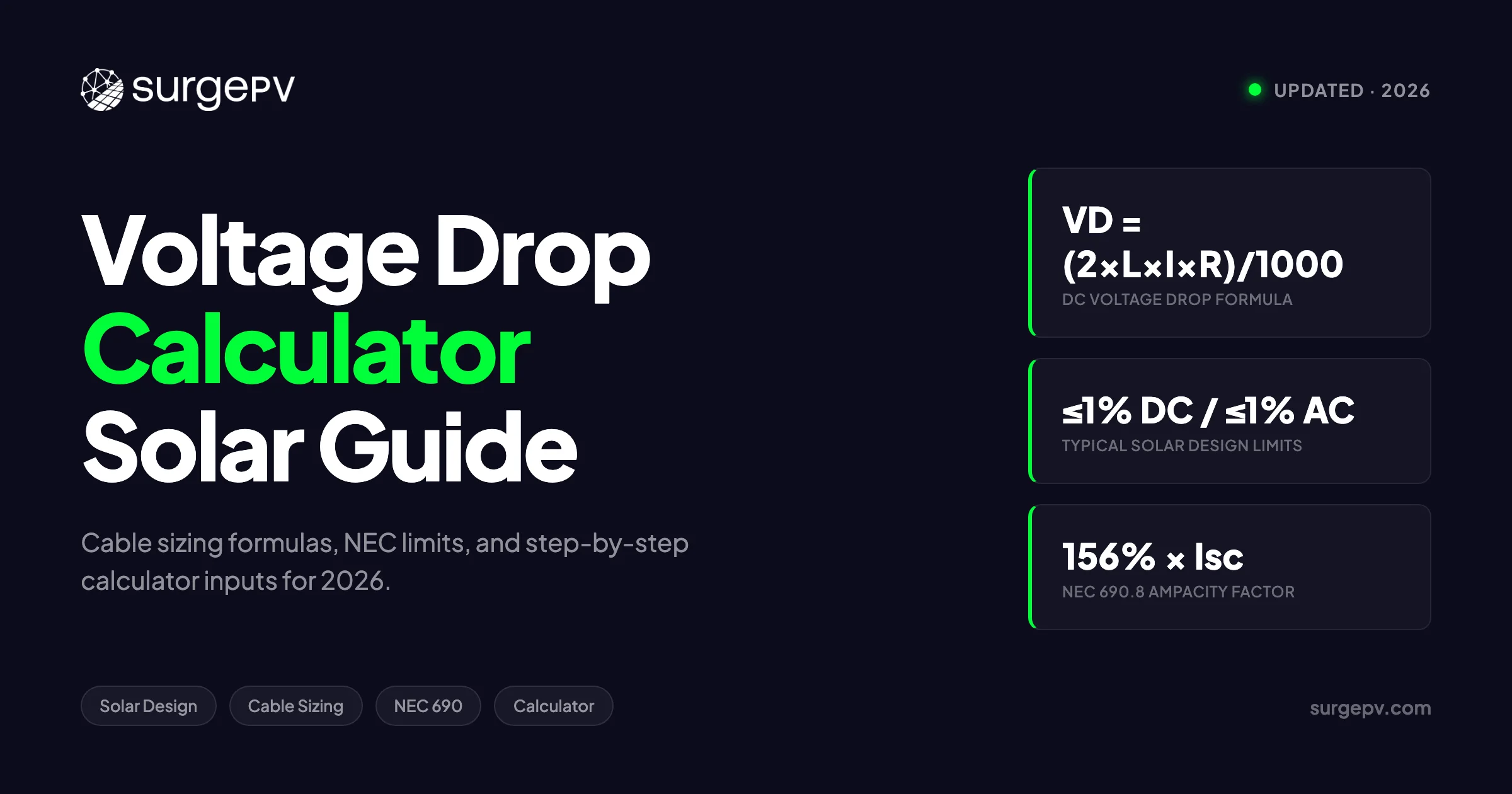
A solar voltage drop calculator estimates power lost in cable runs. Enter cable length, current, conductor size, material, and system voltage. The tool returns voltage drop in volts and as a percentage. For DC solar circuits, the standard formula is VD = (2 × L × I × R) / 1000. Most designers target ≤1% on DC strings, ≤1.5% on combiner-to-inverter runs, and ≤1% on AC inverter output.
Quick Answer
Use a voltage drop calculator by entering one-way cable length, operating current, conductor size and material, and system voltage. For DC circuits, the formula is VD = (2 × L × I × R) / 1000. Target 1% drop on DC strings, 1.5% on DC homeruns, and 1% on AC inverter output. Always add a 10–15% margin for temperature and actual pulled length.
In this guide:
- What a voltage drop calculator does and when to use it
- The exact inputs every solar calculator needs
- DC, single-phase AC, and three-phase AC formulas
- NEC 2026 voltage drop guidance vs. solar industry practice
- Worked examples: residential string, commercial rooftop, utility ground-mount
- How temperature, conduit fill, and bundling change results
- Common calculator mistakes that cost real projects money
- When to upsize conductors vs. raise system voltage
- FAQ section with the most asked voltage drop questions
What a Voltage Drop Calculator Does
A voltage drop calculator solves one problem: how much voltage disappears between two points because of conductor resistance. In solar, those two points might be:
- A module string and the combiner box
- A combiner box and the inverter
- An inverter and the AC panelboard
- A battery and the inverter DC bus
The calculator does not replace NEC ampacity checks. It answers a different question. Ampacity checks make sure the cable does not overheat. Voltage drop checks make sure the cable does not waste energy or push the inverter outside its operating window.
Most solar voltage drop calculators return three numbers:
- Voltage drop in volts — the absolute loss across the run
- Voltage drop as a percentage — the loss relative to system voltage
- Voltage at the load end — what the inverter or device actually sees
The percentage is what designers compare against project limits. A 4 V drop on a 400 V string is 1%. The same 4 V drop on a 48 V battery circuit is 8.3%.
Pro Tip
Always run the voltage drop check after ampacity sizing is complete. On runs longer than 30 m, voltage drop usually becomes the binding constraint, not ampacity.
Inputs Every Solar Voltage Drop Calculator Needs
The quality of the output depends on the inputs. A basic calculator asks for five values. A professional-grade tool asks for nine or ten.
Basic inputs
| Input | Why it matters | Typical source |
|---|---|---|
| One-way cable length | Resistance scales directly with length | Site plan or CAD pull length |
| Circuit current | Determines the voltage loss | Module datasheet Imp or Isc |
| Conductor size | Sets resistance per unit length | NEC Table 8 or manufacturer data |
| Conductor material | Copper and aluminum have different resistance | Project spec or cost decision |
| System voltage | Used to convert volts to percentage | String sizing or inverter rating |
Advanced inputs
| Input | Effect on result | When to use |
|---|---|---|
| Ambient temperature | Higher temperature raises resistance | Rooftop, desert, or hot climates |
| Conduit fill | Bundled conductors run hotter | More than 3 current-carrying conductors |
| Power factor | AC only; lower PF increases drop | Three-phase inverter output |
| Frequency | Affects reactance on large AC cables | Utility-scale AC collection |
| Actual pulled length | Adds 10–15% over straight-line distance | Complex routing or conduit paths |
If you only enter straight-line distance from a roof plan, your result will be low. Real cable runs follow conduit paths, go around equipment, and include vertical drops. Add 10–15% to the plan length for residential jobs and 15% for commercial jobs.
Voltage Drop Formulas Behind the Calculator
Every voltage drop calculator uses one of three formulas. The math is simple, but the wrong formula gives the wrong answer.
DC and single-phase AC
VD = (2 × L × I × R) / 1000Where:
- VD = voltage drop in volts
- L = one-way length in feet
- I = current in amps
- R = conductor resistance per 1,000 feet
For DC circuits, drop the power factor. For single-phase AC, multiply by cos θ if the calculator asks for power factor.
Three-phase AC
VD = (√3 × L × I × R × cos θ) / 1000Where:
- √3 ≈ 1.732
- cos θ = power factor
- Use line-to-line voltage for the percentage calculation
Percentage voltage drop
VD% = (VD / V_system) × 100Temperature-corrected resistance
R_T = R_20 × [1 + α × (T - 20)]Where:
- R_20 = resistance at 20°C
- α = 0.00393 for copper, 0.00403 for aluminum
- T = operating temperature in °C
At 75°C, copper resistance is about 22% higher than at 20°C. A calculator that uses 20°C resistance will understate real-world drop by roughly that amount on a hot roof.
NEC 2026 Guidance vs. Solar Industry Practice
NEC 2026 does not make voltage drop a hard requirement. The limits in NEC 210.19(A)(1) and 215.2(A)(1) are informational notes. They recommend 3% on feeders, 3% on branch circuits, and 5% combined. Inspectors may not enforce them, but they are still the starting point for good design.
Solar projects usually need tighter targets because the system lifetime is 25–30 years. Every extra 1% of voltage drop is energy lost for decades.
| Circuit type | NEC recommendation | Common solar target |
|---|---|---|
| DC string to combiner | 3% branch | ≤ 1.0% |
| DC combiner to inverter | 3% feeder | ≤ 1.5% |
| AC inverter to panelboard | 3% feeder | ≤ 1.0% |
| AC panelboard to service | 3% feeder | ≤ 1.0–1.5% |
| Combined end-to-end | 5% combined | ≤ 2.5–3.0% |
NEC 690.8 also matters for the current input. PV source circuit conductors must carry 156% of module short-circuit current:
I_design = Isc × 1.25 × 1.25 = 1.5625 × IscFor voltage drop, some designers use Imp for normal operation and Isc × 1.5625 for a conservative worst-case check. The conservative check is safer on long homeruns.
Worked Examples
The best way to understand a voltage drop calculator is to run real numbers.
Example 1: Residential DC string
A rooftop string uses 10 modules in series. The run from the array junction box to the string inverter is 60 ft one-way. The string operates at 400 V and 8 A.
| Input | Value |
|---|---|
| Length | 60 ft one-way |
| Current | 8 A |
| Conductor | 10 AWG copper |
| R at 20°C | 1.02 Ω / 1,000 ft |
| System voltage | 400 V |
Calculation:
VD = (2 × 60 × 8 × 1.02) / 1000 = 0.98 V
VD% = (0.98 / 400) × 100 = 0.24%
Result: 0.24% drop. This is well below the 1% target. The designer could even use 12 AWG for a short run, but 10 AWG is the common residential default.
Example 2: Commercial DC homerun
A 250 kWp rooftop has 200 m DC homeruns from combiner boxes to a central inverter. The system voltage is 1000 V and the operating current is 90 A.
| Input | Value |
|---|---|
| Length | 656 ft one-way (200 m) |
| Current | 90 A |
| Conductor | #2 AWG copper |
| R at 20°C | 0.156 Ω / 1,000 ft |
| System voltage | 1000 V |
Calculation:
VD = (2 × 656 × 90 × 0.156) / 1000 = 18.4 V
VD% = (18.4 / 1000) × 100 = 1.84%
At 50°C, resistance rises about 12%, so the corrected drop is roughly 2.06%. This exceeds the 1.5% target. The designer should upsize to #1 AWG or #1/0 AWG, or consider moving the inverter closer.
Example 3: Three-phase AC inverter output
A 1.2 MW ground-mount system uses a 800 V three-phase inverter. The output current is 880 A and the run to the medium-voltage transformer is 500 m one-way. The designer uses three parallel aluminum runs.
| Input | Value |
|---|---|
| Length | 1,640 ft one-way |
| Current per run | 293 A (880 A ÷ 3) |
| Conductor | 600 kCmil aluminum |
| R at 20°C | 0.026 Ω / 1,000 ft |
| Power factor | 0.98 |
| Line voltage | 800 V |
Calculation:
VD = (1.732 × 1640 × 293 × 0.026 × 0.98) / 1000 = 21.4 V
VD% = (21.4 / 800) × 100 = 2.68%
This exceeds the 1% AC target. The designer should either upsize to 1000 kCmil or 1250 kCmil, move the transformer closer, or raise the AC collection voltage.
How Temperature, Conduit Fill, and Bundling Change Results
A voltage drop calculator that assumes 20°C free-air resistance will miss real-world conditions. Three factors push resistance higher.
Temperature
Copper resistance rises about 0.393% per °C above 20°C. Aluminum rises about 0.403% per °C. The table below shows the multiplier to apply.
| Operating temperature | Copper multiplier | Aluminum multiplier |
|---|---|---|
| 20°C | 1.00 | 1.00 |
| 40°C | 1.08 | 1.08 |
| 60°C | 1.16 | 1.16 |
| 75°C | 1.22 | 1.22 |
| 90°C | 1.28 | 1.28 |
For rooftop conduit in full sun, 60–75°C conductor temperature is common. Multiply the calculator result by 1.15 to 1.25.
Conduit fill and bundling
NEC 310.15(C)(1) requires ampacity derating when more than three current-carrying conductors share a conduit or cable tray. Higher ampacity derating usually forces a larger conductor, which also reduces voltage drop. But if you size only for ampacity and not for drop, bundled runs can still surprise you.
A good rule of thumb: add 5–10% to your calculated voltage drop for bundled cable trays.
Actual pulled length
Cable never travels in a straight line. It goes up walls, across rafters, down conduit, and around equipment. Field measurements often show 10–15% more length than the CAD plan. Enter the estimated pulled length, not the straight-line length.
Common Voltage Drop Calculator Mistakes
Even experienced designers make these errors. The calculator gives a number, but the number is only as good as the inputs.
- Using Isc for operating drop. Isc is for ampacity and worst-case checks. Use Imp for normal voltage drop and energy-loss estimates.
- Forgetting the 2× round-trip factor on DC. Current flows out and back. Some calculators ask for one-way length and apply the factor internally; others do not. Read the tool carefully.
- Using 20°C resistance for hot roofs. Add a temperature margin or use 75°C resistance values.
- Confusing single-phase and three-phase formulas. Using 2 instead of √3 on three-phase AC understates drop by 15%.
- Ignoring power factor on AC output. Modern inverters run near unity power factor, but not always. Use 0.95 to 1.0 unless you know better.
- Entering straight-line distance. Add 10–15% for actual routing.
- Stopping at ampacity. A conductor that passes ampacity can still fail the voltage drop target on long runs.
- Ignoring transformer impedance. A transformer can add 1.5–2% drop at full load. Add it to the cable drop for the full picture.
- Mixing AWG and kCmil. Sizes above 4/0 AWG are expressed in kCmil. Make sure the calculator and your spec use the same unit.
- Not documenting the calculation. Permits and peer reviews need to see the inputs and limits.
Stop Losing Energy to Bad Cable Sizing
SurgePV runs voltage drop checks as you design, so every string and homerun is sized correctly the first time.
Book a DemoNo commitment required · 20 minutes · Live project walkthrough
When to Upsize Conductors vs. Raise System Voltage
Once a voltage drop calculator shows a problem, you have four levers.
| Lever | Effect | Best for |
|---|---|---|
| Upsize conductor | Cuts resistance 22–25% per trade size | Short to medium runs where cable cost is low |
| Raise DC voltage | Halves current; quarters percentage drop | Commercial systems above 200 kWp |
| Shorten the run | Reduces length directly | Layout flexibility exists |
| Add parallel runs | Splits current across multiple paths | Very high current, long runs |
Raising system voltage is often the most powerful move. Moving from 600 V to 1000 V DC cuts current by 40% at the same power. Moving from 1000 V to 1500 V cuts it by another 33%. Because voltage drop scales with the square of current in percentage terms, a 1500 V system can use much smaller cable than a 600 V system for the same run.
For example, a 250 kWp system with a 100 m homerun might need #2 AWG at 1000 V. At 1500 V, the same energy loss target could allow #6 AWG. The conductor cost difference often pays for the higher-voltage inverter and modules.
Voltage Drop Calculator Checklist
Use this checklist every time you run a solar voltage drop calculation.
- Confirm the circuit type: DC, single-phase AC, or three-phase AC
- Use the right current: Imp for operating drop, Isc × 1.5625 for worst-case
- Enter one-way length, then verify whether the calculator applies the round-trip factor
- Add 10–15% to plan length for actual pulled distance
- Use 75°C resistance for hot operating conditions
- Apply conduit fill and bundling adjustments if needed
- Set AC power factor to 0.95–1.0 unless known otherwise
- Compare the result to project limits, not just NEC informational notes
- Document inputs, outputs, and conductor selection in the design file
- Re-run the calculation if layout, voltage, or conductor size changes
Voltage Drop Targets by Project Type
Different projects have different budgets and tolerances. The table below gives practical targets used by solar EPCs in 2026.
| Project type | DC string | DC homerun | AC inverter output | Total end-to-end |
|---|---|---|---|---|
| Residential rooftop | ≤ 1.0% | ≤ 1.5% | ≤ 1.0% | ≤ 2.5% |
| Commercial rooftop | ≤ 1.0% | ≤ 1.5% | ≤ 1.0% | ≤ 2.5% |
| Ground-mount C&I | ≤ 1.0% | ≤ 1.5% | ≤ 1.5% | ≤ 3.0% |
| Utility-scale | ≤ 1.0% | ≤ 1.5% | ≤ 1.5% | ≤ 3.0% |
| Off-grid / battery | ≤ 1.0% | ≤ 1.0% | ≤ 1.5% | ≤ 2.5% |
These targets are tighter than NEC recommendations because they protect long-term energy production. A 1% improvement on a 500 kWp system is roughly 5–7 MWh per year. At $0.10/kWh, that is $500–$700 per year for 25 years.
International Voltage Drop Standards
Voltage drop limits vary by country. If you are designing outside the United States, check the local standard before setting calculator targets.
| Country / region | Standard | Typical DC limit | Typical AC limit |
|---|---|---|---|
| United States | NEC 2026 | 2% industry / 3% NEC info | 3% feeder / 5% combined |
| United Kingdom | BS 7671 | 3% | 5% total |
| European Union | IEC 60364-5-52 | 3% industry | 4% |
| Australia | AS/NZS 5033 | 3% string / 1% AC | 5% total |
| India | CEA / IS 14286 | 3% | 5% total |
Always confirm the latest amendment. Standards update on multi-year cycles, and local utilities may impose stricter limits than the national code.
Conclusion
A voltage drop calculator is only as good as the inputs and the limits you compare against. Start with the right formula for the circuit type. Use Imp for operating loss and Isc × 1.5625 for conservative checks. Add temperature and routing margins. Compare the result to solar industry targets, not just NEC informational notes.
Three actions to take away:
- Run a voltage drop check on every circuit longer than 30 m before finalizing cable size.
- Default to 1000 V or 1500 V DC on commercial systems to cut current and voltage drop.
- Build a 10–15% safety margin into every voltage drop budget to cover heat, routing, and aging.
For more on cable sizing, read Solar Cable Sizing Calculation 2026: NEC 310.16 & Voltage Drop. For string-level design, see Solar String Sizing Calculator. And if you want voltage drop checks built into your design workflow, try solar design software that connects layout, stringing, and electrical sizing in one place.
Frequently Asked Questions
This section mirrors the FAQ schema in the frontmatter above.
What is a voltage drop calculator for solar?
A voltage drop calculator for solar is a tool that estimates how much voltage is lost between the source and the load due to conductor resistance. You enter cable length, current, conductor size and material, and system voltage. The calculator returns voltage drop in volts and as a percentage. Solar designers use it to check that DC string cables, combiner-to-inverter homeruns, and AC inverter output circuits stay within project limits.
How do you calculate voltage drop for solar DC cables?
For DC solar cables, use the formula VD = (2 × L × I × R) / 1000, where L is one-way cable length in feet, I is current in amps, and R is conductor resistance per 1,000 feet. Multiply by two because current travels out and back. Then divide by system voltage and multiply by 100 to get the percentage drop. For example, a 50 ft run of 10 AWG copper at 8 A on a 400 V string gives about 0.82% drop.
What is the maximum voltage drop allowed in solar PV systems?
NEC 2026 keeps voltage drop as a recommendation, not a hard rule. The informational notes suggest 3% on feeders, 3% on branch circuits, and 5% combined. Solar engineers usually design tighter: 1% on DC strings, 1.5% on combiner-to-inverter runs, and 1% on AC inverter-to-panelboard circuits. End-to-end budgets of 2.5% to 3% are common for systems with 20+ year economics.
Should I use Isc or Imp for voltage drop calculations?
Use Imp for normal operating voltage drop and energy-loss estimates. Use Isc multiplied by 1.25 × 1.25, or 1.5625 × Isc, for worst-case ampacity and conservative voltage drop checks on PV source circuits. NEC 690.8 requires conductors to carry 156% of Isc for sizing, so many designers run the voltage drop check at this corrected current to stay safe.
What inputs does a solar voltage drop calculator need?
A solar voltage drop calculator needs: one-way cable length, circuit current, conductor size and material, system voltage, number of phases, and power factor for AC circuits. Advanced calculators also ask for ambient temperature, conduit fill, bundling conditions, and whether the run is in free air or conduit. These inputs affect resistance and the final drop.
How does temperature affect voltage drop?
Conductor resistance rises about 0.4% for every degree Celsius above 20°C. A copper conductor at 75°C has roughly 22% more resistance than at 20°C, which directly increases voltage drop. For hot rooftops or desert installs, multiply the base voltage drop by 1.15 to 1.25 to stay accurate.
When should I choose aluminum over copper for solar homeruns?
Aluminum is usually the better choice for conductors above 250 kCmil and runs longer than 75 to 100 meters. It costs about 60% of copper per ampere but has 1.6 times the resistance. For large commercial or utility-scale DC homeruns, aluminum often wins on installed cost even after larger lugs and anti-oxidant paste. Copper stays preferred for small sizes, short runs, and tight spaces.
Can I use a voltage drop calculator for three-phase AC inverter output?
Yes. For three-phase AC, use VD = (√3 × L × I × R × cos θ) / 1000, where cos θ is the power factor. Modern inverters usually run at 0.95 to 1.0 power factor. Use line-to-line voltage for the percentage calculation. Do not use the DC factor of 2 for three-phase systems, or you will understate the drop.
What is the difference between voltage drop and voltage rise?
Voltage drop is the loss of voltage from source to load on the supply side. Voltage rise is the increase in voltage on the line side of a grid-tied inverter when PV exports current back toward the grid. Both follow the same resistance formula but with opposite sign. NEC 705.28 in the 2026 cycle now references voltage rise as a parallel concern for interconnection.
How can I reduce voltage drop without changing cable size?
You can reduce voltage drop by shortening the cable run, raising system voltage, moving the inverter closer to the array, or increasing the number of parallel conductors. Doubling system voltage halves current at the same power, which quarters the percentage voltage drop. This is why commercial solar moved from 600 V to 1000 V and now often uses 1500 V DC.