

Quick Answer
Solar PV surge protection devices (SPDs) protect inverters and electronics from lightning-induced surges. Type 1 SPDs handle direct lightning strikes (≥12.5 kA); Type 2 handles indirect surges (≥5 kA). NEC 690 requires SPDs on DC and AC sides for most commercial installations. Cost: $100–$500 per device.
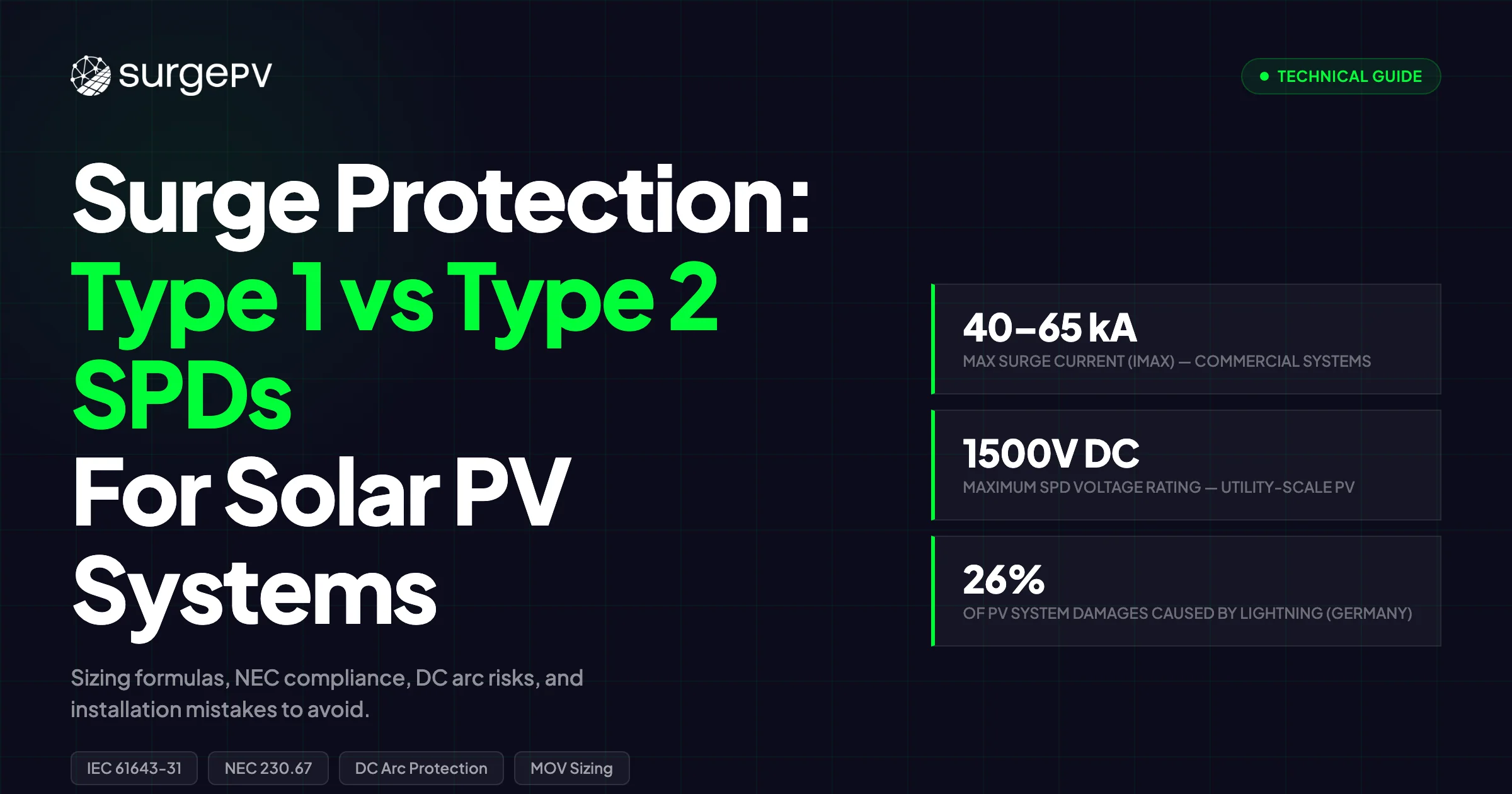
Replacing a blown inverter after a lightning event costs between $1,500 and $8,000 depending on system size (as of May 2025). A correctly sized DC surge protection device costs $30 to $200 (as of May 2025). That cost ratio should make SPD selection straightforward — yet industry data from Germany indicates lightning causes 26% of PV system damages, with inverters among the most commonly affected components (PLOS ONE, 2019). Also see: Germany solar subsidies.
Solar PV surge protection devices (SPDs) protect inverters and electronics from lightning-induced surges. Type 1 SPDs handle direct lightning strikes (≥12.5 kA); Type 2 handles indirect surges (≥5 kA). NEC 690 requires SPDs on DC and AC sides for most commercial installations.
Solar PV surge protection devices (SPDs) protect inverters and electronics from lightning-induced surges. Type 1 SPDs handle direct lightning strikes (≥12.5 kA); Type 2 handles indirect surges (≥5 kA). NEC 690 requires SPDs on DC and AC sides for most commercial installations. Cost: $100–$500 per device.
The problem is not awareness. Most solar installers know they need SPDs. The problem is selection and installation errors: wrong voltage rating, wrong device type for the location, leads that are too long, and no monitoring plan. This guide covers every variable that matters — from the IEC test waveforms behind the Type 1 / Type 2 classification to the NEC 230.67 surge-protection mandate that now applies to the AC side of most new residential installations in the United States. For United States-specific compliance details, see United States arizona/phoenix. For United States-specific compliance details, see United States california/los-angeles.
TL;DR
Type 1+2 DC SPDs belong at LPZ 0→1 boundaries (where DC cables enter a building that has an external lightning protection system). Type 2 DC SPDs belong at the inverter DC input — and at the combiner box if the cable run exceeds 10 m. AC SPDs belong at the inverter AC output and at the service entrance. Uc must exceed your temperature-corrected Voc max multiplied by 1.1. SPDs degrade with every surge; inspect them every 6 months on residential systems, monthly on commercial.
What this guide covers:
- Type 1, Type 2, and Type 3 SPDs: what the test waveforms mean and where each device belongs in a PV system
- DC-side and AC-side installation positions with minimum specs
- How to calculate Uc and Imax for any string voltage using the IEC 61643-31 formula
- NEC 230.67 and IEC 61643-31 compliance requirements by jurisdiction
- SPD failure modes and why the silent open-circuit failure is the more dangerous one
- The 7 installation mistakes that consistently destroy inverters
Why Solar PV Systems Are Vulnerable to Surge Damage
PV arrays combine every feature that increases lightning risk: they are elevated, exposed to open sky, cover large surface areas, and connect to long runs of unshielded DC cable. This geometry makes them efficient collectors of both direct lightning strikes and induced electromagnetic surges from nearby events.
Two distinct threat categories require different responses. Direct lightning strikes transfer full impulse currents in the range of 10–100+ kA — no SPD absorbs this; an external lightning protection system (LPS) with air terminals, down conductors, and earthing is the only defense. Induced surges from nearby strikes and grid switching transients are the more common threat, with surge currents typically in the 5–40 kA range at the equipment terminals. Properly selected SPDs absorb these without damage.
The scale of the induced surge risk depends heavily on location. Lightning ground flash density (Ng) in Florida exceeds 10 flashes/km²/year — above 14 flashes/km²/year in three areas of the Florida peninsula (Vaisala National Lightning Detection Network, 2010); the contiguous US average is approximately 2.0 flashes/km²/year (NOAA, 1994). High-voltage inverter IGBT modules can sustain damage from transients as low as 1–2 kV above their rated operating voltage. Given that a 1000V DC string operating at 900V already sits close to the damage threshold for many inverters, even moderate induced surges cause cumulative degradation that eventually triggers premature failure.
The risk assessment framework in IEC 62305-2 quantifies this exposure by combining Ng with the structure’s collection area, equipment replacement cost, and consequence severity. The output determines whether an external LPS is needed and which SPD types are appropriate. For most residential and commercial installations in moderate-risk zones, a Type 2 SPD at the inverter DC input and AC output provides adequate protection. For ground-mount systems in high-lightning regions or any system with an external LPS, a Type 1+2 SPD at the LPZ boundary is mandatory.
Using solar PV design software that maps system geometry and generates the DC homerun layout helps identify which installation nodes need SPDs before the design is finalized.
Type 1 vs Type 2 vs Type 3 SPDs — What the Test Waveforms Mean
The Type 1/2/3 classification comes from IEC 61643 (AC systems) and IEC 61643-31 (DC PV systems specifically). Each type is validated against a different test waveform that simulates a different surge source.
| Type | Test Waveform | Threat Simulated | Key Parameter | Typical PV Installation Point |
|---|---|---|---|---|
| Type 1 | 10/350 µs | Partial lightning current (direct strike into LPS) | Iimp: 12.5–50 kA | LPZ 0→1 boundary with external LPS |
| Type 2 | 8/20 µs | Induced surges, switching transients | In: 5–20 kA; Imax: 20–65 kA | Combiner box, inverter DC input, inverter AC output |
| Type 1+2 | Both | Direct + indirect combined | Iimp + Imax in single housing | Space-constrained LPZ 0→1 boundary, retrofits |
| Type 3 | 1.2/50 µs + 8/20 µs combination wave | Fine residual surges | Imax ≤ 10 kA | Monitoring/communications lines only |
Type 1 — Partial Lightning Current
The 10/350 µs waveform in the Type 1 test represents the shape of actual lightning current: a sharp 10-microsecond rise to peak, then a slow 350-microsecond decay. This is a high-energy waveform. A device that passes this test can absorb the fraction of a direct lightning strike current that flows through the building’s electrical system when a proper external LPS diverts most of the energy to earth.
Type 1 SPDs belong at LPZ 0→1 boundaries — the point where cables from outside the protected zone enter the building. In solar terms, this is where the DC homerun from the array combiner penetrates the building envelope, if the array is connected to an external LPS. Without an external LPS, there is no LPZ 0→1 boundary, and Type 1 SPDs are not required (though they do not hurt).
Type 2 — Induced Surges and Switching Transients
The 8/20 µs waveform is shorter and less energetic than the 10/350 µs. It represents the surge shape of induced currents from nearby lightning events and from grid switching operations (capacitor bank switching, transformer energization). Type 2 is the standard choice for most residential and commercial solar installations.
The critical ratings are In (nominal discharge current — the level the device must handle 15 times without degradation) and Imax (maximum discharge current — the peak single event the device can survive). Most residential applications require In ≥ 20 kA; commercial systems with higher lightning exposure need In ≥ 40 kA.
Type 1+2 — The Practical Retrofit Solution
A Type 1+2 device passes both test protocols in a single housing. These are useful in retrofits where there is no physical space to install a Type 1 at the service entrance and a separate Type 2 downstream, and in new installations where the LPS designer wants to minimize the number of devices at the combiner box.
Type 3 — Communications Lines Only
On PV systems, Type 3 devices are not used on DC power circuits. The voltage levels and required Uc ratings of PV circuits exceed what Type 3 devices are designed for. Type 3 is appropriate for RS-485 monitoring lines, Ethernet cables running to inverter data loggers, and similar low-voltage communications circuits at LPZ 2→3 boundaries.
Cascade Coordination
When a Type 1+2 and a downstream Type 2 are both installed, they must be separated by at least 10 m of cable, or a decoupling inductor (15–25 µH) must be inserted. Without this separation, the Type 1+2 clamps the surge so fast that the downstream Type 2 sees a reverse voltage spike that can damage or destroy it.
Where to Install SPDs in a Solar System
DC-Side Installation Points
Position 1: PV Array Combiner Box
Install a DC SPD at the combiner box output whenever the cable run from the combiner to the inverter exceeds 10 m. The SPD goes between the combiner output terminals and the DC disconnect, connected line-to-PE and neutral-to-PE (or in 3-mode Y configuration for floating systems).
For systems with an external LPS, this SPD must be Type 1+2. For systems without an external LPS and cable runs under 50 m in moderate-lightning zones, a Type 2 is sufficient.
Position 2: Inverter DC Input
Every grid-connected inverter input should have an SPD. This is required by IEC 61643-32 for PV systems and by many U.S. utility interconnection rules, though NEC Article 690 does not currently mandate it nationally. The device must be installed within 0.5 m of the inverter DC terminals — measured by the total lead length of both the L+ and L− conductors from the SPD connection points to the PE reference. Every additional 0.5 m of lead length adds approximately 0.5–1 kV of effective clamping voltage due to the inductance of the leads, which negates the SPD’s protection level rating.
Pro Tip
Keep SPD leads as short as possible — under 0.5 m total for both conductors. Twist the L+ and L− leads together to reduce inductance further. If the inverter’s DC input terminal block is not close to a PE bus, run a short, dedicated earth conductor to the nearest equipotential bonding point rather than routing through long conduit runs.
Position 3: String-Level Protection (Utility-Scale Only)
In large ground-mount EPC projects, string-level SPDs — one per string — are sometimes specified in addition to combiner-box and inverter-input devices. This adds cost but provides the lowest effective Up at the module level. It is not standard practice for residential or commercial rooftop systems.
Configuration Modes
The correct SPD configuration depends on the earthing system of the DC array:
- Floating / IT system (most transformer-less inverters in Europe): Use a 3-mode Y-configuration SPD with protection between L+ and PE, L− and PE, and L+ and L−.
- Functionally earthed (negative rail earthed, common in older US string inverters): 2-mode protection — L+ to PE and L− to PE.
- High-resistance earthed: Maintain SPD leakage resistance above 100 kΩ to avoid false ground fault alarms from inverter insulation monitoring. Also see: European Solar Incentives.
AC-Side Installation Points
Position 1: Inverter AC Output
A Type 2 AC SPD (UL 1449-listed for North America, or IEC 61643-11 certified for IEC jurisdictions) belongs at the inverter’s AC output. Voltage rating for 230V single-phase systems: Uc ≥ 275V. For 400V three-phase systems: Uc ≥ 440V.
Position 2: Main Distribution Board
If the solar sub-panel feeds into a main distribution board at a different location, add a second Type 2 AC SPD at the main board. Maintain 10 m cable separation from the inverter AC SPD, or add a decoupling inductor.
Position 3: Service Entrance
NEC 230.67 requires a Type 1 or Type 2 SPD at all new and replaced dwelling unit service equipment. This is separate from any solar-specific SPD requirement and applies regardless of whether PV is present. If your service entrance is being upgraded as part of the solar installation, verify that the panel manufacturer’s integrated SPD option (now common in residential load centers) meets the rating requirements.
Why Both DC and AC SPDs Are Mandatory
The inverter’s galvanic isolation between its DC and AC circuits prevents a surge on one side from directly coupling through to the other. However, a surge entering through the grid can damage the inverter’s AC-side circuitry even if DC SPDs are fully functional — and vice versa. Both protection points are required independently.
Sizing Your SPD — Uc and Imax Calculations
Selecting Uc (Maximum Continuous Operating Voltage)
The most frequent sizing error is selecting Uc based on the string’s nominal operating voltage rather than its maximum open-circuit voltage under coldest site conditions. Photovoltaic module Voc increases as temperature drops. A 900V string at 25°C can reach 1,020V on a cold morning in a northern climate. An SPD rated at 1000V Uc will conduct continuously at that voltage, heat up, and fail prematurely.
The correct formula per IEC 61643-31 is:
UcPV ≥ VOC(STC) × [1 + |αVoc| × (Tmin − 25°C)] × 1.1Where:
- VOC(STC) = module open-circuit voltage at Standard Test Conditions × number of modules in series (from datasheet)
- αVoc = temperature coefficient of Voc (use absolute value; typically 0.0028 to 0.0034 per °C for crystalline silicon)
- Tmin = minimum expected ambient temperature at the site (use 10-year historical low from meteorological records, not just the regional average)
- 1.1 = IEC 61643-31 safety factor
Worked Example:
- String: 20 modules, Voc(STC) per module = 41.5V
- String Voc(STC) = 20 × 41.5V = 830V
- Temperature coefficient αVoc = 0.0028/°C
- Minimum site temperature Tmin = −10°C
- VOC at −10°C = 830V × [1 + 0.0028 × (−10 − 25)] × (−1) = 830V × [1 + 0.0028 × 35] = 830V × 1.098 = 911.3V
- Apply IEC safety factor: 911.3V × 1.1 = 1,002V → select 1200V SPD
Standard DC SPD voltage ratings: 600V, 800V, 1000V, 1200V, 1500V. Always select the next standard rating above your calculated value.
Important
If your DC string voltage falls between 1000V and 1500V after temperature correction, select a 1500V SPD — not a 1000V device. The extra headroom prevents continuous conduction on cold mornings, which is the leading cause of premature SPD thermal failure in northern climates.
Selecting Imax (Discharge Current Rating)
The discharge current rating determines how much surge energy the SPD can absorb without damage. Select based on the site’s lightning risk level:
| Application | Lightning Risk | Recommended In | Recommended Imax |
|---|---|---|---|
| Residential rooftop, no LPS, Ng < 2.5 | Low | 20 kA | 40 kA |
| Commercial rooftop, moderate lightning zone | Medium | 20–40 kA | 40–65 kA |
| Ground-mount, external LPS, Ng > 5 | High | 12.5 kA (Iimp) | 40–65 kA |
| Utility-scale, LPZ 0→1 boundary | Very High | 25 kA (Iimp) Type 1+2 | 40–65 kA |
Always round up to the next available standard rating from the manufacturer’s product line.
Voltage Protection Level (Up)
Up is the clamping voltage the SPD presents to the protected equipment during a surge event — the lower the better. The rule from IEC 61643-31:
Up ≤ 0.8 × UwWhere Uw is the equipment’s impulse withstand voltage. Most string inverters have a DC input Uw of 4–6 kV. This gives a target Up of 3.2–4.8 kV for the SPD at the inverter terminals.
The critical caveat: Up is measured at the SPD terminals, not at the inverter terminals. Every 0.5 m of lead length from the SPD to the protected equipment adds approximately 0.5–1 kV of effective clamping voltage due to lead inductance. A device rated Up = 2.5 kV with 1 m of lead length can present an effective Up of 3.5–4.5 kV at the inverter terminals. This is why keeping leads under 0.5 m total is not optional.
NEC and IEC Compliance Requirements
United States — NEC Articles
Solar-specific SPD requirements in the United States are distributed across several NEC articles and local jurisdiction rules:
| NEC Article | Requirement | Scope |
|---|---|---|
| NEC 230.67 (2020+) | Mandatory — Type 1 or Type 2 SPD at dwelling unit service | All new/replaced residential service equipment |
| NEC 242 (consolidated from 285 in 2020) | SPD installation rules; SCCR coordination | All SPD installations |
| NEC 285 (pre-2020 editions) | Earlier SPD installation requirements | Systems designed under pre-2020 NEC |
| NFPA 780 | SPDs required when external LPS is installed | Any structure with lightning rods/air terminals |
NEC 230.67 is the key nationwide requirement for residential installations. It applies to dwelling unit services and is not dependent on the system’s lightning risk level — it applies everywhere NEC 2020 or later is adopted. The AHJ determines which NEC edition governs; as of 2025, most US states have adopted NEC 2020 or NEC 2023.
While NEC Article 690 does not currently mandate a DC-side SPD at the inverter input, many U.S. utilities and local AHJs require DC SPDs as a condition of PV interconnection. Austin Energy, for example, requires a listed Type 1 or Type 2 SPD for all PV interconnections at the service. Always verify local amendments beyond the base NEC.
Short-circuit current rating (SCCR) coordination under NEC 242 requires that the SPD’s marked SCCR equals or exceeds the available fault current at the installation point. Verify this against the utility’s fault current data or the engineering calculation for the system.
International — IEC 61643-31 and EN 50539-12
In IEC jurisdictions, SPDs are mandatory when:
- An external LPS is present on the structure (IEC 62305-4)
- The installation is connected via overhead LV supply in a high-keraunic region (Ng > 25 or as specified by local regulations)
- National supplements (e.g., Germany’s DIN EN 62305-3 Supplement 5) specifically require them See our guide on Community Solar Projects Germany for more. Read more about Multi-Family Residential Solar Case Study.
IEC 61643-31 vs UL 1449 — Key Distinction
| Aspect | IEC 61643-31 | UL 1449 5th Edition |
|---|---|---|
| Application scope | DC PV circuits specifically, up to 1500V | AC systems primary; covers DC but not PV-specific arc behavior |
| Test waveform (Type 2) | 8/20 µs In and Imax | 8/20 µs combination wave; VPR at 3 kA |
| DC arc extinction | Explicitly required; disconnector mandatory | SCCR focus; arc extinction less granular for PV voltages |
| Certification mark | CE, TÜV, CB (EN 50539-12 for EU) | UL listed, cUL, ETL |
A device listed only under UL 1449 for AC service entrance use is not appropriate for the DC side of a PV system. IEC 61643-31 is the correct standard for DC PV SPDs. Many manufacturers (ABB, Dehn, Phoenix Contact, Littelfuse) dual-certify products for both markets.
Stop Guessing on SPD Sizing — Use Software That Calculates It
SurgePV calculates temperature-corrected string Voc, maps combiner positions, and flags the SPD Uc rating required at each node — so your design documentation is audit-ready from day one.
Book a DemoNo commitment required · 20 minutes · Live project walkthrough
For a direct comparison, see Arka 360 vs SurgePV.
SPD Failure Modes and Why Monitoring Matters
How MOV-Based SPDs Degrade
The vast majority of DC and AC SPDs in solar applications use metal oxide varistors (MOVs) as the clamping element. MOVs work by presenting high impedance at normal operating voltages and collapsing to low impedance when the voltage exceeds the clamping threshold, diverting surge current to earth.
Each surge event causes irreversible micro-structural damage to the zinc oxide grain boundaries inside the MOV. Leakage current increases. The clamping voltage drifts downward. Eventually, the device either degrades into a continuous partial-conduction state (leading to thermal runaway) or reaches the threshold at which its internal disconnector trips. For more on this topic, see Rooftop Solar Structural Assessment.
Short-Circuit Failure — The DC Arc Risk
When an MOV fails by short-circuit, it collapses to low impedance and begins drawing sustained follow current from the source. On AC systems, this arc self-extinguishes at the next zero crossing — typically within 8 ms. On DC systems, there is no zero crossing. The arc sustains indefinitely at the system voltage.
At 1000V DC, a sustained arc inside a combiner box or inverter cabinet can cause a fire within seconds. At 1500V, the energy is higher still. This is why IEC 61643-31 requires DC PV SPDs to have a disconnector that isolates the device on failure — most products use an integrated thermal fuse bonded directly to the MOV element — and why short-circuit current rating (SCCR) coordination with the upstream fuse or DC MCB is not optional.
The disconnector opens the circuit, converting the SPD to an open-circuit state. The system keeps running, but with no surge protection.
Open-Circuit Failure — The Silent Vulnerability
After a disconnector opens, the SPD is dead but the system looks normal. The inverter keeps generating. The monitoring system shows no fault. If the SPD has a visual status window, it has changed from green to red — but only someone physically present and looking at it would know.
This is the more dangerous failure mode in practice. An installer might replace a tripped SPD after a known surge event. But an SPD that degrades gradually over 3–5 years may trip on a moderate surge with no dramatic event to trigger an inspection. The next surge, which might have been absorbed, instead reaches the inverter unimpeded.
Pro Tip
For commercial and utility-scale systems, specify SPDs with remote dry-contact status outputs (normally-open or normally-closed relay contacts). Wire these into the SCADA or monitoring system so that an SPD failure triggers an alert without requiring a physical inspection. On residential systems, check the visual status window on every maintenance visit — it takes 5 seconds.
Status Indication Types
| Type | Reliability | Use Case |
|---|---|---|
| Mechanical flag / visual window | High — no power required | All system types; standard minimum |
| LED indicator | Medium — requires live circuit | Accessible residential panels |
| Remote dry contact (NO/NC) | High — full SCADA integration | Commercial, utility-scale systems |
Inspection Schedule
| System Type | Inspection Frequency |
|---|---|
| Residential | Every 6 months |
| Commercial | Monthly |
| Utility-scale | Continuous SCADA monitoring |
7 SPD Installation Mistakes That Destroy Inverters
| Mistake | Consequence | Correct Practice |
|---|---|---|
| Using AC SPD on DC side | DC arc cannot self-extinguish; fire risk inside combiner box | Only IEC 61643-31-certified DC SPDs on PV DC circuits |
| Undersized Uc (MCOV) | SPD conducts continuously on cold mornings; thermal runaway | Calculate temperature-corrected Voc max; apply ×1.1 safety factor |
| Lead length > 0.5 m | Each 0.5 m of lead adds 0.5–1 kV effective clamping voltage; protection level wasted | Keep total L+ and L− lead length to PE under 0.5 m; twist leads |
| Missing or high-impedance earth | Surge current cannot dissipate; SPD clamps ineffectively | Common equipotential earth bus; ground resistance < 5 Ω; conductor ≥ 16 mm² Cu for Type 1 |
| Single-pole protection on floating system | Ungrounded pole unprotected; differential surge reaches inverter | 3-mode Y-configuration SPD for IT/floating DC systems |
| No backup overcurrent protection (SCPD) | MOV short-circuit draws follow current; panel fire if upstream fuse is inadequate | Coordinate SPD SCCR with upstream gPV fuse or DC MCB per manufacturer’s table |
| Ignoring status indicators after known surge event | Failed SPD remains in place; next surge destroys inverter | Inspect or replace every SPD after any confirmed lightning event in the system’s vicinity |
The Most Expensive Mistake
The most costly error is using an AC-rated SPD on the DC side of a PV system. A conventional AC SPD has no DC arc-extinction mechanism. When the MOV fails under DC fault current, the arc sustains, the housing heats up, and the combiner box or inverter cabinet can catch fire. The device might be visually identical to the correct DC SPD from the same manufacturer — check the certification label for IEC 61643-31, not just UL 1449.
How Solar Design Software Reduces SPD Errors
SPD specification requires two data inputs that are often guessed rather than calculated: the temperature-corrected Voc max for Uc selection, and the cable lengths between system nodes to determine which positions need SPDs.
Solar design suite that models string configuration and DC homerun routing automates both calculations. When you model a string at the actual minimum site temperature — not just at STC — the correct Uc rating is output directly, without manual formula application. When cable lengths between the combiner and inverter are modeled in the system layout, SPD placement requirements become visible as part of the design output rather than a field decision. See String Sizing Solar PV System for detailed guidance.
SurgePV’s solar proposals output includes the SPD specification table as part of the system design documentation, giving clients and AHJs a single reference document that covers both the electrical design and the protection scheme. The generation and financial tool can account for SPD O&M costs — including replacement cycles — in the project’s 25-year financial model.
For installers who design and sell systems, having SPD specifications in the proposal rather than as an afterthought avoids the cost of retrofits when an AHJ requests documentation at inspection.
Frequently Asked Questions
What is the difference between a Type 1 and a Type 2 SPD for solar PV?
Type 1 SPDs are validated against the 10/350 µs test waveform, which simulates partial lightning current from a direct strike. They belong at LPZ 0→1 boundaries — where DC cables enter a building connected to an external lightning protection system. Type 2 SPDs are validated against the 8/20 µs waveform, which simulates induced surges from nearby lightning and grid switching. They go at inverter DC inputs, inverter AC outputs, and distribution boards on most residential and commercial systems. A Type 1+2 combined device meets both test protocols in a single housing and is the practical choice when an LPS is present but space is constrained.
Where should I install a surge protection device in a solar system?
Install a DC SPD at the PV array combiner box if the cable run to the inverter exceeds 10 m, and at the inverter DC input terminals (within 0.5 m). Install an AC SPD at the inverter AC output and at the main distribution board or service entrance. Both DC and AC protection points are required — the inverter’s galvanic isolation does not protect against surges entering independently through either circuit.
What Uc voltage rating do I need for my solar SPD?
Apply the IEC 61643-31 formula: UcPV ≥ VOC(STC) × [1 + |αVoc| × (Tmin − 25°C)] × 1.1. Use the module’s Voc at STC from the datasheet, the temperature coefficient of Voc (typically 0.0028–0.0034/°C for crystalline silicon), and the coldest expected site temperature. Apply the 1.1 safety factor. Select the next standard rating above your result from the available options: 600V, 800V, 1000V, 1200V, or 1500V DC.
Does a solar inverter need both DC and AC surge protection?
Yes. DC SPDs protect the inverter’s input terminals against surges entering through the array wiring. AC SPDs protect the output terminals against surges from the grid. A surge on the AC side can damage the inverter’s AC output stage even if DC SPDs are in place — and vice versa. The AC side is required under NEC 230.67 for dwelling units; the DC side is required by IEC 61643-32 and many local utility interconnection rules.
Is an SPD mandatory for solar PV systems under NEC?
Under NEC 2020 and later, NEC 230.67 requires a Type 1 or Type 2 SPD at all new or replaced dwelling unit services (AC side). NEC Article 690 does not currently mandate DC-side SPDs nationally, though many local AHJs and utilities require them for PV interconnection. Confirm which NEC edition is adopted in your AHJ’s jurisdiction, as some areas still operate under pre-2020 editions where the residential SPD requirement did not exist.
Three action items before your next SPD specification:
- Calculate UcPV using the temperature-corrected formula — not the string’s nominal voltage. Use the 10-year historical minimum temperature for the site, not a regional average.
- Specify SPDs on both the DC and AC sides. A single device protects one side only.
- Set a maintenance calendar for SPD status inspection. On commercial systems, wire the dry-contact output into your monitoring platform so you get an alert when the device fails rather than discovering it at the next annual inspection. Solar proposal software generates professional quotes in minutes.
Where this fits
This article is part of SurgePV's Solar Design hub, which works through the topic from first principles to the decisions a project team actually has to make.
