

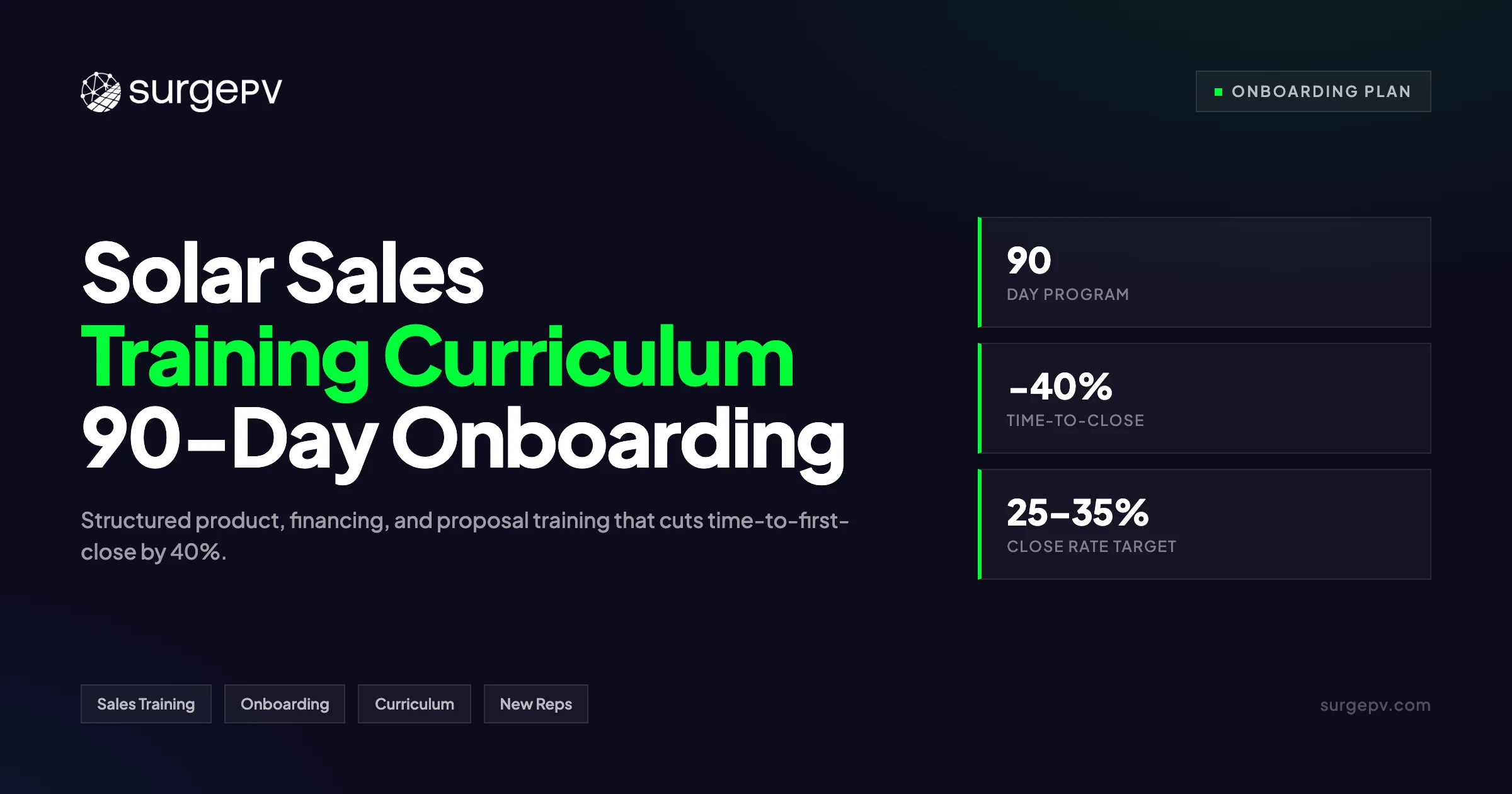
Most solar reps take 45 to 60 days to close their first deal. That delay costs money. Poor onboarding costs $100,000 to $200,000 per failed hire when you count recruitment, training, and lost revenue (CareerTrainer.ai, 2026). Yet companies with structured onboarding programs see 50% higher retention and 62% greater productivity than those without them (SHRM).
Most solar reps take 45 to 60 days to close their first deal. Yet companies with structured onboarding programs see 50% higher retention and 62% greater productivity than those without them (SHRM). Reps who complete a formal curriculum close their first deal in under 45 days.
The residential solar market contracted 31% year over year in 2024. The U.S. installed 4,742 MWdc of residential capacity, the lowest annual total since 2021 (SEIA/Wood Mackenzie, 2025). Reps now face harder objections, longer cycles, and tighter financing. Generic onboarding checklists do not prepare them for these realities.
This guide gives you a solar-specific 90-day training curriculum. It covers pre-boarding, product knowledge, objection handling, and proposal speed. Each phase includes measurable gates so managers know when reps are ready.
TL;DR — Solar Sales Training Curriculum
A structured solar sales training curriculum cuts time-to-first-close by 40% and raises retention by 25%. High-performing teams onboard reps in 90 days using blended learning: classroom, shadowing, role-play, and software drills. Reps who deliver proposals within 24 hours close at 2-3x the rate of reps who wait 3-5 days.
In this guide:
- What the data says about onboarding ROI
- Pre-boarding setup (Days -7 to 0)
- Days 1-30: Foundation building and first proposals
- Days 31-60: Shadowing and objection drills
- Days 61-90: Independent execution and speed-to-lead
- The 10 objections every rep must master
- Certification gates before solo selling
Solar Sales Training Curriculum: What the Data Says About Onboarding ROI
Structured onboarding makes new reps productive faster. It also cuts turnover. Companies with strong onboarding improve new-hire productivity by 70% and retention by up to 82% (Brandon Hall Group). Reps who complete a formal curriculum close their first deal in under 45 days. Those without one often need 60 to 90 days.
Sales onboarding is expensive. Companies spend $4,000 to $7,000 per hire on onboarding alone (Docustream.ai, 2025). A failed hire costs $100,000 to $200,000 when you include recruitment, management time, and lost revenue (CareerTrainer.ai, 2026).
The numbers get worse in solar. Customer acquisition cost averages $0.43 per watt nationally (RGR Marketing, via GlassHouse). In competitive markets, a single sale can cost up to $10,000 to acquire (McKinsey, via GlassHouse). A rep who takes 90 days to close their first deal burns cash the entire time.
Structured training fixes this. Research shows that organizations with formal onboarding programs have ramp-up times that are 34% faster than unstructured hires (CareerTrainer.ai, 2026). These programs also deliver 50% better retention.
Solar adds a layer of complexity that generic sales training ignores. Reps must understand net metering, financing options, inverter specifications, and local permitting timelines. They need to explain why a $26,880 system makes sense against a $200 monthly electric bill. Without this knowledge, they stumble in the home and lose trust.
The residential market declined 31% year over year in 2024 (SEIA/Wood Mackenzie, 2025). SEIA and Wood Mackenzie forecast a further 13% contraction in 2026. Reps now face harder objections, longer cycles, and more price-sensitive buyers. Training must reflect this new reality.
Reps need to understand battery attach rates. The national battery attachment rate jumped to 45% in the second half of 2024, an all-time high (EnergySage, 2025). Sunrun reached 62% on new installs in Q4 2024 (Sunrun Q4 2024 Earnings Call, 2025). Reps must explain backup duration, load coverage, and incremental cost without relying on outdated tax credit language.
Svea Solar proved that scaled onboarding works. The Swedish installer onboarded 90 sales consultants in 96 days using classroom training, digital modules, self-study, group work, role-play, and peer shadowing. Survey scores hit 4.7 out of 5. Reflection scores reached 8.4 out of 10 (Svea Solar, 2024).
The lesson is clear. Solar reps need solar-specific content delivered through multiple formats. A 90-day solar sales training curriculum beats both generic checklists and unstructured field learning.
The Pre-Boarding Phase (Days -7 to 0): Setting Up New Reps Before Day One
Pre-boarding sends tool logins, reading material, and account setup before the rep walks in. Reps who arrive with software access and product context hit the ground running on Day 1. Managers who skip this phase lose a full week to passwords, paperwork, and confusion.
Most onboarding starts on Day 1. That wastes a full week. Smart managers start the solar sales training curriculum seven days before the first official day.
Send three things during pre-boarding.
First, software credentials. Set up the CRM, canvassing app, and PV design software accounts. New reps should log into solar proposal tools and click through a sample project before they meet the team. This removes first-day IT friction entirely.
Second, product reading. Share a 20-page primer on PV basics. Cover how solar panels work, what inverters do, and how net metering credits apply to local utility rates. Keep it short. Reps do not need engineering degrees. They need enough knowledge to answer early questions without freezing.
Third, compliance context. Share the ANSI/SEIA 401-2025 consumer protection standard summary. This standard defines ethical sales practices, cost disclosure rules, and contract transparency requirements. Reps who understand compliance from Day 1 avoid costly missteps later. SEIA launched professional certification programs tied to this standard in November 2025 (SEIA, 2025).
Add a 30-minute intro call during pre-boarding. Walk through the 90-day schedule and set expectations. Tell reps what success looks like at Day 30, Day 60, and Day 90. Show them the certification gates they must pass.
Send a welcome packet with company battlecards. Include one-page sheets on the top three competitors in your market. Add a local utility rate card. Add a financing comparison chart showing cash, loan, lease, and PPA side by side. For France-specific information, see Agricultural Solar Case Study. For the latest details on France, see Floating Solar Farms France.
Pre-boarding removes first-week friction. Reps arrive with passwords, context, and confidence instead of paperwork and confusion. Managers save hours of repetitive explanation. The rep starts learning on Day 1 instead of Day 4.
Days 1 to 30 — Foundation: Product Knowledge, Compliance, and First Proposals
The first month builds PV fluency, financing knowledge, and hands-on proposal skills using real software. Reps must pass a product knowledge gate before they shadow a senior rep or join a live consultation. Month 1 sets the pace for everything that follows.
Week 1 is product immersion. Reps study module specifications, inverter datasheets, and warranty terms. They learn the difference between string inverters and microinverters. They review shading impact on output and how shadow analysis tool reports work. For more on this topic, see [Solar Shading Analysis Guide](/blog/solar-shading-analysis-guide).
Include a half-day on financing. Reps must explain cash purchase, solar loan, lease, and PPA options without reading from a script. Cash delivers the highest lifetime savings. Loans run 3% to 8% depending on credit. Leases and PPAs offer $0 down but lower long-term returns. Reps who can show all four side-by-side close 20% to 30% more deals. For more on this topic, see Solar PPA Negotiation Guide.
Week 2 introduces compliance and consumer protection. Walk through the ANSI/SEIA 401 standard in detail. Cover truth-in-lending disclosures, cancellation rights, and equipment specification requirements. Role-play a high-pressure scenario where a homeowner pushes for immediate signing. The rep must practice pausing, disclosing, and documenting instead of rushing.
Week 3 is software training. This is where modern onboarding differs from outdated playbooks. Traditional training teaches product knowledge first and software later. That creates a gap between learning and selling.
Train reps on solar design tool basics immediately. Show them how to enter an address, trace a roof, place panels, and run a shading report. Then move to solar proposal tools training. Reps should build a complete proposal from a real address within their first 14 days.
Clara AI helps new reps skip the steep learning curve. Reps enter a property address. Clara AI generates a layout in under five minutes. The rep reviews the design, adjusts financing, and exports a branded proposal. No CAD skills required.
Week 4 adds competitive positioning. Reps must know how to position against national installers. Sunrun captured about 19% of new U.S. residential installations in Q1 2025 (Matrix BCG, 2025). Their digital platform qualifies leads before field reps arrive. Local installers win on personalized service, faster install timelines, and direct owner access.
Build battlecards for the top three competitors in your market. Each card should list the competitor’s pitch, common weakness, and your counter. Reps should memorize these before their first live consultation.
End Month 1 with a product knowledge exam. Reps must score 80% or higher to advance to shadowing. Test PV basics, financing rules, compliance requirements, and software navigation. Reps who fail get three days of remedial study and one retake.
Days 31 to 60 — Application: Shadowing, Objection Handling, and Live Pitches
Month 2 moves reps from theory to practice through supervised shadowing, structured role-play, and live consultations. Reps who complete structured shadowing and role-play build confidence faster than those who skip these steps. This is where habits form.
Shadowing is the fastest way to build real-world judgment. Pair each new rep with a senior performer for at least 10 hours across Weeks 5 and 6. Use a shadowing scorecard. The new rep rates the senior on greeting quality, discovery depth, objection handling, proposal delivery, and close technique. The senior rates the new rep on engagement, note-taking, and question quality.
Shadowing must have structure. Random ride-alongs teach habits without context. Give the new rep one focus per session. Today, watch how the senior handles the “three bids” objection. Tomorrow, study how they transition from discovery to proposal. Next session, observe how they ask for the signature.
Week 6 introduces objection handling drills. Reps face the 10 most common solar objections in scripted role-play. Each drill uses a weak response and a strong response. The rep practices the strong version until it sounds natural.
The top objections are price, three bids, spousal approval, moving, repairs, roof condition, financing rates, roof suitability, thinking it over, and battery backup. Also see: Us Residential Solar Market Trends 2026. For United States-specific compliance details, see United States arizona/phoenix. For United States-specific compliance details, see United States california/los-angeles.
Use proven rebuttals. For price, reframe the conversation from total cost to monthly payment versus the current electric bill. “You already spend this money every month. The only question is whether you pay the utility or pay yourself.”
For three bids, teach reps to control the comparison. “While you compare, focus on three things: total cost after incentives, warranty coverage including workmanship, and who actually installs the system.” For France-specific information, see France Solar Feed-in Tariffs.
For moving, use data. “Homes with solar sell for 4.1% more than comparable homes without solar. A house with near-zero electric bills sells faster than one without.” (Zillow, 2019)
Run each drill three times. First with scripts visible. Second with notes only. Third from memory with a manager scoring delivery, tone, and accuracy.
Weeks 7 and 8 add live pitches with supervision. The rep leads the consultation. The manager or senior sits in the room but does not intervene unless asked. After the pitch, run a 15-minute debrief. What worked? What stalled? What will you change next time?
Set a target of 5 live supervised pitches before Month 2 ends. Reps who hit this mark build confidence without developing bad habits in private. Managers catch mistakes early and correct them before they become permanent.
Your Reps Should Close Faster Starting Week 2
SurgePV turns new hires into proposal-ready sellers in days, not months.
Book a DemoNo commitment required · 20 minutes · Live project walkthrough
For a direct comparison, see Arka 360 vs SurgePV.
Days 61 to 90 — Independence: Speed-to-Lead, Same-Day Proposals, and First Closes
Month 3 shifts reps to independent execution with strict targets for response time, proposal speed, and close rate. Reps who respond to leads in under 5 minutes and deliver same-day proposals double their install rate. This is where training converts to revenue.
Speed-to-lead is the highest-ROI skill most teams ignore. Data from Harvard Business Review and Velocify shows that contacting a new prospect within one minute increases conversion likelihood by roughly 4x. Teams that reply in under five minutes see contact rates jump from 20-25% to 40-50% (Blazeo, 2025).
Train reps to treat every inbound lead as urgent. Set CRM automations that assign leads instantly and trigger follow-up tasks. Reps should call before they email. A live conversation beats a template message every time.
Proposal speed is equally important. EnergySage marketplace data shows that 24-hour proposals close at 2 to 3 times the rate of 3-to-5-day delays (EnergySage, via SurgePV).
Build a same-day proposal standard into your curriculum. Reps should never leave a home without delivering the proposal. This is where solar proposal tool training pays off. A rep who can model the roof, run financials, and export a branded PDF during the consultation removes every reason for delay.
Teach reps to handle the kitchen-table close. This is different from the email-and-wait approach. In a kitchen-table close, the rep builds the proposal with the homeowner present. They adjust panel count, financing terms, and battery options in real time. The homeowner sees the system on their actual roof. They see year-by-year savings. They see payback and break-even lines. By the time objections arise, the visual proof has already answered them.
SurgePV supports this workflow directly. Reps use solar design tools to model the home in minutes. Clara AI auto-generates layouts so the rep focuses on the customer, not CAD clicks. The generation and financial tool shows ROI, payback, and LCOE side by side. The proposal exports before the coffee gets cold.
Set clear KPIs for Month 3. Response time: under 5 minutes. Proposal delivery: same day as consultation. Close rate target: 15% by Day 75, 25% by Day 90. Sales cycle: under 60 days from first contact to signed contract.
Track lead source performance too. Referral leads close at 29% to 37.5%. Third-party leads close at 4% to 9% (GlassHouse, 2025). Reps should prioritize follow-up by source, not by arrival order.
Reps who hit these targets earn full quota and territory independence. Reps who miss enter a 15-day improvement plan with daily manager check-ins.
The 10 Solar Sales Objections Every Rep Must Master
The most successful solar reps do not avoid objections. They anticipate them and use visual proposals to answer questions before the homeowner asks. A rep who masters the top 10 objections closes 25% to 35% of qualified leads. Training separates top performers from average ones more than any other single factor.
Objections are not rejections. They are requests for more information delivered with skepticism. Train each objection using a three-part framework: acknowledge, reframe, prove.
Acknowledge validates the homeowner’s concern. “I understand why price feels like the first question.”
Reframe shifts the mental model. “Let’s look at what you already pay the utility each year.”
Prove uses data or visuals. “Here’s your 25-year savings chart next to your current electric bill trend.”
The 10 objections and core responses:
-
“Solar is too expensive.” Reframe from total cost to monthly payment. Show the financed payment against the current average bill. Remind them that residential system costs dropped 65% to 83% from 2010 to 2024 (NREL, 2024).
-
“We are getting three bids.” Do not argue. Guide the comparison. Focus on total cost after incentives, warranty coverage, and installer track record.
-
“I need to talk to my spouse.” Ask what specific concerns need discussion. Offer to address them now to save weeks of back-and-forth.
-
“What if we move?” Show the Zillow data. Solar homes sell for 4.1% more and move faster (Zillow, 2019).
-
“What happens when panels need repair?” Explain warranty layers. Product warranties cover panels for 25 years. Workmanship warranties cover install quality.
-
“Our roof needs replacement soon.” Offer to bundle roof work or schedule install post-replacement.
-
“Financing rates are too high.” Compare the loan rate to the annual utility rate increase. Utility rates rise every year. A fixed loan payment beats a rising bill.
-
“I am not sure solar works for my roof.” Open the solar design tool and model it live. Show panel count, annual production, and shading impact in real time.
-
“I need to think about it.” Ask what specific information is missing. Offer a 48-hour follow-up with a revised proposal if needed.
-
“What about battery backup?” Battery attachment rates hit 45% nationally in H2 2024. Sunrun reached 62% in Q4 2024. Explain backup duration, load coverage, and incremental cost (EnergySage, 2025; Sunrun, 2025).
Run role-play on all 10 objections every two weeks. Reps should score 8 out of 10 or higher on a manager-graded rubric before advancing to solo selling.
Certification Gates: How to Know a Rep Is Ready to Sell Solo
Certification gates prevent premature independence. Reps should pass knowledge, skill, and performance tests before they carry quota or run solo consultations. Unstructured onboarding lets reps sell before they are ready. That creates compliance risk, poor customer experience, and bad habits.
Build three gates into your solar sales training curriculum.
Gate 1: Knowledge certification. Administer a written exam at Day 30. Cover PV technology, financing options, local incentives, compliance rules, and software navigation. Passing score: 80%. Reps who fail get three days of remedial training and one retake.
Gate 2: Skills certification. Administer a live role-play at Day 60. The rep delivers a full consultation from greeting to close. A manager scores them on discovery, objection handling, proposal delivery, and closing technique. Passing score: 8 out of 10 on each category.
Gate 3: Performance certification. Track live KPIs from Day 61 to Day 90. Reps must hit all of these to carry full quota:
- 5+ same-day proposals delivered
- 10+ live consultations completed
- Response time under 5 minutes on 80% of leads
- Close rate of 15% or higher by Day 75
- Zero compliance complaints or false claims
Reps who miss one metric get a 15-day improvement plan. Reps who miss two or more repeat Month 3 with closer supervision.
NABCEP offers an external credential for reps who want deeper credibility. The PV Technical Sales Certification requires 58 hours of advanced training. It covers customer qualification, site analysis, conceptual design, financial estimates, and proposal prep (NABCEP, via HeatSpring). Not every rep needs this. But it sets a clear standard for senior reps and team leads.
Certification gates protect your brand. They also protect new reps from failure. A rep who passes all three gates closes faster, stays longer, and builds a referral pipeline sooner.
Conclusion
- Audit your current onboarding. Does it include pre-boarding, software training, and certification gates? If not, add them in this order.
- Add a same-day proposal standard. Reps who build proposals during the consultation close more deals in less time. The proposal becomes the close.
- Run objection drills every two weeks. Mastery comes from repetition, not from one training session. Schedule them like team meetings.
Download the 90-day checklist. Schedule your first certification exam this week. Reps who start strong sell strong.
Frequently Asked Questions
How long does solar sales onboarding take?
The standard is 90 days. Structured programs cut time-to-first-close to under 45 days. Unstructured onboarding often stretches to 60 or 90 days before the first deal.
What should solar sales training include?
Solar sales training should cover PV technology, financing options, compliance standards, objection handling, proposal software, and competitive positioning. It should also include certification gates before reps sell solo.
What is a good close rate for solar sales?
Qualified residential leads close at 25% to 35%. Referral leads close at 29% to 37.5%. Third-party leads close at 4% to 9%. New reps should target 15% by Day 75 and 25% by Day 90.
What tools do solar sales reps need on day one?
Reps need CRM access, a canvassing app, and solar proposal generator. Solar design tools and shadow analysis tool access let them model roofs and build proposals during consultations.
How can solar proposals help close objections before they arise?
Visual proposals show the homeowner’s actual roof with panels, year-by-year savings, and financing comparisons. When prospects see transparent data during the consultation, price becomes a line item in an analysis they already agree with.
Where this fits
This article is part of SurgePV's Solar Sales & Proposals hub, which works through the topic from first principles to the decisions a project team actually has to make.


