

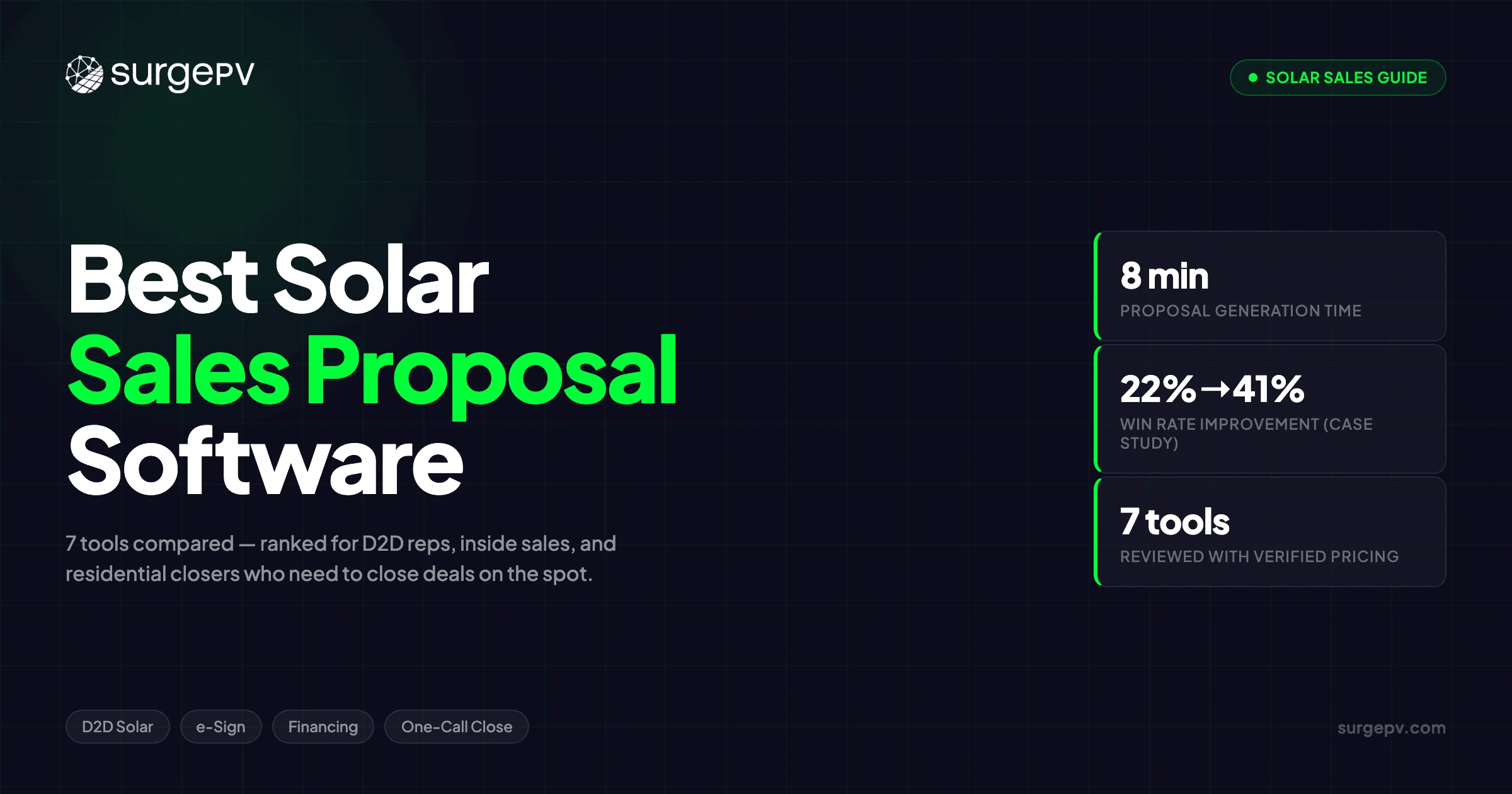
TL;DR: Solar sales is a speed game. The 7 best solar sales proposal software tools in 2026 are SurgePV (best all-in-one: design + branded proposals + e-sign in one workflow, from $1,299/user/year), Solargraf (best iPad speed for Enphase dealers), GoSolo/SOLO (best for D2D teams with financing integrations), Aurora Solar (best for enterprise residential with bankable accuracy), OpenSolar (best free tier), Enact Solar (best financing depth), and Jobber (only if you also run field service — not a solar proposal tool).
Your Proposal Is the Product Your Customer Actually Buys
The panels go on the roof. But what the customer signs is your proposal.
In solar sales, every deal comes down to a single moment: you’re sitting at a kitchen table, or you’re on a video call, or you’re standing in a driveway after a knock. Your customer has questions. They want to know the cost, the savings, the financing options. They want to see their roof with panels on it. They want to feel confident.
What you show them — and how fast you show it — determines whether you close the deal today or lose it to the next installer who calls tomorrow.
Solar sales proposal software is the tool that converts that moment from a question into a signature. This guide covers the 7 best platforms for 2026, ranked by the needs of the people actually running those kitchen-table conversations: door-to-door reps, inside sales teams, and residential installers closing deals in the field.
In this guide, you’ll find:
- 7 tool reviews with verified pricing, pros/cons, and use-case verdicts
- Side-by-side comparison table across 12 features
- Dedicated section on D2D solar sales workflows
- One-call-close workflow: knock to signed contract
- Financing integration matrix (GoodLeap, Mosaic, Sunlight, Dividend, Sungage)
- Hidden costs your pricing page won’t mention
- Decision framework by sales team type
What Makes Great Solar Sales Proposal Software?
Generic proposal tools miss the point. Solar sales has specific requirements that document builders like PandaDoc or Proposify can’t meet.
Design Integration
A solar proposal that doesn’t show a panel layout on the customer’s actual roof is just a quote. Great solar design tools generates the roof model and feeds that data directly into the proposal — no re-keying system specs, BOM, or production estimates. The best platforms auto-populate every field from the design.
Financing Engine
Solar customers buy monthly payments, not kilowatt-hours. Your proposal must show cash, loan, lease, and PPA options side-by-side with calculated monthly savings. Direct lender integrations (GoodLeap, Mosaic, Sunlight, Dividend) pull live rates so you’re not estimating. Installers who show multiple financing options close 20–30% more deals than those who offer one.
e-Signature (In-Meeting)
The best time to close is right now. Built-in e-signature on a tablet or phone lets customers sign during the meeting — before they “think about it” and call three competitors. Every day between proposal delivery and signature is a day your lead can go cold.
Mobile-First Design
D2D reps work from driveways and living rooms. Inside sales teams present on screen shares. Either way, your proposal software must work flawlessly on an iPad or phone, not just a desktop. Responsive web proposals beat native apps for cross-device compatibility.
Proposal Speed
According to EnergySage marketplace data, customers who receive proposals within 24 hours close at 2–3x the rate of those who wait 3–5 days. Manual PDF proposals take 1–3 hours to build. Software cuts that to 8–20 minutes. That difference is the gap between closing in one meeting and losing to the next rep who shows up with a proposal already built.
Transparent Pricing
Per-project credit pricing (Solargraf, GoSolo) creates unpredictable monthly costs. Flat per-user pricing (SurgePV, OpenSolar) scales cleanly with your team. Know what you’re paying before you sign.
Who Uses Solar Sales Proposal Software?
The right tool depends on your sales motion.
Door-to-Door (D2D) Field Reps
D2D solar has a specific math: roughly 1 appointment per 50 knocks, with referral close rates around 30–37% (Ipsun Solar data) and Google lead close rates closer to 15%. Volume is everything.
D2D reps need proposals built in under 2 minutes at the door, iPad-optimized presentation mode, in-home e-signature, and on-the-spot financing qualification. Tools like Solargraf and GoSolo are built for this motion. SurgePV delivers 8-minute proposals from a completed design — fast enough for in-home use.
Inside Sales / Virtual Closers
Post-2020, virtual solar sales is standard at mid-to-large installers. Inside reps need shareable web links with engagement tracking (you see when the customer opens the proposal), embedded financing calculators the customer can adjust live on a video call, and DocuSign or built-in e-sign for remote closing. Aurora Solar’s web proposal format is built for this.
Installer-Owners & Small Teams
Solo operators and small installer teams need one tool that handles design, proposal, and client communication — not three separate subscriptions. Solar software platform like SurgePV and OpenSolar are built for this buyer: full-stack platforms where you go from satellite imagery to signed proposal without switching apps.
Commercial EPCs
Commercial proposals are fundamentally different: 30–50 pages, multi-stakeholder approvals, PPA modeling, MACRS depreciation, permit-ready SLDs. Only two tools on this list handle commercial proposals well — SurgePV and Aurora Solar.
Top 7 Solar Sales Proposal Software Tools (2026)
1. SurgePV — Best All-in-One Platform (Design to Close)
Rating: 9.3/10 | Price: from $1,299/user/year | Book demo | See pricing
SurgePV is the only platform that combines solar design software, electrical engineering, bankable simulation, and solar proposal software in a single workflow. You design the system, generate a permit-ready SLD, and click “Create Proposal” — the proposal auto-populates with the panel layout, BOM, production estimates, and financial analysis. No tab-switching, no data re-entry.
Proposal features that matter for sales:
- 8-minute proposal generation (per surgepv.com/solar-proposals — under 5 minutes from a completed design)
- White-label branding: your logo, colors, custom cover pages, multilingual support
- Interactive web proposals: shareable link, works on any device, before/after cost comparison side-by-side
- Built-in e-signature: secure, any device, no DocuSign subscription required
- Flexible financing options: cash, loan, PPA, lease — with incentive auto-application and net metering credits
- 3D visuals pulled directly from the design — customers see their actual roof
- Document integration: upload supporting docs (HOA approval, utility bills) directly into the proposal
- PDF export for clients who want a physical copy
The SurgePV financial tool calculates year-by-year savings, payback period, IRR, and NPV using the customer’s actual utility tariff. For sales reps, that means a proposal that answers “will I save money?” with specific numbers, not estimates.
What the data shows:
SOLARTabs, an Australian installer, reported their win rate went from 22% to 41% after switching to SurgePV’s proposal workflow. SunWorks Australia cut proposal creation time from 3 hours to 20 minutes.
Pricing:
- Individual: $1,899/user/year (1 user, unlimited projects)
- 3-User: $1,499/user/year (3 users, unlimited projects)
- 5-User: $1,299/user/year (5 users, unlimited projects)
- Enterprise: custom
Aurora Solar lists Basic $159/user/month or $135/user/month billed annually, Premium $259/user/month or $220/user/month billed annually, Enterprise custom per project (aurorasolar.com/pricing, checked 21 September 2026). Solargraf is $2,799/year for 2 users with 240 project credits. SurgePV includes electrical engineering (automated SLDs) that Aurora and Solargraf don’t, so there is no separate AutoCAD subscription to buy and renew alongside it.
Pros:
- Auto-populates proposal from design data — zero re-entry
- Built-in e-sign, no third-party subscription needed
- Flat per-user pricing — no credit traps or per-project overages
- Includes electrical engineering (SLDs, wire sizing, NEC compliance)
- Bankable simulation
- Commercial structures: carports, trackers, East-West racking
- Multilingual proposals (Spanish localization available)
- 98% BOM accuracy, 70,000+ projects globally
Cons:
- Web-responsive on mobile (not a dedicated native iPad app like Aurora Sales Mode)
- Newer brand vs Aurora’s market dominance
- Smaller third-party integration ecosystem than Aurora
Best for: Residential and commercial installers who want one platform from design to signed contract. Especially strong for small-to-midsize teams (1–20 users) running both residential and C&I projects.
2. Solargraf (Enphase) — Best for iPad-Based In-Home Closing
Rating: 8.3/10 | Price: $2,799–$12,999/year (credit-based) | Solargraf
Solargraf is Enphase Energy’s proposal and design platform. For residential Enphase dealers who close deals on an iPad at the kitchen table, it is the fastest tool in this category — the company claims 3-minute proposals, which is faster than any competitor.
What Solargraf does well:
- Proposal speed: 3 minutes from completed design (fastest in category)
- iPad-first design: Express Editor for on-the-spot proposal adjustments during client meetings
- NEM 3.0 support: CPUC 8760 hourly sell rates for California installers
- Auto roofline detection: HD imagery with automatic roof boundary detection
- DocuSign integration: e-signature via DocuSign for in-meeting or remote closing
- Enphase Enlighten integration: customer portal shows live production data post-install
The Express Editor is a genuine differentiator. Reps can adjust panel counts, orientations, and financing options in real time during the presentation — something Aurora’s sales mode and SurgePV’s web proposals don’t match for speed.
Where Solargraf falls short:
Multiple verified G2 and Capterra reviewers report shading accuracy issues — with variance estimates ranging from 10–20% compared to Aurora or HelioScope. One G2 reviewer wrote: “Shading software is absolute garbage and entirely inaccurate.” Permit packages require revisions more than 50% of the time according to installer reports. And Solargraf is Enphase-only in any practical sense — using it with SolarEdge or Fronius equipment loses most of its value.
Pricing (2026, annual-only):
- Starter: $2,799/year — 240 project credits, 2 users
- Small Business: $4,799/year — 480 credits, 4 users
- Teams: $6,399/year — 720 credits, 6 users
- Enterprise: $12,999/year — 1,500 credits, unlimited users
- Commercial projects consume 5 credits each
- Extra users: $960–$1,440/year additional
The credit-based pricing creates real risk for teams with variable monthly volume. At 240 credits per year, a Starter team averaging 25 residential projects per month exhausts their credits in 10 months and pays overage at $9–$11/credit.
Pros:
- Fastest proposal generation (3 minutes)
- iPad-optimized Express Editor for in-home adjustments
- NEM 3.0/California-specific rate modeling
- Strong Enphase ecosystem integration
- Auto roofline detection
Cons:
- Shading accuracy concerns (10–20% variance reports)
- Credit-based pricing creates budget uncertainty
- Enphase-only practical value
- DocuSign required (not built-in e-sign)
- No commercial structures (carports, trackers)
- Permit packs require frequent revisions
- No built-in CRM
Best for: Enphase-exclusive residential installers in California and other NEM 3.0 markets who close deals on an iPad at the kitchen table and prioritize proposal speed over simulation accuracy.
3. GoSolo / SOLO — Best for High-Volume D2D Teams
Rating: 8.1/10 | Price: $1,600–$3,200/month or $24/project | GoSolo
GoSolo (also marketed as SOLO) targets high-volume residential sales teams who run door-to-door campaigns. The platform acquired SolarNexus in September 2023, adding CRM and project management to its managed design service.
What GoSolo does well:
- Managed design service: 25+ in-house designers with a 15-minute average proposal turnaround
- DirectDesign: field reps adjust panel layouts in real time during the sales meeting
- DNV-certified accuracy: 99.9% claimed production accuracy (independent validation confirmed 97% across 1,899 systems)
- Financing depth: 7+ integrated lenders including GoodLeap, LightReach, and Sungage — real-time rate info and instant credit qualifications within the proposal
- SoloSign: built-in e-signature plus DocuSign integration
- CRM (via SolarNexus): lead tracking, project milestones, automated tasks, customer communications
- 70+ integrations: open API and webhooks; common pairing with SPOTIO for D2D canvassing
The financing integration is GoSolo’s strongest differentiator. Reps can pull live GoodLeap, Mosaic, and Sungage rates, run instant credit qualifications, and get lender documents signed — all within the proposal interface. No lender portal switching.
Where GoSolo falls short:
GoSolo is residential-only. No commercial structures, no SLD generation, no permit-ready electrical documentation. The per-proposal pricing model is economically risky for seasonal D2D teams: at 100 proposals/month, the pay-as-you-go rate exceeds $35,000/year. Platform plans start at $1,600/month — $19,200/year before onboarding fees. And GoSolo’s design control sits with their in-house team, not yours — a trade-off that frustrates installers who want to control their own layouts.
Pricing (2026):
- Flex (pay-as-you-go): ~$24–$32/project (scales down at 500+/month)
- Pro Plan: $1,600/month ($19,200/year)
- Elite Plan: $3,200/month ($38,400/year)
- Onboarding fee: undisclosed (contact sales required)
- No free trial
Pros:
- Fastest managed design service (15-minute turnaround)
- Deepest financing integration (GoodLeap, Sungage, LightReach + 4 more)
- Built-in e-sign (SoloSign) + DocuSign
- DirectDesign for in-field layout adjustments
- CRM included via SolarNexus acquisition
Cons:
- Residential-only — no commercial structures, no SLDs
- Monthly pricing ($1,600–$3,200) is expensive for small teams
- Per-proposal pricing punishes high-volume months
- No free trial; opaque onboarding fees
- Design control sits with GoSolo’s team, not yours
- Independent review coverage is minimal
Best for: High-volume D2D residential sales organizations (50+ proposals/month) who have in-house canvassing operations and need financing-on-the-spot closing capability. Not suitable for commercial or C&I work.
4. Aurora Solar — Best for Enterprise Residential (High Accuracy + Sales Mode)
Rating: 8.8/10 | Price: Basic $159/user/month, Premium $259/user/month, Enterprise custom per project (aurorasolar.com/pricing, checked 21 September 2026) | Aurora Solar | Aurora Solar review
Aurora Solar is the most widely trusted platform in US residential solar. Industry-leading AI roof detection, G2 rating of 4.7/5 (widest review base in the category), and proven close-rate improvements make it the default enterprise choice.
What Aurora does well for sales:
- Sales Mode: iPad-optimized presentation mode designed for in-home sales consultations
- 3D visualizations: the most polished customer-facing renderings in the category
- Multi-lender financing: Mosaic, GoodLeap, Sunlight Financial with live rate integration
- Contract Manager: e-signature with DocuSign integration for in-meeting or remote closing
- Proposal web links: trackable — you see when the customer opens the proposal and which sections they view
- CRM integrations: Salesforce, HubSpot, Zoho via API and Zapier
- Aurora Intelligence: AI-powered insights surfacing proposal optimization recommendations
One Aurora customer case study shows their close rate improved from 30% to 65% after switching from manual PDF proposals to Aurora’s interactive workflow.
Where Aurora falls short:
Aurora does not generate electrical documentation. Permit-ready SLDs, wire sizing calculations, and conduit fill require AutoCAD, which is licensed separately. For C&I commercial EPCs, that means a second licence to buy and renew. Aurora Solar publishes its standard rates: Basic $159/user/month or $135/user/month billed annually, Premium $259/user/month or $220/user/month billed annually, Enterprise custom per project (aurorasolar.com/pricing, checked 21 September 2026).
Pricing (2026):
- Basic: $159/user/month, or $135/user/month billed annually ($1,620/year)
- Premium: $259/user/month, or $220/user/month billed annually ($2,640/year)
- Enterprise: custom per project, contact sales
- Source: aurorasolar.com/pricing, checked 21 September 2026
- Annual plan discount: ~15%
Pros:
- G2 4.7/5 — widest and most trusted review base in category
- Sales Mode for iPad-based in-home presentations
- Industry-leading 3D visualizations
- Multi-lender financing integration
- Proven close-rate case studies (30%→65%)
- Strong CRM ecosystem (Salesforce, HubSpot, Zoho)
Cons:
- No electrical engineering (AutoCAD required separately, licensed from Autodesk)
- Enterprise pricing opaque; lower tiers have limited features
- Credit-based pricing on some tiers creates cost uncertainty
- No built-in CRM
- Steeper onboarding curve for non-technical reps
Best for: Large residential installers (50+ projects/month) with dedicated sales teams and engineering teams who need industry-leading accuracy and polished presentations. Enterprise budget required.
5. OpenSolar — Best Free Tier for Small or International Teams
Rating: 7.6/10 | Price: Free core; API/connector fees from April 2026 | OpenSolar | OpenSolar review
OpenSolar is the only genuinely free solar proposal platform. The business model monetizes via financing and hardware partner referrals rather than subscription fees, which means the core tools — design, proposals, basic CRM, and e-sign — remain free.
What OpenSolar provides:
- Free: proposal generation, basic design, CRM, project management, e-signature
- Financing integration: GoodLeap, Mosaic, and other partners accessible via the platform’s marketplace
- DocuSign integration: built-in for e-sign workflows
- Web-based proposals: shareable links, works on any device
- International focus: strong multi-currency and multi-language support
For small teams just starting out, or for international installers who can’t justify $1,300–$2,800/year in software costs, OpenSolar removes the financial barrier entirely.
Where OpenSolar falls short:
Financial modeling is basic. There’s no native SLD generation — AutoCAD or a separate drafting tool is a separate licence for commercial work. The design accuracy is functional but not bankable (no P50/P90 certification). Starting April 2026, API access and third-party connectors shift to paid tiers, which will affect integrations-heavy workflows.
Pricing (2026):
- Core (design, proposals, CRM, e-sign): Free
- HD imagery bundles: paid add-on
- API access and third-party connectors: moving to paid (April 2026)
Pros:
- Genuinely free for core proposal and design workflow
- GoodLeap and Mosaic financing integration
- Built-in e-signature (and DocuSign integration)
- Fast onboarding (1–2 weeks to productivity)
- Strong international/multi-language support
Cons:
- No native SLD generation (commercial projects need AutoCAD)
- Basic financial modeling vs paid platforms
- No P50/P75/P90 bankable simulation
- API fees starting April 2026 affect integrations
- Limited commercial capability above ~500 kW
- Partner-driven roadmap means features follow lender priorities
Best for: Budget-conscious small installers (under 20 projects/month), startups, and international teams who need proposal functionality without upfront software costs.
6. Enact Solar — Best for Financing-Heavy Workflows
Rating: 7.9/10 | Price: ~$3,000–$6,000/year (estimated) | Enact Solar
Enact Solar positions itself on accuracy and financing integration depth. With 20+ lenders integrated, it is the most comprehensive financing tool in the category — and it pairs that with production accuracy tracking and built-in QA dashboards.
What Enact Solar provides:
- 20+ lender integrations: widest financing ecosystem in the category
- Instant BOMs and proposals: auto-generated from design data
- QA dashboards: track close rates and production variance by rep and project
- Accuracy focus: proposal accuracy tied back to real system performance data
The QA dashboards are a genuinely useful sales management feature: managers can see which reps are quoting within production accuracy bounds and which are overclaiming to close deals.
Where Enact falls short:
Pricing is opaque (contact sales required). Brand recognition is significantly lower than Aurora or Solargraf in the residential market. The installer community is smaller, meaning fewer peer reviews and community resources.
Pros:
- 20+ financing lenders (widest in category)
- QA dashboards for sales team management
- Instant BOM and proposal generation
- Production accuracy tracking
Cons:
- Pricing not transparent (contact sales required)
- Lower brand recognition vs Aurora and Solargraf
- Smaller user community
- Less polish on presentation UX vs Aurora Sales Mode
Best for: Residential and light commercial teams where financing is the primary close mechanism and sales managers need visibility into rep performance and proposal accuracy.
7. Jobber — Field Service with Basic Quoting (Not a Solar Proposal Tool)
Rating: 5.2/10 for solar sales | Price: $39–$529/month | Jobber
Jobber is a field service management platform used by HVAC, roofing, plumbing, and some solar installation companies. With a G2/Software Advice rating of 4.35–4.6/5 across 1,400+ reviews, it’s a genuinely excellent operations tool.
It is not a solar proposal tool.
Jobber provides quoting, invoicing, scheduling, route optimization, crew dispatching, and online payment collection. What it does not provide: PV design, shading analysis, production estimates, solar-specific financing integration, or branded solar proposals with system visuals. If you need to show a customer their roof with panels on it and model 25 years of utility savings, Jobber cannot do that.
When Jobber makes sense: You run a mixed-trade business (solar + roofing, solar + HVAC) and you need field service management on top of solar-specific tools. Many small solar companies use Jobber for scheduling and invoicing while using SurgePV or OpenSolar for actual proposals.
Pros:
- 4.35–4.6/5 rating across 1,400+ verified reviews
- Excellent scheduling, dispatching, and routing
- Online payment collection
- Good for mixed-trade businesses
- Transparent pricing ($39–$529/month)
Cons:
- No PV design or shading analysis
- No solar-specific financing integration
- No production estimates
- No permit-ready electrical documentation
- Generic quote builder (not branded solar proposals)
- Two-way SMS locked behind highest pricing tier
Best for: Solar installation companies that also operate other trades and need field service operations management. Pair with a dedicated solar proposal tool like SurgePV or OpenSolar.
Note
The top SERP results for “solar sales proposal software” include generic tools like HoneyBook, PandaDoc, and Proposify. These are document workflow platforms, not solar design-to-proposal tools. They don’t model PV production, calculate utility bill savings, or integrate with solar financing lenders. If you’re evaluating generic proposal software for solar sales, you’re starting from the wrong category.
Solar Sales Proposal Software Comparison Table
| Feature | SurgePV | Solargraf | GoSolo | Aurora Solar | OpenSolar | Enact Solar | Jobber |
|---|---|---|---|---|---|---|---|
| Proposal Builder | Yes (auto from design) | Yes (3-min) | Yes (managed service) | Yes (Sales Mode) | Yes (basic) | Yes | Generic quote only |
| PV Design | Yes (full 3D) | Yes (Enphase-focused) | Yes (managed) | Yes (industry-leading AI) | Yes (basic) | Yes | No |
| Shading Analysis | Yes | Limited (accuracy concerns) | Yes (DNV-certified) | Yes (industry-leading) | Yes (basic) | Yes | No |
| e-Signature | Built-in | DocuSign only | SoloSign + DocuSign | DocuSign integration | Built-in + DocuSign | Built-in | No |
| Financing Integration | Cash/loan/PPA/lease | Limited | 7+ lenders (GoodLeap, Sungage, LightReach) | Mosaic, GoodLeap, Sunlight | GoodLeap, Mosaic | 20+ lenders | No |
| CRM | Built-in | No | Yes (SolarNexus) | Via API (Salesforce, HubSpot) | Basic built-in | Yes | Yes (excellent) |
| Electrical Engineering (SLD) | Yes (automated) | No | No | No (AutoCAD required) | No | No | No |
| Commercial Structures | Yes (carports, trackers) | No | No | Limited | No | No | No |
| Bankable Simulation | Yes (P50/P75/P90) | No | Yes (DNV-certified) | Yes | No | Yes | No |
| Mobile/iPad | Web-responsive | iPad-optimized (best) | Field-optimized | Sales Mode (iPad) | Web-responsive | Web-responsive | iOS/Android app |
| Pricing (2026) | $1,299–$1,899/user/yr | $2,799–$12,999/yr (credits) | $1,600–$3,200/mo | Basic $159/user/mo, Premium $259/user/mo (aurorasolar.com/pricing, checked 21 September 2026) | Free | ~$3,000–$6,000/yr | $39–$529/mo |
| Best For | All-in-one, residential + commercial | Enphase D2D, iPad closers | High-volume D2D teams | Enterprise residential | Budget/startups | Financing-heavy teams | Field service (not solar proposals) |
Solar Sales Proposal Software for D2D Teams
Door-to-door solar has specific workflow requirements that most software comparison articles ignore.
The D2D Math
D2D solar conversion looks like this: roughly 1 appointment per 50 knocks (2–3% knock-to-lead conversion). From appointments, referral close rates run 30–37%. Google lead close rates are closer to 15%. If your cost per appointment is $150 and your average commission is $3,000, you need to close at least 1-in-20 appointments to break even on a referral-generated lead — and faster proposals tighten that math significantly.
What D2D Reps Actually Need
At the door (pre-appointment): A canvassing app like SPOTIO or Knockio to track territory and log knocks. GoSolo integrates with SPOTIO natively — canvass data pushes directly to the proposal queue.
At the kitchen table (proposal): A tool that generates a visual proposal on an iPad in under 5 minutes using the homeowner’s address. The customer needs to see their roof with panels, their estimated monthly savings, and 3 financing options. They need to be able to sign digitally before you leave.
Post-appointment (follow-up): CRM automation that logs the outcome and triggers a follow-up sequence if the customer didn’t sign.
Tool Recommendations by D2D Scenario
Scenario A — You’re an Enphase-exclusive installer in California: Solargraf. The 3-minute proposal and Express Editor are built for your workflow. Pair it with the Enphase Enlighten monitoring integration for post-install customer engagement.
Scenario B — You run a high-volume D2D operation (50+ proposals/month) with multiple financing lenders: GoSolo. The DirectDesign feature lets reps adjust layouts in real time, and the 7+ lender integrations let you run financing qualification at the door. Budget for $1,600–$3,200/month.
Scenario C — You run a mixed residential/commercial operation with a small team: SurgePV. The 8-minute proposal time is fast enough for in-home use, and the flat per-user pricing scales predictably. You also get SLD generation when commercial projects come in — no AutoCAD subscription.
Scenario D — You’re starting a solar business on a tight budget: OpenSolar. Free tier includes design, proposals, and e-sign. Upgrade later when volume justifies a paid platform.
The One-Call-Close Workflow (Knock to Signed Contract)
The fastest solar sales teams close deals in a single visit. Here’s the workflow that enables that:
Step 1 — Qualify at the door (2 minutes): Confirm ownership, roof age, and monthly utility bill. Use a canvassing app (SPOTIO, Knockio) to log the contact and route the lead to your proposal tool.
Step 2 — Generate the satellite design (3–8 minutes): Pull up the homeowner’s address in your proposal software. Most platforms generate an initial panel layout from satellite imagery automatically. Adjust panel count for the target system size.
Step 3 — Build the proposal (2–5 minutes from design): Auto-populate proposal from design data. Select financing options — show 3 options (cash, best-rate loan, $0-down loan). Apply current incentives automatically.
Step 4 — Present on the iPad (10–15 minutes): Walk through the proposal screen-by-screen. Let the customer interact with the financing calculator. Show the before/after utility bill comparison. Answer objections with real numbers, not talking points.
Step 5 — Close with e-sign (2 minutes): When the customer is ready, tap “Sign Now.” They sign on the tablet. Contract is filed, lender notification triggered, next-step task created in CRM.
Total time: 20–30 minutes from knock to signed contract.
Tools that support this workflow completely: SurgePV, GoSolo, Aurora Solar (with Sales Mode), Solargraf (for Enphase). Tools that support it partially: OpenSolar (no in-meeting financing qualification). Tools that don’t support it: Jobber.
Financing Integration: Which Lenders Integrate With Which Tools?
Financing is the variable that closes or kills residential solar deals. Here’s the current integration matrix:
| Lender | SurgePV | Solargraf | GoSolo | Aurora | OpenSolar | Enact |
|---|---|---|---|---|---|---|
| GoodLeap | Custom calc | Limited | Yes (live rates) | Yes | Yes | Yes |
| Mosaic | Custom calc | Limited | Limited | Yes | Yes | Yes |
| Sunlight Financial | Custom calc | No | Limited | Yes | No | Yes |
| Dividend Finance | Custom calc | No | No | Limited | No | Yes |
| Sungage | No | No | Yes | No | No | Yes |
| LightReach | No | No | Yes | No | No | Yes |
| EnFin | No | No | No | No | No | Yes |
Dealer fee disclosures: A word on transparency. The Minnesota Attorney General’s 2024 investigation found average dealer fees of 19.32% (GoodLeap), 21.4% (Sunlight), 17.6% (Mosaic), and 18.8% (Dividend). These fees are real costs passed to homeowners through higher system prices. Platforms that display dealer fees transparently in the proposal (rather than hiding them in the financing structure) reduce chargeback and fraud risk — and build customer trust.
Pro Tip
Show three financing options in every proposal — one cash option with payback period, one best-rate loan with monthly payment, and one $0-down option. Customers who compare options close at higher rates than customers presented with a single option. The choice itself signals transparency.
Hidden Costs: What the Pricing Page Won’t Tell You
Every pricing page shows the subscription cost. Here’s what else you’ll pay:
Solargraf: Credit overages at $9–$11/credit. A 5-person team averaging 25 residential projects/month exhausts the Teams plan’s 720 credits in about 6 months and pays $9/credit thereafter. Annual-only billing means no monthly flexibility during slow seasons.
GoSolo: Onboarding fees are not published (contact sales required). Platform plans start at $1,600/month — $19,200/year — before you’ve run a single proposal. At 100 proposals/month on pay-as-you-go, costs exceed $35,000/year.
Aurora Solar: The base subscription doesn’t include advanced commercial features or enterprise CRM integrations. Aurora lists Basic $159/user/month or $135/user/month billed annually, Premium $259/user/month or $220/user/month billed annually, Enterprise custom per project (aurorasolar.com/pricing, checked 21 September 2026), and users still need to add AutoCAD, licensed separately, for permit-ready SLD generation. That is two separate licences to buy and renew.
OpenSolar: Core features are free, but HD imagery bundles (required for accurate roof modeling in dense urban markets) are paid add-ons. API access for third-party integrations moves to paid tiers in April 2026.
SurgePV: Flat per-user pricing includes all features — design, simulation, SLDs, proposals, e-sign. No per-project credits, no AutoCAD required, no tiered feature gating. The $1,299/user/year 5-user plan includes unlimited projects for all 5 users.
Jobber: The two-way SMS feature — critical for lead follow-up automation — is locked to the Grow plan ($149–$529/month depending on user count).
How to Choose the Right Solar Sales Proposal Software
You’re an Enphase-exclusive residential installer closing on iPads: Choose Solargraf. The 3-minute proposal speed and Express Editor are built for your workflow. Budget for the annual credit model.
You run a high-volume D2D organization (50+ proposals/month) with dedicated canvassers: Choose GoSolo. The DirectDesign, 7+ lender integrations, and CRM give D2D teams the stack they need. Budget for platform pricing ($1,600–$3,200/month).
You’re a large residential installer with an enterprise budget needing polished presentations: Choose Aurora Solar. Industry-leading 3D, proven close-rate improvements, and Sales Mode for iPad make it the gold standard for enterprise residential. Add AutoCAD for permit-ready electrical.
You run residential and commercial projects with a small team: Choose SurgePV. One platform handles design, shadow analysis, SLDs, proposals, and e-sign. Flat per-user pricing scales without surprises. Commercial structures (carports, trackers) are included.
You’re starting out and can’t justify $1,000+/year in software: Choose OpenSolar. The free tier covers the basics — design, proposals, e-sign, basic CRM. Upgrade when volume grows.
You need maximum financing depth (20+ lenders): Choose Enact Solar. No other platform touches its lender ecosystem.
You need field service operations for a multi-trade business: Choose Jobber alongside a dedicated solar proposal tool.
Generate Professional Solar Proposals in 8 Minutes
Design, simulate, and create client-ready proposals — all in one platform, no tool-switching.
Book a DemoNo commitment required · 20 minutes · Live project walkthrough
Where SurgePV fits
For the product-side detail, SurgePV commercial proposal output covers the workflow, outputs and limits.
Sources and Methodology
We evaluated each platform based on official product documentation, verified user reviews on G2/Capterra/Software Advice, public pricing pages, and direct claims made by vendors. Pricing was verified against official sources as of May 2026. Close-rate statistics are sourced from named case studies and attributed market data — no unattributed statistics were included.
- SEIA / Wood Mackenzie — Q3 2025 residential solar installation data; $3.35/Wdc average residential system price (accessed May 2026)
- EnergySage — Solar marketplace data on proposal delivery speed and close rate correlation (accessed May 2026)
- Ipsun Solar — Published appointment close rate benchmarks by lead source (referral ~30–37%, Google organic ~15%)
- DNV — GoSolo DNV certification context; 97% accuracy validation across 1,899 systems (accessed May 2026)
- NABCEP — 2024 solar industry workforce survey; NABCEP certification penetration data
- Minnesota Attorney General Office — 2024 dealer fee investigation data: GoodLeap 19.32%, Sunlight 21.4%, Mosaic 17.6%, Dividend 18.8%
- G2 / Capterra / Software Advice — Verified user review sentiment for Solargraf, Aurora Solar, OpenSolar, Jobber (accessed May 2026)
Transparency Note
SurgePV publishes this content. We have been transparent about this relationship throughout the comparison and have acknowledged each competitor’s genuine strengths. All platforms were evaluated using the same criteria. See our editorial standards.
Frequently Asked Questions
What is solar sales proposal software?
Solar sales proposal software generates customer-facing proposals that combine system design visuals, production estimates, utility bill savings calculations, financing options, and e-signature capability in one document. Unlike generic proposal builders (PandaDoc, Proposify), solar-specific tools are integrated with PV design — the proposal auto-populates from the system design rather than requiring manual data entry. The best platforms deliver proposals in 8–20 minutes vs 1–3 hours for manual PDF workflows.
What is the best solar proposal software for D2D sales?
For door-to-door solar sales, the best tools depend on your inverter brand and volume. Enphase-exclusive installers in California: Solargraf (3-minute proposals, iPad-optimized Express Editor). High-volume D2D organizations (50+ proposals/month) with multiple lenders: GoSolo (DirectDesign, 7+ lender integrations). Small-to-midsize teams running residential and commercial: SurgePV (8-minute proposals, built-in e-sign, flat pricing). All three support tablet-based in-home closing.
How fast should solar proposal software generate proposals?
Top platforms generate proposals in 3–20 minutes from a completed design:
- Solargraf: 3 minutes (fastest)
- SurgePV: 8 minutes (from completed design)
- GoSolo: 15 minutes (managed service)
- Aurora Solar: under 20 minutes (user-reported) Manual PDF proposals take 1–3 hours. According to EnergySage marketplace data, proposals delivered within 24 hours close at 2–3x the rate of proposals delivered after 3–5 days.
Does solar sales proposal software include e-signature?
Yes — most modern platforms include e-signature capability. Built-in e-sign (no third-party subscription needed): SurgePV, OpenSolar, GoSolo (SoloSign). DocuSign integration only: Solargraf, Aurora Solar. Built-in + DocuSign: GoSolo. Jobber includes generic e-sign for service agreements but not solar contracts. In-meeting tablet signing (during the kitchen-table presentation) is available on all platforms except Jobber.
What’s the difference between solar quoting software and solar proposal software?
Quoting software generates fast price estimates early in the sales funnel — typically in 1–5 minutes using basic inputs (address, roof type, energy bill). It answers “How much will this cost?” Proposal software creates comprehensive closing documents: panel layout on the actual roof, 25-year savings model, multi-lender financing comparison, incentive breakdown, and e-sign contract. It answers “Why should I sign with you?” Some platforms (SurgePV, GoSolo, Aurora) do both. Others specialize in proposals and assume you’ve already qualified the lead.
How does solar proposal software improve close rates?
Three mechanisms: First, speed — proposals delivered within 24 hours close at 2–3x the rate of delayed proposals (EnergySage data). Second, in-meeting e-sign — eliminating the “I’ll think about it” delay by closing on the spot. Aurora Solar case study documented close rate improvement from 30% to 65%. SOLARTabs reported improvement from 22% to 41% with SurgePV. Third, financing comparison — presenting 3 options (cash, loan, $0-down) gives customers agency rather than a binary yes/no decision, which consistently improves conversion.
Is there free solar sales proposal software?
OpenSolar offers a genuinely free core tier — design, proposals, basic CRM, and e-signature are all included at no cost. The business model monetizes via financing and hardware partner referrals. Starting April 2026, API connectors and some third-party integrations move to paid tiers. For teams under 20 projects/month or international installers in cost-sensitive markets, OpenSolar’s free tier is a credible starting point.
What financing lenders integrate with solar proposal software?
The widest lender integration is Enact Solar (20+ lenders). GoSolo integrates with 7+ lenders including GoodLeap, LightReach, and Sungage — with live rate pulls and in-proposal credit qualification. Aurora Solar integrates with Mosaic, GoodLeap, and Sunlight Financial. OpenSolar connects to GoodLeap and Mosaic. SurgePV includes a built-in financing engine for cash, loan, PPA, and lease calculations but does not have direct API integrations with major lenders — financing terms are entered manually or via custom configuration. If direct lender integration at point-of-sale is your primary requirement, GoSolo or Enact Solar are the strongest options.
How does SurgePV’s solar proposal software compare to Aurora Solar?
SurgePV and Aurora Solar are the two strongest all-in-one platforms for design-to-proposal workflows. The key differences:
- Electrical engineering: SurgePV generates permit-ready SLDs automatically (5–10 min). Aurora requires AutoCAD, which is licensed separately.
- Pricing: SurgePV at $1,299–$1,899/user/year (unlimited projects, flat). Aurora Solar lists Basic $159/user/month or $135/user/month billed annually, Premium $259/user/month or $220/user/month billed annually, Enterprise custom per project (aurorasolar.com/pricing, checked 21 September 2026).
- Commercial structures: SurgePV supports carports, trackers, East-West racking. Aurora does not handle these natively.
- 3D visualizations: Aurora’s AI roof detection is more polished for residential presentations.
- Brand recognition: Aurora has significantly higher market awareness in US residential solar.
- iPad optimization: Aurora Sales Mode is purpose-built for in-home tablet presentations; SurgePV is web-responsive.
An Aurora plus AutoCAD workflow means two separate licences to buy and renew, one of them not publicly priced. SurgePV costs $4,497/year for 3 users with SLD generation included in the one subscription.
Further Reading
For related comparisons, see best solar proposal software, best solar quoting software, best solar sales software, and best solar simulation software.
