

Gyms are among the most energy-intensive small commercial buildings in the United States. A fitness center runs 16 to 24 hours a day, powers dozens of cardio machines, maintains humidification and ventilation for packed classes, and heats water for showers. That combination creates a large, predictable electricity bill that is increasingly painful. Commercial electricity rates averaged 13.51 cents per kWh in April 2026, up 4.8 percent year over year, according to the U.S. Energy Information Administration. In California, New York, and Massachusetts, large commercial users regularly pay more than 25 cents per kWh.
Solar generation can displace those kilowatt-hours at a fixed cost for 25 years or more. The question for gym owners is not whether solar works in theory. It is whether the numbers work for a specific building with a specific load shape, roof condition, and tariff.
This guide is written for gym owners, franchise operators, property managers, solar installers, and EPCs bidding on fitness centers. It explains how to calculate solar ROI for a gym, what system sizing and financing assumptions matter, and where the numbers can go wrong. We use 2026 market data, named sources, and a worked example you can replicate for a specific property.
If you are modeling multiple locations or a franchise portfolio, use SurgePV’s cloud solar design platform. It imports interval data, runs solar shading analysis, and exports permit-ready plans. The PV generation and financial modeling models gym-specific tariffs, demand charges, and incentive stacks in one workflow.
Quick Answer
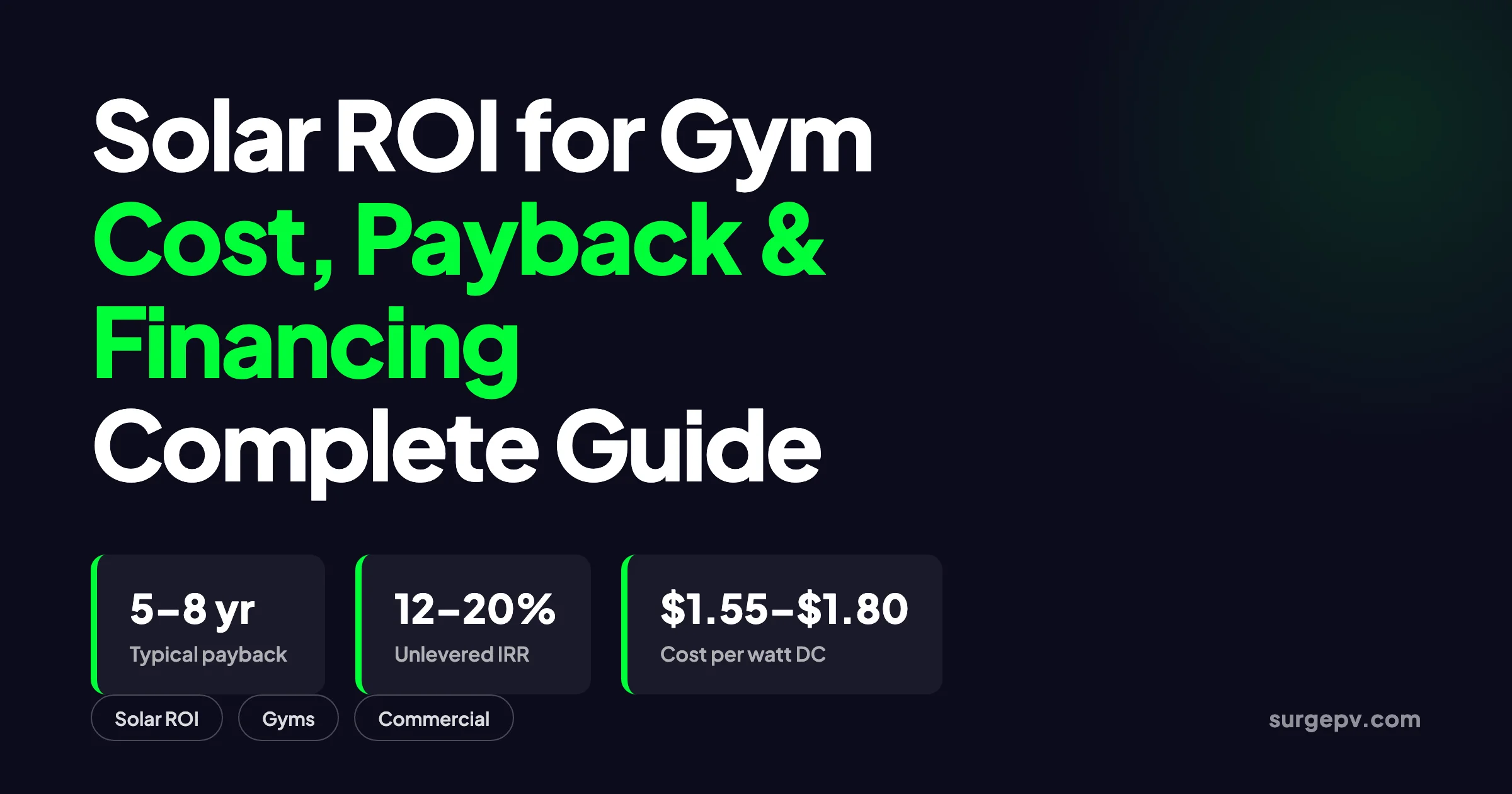
Gym solar ROI in the U.S. typically delivers a 12 to 20 percent unlevered IRR and a 5 to 8 year simple payback after the 30 percent federal ITC. A 100 kW rooftop system on a mid-size fitness center costs roughly $155,000 to $180,000 before incentives. Annual savings range from $18,000 to $30,000, depending on local rates, self-consumption, and demand charges.
In this guide:
- Why gyms are strong solar candidates
- How much energy a gym actually uses
- What a gym solar system costs in 2026
- The full 2026 incentive stack: ITC, MACRS, state and utility programs
- Ownership, loan, PPA, and lease trade-offs
- A worked ROI example for a 100 kW rooftop gym
- Battery storage and demand-charge economics
- Common mistakes that kill gym solar returns
- When gym solar does not make sense
- FAQ with 10 gym solar ROI questions
Why Gyms Are Strong Solar Candidates
Gyms are not generic commercial buildings. A fitness center consumes power during long hours that overlap strongly with solar production. Cardio floors pull steady load from 5 AM through 10 PM. HVAC fights heat and humidity from exercising bodies. Lighting, sound systems, and hot water run continuously. That daytime load means a high self-consumption rate, which is the single biggest driver of ROI.
Most commercial buildings self-consume 40 to 60 percent of onsite solar production. Well-designed gyms often self-consume 60 to 85 percent, according to industry studies of high-daytime-load sites. Every self-consumed kilowatt-hour avoids the full retail rate plus delivery and demand charges. Exported kilowatt-hours, by contrast, are credited at avoided-cost or net-billing rates that can be half the retail value or less.
Gyms also have predictable, repeatable footprints. A 10,000 square foot club in Phoenix behaves like a 10,000 square foot club in Atlanta once you adjust for climate and tariff. That repeatability lets franchise operators standardize system sizes, equipment lists, and financing structures across dozens of locations. Standardization reduces soft costs and speeds up corporate approval.
The third difference is brand value. Members increasingly expect sustainability credentials. A visible solar array on the roof or over parking sends a clear signal. It is not the primary driver of ROI, but it can support member acquisition and retention, which is the core revenue engine of any gym.
For a deeper look at the design side, read our guide to solar design for gym. The load-curve logic is similar, even though the financial questions differ.
How Much Energy a Gym Actually Uses
A credible ROI model starts with an accurate load estimate. The ENERGY STAR Portfolio Manager data shows fitness centers operate at a median source energy use intensity of 112.0 kBtu per square foot, according to Envigilance’s summary of EPA data. After accounting for long operating hours, humidity loads, and variable occupancy, actual consumption per usable hour often exceeds every other commercial property type except hospitals and data centers.
Real consumption varies widely by format:
- Boutique studio / small gym: 30,000 to 50,000 kWh/year, mostly lighting, HVAC, and plug loads.
- Mid-size fitness center: 100,000 to 250,000 kWh/year, with significant cardio floor and hot-water load.
- Large health club / athletic center: 500,000 to 2,000,000 kWh/year or more, with pools, saunas, and 24/7 operations.
A standard gym facility uses between 30,000 and 50,000 kWh of electricity per year, while larger fitness centers can consume up to 75,000 kWh annually, according to 8MSolar’s 2026 review of solar-powered gyms. At the national average commercial rate of 13.51 cents per kWh, a 50,000 kWh gym spends about $6,750 per year on electricity before demand charges. In high-rate markets, the same building can spend $12,000 or more.
HVAC and humidity control are the hidden drivers. They account for 25 to 50 percent of gym electricity use, depending on climate and building envelope quality. A poorly insulated building with old rooftop units can consume twice as much per square foot as a modern building with LED lighting and efficient systems. That is why energy efficiency should be addressed before or alongside solar sizing.
Cardio equipment is the second major load. A treadmill can consume 600 to 700 watts while in use. A cardio floor with 30 machines running during peak hours can pull 20 to 30 kW of continuous load. Lighting, sound systems, and hot water round out the profile. The key is to model interval data, not just annual usage, because the shape of the load determines how much solar is consumed onsite.
Solar ROI Differs by Gym Format
Not every fitness facility gets the same return. The business model, operating hours, and load shape change the economics.
Boutique studios and yoga centers often have the simplest load profile. They run classes in the morning and evening, with low midday use. That shape is a problem for solar unless the studio also hosts midday classes or has battery storage. A 20 kW system on a 2,500 square foot studio in a high-rate market can still pay back in 6 to 9 years, but self-consumption must be modeled honestly.
Mid-size fitness centers are the sweet spot. They open early, stay busy through the evening, and have steady HVAC and cardio loads during the middle of the day. A 100 kW rooftop system can offset 60 to 80 percent of daytime consumption. These facilities usually have enough roof area and enough load to make solar work without storage.
Large health clubs and athletic centers consume the most energy but also have the most complex tariffs. Pools, saunas, and 24/7 operations create high baseline loads. They also have large roofs and parking fields that can host 200 to 500 kW of solar plus carports. Demand charges often dominate the bill, which makes battery storage and careful load shifting more valuable.
CrossFit boxes and functional fitness gyms typically occupy warehouses or industrial spaces. They have high ceilings, simple HVAC, and short but intense operating hours. Solar works well if the box runs daytime classes. The low-cost shell and large roof often make installation straightforward, but evening-only boxes may need storage to capture value.
The rule across all formats is the same. The best returns go to facilities that consume most of their solar generation onsite during daylight hours. A gym that runs primarily at night will not see the same ROI as a gym with strong daytime occupancy.
What a Gym Solar System Costs in 2026
A credible ROI model starts with an accurate installed cost. The table below blends the latest benchmark data for commercial rooftop projects.
| Cost component | Benchmark value | Source |
|---|---|---|
| Commercial rooftop PV, NREL 2024 benchmark | $1.55/Wdc | NREL cost benchmarks via Local Solar Directory |
| Commercial rooftop PV, SEIA/WoodMac Q1 2026 market price | $1.67/Wdc | SEIA Solar Market Insight Report Q2 2026 |
| Solar carport adder | $0.40–$0.70/Wdc | Industry range for structural steel and foundations |
| Soft costs, permitting, interconnection | $0.30–$0.50/Wdc | Typical for distributed commercial projects |
| Annual O&M | $10–$15/kW-year | Cleaning, monitoring, inspections |
| Inverter replacement reserve | $0.15–$0.25/Wdc in year 12–15 | Budgeted over system life |
For planning, use $1.55 to $1.80 per watt DC for rooftop projects and $2.00 to $2.40 per watt DC for carports. The SEIA figure of $1.67/Wdc reflects higher balance-of-system costs and tariff-driven price pressure in 2025 and early 2026. The NREL benchmark of $1.55/Wdc is useful for conservative modeling. A 100 kW rooftop system therefore costs $155,000 to $180,000 before incentives.
Operating costs are low but persistent. Budget $10 to $15 per kW per year for O&M, plus an inverter replacement reserve. Over 25 years, these costs are typically 5 to 8 percent of the upfront capital cost. Ignoring them makes payback look shorter than it really is.
The Full 2026 Incentive Stack
Federal incentives remain the largest driver of gym solar ROI in 2026, but the rules have tightened. The Inflation Reduction Act’s Section 48E Clean Electricity Investment Credit provides a 30 percent tax credit for qualifying commercial solar. To secure the full credit, projects generally must be placed in service by December 31, 2027. Projects that began construction by July 4, 2026 may also qualify under continuity rules, according to IRS Instructions for Form 3468.
The credit is claimed on IRS Form 3468. It is a dollar-for-dollar reduction in federal tax liability, not a deduction. If the credit exceeds tax liability in year one, the unused portion can generally be carried back one year or forward up to 20 years.
MACRS depreciation adds a second large benefit. Commercial solar is depreciated over five years. In 2026, 100 percent bonus depreciation may still apply for federal purposes, allowing the entire depreciable basis to be written off in year one. The depreciable basis is reduced by half of the ITC, so a 30 percent ITC leaves 85 percent of cost to depreciate. For a profitable owner in a 21 percent federal tax bracket, the depreciation shield is worth roughly 18 to 22 percent of project cost. That figure is expressed in present-value terms.
Bonus adders can push the ITC above 30 percent. These include:
- Domestic content bonus: 10 percentage points if steel, iron, and manufactured products meet U.S. content thresholds.
- Energy community bonus: 10 percentage points for projects in designated fossil-fuel-dependent or brownfield areas.
- Low-income bonus: 10 or 20 percentage points for qualifying community-serving projects, subject to capacity allocation.
State and utility incentives vary. Common programs include Solar Renewable Energy Certificates, utility rebates, green bank financing, and sales or property tax exemptions. The Database of State Incentives for Renewables and Efficiency tracks current rules by state.
For a deeper breakdown, see our guide to solar IRA tax credits in the U.S..
Financing Options: Cash, Loan, PPA, or Lease
The financing structure changes who keeps the tax benefits and who carries the risk. The table below compares the four main options for gym solar.
| Structure | Upfront cost | Tax credits | Depreciation | O&M risk | Best for |
|---|---|---|---|---|---|
| Cash purchase | Full CapEx | Owner keeps | Owner keeps | Owner | Owners with tax appetite and capital |
| Solar loan | Small to no down payment | Owner keeps | Owner keeps | Owner | Owners that want ownership without large cash outlay |
| PPA | $0 | Investor keeps | Investor keeps | Investor | Short lease terms or constrained capital |
| Operating lease | $0 or low | Lessor keeps | Lessor keeps | Lessor | Off-balance-sheet treatment priority |
Cash purchase produces the highest lifetime return because there is no financing cost and the owner captures every tax benefit. A 100 kW system with a 30 percent ITC and bonus depreciation can recover 45 to 55 percent of cost in year one.
A solar loan often improves return on equity. An owner that puts 20 percent down can earn a higher IRR on the equity portion than an all-cash buyer. Financing rates of 6 to 8 percent work well if the loan term stays below the payback period.
A PPA fixes a long-term energy rate below the utility tariff and requires no capital. It is attractive for leased properties where the tenant pays the electric bill and the landlord does not want to own equipment. The trade-off is lower total savings over 20 years.
A lease is simpler than a PPA but usually the most expensive over time. It also creates off-balance-sheet treatment questions that accountants must review.
Worked ROI Example: 100 kW Gym Rooftop
Here is a complete 25-year model for a cash-purchase gym rooftop system. The numbers are realistic for a high-rate state such as California, New York, or Massachusetts.
Project assumptions
| Assumption | Value |
|---|---|
| System size | 100 kW DC |
| Specific yield | 1,450 kWh/kWp/year |
| First-year production | 145,000 kWh |
| Self-consumption rate | 75 percent |
| Commercial electricity rate | $0.15/kWh |
| Annual degradation | 0.5 percent |
| Installed cost | $1.65/Wdc = $165,000 |
| ITC | 30 percent = $49,500 |
| Net cost after ITC | $115,500 |
| O&M | $12/kW-year = $1,200/year, escalating 2.5 percent |
| Analysis period | 25 years |
| Discount rate | 8 percent |
Year-one savings
- Self-consumed solar: 108,750 kWh × $0.15 = $16,313
- Exported solar: 36,250 kWh × $0.07 net billing credit = $2,538
- Gross year-one savings: $18,851
- Less O&M: $1,200
- Net year-one savings: $17,651
Tax benefits in year one
- ITC: $49,500
- Bonus depreciation on 85 percent of cost at 21 percent federal rate: $29,423
- Total year-one tax benefit: $78,923
Return metrics
| Metric | Result |
|---|---|
| Simple payback | 6.5 years |
| Discounted payback | 7.7 years |
| Unlevered IRR | 15.8 percent |
| NPV at 8 percent discount | $98,000 |
| LCOE | $0.057/kWh |
The LCOE of 5.7 cents per kWh is well below the 15 cent retail rate. That spread is the economic engine. In a lower-rate state at 10 cents per kWh, the same system still produces a 9 to 12 percent IRR. Payback stretches to 8 to 11 years, assuming similar self-consumption.
Real projects support these figures. BPL Fitness Flex Mansfield in the UK installed a 122 kWp solar system. It delivered over £11,000 in annual energy savings while preventing 24 tonnes of CO2 emissions per year. In the U.S., mid-size gyms with high daytime load and rates above 15 cents per kWh regularly see payback in the 5 to 7 year range.
You can model your own numbers in SurgePV’s solar yield and financial analysis or commercial solar ROI calculator.
Battery Storage and Demand-Charge Economics
A gym has three solar options, not one. Rooftop is usually cheapest per watt. Carports are more expensive but add shade, weather protection, and customer-facing sustainability. Battery storage captures value that panels alone cannot.
Solar carports typically add $0.40 to $0.70 per watt for the steel structure and foundation. A 50-space canopy can host 100 to 200 kW of solar and generate 130 to 300 MWh per year, depending on location. The economics improve when the canopy also supports EV chargers.
EV charging is changing gym load profiles. A single DC fast charger can draw 50 to 150 kW. Multiple Level 2 chargers add smaller but steady loads. If chargers are used by members and staff during the day, solar self-consumption rises. If they are used mainly in the evening, a battery becomes valuable.
Battery storage does two things for gym solar. It shifts midday solar production into evening peak periods, and it shaves monthly demand charges. A single 100 kW spike from HVAC or cardio equipment startup can cost $12,000 to $30,000 per year in demand charges. A 100 kW / 200 kWh battery can discharge during those spikes and cut that line item.
The added cost is meaningful. A 100 kW / 200 kWh lithium-ion battery costs $60,000 to $90,000 installed before incentives. Commercial batteries paired with solar qualify for the same Section 48E ITC and MACRS depreciation as the PV system. That brings the net cost down to $35,000 to $55,000 for a profitable owner.
The decision rule is simple. If your gym tariff has demand charges above $15 per kW per month or a large time-of-use spread, model storage. If your tariff is purely energy-based with low demand charges, solar alone is usually the better first investment.
What Most Gym Owners Get Wrong About Solar ROI
A good model is only as honest as its assumptions. The following errors appear repeatedly in gym solar proposals.
Overstating self-consumption. A gym that is busiest at 6 PM cannot consume solar production after sunset. If the model assumes 95 percent self-consumption without an 8760-hour load and production simulation, it is probably wrong. Use interval data, not monthly bills.
Ignoring demand charges. Many commercial tariffs include demand charges based on the highest 15-minute peak each month. HVAC startup, cardio equipment, and pool pumps create sharp peaks. Solar can reduce daytime peaks, but a cloudy afternoon followed by evening class load can create a new peak. Model demand charges with interval data, or add a battery to shave the peak.
Using aggressive rate escalation. Some proposals assume 4 to 5 percent annual utility rate increases forever. Historical utility rate growth has been closer to 2 to 3 percent nationally. Overstating escalation inflates NPV and IRR.
Mismatching roof life and project life. A solar system lasts 25 to 30 years. If the roof membrane has 8 years of life left, the project should include re-roofing cost or move to a carport. Re-roofing after panel installation is expensive.
Failing to address utility interconnection early. Gyms can have limited transformer capacity. Adding 100 kW of solar may require a service upgrade. That upgrade can cost $10,000 to $50,000 and add months to the timeline. Check with the utility before finalizing the design.
The contrarian truth is that gym solar is often more profitable when the array is smaller. A right-sized system with high self-consumption, no export losses, and low interconnection cost can deliver a better NPV than a maxed-out roof.
When Gym Solar Does Not Make Sense
Solar is not universal. Gym solar ROI is weak or negative when several conditions coincide.
- Low commercial rates: At rates below 10 cents per kWh, the avoided-cost spread may not cover O&M, inverter replacement, and capital recovery.
- Short lease term: If the gym lease expires in 7 years and the payback is 8 years, the owner will not see savings.
- Poor solar resource or heavy shading: A shaded roof in Seattle produces far less than a flat roof in Phoenix. Shading analysis is mandatory.
- Weak net-metering rules: Markets that pay wholesale rates for exports and offer no demand-charge value cut project returns by 30 to 50 percent.
- Roof replacement within five years: Moving panels to replace a roof destroys first-year economics.
The exception is a PPA. Even in marginal markets, a zero-upfront PPA can deliver day-one savings if the investor can use tax credits and accept lower long-term returns.
How SurgePV Models Gym Solar ROI
Commercial gym projects move slowly enough without spreadsheet friction. SurgePV brings the design, simulation, and proposal workflow into one cloud platform.
- Fast site modeling: Import aerial imagery and draw the roof in minutes. SurgePV’s Clara AI identifies usable areas, pitches, and obstructions automatically.
- Accurate shade analysis: Run hourly shadow analysis across the full year and export shade-loss values by string.
- Load and tariff modeling: Upload interval data and model the gym’s actual load shape against production. The generation and financial tool handles net metering, net billing, demand charges, and incentive stacking.
- Multi-meter allocation: Define tenant or department shares by kWh, square footage, or custom rules, then export the allocation table for virtual net metering applications.
- Permit-ready proposals: Generate branded solar proposals with production graphs, financial summaries, and equipment schedules.
Model solar ROI for your gym in SurgePV
Import interval data, size the array to daytime load, and build a finance-ready proposal — all in one platform.
Book a DemoNo commitment required · 20 minutes · Live gym ROI walkthrough
For teams that also need detailed engineering deliverables or PE-stamped permit packages, a solar design and engineering consultancy can extend the workflow without duplicating effort.
FAQ
What is a typical solar ROI for a gym in 2026?
Gym solar in the U.S. typically delivers a 12 to 20 percent unlevered IRR and a 5 to 8 year simple payback after the 30 percent federal ITC. The range depends on local commercial electricity rates, available roof or carport area, self-consumption rate, and whether the project includes battery storage for demand-charge management.
How much does a gym solar system cost?
A rooftop gym solar system in 2026 costs roughly $1.55 to $1.80 per watt DC before incentives, according to NREL and SEIA benchmarks. A 100 kW system therefore lands between $155,000 and $180,000 before the ITC. Solar carports add $0.40 to $0.70 per watt because of structural steel and foundations.
Why is solar ROI strong for gyms?
Gym loads peak during operating hours, which overlap with solar production. HVAC, lighting, cardio equipment, and hot water consume 60 to 85 percent of solar generation onsite at the full retail rate. High commercial electricity rates, averaging 13.5¢/kWh nationally and over 25¢/kWh in some coastal markets, make each onsite kilowatt-hour valuable.
Should a gym owner buy solar outright or use a PPA?
Direct ownership captures the 30 percent federal ITC, MACRS depreciation, and all long-term savings. It produces the highest lifetime ROI but requires capital and tax appetite. A PPA preserves cash, fixes a long-term energy rate, and transfers O&M risk, but passes tax benefits to the investor. Choose ownership if the balance sheet supports it; choose a PPA if capital is constrained or the property lease is short.
What federal incentives apply to gym solar in 2026?
The Section 48E Clean Electricity Investment Credit provides a 30 percent tax credit for qualifying commercial solar. Projects must generally be placed in service by December 31, 2027. Projects that began construction by July 4, 2026 may also qualify under continuity rules. Businesses can also use accelerated MACRS depreciation. In 2026, 100 percent bonus depreciation may apply, adding 20 to 25 percent of project cost in present-value tax shield.
How does net metering affect gym solar ROI?
Full retail net metering makes ROI strongest because summer midday surplus offsets winter or evening usage at the retail rate. Net billing pays only avoided-cost rates for exports, which can be 30 to 60 percent lower. In net-billing markets, size the array closer to daytime load and consider battery storage to increase self-consumption.
What are the biggest mistakes that hurt gym solar ROI?
The most common mistakes are oversizing relative to daytime load, ignoring demand charges from HVAC and cardio equipment peaks, using optimistic electricity rate escalation, and failing to coordinate roof replacement timing. Gyms with early-morning or late-evening peaks must also model those loads carefully because solar production may not coincide with them.
When does gym solar not make financial sense?
Gym solar struggles in several conditions. These include rates under 10¢/kWh, roof replacement within five years, and a lease that expires before payback. Local rules that pay wholesale export prices with no demand-charge value also hurt returns. Low load-factor facilities, such as boutique studios with heavy evening-only usage, also see weaker returns unless storage shifts production into open hours.
Can battery storage improve gym solar ROI?
Yes, in markets with high demand charges or time-of-use spreads. A battery can store midday solar for evening peak periods and shave monthly demand peaks. Gyms with demand charges above $15 per kW per month often see payback improvements of 1 to 2 years when storage is sized correctly.
How long does a gym solar project take from feasibility to commissioning?
A typical gym rooftop project takes 8 to 16 months. Feasibility and design take 1 to 2 months. Procurement and permitting take 2 to 4 months. Utility interconnection approval takes 2 to 5 months. Construction, usually scheduled around gym hours, lasts 1 to 2 months.
Gym solar is a portfolio finance decision, not a one-roof science project. The economics are strongest for owners that can standardize design, finance in bulk, and act before the 2026 construction deadlines. The highest-ROI moves in the next 12 months are:
- Run interval-data models for your top 10 locations to find the fastest paybacks.
- Lock construction starts before the July 4, 2026 safe-harbor deadline if you want the full federal ITC.
- Use a PPA or lease for short-lease or capital-constrained locations, and own the systems where the balance sheet and tax appetite support it.
Ready to model your gym solar ROI? Use SurgePV’s generation and financial tool to run real utility rates, incentives, and financing structures for every property in your portfolio. Book a demo to see the workflow.
Where this fits
This article is part of SurgePV's Solar Business & Operations hub, which works through the topic from first principles to the decisions a project team actually has to make.
