

The permit arrived 11 weeks late. The inverter shipment sat in a port warehouse in Long Beach. The client, a school district in Fresno, called every morning at 7:00 AM for three weeks straight. By month four of what should have been a ten-week commercial install, the project was $47,000 over budget and the general contractor had walked off the job.
That was my third project as an assistant PM. I learned more in those four months than in two years of coursework. Solar project management is not about Gantt charts and status meetings. It is about keeping a hundred moving parts aligned when half of them are outside your control.
This guide is for anyone considering the role, transitioning into it, or trying to advance. It covers what solar project managers actually do, how much they earn, which certifications matter, and what separates the PMs who thrive from the ones who burn out.
Quick Answer — Solar Project Manager Career Guide 2026
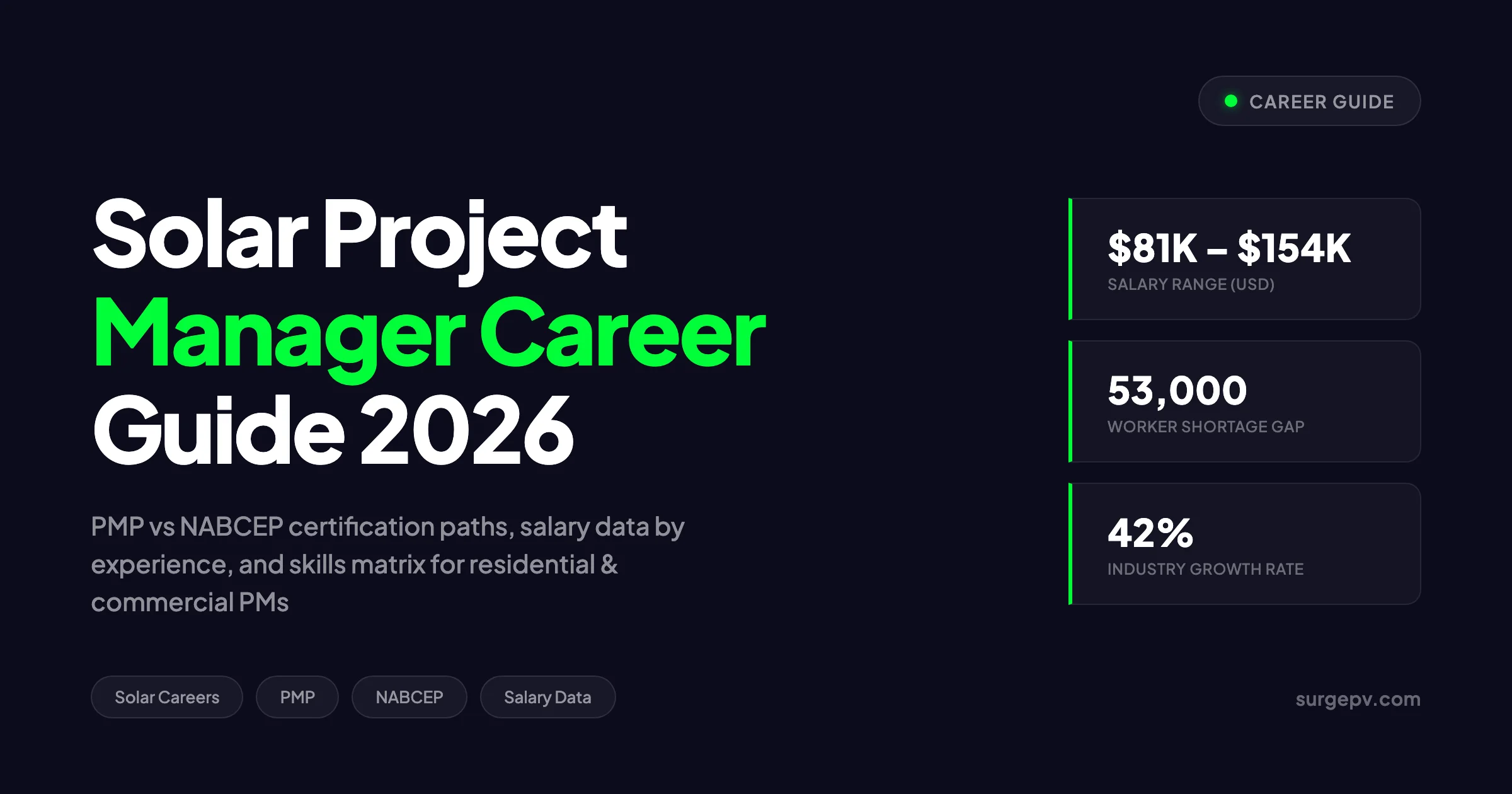
U.S. solar project managers earn $81,000–$154,000 depending on experience, location, and certification. PMP certification adds $20,000–$30,000 to base salary. NABCEP PVIP provides solar-specific technical credibility. The industry faces a 53,000-worker shortage threatening 60–70 GW of 2026 deployment. Residential PMs manage 5–50 kW systems in 2–4 weeks. Commercial PMs handle 100 kW–10 MW systems over 3–18 months. Both tracks are in high demand, but commercial PMs earn 30–50% more.
In this guide:
- What a solar project manager does — role overview and daily responsibilities
- PMP certification path — requirements, cost, timeline, and ROI
- NABCEP vs PMP — direct comparison table for solar PMs
- Solar project manager salary data by experience, location, and certification
- Residential vs commercial PM — scope, skills, and pay differences
- Skills matrix — technical, project management, and soft skills
- Day in the life — hour-by-hour breakdown of a commercial solar PM
- Career progression — from installer to director
- Common PM mistakes — what most get wrong and how to avoid them
- 2026 market demand — workforce gap, growth projections, and hiring trends
What Does a Solar Project Manager Do?
A solar project manager owns the full lifecycle of a solar installation. From the moment a contract is signed to the day the system is commissioned and producing power, the PM is the single point of accountability.
Core Responsibilities
Solar PMs coordinate five parallel workstreams:
- Design and engineering — Review PV system designs, approve single-line diagrams, verify string sizing, and ensure NEC 690 compliance
- Permitting and regulatory — Submit plans to AHJs, manage utility interconnection applications, and track environmental approvals
- Procurement and logistics — Order modules, inverters, racking, and BOS components; manage delivery schedules and warehouse coordination
- Construction and installation — Schedule crews, coordinate subcontractors, enforce OSHA and NFPA 70E safety protocols, and conduct quality inspections
- Financial and contractual — Track budgets against actuals, process change orders, manage lien releases, and ensure milestone payments
The PM does not do all of this alone. They lead a team that typically includes a site superintendent, a procurement coordinator, a design engineer, and one or more installation crews. But when something goes wrong — a failed inspection, a delayed shipment, a scope dispute — the PM owns the fix.
Residential vs Commercial Scope
| Factor | Residential PM | Commercial PM |
|---|---|---|
| System size | 5–50 kW | 100 kW–10+ MW |
| Project timeline | 2–6 weeks | 3–18 months |
| Budget range | $15,000–$150,000 | $200,000–$50M+ |
| Team size | 2–6 people | 10–50+ people |
| Permitting complexity | Simple (single AHJ) | Complex (AHJ + utility + fire + environmental) |
| Client type | Homeowner | Business, school, utility, government |
| Equipment procurement | Standard SKUs | Custom engineering, long-lead items |
| Contract type | Fixed price | EPC, design-build, or IPP |
| Typical salary | $65,000–$95,000 | $95,000–$154,000 |
Residential PMs move fast. They might manage 8–15 projects simultaneously, each in a different phase. Commercial PMs run fewer projects — often just 1–3 at a time — but each one involves hundreds of decisions, dozens of stakeholders, and capital exposure that can run into the millions.
I spent my first five years in commercial C&I. A typical project was a 1.2 MW rooftop array on a distribution center. The timeline ran 8 months from contract to PTO (permission to operate). The budget was $1.8 million. The team included 2 design engineers, a procurement lead, 3 installation crews of 4 people each, an electrical subcontractor, a roofing contractor, and a structural engineer. My job was to make sure all of them had what they needed, when they needed it, and that nobody’s work conflicted with anyone else’s.
PMP Certification Path for Solar PMs
The Project Management Professional (PMP) certification is the most recognized project management credential in the world. For solar PMs, it signals that you can manage complex projects using standardized methodologies — regardless of industry.
PMP Requirements
| Requirement | Details |
|---|---|
| Education | 35 hours of project management education |
| Experience (no degree) | 60 months (7,500 hours) leading projects |
| Experience (with bachelor’s) | 36 months (4,500 hours) leading projects |
| Exam | 180 questions, 230 minutes |
| Exam cost | $555 (non-member) / $405 (PMI member) |
| Maintenance | 60 PDUs every 3 years |
The experience requirement is the biggest hurdle for most candidates. PMI defines “leading and directing projects” broadly — scheduling, budgeting, risk management, stakeholder communication, and team leadership all count. If you have managed solar installations, coordinated subcontractors, or run project budgets, those hours likely qualify.
PMP Exam Content for Solar PMs
The PMP exam covers three domains:
- People (42%) — Team leadership, conflict management, stakeholder engagement
- Process (50%) — Schedule management, cost control, risk response, procurement
- Business Environment (8%) — Compliance, organizational change, benefits delivery
Solar PMs tend to score well on Process and People. The Business Environment domain — organizational strategy, market conditions, and regulatory compliance — is where hands-on installers sometimes struggle. Study this section deliberately.
PMP Cost and Timeline
| Item | Cost | Time |
|---|---|---|
| PMI membership (optional) | $139/year | Immediate |
| 35-hour prep course | $300–$1,500 | 1–2 months |
| Exam fee | $405–$555 | 1 day |
| Study and practice exams | $100–$300 | 2–3 months |
| Total investment | $900–$2,500 | 3–6 months |
The return on that investment is strong. According to PMI’s 2025 salary survey, PMP holders earn a median of $130,000 globally — $30,000 more than non-certified project managers. In the solar industry specifically, PMP certification is listed as “highly desirable” or “preferred” on most senior PM job postings. For Global-specific compliance details, see Global net-metering-by-country. For Global-specific compliance details, see Global solar-permitting-speed-by-country.
Pro Tip
Do not wait until you are a full PM to start your PMP. If you are currently a site engineer, installation lead, or project coordinator, your hours already count toward the experience requirement. Start logging them in PMI’s application portal now. The audit rate is low, but if you are selected, you will need contact information for every project you claim.
NABCEP vs PMP: Which Certification Should Solar PMs Pursue?
This is the question every aspiring solar PM faces. The answer depends on your background, your goals, and the type of projects you want to manage.
NABCEP Certifications Relevant to PMs
NABCEP (North American Board of Certified Energy Practitioners) offers several credentials. The most relevant for project managers are:
| Certification | Focus | Experience Required | Training Required |
|---|---|---|---|
| PV Installation Professional (PVIP) | Comprehensive: installation, design, commissioning, O&M, project management | 3–5 installations in decision-making role | 58 hours advanced PV training |
| PV Design Specialist (PVDS) | System design and engineering | Design portfolio | 58 hours |
| PV Technical Sales (PVTS) | Sales, site assessment, financial analysis | Sales experience | 24 hours |
The PVIP is the “gold standard” for solar professionals. It covers technical solar knowledge, NEC code compliance, equipment specifications, and includes a project management domain. It is ANSI-accredited to ISO/IEC 17024.
PMP vs NABCEP PVIP: Direct Comparison
| Factor | PMP | NABCEP PVIP |
|---|---|---|
| Scope | Cross-industry project management | Deep solar-specific technical knowledge |
| Technical solar knowledge | None | Extensive (NEC, equipment, design, commissioning) |
| Project management depth | Comprehensive (scheduling, risk, budget, stakeholder) | Moderate (subset of PVIP curriculum) |
| Industry recognition | Universal — any industry | Solar industry gold standard |
| Career flexibility | Any sector | Renewable energy / solar focused |
| Typical role level | Senior PM, Program Manager, Director | Lead Installer → PM → Technical Director |
| Salary impact | +$20,000–$30,000 | +$10,000–$20,000 |
| Exam difficulty | Very high (pass rate ~60%) | High (pass rate ~55%) |
| Total cost | $900–$2,500 | $1,200–$2,000 |
| Time to complete | 3–6 months | 6–12 months |
| Recertification | 60 PDUs every 3 years | 24 CEUs every 3 years |
My Recommendation by Career Stage
If you are new to solar with a technical background: Start with NABCEP PVIP. You need solar credibility before anyone will trust you to manage projects. Get 2–3 years of installation or design experience, then pursue PMP.
If you are an experienced PM transitioning from construction or another industry: Get PMP first if you do not already have it. Then add NABCEP Associate or PVIP to build solar-specific knowledge. Your project management skills transfer. Your solar knowledge does not.
If you are a senior installer moving into management: NABCEP PVIP first, then PMP. You already have the technical foundation. The PMP gives you the vocabulary and frameworks to communicate with executives, clients, and investors.
If you want maximum career optionality: Get both. The combination of PMP and NABCEP PVIP is the strongest credential profile in solar project management. It says you can manage any complex project, and you understand the technology deeply enough to make informed decisions when things go wrong.
What Most Candidates Get Wrong
Most people treat PMP and NABCEP as either/or choices. Employers do not. Senior solar PM job postings frequently list both as “preferred” or “highly desirable.” A 2024 Clean Energy Career Pathways survey found that 68% of solar EPC firms prefer candidates with dual credentials for roles above $100K salary. One certification gets you in the door. Both get you the interview for the senior role.
Solar Project Manager Salary Data by Experience
Salary data for solar project managers varies widely by source, location, and methodology. The figures below combine data from Salary.com, Glassdoor, ZipRecruiter, and Talent.com as of May 2026.
National Salary Ranges by Experience
| Experience Level | Annual Salary (USD) | Hourly Rate | Typical Role |
|---|---|---|---|
| Entry-level (0–2 years) | $60,000–$80,000 | $29–$38 | Project Coordinator, Junior PM |
| Early career (2–4 years) | $75,000–$95,000 | $36–$46 | Assistant PM, Residential PM |
| Mid-level (4–7 years) | $95,000–$118,000 | $46–$57 | Solar Project Manager |
| Senior (8–12 years) | $115,000–$140,000 | $55–$67 | Senior PM, Program Manager |
| Expert (12+ years) | $130,000–$154,000 | $62–$74 | Director, VP of Operations |
Salary by Source (May 2026)
| Source | Average/Base Salary | Notes |
|---|---|---|
| Salary.com | $116,307 (base) / $123,726 (total cash) | Includes bonus and incentives |
| Glassdoor — “Project Manager Solar” | $117,810 | Title-specific search |
| Glassdoor — “Solar Project Manager” | $98,608 | Broader title match |
| ZipRecruiter | $80,997 | Includes entry-level roles |
| Talent.com | $106,125 | National average |
| US Solar Development (Indeed) | $103,945 | 17% above national PM average |
The wide spread reflects differences in data collection. Salary.com and Glassdoor’s “Project Manager Solar” filter tend to capture mid-to-senior roles. ZipRecruiter’s broader match includes coordinator and assistant positions, pulling the average down.
Salary by Location
| Location | Salary Premium | Typical Range |
|---|---|---|
| California | +25% | $105,000–$145,000 |
| Massachusetts | +20% | $100,000–$140,000 |
| Texas | +5% | $85,000–$125,000 |
| Florida | +8% | $88,000–$128,000 |
| Arizona | +3% | $84,000–$122,000 |
| National average | Baseline | $81,000–$117,000 |
California and Massachusetts command premiums because of high costs of living, strong state renewable energy mandates, and dense concentrations of solar developers and EPC firms. Texas and Florida are growth markets with high demand but lower costs of living, so salaries are closer to national averages.
Certification Salary Impact
| Credential | Salary Premium | Typical Total Compensation |
|---|---|---|
| No certification | Baseline | $75,000–$95,000 |
| NABCEP PVIP only | +$10,000–$15,000 | $90,000–$110,000 |
| PMP only | +$20,000–$30,000 | $100,000–$130,000 |
| PMP + NABCEP PVIP | +$35,000–$50,000 | $120,000–$154,000 |
The PMP salary premium is well-documented across industries. PMI’s 2025 salary survey found PMP holders earn a median of $130,000 compared to $100,000 for non-certified PMs. In solar, the premium is amplified by the technical complexity of the projects and the shortage of qualified managers.
Total Compensation Beyond Base Salary
Senior solar PMs often receive additional compensation:
- Performance bonuses: 5–15% of base salary for on-time, on-budget delivery
- Project completion bonuses: $5,000–$25,000 for large commercial or utility-scale projects
- Stock options / equity: Common at venture-backed solar startups and developers
- Vehicle allowance: $500–$800/month for site travel
- Certification reimbursement: Most employers cover PMP and NABCEP exam costs
A senior PM at a mid-size commercial EPC firm in California with PMP and NABCEP certifications might earn $135,000 base + $15,000 bonus + $8,000 vehicle allowance = $158,000 total compensation.
Residential vs Commercial Solar Project Management
The day-to-day work of a residential PM and a commercial PM looks completely different. Understanding these differences is critical when choosing your career path.
Residential Solar PM
A residential PM at a company like Sunrun, Tesla Energy, or a regional installer manages a portfolio of 8–15 active projects. Each project is a single-family home or small multi-family building.
Typical project: 8 kW rooftop system, $24,000 contract, 3-week timeline
Daily work:
- Review new site assessments and flag design issues
- Check permit status across multiple AHJs
- Coordinate installation crews for the week ahead
- Call homeowners to schedule site visits and inspections
- Resolve interconnection paperwork with the local utility
- Process change orders for roof repairs or electrical upgrades
What makes it challenging: Volume and pace. Residential PMs context-switch constantly. One minute you are explaining net metering to a homeowner in Sacramento. The next you are arguing with a city permit clerk in San Jose about a fire setback. The next you are rescheduling a crew because yesterday’s rain made the roof unsafe.
What makes it rewarding: Speed of completion. You see projects from start to finish in weeks, not months. Homeowners are grateful. The environmental impact is immediate and visible.
Commercial Solar PM
A commercial PM at an EPC firm or developer manages 1–3 large projects. Each project is a warehouse, school, factory, or ground-mount array.
Typical project: 1.5 MW rooftop system, $2.2 million contract, 10-month timeline
Daily work:
- Review weekly construction schedules and critical path updates
- Lead subcontractor coordination meetings (electrical, roofing, structural)
- Track procurement status for long-lead equipment (inverters, switchgear)
- Manage utility interconnection timelines and witness tests
- Review monthly cost reports and forecast final project margin
- Negotiate change orders with the client or general contractor
- Ensure OSHA compliance and conduct safety audits
What makes it challenging: Stakes and complexity. A single delayed inverter shipment can push a $2 million project back by a month. A failed utility witness test can add $50,000 in rework. The client is a CFO or facilities director, not a homeowner, and they measure success in financial returns, not kilowatts.
What makes it rewarding: Scale and impact. A single commercial project offsets more carbon than a hundred residential systems. The financial structures are interesting — PPAs, tax equity, green bonds. And the pay is significantly better.
Key Tradeoff
Residential PMs gain breadth — they see every phase of many projects. Commercial PMs gain depth — they master the complexity of large capital projects. Most successful senior PMs have experience in both. I recommend starting in residential to build speed and adaptability, then moving to commercial for the bigger challenges and bigger paychecks.
Skills Matrix: What Solar PMs Need to Succeed
Solar project management sits at the intersection of three skill domains. Weakness in any one of them will cap your career.
Technical Solar Skills
| Skill | Why It Matters | How to Learn It |
|---|---|---|
| PV system design basics | You cannot manage what you do not understand | NABCEP coursework, PVSyst or Helioscope training |
| NEC 690 (solar PV systems) | Code violations kill permits and inspections | NEC code classes, NABCEP prep |
| Inverter and module specifications | Wrong equipment = project delays and performance issues | Manufacturer training (SMA, SolarEdge, Enphase) |
| Energy storage integration | Battery + solar is the fastest-growing segment | NABCEP energy storage courses |
| Utility interconnection standards | Every project needs utility approval | Utility-specific training, IEEE 1547 |
| Solar design software | Modern PMs review designs digitally | SurgePV, Aurora, or Helioscope training |
You do not need to be a design engineer. But you need to know enough to catch errors, ask intelligent questions, and make informed decisions when the engineer is not available.
Project Management Skills
| Skill | Application in Solar |
|---|---|
| Schedule management (MS Project / Primavera P6) | Build and maintain construction schedules with 50–200 line items |
| Budget control and forecasting | Track actuals against budget, forecast final margin, manage contingency |
| Risk management | Identify weather, supply chain, permitting, and safety risks; build response plans |
| Contract management | Negotiate EPC, subcontractor, and equipment purchase agreements |
| Change control | Document scope changes, price adjustments, and schedule impacts |
| Quality assurance | Inspect workmanship, verify commissioning test results, manage punch lists |
These are the core PMP competencies. If you have PMP certification, you have the framework. The gap is applying it to solar-specific contexts — like knowing that inverter lead times are currently 12–16 weeks, or that AHJ inspections often fail on the first attempt.
Soft Skills
| Skill | Why It Is Critical |
|---|---|
| Communication | You translate between engineers (technical), clients (financial), and crews (practical) |
| Leadership | Installation crews work long hours in hard conditions; they need to trust you |
| Negotiation | Change orders, subcontractor rates, and utility timelines all require negotiation |
| Problem-solving | Something goes wrong on every project; your job is to fix it fast |
| Adaptability | Weather, supply chains, and regulations change constantly |
| Stakeholder management | Clients, utilities, AHJs, subcontractors, and investors all need different information |
The soft skills are what separate good PMs from great ones. I have seen technically brilliant PMs fail because they could not manage client expectations. I have seen mediocre engineers succeed as PMs because they could build trust with crews and communicate clearly with executives.
A Day in the Life: Commercial Solar PM
Here is what a typical Tuesday looks like for a mid-level commercial solar PM managing a 2 MW ground-mount project in Texas.
6:30 AM — Check weather forecast. Rain expected Thursday. Decide whether to push concrete pour from Thursday to Friday and send updated schedule to the civil contractor.
7:00 AM — Drive to site (45 minutes). Conduct morning safety briefing with the installation crew. Review JSA (Job Safety Analysis) for today’s racking assembly work. Verify everyone has hard hats, harnesses, and arc-rated PPE.
8:30 AM — Walk the site with the site superintendent. Check racking alignment, verify torque values on foundation bolts, and photograph any issues for the daily report.
10:00 AM — Return to office. Review overnight email from the module supplier: shipment delayed by one week due to port congestion. Call the logistics coordinator to explore air freight options. Calculate cost impact ($8,500) and draft a notice of delay for the client.
11:00 AM — Weekly project status call with the client (a data center operator). Update them on construction progress (62% complete), flag the module delay, and confirm the commissioning timeline. They ask about the PPA rate escalation clause. You defer to the business development team and promise a response by Thursday.
12:00 PM — Lunch at desk. Review subcontractor invoices for the month. Flag a $3,200 overage on the electrical contractor’s invoice and schedule a call to reconcile.
1:00 PM — Call with the utility interconnection engineer. They need revised single-line diagrams showing the new switchgear configuration. You relay this to the design engineer and set a deadline of Friday.
2:00 PM — Update the project schedule in MS Project. The module delay pushes commissioning back by 5 days. You run a what-if analysis: if we expedite the inverter startup by working Saturdays, can we recover 3 days? The answer is yes, at a cost of $4,200 in overtime. You draft a change order for the client.
3:00 PM — Safety audit walkthrough with the OSHA consultant. They flag two issues: missing guardrails on the DC combiner pad and inadequate signage on the 480V switchgear. You write corrective action items and assign them to the site superintendent with a 48-hour deadline.
4:00 PM — Review tomorrow’s crew assignments and material deliveries. Confirm the crane is scheduled for 7:00 AM. Check that the 20-ton module pallets are staged correctly.
5:00 PM — Write the daily report for the client: progress photos, percentage complete, issues log, and lookahead schedule for the next two weeks.
6:00 PM — Respond to emails from the procurement team about a change in transformer specifications. The original model is discontinued. The replacement is $12,000 more expensive and has a 3-week longer lead time. You call the design engineer to confirm compatibility and prepare a budget impact memo.
7:30 PM — Leave office. Dinner with family. Try not to check email until morning. Fail.
This is not an unusual day. It is a normal one. The job is relentless, but it is never boring.
Career Progression: From Installer to Director
The solar project management career path is more flexible than many people realize. Here is the typical progression, with timelines and what you need at each stage.
Stage 1: Site Engineer or Installer (Years 1–3)
Role: Execute the physical work. Install modules, run conduit, terminate conductors, or assist with site assessments.
What you learn: How solar systems are actually built. What can go wrong in the field. How crews think and communicate.
Key move: Start documenting your project involvement for future PMP or NABCEP applications. Log hours, take photos, and build a portfolio.
Stage 2: Assistant or Junior PM (Years 3–5)
Role: Support a senior PM on 2–4 projects. Handle permitting, scheduling, and client communication. Learn the full project lifecycle.
What you learn: How to manage multiple workstreams. How to communicate with clients and AHJs. How to read and manage budgets.
Key move: Get NABCEP PVIP certification. Start your PMP education hours. Take on increasing responsibility until you are ready to manage your own projects.
Stage 3: Solar Project Manager (Years 5–8)
Role: Own 1–3 projects (commercial) or a portfolio of 8–15 projects (residential). Full accountability for schedule, budget, and quality.
What you learn: How to make decisions with incomplete information. How to manage conflict between subcontractors. How to recover when projects go off track.
Key move: Get PMP certification if you have not already. Build a track record of on-time, on-budget delivery. Develop relationships with key subcontractors and utility contacts.
Stage 4: Senior PM or Program Manager (Years 8–12)
Role: Manage the most complex projects or oversee a portfolio of projects. Mentor junior PMs. Contribute to process improvement and methodology development.
What you learn: Strategic thinking. How to balance multiple project priorities against organizational goals. How to build and lead a PM team.
Key move: Consider an MBA or advanced degree if you want to move into executive roles. Build expertise in a specialization — utility-scale, energy storage, or international projects.
Stage 5: Director or VP (Years 12+)
Role: Lead the project delivery function for a company or division. Set strategy, hire and develop PMs, own the P&L for project execution.
What you learn: Executive communication. Board-level reporting. M&A and business development.
Alternative paths from Stage 3 or 4:
- Solar Project Developer: Focus on origination, finance, and commercial structuring rather than execution
- Solar Fleet Manager: Oversee O&M for a portfolio of operating assets
- Consultant: Advise developers, investors, and utilities on project delivery
- Entrepreneur: Start your own EPC firm or project development company
Pro Tip
The fastest career accelerant I have seen is moving between company types. A PM who has worked at a residential installer, a commercial EPC, and a utility-scale developer has seen three different project delivery models. That breadth is rare and valuable. It also helps you figure out which environment fits your temperament — some people thrive in the chaos of residential volume, others need the structure of large commercial projects.
Common Solar PM Mistakes (and How to Avoid Them)
After managing 300+ commercial installations, I have seen the same mistakes repeatedly. Here are the ones that cost the most time and money.
Mistake 1: Underestimating Permitting Timelines
What goes wrong: New PMs assume AHJ plan review takes 2–3 weeks. In reality, it often takes 4–12 weeks, especially in jurisdictions with understaffed building departments.
The fix: Build a permitting database for every jurisdiction you work in. Track actual vs. estimated review times. Add 50% buffer to your schedule for jurisdictions you have not worked with before. Engage the AHJ early — a pre-application meeting can save weeks.
Mistake 2: Poor Equipment Procurement Planning
What goes wrong: Inverters, transformers, and switchgear often have 8–16 week lead times. Ordering them late pushes the entire project schedule.
The fix: Issue long-lead purchase orders within 2 weeks of contract execution. Maintain relationships with multiple suppliers. Keep a buffer stock of critical components if your volume supports it. Track supplier lead times monthly — they change constantly.
Mistake 3: Weak Change Order Documentation
What goes wrong: Scope changes happen on every project. Client requests an EV charger circuit. The roof needs unexpected repairs. The utility requires additional switchgear. If these are not documented and priced immediately, they erode margin.
The fix: Implement a same-day change order policy. Any scope change gets a written quote within 24 hours. No exceptions. Track cumulative change order value weekly. If it exceeds 5% of contract value, escalate to senior management.
Mistake 4: Ignoring Weather Contingency
What goes wrong: PMs build schedules based on ideal weather conditions. Rain, snow, extreme heat, and high winds routinely add 10–20% to construction timelines.
The fix: Build weather contingency into every schedule. For outdoor construction, assume 15–20% weather delay days depending on season and location. Have indoor work (electrical rough-in, documentation, training) ready to fill weather days.
Mistake 5: Inadequate Stakeholder Communication
What goes wrong: PMs communicate reactively — only when something goes wrong. Clients, utilities, and AHJs feel blindsided by delays and issues.
The fix: Set a proactive communication rhythm. Weekly status reports to clients. Biweekly check-ins with utility interconnection teams. Monthly meetings with key subcontractors. When bad news happens, deliver it fast with a proposed solution.
What Most Get Wrong About Solar PM Careers
Most people think solar project management is about technical knowledge. It is not. The best PMs I know are not the best engineers. They are the best communicators and organizers. Technical knowledge gets you to the PM role. Communication, organization, and resilience get you to the senior roles. If you are choosing between spending an extra month studying NEC code or an extra month practicing stakeholder communication, choose communication. The code you can look up. The client relationship you cannot rebuild.
2026 Market Demand: Why Solar PMs Are in Short Supply
The solar industry is growing faster than it can hire. This is not a temporary boom. It is a structural shortage that will last for years.
The Workforce Gap
| Metric | Figure |
|---|---|
| Current U.S. solar workforce | 280,000+ workers |
| Workers needed by late 2026 | ~355,000 |
| Projected gap | 53,000 workers |
| Installation targets at risk | 60–70 GW |
According to PV Magazine USA, this 53,000-worker gap threatens the industry’s ability to meet deployment targets tied to the July 4, 2026 federal tax credit deadline. The shortage is not just installers. It extends to project managers, site supervisors, and design engineers. The SEIA National Solar Jobs Census documents this gap in detail, and the Bureau of Labor Statistics projects 42% growth through 2034 — second-fastest of any U.S. occupation. Also see: Us Residential Solar Market Trends 2026.
Hiring Difficulty by Role
| Role | Employers Reporting Difficulty |
|---|---|
| Installation crews | 86% |
| Project managers and supervisors | 47% |
| Design engineers | 38% |
| Sales and development | 32% |
The 86% figure comes from the 2025 U.S. Energy and Employment Report. Nearly every solar employer is struggling to find qualified people. For PMs specifically, the problem is that the role requires a rare combination of technical solar knowledge and formal project management training. Most candidates have one or the other. Few have both.
Industry Growth Projections
| Metric | Projection |
|---|---|
| BLS solar installer growth (2024–2034) | 42% |
| Solar industry private investment (2024) | $71.3 billion |
| Projected workforce by 2033 | ~500,000 |
| Additional jobs from IRA (over decade) | 137,000 |
The Bureau of Labor Statistics projects 42% growth for solar photovoltaic installers through 2034 — second only to wind turbine technicians. Solar project managers, who sit one level above installers in the organizational hierarchy, will see comparable or stronger demand.
For more details, see our guide on wind turbine vs solar.
What This Means for Your Career
If you are qualified — meaning you have project management experience and solar technical knowledge — you are in an unusually strong negotiating position. Employers are offering:
- Signing bonuses of $5,000–$15,000 for experienced PMs
- Remote or hybrid work arrangements for non-site days
- Accelerated promotion tracks
- Full reimbursement for PMP and NABCEP certification
- Equity participation at venture-backed firms
The window will not stay open forever. As training programs expand and more people enter the field, the shortage will ease. But for the next 3–5 years, experienced solar PMs will have more leverage than at any point in the industry’s history.
Pro Tip
The 15% apprenticeship labor hour requirement for full Section 45Y and 48E tax credits is creating a new career pathway. If you are a junior PM or coordinator, consider joining a registered apprenticeship program. You will earn while you learn, and employers receive tax credit benefits for your hours. It is one of the fastest ways to build the experience hours needed for PMP certification.
Solar Project Manager Misconceptions
Several myths persist about solar project management. Let me address the ones I hear most often.
Misconception: You need an engineering degree to be a solar PM.
Reality: You do not. I have worked with excellent PMs who had backgrounds in construction management, business administration, and even liberal arts. What you need is the ability to learn technical concepts quickly, communicate across disciplines, and manage complex schedules. An engineering degree helps for certain roles — especially at utility-scale developers — but it is not a requirement for most commercial and residential PM positions.
Misconception: Solar PM is a desk job.
Reality: You will spend 30–50% of your time on construction sites, in AHJ offices, and in utility meeting rooms. The job involves climbing ladders, walking rooftops, and standing in muddy fields. If you want a purely desk-based role, look at project controls or scheduling specialist positions instead.
Misconception: The work is seasonal.
Reality: Construction is seasonal in some climates, but project management is year-round. Winter months are for permitting, procurement, design finalization, and pre-construction planning. Summer months are for execution. A good PM uses the slow season to get ahead on the next year’s projects.
How Solar Design Software Supports Project Managers
Modern solar PMs do not manage projects with spreadsheets and whiteboards alone. Solar design software has become an essential tool for project planning, design review, and client communication.
Tools like SurgePV let PMs:
- Review and validate PV system designs before they go to permitting
- Generate accurate BOMs and cost estimates for procurement planning
- Create client-ready proposals and renderings for stakeholder meetings
- Track project milestones and deliverables in a centralized platform
- Coordinate between design, engineering, and installation teams
For commercial PMs, the solar financial modeling is particularly valuable. It lets you model energy production, financial returns, and payback periods for client presentations and internal go/no-go decisions. When a client asks “what happens to our ROI if we add 500 kWh of battery storage?” you can answer in minutes, not days. See Adding Battery Storage Services for detailed guidance.
If you are a solar installer or commercial solar professional looking to move into project management, fluency with these tools is increasingly a job requirement. Employers expect PMs to review designs digitally, not just on paper.
Frequently Asked Questions
What is the average solar project manager salary in 2026?
The average solar project manager salary in the United States ranges from $81,000 to $154,000 depending on experience and location. Entry-level PMs earn $60,000–$80,000. Mid-level managers with 4–7 years earn $95,000–$118,000. Senior PMs with 8+ years and PMP certification earn $120,000–$154,000. California and Massachusetts pay 15–25% above the national average.
Should I get PMP or NABCEP certification for solar project management?
Get PMP if you want cross-industry flexibility and senior leadership roles — it adds $20,000–$30,000 to your salary and is recognized globally. Get NABCEP PVIP if you want deep solar technical credibility and field credibility with installers and inspectors. The strongest candidates hold both: PMP proves you can manage complex projects, and NABCEP proves you understand PV systems, NEC codes, and installation practices.
How long does it take to become a solar project manager?
Most solar project managers need 5–10 years of combined education and experience. A typical path: bachelor’s degree (4 years) plus 2–3 years in site engineering, installation, or project coordination, then 2–4 years as an assistant or junior PM before managing your own projects. Fast-track candidates with construction or electrical backgrounds can compress this to 4–6 years.
What skills does a solar project manager need?
Solar PMs need three skill layers: (1) Technical — PV system design, NEC code compliance, inverter and racking specifications, energy storage integration; (2) Project management — scheduling (MS Project/Primavera P6), budgeting, risk management, contract negotiation (EPC, O&M); (3) Soft skills — stakeholder communication, team leadership, conflict resolution, and adaptability to weather delays and supply chain issues.
What is the difference between residential and commercial solar project management?
Residential PMs manage 5–50 kW systems with 2–4 week timelines, simpler permitting, and direct homeowner communication. Commercial PMs handle 100 kW–10 MW systems with 3–18 month timelines, complex utility interconnection, procurement of $500K–$50M in equipment, and coordination with EPC contractors, AHJs, and utility engineers. Commercial PMs earn 30–50% more but face higher stakes and longer hours.
Is there a shortage of solar project managers in 2026?
Yes. The U.S. solar industry faces a 53,000-worker gap threatening 60–70 GW of deployment targets. 86% of solar employers report difficulty hiring, and 47% struggle to fill director and supervisor roles. The July 2026 federal tax credit deadline is intensifying demand. Solar project managers with both technical solar knowledge and formal project management training are among the most sought-after hires.
Can I become a solar project manager without an engineering degree?
Yes, but it is harder. Non-engineering paths include construction management, business administration, or military project management experience. You will need to compensate with hands-on solar installation experience (2–3 years minimum), NABCEP certification, and strong financial modeling skills. Many successful commercial PMs started as installers or sales coordinators and built project management skills on the job.
What are the biggest mistakes new solar project managers make?
The five most common mistakes: (1) Underestimating permitting timelines — AHJ reviews can take 4–12 weeks, not days; (2) Poor equipment procurement planning — inverter lead times of 8–16 weeks can stall entire projects; (3) Weak change order documentation — unrecorded scope changes erode 5–15% of project margin; (4) Ignoring weather contingency — rain days and winter conditions routinely add 10–20% to construction schedules; (5) Inadequate stakeholder communication — utility engineers and fire marshals can delay projects by months if not engaged early.
What is the career progression for a solar project manager?
The typical path runs: Site Engineer or Installer (years 1–3) → Assistant/Junior PM (years 3–5) → Solar Project Manager (years 5–8) → Senior PM or Program Manager (years 8–12) → Director of Operations or VP of Project Delivery (years 12+). Alternative paths include Solar Project Developer (business development focus), Solar Fleet Manager (multi-site O&M oversight), or starting your own EPC contracting business.
How do I transition from general construction to solar project management?
Start by getting NABCEP PV Installation Professional certification to prove solar technical knowledge. Take a 40-hour solar PV design course to understand module specifications, string sizing, and inverter selection. Shadow a solar PM for 2–3 projects to learn utility interconnection, permitting, and solar-specific safety (NFPA 70E arc flash). Your construction scheduling and subcontractor management skills transfer directly — the gap is technical solar knowledge and regulatory familiarity. Shadow analysis software identifies shading issues before installation. See Inverter Selection Solar Design Guide for detailed guidance.
Conclusion: Three Actions to Take This Week
Solar project management is one of the most stable and well-compensated career paths in clean energy. The industry is growing, the talent pool is shallow, and the work is genuinely meaningful — every project you complete reduces carbon emissions and saves clients money.
If this guide resonated with you, here are three concrete actions to take this week:
-
Audit your current skills against the matrix in this guide. Identify your strongest domain (technical, PM, or soft skills) and your weakest. Spend 30 minutes researching one course or certification that addresses the gap. If you lack solar technical knowledge, look at NABCEP’s entry-level Associate program. If you lack formal PM training, sign up for a 35-hour PMP prep course.
-
Update your LinkedIn profile and resume to highlight project outcomes, not just responsibilities. Do not write “managed solar installations.” Write “delivered 12 commercial solar projects totaling 4.5 MW on time and 3% under budget.” Numbers matter. If you do not have project management experience yet, highlight transferable skills from construction, engineering, or operations roles.
-
Apply to three solar PM or assistant PM roles this week, even if you do not meet every requirement. The shortage is real. Employers are hiring for potential, not just credentials. A candidate with 70% of the requirements and strong communication skills often beats a candidate with 100% of the requirements and poor interpersonal skills. The worst outcome is a “no.” The best outcome is a conversation that changes your career.
The solar industry needs more good project managers. The projects are getting bigger, the technology is getting more complex, and the deployment targets are getting more ambitious. If you are organized, resilient, and willing to learn, there is a place for you. Solar PV design software automates design and compliance. Solar proposal software generates professional quotes in minutes.
Where this fits
This article is part of SurgePV's Solar Business & Operations hub, which works through the topic from first principles to the decisions a project team actually has to make.


