

Quick Answer
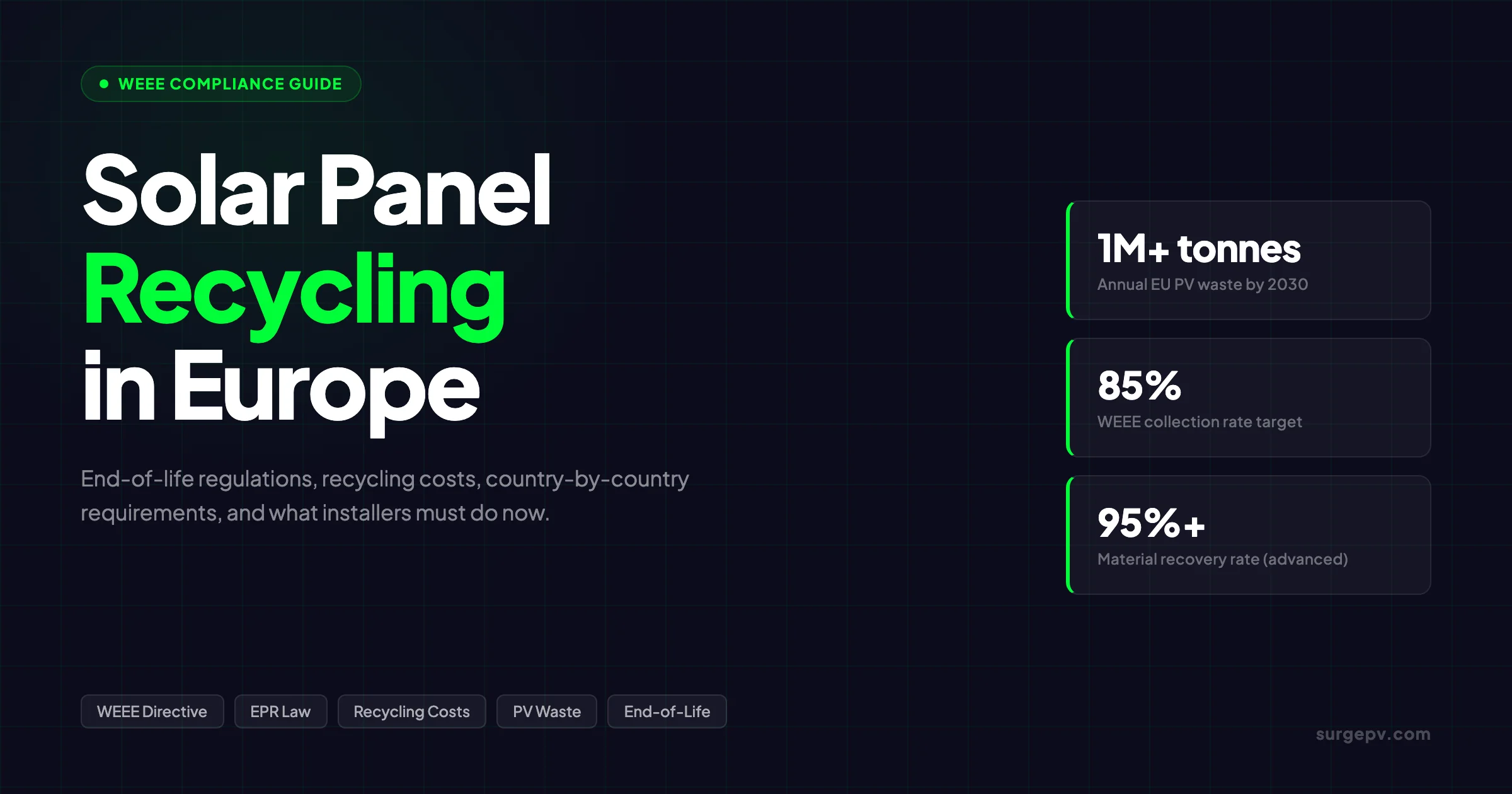
Europe's WEEE Directive mandates solar panel recycling with 85% recovery and 80% reuse targets. Recycling recovers silicon, silver, aluminum, and glass. Current European recycling capacity is 50,000 tonnes/year.
Europe is heading toward a solar panel waste surge that will dwarf anything the continent’s recycling infrastructure was built to handle. The first generation of large-scale PV installations — systems commissioned in Germany and Spain between 2000 and 2012 — is now approaching end-of-life. By 2030, the continent will generate over 1 million tonnes of decommissioned panels per year. By 2050, IRENA projects global solar PV waste at 78 million tonnes. The regulatory framework governing what happens to those panels is the EU WEEE Directive. Amended in 2012 to include photovoltaics, it places the cost and legal responsibility for collection, treatment, and recycling on producers — the manufacturers and importers who placed panels on the EU market. The 85% collection target and 80% recycling-by-weight minimum are already law. But enforcement quality, recycling infrastructure depth, and compliance culture vary sharply across member states. Also see: Germany solar subsidies. Also see: Spain net metering.
Europe’s WEEE Directive mandates solar panel recycling with 85% recovery and 80% reuse targets. Recycling recovers silicon, silver, aluminum, and glass. Current European recycling capacity is 50,000 tonnes/year.
TL;DR — Solar Panel Recycling in Europe
The EU WEEE Directive (amended 2012) covers all PV panels sold in Europe. Producers must register nationally, finance collection and recycling, and achieve an 85% collection rate and 80% recycling rate. End-of-life costs run roughly 0.10 to 0.50 euros per kg depending on country and logistics. Europe will exceed 1 million tonnes of annual PV waste by 2030 — and current recycling capacity is already under pressure.
What this guide covers:
- The exact legal obligations under the WEEE Directive — what applies to producers, distributors, and installers (and how to surface them in solar proposal software for compliance-conscious customers)
- Country-by-country requirements for Germany, France, Italy, Spain, and the UK
- How solar panels are actually recycled and what materials come out
- The real cost of recycling — eco-fees, transport, treatment, and material recovery credits
- The 2030 waste surge and why current capacity is insufficient
- What installers must do today to stay compliant on decommissioning jobs
- Design choices that reduce end-of-life costs 25 years from now Also see: solar panel ROI in Italy. Also see: France solar feed-in tariffs.
Regulation Status: Solar Panel Recycling Rules Across Europe
The table below summarizes the current regulatory framework across Europe’s five largest solar markets.
| Country | Regulatory Framework | Producer Registry | Main Compliance Scheme |
|---|---|---|---|
| Germany | ElektroG (WEEE transposition) | Stiftung EAR | PV CYCLE, individual compliance |
| France | REP Equipements Electriques et Electroniques | ADEME | PV CYCLE France |
| Italy | D.Lgs. 49/2014 | CENTR | EcoTre, PV CYCLE Italy |
| Spain | RD 110/2015 | SEPA | Ambilamp, EcoRaee |
| UK | WEEE Regulations 2013 (post-Brexit retained) | Environment Agency / SEPA | PV CYCLE UK, Valpak |
All five countries operate under extended producer responsibility (EPR). Producers — defined as the entity that first places panels on the national market — must register before selling, report volumes on a quarterly or monthly basis, and fund collection and treatment operations.
Key Takeaway
The EU WEEE framework creates consistent obligations across all 27 member states, but enforcement varies substantially. Germany and France have mature national registries and active collection networks. Several Eastern European markets still lack the recycling infrastructure to process PV waste locally, leading to cross-border transport that now triggers Basel Convention oversight.
See our guide on Agricultural Solar Case Study for more.
For context on the broader solar energy policies in Europe that shape how these recycling obligations fit into national energy law, see our dedicated country analysis.
What the WEEE Directive Actually Requires
The Waste Electrical and Electronic Equipment Directive (2012/19/EU) is the legal engine behind PV recycling in Europe. Solar panels were classified as Category 4 equipment (“Large Equipment”) and brought into WEEE scope in 2014 through a political compromise that excluded them from RoHS (the manufacturing-phase hazardous substances restriction) but included them in WEEE for end-of-life management. Here is what the directive specifically mandates.
Producer Registration
Every company that manufactures panels in the EU, imports them from outside the EU, or sells panels under its own brand is classified as a “producer” and must:
- Register with the national WEEE authority in each EU member state where it places panels on the market
- Report volume data — pieces and kilograms — on monthly or quarterly cycles, depending on the country
- Maintain a financial guarantee (bond, insurance, or compliance scheme membership) covering future collection and treatment costs
A foreign manufacturer selling into France, Germany, and Italy simultaneously must maintain three separate national registrations, with three separate reporting obligations. This is why most producers join a pan-European compliance scheme like PV CYCLE, which handles registration and reporting across multiple member states under a single contract. See our guide on [Commercial Rooftop Solar Case Study Italy](/blog/commercial-solar-rooftop-case-study-italy-warehouse) for more.
Collection and Recycling Targets
The directive sets binding minimum targets:
| Metric | Minimum Target |
|---|---|
| Collection rate | 85% of estimated PV waste generated |
| Recycling / Reuse | 80% of collected material by weight |
| Additional energy recovery | Up to 5% of collected weight |
These targets apply to Category 4 as a whole, but PV waste is reported and tracked separately from other large electrical equipment by most national registries.
Take-Back Obligation
Producers must offer end-users a mechanism to return panels free of charge. In practice, this is delivered through:
- Direct take-back programs run by the manufacturer
- PV CYCLE collection points distributed across Europe
- Certified WEEE treatment facilities (WTF) contracted by compliance schemes
Distributors — solar wholesalers and installers who sell or import panels — face an additional obligation: when supplying a new panel, they must offer to accept the equivalent old panel back at no charge to the end-user.
Financing: The Eco-Fee
The cost of future recycling is not collected at end-of-life — it is embedded in the product price at point of sale. Producers pay an eco-fee into a compliance scheme or financial guarantee fund. Current eco-fee ranges:
| Market | Eco-Fee Range (per kg) |
|---|---|
| Germany | 0.06–0.18 euros |
| France | 0.05–0.15 euros |
| Italy | 0.08–0.20 euros |
| Spain | 0.05–0.12 euros |
| UK | 0.07–0.17 pounds |
For a standard 25 kg residential panel, this translates to roughly 1.25–5.00 euros of the purchase price going toward future recycling. On a 10 kWp residential system (30 panels), that is 37.50–150 euros in pre-paid recycling costs.
Pro Tip for Installers
When quoting a project, confirm with the client that all panels carry WEEE eco-fees from the producer. Purchasing grey-market or non-EU-registered panels can shift the legal “producer” classification to the buyer — meaning your client inherits the full recycling liability at decommissioning.
Country-by-Country Breakdown: Germany, France, Italy, Spain, and the UK
Germany: Europe’s Largest PV Waste Market
Germany leads Europe in both installed solar capacity (66 GW as of 2025) and PV waste generation. In 2024, Germany accounted for approximately 45% of all recycled PV panels in Europe by volume. The national registry is operated by the Stiftung EAR (Elektro-Altgeräte-Register).
Current waste volumes: Germany generated an estimated 30,000–40,000 tonnes of end-of-life PV modules in 2025. Projections show this could reach 1 million tonnes annually by 2030 as the early feed-in-tariff generation — systems commissioned under the original EEG between 2000 and 2012 — reaches its 20–25 year mark.
Compliance path: Producers register with EAR and either join a compliance scheme (PV CYCLE is the dominant operator) or submit individual financial guarantees. Collection points are distributed nationally; certified WEEE treatment facilities are concentrated in Baden-Württemberg, Bavaria, and North Rhine-Westphalia.
Enforcement: Germany’s enforcement under ElektroG is among the strictest in Europe. Since 2022, online marketplaces including Amazon.de and Otto.de must verify WEEE registration before listing electrical products. Non-compliant producers face immediate delisting in addition to financial penalties.
France: The Regulatory Reform Market
France operates its WEEE scheme through ADEME (Agence de la transition ecologique) and mandates registration in its national register. PV CYCLE France is the leading compliance scheme for solar-specific producers.
Key difference: France introduced a specific producer obligation for PV panels ahead of the 2012 WEEE revision, making it one of the earliest EU countries to mandate solar panel collection. ECOSYSTEMES and ECOLOGIC schemes also accept PV producers.
Recent update: France’s REP (Responsabilite Elargie du Producteur) reform, enacted in 2020 as part of the Anti-Waste and Circular Economy Law (AGEC), tightened traceability requirements and introduced quarterly public reporting obligations for compliance schemes. This makes France’s recycling data the most transparent in Europe.
Italy: Mandatory Certificate of Conformity
Italy’s WEEE transposition (D.Lgs. 49/2014) is among the most documentation-heavy in Europe. Italian law requires producers to obtain a certificate of conformity from one of the approved compliance consortia — EcoTre, PV CYCLE Italy, Remedia, or ECOLIGHT — before any panels can be legally sold on the Italian market.
Unique requirement: Italian installers must issue a “dichiarazione di fine vita” (declaration of end-of-life) when decommissioning a system. This document identifies the number and weight of panels, the WEEE compliance scheme covering them, and the certified treatment facility used. Without it, the installer faces liability.
Infrastructure gap: Italy’s rapid solar expansion — 25 GW installed — is generating increasing end-of-life volumes. But recycling facilities remain concentrated in the north; southern Italian installers often face higher transport costs and fewer certified collection partners.
Spain: Integrated Waste Management Plans
Spain’s WEEE transposition (Real Decreto 110/2015) requires producers to submit an Integrated Waste Management Plan (PGRI) to SEPA before selling panels. The plan must demonstrate the financial and logistical capacity to meet collection and recycling targets.
Compliance scheme operators: Ambilamp, EcoRaee, and PV CYCLE Spain are the primary operators. Spain’s 30 GW installed base is generating increasing waste volumes, particularly from early 1–3 MW utility installations commissioned during the 2007–2010 feed-in-tariff boom.
Enforcement gap: Spain’s SEPA has historically had a lighter enforcement posture than Germany or France. This is expected to change as the EU’s Single Market Surveillance Regulation (2019/1020) tightens cross-border enforcement coordination among member states. Installers operating in Spain should assume stricter enforcement within 2–3 years.
United Kingdom: Equivalent Framework Post-Brexit
The UK retained the WEEE Regulations 2013 following Brexit, and the framework remains broadly equivalent to the EU directive. Oversight is split between the Environment Agency (England), SEPA (Scotland), Natural Resources Wales, and NIEA (Northern Ireland). For UK-specific information, see Battery Solar System Design UK.
Key divergence: As of January 1, 2025, the Basel Convention Amendment tightened transboundary movement controls for electrical and electronic waste. The UK has not yet formally aligned with the EU’s implementing measures under the new Waste Shipment Regulation (2024/1157/EU). UK-to-EU panel shipments and EU-to-UK shipments now require additional Basel-compliant documentation — a new compliance step for cross-border recycling operations that emerged in 2025.
Compliance schemes: PV CYCLE UK, Valpak, and Recolight accept solar producers. Registration is with the Environment Agency’s Producer Compliance Scheme list.
Key Takeaway
Every EU member state and the UK has binding PV panel take-back obligations for producers. The mechanisms vary — Germany uses EAR, France uses ADEME, Italy requires a conformity certificate, Spain requires a management plan, the UK uses the Environment Agency. PV CYCLE operates across all five countries and is the practical path of least resistance for multi-market producers.
How Solar Panels Are Recycled: The Industrial Process
Understanding the recycling process matters for installers specifying decommissioning services and for system designers who want to specify materials that are cheaper to process at end-of-life.
Step 1: Collection and Transport
Decommissioned panels must be transported by WEEE-certified carriers. In most EU countries, this means the carrier holds a waste transport licence and maintains a digital chain of custody from the collection point to the treatment facility. Panels cannot be mixed with general construction waste. Incorrect classification as construction and demolition waste is one of the most common enforcement violations.
Step 2: Sorting and Condition Assessment
On arrival at the treatment facility, panels are sorted by:
- Panel type: crystalline silicon (c-Si) vs. thin-film (CdTe, CIGS, amorphous silicon)
- Physical condition: intact, cracked, delaminated, or fire-damaged
- Age and manufacturer: older panels may contain higher silver content per watt
Panels assessed as still functional (above 70–80% of original rated output) may be redirected to a refurbishment and second-life pathway rather than immediate recycling.
Step 3: Frame and Junction Box Removal
Aluminium frames and junction boxes are removed manually or with semi-automated tooling. This step recovers the highest-value material per unit weight. Aluminium frames retain approximately 95% of their original market value when smelted and returned to industrial production.
Step 4: Mechanical Processing
The de-framed module enters the mechanical processing line:
- Laminate separation: Heat or chemical solvents separate the encapsulant (typically ethylene vinyl acetate, EVA) from the glass and cell layers
- Crushing: Separated components are reduced to particle sizes suitable for downstream material separation
- Screening: Size-based separation of glass cullet, silicon fragments, and metal particles
- Eddy current separation: Recovers copper and other conductive metals from the mixed material stream
Step 5: Material Recovery Rates
| Material | Share of Panel Weight | Recovery Rate | End Use |
|---|---|---|---|
| Glass | 70–75% | 90–95% | Construction glass, new solar glass |
| Aluminium frame | 8–10% | 95% | Industrial aluminium production |
| Silver (cell interconnects) | under 0.1% by weight | 90%+ | Electronics, photovoltaics |
| Copper (wiring, busbars) | 1–2% | 90%+ | Electrical manufacturing |
| Silicon (cells) | 4–5% | 70–85% standard / up to 99% next-gen | Solar cell production |
| Encapsulant (EVA) | 6–8% | Low — often burned | Energy recovery |
Advanced facilities — notably ROSI Solar in France — are achieving near-complete recovery of silver and high-purity silicon. At current commodity prices, the silver recovered from 1 tonne of crystalline silicon panels is worth approximately 800–1,200 euros. This is the economics driver that will eventually make PV recycling profitable at scale.
Thin-Film Processing: Different Chemistry, Different Risks
Thin-film panels (CdTe, CIGS, amorphous silicon) require a different treatment pathway because they contain hazardous or critical materials not present in standard silicon panels:
- CdTe (Cadmium Telluride): Contains cadmium, a Category 1 carcinogen. Must be processed at facilities licensed to handle hazardous materials. First Solar operates its own closed-loop recycling program for CdTe modules with recovery rates above 90%.
- CIGS (Copper Indium Gallium Selenide): Contains indium and gallium, both classified as critical raw materials with restricted global supply. Specialist recovery processes are required to extract these economically.
- Amorphous silicon: Fewer hazardous materials; processing is closer to standard crystalline silicon in most respects.
Thin-film panels in the EU carry the same WEEE collection obligations as silicon panels but must be routed to facilities with hazardous waste treatment authorisations. Routing CdTe panels to a standard silicon recycling facility is a WEEE violation in most member states — and the hazardous material liability falls on the installer if the routing decision was made at site.
Pro Tip for Specifiers
When specifying panels for a commercial project, ask the manufacturer to confirm which certified recycling facilities handle their product and to provide a decommissioning cost estimate per module. First Solar, Sunpower, and several European manufacturers publish this data in product sustainability reports. It belongs in project documentation from day one, not as an afterthought 25 years later.
The Real Cost of Recycling Solar Panels in Europe
Recycling costs vary based on logistics, panel condition, country, and treatment facility capacity. Here is the current cost structure for the European market.
| Cost Element | Current Range |
|---|---|
| Collection and transport (per panel) | 2.50–8.00 euros |
| Treatment and processing (per tonne) | 80–250 euros |
| Thin-film surcharge (CdTe/CIGS) | +50 to +100% vs. silicon |
| Eco-fee (pre-paid at purchase) | 1.25–5.00 euros per panel |
| Net cost after material recovery credits | Often 20–80 euros per tonne (not yet profitable at scale) |
The economics of PV recycling are not yet self-sustaining at current volumes. Recovered glass — the largest fraction by weight — sells for 8–12 euros per tonne, well below the cost of sorting and cleaning it. Aluminium recovery creates positive value, but silicon and silver recovery requires specialized facilities that few European operators have built at commercial scale.
The recycling market becomes profitable under two conditions: commodity prices for silver and silicon rise significantly (silicon purity determines whether it can re-enter cell production), or processing volumes reach the scale at which fixed facility costs are absorbed across a much larger throughput. Both conditions are likely by the mid-2030s as the first-generation installation wave matures.
Key Takeaway
Solar panel recycling in Europe is still largely cost-negative at current volumes — meaning recovered material value does not cover the full processing cost. This changes as volumes grow after 2030 and silver and silicon recovery technology matures. The eco-fee system was designed to pre-fund this transition, but questions exist about whether fees collected in the 2010s are sufficient to cover the volume surge now projected for 2030–2040.
Design Systems That Are Ready for Decommissioning
SurgePV’s solar design software lets you document material specifications, panel quantities, and system configurations — creating the project record your client needs for WEEE compliance at end-of-life.
Book a DemoNo commitment required · 20 minutes · Live project walkthrough
For a direct comparison, see Arka 360 vs SurgePV.
What Installers Must Do Under WEEE
Installers are not classified as producers under WEEE — the obligation rests with the manufacturer or importer. But installers have specific operational duties that carry real compliance risk if ignored.
1. Use WEEE-Certified Removal and Transport
When decommissioning a system, all removed panels must be handled by a licensed WEEE collector or transported using a valid waste carrier licence. Disposing of panels in a skip, construction waste skip, or general waste stream is a criminal offence in all EU member states and the UK. Fines range from 5,000 euros in some jurisdictions to over 100,000 euros for commercial-scale disposal violations. In Germany and France, directors of the responsible company can face personal criminal liability.
2. Issue and Retain Documentation
Most national laws require a paper or electronic chain of custody for every WEEE shipment. The documentation should show:
- Number and total weight of panels removed
- Site address and decommissioning date
- Name and licence number of the WEEE-certified carrier
- Name and authorisation number of the receiving treatment facility
- Signature of the receiving facility confirming acceptance
Retain these records for at least 4 years — the standard EU audit lookback period. Germany and Italy require 5 years.
3. Inform End-Users of Their Rights
As a distributor of new panels — even when your primary role is installation — you must inform residential customers that they can return end-of-life panels free of charge via the producer’s take-back scheme. This is a legal requirement in France, Italy, and Germany. A single clause in the installation contract or the customer handover documentation satisfies this requirement.
4. Do Not Export to Non-EU Countries Without Documentation
Since January 1, 2025, the Basel Convention Amendment tightens controls on EEE waste exports from OECD to non-OECD countries. Any shipment of end-of-life panels from an EU country to a country outside the EU requires a Basel prior informed consent (PIC) procedure — unless the panels are demonstrably functional and exported for reuse, not recycling. Exporting damaged or degraded panels without PIC documentation is now a Basel violation in addition to a WEEE compliance issue.
Pro Tip
The simplest compliant path for most installers: register as a PV CYCLE collection partner. PV CYCLE operates take-back points across Europe, handles all transport and treatment documentation, and confirms WEEE compliance to the producer’s register on your behalf. Installer registration is free and takes approximately one working day.
For a full picture of solar permit requirements in Europe including grid connection and planning obligations alongside these WEEE duties, see our dedicated guide.
The 2030 Waste Surge: Why Capacity Is Already Under Pressure
The volume of end-of-life PV panels arriving at European recycling facilities is still modest in 2026. But the trajectory is steep, and the arithmetic is unambiguous.
Installed capacity context:
| Country | Installed Solar Capacity (2025) |
|---|---|
| Germany | 66 GW |
| Netherlands | 24 GW |
| Spain | 30 GW |
| Italy | 25 GW |
| France | 22 GW |
Most of this capacity was installed between 2010 and 2023. Using an average panel lifespan of 25–30 years, the first generation of German EEG systems commissioned from 2000 to 2005 is already reaching end-of-life. The main wave — the mass-market installations of 2010–2015 — arrives in the 2035–2040 window.
Projected annual PV waste volumes for Europe:
| Year | Estimated Annual Waste (EU) |
|---|---|
| 2025 | ~80,000–120,000 tonnes |
| 2030 | ~1 million tonnes |
| 2040 | ~3–4 million tonnes |
| 2050 | ~15–16 million tonnes |
A 2025 study published in Advanced Energy and Sustainability Research by researchers from the University of Murcia and the EU Joint Research Centre identified a growing mismatch between projected PV waste flows and the recycling infrastructure across EU member states. Current EU recycling capacity sits at approximately 170,000 tonnes per year — adequate for 2026 volumes, but insufficient for the 2030 surge unless significant new facilities open.
Germany’s specific challenge: With up to 1 million tonnes of PV waste projected by 2030, Germany’s current capacity of roughly 70,000–80,000 tonnes per year is insufficient by roughly an order of magnitude. Policymakers in Berlin are reviewing ElektroG to introduce volume-based capacity guarantees from producers — similar to the deposit-refund models already used in Germany’s battery recycling market.
The European Environment Agency has flagged this capacity gap as one of the priority issues in its green technology material recycling indicators. The EEA’s position is that without mandatory capacity planning from the WEEE revision process, the 2030 wave will overwhelm existing infrastructure and drive up treatment costs sharply.
Key Takeaway
Europe is heading into a PV waste surge with under-sized recycling infrastructure. This creates two near-term commercial opportunities: new recycling capacity investment, and second-life panel markets that defer recycling and extend asset value. Both are being actively developed across Germany, France, and the Netherlands.
Second Life and Refurbishment: The Alternative to Immediate Recycling
Not all decommissioned panels need to go straight to a recycling facility. Panels that still perform at 70–80% of rated output have a viable second life in applications where peak performance is less critical than cost.
Where Second-Life Panels Are Used
- Off-grid agricultural and rural electrification: Farmers in Eastern Europe, Africa, and Southeast Asia use second-life panels for irrigation pumps, lighting, and cold storage — applications where 80% of rated output is fully adequate
- Community solar and social housing: Low-margin projects where upfront cost is the primary constraint and maximum generation density is not required
- EV charging and battery storage backup sites: Applications where cost per kWh generated matters more than energy density per square metre
- Research and training facilities: Second-life panels serve well in test installations and educational settings
WEEE Implications for Second-Life Transactions
Exporting second-life panels outside the EU as “functional equipment” — not waste — exempts the transaction from WEEE and Basel waste regulations. But this requires the exporter to document:
- Functional test results, typically an IV curve trace showing at least 70% of original Pmax
- A written statement of intended use by the recipient
- Compliance with any import regulations in the destination country
Getting this wrong — exporting degraded panels as “reuse” without proper documentation — exposes the exporter to prosecution under the new EU Waste Shipment Regulation (2024/1157/EU). This regulation replaced the 2006 framework and entered into force in 2026, with stricter documentation requirements and higher penalties for misclassification.
The second-life market is growing, but it is not a WEEE loophole. It is a legitimate end-of-life pathway with its own compliance requirements.
Design for End-of-Life: What to Specify in New Projects
The cheapest point to reduce future recycling costs is during system design. Material choices and documentation practices at commissioning directly affect decommissioning cost and compliance ease 20–30 years later.
Material Specifications That Affect EOL Costs
| Design Choice | End-of-Life Impact |
|---|---|
| Standard framed crystalline silicon panels | Lowest recycling cost — aluminium frames easily separated and sold |
| Frameless bifacial glass-glass panels | Slightly higher processing cost — no frame recovery revenue, glass-glass laminate is harder to delaminate |
| Thin-film CdTe or CIGS | 50–100% higher recycling cost — hazardous material handling required |
| EVA encapsulant (standard) | Lower EVA recovery value — encapsulant typically burned for energy |
| POE encapsulant | Marginally better recovery potential; increasingly used in bifacial panels |
| Mechanically fastened racking | Lower deconstruction labour vs. bonded or adhered systems |
| Roof-integrated BIPV | Highest deconstruction complexity and cost — reroofing required |
Documentation to Hand Over at Commissioning
The most common cause of WEEE compliance failure at decommissioning is documentation that cannot be retrieved — often 25 years after the original installer has closed the job file. At commissioning, create and hand to the client:
- Panel WEEE compliance certificate — the compliance scheme membership document from the producer
- Module serial number log — traceable back to the producer’s WEEE register entry
- Eco-fee confirmation — evidence that recycling costs were pre-paid at point of sale
- End-of-life instructions — which WEEE scheme to contact and the nearest collection point
Using cloud solar design software with structured project documentation makes maintaining this record straightforward. SurgePV’s solar software stores system specifications, panel model data, and project documents in a single project record retrievable at any point in the project lifecycle — including at decommissioning 25 years later.
For the financial side, the generation and financial tool can model a decommissioning cost estimate as a line item in the total cost of ownership — giving clients a transparent picture from day one and differentiating professional installers from commodity operators.
Pro Tip
Include a projected decommissioning cost estimate in every proposal, with a note explaining that it is pre-funded through the eco-fee system. Clients who understand they have already paid for recycling are less likely to be surprised — or to make illegal disposal decisions — at end-of-life.
PV CYCLE: Europe’s Main Compliance Operator
PV CYCLE is the industry-supported producer responsibility organisation that handles WEEE compliance for solar PV panels across the EU and UK. It was founded in 2007 — five years before PV panels were formally included in the WEEE Directive — making it the incumbent compliance infrastructure for most of the European market.
How it works:
- A producer joins PV CYCLE in each country where it sells panels
- The producer reports volume data (quantities and kilograms) on the prescribed schedule per country
- PV CYCLE uses these fees to operate a network of take-back points, arrange transport to certified treatment facilities, and fund recycling operations
- PV CYCLE reports compliance metrics to national WEEE authorities on the producer’s behalf
Collection network: PV CYCLE operates over 1,500 take-back collection points across Europe, with the densest coverage in Germany, France, and Italy. Installers can register as collection partners at no cost and request collections when they accumulate panels at a decommissioning site.
Key limitation: PV CYCLE’s network was scaled for current waste volumes. The organisation has acknowledged that its infrastructure needs to expand before 2030. PV Tech reported in 2025 that urgent reform of EU PV recycling — including mandatory recycling capacity guarantees from producers — was under active debate at the European Commission level. PV CYCLE is participating in those negotiations and has proposed a volume-based capacity reservation system to guarantee sufficient treatment capacity is available as waste volumes scale.
What Changes After 2026: Anticipated Regulatory Developments
The WEEE Directive is under review by the European Commission as part of the Circular Economy Action Plan. Several changes are expected to affect PV producers and installers within the next 2–4 years.
Ecodesign for Sustainable Products Regulation (ESPR)
The ESPR (Regulation 2024/1781/EU) began phasing in from 2024 and will set mandatory repairability, recyclability, and material content standards for energy-related products including solar panels. The first solar-specific delegated acts are expected by 2027 and may require:
- Minimum recyclable content percentages in new panel manufacturing
- Mandatory Digital Product Passports tracking material composition, production emissions, and end-of-life instructions
- Minimum silver and silicon recovery rates from certified recyclers
The Digital Product Passport requirement is the most operationally significant for installers. It would mean every panel sold in Europe carries a machine-readable data record containing WEEE registration details, material composition, and take-back scheme contact — dramatically simplifying decommissioning documentation.
Revised WEEE Targets
The Commission’s WEEE review is expected to propose higher collection targets — possibly moving from 85% to 90% or beyond — and to introduce PV-specific recycling targets separate from the general Category 4 framework. A formal proposal is anticipated in 2027.
EU Battery Regulation as a Model
The EU Battery Regulation (2023/1542/EU) sets binding recycled content minimums for new batteries and has been cited as a template for potential PV regulation. Under this approach, new panels would be required to contain a minimum percentage of recycled silicon, glass, or aluminium — creating direct market demand for high-quality PV recycled materials and improving the economics of the recycling process. If adopted, this would be the most significant structural change to PV recycling economics since the original WEEE inclusion in 2012.
For broader context on how European solar energy policies and incentives interact with these end-of-life requirements across the full project lifecycle, see our European solar incentives guide.
Conclusion
Three things are true simultaneously about solar panel recycling in Europe: the regulatory framework is already in place and legally binding; the recycling infrastructure is inadequate for post-2030 volumes; and the cost economics are not yet self-sustaining. The WEEE Directive mandates 85% collection and 80% recycling — but enforcement quality, facility capacity, and recovered-material markets all need to develop significantly before the first-generation installation wave reaches full end-of-life in the early 2030s.
For installers, the compliance obligations are clear now: use certified carriers, issue and retain documentation, register as a PV CYCLE collection partner, and brief clients on their take-back rights at commissioning. For system designers, the window to embed end-of-life planning into project documentation is at commissioning — not at decommissioning.
The broader commercial opportunity — second-life markets, critical material recovery, and circular supply chains for glass and silicon — is real and growing. IRENA values recovered solar panel materials at approximately USD 8.8 billion globally by 2050. The companies building this infrastructure now, rather than waiting for the regulatory pressure of the 2030 wave, will hold a significant advantage. For Global-specific compliance details, see Global net-metering-by-country. For Global-specific compliance details, see Global solar-permitting-speed-by-country.
- Confirm WEEE compliance documentation from panel suppliers before purchasing — grey-market panels can shift legal liability to the buyer
- Register as a PV CYCLE collection partner now — it is free, takes one working day, and protects against illegal disposal liability on every future decommissioning job
- Include a decommissioning cost estimate in every project proposal — it demonstrates professionalism and sets realistic total-cost-of-ownership expectations
Frequently Asked Questions
Are solar panels covered by the WEEE Directive in Europe?
Yes. Photovoltaic panels were formally included in the EU WEEE Directive in 2012 as Category 4 equipment. All producers — manufacturers and importers — placing panels on EU markets must register with national authorities, report volumes, and finance collection and recycling.
What is the WEEE recycling target for solar panels in Europe?
EU law requires an 85% collection rate for end-of-life PV panels and mandates that at least 80% of collected material by weight must be prepared for reuse or recycled. These targets apply to all 27 EU member states.
Who pays for solar panel recycling in Europe?
Producers — the manufacturers or importers that first placed the panels on the EU market — bear the financial responsibility for end-of-life collection and recycling. This cost is typically passed on as an eco-fee embedded in the product price, usually 0.05–0.20 euros per kg.
How much solar panel waste will Europe generate by 2030?
Europe is projected to generate over 1 million tonnes of end-of-life PV waste per year by 2030. Germany alone could face up to 1 million tonnes by 2030 given its 66 GW of installed capacity. Globally, IRENA projects total PV waste will reach 4 million tonnes by 2030 and 78 million tonnes by 2050.
What materials can be recovered from recycled solar panels?
A standard crystalline silicon panel is 70–75% glass by weight. Advanced processes recover glass for construction or new solar glass, aluminium frames at 95% of original value, silver and copper at above 90% recovery rates, and silicon at 70–85% currently with next-generation processes approaching 99%. Modern facilities achieve 95% or higher total material recovery rates by weight.
Do installers have obligations under the WEEE Directive?
Installers are not classified as producers under WEEE, but they have operational obligations. They must use certified WEEE-registered collection and transport services, provide customers with information on where to return panels, and must not dispose of panels in general waste streams. Most national laws require documented disposal certificates retained for 4–5 years.
What happens to solar panels in the UK after Brexit?
The UK retained the WEEE Regulations 2013 post-Brexit, so requirements are broadly equivalent to the EU framework. Producers must register with UK WEEE producer compliance schemes, report volumes, and finance end-of-life management. The Environment Agency and SEPA oversee enforcement.
Can solar panels be reused or refurbished instead of recycled?
Yes. Panels that still perform at 70–80% of rated output may qualify for a second-life deployment in off-grid applications, developing-world markets, or community solar projects. Refurbishment extends asset life by 5–15 years and delays the recycling cost. Second-life transactions must include IV curve test results and a written statement of intended use to avoid misclassification as waste export under the Basel Convention. See Community Solar Business Model for detailed guidance. Read Off Grid Solar System Sizing for a complete walkthrough.
Where this fits
This article is part of SurgePV's Solar Technology hub, which works through the topic from first principles to the decisions a project team actually has to make.
