Quick Answer
A landmark study by Jan Kleissl at UC San Diego tracked 186 California solar sites and found 7.4% efficiency loss after just 145 days without rain or cleaning. In the Atacama Desert, research published in Nature Scientific Reports documented soiling losses reaching up to 39% annually.
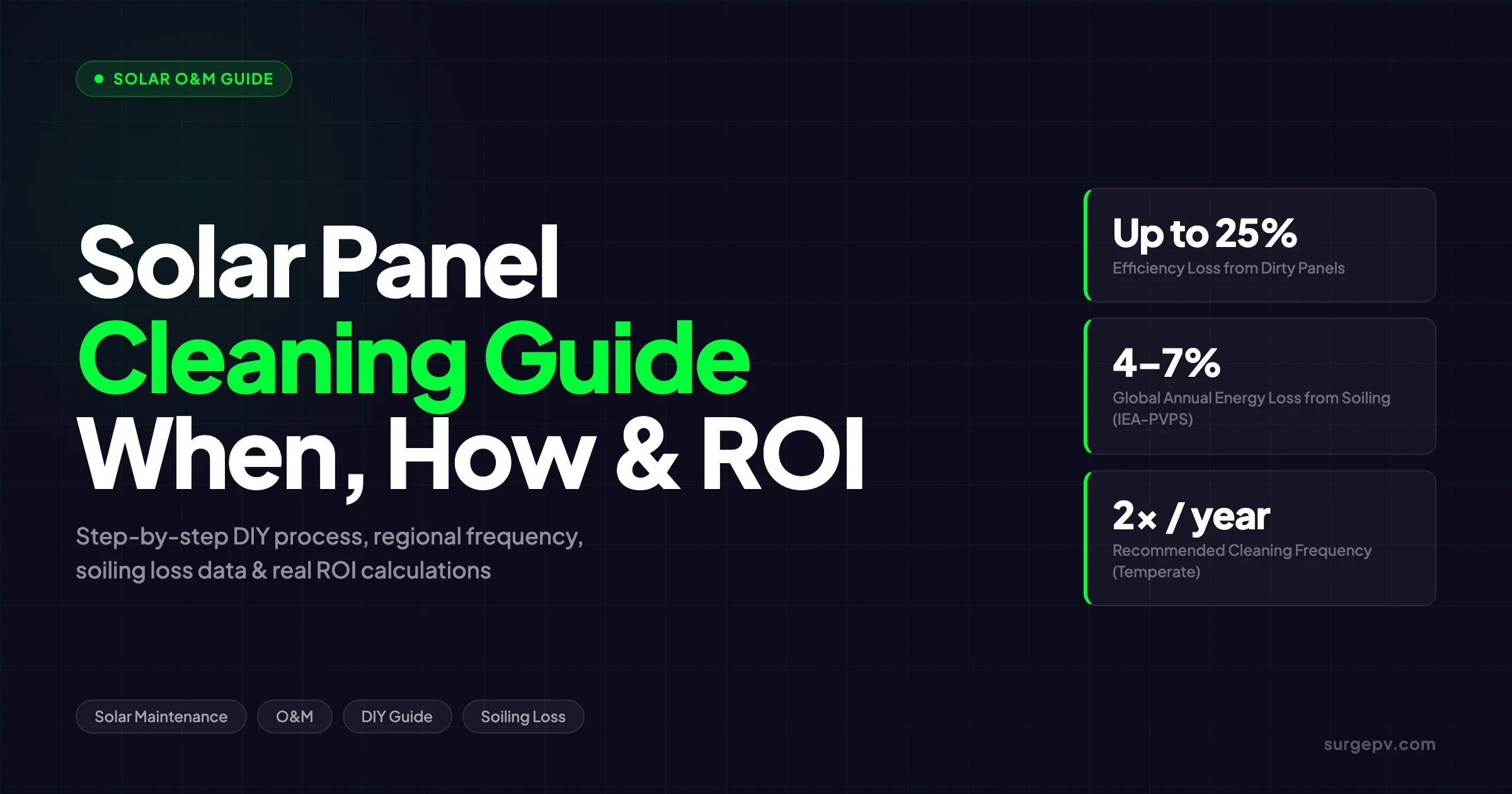
Dirty solar panels are not just an aesthetic problem. The IEA’s Photovoltaic Power Systems Programme found that soiling causes 4–7% average annual energy loss globally — and in dust-heavy or coastal regions, individual systems lose 15–25% of generation every year. This solar panel cleaning guide covers how to detect a soiling problem using monitoring data, the exact steps for safe DIY cleaning, regional frequency recommendations, and the real ROI math so you can decide whether to clean the panels yourself or hire a professional. For Global-specific compliance details, see Global net-metering-by-country.
A landmark study by Jan Kleissl at UC San Diego tracked 186 California solar sites and found 7.4% efficiency loss after just 145 days without rain or cleaning. In the Atacama Desert, research published in Nature Scientific Reports documented soiling losses reaching up to 39% annually.
TL;DR — Solar Panel Cleaning
Most residential systems need cleaning 1–2 times per year. Desert and coastal systems need cleaning every 2–3 months. A standard garden hose, soft brush, and mild soap are all you need. Pressure washers, harsh chemicals, and abrasive tools void warranties. Use your monitoring app — not guesswork — to decide when to clean.
How Soiling Steals Your Solar Output
Soiling is the accumulation of dust, dirt, bird droppings, pollen, sea salt, and other particulates on panel glass. It reduces the amount of sunlight reaching the photovoltaic cells, which directly cuts output. The effect is not uniform — a few concentrated bird droppings cause more damage than a layer of fine dust covering the entire array, because they create a hard shadow on specific cells rather than a diffuse reduction across the surface. Shadow analysis software identifies shading issues before installation.
The data on soiling losses is unambiguous. A landmark study by Jan Kleissl at UC San Diego tracked 186 California solar sites and found 7.4% efficiency loss after just 145 days without rain or cleaning. In the Atacama Desert, research published in Nature Scientific Reports documented soiling losses reaching up to 39% annually. In Oman’s Al Seeb region, field measurements recorded 18.8% power loss from soiling. The IEA-PVPS estimates the global economic impact at €3–5 billion per year in lost production — a figure expected to rise as more capacity is added in high-soiling regions of Africa, the Middle East, and South Asia.
The mechanism is simple: particulates scatter and absorb incoming photons before they reach the cells. But there are two less obvious failure modes that cost installers clients.
Potential Induced Degradation (PID): Conductive dirt on panel surfaces, especially in humid conditions, creates a leakage path for electrical current. This can trigger PID — a form of degradation that permanently reduces cell output. Cleaning removes the leakage path, but any output already lost to PID is permanent.
Insulation Resistance (RISO) Failures: Wet, dirty electrical connections cause inverter RISO alarm failures. The inverter detects a drop in insulation resistance between the array and ground, faults out, and delays system startup. Homeowners experience this as the system “not working in the morning” — but the root cause is soiling-driven electrical contamination, not a hardware fault.
Both failure modes are preventable with a regular cleaning schedule. Neither appears in simple soiling-loss ROI calculations, which is why those calculations consistently understate the real value of maintenance.
Key Takeaway
Soiling does not just reduce output gradually. It can trigger inverter faults and, in high-humidity environments, drive irreversible cell degradation. A $150–$500 annual cleaning visit protects against both — and preserves the asset value of the system.
Soiling Rates by Particle Type
Different contaminants behave very differently on panel glass. Understanding the type of soiling on your array determines both the cleaning approach and the urgency:
| Soiling Type | Efficiency Impact | Key Risk |
|---|---|---|
| Fine dust (PM10/PM2.5) | 1–2% per week in desert conditions | Accumulates daily; worst in arid and industrial regions |
| Bird droppings | 1–3% per sq. inch blocked | Uric acid permanently etches anti-reflective coatings if left more than a few weeks |
| Pollen | 5–10% during peak spring weeks | Seasonal; washes off relatively easily with water alone |
| Hard water mineral deposits | Cumulative, persistent film | Blocks light and cannot be removed by rain; requires deionized rinse |
| Sea salt film | Up to 45% soiling index in severe coastal zones | Corrodes aluminum frames and junction box sealants over time |
| Wildfire ash | Immediate, severe | Contains sharp silica; do not dry-brush — soak first |
| Agricultural dust | Seasonal spikes post-harvest | Often contains silica and pesticide residues; abrasive |
| Tree sap / pine needles | Localized blockage | Sticky and difficult to rinse; requires soft physical removal |
The tilt angle of your array also determines how much soiling accumulates. Panels installed below 10 degrees accumulate significantly more particulate matter because gravity does not assist drainage. Panels at 15–35 degrees achieve the best balance between irradiance capture and self-cleaning in rainfall. Flat commercial rooftop arrays and parking carport systems are the most vulnerable to soiling buildup — and the least likely to self-clean between manual services. Read [Commercial Solar Carport Design Guide](/blog/solar-carport-design-guide) for a complete walkthrough.
When to Clean Solar Panels: The Regional Frequency Guide
Cleaning frequency is not a single universal answer. It depends on your location, local pollution sources, rainfall patterns, and panel tilt. The table below gives recommended cleaning intervals by region type, based on aggregated field data:
| Region Type | Annual Cleaning Frequency | Notes |
|---|---|---|
| High-rainfall temperate (UK, NW Europe, Pacific Northwest) | 1× per year (spring) | Rain handles most light soiling; one spring clean is standard |
| Mediterranean / dry summer (Spain, Italy, Southern California) | 2× per year | Dry summer season builds soiling; clean spring and late summer |
| Desert / semi-arid (Arizona, Rajasthan, Saudi Arabia) | Every 2–3 months (4–6×/year) | Soiling accumulates within days; most critical cleaning schedule |
| Coastal with sea spray | Every 3–4 months (3–4×/year) | Salt film is corrosive and not removed by rainfall |
| Urban / suburban with industrial pollution | Every 3–4 months | Traffic particulates and industrial fallout accumulate rapidly |
| Agricultural zones | 2× yearly + post-harvest | Harvest stirs silica dust; schedule a clean after autumn harvest |
| Near highways or airports | Every 3 months | Exhaust residue and rubber particulates are heavy and sticky |
| Post-wildfire zone | Immediately + one follow-up 2 weeks later | Ash contains abrasives; do not delay cleaning |
Tilt angle adjustment: If your system is installed below 10 degrees, add one extra cleaning cycle per year above the table baseline. If installed at 15–35 degrees in a high-rainfall area, you may be able to skip one cycle in a particularly wet year — but verify this with your monitoring data first, not by assumption.
Commercial systems: Ground-mounted and rooftop commercial arrays above 100 kW should be cleaned 2–4 times per year regardless of region. At scale, even small soiling losses represent significant revenue. At 1 MW with a 10% soiling loss and a grid export price of €0.08/kWh, annual lost revenue exceeds €8,000 — well above the cost of two professional cleaning visits. Read Design Commercial Solar System 1MW for a complete walkthrough.
Pro Tip
Schedule your first clean of the year just before your highest-production months — typically April through June in the Northern Hemisphere. Spring pollen can reduce output by 5–10% during peak weeks. A clean array entering summer captures the most valuable generation days of the year.
Manufacturer-Recommended Minimum Frequency
Major manufacturers specify minimum cleaning requirements in their warranty documentation. These are the floors, not the targets — real-world soiling conditions often demand more frequent service:
| Manufacturer | Minimum Recommendation | Key Restrictions |
|---|---|---|
| Panasonic | Twice per year | Prohibits all chemical detergents |
| Canadian Solar | Annual minimum | Documented professional service required before warranty claims |
| Jinko Solar | Every 1–3 years depending on location | Lower standard; region-specific guidance |
| Trina Solar | Annual minimum | Documentation required before claims are assessed |
| Sharp | Annual minimum | Explicitly prohibits pressure washing in warranty terms |
How to Detect a Soiling Problem Without Getting on the Roof
The most reliable way to identify when cleaning is needed is through your monitoring system, not through visual inspection from the ground. Here is the detection process in order:
Production comparison: In your inverter or monitoring app, compare the last 7 days of output to the same 7 days from 4 weeks prior on days with similar weather. Filter out cloud-cover days. A consistent 5% or greater output gap on clear days points to a soiling event rather than a weather pattern. Read more about Agricultural Solar Case Study. For the latest details on France, see Floating Solar Farms France.
Performance ratio check: Performance ratio (PR) measures actual output against expected output for the given irradiance level. A PR drop of more than 3 percentage points from your system’s established baseline on a clear day is a signal worth acting on. See the solar performance ratio guide for the full calculation methodology.
String-level monitoring: If you have module-level or string-level monitoring, check for one string performing significantly below the others. This pattern often indicates bird droppings concentrated on one section — a targeted spot clean is more efficient than cleaning the entire array in this case.
Ground-level visual inspection: Stand back from the array in direct sunlight and look at the panels at a low angle. A uniform grey or brown film across all panels confirms general soiling. Dark spots or streaks indicate bird activity. White mineral rings — especially around the lower frame edges — indicate hard water deposits from a previous cleaning.
Key Takeaway
Without monitoring data, cleaning decisions are guesswork. Use your inverter dashboard or PV design software to track performance ratio before and after every clean. This is the only way to measure cleaning ROI accurately and document the value of maintenance for clients.
Step-by-Step: How to Clean Solar Panels (DIY)
DIY cleaning is safe and effective for ground-mounted arrays and single-story rooftop systems with a manageable pitch. For systems on steep roofs or above two stories, the fall risk outweighs the cost of hiring a professional. If in doubt, hire out.
What You Need
- Soft-bristle, non-abrasive brush (nylon, not metal)
- Extension pole or water-fed pole for roof arrays
- Garden hose with gentle spray or shower nozzle
- Bucket with mild dish soap solution (a few drops per gallon of water)
- Microfiber cloths or rubber-bladed squeegee
- Non-slip footwear and a ladder stabilizer for roof access
- Roof harness and fixed anchor point for any pitch above 15 degrees
Step 1: Check Your Monitoring App
Confirm the output drop is real and quantify it. Document the pre-clean output baseline — you will compare against this figure in Step 8 to verify the cleaning worked. If output appears normal, you may be cleaning unnecessarily.
Step 2: Pick the Right Time
Clean early morning (before 9am) or late evening (after 6pm) when panels are cool. At these times, soap solution does not evaporate instantly, you avoid leaving mineral residue from rapid drying, and the temperature differential between cold water and hot glass is minimal. Never clean in direct midday sun.
Step 3: Safety Setup
Secure your ladder against the roof edge with a standoff bracket — never lean the ladder directly against the gutter or panel frames. On pitches above 15 degrees, attach a roof harness to a fixed anchor point before stepping onto the roof. Wear non-slip footwear. Never step on the panel surface, even at the frame edges.
Step 4: Dry Brush First
Before introducing any water, use a soft-bristle brush to sweep off loose debris — leaves, twigs, dry bird droppings, caked dust. This step removes the abrasive particles that would scratch the glass during wet cleaning if dragged across the surface under pressure.
Step 5: Rinse With Low-Pressure Water
Use a standard garden hose on a gentle or shower setting. Rinse from top to bottom so dirty water runs clear of already-cleaned areas. Keep pressure well below 35 bar at the nozzle. Do not use a pressure washer — the focused high-pressure jet strips anti-reflective coatings and can force water under the panel junction box seal, leading to long-term moisture damage.
Step 6: Mild Soapy Wash
Dip a soft brush or microfiber wash head in your diluted dish soap solution and work in sections, top to bottom. Scrub gently with overlapping strokes. For bird droppings specifically: do not scrub in circles — place a damp cloth over the dropping for 60 seconds to soften it, then lift in a single wipe to avoid spreading uric acid residue across a wider area. Avoid the junction box, cables, and MC4 connectors throughout.
Step 7: Final Rinse and Squeegee
Rinse thoroughly from top to bottom. In areas with hard tap water (TDS above 50 ppm — check your municipal water report), follow with a deionized water rinse. Hard water leaves calcium carbonate deposits on the glass as it dries, which accumulate with every cleaning cycle and eventually become harder to remove than the original soiling. Finish with a squeegee or clean microfiber cloth to prevent spotting.
Step 8: Verify Output Recovery
Return to your monitoring app 24 hours after cleaning. Compare output to the pre-clean baseline on a day with similar irradiance and weather conditions. A successful clean on a significantly soiled array typically recovers 5–25% of lost generation. Document this figure — it is your cleaning ROI proof point and a useful data point for your O&M business records.
Pro Tip
Never clean from the top of the panels. If you need roof access, stay on the roof surface beside the array and reach across to the panel glass with an extension brush. Stepping on the panel — even at the frame edges — stresses the cell laminate and can create microcracks that are invisible but degrade output over several years.
Equipment You Need — and What Ruins Panels
The wrong equipment causes permanent, irreversible damage. A 2026 study from Fraunhofer CSP tested 5 commercially marketed solar panel cleaning products and found that 3 of them caused measurable permanent output reduction — up to 5.6% — through chemical attack on anti-reflective glass coatings. The damage appeared as rainbow-like discoloration and was not reversible. You cannot clean your way out of cleaning-induced damage.
Safe Equipment
| Item | Notes |
|---|---|
| Soft-bristle nylon brush | Standard across all manufacturer warranty documents |
| Microfiber wash head | Ideal for frame-level scrubbing without glass abrasion |
| Water-fed pole with DI system | Professional standard; delivers deionized water through the brush head directly at the panel surface |
| Standard garden hose | Acceptable; use shower or mist setting only |
| Rubber-bladed squeegee | For streak-free finish; replace blades when they show nicks or wear |
| Mild dish soap | A few drops per gallon; the safest widely available cleaning agent |
| Deionized / purified water | Preferred for final rinse; TDS below 10 ppm prevents mineral spotting |
What to Avoid
| Item | Why It Causes Damage |
|---|---|
| Pressure washer | Strips anti-reflective coating; forces water under junction box seals; voids most warranties |
| Abrasive sponges or steel wool | Scratches glass permanently; reduces light transmission indefinitely |
| Ammonia-based cleaners | Degrades sealants around junction boxes and framing |
| Alcohol-based products | Dissolves anti-reflective coating rapidly; irreversible |
| Bleach or disinfectants | Corrosive to aluminum frames and electrical contact surfaces |
| Commercial “solar cleaning sprays” | 60% of products tested by Fraunhofer (2026) damaged anti-reflective coatings — do not use unless the product has been tested specifically on anti-reflective glass |
| Metal scrapers | Scratch glass immediately; acceptable only for ice on flexible film panels with explicit manufacturer approval |
| Undiluted vinegar | Acidic; safe only when diluted 1 part in 8 parts water, and only for mineral deposit removal, not general cleaning |
Water quality is more important than most guides acknowledge. If your local tap water has a TDS above 50 ppm, it will leave mineral deposits on the panel glass as it dries. These spots scatter light and accumulate with each clean, eventually becoming harder to remove than the original soiling. An inline deionized water system costs around $400 for a dual-tank setup and pays for itself in 6–12 months for professionals cleaning 10 or more systems per month.
Professional Cleaning: When It Is Worth the Cost
Hiring a professional is the right call in several specific situations:
- Your system is above single-story height or on a steep pitch
- You do not have appropriate safety equipment or roof harness anchor points
- Your system is 30 kW or larger, where time investment makes DIY uneconomic
- You have a warranty claim pending that requires documented professional service
- Your location demands 4 or more cleans per year and the recurring logistics favor an O&M contract
Design Systems That Are Easy to Maintain
Panel placement, tilt angle, and row spacing all affect soiling rates and cleaning access. SurgePV’s solar design software helps you optimize the layout for both output and maintainability from day one — so you hand clients a system that stays clean longer.
Book a DemoNo commitment required · 20 minutes · Live project walkthrough
What to Expect from a Professional Service
A professional cleaning company should provide:
- Before/after production comparison — if they cannot provide this, look elsewhere
- Deionized water cleaning or confirmation that their water quality is below 10 ppm TDS
- Written documentation of service date, method, and technician (required for some manufacturer warranty claims)
- A brief visual inspection report noting any physical damage, discoloration, or loose cabling observed during the clean
Any professional service that cannot produce monitoring-backed before/after data is providing a cleaning service, not a maintenance service. The distinction matters when you are making warranty claims or demonstrating O&M compliance to a system owner.
Professional Cleaning Cost Reference (US, 2026)
| System Size | Typical Cost Range | Notes |
|---|---|---|
| 10–20 panels, easy access | $100–$250 | Single-story, flat or gentle pitch |
| 20–30 panels, standard | $150–$500 | Typical residential two-story |
| 20–30 panels, steep pitch | $300–$600 | Difficult-access premium applies |
| 50–100 panels, commercial rooftop | $500–$2,000 | Depends on access equipment needed |
| Annual maintenance contract (residential) | $390–$720/year | Includes 2× cleaning + inspection; typically 15–30% cheaper per visit than one-off calls |
The ROI of Solar Panel Cleaning: Real Numbers
This is where most guides oversimplify. The ROI of cleaning depends on three variables: how much energy you are currently losing to soiling, the local electricity or feed-in rate, and the cost of cleaning. Here is how to calculate it for any system.
The ROI Formula
Annual cleaning ROI = (Soiling loss % × Annual generation kWh × Electricity rate) − Annual cleaning costWorked Examples
Scenario 1: 10 kW residential, California desert zone
- Annual generation (clean): 16,500 kWh
- Estimated soiling loss: 15% (conservative for desert conditions)
- Lost generation: 2,475 kWh/year
- Lost savings at $0.22/kWh: $545
- Two professional cleans (25 panels × $7 × 2 visits): $350
- Net annual ROI: $195
Scenario 2: 5 kW residential, UK temperate climate
- Annual generation (clean): 4,500 kWh
- Estimated soiling loss: 5% (low soiling, regular rainfall)
- Lost generation: 225 kWh/year
- Lost savings at £0.28/kWh: £63
- One annual DIY clean: £0 out-of-pocket
- One annual professional clean: £80–£120
- Net annual ROI: £63 (DIY) / £0 or negative (professional) Read more about Battery Solar System Design UK.
This is the scenario the UC San Diego study was describing when it found that a single mid-summer clean on a California 5 kW system generated only about $20 in recovered value. In a mild-climate small system, hiring a $150 professional service makes no financial sense on direct ROI alone. But the calculation changes completely for larger systems, dustier environments, higher electricity rates, or when warranty preservation is a factor.
Scenario 3: 100 kW commercial rooftop, Spain
- Annual generation (clean): 145,000 kWh
- Estimated soiling loss: 8% (Mediterranean; two dry seasons)
- Lost generation: 11,600 kWh/year
- Lost revenue at €0.12/kWh: €1,392
- Two professional cleans at commercial rate: €1,800
- Net annual ROI: −€408 on direct savings alone
At this scale, the math favors pairing automated monitoring with threshold-based cleaning decisions. Use your solar financial modeling to model the exact breakeven soiling percentage for your feed-in or self-consumption rate, then set a monitoring alert at that threshold — rather than cleaning on a fixed calendar schedule regardless of actual conditions.
Key Takeaway
Small residential systems in mild climates often have marginal direct ROI from paid professional cleaning. Desert and large commercial systems almost always have strong positive ROI. Calculate your specific number using actual monitoring data and your local electricity rate — industry averages will mislead you.
Factors That Shift the ROI Positive
Several factors make cleaning more financially compelling than the basic formula suggests:
Feed-in tariff and export rates: If you export excess generation to the grid, every recovered kWh has monetary value beyond self-consumption savings. See the guide to solar system losses for the full breakdown of how soiling interacts with other loss factors.
Degradation compounding: A soiled panel in a high-humidity environment does not only lose output temporarily. Persistent soiling increases PID risk, and PID causes permanent cell degradation — 1–5% of additional irreversible output loss per year in high-risk conditions. The true lifetime cost of neglecting cleaning is significantly higher than the annual soiling loss alone.
Warranty preservation: Some manufacturers require documented cleaning records before processing warranty claims. The €100 cleaning service today may be the documentation that unlocks a €2,000 panel replacement in year 12.
System resale value: In commercial O&M contracts and project finance, documented maintenance records directly affect asset valuation. A system with a complete, auditable service history commands a higher price and easier financing than one without.
Soiling Types and Targeted Cleaning Approaches
Different soiling types require different handling. A single approach leads to either ineffective cleaning or panel damage.
Bird Droppings
Bird droppings are the most damaging single soiling source because uric acid actively etches anti-reflective glass coatings. A dropping left on a panel for more than a few weeks causes permanent micro-pitting that scatters light even after the dropping itself is removed. Speed matters here more than with any other soiling type.
Treatment: Do not dry-scrub or dry-brush bird droppings. Place a damp cloth against the dropping and hold it there for 60 seconds to soften the dried uric acid. Then lift in a single motion — no circular scrubbing. Rinse the area with deionized water. If you see rainbow discoloration on the glass after cleaning, the anti-reflective coating is already etched at that site.
Hard Water Mineral Deposits
White rings or a hazy film from previous cleaning cycles are calcium carbonate deposits from hard tap water. They accumulate with every rinse that uses unfiltered tap water above 50 ppm TDS.
Treatment: Diluted white vinegar (1 part vinegar to 8 parts deionized water) dissolves calcium carbonate deposits without attacking the glass coating. Apply, leave for 2 minutes, then rinse thoroughly with deionized water. Do not use full-strength vinegar — the acidity at full concentration can damage certain anti-reflective coatings over repeated use.
Wildfire Ash
Wildfire ash contains sharp silica particles that act as an abrasive if you brush or wipe immediately. Dry brushing ash across the glass surface is worse than leaving it in place.
Treatment: Soak the ash with the hose for 2–3 minutes to lift particles from the glass surface first. Only then apply a soft wet brush. A follow-up clean 2 weeks later is typically needed to remove fine residual ash that the first clean misses, as it can embed in frame seals and re-deposit onto the glass surface.
Pollen Film
Pollen creates a yellow-green film during spring that is one of the easier soiling types to remove — it has no adhesive chemistry and no acidic component. The primary concern is the 5–10% output impact during peak pollen weeks, not any long-term glass damage.
Treatment: A standard rinse followed by a mild soap wash removes pollen completely. Clean after pollen season peaks in your local area, not during it. Cleaning during peak pollen season means re-soiling within days.
Sea Salt Film
Coastal panels accumulate salt film that is initially invisible, building up into a light-blocking layer over weeks. Salt also slowly corrodes aluminum frame alloys and can compromise sealants around junction boxes over multiple seasons.
Treatment: Rinse thoroughly with deionized water — fresh water dissolves salt completely. Tap water re-deposits minerals as it dries, which is counterproductive. After cleaning, inspect frames for white oxidation marks and check junction box seals for any sign of compromise. Flag corroded frames for professional attention if the corrosion extends past the surface finish.
Manufacturer Warranty Requirements for Cleaning
Warranty documentation from major manufacturers contains explicit requirements about cleaning methods — and violations are grounds for voiding the warranty. This is one of the most overlooked aspects of solar panel maintenance, and one that catches both homeowners and installers off guard during claims.
Key Takeaway
The 2026 Fraunhofer CSP study found permanent 5.6% output loss from 3 of 5 commercial solar cleaning products. Using the wrong cleaning product does not just reduce efficiency — it gives the manufacturer grounds to reject a warranty claim for improper maintenance.
Methods That Void Warranties
| Method | Manufacturers Explicitly Prohibiting |
|---|---|
| Pressure washing | Sharp (explicitly stated); implied by all others |
| Ammonia-based products | Panasonic, Canadian Solar |
| Alcohol-based products | Panasonic |
| Abrasive tools (steel wool, scrub pads) | All major manufacturers |
| Stepping on panels | All major manufacturers |
| Detergents with chemical surfactants | Panasonic specifically |
Documentation That Supports Warranty Claims
Service records: A written record from a professional cleaning company with date, method, and water quality is the strongest single piece of evidence for warranty claims. Some manufacturers — Canadian Solar and Trina notably — require documented cleaning within a defined period before they will assess a performance claim. For Canada-specific compliance details, see Canada comparisons/solar-designing.
Monitoring history: A continuous production record showing no unexplained drops beyond normal soiling rates demonstrates the system was properly maintained and that any performance issue is a product defect, not neglect.
See the solar warranty claims guide for installers for the full process of filing and managing manufacturer warranty claims.
The Installer’s Cleaning Handoff Protocol
For solar installers, cleaning is not just a maintenance consideration — it is a commissioning responsibility. Systems handed over without a documented cleaning protocol generate more support calls and warranty disputes in years 2–5 than almost any other omission.
A standard cleaning handoff at commissioning should include five deliverables:
1. Post-installation clean: New panel glass carries manufacturing residue, protective film adhesive, and installation fingerprints. These reduce initial output. Clean before commissioning and before recording the baseline performance ratio.
2. Documented baseline PR: Record the performance ratio at commissioning with clean panels. This becomes the benchmark for detecting soiling-induced drops in subsequent monitoring reviews.
3. Written cleaning schedule: Provide the client a written schedule matched to their specific soiling environment. A desert installation in Arizona needs a different protocol than a residential system in the Netherlands. Generic advice produces generic compliance.
4. Equipment and product guidance: Tell the client exactly what they can and cannot use — and reference the Fraunhofer 2026 finding explicitly when discussing commercial cleaning products. Most homeowners have no idea that the wrong spray can permanently damage their panels.
5. Monitoring setup for self-detection: Show the client how to read their inverter app for soiling indicators. A client who catches a 10% output drop themselves is far less likely to blame the installer for a performance issue that was entirely preventable.
The solar O&M business guide covers how to build a recurring revenue model around maintenance contracts — a model that top installers are using to add €50K–€200K in annual recurring revenue to their EPC business without adding project headcount.
Pro Tip
Include a 2-year maintenance contract in every residential system sale. Cover 2 annual cleans, one visual inspection, and one inverter health check. Price it at €200–€400 per year. It is profitable at scale, it keeps the client relationship active through their highest-anxiety period with the new system, and it protects your warranty exposure on performance claims.
Advanced: Robotic and Automated Cleaning Systems
For utility-scale and large commercial arrays, manual cleaning is operationally impractical and increasingly being replaced by robotic systems and monitoring-triggered protocols.
Robotic Cleaning Options
The commercial robotic cleaning market is growing, driven by the need to clean large arrays in water-scarce desert regions where manual cleaning frequency is 4–6 times per year:
- SolarCleano: Rail-based brush robot for ground-mounted and rooftop commercial arrays. Operates on tracks along panel rows. Achieves consistent cleaning at reduced per-clean labor cost.
- Airtouch Solar: Waterless cleaning using directed airflow. Removes dust without water — particularly relevant in water-scarce regions. Validated for dust-dominant soiling in Middle East and Africa deployments.
- Hekabot / Solabot: Autonomous surface-navigating robots for large flat rooftop commercial systems.
Robotic cleaning makes economic sense for systems above 500 kW in high-soiling regions where cleaning frequency is 4 or more times per year. Below that threshold, the capital cost of robotic equipment typically does not justify the labor savings — conventional manual O&M contracts remain more cost-effective.
MIT Electrostatic Cleaning (Emerging Technology)
A 2022 MIT study published in Science Advances demonstrated an electrostatic cleaning method that uses a charged curtain to lift dust particles from panel surfaces without water or brushes. It recovered over 95% of lost output in laboratory conditions with zero water consumption. The technology is at early commercial stage but represents the most water-efficient direction for large desert installations where both cleaning frequency and water cost are high.
Anti-Soiling Coatings
Hydrophobic and self-cleaning coatings applied to panel glass reduce the adhesion rate of particulates, meaning rainfall is more effective at self-cleaning the surface and manual cleaning intervals can be extended:
- Availability: Commercially available from several suppliers; not yet universally adopted across the market
- Performance: Reduces soiling accumulation rate by 30–70% depending on soiling type and coating quality
- Limitations: Coatings degrade over 3–7 years and require reapplication; chemical compatibility with the existing panel anti-reflective coating must be verified with the manufacturer before application
- Best applications: Desert and coastal installations where cleaning costs are high and water is expensive or scarce
When using solar software to plan systems in high-soiling regions, build a realistic soiling loss figure into the energy yield simulation rather than using default values. The solar irradiance and soiling data article covers irradiance data sources that include soiling adjustment factors for European markets.
Conclusion
- Calculate your ROI before scheduling: Multiply your estimated soiling loss percentage by annual generation and your electricity rate. Compare the result to cleaning cost. If the lost value exceeds cleaning cost, clean on schedule. If not — particularly for small systems in mild climates — monitoring-triggered cleaning is more economical than a fixed calendar.
- Protect the warranty through documentation: Use only soft brushes, mild soap, and low-pressure water. Avoid pressure washers and any commercial cleaning product that has not been tested on anti-reflective glass. Document every professional service in writing.
- For commercial and desert systems, regular cleaning is not optional: At 100 kW and above in high-soiling environments, annual losses from unmanaged soiling run into thousands of euros. A systematic maintenance schedule with monitoring data to guide timing is standard O&M practice — and expected in any professional solar proposal software output for commercial clients. Also see: Us Residential Solar Market Trends 2026.
The solar design tools used to size and plan a system can also model soiling losses explicitly in generation simulations, making it straightforward to show clients the annual production gap that a cleaning schedule is designed to close — before they ever sign a contract.
Frequently Asked Questions
How often should solar panels be cleaned?
Most residential systems in temperate climates need cleaning once or twice a year. Desert, coastal, and urban industrial locations require more frequent cleaning — every 2–4 months. The exact schedule depends on your local soiling rate, panel tilt angle, and rainfall patterns.
Does rain clean solar panels sufficiently?
Rain removes loose dust and light debris, but it does not clean effectively in areas with hard water, bird activity, pollen, or industrial pollution. Panels in high-rainfall temperate climates may need only one annual clean. In most other locations, rain is not enough.
Can I clean solar panels myself?
Yes, for accessible single-story or ground-mounted systems. You need a soft brush, mild soap, a low-pressure hose, and microfiber cloths. Never use a pressure washer, abrasive tools, or harsh chemicals. For steep roofs or systems above two stories, hire a professional.
Will cleaning solar panels void the warranty?
Improper cleaning can void the warranty. Manufacturers including Panasonic, Canadian Solar, and Jinko prohibit pressure washing, harsh chemicals, and abrasive tools. Use only soft brushes, mild soap, and low-pressure water — or hire a certified professional who documents the service.
How much does professional solar panel cleaning cost?
Professional cleaning typically costs $5–$20 per panel in the US. A standard 20–25 panel residential system runs $150–$500 per visit. Annual maintenance contracts including inspection cost $390–$720 and offer 15–30% savings over one-off visits.
How much efficiency do dirty solar panels lose?
IEA-PVPS data shows 4–7% average annual energy loss from soiling globally. In desert and high-pollution regions, individual systems can lose 15–25% or more. A UC San Diego study of 186 California sites found 7.4% efficiency loss after just 145 days without rain or cleaning.
What time of day should I clean solar panels?
Clean early morning or late evening when panels are cool. Avoid midday sun — water and soap evaporate instantly, leaving mineral deposits, and the temperature differential between cold water and hot glass increases thermal stress risk.
Can I use dish soap to clean solar panels?
Yes — a small amount of mild dish soap in water is safe for most panels. Do not use products containing ammonia, alcohol, bleach, or abrasive compounds. A 2026 Fraunhofer CSP study found that 3 of 5 commercial solar cleaning products caused permanent damage to anti-reflective coatings.
Where this fits
This article is part of SurgePV's Solar Installation hub, which works through the topic from first principles to the decisions a project team actually has to make.