Rhode Island homeowners pay some of the highest electricity rates in the country. At roughly $0.28–$0.32 per kWh, the average residential bill is well above the national average. Solar has become the most direct way to cut that exposure, but the market changed sharply in 2026. The 30% federal residential tax credit expired on December 31, 2025. That single shift makes installer selection and state incentive timing more important than ever.
This guide is written for Rhode Island homeowners who are searching for solar installers in RI and want a practical way to compare companies, understand current incentives, and avoid common mistakes. We cover local and national installers, real 2026 costs, the REG program, net metering, grants, and what to ask before you sign.
In this guide, you will learn:
- Which solar installers serve Rhode Island and how they differ
- What solar costs in RI after the federal tax credit expiration
- How the REG program, REF grants, and net metering work in 2026
- How to compare quotes and vet installers
- Common mistakes Rhode Island homeowners make when going solar
Quick Answer
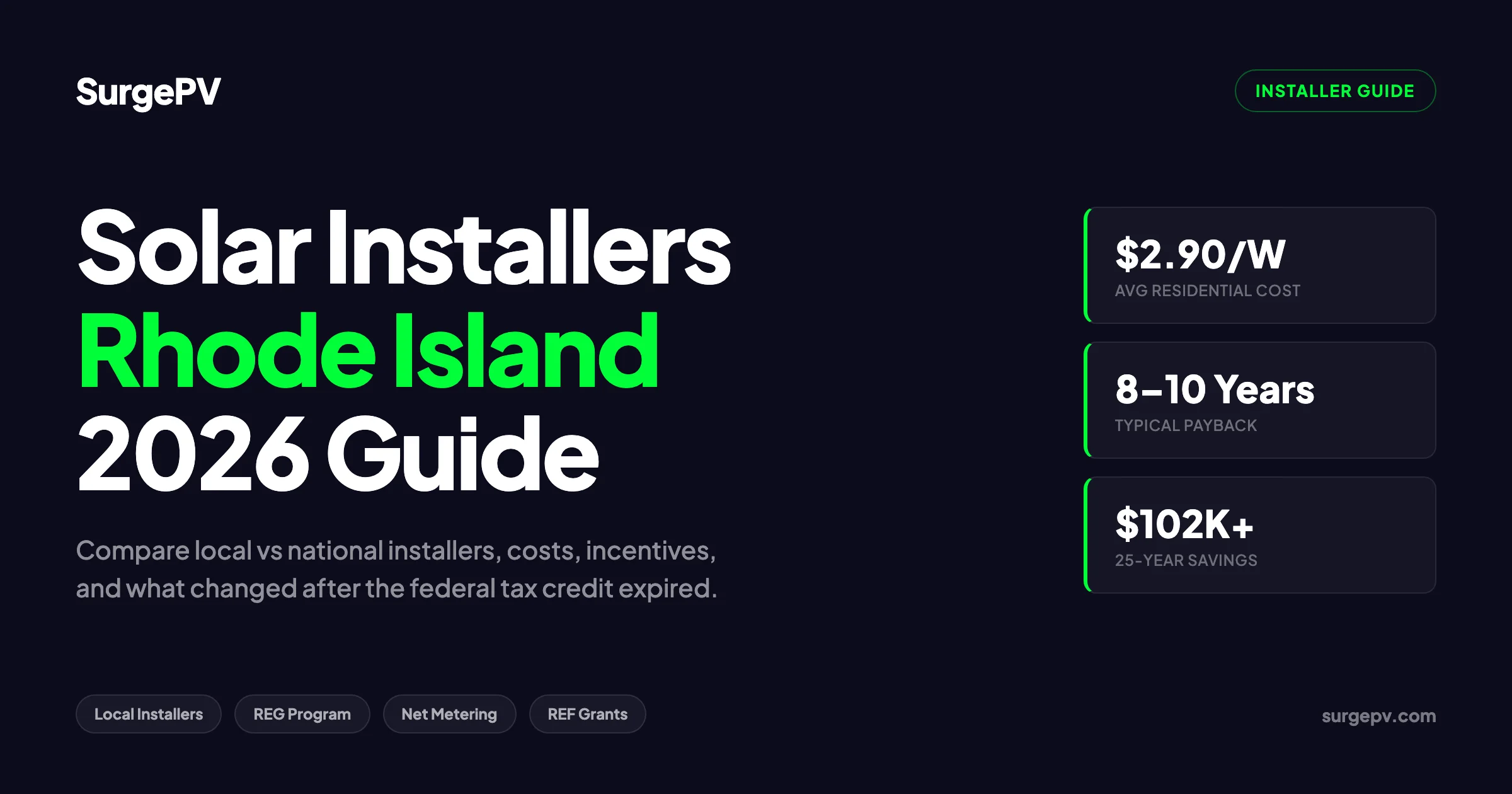
The best solar installers in RI include local companies like Newport Solar, ISM Solar, Sol Power Co., OneGrid, Rooftop Power, and NuWatt Energy, plus national providers like Sunrun, Tesla Energy, and Palmetto Solar. A typical 10.75 kW system costs about $31,219 before incentives, with payback in 8–10 years. In 2026, the federal residential tax credit is gone, so state incentives and installer quality matter most.
Rhode Island Solar Market Snapshot: 2026
Rhode Island is small in land area but punches above its weight in solar adoption. The state ranks 35th nationally in total installed solar capacity, with 1,277 MWdc online and enough solar to power roughly 240,864 homes, according to the Solar Energy Industries Association (SEIA, 2026). Solar now supplies about 10.8% of the state’s electricity.
The industry supports 1,420 solar jobs across 28 companies, including 10 installer or developer firms. Total investment in Rhode Island solar exceeds $2.3 billion, spread across 26,441 installations.
| Metric | Figure | Source |
|---|---|---|
| Total installed capacity | 1,277 MWdc | SEIA, 2026 |
| Homes powered | ~240,864 | SEIA, 2026 |
| Share of state electricity | 10.8% | SEIA, 2026 |
| Solar jobs | 1,420 | SEIA, 2026 |
| Solar companies | 28 | SEIA, 2026 |
| Total installations | 26,441 | SEIA, 2026 |
| Total investment | $2.3 billion | SEIA, 2026 |
The state’s high electricity prices make solar economics compelling even without the federal credit. National Grid’s former Rhode Island utility is now Rhode Island Energy, which administers interconnection, net metering, and the REG program. Most residential projects interconnect in 4–10 weeks after installation, though the full timeline from contract to activation is usually 8–16 weeks.
Solar Installers in RI: Local vs National vs Regional
Not every company that advertises in Rhode Island is based there. The installer you choose affects pricing, warranty enforcement, service speed, and how well your system is designed for local conditions.
Local Rhode Island Installers
Local installers are usually the safest bet for homeowners who want responsive service and deep knowledge of RI programs. They understand coastal wind loads, salt-air corrosion, National Grid/Rhode Island Energy interconnection rules, and the tight deadlines for REF grants and REG enrollment.
| Company | Location | Established | Notes |
|---|---|---|---|
| Newport Solar | Newport / North Kingstown | 2009 | 1,000+ in-state installs; strong coastal coverage |
| ISM Solar | East Providence | 2009 | NABCEP-certified; REG program experience |
| Sol Power Co. | Pawtucket | 2009 | EnergySage-screened; NABCEP-certified |
| OneGrid | Providence | 2012 | EnergySage Elite Installer; lifetime warranty |
| Rooftop Power | Warwick | 2017 | Family-owned; serves RI, MA, CT |
| NuWatt Energy | Coventry | 2010 | Focus on energy independence and efficiency |
| Sunwatt Solar | Pawtucket | — | Local installer active in RI |
| US SolarWorks | Pawtucket | — | Local installer active in RI |
| Newport Renewables | Wakefield-Peace Dale | 2011 | Commercial, multifamily, institutional focus |
Newport Solar stands out for sheer volume inside the state. ISM Solar and Sol Power Co. have been operating since 2009, which matters because labor warranties are only as reliable as the company behind them. OneGrid and Rooftop Power are newer but have strong customer ratings.
National Installers Active in RI
National installers bring scale, brand recognition, and financing products. They are often the best fit for homeowners who want a lease or power purchase agreement rather than a cash or loan purchase.
| Company | Model | Notes |
|---|---|---|
| Sunrun | Lease, loan, purchase | Largest residential solar installer in the US |
| Tesla Energy | Purchase, loan | Low pricing; customer service mixed |
| Palmetto Solar | Purchase, loan, lease | EnergySage Elite+ tier; 512 RI installs since 2020 |
Palmetto Solar has a meaningful Rhode Island presence, with 512 installations since 2020, according to its local page. Tesla often undercuts competitors on price but can be harder to reach after installation. Sunrun’s lease product can still capture the commercial tax credit, which may make it attractive in 2026 even though the residential credit is gone.
Regional Installers Serving Rhode Island
Regional companies from neighboring states often cross into Rhode Island for larger projects or specific towns.
| Company | Base | Notes |
|---|---|---|
| NEC Solar | RI / MA | Family-owned since 2008; 4,000+ installs across RI and MA |
| C-TEC Solar | Connecticut | Active RI coverage |
| Trinity Solar | New Jersey | Large Northeast presence; mixed complaint history |
| Venture Solar | Northeast | Regional installer with RI coverage |
NEC Solar is worth highlighting because it is family-owned and has deep experience on both sides of the Rhode Island-Massachusetts border.
Installers to Avoid
A few large names have exited residential solar or filed for bankruptcy. Avoid signing new contracts with:
- Sunnova — Chapter 11, June 2025
- Original SunPower — Chapter 11, August 2024
- ADT Solar — exited residential solar, January 2024
- Freedom Forever — Chapter 11, April 2026
If a company offers to buy out an existing lease from one of these providers, read the fine print carefully. Transferring a lease is not the same as getting a new installation from a stable company.
What Solar Costs in Rhode Island in 2026
Pricing in Rhode Island is higher than the national average, but so are the savings from avoided utility bills.
Typical Residential Costs
| System Size | Cost Before Incentives | $/W | Estimated Annual Production |
|---|---|---|---|
| 7.29 kW | ~$23,641 | $3.24 | ~8,750–9,500 kWh |
| 8 kW | ~$22,000–$28,000 | $2.75–$3.60 | ~9,600–10,400 kWh |
| 10 kW | ~$29,000–$32,000 | $2.90–$3.00 | ~12,000–13,000 kWh |
| 10.75 kW | ~$31,219 | $2.90 | ~12,900–14,000 kWh |
The EnergySage marketplace reports an average system size of 10.75 kW and an average price of $2.90 per watt, for a total of $31,219 before incentives. Palmetto quotes a 7.29 kW system at about $3.24 per watt, or $23,641. The range reflects roof complexity, equipment choice, and whether the quote includes a battery.
Payback and Savings
| Metric | Value | Source |
|---|---|---|
| Average payback | 8–10 years | EnergySage / Palmetto |
| 25-year savings | ~$97,000–$102,500 | EnergySage / Palmetto |
| Average residential rate | $0.28–$0.32/kWh | Rhode Island Energy / Palmetto |
| Monthly bill offset | ~$222 | Palmetto |
High electricity rates shorten payback periods. Even without the federal tax credit, a well-designed system in Rhode Island can pay for itself in under a decade and save more than $90,000 over 25 years.
Commercial Solar Costs
Commercial systems are cheaper per watt due to economies of scale. NPTRE reports commercial pricing of $1.80–$2.40 per watt before incentives, with payback often under five years. A 520 kW warehouse project cited by NPTRE had a net cost of $766,000 after incentives, first-year savings of $142,000, and a 5.4-year payback.
Rhode Island Solar Incentives in 2026
The federal incentive landscape changed, but Rhode Island still offers several programs that can make solar worthwhile.
Federal Tax Credit: The Big Change
The 30% Residential Clean Energy Credit expired on December 31, 2025. Homeowners who purchase systems with cash or loans in 2026 receive no federal tax credit. This is the single biggest headwind for RI solar buyers this year.
However, the commercial Section 48E credit remains available through December 31, 2027. That is why leases and power purchase agreements from national companies may still carry implicit tax-credit savings passed through to the homeowner.
Renewable Energy Growth (REG) Program
The REG program is Rhode Island’s flagship solar incentive. It is a production-based tariff administered by Rhode Island Energy. Instead of net metering, you sell all the electricity your system produces to the grid at a fixed price.
| Feature | Detail |
|---|---|
| 2026 ceiling rate | ~$0.2723/kWh |
| Contract term | 15 or 20 years |
| Residential cap | Up to 25 kW DC |
| Enrollment | First-come, first-served; opens ~April 1 for small solar |
| 2026 allocation | 40 MW residential; historically fills within weeks |
| Best for | Homeowners who want predictable long-term income |
An average 8 kW system can earn roughly $2,642 per year under REG, according to industry estimates. The tradeoff is that you cannot also net meter. You must choose one or the other.
Renewable Energy Fund (REF) Grants
REF grants reduce upfront cost. They are administered by the Rhode Island Commerce Corporation and open several times per year.
| Segment | Incentive | Cap |
|---|---|---|
| Residential / small-scale | $0.65–$1.65/W | $5,000–$14,500 per project |
| Battery adder | $2,000–$5,000 flat | Varies by round |
| Commercial | $0.20–$0.70/W by tier | $75,000 per project |
The 2026 REF rounds open on May 1, July 17, and October 16 for small-scale projects. Round 1 is first-come, first-served and tends to fill quickly. Some sources cite $0.65 per watt and a $5,000 cap, while New England Clean Energy cites $1.65 per watt and a $14,500 cap. The actual amount depends on the funding round and project details, so confirm the current rate before you commit.
Net Metering
Net metering credits excess solar production against your bill. In Rhode Island, systems interconnected after April 15, 2023 receive credits at about 80% of the retail rate.
| Feature | Detail |
|---|---|
| Export credit | ~80% of retail rate |
| Retail rate | ~$0.28–$0.32/kWh |
| Effective export value | ~$0.22–$0.26/kWh |
| Protection | Guaranteed through 2039 |
Net metering is simpler than REG because you do not sell all your production to the grid. You consume what you make and export the rest. It works best for homeowners whose daytime usage matches solar production.
Other Incentives
- Sales tax exemption: Rhode Island waives its 7% sales tax on solar equipment and labor.
- Property tax exemption: Qualifying systems are excluded from property tax assessments for 20 years, saving roughly $362 per year on average.
- ConnectedSolutions: Battery owners can earn $225 per average kW of capacity dispatched each summer through the demand response program.
- C-PACE: Commercial property assessed clean energy financing for businesses.
- USDA REAP: Grants and loan guarantees for agricultural and rural business solar projects.
REG vs Net Metering vs REF: Which Should You Choose?
Most Rhode Island homeowners face a choice between three incentive structures. You cannot stack REG and net metering, and REF grants have their own rules.
| Incentive | Type | Best For | Key Tradeoff |
|---|---|---|---|
| REG Program | Fixed-price production contract | Long-term predictability; high usage homes | Cannot net meter; must sell all production to grid |
| Net Metering | Bill credit for excess production | Homes with daytime usage matching solar output | Export credit is ~80% of retail rate |
| REF Grant | Upfront cash rebate | Lowering initial out-of-pocket cost | Limited funding; may not combine with REG |
A homeowner with high evening usage and a battery might prefer net metering plus ConnectedSolutions. A homeowner who wants stable, long-term income and can size the system to match annual usage may prefer REG. A homeowner who needs the lowest possible upfront cost should apply for a REF grant as early as possible.
The right answer depends on your roof, usage pattern, financing method, and risk tolerance. Any installer that pushes one option without modeling the others is selling, not advising.
How to Compare Solar Installers in RI
Price per watt is a useful starting point, but it is not the whole story. Here is a practical checklist.
1. Verify Licenses and Certifications
Rhode Island requires solar installers to hold a state electrical contractor’s license. Ask for the license number and verify it with the RI Division of Professional Regulation. NABCEP certification is a strong plus because it shows the installer has passed a rigorous technical exam.
2. Check Years in Business and Local Track Record
A company that has been in Rhode Island for at least five years is more likely to honor a 10-year labor warranty. Ask how many systems the company has installed in your town or county. Local permitting knowledge matters.
3. Read Reviews on Multiple Platforms
EnergySage, Google, Better Business Bureau, and SolarReviews all offer customer feedback. Look for patterns in recent reviews, not just the overall score. Slow interconnection, roof leaks, and unresponsive service are red flags.
4. Compare Equipment and Warranties
| Component | Typical Warranty | What to Ask |
|---|---|---|
| Panels | 25 years | Is the manufacturer Tier 1? |
| Inverters | 10–25 years | String, micro, or power optimizer? |
| Labor | 5–10 years | Does the installer handle warranty claims? |
| Roof penetration | 5–10 years | Who pays for leak repairs? |
| Production guarantee | Varies | What happens if output falls short? |
5. Get at Least Three Quotes
Aim for a mix of local and national installers. Make sure each quote uses the same assumed energy usage and financing method. A cash quote and a lease quote are not directly comparable.
6. Ask About Incentive Timing
If you want a REF grant, ask whether the installer will prepare your application before the round opens. If you want REG, ask how they handle the April 1 enrollment rush. Missing a deadline can cost thousands of dollars.
7. Review the Contract Carefully
Watch for escalation clauses in leases, prepayment penalties in loans, and vague language about interconnection timelines. A reputable installer will explain every line.
Common Mistakes Rhode Island Homeowners Make
Even savvy buyers make these errors.
Waiting for the Federal Tax Credit to Return
The residential credit is gone for 2026. Waiting is a bet on Congress, and Rhode Island’s state programs have their own deadlines. If solar makes sense today with current incentives, delaying rarely pays off.
Ignoring the REG Enrollment Window
REG allocations fill fast. If your installer is not ready to submit your application when the window opens, you may miss the year’s best tariff.
Choosing Price Over Service
The cheapest quote is not always the best. A low price from an installer with poor reviews or no local presence can turn into expensive repairs later.
Oversizing the System
REG and net metering both have rules about system size relative to usage. An oversized system may not earn the credits you expect.
Skipping the Site Assessment
Coastal Rhode Island has salt air, high winds, and older roofs. A remote quote without a site visit can miss shading, structural issues, or electrical upgrades.
What the Installation Process Looks Like
Most Rhode Island homeowners go through these steps.
- Initial consultation and usage review. The installer looks at your roof, shading, and past electric bills.
- System design and proposal. You receive a layout, production estimate, and financing options.
- Contract and incentive application. You sign and apply for REF, REG, or net metering as appropriate.
- Permitting. The installer submits plans to your city or town.
- Installation. Typically one to three days on site.
- Inspection and interconnection. Rhode Island Energy reviews the system and turns it on.
- Monitoring and maintenance. You track production and report any issues.
The full timeline is usually 8–16 weeks. Permitting and interconnection are the most variable steps.
Should You Add a Battery in Rhode Island?
Batteries add $10,000–$20,000 to a typical system but offer two advantages in Rhode Island.
First, time-of-use rates and frequent storms make backup power valuable. A battery can keep critical circuits running during outages.
Second, ConnectedSolutions pays battery owners $225 per average kW of summer capacity. For a 10 kW battery, that can mean $2,250 per year in demand response revenue.
The math is tighter without the federal tax credit, but the REF battery adder and ConnectedSolutions can improve the payback. Ask your installer to model battery economics both with and without backup value.
Design Your Rhode Island Solar System in Minutes
SurgePV helps solar installers and homeowners model production, shading, and financial returns for Rhode Island roofs. See how much you could save before you talk to an installer.
Try Solar Design SoftwareCloud-based · No credit card · Built for solar professionals
2026 Policy Risks to Watch
Rhode Island’s solar incentives are not guaranteed forever. In 2025, bills HB 6202 and HB 6203 proposed a moratorium on new net metering contracts and a repeal of the REG program. Those bills did not pass at the time of writing, but they signal political pressure on solar incentives.
The safest move is to act while current programs are open. If you are considering solar in 2026, apply for REF grants and REG enrollment as early as possible. Locking in net metering terms before any future legislative change is also prudent.
Conclusion: Three Steps to Choose the Right RI Solar Installer
Rhode Island is one of the better states for residential solar, even after the federal tax credit expired. High electricity rates, strong state incentives, and a mature installer market keep the economics attractive.
To move forward:
- Get three quotes from a mix of local and national installers. Compare price per watt, equipment, warranties, and reviews.
- Model your incentives under REG, net metering, and REF to see which structure saves you the most. Do not let an installer choose for you.
- Apply early. REF rounds and REG enrollment are first-come, first-served. Missing a window can erase thousands in savings.
Solar is a 25-year decision. The right installer will still be around to honor it.
Frequently Asked Questions
Who are the best solar installers in Rhode Island?
Top local installers include Newport Solar, ISM Solar, Sol Power Co., OneGrid, Rooftop Power, and NuWatt Energy. National options like Sunrun, Tesla Energy, and Palmetto Solar also serve the state. The best choice depends on whether you want local service, lease options, or battery pairing.
How much does solar cost in Rhode Island in 2026?
A typical 10.75 kW residential system costs about $31,219 before incentives, or roughly $2.90 per watt, according to EnergySage. Smaller systems run closer to $3.24 per watt. Payback periods average 8–10 years, with 25-year savings around $97,000–$102,500.
Is the 30% federal solar tax credit still available in Rhode Island in 2026?
No. The federal Residential Clean Energy Credit expired on December 31, 2025. Homeowners who buy systems with cash or loans in 2026 receive no federal tax credit. Leases and power purchase agreements may still capture the commercial Section 48E credit through the financing company.
What is the RI REG program?
The Renewable Energy Growth Program is a fixed-price contract through Rhode Island Energy. Participants sell all solar production to the grid at roughly $0.2723 per kWh for 15–20 years. It is an alternative to net metering, not an add-on.
What is net metering in Rhode Island in 2026?
Net metering credits excess solar production at about 80% of the retail rate for systems interconnected after April 15, 2023. The retail rate is roughly $0.28–$0.32 per kWh. These terms are protected through 2039.
Can I get a grant for solar in Rhode Island?
Yes. The Renewable Energy Fund grant offers up to $0.65–$1.65 per watt for residential projects, with caps ranging from $5,000 to $14,500 depending on the round. A battery adder of $2,000–$5,000 is also available. Funding is limited and first-come, first-served.
Should I choose a local or national solar installer in RI?
Local installers often respond faster, know RI incentive deadlines, and handle coastal wind and salt-air conditions better. National installers may offer lower-cost leases or longer warranties. Compare at least three quotes, and verify licenses and reviews before signing.
How long does solar installation take in Rhode Island?
Most residential projects take 8–16 weeks from contract to activation. Permitting and interconnection with Rhode Island Energy are usually the longest steps. Larger commercial systems can take several months.
Where this fits
This article is part of SurgePV's Solar Installation hub, which works through the topic from first principles to the decisions a project team actually has to make.