

Back to Blog
solar installation 10 min read

Solar Installation Companies 2026: How to Choose, Verify, and Hire

Solar installation companies: how to choose the right one in 2026. Compare certifications, quotes, warranties, and red flags. Plus a 12-point hiring checklist.

Keyur Rakholiya

Written by

Keyur Rakholiya

CEO & Co-Founder · SurgePV

Rainer Neumann

Edited by

Rainer Neumann

Content Head · SurgePV

Published ·Updated

The US added 7.8 GWdc of solar in Q1 2026, and the country now hosts more than 11,000 solar panel installation businesses, according to SEIA and IBISWorld. For homeowners and businesses, that abundance creates a real problem: more choice does not make the decision easier. The wrong solar installation company can leave you with a system that underperforms, a roof that leaks, or a warranty that disappears when the firm closes.

This guide explains how to choose a solar installation company in 2026. It covers the difference between an installer and an installation company, the certifications that matter, how to compare quotes, the questions that expose weak proposals, and the red flags that should end the conversation. It also shows how solar design software and transparent proposals separate serious companies from sales-heavy operations.

Quick Answer

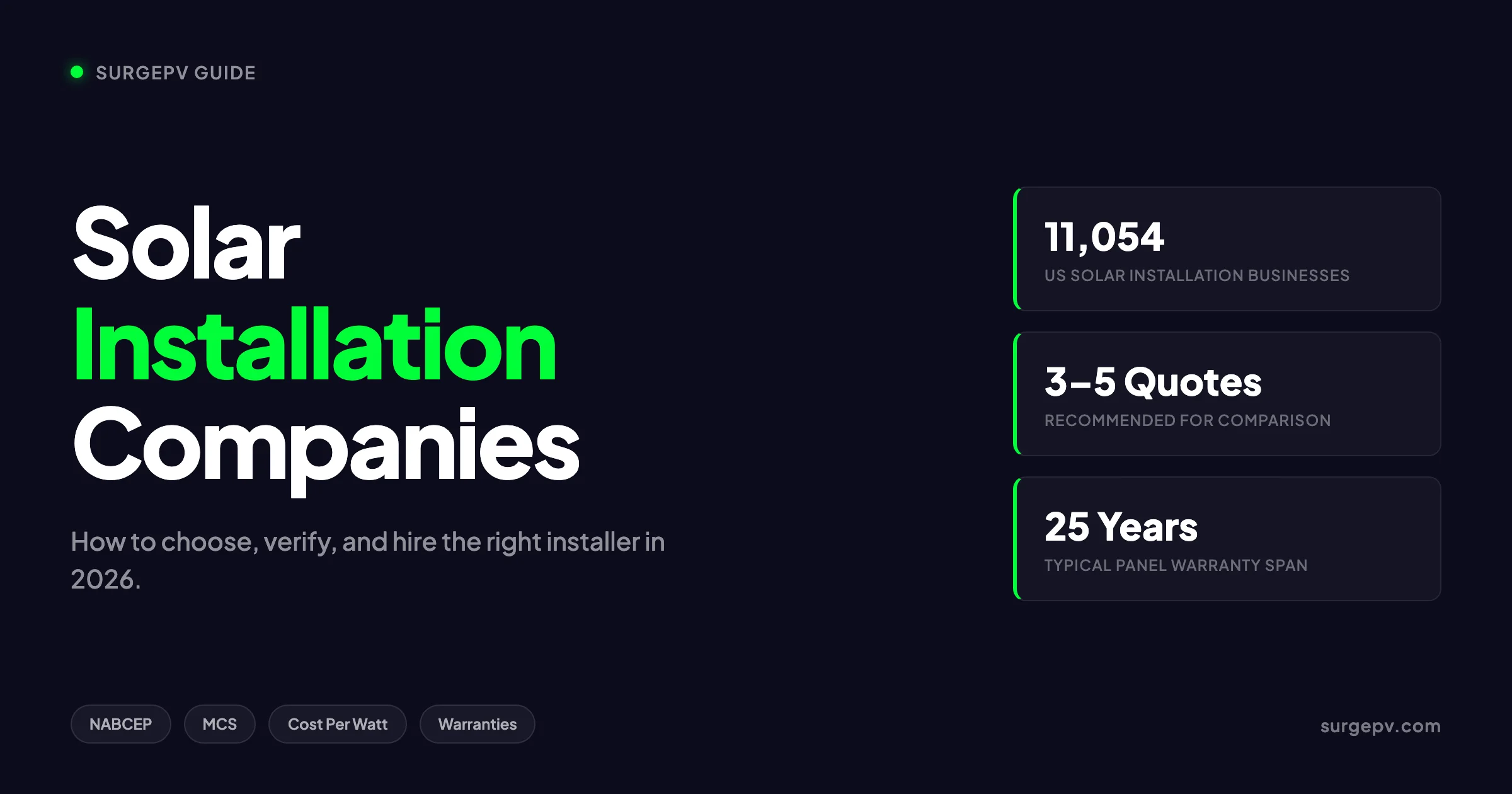
A solar installation company manages the full project lifecycle, from design and permitting to installation and service. Choose one with verified licenses and certifications, at least 5 years of operating history, itemized quotes, strong warranties, and clear after-sales support. Get 3–5 quotes and compare cost per watt, not total price.

In this guide:

  • Solar installer vs. solar installation company: what the names mean
  • 2026 market snapshot: how many companies exist and where
  • Certifications that matter by country
  • A 12-point checklist for hiring
  • How to compare quotes on cost per watt
  • Warranties, production guarantees, and after-sales support
  • National vs. local installers: the real tradeoffs
  • Red flags that should stop the sale
  • How software transparency signals a better installer

Solar Installer vs. Solar Installation Company

The terms sound interchangeable, but they describe different things. A solar installer is the person or crew on the roof. They mount panels, run conduit, connect the inverter, and test the system. A solar installation company is the business that sells, designs, permits, procures, installs, inspects, and supports the system over its life.

The company may employ installers directly, or it may subcontract the physical work. Both models work, but accountability changes. A company with in-house crews controls scheduling, training, and quality directly. A company that subcontracts may offer lower prices but can become a coordination layer between you and the actual workers.

When you sign a contract, you almost always sign with a solar installation company, not an individual installer. That is who holds the warranties, manages the utility interconnection, and answers the phone if something fails. Understanding this distinction matters when you evaluate reviews, ask about credentials, and compare liability.


2026 Market Snapshot: How Many Solar Installation Companies Exist

Solar installation is a fragmented industry. In the United States, IBISWorld estimates 11,054 solar panel installation businesses in 2026, up 2.0% from 2025. Those businesses employ roughly 52,900 people, for an average of 4.8 employees per firm. SEIA reports the US has installed 6,102,509 solar systems and reached 287.7 GW of total solar capacity.

Globally, the picture is larger. SolarPower Europe reports that the world added a record 664 GW of solar in 2025, pushing total installed capacity past 3 TW. That growth supports tens of thousands of installation companies worldwide, from one-person regional shops to multinational EPC contractors.

Fragmentation is good for competition but hard for customers. A crowded market means prices vary widely, quality is uneven, and marketing can outrun competence. The rest of this guide is designed to cut through that noise.


Certifications That Matter by Country

Certifications are the fastest way to filter a long list of solar installation companies. The right credential depends on your market.

United States

  • NABCEP PV Installation Professional (PVIP): The most recognized individual certification for solar installers. It requires training, documented field experience, OSHA 10, and a passing exam.
  • State contractor license: Required in most states. Verify the license number with the state contractor board.
  • General liability and workers compensation insurance: Non-negotiable. Ask for certificates and confirm coverage directly with the insurer.
  • Electrical license: Many jurisdictions require a licensed electrician to sign off on the AC connection.

United Kingdom

  • MCS accreditation: A company-level quality scheme. Customers need an MCS Installation Certificate to register for the Smart Export Guarantee (SEG). Read more in our NABCEP certification guide.
  • NAPIT or NICEIC registration: Electrical competence for the AC side.
  • RECC or HIES membership: Consumer codes that add dispute-resolution protections.

South Africa

  • SAPVIA membership: Industry association with installer standards.
  • Registered master electrician: Required to issue the Certificate of Compliance (CoC) for the electrical installation.
  • Public liability insurance: Standard for reputable firms.

Australia

  • CEC accreditation: Clean Energy Council accreditation for designers and installers.
  • NETCC approval: New Energy Tech Consumer Code for consumer protection.
  • SAA accreditation: Electrical safety compliance.

Certifications do not guarantee a perfect project, but they raise the floor. A company that has invested in accreditation is more likely to follow standards, train staff, and stay in business long enough to honor a 25-year warranty.


12-Point Checklist for Hiring a Solar Installation Company

Use this checklist before you sign. It works for residential, commercial, and small industrial projects.

  1. Verify the license. Check the contractor license number with the state or local board. Confirm it is active and covers solar or electrical work.
  2. Confirm insurance. Ask for certificates of general liability and workers compensation. Call the insurer to verify.
  3. Check certifications. Look up NABCEP, MCS, SAPVIA, or CEC credentials in the official directory.
  4. Review history. Prefer companies with at least 5 years of continuous operation. Ask how many systems they have installed.
  5. Read recent reviews. Focus on reviews from the last 12 months. Look for patterns in workmanship, communication, and post-install service.
  6. Request references. Ask for 3 recent installations near you, then contact at least one.
  7. Compare 3–5 quotes. Normalize by cost per watt. A $15,000 6 kW system and an $18,000 8 kW system are closer than they look.
  8. Inspect the equipment list. Panels, inverter, battery, racking, and monitoring should be named by brand and model.
  9. Ask who does the work. Employees, subcontractors, or a mix? Who is the project manager?
  10. Understand the timeline. Get a written estimate from contract to permission to operate (PTO).
  11. Review warranties. Equipment, workmanship, and production guarantees should be in writing.
  12. Clarify after-sales support. Who monitors the system? Who responds if production drops?

This checklist takes an hour to complete and can save years of regret.


How to Compare Quotes on Cost Per Watt

Total price is misleading. A larger system costs more in dollars but may cost less per watt. Always compare on cost per watt (DC).

System SizeLow Range ($/W)Mid Range ($/W)High Range ($/W)Typical Total (US)
4 kW residential$2.50$3.00$3.75$10,000–$15,000
6 kW residential$2.40$2.90$3.50$14,400–$21,000
8 kW residential$2.30$2.75$3.30$18,400–$26,400
100 kW commercial$1.80$2.20$2.80$180,000–$280,000

Prices vary by roof complexity, local labor rates, equipment choice, and permitting costs. A quote that is 30% below the others is not a bargain. It is a warning. Either the company is cutting equipment quality, omitting necessary work, or planning to add change orders later.

Ask each company to quote the same system size and equipment tier. If one proposal uses premium panels and another uses budget panels, the cost-per-watt comparison is not fair. Make the proposals comparable first, then compare price.


Warranties, Production Guarantees, and After-Sales Support

A solar system is a 25-year asset. The company you hire should be around long enough to support it.

Equipment Warranties

  • Solar panels: 20–25 years for product and performance.
  • Inverters: 10–12 years standard; some premium models offer 20–25 years.
  • Batteries: 5–15 years depending on chemistry and brand.

Workmanship Warranty

This covers installation defects such as roof leaks, loose conduit, or faulty wiring. A workmanship warranty of at least 5–10 years is standard. Anything below 5 years is a red flag.

Production Guarantee

A production guarantee is stronger than a workmanship warranty. The company promises the system will produce a minimum number of kilowatt-hours in the first year, or sometimes over several years. If actual production falls short, the company pays the difference. Not every company offers this, but those that do tend to have more confidence in their design process.

After-Sales Support

Ask who monitors the system, how alerts are handled, and what a service call costs after the workmanship warranty expires. A company that designs systems with remote monitoring and clear escalation paths will save you money over the system life.


National vs. Local Solar Installation Companies

Both have strengths. The right choice depends on what you value.

FactorLocal InstallerNational Installer
Permitting speedUsually faster; knows local AHJMay be slower; uses centralized teams
Utility interconnectionFamiliar with local utility rulesStandardized but less flexible
Service responseFaster for repairs and warranty claimsMay route through call centers
Financing optionsFewer in-house optionsMore lease, loan, and PPA products
PriceSometimes higher, more negotiableOften lower through volume
AccountabilityOwner is usually reachableEscalation can take longer

The best installer is often a local or regional company with a strong track record in your city. National brands are not automatically better. What matters is who will answer the phone when your inverter fails in year eight.


Red Flags That Should Stop the Sale

Some warning signs are obvious. Others are easy to miss during a polished sales pitch.

  • Door-to-door urgency. Legitimate incentives do not expire at the end of the conversation.
  • Full payment upfront. A reasonable deposit is 10–30%. The bulk of payment should follow substantial completion or PTO.
  • No physical address or website. A WhatsApp-only operation is not a company.
  • Vague quotes. If the proposal does not list equipment brands, quantities, and labor, you cannot compare it.
  • Pressure to sign today. Good companies let you review the contract.
  • No proof of insurance or license. Any hesitation here is disqualifying.
  • Too-good-to-be-true pricing. A quote 30% below the market usually hides cuts in labor, equipment, or permits.
  • Reluctance to answer questions. If the salesperson cannot explain the design, the company may not have engineers reviewing it.

Trust your discomfort. A reputable solar installation company welcomes scrutiny.


How Software Transparency Signals a Better Installer

Serious solar installation companies do not guess. They use software to design systems, model shading, forecast production, and build proposals. The quality of that process shows up in the quote.

A professional proposal should include:

  • A site-specific roof layout or array design
  • Shading analysis and estimated solar access
  • Annual and monthly production estimates
  • Equipment specifications with brand and model
  • Cost breakdown and financing options
  • Payback, savings, and ROI projections

Companies that use modern solar design software and shadow analysis produce more accurate designs and fewer surprises. Their proposals are easier to verify, and their production estimates are more likely to match reality. If a company cannot show you a detailed design or explain how it was calculated, that is a sign the design was rushed or outsourced.

For commercial projects, financial modeling matters just as much as hardware. A proposal tied to a generation and financial tool can show cash flows, NPV, and sensitivity to energy price changes. For sales teams, solar proposal software keeps pricing consistent and compliant.

Design and Propose Solar Projects with SurgePV

SurgePV helps solar installation companies create accurate designs, shade analysis, and professional proposals in one platform.

Book a Demo

No commitment required · 20 minutes · Live project walkthrough


Latest Updates: Solar Installation Companies 2026

The solar installation market continues to shift in 2026. Here is the current status of key trends.

TrendStatusWhat It Means for Customers
US residential solar growthRecoveringQ1 2026 residential installations rose 6% YoY after a slower 2024
US commercial solarFlat to downQ1 2026 commercial fell 4% YoY; financing and tariff uncertainty persist
Utility-scale solarSlowingQ1 2026 utility-scale additions dropped 34% YoY due to interconnection queues
Solar + storageDominant91% of new US electricity-generating capacity in Q1 2026 was solar plus storage
Installer consolidationActiveSmaller companies are merging or exiting; verify company stability
Tariff and policy uncertaintyHighModule and inverter pricing remains volatile; lock equipment early

The most important update for customers is consolidation. With market pressure rising, some smaller companies are closing or being acquired. Before you sign, confirm the company has been operating for several years and has a clear ownership structure. A 25-year panel warranty is only useful if the company that installed them is still around to service it.


Conclusion: Three Actions to Take This Week

Choosing a solar installation company is a decision you will live with for decades. Here are three concrete steps to take now:

  1. Build a shortlist of 3–5 companies. Use the SurgePV solar installers directory to filter by city, ratings, and certifications, then verify each license and insurance.
  2. Request itemized quotes and compare cost per watt. Insist on named equipment brands, production estimates, and a written timeline to PTO.
  3. Ask the hard questions before signing. Who installs the system? What warranties apply? What happens if production falls short? The answers will tell you which company deserves your business.

The cheapest quote is rarely the best. The right solar installation company combines technical competence, financial transparency, and long-term accountability. Use this guide to find one.


Frequently Asked Questions

What is the difference between a solar installer and a solar installation company?

A solar installer is the individual or crew that performs the physical installation. A solar installation company is the business that manages the full project: design, sales, permitting, procurement, installation, inspection, utility interconnection, and after-sales support. The company may use in-house installers or subcontractors.

How do I choose a solar installation company?

Start by verifying licenses, insurance, and certifications such as NABCEP in the US or MCS in the UK. Get 3–5 itemized quotes and compare cost per watt. Check at least 5 years of operating history, recent references, and verified reviews. Ask who performs the work, what warranties apply, and how the company handles permits and grid connection.

What certifications should a solar installation company have?

In the US, look for NABCEP PV Installation Professional certification, a state contractor license, general liability insurance, and workers compensation. In the UK, the company should hold MCS accreditation and ideally RECC or HIES membership. In South Africa, look for SAPVIA membership and a registered master electrician who can issue a Certificate of Compliance.

How many quotes should I get from solar installation companies?

Get 3–5 quotes. Comparing multiple proposals reveals the real market price, exposes outliers, and helps you evaluate equipment quality, warranty terms, and projected production on an equal basis. Always normalize quotes by cost per watt.

What questions should I ask a solar installation company before signing?

Ask: Are you licensed, insured, and certified? Who will be on my roof — employees or subcontractors? What panels, inverter, and battery brands do you use? What is the timeline from contract to permission to operate? What warranties cover equipment, workmanship, and production? How do you handle permits, inspections, and utility interconnection?

Are local or national solar installation companies better?

Local companies often know regional permitting, utility rules, and weather patterns, and they can respond faster for service calls. National companies may offer lower prices through scale and standardized financing. The better choice depends on the company’s track record in your area, not its brand size.

What warranties should a solar installation company offer?

Equipment warranties are typically 10–12 years for inverters and 20–25 years for panels. A workmanship warranty of at least 5–10 years is standard. Some companies also offer a production guarantee, which pays you if the system underperforms modeled output.

How long does solar installation take from contract to permission to operate?

Physical installation usually takes 1–3 days. The full process from contract signing to permission to operate (PTO) typically takes 2–6 months, driven by permitting, utility interconnection review, and inspection scheduling. Complex roofs, batteries, or slow utilities can extend this.

What is a solar production guarantee?

A production guarantee is a promise from the installation company to compensate you if the system produces less energy than modeled in the first year, or sometimes over several years. It is stronger than a workmanship warranty because it ties payment to actual performance.

How do I verify a solar installation company is legitimate?

Check the license number with your state or local contractor board. Confirm insurance certificates directly with the insurer. Look up NABCEP, MCS, or SAPVIA certification in the official directory. Search court records and consumer complaints. Read recent reviews on Google, Trustpilot, or the Better Business Bureau.

About the Contributors

Author
Keyur Rakholiya
Keyur Rakholiya

CEO & Co-Founder · SurgePV

Keyur Rakholiya is CEO & Co-Founder of SurgePV and Founder of Heaven Green Energy Limited, where he has delivered over 1 GW of solar projects across commercial, utility, and rooftop sectors in India. With 10+ years in the solar industry, he has managed 800+ project deliveries, evaluated 20+ solar design platforms firsthand, and led engineering teams of 50+ people.

Editor
Rainer Neumann
Rainer Neumann

Content Head · SurgePV

Rainer Neumann is Content Head at SurgePV and a solar PV engineer with 10+ years of experience designing commercial and utility-scale systems across Europe and MENA. He has delivered 500+ installations, tested 15+ solar design software platforms firsthand, and specialises in shading analysis, string sizing, and international electrical code compliance.

Get Solar Design Tips in Your Inbox

Join 2,000+ solar professionals. One email per week - no spam.

No spam · Unsubscribe anytime

Book Free Demo
