

Virginia homeowners paid an average of 14.5 cents per kWh for electricity in 2024, up about 21% since 2020, according to Palmetto market data (2025). For a state with roughly 4.9 peak sun hours per day, that combination makes rooftop solar a practical hedge against rising utility rates. The financial case in 2026 no longer rests on the federal Investment Tax Credit, which expired for residential systems at the end of 2025. Instead, it depends on stacking state-level incentives correctly.
This guide covers Virginia’s 2026 solar incentive stack, real installed costs, financing options, and the recent State Corporation Commission decision that preserved full retail-rate net metering. For installers and EPCs, the lesson is the same as in every incentive-heavy market: the proposal that wins is the one that models the customer’s actual utility tariff, net metering rules, and SREC income accurately.
SurgePV’s solar design software and generation and financial tool let you build Virginia-specific proposals that factor in net metering, SREC revenue, and local electricity escalation. Generate professional solar proposals in minutes, then check pricing or book a demo.
Virginia’s 2026 solar incentive stack is real, but it is not a single rebate. The value comes from combining net metering, SREC sales, property tax exemption, sales tax exemption, and smart financing.
Quick Answer
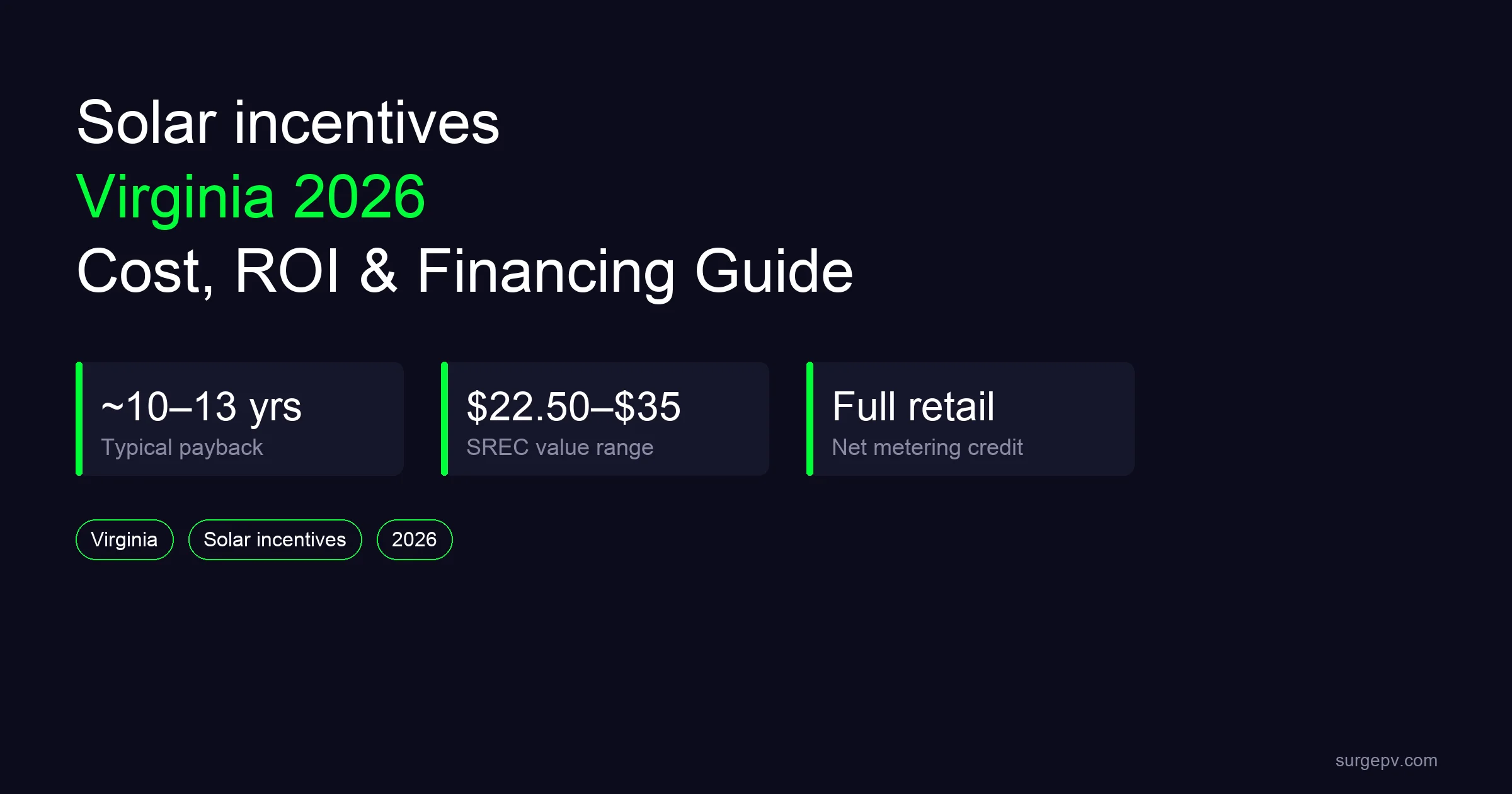
Virginia’s 2026 solar incentives include full retail-rate net metering protected by a spring 2026 SCC ruling, Solar Renewable Energy Credits worth roughly $22.50–$35 each, automatic property and sales tax exemptions, and federal battery storage credits. A typical residential system pays back in 10–13 years without the former federal ITC.
In this guide:
- Current status of every active Virginia solar incentive in 2026
- How the spring 2026 SCC ruling protects net metering
- How SRECs work and what they are worth
- Property and sales tax exemptions that apply automatically
- Financing options after the federal residential ITC ended
- Real cost, ROI, and payback numbers for Virginia homeowners
- Common mistakes that reduce project value
Virginia Solar Incentives at a Glance — 2026
Virginia does not offer one large statewide rebate. The value comes from layering several programs. Here is the current status.
| Incentive | Type | 2026 Status | Typical Value |
|---|---|---|---|
| Net metering | Bill credit | Active, protected by SCC ruling | Full retail-rate credit for excess generation |
| Solar Renewable Energy Credits (SRECs) | Performance credit | Active | $22.50–$35 per MWh produced |
| Property tax exemption | Tax exemption | Active, automatic | 100% exemption on added home value for systems up to 25 kW |
| Sales tax exemption | Tax exemption | Active, automatic | 5.3% state sales tax removed from equipment |
| Federal battery storage credit | Tax credit | Active for 2026 | 30% of battery cost for systems 3 kWh or larger with solar |
| Shared solar program | Bill credit | Expanding | ~10% bill savings for subscribers |
| Income and age qualifying solar program | Rebate | Active | No-cost installation for eligible Dominion customers |
| Commercial PACE financing | Financing | Active in participating localities | 100% financing repaid via property tax assessment |
The most important rule for 2026 is that net metering survived a major regulatory challenge. That matters more than any other single incentive.
Net Metering: The Centerpiece of Virginia Solar Value
Net metering is the mechanism that makes rooftop solar financially viable for most Virginia homeowners. Under Virginia Code §56-594, investor-owned utilities Dominion Energy and Appalachian Power Company must offer net metering to eligible customer-generators.
How Virginia Net Metering Works
When solar panels produce more electricity than the home uses, the surplus flows to the grid. The utility credits that surplus at the full retail rate. Those credits roll forward month to month within a 12-month period. At the end of the cycle, any unused credits are typically carried forward or paid out at the utility’s avoided-cost rate.
Key rules for residential systems:
- System capacity must be under 25 kW.
- System size cannot exceed 100% of the customer’s expected annual energy consumption.
- Credits accumulate over a 12-month netting period.
- The aggregate program cap is 6% of the utility’s prior-year peak-load forecast, with 1% reserved for low-income customers.
Without net metering, exported solar would be worth only the wholesale avoided-cost rate. That single change can stretch payback from roughly 10 years to 20 years or more.
The 2026 SCC Ruling
In spring 2026, the Virginia State Corporation Commission issued its final ruling on Dominion Energy’s proposed NEM 2.0 changes under Case No. PUR-2025-00079. The Commission rejected the most damaging parts of Dominion’s proposal, according to Solar United Neighbors (2026) and Convert Solar (2026):
- Full retail-rate crediting remains.
- The 12-month crediting period stays in place.
- Customers keep ownership of their SRECs.
- No new application fees were approved.
- The 6% aggregate net metering cap was preserved.
What did change:
- Dominion may charge a $1 per month administrative fee for new net metering customers.
- Year-end excess generation beyond annual consumption is compensated at approximately $0.058/kWh, lower than the prior avoided-cost payout.
The practical takeaway is unchanged: size systems for annual self-consumption, not maximum export.
Solar Renewable Energy Credits (SRECs)
SRECs are Virginia’s main performance-based incentive. The Virginia Clean Economy Act requires utilities to meet rising solar carve-out targets. Utilities can either buy SRECs from system owners or pay an alternative compliance penalty.
How SRECs Work
- One SREC is created for every 1,000 kWh (1 MWh) of solar production.
- SRECs are sold through brokers or aggregators such as SRECTrade, SolSystems, or RECmint.
- Prices are market-based and have recently ranged from $22.50 to $35 per credit, according to Palmetto (2025).
- The statutory alternative compliance payment of roughly $75 per SREC acts as a practical price ceiling.
- SRECs are valid for five years from the year they are generated.
A typical 10 kW residential system in Virginia produces about 12,600–13,600 kWh per year, which generates roughly 12–14 SRECs annually. At $25 per credit, that is $300–$350 per year of income on top of bill savings.
The Distributed Generation Expansion Act, effective July 1, 2026, raises utility solar procurement requirements from 1% to 4.5%. SREC brokers estimate this could increase SREC revenue by 60–90% over the following 18 months as utility demand rises, according to Palmetto market analysis (2025).
To participate, you must own the system outright, complete utility interconnection, and register with an SREC aggregator within the same calendar year as interconnection.
Tax Exemptions: Property and Sales
Virginia offers two automatic tax benefits that reduce lifetime cost without requiring paperwork.
Property Tax Exemption
Under Virginia Code §58.1-3661, residential solar systems up to 25 kW are fully exempt from property tax on the value the system adds to the home. Because a solar installation can add $20,000–$25,000 in assessed value, this exemption typically saves $250–$750 per year depending on local tax rates, according to Palmetto (2025). The exemption is automatic; homeowners do not apply.
Several localities add their own benefits. Charlottesville, for example, offers a local solar tax credit on top of the state exemption.
Sales Tax Exemption
Virginia exempts solar energy equipment from the state’s 5.3% sales tax. The exemption covers solar panels, inverters, racking, and associated components. On a typical $25,000 system, the exemption saves roughly $1,325 at the point of sale. Reputable installers should already factor this into quoted prices.
Federal Context: What Changed in 2026
The 30% federal Residential Clean Energy Credit under Section 25D ended for systems placed in service after December 31, 2025. That is the single biggest change for Virginia homeowners in 2026. Systems installed and operational by the end of 2025 can still claim the credit, including carryforward of unused amounts.
However, the federal battery storage credit remains available in 2026. Homeowners who install a battery of 3 kWh or larger as part of a solar project can claim a 30% credit on the battery cost under Section 25D. On a $12,000 battery, that is a $3,600 credit.
Commercial and third-party-owned residential systems may still access federal clean energy credits, which is why leases and PPAs can still offer lower monthly payments even after the homeowner-owned ITC expired.
Financing Options in Virginia
How you pay for solar changes which incentives you capture.
Cash Purchase
Cash delivers the strongest lifetime return. The owner keeps all SRECs, property tax exemption, sales tax exemption, and long-term bill savings. Payback periods in Virginia typically run 10–13 years after the federal ITC repeal, according to Convert Solar (2026).
Solar Loan
Loans preserve ownership benefits while eliminating upfront cost. Monthly loan payments are often comparable to or lower than current utility bills. The main risk is interest cost, which extends payback.
Lease or Power Purchase Agreement
Leases and PPAs require no money down and include maintenance. However, the financing company usually keeps the SRECs and federal tax benefits. Homeowners get predictable monthly savings but give up long-term ownership value.
Commercial PACE
VirginiaSAVES offers Commercial Property Assessed Clean Energy financing for businesses, nonprofits, and industrial property owners. The loan is repaid through a property tax assessment over up to 30 years and transfers automatically if the property is sold, according to Palmetto (2025).
Cost, ROI, and Payback in Virginia
Installed costs in Virginia vary by system size, roof complexity, and installer. Recent market data points to a range of $2.75–$3.05 per watt before incentives, according to Palmetto (2025) and SolarReviews (2026).
Typical Residential System Economics
| Item | 9 kW System | 10 kW System |
|---|---|---|
| Gross cost at $2.85/W | $25,650 | $28,500 |
| Sales tax exemption savings | ~$1,360 | ~$1,510 |
| Net upfront cost | $24,290 | $26,990 |
| Annual production | ~12,150 kWh | ~13,500 kWh |
| Annual bill savings at $0.145/kWh | ~$1,762 | ~$1,958 |
| Annual SREC income at $25/credit | ~$300 | ~$335 |
| Simple payback | ~11.8 years | ~11.6 years |
| 25-year net savings (3% rate escalation) | ~$38,000–$45,000 | ~$43,000–$51,000 |
These figures assume cash purchase, full retail net metering, and a system sized to match annual usage. Actual payback depends on roof orientation, shading, utility rate structure, and financing cost.
Common Mistakes Virginia Solar Buyers Make
Even with strong incentives, poorly planned projects underperform.
Oversizing for Export
Net metering credits roll over for 12 months, but excess generation beyond annual usage is paid at the lower avoided-cost rate. A system sized to 120% of annual usage wastes the surplus value.
Ignoring Utility Territory
Dominion and APCo have similar but not identical net metering rules. Municipal utilities and electric cooperatives are not required to offer the same terms. Always confirm the tariff before quoting.
Missing the SREC Registration Window
You must register with an SREC aggregator in the same calendar year as interconnection. Missing this window can cost years of income.
Assuming the Federal ITC Still Applies
The residential ITC ended after 2025. Any proposal assuming a 30% federal credit for a 2026 installation is wrong unless the system is part of a lease or commercial structure.
Poor Production Modeling
Virginia’s solar resource is good but not uniform. Coastal, Piedmont, and mountain regions differ. Accurate shading analysis and hourly load matching are essential. Use shadow analysis and production modeling tools to avoid overpromising.
Conclusion
Virginia solar incentives in 2026 are a stack, not a single handout. Net metering is the largest value driver, and the spring 2026 SCC ruling preserved full retail-rate crediting for new Dominion customers. SRECs, property tax exemption, and sales tax exemption add thousands of dollars in lifetime value. The federal residential tax credit is gone, but cash purchases, loans, leases, and battery storage credits still make solar viable for many homeowners.
For installers, the competitive edge is a proposal that models the customer’s actual utility, production, and incentives correctly. SurgePV’s solar design software, solar financial modeling, and solar proposals help you do exactly that. Book a demo or view pricing.
Three actions to take now:
- Size for annual usage, not maximum export. Full retail credits are more valuable than avoided-cost payouts.
- Register SRECs in the interconnection year. Missing the calendar-year window loses years of income.
- Model the actual utility tariff. Dominion and APCo rates and rules differ, and cooperatives may vary further.
Frequently Asked Questions
What solar incentives are available in Virginia in 2026?
Virginia’s 2026 solar incentives include full retail-rate net metering for Dominion and APCo customers, Solar Renewable Energy Credits, automatic statewide property tax exemption for residential systems up to 25 kW, a 5.3% state sales tax exemption on solar equipment, and a 30% federal tax credit for battery storage installed with solar.
Does Virginia have a state solar tax credit?
No. Virginia does not offer a state income tax credit for solar. The value comes from net metering, SREC sales, and automatic property and sales tax exemptions. The 30% federal residential tax credit ended on December 31, 2025.
How does net metering work in Virginia?
Net metering in Virginia credits excess solar generation at the full retail electricity rate. Credits roll over month to month for 12 months. Any leftover credits after the annual cycle are typically paid out at the utility’s avoided-cost rate. Residential systems must be under 25 kW and sized no larger than 100% of prior annual usage.
What happened to Virginia net metering in 2026?
The Virginia State Corporation Commission issued a final ruling in spring 2026 that preserved full retail-rate net metering, customer ownership of SRECs, and free interconnection for new Dominion customers. The ruling added a $1 per month administrative fee and lowered the year-end excess generation payout to about $0.058/kWh.
How much are Virginia SRECs worth?
Virginia SRECs have recently traded between approximately $22.50 and $35 per credit, with a statutory alternative compliance payment that acts as a practical ceiling near $75. A typical 10 kW residential system produces about 12–14 SRECs per year.
Is solar exempt from property tax in Virginia?
Yes. Under Virginia Code §58.1-3661, residential solar systems up to 25 kW are automatically exempt from property tax on the value the system adds to the home. There is no application required. Some localities, such as Charlottesville, offer additional local credits.
How much does solar cost in Virginia in 2026?
Installed costs in Virginia typically range from about $2.75 to $3.05 per watt before incentives. A typical 9–10 kW residential system costs roughly $24,750–$30,500 before incentives. Payback periods generally run 10–13 years after the federal residential tax credit expired.
Can I get solar with no money down in Virginia?
Yes. Solar loans, leases, and power purchase agreements allow $0-down options. Loans preserve ownership benefits like SRECs and tax exemptions. Leases and PPAs provide lower monthly payments but usually transfer SREC ownership and long-term value to the financing company.
Does the federal solar tax credit still apply in Virginia?
The 30% federal residential Investment Tax Credit ended for systems placed in service after December 31, 2025. However, a separate 30% federal credit for battery storage systems of 3 kWh or larger remains available in 2026 when installed with solar. Commercial projects can still access federal clean energy credits.
What is the best way to size a solar system in Virginia?
Size the system to match your annual electricity consumption rather than maximizing production. Virginia net metering credits roll over for 12 months, but excess generation beyond annual usage is compensated at a lower avoided-cost rate. Right-sizing maximizes the value of full retail-rate credits.
Where this fits
This article is part of SurgePV's Solar Incentives & Policy hub, which works through the topic from first principles to the decisions a project team actually has to make.

