

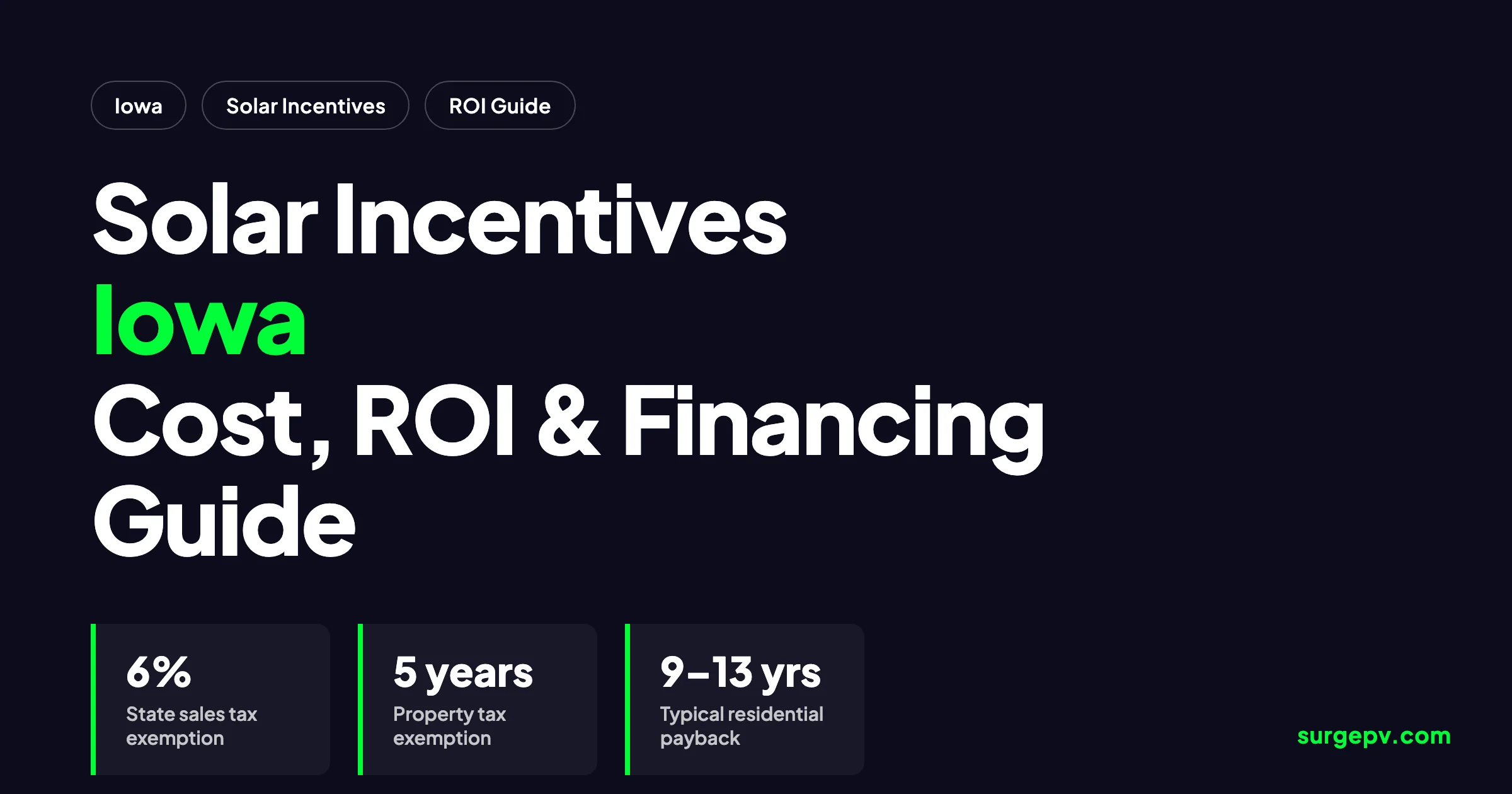
Iowa homeowners paid an average residential electricity rate of about 14 cents per kWh in early 2026, according to Electricity Cost Comparison state rate data (2026). That is below the national average, but Iowa’s rates have risen steadily. The state’s solar incentive stack is thinner than Illinois or California, yet the economics still work for many households. The trick is knowing which benefits actually exist and which ones disappeared.
Iowa ended its state solar tax credit at the start of 2022. Then, at the end of 2025, the federal Residential Clean Energy Credit under Section 25D expired for homeowner-owned systems. What remains is a set of smaller but meaningful incentives: a sales tax exemption, a five-year property tax exemption, inflow-outflow net metering for customers of MidAmerican and Alliant, and a handful of local rebates. Those pieces, combined with falling module prices and Iowa’s decent solar resource, keep residential solar competitive in 2026.
This guide covers every Iowa solar incentive that matters in 2026. It explains the federal tax credit status, the state exemptions, how inflow-outflow billing works, local rebate programs, cost and ROI scenarios, and financing options. For installers, getting these details right in every proposal is critical. SurgePV’s solar design software and generation and financial tool let you model Iowa utility rates, incentives, and financing scenarios in one workflow. You can then generate professional solar proposals and check pricing or book a demo.
Quick Answer
Iowa solar incentives in 2026 include a 6% state sales tax exemption on qualifying solar equipment, a five-year property tax exemption, inflow-outflow net metering through MidAmerican and Alliant, and local rebates such as Ames Electric’s $300/kW peak-production rebate. The federal residential Section 25D tax credit expired for homeowner-owned systems after December 31, 2025.
TL;DR — Iowa Solar Incentives 2026
Active programs: 6% state sales tax exemption, five-year property tax exemption, inflow-outflow net metering for MidAmerican and Alliant customers, Ames Electric PV rebate, and Waverly Utilities solar water heater rebate. No state income tax credit. Federal Section 25D expired for homeowner-owned systems placed in service after December 31, 2025. Typical residential payback is 9–13 years without the federal credit.
In this guide:
- Iowa solar incentive snapshot and what changed in 2026
- Federal tax credit status for residential and commercial projects
- Iowa state solar incentives: sales tax and property tax exemptions
- How net metering works in Iowa: inflow-outflow explained
- Local utility rebates and municipal programs
- Solar costs, production, and ROI scenarios for Iowa
- Financing options and common mistakes
Iowa Solar Incentives at a Glance — 2026
Iowa’s solar market does not rely on large upfront rebates. The value comes from stacking exemptions and bill-credit mechanisms. Utility territory matters because MidAmerican and Alliant operate under different tariffs, while rural cooperatives and municipal utilities set their own rules.
| Incentive | Type | 2026 Status | Typical Value |
|---|---|---|---|
| Federal residential ITC (Section 25D) | Tax credit | Expired | $0 for cash or loan residential purchases |
| Federal Section 48E | Commercial tax credit | Active, deadlines apply | 30% for eligible commercial, lease, or PPA systems |
| Iowa sales tax exemption | Tax exemption | Active | 6% state + 1% local on qualifying equipment |
| Iowa property tax exemption | Tax exemption | Active | 5 years of exemption on added home value |
| Inflow-outflow net metering | Bill credit | Active for MidAmerican and Alliant | Credits locked for 20 years; expire after 12 months |
| Ames Electric PV rebate | Utility rebate | Active | $300/kW based on 5 p.m. peak output |
| Waverly Utilities solar thermal rebate | Utility rebate | Active | $30/sq ft, capped at $3,500 |
| Eastern Iowa REC rebates | Utility rebate | Active | $500 for qualifying energy upgrades |
| Iowa state solar tax credit | State tax credit | Not available | Ended January 1, 2022 |
The biggest misconception is that Iowa still offers a state tax credit. It does not. The real money is in the sales tax exemption, the property tax exemption, and net metering. The biggest risk is designing a system for generous incentives that no longer exist.
How the Federal Tax Credit Changed in 2026
The federal Residential Clean Energy Credit under Internal Revenue Code Section 25D allowed homeowners to claim 30% of qualified solar and battery costs. It expired on December 31, 2025. Homeowner-owned systems placed in service on or after January 1, 2026 no longer qualify. This is a hard stop, not a phase-down.
For Iowa homeowners, this changes the sales conversation. In 2024 and 2025, installers could lead with “30% federal tax credit plus state exemptions.” In 2026, the proposal has to stand on state exemptions and avoided utility costs. The math still works for many households because Iowa has decent sun and electricity rates keep climbing, but the payback period is longer than it was.
Commercial and third-party-owned residential systems still have a path. Section 48E, the Clean Electricity Investment Credit, offers a 30% base credit for projects that begin construction by July 4, 2026, or are placed in service by December 31, 2027. This is why solar leases and power purchase agreements can still advertise lower monthly payments in 2026. The system owner, not the homeowner, claims the credit.
Homeowners who want to claim any remaining federal benefit should consult a tax professional. The Internal Revenue Service publishes guidance on the Residential Clean Energy Credit at IRS Residential Clean Energy Credit (2026).
Iowa State Solar Incentives
Iowa offers two meaningful state-level incentives. Both are tax exemptions, not cash rebates or tax credits. They reduce the upfront cost and protect against higher property taxes.
Iowa Solar Sales Tax Exemption
Iowa exempts qualifying solar energy equipment from the state’s 6% sales tax and any applicable 1% local option sales tax. The exemption is automatic at the point of sale for eligible equipment. You do not file a separate application.
The exemption applies to equipment directly involved in “collecting, converting, or transmitting” clean energy. Solar panels, inverters, and solar roof shingles generally qualify. Racking, batteries, and installation labor generally do not. That limitation matters for battery add-ons, which are becoming more common as net metering values fall nationwide.
For a typical 9 kW residential system priced at roughly $30,000 before incentives, the qualifying equipment might be $26,000 to $28,000. A 6% to 7% sales tax exemption on that amount saves $1,600 to $2,000. EnergySage provides a current Iowa incentive summary at EnergySage Iowa Solar Incentives (2026).
Iowa Solar Property Tax Exemption
Installing solar increases the market value of your home. In Iowa, the added value is excluded from property tax assessments for five years after installation. The exemption is also automatic; the assessor simply does not include the system’s value during the exempt period.
With Iowa’s average effective property tax rate near 1.5%, a $30,000 solar system would otherwise add roughly $450 to $500 in annual property taxes. Over five years, the exemption saves $2,250 to $2,500. That is not as generous as states with 15- or 20-year exemptions, but it is meaningful in a state with relatively high property taxes.
The exemption lasts five property assessment years. After that, the system’s depreciated value may be added to the assessment. Homeowners should keep installation documentation in case the assessor asks for it.
Net Metering in Iowa: Inflow-Outflow Explained
Net metering in Iowa changed in 2020. Senate File 583, signed by Governor Kim Reynolds, required the state’s two investor-owned utilities to file net metering tariffs using either net billing or inflow-outflow billing. MidAmerican Energy and Alliant Energy both chose inflow-outflow. The law took effect July 1, 2020, and existing net metering customers were grandfathered.
The Iowa Utilities Commission explains the rules at Iowa Utilities Commission On-Site Distributed Generation (2025). The Database of State Incentives for Renewables and Efficiency also summarizes Iowa net metering at DSIRE Iowa Net Metering (2026).
How Inflow-Outflow Billing Works
Under inflow-outflow billing, your meter tracks electricity flowing in two directions.
- Inflow: Electricity you draw from the grid is billed at your normal retail rate.
- Outflow: Electricity you export to the grid is credited at a set outflow purchase rate.
The credits appear as dollar amounts on your bill. They can offset volumetric energy charges but cannot offset fixed charges such as the monthly meter fee. Credits roll over month to month for up to 12 months. At the end of the 12-month period, unused credits expire.
The outflow rate for each system is locked for 20 years. That gives customers long-term certainty. The rate for new systems is adjusted annually based on a Value of Solar study, which is triggered once statewide distributed generation reaches 5% of total peak demand or after 2027, whichever comes first. The Iowa Environmental Council described the compromise in detail at Iowa Environmental Council IUB Tariff Rulings (2020).
Net Billing Alternative
Utilities can also offer net billing, where exported energy is credited in kilowatt-hours rather than dollars. Those kWh credits can offset future kWh consumption. MidAmerican and Alliant chose inflow-outflow, but some municipal utilities and cooperatives may use net billing or their own buyback programs.
What This Means for System Design
Inflow-outflow makes self-consumption valuable. Every kWh you use on-site avoids the full retail rate. Every kWh you export is credited at the outflow rate, which may be lower than the retail rate. This is why load timing, roof orientation, and battery storage matter more in Iowa than they did under older retail-rate net metering.
Installers should model the customer’s actual usage pattern, not just annual production. A south-facing system that produces most of its power while the homeowner is at work will export more and earn lower credits. A west-facing system that produces more in late afternoon may match the household’s peak usage better.
Local Solar Rebates and Utility Programs
Iowa does not have a statewide solar rebate program. A few municipal utilities and cooperatives offer their own incentives. These programs have limited budgets and can change, so verify eligibility before quoting.
Ames Electric Department Photovoltaic Rebate
Ames Electric Department offers a photovoltaic rebate worth $300 per kW based on the system’s output at the utility’s peak hour, typically 5 p.m. The rebate requires pre-approval from the City of Ames and a completed application after installation. The installer must calculate the system’s expected production at the specified peak hour.
For a 6 kW system that produces 4.5 kW at 5 p.m., the rebate would be $1,350. The program also offers up to $500 for a Level 2 electric vehicle charger as of the 2024 program update. EcoWatch lists the program requirements at EcoWatch Iowa Solar Incentives (2025).
Waverly Utilities Solar Water Heater Rebate
Waverly Utilities offers a rebate for solar thermal water heating systems of $30 per square foot of collector area, capped at $3,500. The rebate requires pre-approval, and installations must meet local permit requirements. This is a solar thermal incentive, not a photovoltaic rebate, but it can be relevant for homeowners considering both technologies.
Rural Electric Cooperative Rebates
Some rural electric cooperatives offer energy efficiency rebates that include solar-adjacent upgrades. Eastern Iowa REC, for example, has offered rebates for heat pumps, water heaters, and EV chargers. A $500 rebate may apply to qualifying renewable energy or efficiency upgrades. Check with your specific cooperative, since programs vary widely.
Solar Costs and ROI in Iowa — 2026
Without the federal residential tax credit, the economics depend on installed cost, electricity rates, production, and incentives. Iowa’s solar resource is better than many people assume. The state receives roughly 4.5 to 5.0 peak sun hours per day on average, with the southern and western counties slightly higher.
Typical Installed Costs
National residential solar pricing in 2026 ranges from about $2.50 to $3.50 per watt installed, according to SunHub Solar Price Per Watt Analysis (2026). Iowa tends to fall in the middle of that range. A typical 9 kW system costs $27,000 to $31,500 before incentives.
| System Size | Estimated Cost Before Incentives | Estimated Annual Production | First-Year Bill Savings |
|---|---|---|---|
| 6 kW | $18,000–$21,000 | 7,500–8,500 kWh | $1,050–$1,200 |
| 9 kW | $27,000–$31,500 | 11,000–12,500 kWh | $1,550–$1,750 |
| 12 kW | $36,000–$42,000 | 14,500–16,500 kWh | $2,050–$2,300 |
Production estimates assume a south-facing roof with minimal shading. Actual output varies by roof pitch, azimuth, shading, and equipment choice.
Net Cost After Iowa Incentives
A $30,000, 9 kW system receives the following first-year benefits:
- Sales tax exemption: $1,600 to $2,000
- Property tax exemption: $450 to $500 per year for five years
- First-year bill savings: $1,550 to $1,750
- Ames Electric rebate (if eligible): $1,200 to $1,800
That brings the effective first-year cost down significantly, even without a federal tax credit. Over 25 years, total avoided electricity costs plus remaining incentive value often reach $35,000 to $50,000 for a 9 kW system. Net savings after paying off the system typically land between $15,000 and $30,000.
Payback Period
A typical residential system in Iowa pays back in 9 to 13 years without the federal residential tax credit. The range depends on financing, system cost, electricity usage, and access to local rebates. Cash purchases at competitive pricing pay back faster. Loans with interest above 7% extend payback by one to three years. Leases and power purchase agreements do not have a payback period in the traditional sense because the homeowner does not own the system.
For installers, the key is to show a realistic payback based on the customer’s actual utility rate, usage pattern, and roof conditions. Generic payback claims based on national averages will not survive scrutiny.
Financing Options for Iowa Solar
Most Iowa homeowners finance solar with one of four options. Each has different implications for incentives, ownership, and lifetime savings.
Cash Purchase
A cash purchase delivers the highest lifetime savings and the simplest incentive stack. The homeowner owns the system, claims all available tax exemptions, and receives all bill savings. The main barrier is the upfront capital requirement.
Solar Loan
A solar loan lets the homeowner own the system without paying the full cost upfront. The homeowner keeps the sales tax exemption, property tax exemption, and net metering credits. Interest costs reduce net savings. Loan terms of 10 to 20 years are common. The effective cost of the loan should be compared to the avoided utility rate over the same period.
Home Equity Line of Credit
A HELOC can offer lower interest rates than an unsecured solar loan. It requires sufficient home equity and good credit. The homeowner still owns the system and keeps all incentives. The risk is that the loan is secured by the home.
Lease or Power Purchase Agreement
Leases and PPAs require little or no upfront payment. The homeowner does not own the system and does not claim tax exemptions directly. The leasing company may benefit from Section 48E and pass some savings through as lower monthly payments. Lifetime savings are usually lower than ownership, but leases can make sense for households that cannot use tax credits or do not want maintenance responsibility.
Iowa does not have active C-PACE enabling legislation for commercial properties as of early 2026, according to Gray Group C-PACE Guide (2026). Commercial buyers should focus on cash, term loans, or equipment financing.
Commercial Solar Incentives in Iowa
Commercial solar in Iowa follows a different incentive path than residential. Businesses cannot claim the expired Section 25D residential credit, but they may still qualify for Section 48E through 2027. They can also depreciate solar assets under MACRS.
Section 48E Clean Electricity Investment Credit
Commercial, industrial, and third-party-owned systems may qualify for a 30% federal investment tax credit under Section 48E. To capture the full base credit, construction must begin by July 4, 2026, or the system must be placed in service by December 31, 2027. Bonus adders for domestic content, energy communities, and low-income projects can raise the credit above 30%.
MACRS Depreciation
Commercial solar systems qualify for Modified Accelerated Cost Recovery System depreciation, typically over five years. Bonus depreciation remains available at 80% in 2026. The combination of Section 48E and MACRS can reduce the after-tax cost of a commercial system by 50% or more.
Sales and Property Tax Exemptions
Commercial systems also benefit from the Iowa sales tax exemption on qualifying equipment and the property tax exemption on added system value for five years. These apply to both owned and financed systems.
Demand Charge Management
Many commercial customers in Iowa pay demand charges based on their highest rate of grid draw during the billing period. Solar can reduce demand charges if peak solar production overlaps with peak usage. Battery storage can further reduce demand charges by discharging during peak periods. Accurate load analysis is essential for commercial ROI.
Common Mistakes Iowa Solar Buyers Make
Several mistakes show up repeatedly in Iowa solar proposals. Avoiding them improves customer trust and reduces post-installation disputes.
Assuming the Federal Tax Credit Still Applies
Some installers and online calculators still default to a 30% federal credit for residential purchases. In 2026, that credit is gone for homeowner-owned systems. Proposals must reflect the actual incentive stack.
Ignoring Inflow-Outflow Rules
Designing a system for old-style net metering overstates export value. Inflow-outflow credits are real, but they are not the same as 1:1 retail net metering. Proposals should show self-consumption value separately from export credits.
Overlooking the Sales Tax Exemption Limit
The exemption does not cover batteries, racking, or labor. A proposal that applies the exemption to the full system price overstates savings. Break out qualifying equipment separately.
Using National Production Estimates
Iowa’s solar resource is decent, but production varies by latitude, roof orientation, and shading. A proposal based on a generic national average will not match actual meter data. Use site-specific shading analysis and production modeling.
Missing Local Rebate Deadlines
Ames Electric and other local programs can run out of budget or change requirements. Pre-approval is often required. Confirm program status before signing a contract.
How to Claim Iowa Solar Incentives
The good news is that most Iowa incentives require little paperwork. The bad news is that the federal credit no longer exists for residential purchases, so there is less to claim.
- Get multiple quotes. Compare at least three installer bids for the same system size and equipment.
- Confirm utility rules. Ask your utility for the current inflow-outflow tariff, interconnection timeline, and any local rebates.
- Verify sales tax treatment. Make sure your contract separates qualifying equipment from non-qualifying items like batteries and labor.
- File interconnection paperwork. Your installer usually handles this, but confirm the application is submitted before installation.
- Monitor the first bill. Check that exported solar is credited correctly under the inflow-outflow tariff.
- Keep installation records. You may need them for the property tax assessor or a future home sale.
For commercial projects, work with a tax advisor to claim Section 48E and MACRS depreciation correctly. Missing the construction begin deadline can cost tens of thousands of dollars.
FAQ
What solar incentives are available in Iowa in 2026?
Iowa solar incentives in 2026 include a 6% state sales tax exemption on qualifying solar equipment, a five-year property tax exemption on the added value of a solar system, inflow-outflow net metering through MidAmerican Energy and Alliant Energy, and local rebates such as Ames Electric’s $300 per kW peak-production rebate and Waverly Utilities’ solar water heater rebate. The federal residential Section 25D tax credit is no longer available for homeowner-owned systems placed in service after December 31, 2025.
Does Iowa have a state solar tax credit in 2026?
No. Iowa used to offer a state solar tax credit equal to 50% of the federal credit, but it expired on January 1, 2022. There is no state income tax credit for residential solar in Iowa in 2026. The main remaining state-level benefits are the sales tax exemption and the property tax exemption.
Is the federal solar tax credit still available in Iowa in 2026?
The 30% federal Residential Clean Energy Credit under Internal Revenue Code Section 25D expired for homeowner-owned systems placed in service after December 31, 2025. Commercial systems and third-party-owned residential arrangements such as leases and power purchase agreements may still qualify for a 30% credit under Section 48E if construction begins by July 4, 2026, or the system is placed in service by December 31, 2027.
How does net metering work in Iowa?
Iowa’s two investor-owned utilities, MidAmerican Energy and Alliant Energy, use inflow-outflow billing under Senate File 583. Customers pay the retail rate for electricity drawn from the grid and receive dollar credits for exported solar at a utility-set outflow rate. The outflow rate is locked for 20 years for each system and adjusted annually for new systems after a Value of Solar study is triggered. Credits expire after 12 months. Rural cooperatives and municipal utilities are not required to offer net metering, though many do voluntarily.
Does Iowa have a sales tax exemption for solar panels?
Yes. Iowa exempts qualifying solar energy equipment from the 6% state sales tax and any applicable 1% local option sales tax. The exemption applies to equipment directly involved in collecting, converting, or transmitting clean energy, such as solar panels and inverters. It generally does not cover racking, batteries, or installation labor. On a typical 9 kW system, the exemption saves roughly $1,600 to $2,000.
Does Iowa have a property tax exemption for solar panels?
Yes. Iowa excludes the value added by a solar energy system from property tax assessments for five years after installation. Based on Iowa’s average effective property tax rate of about 1.5%, a $30,000 solar system avoids roughly $450 to $500 in annual property taxes during the exemption period, for a total savings of about $2,250 to $2,500.
What is the typical solar payback period in Iowa in 2026?
A well-designed residential solar system in Iowa typically pays back in 9 to 13 years in 2026 without the federal residential tax credit. Payback is shorter for customers with high daytime electricity use, good roof orientation, and access to local rebates. Over a 25-year system life, total net savings often range from $15,000 to $30,000 for a 9 kW system.
Are there local solar rebates in Iowa?
Yes, but they are limited and utility-specific. Ames Electric Department offers a photovoltaic rebate of $300 per kW based on the system’s output at the utility’s peak hour, typically 5 p.m. Waverly Utilities offers a solar water heater rebate of $30 per square foot of collector area, capped at $3,500. Some rural electric cooperatives also offer energy efficiency rebates. Availability changes, so confirm with your installer or utility before finalizing a quote.
What financing options are available for solar in Iowa?
Iowa homeowners can pay cash, use a solar loan, open a home equity line of credit, or sign a lease or power purchase agreement. Cash purchases deliver the highest lifetime savings but require upfront capital. Solar loans keep incentives with the homeowner but add interest cost. Leases and power purchase agreements require no upfront payment and may still benefit from federal Section 48E credits, though lifetime savings are usually lower than ownership.
Is solar worth it in Iowa without the federal tax credit?
Yes, solar can still be worth it in Iowa without the federal residential tax credit for households with above-average electricity bills and suitable roofs. The combination of sales tax exemption, property tax exemption, inflow-outflow net metering, and retail electricity rates near 14 cents per kWh creates a viable payback period for many homeowners. The key is accurate production modeling, competitive pricing, and financing that does not erode too much of the energy savings.
Next steps: Compare installer quotes for your Iowa home or business. Ask each bidder to separate qualifying equipment from non-qualifying costs, model inflow-outflow credits using your actual utility rate, and show payback with and without the expired federal residential credit. If you are an installer, use SurgePV’s solar design software to build Iowa-specific proposals that reflect real incentives, real rates, and real roof conditions. Book a demo or review pricing to see how the platform handles state-by-state incentive modeling.
Where this fits
This article is part of SurgePV's Solar Incentives & Policy hub, which works through the topic from first principles to the decisions a project team actually has to make.
