

Answer
Ukraine's 2026 solar incentives include the green tariff feed-in scheme, the net billing programme, 0% household loans, the 5-7-9% business loan programme, and VAT/customs exemptions on energy equipment. The green tariff pays residential systems up to 30 kW about UAH 6.04 per kWh and runs until the end of 2029.
Ukraine’s solar market is rebuilding around resilience rather than returns alone. Before the full-scale invasion, the country had about 8 GW of installed solar capacity. It had attracted more than EUR 8 billion in renewable investment, according to the German-Ukrainian Energy Partnership. Russian attacks have since damaged or occupied a large share of that capacity. They have also made decentralized generation a national priority. In 2024 alone, Ukraine added roughly 800 MW of new solar. The government now targets 12.2 GW of solar by 2030.
For installers, project developers, and prosumers, the incentive stack in 2026 is unusually broad. The legacy green tariff still pays a fixed price for exported power. A new net billing scheme offers a market-based alternative. Households can borrow at 0% interest, businesses can access the 5-7-9% loan programme, and most solar hardware is exempt from VAT and customs duties until 2029. The challenge is choosing the right combination for each project. This is the same trade-off facing prosumers across Europe, as summarised in our solar self-consumption rules Europe guide.
In this guide, you will learn:
- How the 2026 green tariff works and what it pays.
- How net billing compares to the green tariff.
- Which state loans and grants are available for homes, apartments, and businesses.
- How VAT and customs exemptions reduce equipment costs.
- What utility-scale investors need to know about green auctions.
- Real payback ranges for residential and commercial systems.
- The practical steps to register a system and start receiving payments.
- Key risks that can overturn project economics.
Quick Answer
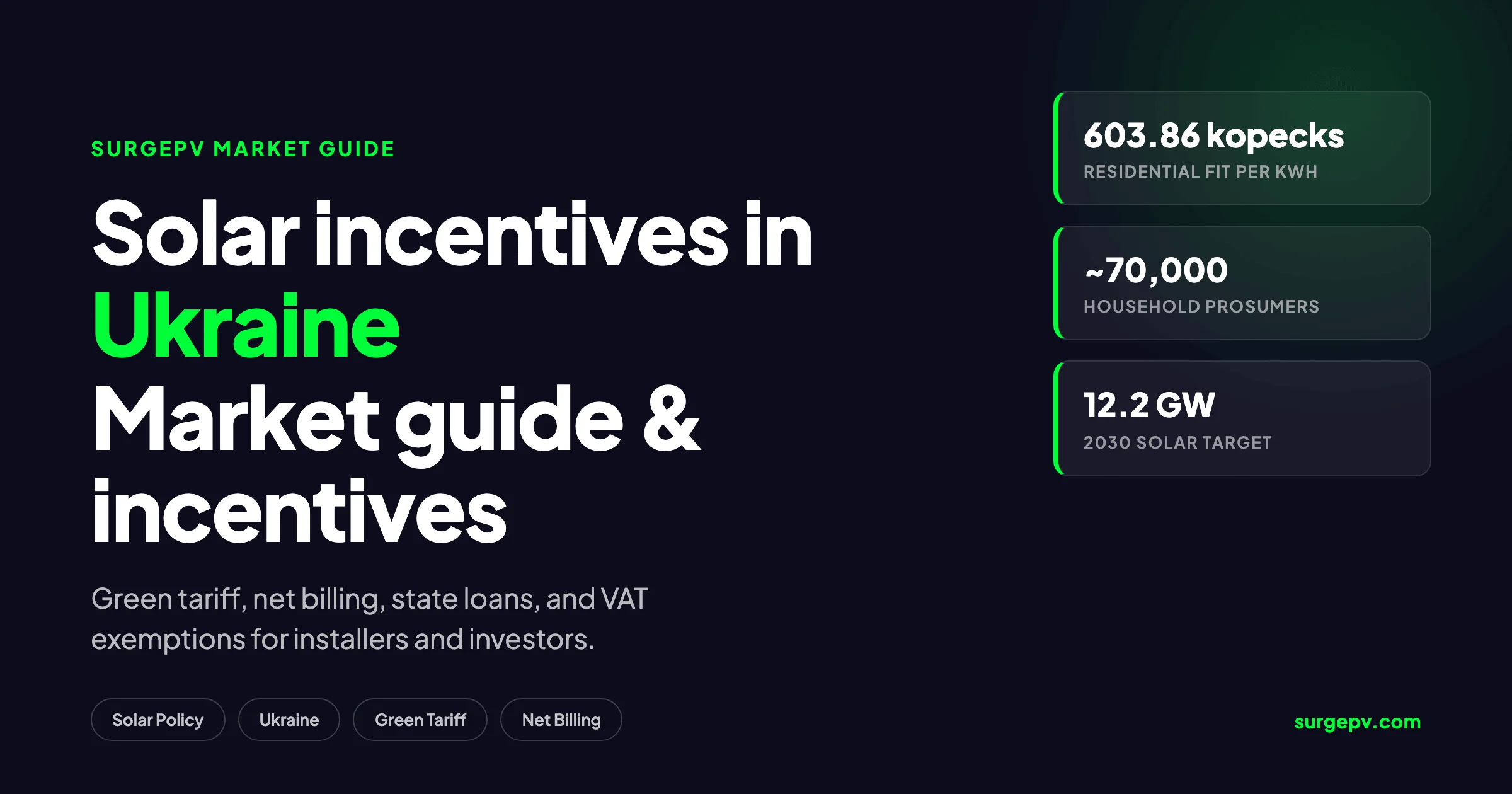
Ukraine’s 2026 solar incentives include the green tariff, net billing, 0% household loans, the 5-7-9% business loan programme, and VAT/customs exemptions on energy equipment. The green tariff pays residential systems up to 30 kW about UAH 6.04 per kWh. It runs until the end of 2029.
Ukraine solar market snapshot in 2026
Ukraine enters 2026 with a power system that is smaller but more decentralized than before the war. Before February 2022, installed renewable energy capacity stood at about 9.9 GW, of which roughly 6 GW was solar, according to UkraineInvest. As of early 2024, total renewable capacity was 8.7 GW. The Energy Community estimates that about 13% of industrial solar plants are in occupied territory and another 6% have been damaged or destroyed.
The response has been a wave of rooftop and commercial installations. DTEK Networks connected more than 1,400 new renewable facilities in 2023, commissioning about 500 MW of solar and 182 MW of wind. The share of Ukrainian companies investing in alternative energy more than tripled from 6% to 20.2% by 2025. That figure comes from the Razom We Stand renewable energy tracker. Supermarket chains, petrol stations, factories, and municipalities are adding solar not only to cut costs but to keep the lights on during grid outages.
The policy target is ambitious. Ukraine’s National Renewable Energy Action Plan and National Energy and Climate Plan aim for 12.2 GW of solar capacity by 2030. They also target 27% renewables in final energy consumption. The IEA estimates that reaching a secure, decentralized system would require about 24 GW of distributed solar and 5.6 GW of battery storage by 2030. Current policies are expected to deliver only a fraction of that, so further support is likely.
Solar irradiance in Ukraine ranges from 1,100 to 1,500 kWh per square metre per year. The whole country is technically viable, and the southern regions are especially productive. The practical constraint is no longer sunshine; it is grid capacity, financing access, and the ability to navigate shifting regulations. Roughly half of the country’s solar plants are concentrated in six regions: Ivano-Frankivsk, Dnipropetrovsk, Vinnytsia, Khmelnytskyi, Kyiv, and Mykolaiv. The least developed regions are in the east, where active hostilities continue.
Green tariff: Ukraine’s feed-in incentive in 2026
The green tariff, introduced in 2009, is the longest-running solar incentive in Ukraine. It is a feed-in tariff: the state-owned Guaranteed Buyer purchases eligible renewable electricity at a fixed price set by law and regulation. The scheme is open until January 1, 2030, and the tariff level depends on the technology, plant size, commissioning date, and local content share.
How the green tariff works
A solar producer signs a contract with the Guaranteed Buyer, the state enterprise responsible for purchasing electricity from renewable sources. The producer consumes part of the generation on site and exports the surplus. The Guaranteed Buyer sells that electricity on the wholesale market. The difference between the market price and the green tariff is covered through a public service obligation. That component sits in the transmission tariff and is administered by the transmission system operator Ukrenergo.
For households and small prosumers, the process is simpler. Once the system is connected, the DSO installs a bidirectional meter. The meter records exports, and the surplus is paid at the green tariff rate. The producer does not need to trade on the wholesale market directly.
Who qualifies
The green tariff is available to:
- Residential rooftop systems up to 30 kW.
- Rooftop and facade systems on private houses and apartment buildings up to 150 kW.
- Energy cooperatives meeting ownership and capacity rules.
- Commercial solar power plants that were commissioned before the 2020 cut-off or that hold a pre-PPA signed before that date.
New large solar projects over 1 MW are generally no longer eligible for the legacy green tariff. Since 2019, they must compete in green auctions instead.
2026 green tariff rates for solar
NEURC updated the green tariff rates in Resolutions No. 497 and No. 498 of March 31, 2026. The new rates took effect on April 1, 2026. The key figures for solar are:
| System type | Capacity | Tariff excluding VAT | Approximate tariff including VAT |
|---|---|---|---|
| Residential rooftop | up to 30 kW | 603.86 kopecks/kWh | about UAH 7.25/kWh |
| Rooftop or facade | up to 150 kW | 526.52 kopecks/kWh | about UAH 6.32/kWh |
Earlier resolutions set the January to March 2026 residential rate at 587.68 kopecks/kWh excluding VAT, according to ProfEnergy. The April revision reflects the regulator’s quarterly adjustment mechanism.
The green tariff is fixed in euro terms for business-scale plants and paid in hryvnia at the official exchange rate. This protects producers from currency depreciation but also means the hryvnia payment moves with the exchange rate. For households, the rate is set directly in kopecks per kilowatt-hour.
Business-scale projects can earn a higher green tariff by using Ukrainian-made equipment. Historically, plants with at least 30% local content received a 5% bonus, and plants with at least 50% local content received a 10% bonus. These bonuses were designed to build a domestic supply chain. In practice, most large projects relied on imported modules and inverters, so the bonus was not always achievable.
A critical detail is the end date. The green tariff stops paying for electricity generated after December 31, 2029. A system commissioned in 2026 therefore has at most four years of fixed-price revenue. After that, the owner can switch to market sales, net billing, or a future support scheme if one is introduced.
Net billing: the market-based alternative
In 2023, Ukraine introduced a net billing option for prosumers. Instead of a fixed green tariff, exported electricity is credited at the hourly day-ahead wholesale price, minus distribution system operator charges and taxes. The IEA describes this as a real-time self-consumption model.
How net billing works
Under net billing, the value of your surplus changes every hour. When wholesale prices are high, exports are worth more. When prices are low, exports are worth less. The household still buys electricity from the grid at the retail tariff when solar output is insufficient. At the end of the billing period, any credit balance can be paid out in cash.
The settlement is based on the day-ahead market price for each hour. NEURC sets price caps for the day-ahead, intraday, and balancing markets. In 2025, the evening peak cap was raised to UAH 15,000 per MWh for the day-ahead market and UAH 16,000 per MWh for the balancing market. A household with a battery can increase net billing revenue by storing midday solar. It can then export during evening peaks, provided the battery control system is programmed to do so.
The IEA reports that wholesale power prices in Ukraine ranged from EUR 70 to EUR 210 per MWh in early 2025. DSO charges averaged about EUR 41 per MWh and ranged from EUR 17 to EUR 71 per MWh depending on location. The residential retail price was around EUR 84 per MWh, but it is subsidised. It is expected to rise once subsidies are phased out.
Because retail prices are currently suppressed by subsidies, net billing often pays less for exports than the green tariff. The advantage of net billing is flexibility. A household that consumes most of its solar generation on site does not depend heavily on export prices. Net billing also avoids the risk that the green tariff’s fixed payments could be delayed or reduced by policy changes.
Green tariff vs. net billing
| Factor | Green tariff | Net billing |
|---|---|---|
| Price | Fixed by NEURC | Hourly wholesale price minus DSO charges |
| Certainty | High until 2029 | Varies with market prices |
| Best for | Systems with large surplus | Systems with high self-consumption |
| Eligibility | Residential up to 30 kW, small rooftop up to 150 kW, legacy plants | Prosumers, often combined with 0% or 5-7-9% loans |
| End date | December 31, 2029 | No fixed end date |
| Payment flow | From Guaranteed Buyer or supplier | Credit on electricity bill, surplus paid out |
The right choice depends on load profile. A family that is home during the day will benefit more from net billing. It can run air conditioning, heat pumps, or appliances on solar hours and avoid buying expensive grid power. A household that exports most of its generation will usually prefer the green tariff. This often happens when the roof is large but occupancy is low.
A 2023 analysis by Low Carbon Ukraine found that a 5 kW rooftop system in Kyiv paid back in 7 to 8 years under the green tariff. The same system paid back 15 to 16 years under net billing at the then-current subsidised retail prices. As retail tariffs rise toward cost-reflective levels, net billing economics should improve.
State-backed financing programmes
Ukraine’s most important new incentives are not tariffs but loans and grants. The government has shifted the focus from subsidising electricity sales to reducing the upfront cost of equipment.
0% household loans
Since July 2024, Ukrainian households can borrow at 0% interest for up to 10 years. The loan covers solar panels, wind turbines, batteries, and inverters. The maximum amount is UAH 480,000, roughly EUR 10,000. The state compensates the bank for the difference between the programme rate and the market rate, which was around 20% for consumer loans.
Partner banks include PrivatBank, Oschadbank, Ukrgasbank, Sens Bank, and Globus Bank. The loan can cover equipment and installation. Because the interest cost is fully borne by the state, a household’s monthly repayment is simply the principal divided by 120 months. For a UAH 300,000 system, that is about UAH 2,500 per month.
The programme is administered through the Entrepreneurship Development Fund. Applicants need proof of ownership or right to use the property, an equipment quote, and a contract with an installer. The first loans were issued within days of the launch, including a UAH 315,000 loan for a 5.6 kW system in Vinnytsia, reported by Ukrinform.
5-7-9% affordable loans
The 5-7-9% programme offers concessional loans to homeowners associations, condominiums, small businesses, and medium-sized enterprises. Interest rates depend on the borrower category. Small businesses pay 5%. Medium businesses and homeowners associations pay 7%. Borrowers in high-risk war zones pay 0% for the first two years.
For energy projects, the maximum loan is UAH 150 million per group of companies, with terms up to 10 years. The funds can buy solar panels, inverters, batteries, gas turbines, and auxiliary equipment. In January 2026, the Cabinet of Ministers raised the maximum loan under the programme to UAH 250 million.
The 5-7-9% loan can be combined with the GreenDim grant, making it especially attractive for apartment buildings.
GreenDim grants for apartment buildings
GreenDim is run by the State Agency on Energy Efficiency and Energy Saving of Ukraine. The Ukrainian Energy Efficiency Fund supports it. It provides grants of up to 70% of the cost of solar power plants, heat pumps, and related equipment for homeowners associations and housing cooperatives.
The maximum grant is UAH 1 million for a solar power plant, UAH 2 million for a heat pump, and UAH 3 million if both are installed together. The programme is designed to help multi-apartment buildings become more resilient during blackouts and reduce electricity bills. By late 2025, the Energy Efficiency Fund had reportedly completed 166 GreenDim projects from 180 applications.
Decarbonisation Fund and EU-backed finance
Ukraine’s Decarbonisation Fund provides low-interest loans for decarbonisation projects in schools, hospitals, industry, and SMEs. In addition, international financial institutions have made billions of euros available for Ukrainian energy recovery. The EBRD’s Hi-Bar programme, the IFC Better Futures programme, and KfW’s Green Growth Fund are active in solar, wind, and battery storage. The Ukraine Facility provides up to EUR 50 billion in macro-financial assistance, grants, and loans for 2024 to 2027.
VAT and customs exemptions
One of the most concrete cost reductions in 2026 is the temporary exemption from VAT and import duties on energy equipment. Laws No. 3853-IX and No. 3854-IX, adopted in July 2024, exempted imports of solar panels, inverters, lithium-ion batteries, wind turbine parts, control panels, and related equipment from VAT and customs duties.
In December 2025, the Verkhovna Rada extended the exemption until January 1, 2029. It also added wind turbines and large generator sets to the list, according to Dentons. The exemption applies for the duration of martial law or until that date, whichever comes first.
For a typical residential system, the exemption can save 20% VAT plus customs duties on imported panels and inverters. For a commercial project importing a container of modules and a battery container, the saving can run into tens of thousands of euros. The exemption covers international postal and express shipments as well as commercial freight. The goods must be properly classified under the Ukrainian Customs Tariff. They also cannot originate from Russia or occupied territory.
Common eligible UKT ZED codes include 8541 43 00 00 for photovoltaic cells and modules, 8504 40 for inverters, and 8507 60 for lithium-ion batteries. Importers should obtain correct technical documentation and, for Energy Community projects, confirmation from the Ministry of Energy.
Green auctions for large-scale solar
New utility-scale solar and wind projects no longer receive the legacy green tariff. Instead, they must compete in green auctions organised by the Guaranteed Buyer on the Prozorro.Sale platform. Winners receive a contract for difference or, since recent reforms, a one-sided market premium for 12 years.
How auctions work
The government announces an annual quota by technology. Bidders submit a price per megawatt-hour. The lowest bids win, up to the quota limit. The winner signs a 12-year support agreement with the Guaranteed Buyer. If the market price is below the auction price, the Guaranteed Buyer pays the difference. If the market price is above the auction price, the producer keeps the higher revenue.
Law No. 4777-IX, adopted in February 2026, extended the auction mechanism until December 31, 2034, and adjusted the quota shares. Solar without storage must receive at least 5% of the annual quota. Solar with storage must receive at least 10%. Wind and other renewables must each receive at least 5%. Hybrid solar-plus-storage plants must have storage power of at least 80% of installed generation capacity. They also need storage capacity of at least 2 kWh per 1 kW of solar. The maximum bid price for hybrid projects is EUR 0.12 per kWh.
The first pilot auction in December 2024 offered only 11 MW and received no bids. Outstanding debts owed to green tariff producers and investor caution explain the lack of interest. Larger auctions and clearer rules in 2026 may improve participation. Auction support is no longer the automatic, high-return mechanism it was five years ago.
Commercial and industrial solar considerations
For Ukrainian businesses, solar in 2026 is primarily a hedge against grid instability and rising retail prices, not a standalone export business. Industrial and commercial systems are usually sized for self-consumption, with batteries added to cover outages.
A 2025 report by the German-Ukrainian Energy Partnership notes that companies such as VARUS, Okko, MHP, and Velta are investing in rooftop solar, cogeneration, and batteries. The Okko petrol station chain had installed 6 MW across 265 stations by 2025, and VARUS committed EUR 3.5 million to solar at 48 supermarkets.
Take a hypothetical 250 kW rooftop project on a small factory near Dnipro. The system generates about 265,000 kWh per year. If the factory consumes 60% of that on site and the retail tariff is UAH 5.50 per kWh, the annual avoided purchase is UAH 874,500. The remaining 40% exported under net billing at an average UAH 3.50 per kWh adds UAH 371,000. Total annual benefit is UAH 1,245,500. With a turnkey cost of UAH 3.5 million after VAT exemption, simple payback is about 2.8 years. That payback shortens further if production outages from grid failures are avoided.
The economics for C&I projects depend on:
- The share of generation consumed on site. Self-consumed power is worth the retail tariff, which is higher than export prices.
- The cost of batteries. Battery prices have fallen, but adding storage extends payback unless outages cause direct production losses.
- The availability of the 5-7-9% loan or EBRD/IFC/KfW finance.
- Whether the project can use VAT and customs exemptions.
A C&I installer should model the project hour by hour. Tools such as the generation and financial tool from SurgePV let you combine irradiance data, load profiles, and tariff structures. You can then add battery dispatch to calculate payback under either the green tariff or net billing.
Solar incentives for municipalities and critical infrastructure
Ukraine’s international partners have prioritised solar on hospitals, schools, water utilities, and other critical infrastructure. These facilities cannot afford blackouts during Russian attacks on the central grid. The Ukraine Facility, the EBRD, the IFC, and KfW have all created dedicated financing windows for public and municipal solar-plus-storage projects.
The Decarbonisation Fund supports low-interest loans for schools, hospitals, industry, and SMEs. Municipalities can also access the 5-7-9% programme through municipal enterprises or public-private partnerships. For apartment buildings, the GreenDim programme is the most relevant route. Municipal co-financing programmes in cities such as Kyiv, Lviv, and Dnipro can add extra grants on top.
A typical municipal project is a 50 to 200 kW rooftop system with a 100 to 500 kWh battery. The battery is sized to keep essential loads running for several hours, not to cover the whole building indefinitely. Payback is less important than resilience. International donors often accept longer paybacks for critical infrastructure because the alternative is diesel generators with high fuel costs and supply risks.
War risk insurance and international guarantees
One of the biggest barriers to foreign investment in Ukrainian solar is not regulation but war risk. Commercial insurers often exclude damage from military action. To fill the gap, international institutions have created guarantee and insurance schemes.
The EBRD’s Resilience and Livelihoods programme provides risk-sharing and grants for private companies and municipalities. The IFC Better Futures programme finances wind, solar, and battery storage. Germany’s DEG ImpactConnect and other European schemes offer war-risk insurance for companies entering Ukraine. These programmes do not eliminate risk, but they can reduce it enough to unlock bank lending.
For local installers and EPCs, the more practical risk is currency. Equipment is priced in dollars or euros. Loans may be in hryvnia, and the green tariff for business projects is euro-denominated. Hedging currency exposure is difficult in a war economy. The safest approach is to match revenues and costs where possible. Import equipment using the VAT exemption. Borrow in the same currency as revenues if available. Avoid long supplier credit lines.
How Ukrainian incentives compare to European neighbours
Ukraine’s incentive mix is unusual. It combines a feed-in tariff, net billing, concessional loans, and import tax exemptions at the same time. Most European countries have moved to one model. Italy, for example, relies on a 50% tax deduction and net metering through the GSE. Spain uses net billing with hourly wholesale prices for most new prosumers. The Ukrainian system therefore gives installers more options. It also adds more complexity.
The key difference is risk allocation. In Italy, the main risk is the annual cap on tax deductions and future retail prices. In Spain, the risk is hourly price volatility. In Ukraine, the risk is policy continuity after 2029 and payment delays from the Guaranteed Buyer. For background on Italian returns, see our solar panel ROI Italy guide. For Spain’s net metering model, see Spain net metering benefits.
One Ukrainian advantage is financing. A 0% household loan is rare in Europe. Even in markets with strong subsidy schemes, households usually borrow at market rates. The combination of a cheap loan and a VAT exemption can make Ukrainian residential solar pay back faster. This is true even though Ukrainian incomes are lower than in many Western European countries.
Payback and ROI for residential solar in Ukraine
Payback depends on the incentive route, financing, and self-consumption. For the green tariff, a reasonable planning range is 6 to 9 years. For net billing, the range is 9 to 14 years.
Example calculation: 10 kW rooftop system in central Ukraine
Assume a 10 kW system with a turnkey cost of UAH 400,000, including panels, inverter, mounting, and installation. With VAT and customs exemptions on equipment, this is roughly equivalent to EUR 8,800 at a 45 UAH per EUR exchange rate. Annual generation is about 10,500 kWh.
| Scenario | Green tariff | Net billing |
|---|---|---|
| Annual generation | 10,500 kWh | 10,500 kWh |
| Self-consumption | 40% | 60% |
| Exports | 6,300 kWh | 4,200 kWh |
| Export price | UAH 6.04/kWh | UAH 3.50/kWh average |
| Export income | UAH 38,052 | UAH 14,700 |
| Grid avoided at UAH 5.50/kWh | UAH 23,100 | UAH 34,650 |
| Total annual benefit | UAH 61,152 | UAH 49,350 |
| Simple payback | 6.5 years | 8.1 years |
These numbers are illustrative. Actual wholesale prices, retail tariffs, and self-consumption rates vary by region and household behaviour. Adding a 10 kWh battery might cost an extra UAH 120,000 to UAH 180,000. It can raise self-consumption to 75% or more. However, it also lengthens payback unless grid outages are frequent enough to justify the backup value.
The payback period calculator can help installers run these numbers for specific customers, while the net metering savings calculator compares export scenarios. For a deeper explanation of how surplus credits work, see the net metering glossary.
What most installers get wrong about Ukrainian solar incentives
The biggest mistake we see in the market is selling a project purely on the green tariff. Yes, the tariff is fixed, but it expires at the end of 2029. A 10 kW system installed in mid-2026 has roughly three and a half years of guaranteed export payments. The remaining 20 years of system life depend on market prices, net billing, or a successor scheme that does not yet exist. Any payback calculation that treats the green tariff as a 25-year revenue stream is wrong.
The second mistake is ignoring self-consumption. In 2018, the optimal strategy was to export everything. In 2026, the optimal strategy is to consume as much as possible on site. A kilowatt-hour used at home replaces grid power at the retail tariff, which is worth more than most export options. Designers should therefore match system size to daytime load and consider batteries for households with significant evening consumption.
The third mistake is assuming the 0% loan is available to everyone. It is a household programme. Businesses and landlords cannot use it for rental properties or commercial roofs. They should look at the 5-7-9% programme, GreenDim, or international finance instead.
Finally, many installers underestimate the grid connection bottleneck. A distribution network that was built for one-way centralised generation struggles with thousands of rooftop exporters. Technical conditions, meter queues, and transformer capacity are increasingly the real schedule drivers. Customers should apply for grid connection before they order equipment.
Practical guide: how to claim solar incentives in Ukraine
The paperwork differs by system size and incentive route, but the sequence is broadly the same.
- Design and quote. Size the system based on roof area, orientation, shading, and annual consumption. A solar design platform can produce a bankable layout and bill-of-materials.
- Choose the incentive route. Decide between the green tariff and net billing. If the household borrows under the 0% loan, it is generally expected to join net billing. Apartment buildings can combine GreenDim with the 5-7-9% loan.
- Buy eligible equipment. Use the VAT and customs exemptions where possible. Keep invoices, technical passports, and conformity certificates.
- Obtain technical conditions. Apply to the local distribution system operator for grid connection approval.
- Install and commission. The work must be performed by a licensed electrical contractor. Obtain an acceptance certificate and register the system.
- Install a bidirectional meter. The DSO installs or approves a meter capable of recording imports and exports.
- Sign the support contract. For the green tariff, sign with the Guaranteed Buyer or your electricity supplier. For net billing, sign a prosumer agreement with your supplier.
- Submit documents. Provide ownership documents, equipment certificates, the connection agreement, and bank details.
- Start receiving payments or credits. Green tariff payments are usually monthly. Net billing credits are settled according to the supplier’s billing cycle.
Installers who handle several projects a month can cut design time by using software such as Clara AI to automate roof modelling and preliminary sizing, then export the project into solar proposals for the customer.
Design Ukrainian solar projects faster
SurgePV combines 3D roof modelling, hourly production simulation, green tariff and net billing financials, and branded customer proposals in one platform. Book a demo to see how it works for your project pipeline.
Risks and tradeoffs to watch
Ukraine’s solar incentives are generous, but they come with real risks.
Payment delays from the Guaranteed Buyer. The Guaranteed Buyer has accumulated debt to renewable producers, partly because of the financial stress on the power system during the war. The government has scheduled repayments, but any project depending on the green tariff should assume some delay risk.
Retail tariff reform. Residential electricity prices are subsidised. When subsidies are removed, retail prices will rise. That helps net billing and self-consumption economics, but it is politically uncertain.
Currency risk. Business green tariffs are fixed in euros and paid in hryvnia. A sharp depreciation of the hryvnia increases the local-currency revenue, but it also raises the local-currency cost of imported equipment and debt service.
Grid connection queues. Distribution networks in some regions are congested. A project can have a permit and equipment but wait months for a connection offer.
The green tariff cliff. After December 31, 2029, the green tariff disappears. A system installed in 2026 has only a few years of fixed-price revenue. Installers should not sell a 25-year payback based solely on the green tariff.
Regulatory changes. Parliament and NEURC can adjust rates, quotas, and auction rules. The February 2026 law already replaced the two-sided contract for difference with a one-sided market premium for auctions. Producers must monitor the rules.
The most resilient projects in 2026 are those that work on self-consumption first and treat exports as a bonus. That is the opposite of the 2018 investment model, when developers built megawatt-scale plants purely to sell everything under the green tariff.
Conclusion
Ukraine’s solar incentive framework in 2026 offers something for almost every segment. Households can borrow at 0% and choose between the green tariff and net billing. Apartment buildings can stack GreenDim grants with cheap loans. Businesses can use the 5-7-9% programme and VAT exemptions. Investors in large projects can compete in green auctions extended through 2034.
The common thread is that incentives are shifting from guaranteed export payments to cost reduction and resilience. The green tariff is still attractive for residential surplus, but it ends in 2029. Net billing rewards self-consumption. State loans and grants cut the upfront cost. VAT and customs exemptions make equipment cheaper.
For installers and EPCs, the opportunity is to help customers pick the right stack and to model it honestly. For project developers, the challenge is to underwrite around payment delays, currency movement, and regulatory change. For households, the best reason to go solar in Ukraine is no longer just income from exports; it is keeping the lights on.
Three actions to take next:
- Model each project under both the green tariff and net billing using local load and irradiance data.
- Confirm equipment qualifies for VAT and customs exemptions before placing orders.
- Register early with the DSO, because grid connection queues are becoming the main bottleneck.
Frequently asked questions
What are the main solar incentives in Ukraine in 2026?
The main solar incentives in Ukraine in 2026 are the green tariff feed-in scheme, the net billing programme, 0% household loans, the 5-7-9% affordable loan programme for businesses and homeowners associations, the GreenDim grant for apartment buildings, and temporary VAT and customs duty exemptions on solar panels, inverters, batteries, and related energy equipment.
How much does the green tariff pay for residential solar in Ukraine?
For residential solar power plants up to 30 kW commissioned in 2026, the green tariff is set at 603.86 kopecks per kWh excluding VAT, or about UAH 7.25 per kWh including VAT, according to NEURC Resolutions No. 497 and No. 498 of March 31, 2026.
What is the difference between the green tariff and net billing in Ukraine?
The green tariff pays a fixed price for every kilowatt-hour exported to the grid and is available until December 31, 2029. Net billing credits surplus electricity at hourly wholesale market prices minus distribution charges, so the value of exports changes throughout the day. Net billing suits households that use most of their solar power on site.
Can Ukrainian households get a 0% loan for solar panels?
Yes. Ukrainian households can apply for a 10-year, 0% loan of up to UAH 480,000 for solar panels, hybrid inverters, batteries, and wind turbines. The state compensates the bank for the interest. The programme is available through partner banks such as PrivatBank, Oschadbank, Ukrgasbank, Sens Bank, and Globus Bank.
Are solar panels exempt from VAT and customs duties in Ukraine?
Yes. Ukraine temporarily exempts imported solar panels, inverters, lithium-ion batteries, and other energy equipment from VAT and customs duties. The exemption was extended until January 1, 2029, by Laws No. 14097 and No. 14170 passed in December 2025, subject to presidential signature and publication.
What is Ukraine’s solar target for 2030?
Ukraine aims to reach 12.2 GW of installed solar capacity and 27% renewable energy in final energy consumption by 2030, according to its National Renewable Energy Action Plan and National Energy and Climate Plan.
What is the typical payback period for residential solar in Ukraine?
A well-sized residential solar system in Ukraine typically pays back in 6 to 9 years under the green tariff, depending on system cost, self-consumption rate, electricity price inflation, and whether a battery is added. Net billing systems often have longer paybacks because export prices follow volatile wholesale rates.
Who regulates solar incentives and tariffs in Ukraine?
The National Energy and Utilities Regulatory Commission of Ukraine, known as NEURC or NKREKP, sets green tariff rates, distribution tariffs, and auction rules. The Ministry of Energy designs policy, the state enterprise Guaranteed Buyer purchases green electricity, and Ukrenergo operates the transmission system.
Where this fits
This article is part of SurgePV's Solar Incentives & Policy hub, which works through the topic from first principles to the decisions a project team actually has to make.

