

Answer
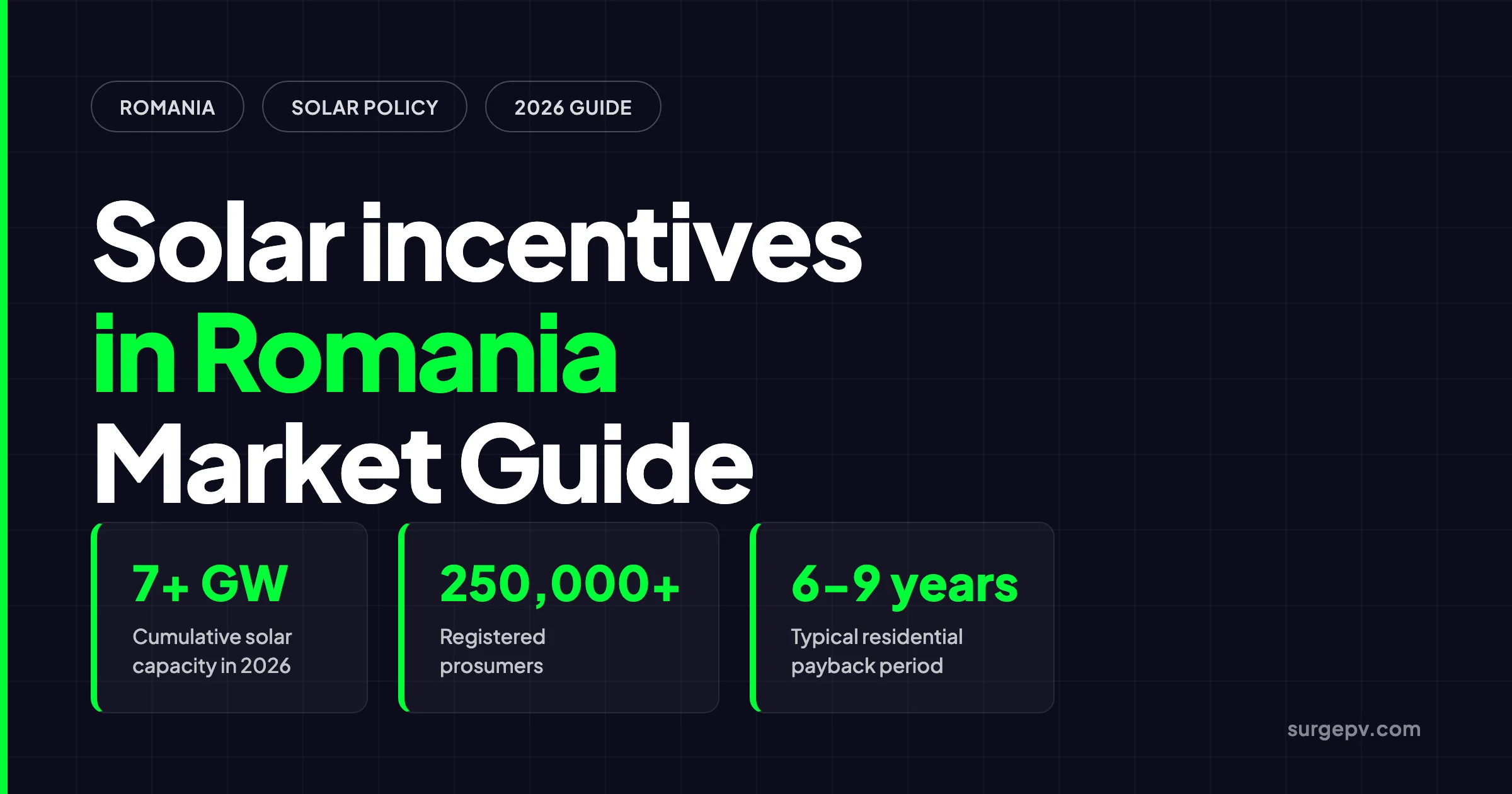
Romania solar incentives in 2026 focus on net metering compensation for prosumers up to 200 kW, the Casa Verde Baterii storage grant for existing prosumers, and CfD auctions for utility-scale projects. Casa Verde Fotovoltaice is suspended for new rooftop PV. A typical 5 kWp residential system costs €4,000-€6,000 and pays back in 6-9 years.
Romania added roughly 2.2 GW of solar in 2025, lifting cumulative installed capacity above 7 GW, according to Renewables Now and pv magazine reporting on RPIA data. That is a record for one of Europe’s fastest-growing solar markets, with IEA noting Romania among the EU countries that set new solar records in 2025. It is also a market at an inflection point. The subsidy that drove most of the residential boom, Casa Verde Fotovoltaice, is suspended for new installations in 2026. The government is redirecting money toward batteries instead of panels. Grid connection queues are long, and new ANRE rules are tightening deadlines and financial guarantees for projects above 1 MW.
For homeowners, installers, and EPCs, the question is no longer whether Romania is a good solar market. It is how to structure a project under the 2026 rules: when net metering still works, when storage is mandatory, how to access the new battery grant, and what the economics look like without the old capital subsidy. This guide answers those questions with current data, specific numbers, and the practical tradeoffs that determine whether a Romanian solar project succeeds.
This guide covers the 2026 incentive framework for Romania solar, including Casa Verde, net metering, storage mandates, tax treatment, installation costs, payback by region, and the pitfalls that delay approvals or hurt returns. For a broader view of European solar economics, see our solar installation cost per kWp Europe guide. For teams designing Romanian projects, solar design software with local tariff and incentive data can speed up accurate proposals. Use a cloud solar design platform that models net metering compensation, shadow analysis for Romanian roof geometries, and financial payback automatically. See SurgePV pricing or book a demo for Romania-specific modeling.
Quick Answer
Romania solar incentives in 2026 focus on net metering compensation for prosumers up to 200 kW, the Casa Verde Baterii storage grant for existing prosumers, and CfD auctions for utility-scale projects. Casa Verde Fotovoltaice is suspended for new rooftop PV. A typical 5 kWp residential system costs €4,000-€6,000 and pays back in 6-9 years.
TL;DR — Solar incentives in Romania 2026
Casa Verde Fotovoltaice is paused for new residential PV in 2026. Casa Verde Baterii redirects about €76 million toward storage for existing prosumers. Net metering quantitative compensation remains for systems up to 200 kW. New prosumer systems from 10.8 kW to 400 kW must include batteries. Utility-scale projects compete in CfD auctions with 15-year contracts. Residential payback is 6-9 years, with the south paying back faster than the north.
In this guide:
- Latest 2026 policy updates — Romania solar incentive status table
- Casa Verde Fotovoltaice and Casa Verde Baterii explained
- Net metering rules, capacity limits, and storage mandates
- Tax incentives and VAT treatment for Romanian solar
- Solar installation costs and payback by region
- Commercial, industrial, and utility-scale support
- Grid connection, ANRE rules, and common mistakes
- FAQ
Solar incentives in Romania 2026: Quick Answer
Romania’s solar incentive framework in 2026 is best understood as three parallel systems. The first is the prosumer regime: households and small businesses with systems up to 200 kW can use quantitative net metering, offsetting exported kilowatt-hours against future consumption over 24 months. The second is the capital-grant regime: Casa Verde Fotovoltaice, which funded more than 200,000 residential systems, is suspended for new PV in 2026, but a new Casa Verde Baterii program is expected to subsidize batteries for existing prosumers. The third is the large-project regime: utility-scale and some commercial projects compete in contracts-for-difference (CfD) auctions backed by the EU Modernisation Fund.
| Incentive | Status 2026 | Key Detail |
|---|---|---|
| Net metering quantitative compensation | Active | Up to 200 kW per consumption point; 24-month credit window |
| Casa Verde Fotovoltaice | Suspended | No new residential PV grants in 2026 |
| Casa Verde Baterii | Pending launch | ~€76 million redirected for existing-prosumer battery storage |
| Prosumer storage mandate | Active from 2026 | New systems 10.8 kW to 400 kW must include BESS |
| CfD auctions | Active | 15-year contracts; solar cap around €78/MWh |
| Green certificates | Closed to new entrants | Existing recipients continue under old rules |
| RRF / Modernisation Fund public PV | Active | €367.6 million for 831 public-sector projects (296.76 MW) |
| Accelerated depreciation / reinvested profit exemption | Active | Available to commercial investors |
The practical impact: a Romanian homeowner who installs a 5 kWp system in 2026 will likely pay €4,000-€6,000 without Casa Verde support but can still recover the investment in 6-9 years through bill savings and net metering credits. A homeowner who already has PV and adds a battery through Casa Verde Baterii may see faster self-consumption gains and better resilience against evening peak prices.
Latest updates: Romania solar policy status 2026
Romania’s solar market has been shaped by two forces in 2025-2026. On one side, deployment is accelerating. On the other, public support is pivoting from rooftop grants to storage and grid discipline.
Romania solar incentive status — mid-2026
| Program / Mechanism | Status | Key Detail |
|---|---|---|
| Casa Verde Fotovoltaice (new PV) | Suspended | No 2026 budget line for new residential rooftop PV |
| Casa Verde Baterii (storage) | Pending | |
| Prosumer net metering | Active | Quantitative compensation up to 200 kW until 31 December 2030 |
| Prosumer financial settlement | Active | 200 kW to 400 kW; surplus paid at monthly day-ahead average |
| Prosumer BESS mandate | Active | Mandatory for new systems 10.8 kW to 400 kW from 2026 |
| CfD auctions | Active | 2024 round: 1,000 MW solar; 2025 round: 1,500 MW solar |
| Green certificate scheme | Closed (legacy) | New projects ineligible; old recipients continue |
| Public-sector PV via RRF | Active | 831 projects, 296.76 MW, €367.6 million grants |
| Standalone BESS state aid | Approved March 2026 | €150 million for at least 2,174 MWh via tender |
| Grid connection reform | Active from 2026 | Capacity auctions, higher guarantees, stricter deadlines |
Key changes since 2024
Casa Verde suspension. The Casa Verde Fotovoltaice program, which historically covered up to 90% of system costs with a cap of 30,000 RON (about €6,000), was the main driver of Romania’s residential solar boom. In 2025 the session was suspended for budgetary reasons. In 2026 the funding was removed from the AFM budget for new PV and redirected to water and wastewater infrastructure, while a separate 400 million RON line was created for battery storage, according to pv magazine and local press reports.
Storage mandate. In July 2024, the Romanian Parliament passed legislation requiring battery energy storage for new prosumer systems from 10.8 kW to 400 kW, with the rules taking effect on 1 January 2026, according to Energy Trend. This aligns Romania with the broader European shift toward self-consumption and grid flexibility.
Grid connection reform. ANRE introduced new rules in 2026 to clear a backlog that RPIA estimates at over 30 GW of project applications. Key measures include capacity allocation auctions for projects above 5 MW, a guarantee of EUR 20/kW to participate, a 20% connection-fee guarantee, and strict set-up authorization deadlines. Projects with existing connection agreements above 1 MW must obtain set-up authorization by May 2027.
Key Takeaway — 2026 Incentive Priority
The most important action for Romanian solar in 2026 is to confirm which support mechanism applies before designing the system. New residential PV should be sized for net metering and self-consumption, not for the old Casa Verde grant. Existing prosumers should prepare documentation for Casa Verde Baterii as soon as the guide is published. Large projects must secure grid access before assuming CfD auction revenue.
Casa Verde Fotovoltaice and Casa Verde Baterii
Casa Verde Fotovoltaice is the name most Romanian homeowners associate with solar subsidies. Understanding why it is paused, and what replaces it, is central to Romanian solar strategy in 2026.
How Casa Verde Fotovoltaice worked
The program was administered by the Environmental Fund Administration (AFM). In recent editions it offered:
| Element | Detail |
|---|---|
| Maximum grant | 30,000 RON (~€6,000) |
| Coverage | Up to 90% of eligible system cost |
| Minimum own contribution | Historically around 3,000 RON |
| Eligible systems | Rooftop PV on residential buildings |
| Eligible components | Panels, inverter, mounting, cabling, protections, labor, and from 2024 batteries |
| Application | Online platform, first-come first-served |
From 2019 to 2024, more than 200,000 households installed PV through Casa Verde, according to installer market sources and Romanian media. The 2024 edition was famously oversubscribed: funds in some regions were exhausted within minutes of the platform opening.
Why it was suspended
The official reason is budget pressure. The Romanian government faces deficit constraints and competing infrastructure priorities. The industry view, expressed by the Association of Prosumers and Energy Communities (APCE), is that the government considers the existing prosumer base of roughly 250,000-260,000 systems large enough to justify shifting support from new generation to grid stabilization.
Roughly 1.5 billion RON that previously funded Casa Verde Fotovoltaice was moved to water and wastewater infrastructure in the 2026 AFM budget proposal, according to Romanian installer reporting. A 400 million RON line was kept for batteries.
Casa Verde Baterii: the replacement
Casa Verde Baterii is the 2026 pivot. It is designed to add battery storage to existing prosumer installations rather than fund new panels.
| Element | Detail |
|---|---|
| Budget | 400 million RON (~€76 million) |
| Target beneficiaries | Existing residential and C&I prosumers |
| Eligible equipment | Battery energy storage systems (BESS) |
| Expected launch | Autumn 2026 (guide pending) |
| Administration | AFM |
The logic is straightforward. Romania’s distribution grid is seeing rising midday solar injection and occasional overvoltage. Adding batteries to existing prosumers increases self-consumption, reduces peak injection, and improves evening supply. ANRE data cited by RPIA shows Romanian prosumers had already installed approximately 850 MW of battery storage capacity by early 2026.
What this means for timing
Households hoping for a new Casa Verde PV grant should not count on one in 2026. The realistic options are:
- Install a small system below 10.8 kW without storage and rely on net metering.
- Install a larger system with mandatory storage and finance it privately or through a green bank loan.
- If already a prosumer, apply for Casa Verde Baterii when the guide opens.
Pro Tip — Design for Net Metering, Not Grants
Without Casa Verde Fotovoltaice, the Romanian residential business case depends on low install costs, high self-consumption, and net metering credits. Size the system to match daytime load, not to maximize the grant cap. A 5 kWp system with 70% self-consumption will usually outperform a 10 kWp system that exports most of its output.
Net metering and prosumer rules in Romania
Net metering is the most important active incentive for Romanian homeowners and small businesses. The rules are more favorable than in many European markets, but they come with capacity limits and a mandatory storage requirement for larger systems.
Legal framework
Romania introduced the prosumer concept in 2018 through Law 184/2018, which transposed parts of the EU Clean Energy Package. The rules were expanded by Emergency Ordinance 143/2021 and subsequent ANRE orders, including Order 226/2018 and Order 15/2022, according to Global Law Experts and ANRE. Prosumers are final customers who own renewable generation and consume part of what they produce. The number of prosumers grew from roughly 40,000 at the end of 2022 to over 110,000 by the end of 2023, with installed capacity surging from 0.4 GW to over 1.4 GW in the same period, according to the European Policy Centre.
Key parameters in 2026:
- Maximum capacity: 400 kW per place of consumption
- Net metering compensation: Quantitative, for systems up to 200 kW
- Financial settlement: For systems 200 kW to 400 kW
- Compensation window: 24 months from billing date
- Storage mandate: Required for new systems from 10.8 kW to 400 kW from 2026
- Eligible technologies: Solar PV, wind, hydro, biomass
Quantitative compensation up to 200 kW
For systems up to 200 kW, the supplier applies quantitative compensation. Surplus kilowatt-hours exported to the grid are credited against future consumption. If exports exceed imports over the billing period, the surplus value can be carried forward for up to 24 months. If a credit remains after that, the supplier pays the prosumer the surplus value, typically when the balance exceeds 100 RON.
This is effectively 1:1 net metering on a 24-month rolling basis. It is generous because a kilowatt-hour exported at midday is worth the same as a kilowatt-hour imported in the evening, valued at the full retail rate.
Financial settlement from 200 kW to 400 kW
Systems between 200 kW and 400 kW do not receive quantitative compensation. Instead, the supplier buys surplus electricity at the weighted average day-ahead market price for the month in which the energy was produced. The prosumer’s bill then reflects the financial adjustment between sold and purchased energy.
This is closer to net billing than net metering. The export value is lower and more volatile than the retail rate, so self-consumption and load matching become critical for project economics.
Storage mandate
From 1 January 2026, new prosumer systems from 10.8 kW to 400 kW must include battery energy storage. The requirement does not specify a minimum battery size in regulations reviewed for this guide, but typical installations pair 5-10 kWh of storage per 5 kWp of PV. The goal is to shift midday solar production to evening consumption and reduce grid injection during peak solar hours.
Who still qualifies for net metering
Net metering quantitative compensation is available to:
- Households with systems up to 200 kW
- Small businesses, farms, and public institutions with systems up to 200 kW
- New and existing prosumers who request the mechanism from their supplier
The compensation window runs until 31 December 2030 under current law.
Tax incentives and VAT treatment
Romania’s tax treatment of solar is straightforward for residential prosumers but more nuanced for commercial investors.
VAT on residential solar
Residential solar installations are generally subject to the standard Romanian VAT rate of 19%. Some AFM grant programs have structured payments to cover the full invoice including VAT, but the general rule is that homeowners pay VAT. Because Casa Verde Fotovoltaice is suspended in 2026, most new residential buyers will face the full 19% VAT unless a future program says otherwise.
VAT on commercial solar
Commercial and industrial solar is also subject to 19% VAT, but VAT-registered businesses can recover input VAT through regular returns. This makes the cash-flow impact neutral for most companies. Export income from systems above 200 kW is treated as taxable supply.
Income tax treatment
Residential prosumers do not pay income tax on self-consumed solar electricity or on small surplus credits settled through the net metering mechanism. The 2018 prosumer law explicitly removed authorization and tax requirements for small renewable systems.
For businesses, solar systems are depreciated fixed assets. Romania offers two important incentives:
- Accelerated depreciation: Renewable energy assets can use accelerated depreciation for corporate tax purposes.
- Reinvested profit exemption: Profits reinvested in productive assets, including renewable energy equipment, may be exempt from profit tax up to the value of the investment.
Property tax and permits
Rooftop solar installations generally do not trigger additional property tax or require full building permits. They are treated as building-mounted technical equipment. Ground-mount systems face land-use, environmental, and grid-connection requirements that vary by location and size.
Solar costs and payback in Romania
Romania combines the lowest installation costs in the European Union, decent solar irradiance, and retail electricity prices that make solar economically attractive even without capital subsidies.
Solar installation costs Romania 2026
| System Size | Total Installed Cost | Cost Per kWp | Notes |
|---|---|---|---|
| 3 kWp | €2,400-€3,600 | €800-€1,200 | Small households |
| 5 kWp | €4,000-€6,000 | €800-€1,200 | Typical family home |
| 8 kWp | €6,400-€9,600 | €800-€1,200 | Larger homes or small businesses |
| 10 kWp | €8,000-€12,000 | €800-€1,200 | Near storage-mandate threshold |
| 50 kWp commercial | €32,500-€43,500 | €650-€870 | C&I rooftop |
All-in costs include monocrystalline PV modules, string or hybrid inverter, mounting system, DC/AC cabling, labor, grid connection application, bidirectional meter, and commissioning. Battery storage adds €4,000-€8,000 for a 5-10 kWh system.
Our solar installation cost per kWp Europe guide places Romania at €800-€1,200/kWp for residential systems, the lowest band in the EU.
Regional yield comparison
| Region | Specific Yield (kWh/kWp/year) | Residential Payback | Notes |
|---|---|---|---|
| Dobrogea (Constanța, Tulcea) | 1,300-1,450 | 5-7 years | Highest irradiance in Romania |
| Muntenia (Bucharest, Ploiești) | 1,200-1,350 | 6-8 years | Strong demand, good yields |
| Oltenia (Craiova, Drobeta) | 1,200-1,330 | 6-8 years | Very good solar resource |
| Banat (Timișoara, Reșița) | 1,150-1,300 | 6-8 years | Good yields, western humidity in winter |
| Moldova (Iași, Bacău) | 1,130-1,280 | 7-9 years | Lower irradiance than south |
| Transylvania (Cluj, Sibiu, Brașov) | 1,080-1,250 | 8-10 years | Mountain influence, longer winters |
The 25% yield gap between Dobrogea and Transylvania translates directly into payback. A system in Constanța can produce 300-400 more kWh per kWp per year than an identical system in Cluj.
Worked example: 5 kWp system in Bucharest
Consider a household in Bucharest with a 5 kWp rooftop system costing €5,000 all-in, without storage. The system produces approximately 6,250 kWh per year. The household consumes 4,375 kWh of that on-site (70% self-consumption) and exports 1,875 kWh.
- Self-consumed value: 4,375 kWh × €0.18/kWh = €788/year
- Export credit value: 1,875 kWh × €0.18/kWh = €338/year
- Total annual benefit: €1,126/year
- Simple payback: €5,000 / €1,126 = 4.4 years
This is an optimistic case with high self-consumption. A more typical household with 50% self-consumption would see:
- Self-consumed value: 3,125 kWh × €0.18/kWh = €563/year
- Export credit value: 3,125 kWh × €0.18/kWh = €563/year
- Total annual benefit: €1,126/year
- Simple payback: €5,000 / €1,126 = 4.4 years
In practice, payback usually falls in the 6-9 year range because retail rates with grid fees and taxes are higher than the wholesale component used in simple examples, but installation quotes vary and maintenance reserves are prudent.
Battery economics
Adding a 7 kWh battery for €5,500 to the same 5 kWp system raises self-consumption from 50% to roughly 75%. Annual production stays 6,250 kWh, but self-consumed energy rises to 4,688 kWh and exports fall to 1,562 kWh.
- Self-consumed value: 4,688 kWh × €0.18/kWh = €844/year
- Export credit value: 1,562 kWh × €0.18/kWh = €281/year
- Total annual benefit: €1,125/year
- Total system cost: €10,500
- Payback with battery only: €10,500 / €1,125 = 9.3 years
If the household receives a Casa Verde Baterii grant covering 50% of the battery cost (€2,750), the payback improves:
- Adjusted system cost: €7,750
- Payback: €7,750 / €1,125 = 6.9 years
Battery payback depends heavily on the grant level, battery cost, and the household’s ability to shift loads. Without a grant, batteries often lengthen simple payback but improve energy independence and resilience.
Commercial, industrial, and utility-scale support
While most homeowners care about Casa Verde and net metering, the larger Romanian solar story is commercial rooftops, corporate power purchase agreements (PPAs), and CfD auctions.
Commercial and industrial solar
C&I solar in Romania benefits from:
- Net metering quantitative compensation up to 200 kW
- Financial settlement for systems 200 kW to 400 kW
- Accelerated depreciation and reinvested profit tax exemption
- Low installation costs (€650-€870/kWp at 50-200 kWp scale)
- Simplified licensing for systems below certain thresholds
A 100 kWp commercial system with 70-80% self-consumption can achieve payback in 5-7 years in southern Romania, assuming retail electricity prices around €0.16-€0.20/kWh.
Contracts for Difference (CfD) auctions
Large-scale solar in Romania secures revenue through competitive CfD auctions organized by Transelectrica. The scheme is financed by the EU Modernisation Fund.
| Element | Detail |
|---|---|
| Contract duration | 15 years |
| Currency | Euro-denominated strike price, settled in lei |
| Solar strike price cap | Around €78/MWh |
| Wind strike price cap | Around €82/MWh |
| Auction volumes | 1,000 MW solar in 2024; 1,500 MW solar in 2025 |
| Settlement | Two-sided: generator pays back when market price exceeds strike price |
The CfD mechanism reduces merchant price risk and makes projects bankable. The strike prices are capped around €78/MWh for solar and €82/MWh for wind, with payments settled in lei, according to Mordor Intelligence and OPCOM. However, winning a CfD requires a valid grid connection permit (ATR) within six months of contract signature, which is the main bottleneck given the connection queue backlog.
Utility-scale project pipeline
Romania has a multi-gigawatt pipeline of utility-scale solar projects. Notable developments in 2025-2026 include:
- A 760 MW solar-plus-storage project near Bucharest
- A 1 GW project in northwest Romania
- DRI Energy’s 126 MW Văcărești Solar Park reaching commercial operation
- OMV Petrom and CE Oltenia’s 550 MW joint development
These projects are driven by CfDs, corporate PPAs, and merchant market exposure. More than 25 corporate PPAs had been signed in Romania by mid-2025, according to RPIA, though the market is constrained by limited tradability of guarantees of origin outside the country.
Standalone battery storage
In March 2026, the European Commission approved a €150 million Romanian state aid scheme to support at least 2,174 MWh of new standalone battery storage capacity through competitive tendering. This is separate from the Casa Verde Baterii residential program and targets grid-scale flexibility.
Grid connection, ANRE rules, and common mistakes
Romania’s solar boom has created grid congestion. The regulatory response in 2026 is stricter deadlines, higher guarantees, and capacity auctions.
ANRE grid connection reform 2026
Key changes effective from 2026 include:
- Capacity allocation auctions: For new projects above 5 MW
- Participation guarantee: EUR 20/kW upon application submission
- Connection guarantee: 20% of connection fee after solution study approval
- Set-up authorization guarantee: EUR 30/kW upon application
- Strict deadlines: Set-up authorization within 12 months of connection agreement or 18 months of ATR issue
These rules aim to clear speculative projects from the queue. The Prime Minister’s Office and Transelectrica both pushed for stronger financial discipline after the application backlog exceeded 30 GW.
Common mistakes
Mistake 1: Assuming Casa Verde Fotovoltaice will return soon. The 2026 budget does not fund new PV grants. Homeowners who delay installation waiting for the grant may miss years of bill savings. The math without the grant is still attractive in most of Romania.
Mistake 2: Oversizing without storage. Under quantitative net metering, exports are credited at the retail rate, so oversizing was less punishing than in net-billing markets. But the new storage mandate for systems above 10.8 kW means larger systems must include batteries. Designers should size storage to match consumption patterns, not just panel capacity.
Mistake 3: Ignoring regional yield differences. A system designed for Bucharest assumptions will underperform in Cluj or Iași. Use region-specific irradiance data and shading analysis before quoting.
Mistake 4: Underestimating grid connection timelines for commercial projects. Distribution operators in saturated areas may take months to approve new connections. Verify local grid capacity before signing equipment contracts.
Mistake 5: Mixing up the 200 kW and 400 kW thresholds. Systems above 200 kW lose quantitative net metering and move to financial settlement at day-ahead prices. This changes the revenue model significantly.
Tradeoff: Storage cost vs grid benefit
Batteries add €4,000-€8,000 to a residential system but are now mandatory for larger prosumer systems. They improve self-consumption, reduce grid injection, and provide backup during outages if the inverter supports islanding. The tradeoff is upfront cost versus long-term savings and resilience.
Tradeoff: Small system vs larger system with storage
Households with modest consumption may be better off installing a system below 10.8 kW without mandatory storage and using net metering. Households with higher consumption or time-of-use tariffs may benefit from a larger system with a battery that captures evening peak prices.
FAQ
What solar incentives are available in Romania in 2026?
Active Romania solar incentives in 2026 include net metering quantitative compensation for prosumers up to 200 kW, the Casa Verde Baterii storage grant for existing prosumers, corporate and utility-scale CfD auctions, and EU Recovery and Resilience Facility funding for public-sector PV. The Casa Verde Fotovoltaice rooftop PV capital grant is suspended for new installations in 2026.
Is Casa Verde Fotovoltaice still available in Romania in 2026?
No. Casa Verde Fotovoltaice is suspended for new residential PV installations in 2026. The Environmental Fund Administration has redirected roughly 400 million RON (about €76 million) toward the Casa Verde Baterii program, which funds battery storage systems for existing prosumers. Eligibility rules and launch dates for the battery program were pending as of mid-2026.
How does net metering work in Romania?
Romanian prosumers with renewable systems up to 200 kW per consumption point can request quantitative compensation from their electricity supplier. Surplus kilowatt-hours injected into the grid offset future consumption within a 24-month window. Systems between 200 kW and 400 kW receive financial settlement: the supplier buys surplus at the monthly weighted average day-ahead market price.
What is the maximum solar system size for prosumers in Romania?
Romanian prosumers can install renewable generation systems up to 400 kW per place of consumption. Systems up to 200 kW qualify for quantitative net metering compensation. Systems from 200 kW to 400 kW must sell surplus at market price. From 2026, new prosumer systems from 10.8 kW to 400 kW must include battery energy storage.
How much does a residential solar system cost in Romania in 2026?
Residential solar in Romania costs approximately €800-€1,200 per kWp all-in, the lowest range in the European Union. A typical 5 kWp turnkey system costs €4,000-€6,000 including panels, inverter, mounting, cabling, labor, and grid connection. Battery storage adds roughly €4,000-€8,000 for a 5-10 kWh lithium-ion system.
What is the solar payback period in Romania?
The solar payback period in Romania is typically 6-9 years for residential systems, with the fastest returns in Dobrogea and Muntenia (5-7 years) and longer paybacks in Transylvania and Moldova (8-10 years). Low installation costs, good solar irradiance, and retail electricity prices around €0.16-€0.20/kWh support these returns.
Are solar exports taxed in Romania?
Residential prosumers in Romania do not pay income tax on self-consumed solar electricity or on small export surpluses settled through the prosumer compensation mechanism. Legal entities treat commercial prosumer systems as fixed assets and can deduct depreciation and operating costs. VAT on residential installations is generally 19%, though eligible public programs may structure grants to cover the full invoice.
What are Romania’s solar targets for 2030?
Romania’s National Energy and Climate Plan targets 10 GW of solar capacity by 2030. Cumulative installed solar capacity reached roughly 7 GW in early 2026 after adding approximately 2.2 GW in 2025, according to industry reporting. The Romanian Photovoltaic Industry Association expects the 10 GW target to be met well before 2030 if grid access keeps pace.
Do Romanian prosumers need battery storage?
From 2026, Romanian law requires battery energy storage for new prosumer systems from 10.8 kW to 400 kW. Smaller residential systems below 10.8 kW are exempt. Existing prosumers without storage can apply for the Casa Verde Baterii grant to add batteries. Battery storage is also increasingly needed to manage grid congestion and maximize self-consumption under net metering.
What support is available for commercial and utility-scale solar in Romania?
Commercial and industrial solar in Romania benefits from accelerated tax depreciation, exemption of reinvested profit tax, and net metering up to 400 kW. Utility-scale projects compete in contracts-for-difference auctions organized by Transelectrica, with 15-year contracts and solar strike prices capped around €78/MWh. The Modernisation Fund and Recovery and Resilience Facility also finance large renewable and storage projects.
Where this fits
This article is part of SurgePV's Solar Incentives & Policy hub, which works through the topic from first principles to the decisions a project team actually has to make.

