

Answer
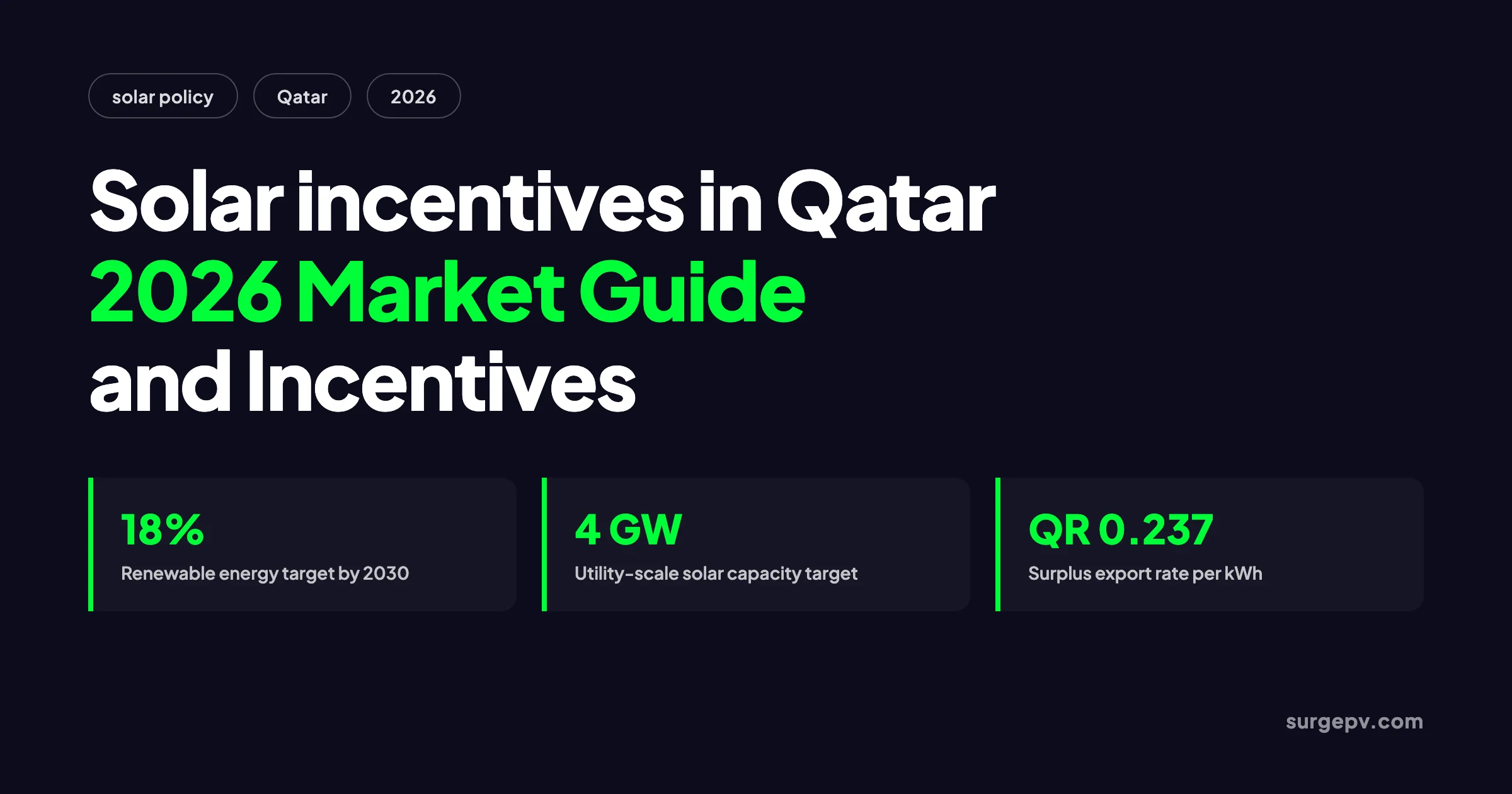
Qatar's 2026 solar incentives are anchored by the Qatar National Renewable Energy Strategy: 18% renewables by 2030, 4 GW of utility-scale solar, and 200 MW of distributed generation through Kahramaa's BeSolar service, which credits surplus exports at QR0.237/kWh. There is no direct residential tax credit; value comes from low solar LCOE, export credits, and strategic business structures.
Qatar’s solar sector reached a new scale in early 2025. The country commissioned the 875 MW Mesaieed and Ras Laffan solar complexes, adding to the 800 MW Al Kharsaah plant that has been online since October 2022. Total solar capacity now sits at roughly 1.675 GW, enough to meet 13–15% of peak electricity demand, according to Vocal Media’s Qatar renewable energy market analysis (2026). For installers, EPCs, and energy managers, the more important number is the target: 18% renewable electricity by 2030 under the Qatar National Renewable Energy Strategy.
This guide is a practical market manual, not a generic policy summary. It covers the 2026 incentive framework, how Kahramaa’s BeSolar service works, the real economics for distributed and utility-scale projects, and the pitfalls that waste money. For the regional context, see our Middle East solar compliance guide. For payback comparisons across markets, see solar payback period by country.
If you are designing systems or writing proposals for Qatari clients, a solar design platform that models local irradiance, tariff structures, and export credits can save hours per project. Model payback and export value automatically, then generate solar proposals in minutes. Check pricing or book a demo to see how SurgePV handles Qatar.
Qatar’s 2026 solar incentive stack is policy-led, not subsidy-heavy. The value comes from high solar irradiance, falling LCOE, Kahramaa’s BeSolar export credits, utility-scale IPP opportunities, and business-friendly structures rather than upfront rebates.
TL;DR — Solar Incentives in Qatar 2026
Active mechanisms: the Qatar National Renewable Energy Strategy (18% renewable electricity by 2030, 4 GW utility-scale solar, 200 MW distributed), Kahramaa’s BeSolar service with surplus exports credited at QR0.237/kWh, 100% foreign ownership of solar LLCs, and free-zone tax holidays. There is no direct residential tax credit, so commercial and industrial projects currently offer the clearest returns.
In this guide:
- Latest 2026 status of Qatar’s solar incentive framework
- QNRES targets and what they mean for project pipelines
- How Kahramaa’s BeSolar net metering service works
- Utility-scale IPP, C&I, and distributed solar routes
- Tax and business structures that reduce project cost
- Regional market conditions and the subsidized-tariff challenge
- Two real-world economic scenarios for Qatar solar
- Common mistakes and how to avoid them
Latest Updates: Qatar Solar Incentives 2026
Qatar’s renewable energy policy has moved from vision to implementation. The Qatar National Renewable Energy Strategy, launched by Kahramaa in 2024, now underpins procurement, licensing, and distributed solar programs. The first large-scale projects are already operating, and the distributed solar route is opening through BeSolar.
Qatar Solar Incentive Status — June 2026
| Incentive | Type | Status | Key Terms |
|---|---|---|---|
| QNRES renewable target | Policy target | Active | 18% renewable electricity by 2030 |
| Utility-scale solar target | Capacity target | Active | 4 GW centralized renewable capacity by 2030 |
| Distributed solar target | Capacity target | Active | 200 MW distributed solar by 2030 |
| BeSolar net metering | Export credit | Active, scaling | Surplus exported at QR0.237/kWh |
| 100% foreign ownership | Business structure | Active | Solar LLCs can be fully foreign-owned |
| Qatar Free Zones | Tax holiday | Active | 20-year zero corporate tax, zero customs duties |
| Kahramaa contractor licensing | Regulatory | Active | Required for electrical and water work |
| Residential solar subsidy | Cash rebate | Not available | No direct tax credit or upfront rebate |
Key Changes Since 2025
May 2024 — QNRES launch: Kahramaa launched the Qatar National Renewable Energy Strategy with support from 22 energy actors. The strategy set the 18% by 2030 target, the 4 GW utility-scale target, and the 200 MW distributed target. It also aims to reduce the average cost of electricity generation by 15% and annual power-sector CO2 emissions by 10% of Qatar’s total, according to ESG Mena (2024).
Early 2025 — Mesaieed and Ras Laffan online: Qatar added 875 MW of solar capacity with the commissioning of the Mesaieed and Ras Laffan complexes. This more than doubled the country’s solar output and raised total installed solar capacity to 1.675 GW, according to Vocal Media (2026).
April 2026 — BeSolar details confirmed: Kahramaa clarified that BeSolar operates through a net metering mechanism. Surplus electricity is purchased at QR0.237/kWh and credited to subsequent bills, according to The Peninsula Qatar (2026). Rooftop, carport, and ground-mounted systems are all eligible.
Dukhan Solar moves ahead: The 2,000 MW Dukhan solar project, with Samsung C&T as EPC contractor, is targeting 1,000 MW by 2028 and full completion by 2029, according to SurgePV Middle East Solar Compliance (2026).
Key Takeaway
2026 is the year Qatar’s solar market shifts from a handful of flagship IPPs to a broader pipeline. The most reliable near-term opportunities are C&I rooftop and carport projects under BeSolar, while utility-scale growth depends on Kahramaa’s IPP procurement schedule.
Why Qatar’s Solar Market Matters in 2026
Qatar has some of the best solar resources on Earth. The country receives an average of 9.5 hours of sunshine per day, and global horizontal irradiance reaches approximately 2,140 kWh per square metre annually, according to Majalla (2025). That makes fixed-tilt PV economically competitive even without large subsidies.
Market Size and Targets
Qatar’s total solar capacity reached approximately 1.675 GW in early 2026. The QNRES target is 4 GW of centralized renewable capacity by 2030, plus 200 MW of distributed solar. Renewables are expected to rise from roughly 5% of the power mix today to 18% by 2030, according to PV Know How (2026).
The economic driver is cost. The levelized cost of electricity for solar PV in Qatar fell from about 4 cents per kWh in 2017 to 1.5 cents per kWh in 2023, and is projected to reach 0.9 cents per kWh by 2030, according to PV Know How (2026). That cost curve is the real incentive.
The BeSolar Service
Kahramaa’s BeSolar service is the main route for distributed solar. Customers install rooftop, carport, or ground-mounted systems connected to the grid through bidirectional smart meters. Excess generation is exported to the grid and credited at QR0.237/kWh. The system calculates the difference between electricity consumed and exported, lowering monthly bills over time.
For solar professionals, BeSolar is the program to watch. It is not yet as mature or transparent as DEWA’s Shams Dubai, but it is the clearest path for C&I and large residential projects.
The Legal Foundation: QNRES, Kahramaa, and Distributed Generation
Qatar’s electricity sector is centralized. Kahramaa, the Qatar General Electricity and Water Corporation, is the sole off-taker for power and water projects and the regulator for distributed solar programs. QatarEnergy, through Siraj Energy, is the main sponsor of large renewable projects.
Generation Routes in Qatar 2026
| Route | Size | Permit/Approval | Typical Use |
|---|---|---|---|
| Distributed solar via BeSolar | Typically rooftop/C&I | Kahramaa application | Homes, offices, warehouses, carports |
| Utility-scale solar IPP | 100+ MW | Kahramaa PPA tender | Solar parks, independent power producers |
| Captive/self-consumption | Varies | Kahramaa approval | Industrial campuses, compounds |
| Free-zone generation | Varies | Free-zone authority | Tech parks, logistics hubs |
Kahramaa’s Role
Kahramaa performs four functions that matter for solar developers:
- Regulatory oversight: Issues licenses and monitors compliance for renewable energy systems.
- Program execution: Runs BeSolar and other distributed energy initiatives.
- Single off-taker: Signs power purchase agreements for utility-scale solar IPPs.
- Contractor approval: Maintains technical and safety standards through its Approved Contractor List.
For installers, the practical implication is that almost every solar project in Qatar must engage Kahramaa at some stage. Design, equipment, and installation must meet Kahramaa standards.
BeSolar Net Metering and Net Billing
BeSolar is Qatar’s answer to distributed solar. It is a net metering-style program with a defined export credit rate. Understanding how it credits surplus generation is essential for accurate financial modeling.
How BeSolar Works
- The customer consumes solar generation on site first.
- Excess electricity flows to the grid through a bidirectional smart meter.
- Kahramaa credits surplus exports at QR0.237/kWh against future bills.
- The customer continues to pay for net grid consumption.
Net Metering vs. Net Billing in Qatar
BeSolar functions as a hybrid. Self-consumed solar offsets the full retail tariff, which is the most valuable part of the system. Exported surplus is credited at QR0.237/kWh. That export rate is lower than the retail tariff for most customer classes, so the economics favor self-consumption maximization.
Why the Export Rate Matters
At QR0.237/kWh, exported energy is worth less than avoided grid purchases. A system that exports 40% of its generation will have a longer payback than a system that exports 10%. The standard design rule is the same as in other net-metering markets: size for 75–95% annual self-consumption, not maximum generation.
A well-modeled energy and financial modeling tool can test system sizes against actual load profiles and the QR0.237/kWh export rate.
Tax and Fiscal Incentives
Qatar does not offer a direct federal tax credit or cash rebate for residential solar buyers. The financial value comes from business structures, free zones, and project-specific arrangements.
No Residential Tax Credit
Homeowners cannot claim an investment tax credit similar to the U.S. ITC. The residential case for solar rests on bill savings through BeSolar and falling system costs. Because residential electricity is subsidized, the savings per kWh are smaller than in markets with high retail tariffs.
Corporate and Business Structures
Commercial entities can structure solar investments in ways that improve returns:
- 100% foreign ownership: The Ministry of Commerce and Industry allows full foreign ownership of LLCs for solar installation, maintenance, and sales, according to Majalla (2025).
- Qatar Free Zones: The Ras Bufontas Airport Free Zone and Um Al Houl Port Free Zone offer 100% foreign ownership, a 20-year tax holiday, zero corporate tax, and zero customs duties, according to PwC Qatar Tax Summaries (2026).
- Strategic project exemptions: Projects deemed strategically significant can apply for tax exemptions, typically for 5 or 10 years.
- Qatar Science and Technology Park: Entities with R&D activities can be fully exempt from Qatar tax.
Customs Treatment
Qatar does not apply VAT, so there is no VAT exemption to claim. Solar equipment imports are subject to standard customs procedures, though free-zone entities and strategic projects can reduce or eliminate duties. Always confirm HS codes and duty treatment with a customs advisor before procurement.
Equipment Standards and Contractor Approval
Every solar project in Qatar must meet Kahramaa’s technical and safety standards. Contractors who underestimate the approval process often face delays that erase project margins.
Kahramaa Approved Contractor List
Kahramaa maintains an Approved Contractor List for electrical and water infrastructure work. Solar installers who connect systems to the Kahramaa grid generally need to be on this list or work under an approved contractor. Registration typically requires:
- ISO 9001 quality management certification.
- ISO 45001 occupational health and safety certification.
- Evidence of qualified HSE personnel and project references.
- Insurance documentation and safety performance records.
Processing can take 2–4 months, according to SmartQHSE (2026). Build this timeline into project schedules.
Technical Standards
Kahramaa publishes technical regulations and safety standards for electrical works, including the TRSSS series. Solar installations must comply with:
- Grid connection and interconnection codes.
- Bidirectional metering requirements.
- Earthing, lightning protection, and arc-fault standards.
- Equipment certification and labeling rules.
Smart Metering
Qatar is replacing traditional meters with intelligent digital devices nationwide. The smart meter program supports real-time consumption monitoring, automated fault detection, and flexible billing. By 2034, the Qatar smart metering market is projected to grow from USD 58.09 million in 2025 to USD 105.83 million, according to IMARC Group (2026). For solar prosumers, bidirectional smart meters are the hardware that makes BeSolar settlements possible.
Practical Tip
Start the contractor and interconnection approval process before finalizing system design. Kahramaa’s requirements can influence inverter selection, metering topology, and single-line diagrams. A solar design platform that exports permit-ready documentation can cut approval cycles. Try solar design software that produces Kahramaa-ready drawings and solar proposals in one workflow.
Utility-Scale and C&I Solar Routes
The strongest 2026 opportunities in Qatar are not identical. Utility-scale developers compete in Kahramaa tenders, while C&I developers use BeSolar or captive structures.
Utility-Scale Solar IPPs
Kahramaa signs long-term power purchase agreements with IPPs. The Al Kharsaah project set the precedent: 800 MW, operational since October 2022, developed by QatarEnergy Siraj Energy with TotalEnergies and Marubeni. The Mesaieed and Ras Laffan plants added 875 MW in early 2025. The Dukhan project is next.
These projects benefit from:
- Long-term offtake by Kahramaa.
- World-class solar resource.
- Falling module and EPC costs.
- Access to international financing.
Commercial and Industrial Solar
C&I solar in Qatar is usually more attractive than residential solar. Reasons include:
- Larger rooftops and carport areas.
- Higher daytime self-consumption.
- Less reliance on subsidized residential tariffs.
- Ability to structure projects through corporate entities or free zones.
For C&I installers, the design priorities are load profiling, carport structural engineering, and PV shade analysis. Qatar’s dust and heat also affect soiling losses, so cleaning schedules and module selection matter.
Captive and Self-Consumption Models
Large compounds, industrial parks, and campuses can install solar for direct self-consumption. These projects still require Kahramaa approval but avoid the complexity of wholesale market participation.
State of the Market: Opportunities and Barriers
Qatar’s solar market is growing, but it is not yet as open as the UAE or Jordan. Three factors shape the opportunity.
The Subsidized Tariff Challenge
Residential and some commercial electricity tariffs are subsidized. That lowers the value of every kilowatt-hour saved, which weakens the payback case for smaller systems. The result is that most near-term distributed growth is in C&I and public-sector buildings rather than homes.
Institutional Centralization
Decision-making is concentrated in a small number of state entities. That makes large projects efficient once approved, but it can slow smaller distributed projects that lack a clear standardized pathway. Licensing procedures can be opaque, and coordination between Kahramaa, the Ministry of Commerce and Industry, and environmental regulators takes time, according to Majalla (2025).
World-Class Solar Resource
Qatar’s irradiance is not a policy incentive, but it acts like one. A 1 MW system in Doha will produce more annually than the same system in most European markets. That high yield compensates for the absence of large subsidies.
How to Evaluate a Qatar Solar Project: Two Scenarios
The following examples are illustrative, based on typical 2026 costs and incentive terms. Actual figures depend on system size, location, tariff, and contractor pricing.
Scenario 1 — 500 kW Commercial Rooftop, Doha Industrial Area
| Item | Amount |
|---|---|
| Gross installed cost | QAR 1,200,000 |
| Annual generation | 850,000 kWh |
| Self-consumption ratio | 85% |
| Avoided grid purchase value | QAR 280,000/year |
| Export (15%) at QR0.237/kWh | QAR 30,195/year |
| Total annual benefit | QAR 310,195 |
| Payback | 3.9 years |
High self-consumption makes this project attractive. The export credit is a secondary benefit.
Scenario 2 — 8 kW Residential Rooftop, Doha
| Item | Amount |
|---|---|
| Gross installed cost | QAR 32,000 |
| Annual generation | 13,600 kWh |
| Self-consumption ratio | 70% |
| Avoided grid purchase value | QAR 4,200/year |
| Export (30%) at QR0.237/kWh | QAR 966/year |
| Total annual benefit | QAR 5,166 |
| Payback | 6.2 years |
The residential case is viable but slower than C&I because subsidized tariffs reduce avoided costs and the export share is higher.
Common Mistakes and Misconceptions
Even experienced developers make errors in Qatar. The most expensive mistakes stem from treating Qatar like a more mature solar market.
Assuming a Mature Net Metering Program
BeSolar is real, but it is not as standardized as DEWA Shams Dubai or Jordan’s net billing framework. Application requirements, approval timelines, and technical standards are still evolving. Confirm the current process with Kahramaa before quoting.
Oversizing for Export
Because the BeSolar export rate is QR0.237/kWh, exported energy is worth less than self-consumed energy. A system sized for 100% offset will export too much and pay back slower than a right-sized system.
Ignoring Kahramaa Contractor Requirements
Electrical work on Kahramaa-connected systems requires approved contractors and compliance with technical safety rules. Using an unapproved contractor can delay interconnection or void the application.
Underestimating Soiling and Heat
Qatar’s desert climate causes dust accumulation and high module temperatures. Soiling losses of 10–20% per month are common without cleaning. Use accurate weather files and soiling assumptions in yield models.
Designing for Subsidized Tariffs
A residential system designed around a subsidized tariff will show weak returns. For C&I projects, use the actual commercial tariff. For residential projects, model the real bill impact rather than the headline tariff.
Conclusion
Qatar’s solar incentive framework in 2026 is built on targets, falling costs, and emerging distributed programs rather than direct subsidies. The Qatar National Renewable Energy Strategy sets the direction: 18% renewable electricity by 2030, 4 GW of utility-scale solar, and 200 MW of distributed generation. Kahramaa’s BeSolar service gives C&I and large residential customers a net metering-style route with surplus exports credited at QR0.237/kWh.
For solar professionals, the opportunity is to model projects accurately, navigate Kahramaa’s approval process, and avoid the mistake of oversizing for export. Tools like Clara AI and SurgePV’s generation and financial tool can automate yield, self-consumption, and payback modeling for Qatari projects.
Three actions to take now:
- Confirm BeSolar eligibility before sizing — not every building or tariff class qualifies for the same export terms.
- Size for self-consumption — exported energy in Qatar is worth less than avoided grid purchases.
- Register with Kahramaa early — contractor approval and interconnection can take longer than installation.
For regional comparisons, see our solar payback period by country guide. For installers scaling in the Middle East, our guide for solar installers covers proposal automation and compliance workflows.
Frequently Asked Questions
What solar incentives are available in Qatar in 2026?
Qatar’s main solar incentives in 2026 are policy-driven rather than cash subsidies. They include the Qatar National Renewable Energy Strategy targets of 18% renewable electricity by 2030, Kahramaa’s BeSolar distributed solar service with surplus export credits at QR0.237/kWh, utility-scale IPP opportunities, and favorable business structures such as 100% foreign ownership of solar LLCs and free-zone tax holidays. There is no direct residential tax credit.
Does Qatar have net metering for rooftop solar?
Kahramaa’s BeSolar service, launched under the Qatar National Renewable Energy Strategy, offers a net metering-style mechanism for distributed solar. Customers offset consumed electricity with self-generated solar, and surplus exports are credited at QR0.237/kWh. The program is still scaling and is less standardized than frameworks in the UAE or Jordan.
What is the maximum size for distributed solar in Qatar?
Qatar has not published a widely distributed system-size cap comparable to the UAE’s emirate-level programs. The national target is 200 MW of distributed solar by 2030. Rooftop, carport, and ground-mounted systems are accepted under Kahramaa’s BeSolar service, with sizing and interconnection determined on a project-by-project basis.
What is the Qatar National Renewable Energy Strategy?
The Qatar National Renewable Energy Strategy, or QNRES, was launched in 2024 by Kahramaa. It targets 18% renewable electricity by 2030, 4 GW of centralized renewable capacity, and 200 MW of distributed solar. The strategy also aims to cut the average cost of electricity generation by 15% and reduce annual power-sector CO2 emissions by 10% of Qatar’s total.
Are solar panels exempt from tax or import duty in Qatar?
Qatar does not have a broad VAT system, so there is no VAT exemption for solar equipment in the conventional sense. Utility-scale and C&I projects typically negotiate customs treatment through approved contractor structures, free zones, or project-specific approvals. Free-zone entities can benefit from zero customs duties and a 20-year tax holiday.
What is the typical solar payback period in Qatar?
Payback periods for commercial and industrial solar in Qatar typically range from 5 to 8 years, driven by high solar irradiance, export credits through BeSolar, and avoided grid purchases. Residential payback is harder to generalize because subsidized residential tariffs weaken the economic case and the BeSolar program is still expanding.
Can foreign companies install solar in Qatar?
Yes. Qatar’s Ministry of Commerce and Industry allows 100% foreign ownership of limited liability companies, including solar installation and maintenance firms. Contractors must register with Kahramaa and meet its technical and safety standards. Free-zone setups also allow full foreign ownership with tax and customs benefits.
What are the biggest solar projects in Qatar?
The largest operational solar facility is the 800 MW Al Kharsaah Solar IPP, which came online in October 2022. In early 2025, Qatar commissioned the 875 MW Mesaieed and Ras Laffan solar complexes, bringing national solar capacity to about 1.675 GW. The planned 2,000 MW Dukhan solar project is expected to add 1,000 MW by 2028.
Is residential solar worth it in Qatar?
Residential solar in Qatar is currently less attractive than commercial solar because residential electricity is subsidized and the BeSolar program is still scaling. For homes with high consumption, large roofs, and strong self-consumption profiles, solar can reduce bills. Most near-term growth is in commercial rooftops, carports, and industrial sites.
What is the most common mistake when planning a solar project in Qatar?
The most common mistake is assuming Qatar has a mature, standardized net metering program like the UAE. Project economics depend on whether the customer qualifies for BeSolar, the actual export rate, and the local tariff structure. Designing without a confirmed interconnection agreement and export credit terms can lead to overstated returns.
Where this fits
This article is part of SurgePV's Solar Incentives & Policy hub, which works through the topic from first principles to the decisions a project team actually has to make.

