

Answer
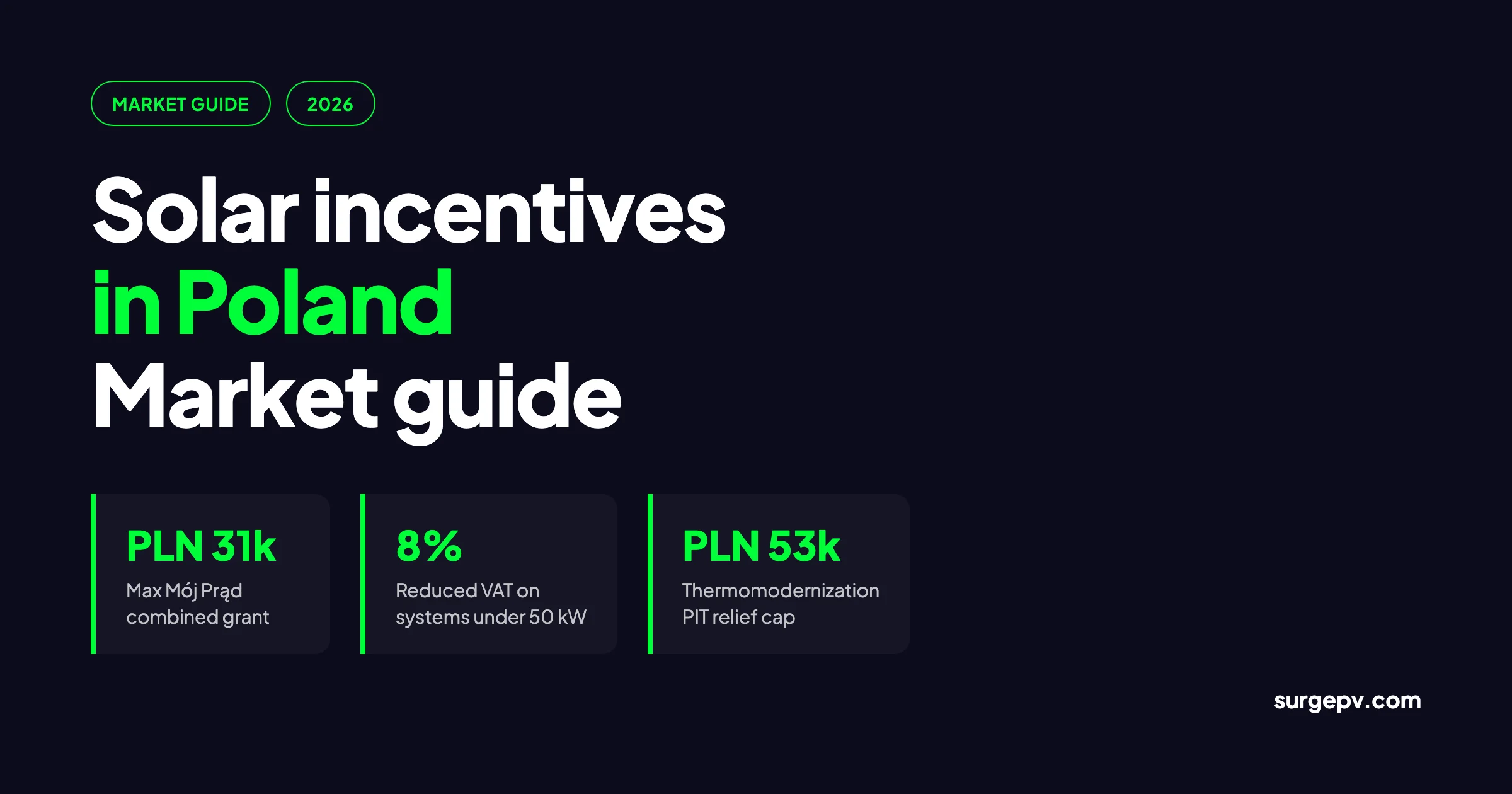
Poland's 2026 solar incentives include the Mój Prąd grant (PLN 7,000 for PV, up to PLN 31,000 with battery, heat pump and EMS), reduced 8% VAT, the Thermomodernization PIT relief up to PLN 53,000, and Czyste Powietrze subsidies up to PLN 135,000. New prosumers use net billing; legacy net metering continues for pre-April 2022 systems.
Poland’s solar market has grown faster than almost any other in Europe. The country added 3.6 GW in 2025, and cumulative capacity reached roughly 25 GW by year-end. That puts Poland among the top five solar markets in the European Union, ahead of countries with far better irradiance. The driver was not sunshine. It was a stack of grants, tax relief and favourable grid rules. That made rooftop PV one of the most accessible household investments in the country.
This guide is a practical incentive manual for installers, EPCs and property owners. It covers the full 2026 incentive stack, the net-billing transition, stacking rules, common mistakes and the programs most relevant to farmers, businesses and residential prosumers. For the broader European picture, see our European solar incentives guide. For design and proposal tools tailored to Poland, see our solar software for Poland guide.
If you design systems or write proposals for Polish clients, a cloud solar design platform with Polish tariffs and incentive templates saves hours on every project. Model payback, self-consumption and stacked incentives automatically, then generate solar proposals in minutes. Check pricing or book a demo to see how SurgePV handles Poland.
Poland’s 2026 solar incentive stack can cut net project cost by 35–55% when layered correctly. Active tools: Mój Prąd grants, reduced VAT, Thermomodernization Relief, Czyste Powietrze for bundled thermal projects, and Agroenergia for farms. The key is matching the program to the project type and sizing the system for self-consumption under net billing.
TL;DR — Solar Incentives in Poland 2026
Mój Prąd grants up to PLN 31,000 for PV plus battery, heat pump and EMS. Reduced 8% VAT applies to systems under 50 kW. Thermomodernization Relief deducts up to PLN 53,000 from taxable income. Czyste Powietrze funds PV bundled with heat-source replacement up to PLN 135,000. New prosumers use net billing. Legacy net metering continues for systems registered before April 2022.
In this guide:
- Latest 2026 status of every active Polish solar incentive
- Market context: why Poland became a top-five EU solar market
- Net metering vs net billing: what still applies and to whom
- Mój Prąd program — rates, eligible systems and application rules
- Tax incentives: reduced VAT and Thermomodernization Relief
- Czyste Powietrze and Agroenergia for bundled and agricultural projects
- Commercial, industrial and utility-scale support through OZE auctions
- Three real-world stacking examples with payback impact
- Common mistakes and how to avoid them
Latest Updates: Poland Solar Incentives 2026
The Polish solar policy environment in 2026 is defined by one word: transition. The residential market is moving from pure PV subsidies to PV-plus-storage packages. Net billing is now the default for new systems. And the national 2030 solar target has already been exceeded, so the policy focus is shifting from capacity growth to grid integration and self-consumption.
Poland Solar Incentive Status — June 2026
| Incentive | Type | Status | Key Terms |
|---|---|---|---|
| Mój Prąd residential PV grant | Capital grant | Active, Round 7 expected H1 2026 | PLN 7,000 for 2–10 kWp |
| Mój Prąd battery bonus | Capital grant | Active | Up to PLN 16,000 |
| Mój Prąd heat pump bonus | Capital grant | Active | PLN 5,000–7,000 |
| Mój Prąd EMS bonus | Capital grant | Active | PLN 3,000 |
| Reduced VAT | Tax break | Active | 8% on systems under 50 kW |
| Thermomodernization Relief | Income tax deduction | Active | Up to PLN 53,000 per taxpayer |
| Czyste Powietrze | Capital subsidy | Active | Up to PLN 135,000 for bundled thermal projects |
| Agroenergia | Capital subsidy | Cyclic calls | Up to 50% for farmers, 10–50 kW typical |
| Legacy net metering | Grid settlement | Protected until 2037 | For systems registered before April 2022 |
| Net billing | Grid settlement | Default for new systems | Hourly market price for exports |
| Virtual prosumer | Regulatory | Active since July 2024 | Share in nearby solar farm |
| OZE auctions | Price support | Annual rounds | 15-year contracts for utility-scale |
Key Changes Since 2024
September 2025 — Mój Prąd 6.0 budget extension: The sixth round received more than 121,000 applications. The budget was expanded to PLN 1.85 billion, with over PLN 1 billion allocated to energy storage. This confirmed that Polish solar policy now prioritizes batteries over pure PV.
July 2024 — Virtual prosumer model: Poland introduced virtual prosumers, allowing consumers without rooftops to buy shares in nearby solar farms and settle under prosumer rules. The model mirrors Italian energy communities and Spanish collective self-consumption.
April 2022 — Net billing transition: New prosumer systems no longer receive net metering. They sell surplus at the monthly average market price and buy at full retail rates. This change made self-consumption and storage central to project economics.
Key Takeaway
2026 is not about installing as much PV as possible. It is about maximizing self-consumed kWh. Grants, VAT relief and tax deductions still work, but net billing rewards the installer who sizes systems for consumption, not generation.
Why Poland’s Solar Market Matters in 2026
Poland does not have Southern European sunshine. Average annual solar irradiance is roughly 950–1,150 kWh/m², comparable to Northern Germany. Yet the country has installed almost 25 GW of solar capacity. The reason is policy design, financing access and a large stock of single-family homes with suitable roofs.
Market Size and Targets
Poland installed 3.6 GW of solar in 2025, according to Agencja Rynku Energii data reported by PV Magazine (2026). That is down from 4 GW in 2024, but still substantial. Cumulative capacity reached 24.8 GW under ARE data, or 25.5 GW under Polskie Sieci Elektroenergetyczne (PSE) figures. The PSE number includes some large farms connected in late 2025 that ARE counted in early 2026.
Over half of 2025 additions were systems between 50 kW and 10 MW. These cover commercial, industrial and medium-sized solar farms connected to the medium- and high-voltage grids. The prosumer segment under 50 kW slowed to just under 1 GW in 2025, down from 1.3 GW in 2024.
Poland’s National Energy and Climate Plan (KPEiK) originally targeted 23 GW of solar by 2030. That target has already been exceeded. The government is expected to revise the target upward in the next NECP update, with industry observers suggesting 30–35 GW as a plausible new goal.
What the Slowdown in Prosumer Growth Means
The slowdown in small residential systems is not a demand collapse. It is a market maturation. Early adopters already have panels. New customers face net billing, which makes the economics more sensitive to self-consumption. installers report that proposals now need to show battery payback, not just panel payback.
For solar professionals, the competitive edge is accurate modelling. A proposal that assumes net-metering-style 1:1 offset will underperform in reality. Tools that model hourly self-consumption, battery dispatch and Polish market prices produce more credible payback forecasts. That is where a generation and financial tool built for Poland becomes useful.
Net Metering vs Net Billing in Poland
Every Polish solar incentive sits on top of a grid settlement framework. Understanding the difference between the old and new rules is essential for correct sizing and honest payback projections.
Legacy Net Metering (Opusty)
Systems registered before April 1, 2022 continue under net metering for 15 years from registration. The rules are simple:
- Systems up to 10 kW: 1 kWh exported earns 1 kWh credit.
- Systems from 10 kW to 50 kW: 1 kWh exported earns 0.7 kWh credit.
- Credits roll over for up to one year.
- The system must remain connected under the same ownership and capacity to keep the status.
Protection lasts until 2037 for the last pre-2022 systems. This creates a two-tier prosumer population. Installers must be careful when upgrading pre-2022 systems. A large panel addition or inverter replacement can trigger reclassification to net billing, wiping out the grandfathered status.
Net Billing (Rozliczenie Net Billing)
Systems registered after April 1, 2022 operate under net billing. The mechanism is monthly financial settlement:
- Exported kWh are paid at the monthly average market price, known as RCEm, typically PLN 0.40–0.70/kWh depending on the month.
- Imported kWh are charged at the full retail tariff, including distribution, fees and taxes, typically PLN 0.85–1.20/kWh for households.
- The difference is settled in cash each month or accumulated as a prosumer deposit.
- Unused annual credits above 20% of exported energy value are forfeited.
The spread between retail purchase and wholesale export makes self-consumption roughly two to three times more valuable than export. Correct sizing therefore targets consumption coverage, not maximum yield.
Virtual Prosumer
From July 2024, consumers without a suitable roof can become virtual prosumers. They purchase a share in a nearby solar farm’s capacity. The farm’s generation is netted against their consumption using the same prosumer settlement rules. This opens community solar models for apartment dwellers, renters and small businesses.
Mój Prąd: Poland’s Main Residential Solar Grant
Mój Prąd, or My Electricity, is Poland’s flagship residential solar subsidy. It is managed by the National Fund for Environmental Protection and Water Management (NFOŚiGW, 2026) and delivered through regional WFOŚiGW portals. Applications are submitted via the Mój Prąd portal (2026). The program has run through multiple rounds since 2019 and has been the single largest driver of household solar adoption.
Mój Prąd 6.0 and 7.0 Grant Rates
| Component | Typical Grant | Notes |
|---|---|---|
| PV system (2–10 kWp) | PLN 7,000 | Base grant for residential prosumers |
| Battery storage | Up to PLN 16,000 | Capacity requirements apply per round |
| Heat pump | PLN 5,000–7,000 | Must meet efficiency criteria |
| EMS / HEMS | PLN 3,000 | Smart energy management system |
| Maximum combined package | Up to PLN 31,000 | Subject to co-financing limits |
The base PV-only grant is roughly PLN 1,200 per kWp. A 6 kWp system therefore receives approximately PLN 7,000. The battery bonus is the most important change in recent rounds. Poland has shifted Mój Prąd from a PV subsidy to a storage subsidy because of grid congestion and the duck curve.
Eligibility Rules
Typical requirements include:
- The applicant is a natural person, not a company.
- The installation is a micro-installation of 2–10 kW connected after February 1, 2020.
- The system is connected under a prosumer agreement with the local distribution system operator.
- A certified installer performs the installation.
- Net billing or net metering settlement applies.
Each round publishes its own technical criteria, eligible equipment lists and documentation requirements. The safe practice is to download the current terms before signing a contract.
Application Process
- Install the system and obtain a grid connection confirmation from the DSO.
- Register on the official portal and submit the online application.
- Attach invoices, payment proofs, technical documentation and photos.
- Wait for verification, typically up to 60 days.
- Receive the grant payment by bank transfer.
Grants are paid after installation. They are reimbursements, not upfront payments. Homeowners and installers should not treat the grant as a deposit.
Why Mój Prąd Is Now a Storage Program
In the September 2025 round, the budget for energy storage exceeded PLN 1 billion. The reason is grid stability. Poland now has over 1.3 million prosumers. Summer afternoon solar generation frequently exceeds local demand, causing overvoltage and inverter shutdowns. Batteries absorb excess production, increase self-consumption and reduce export-driven grid stress.
For installers, this means the default 2026 proposal should include a battery option. A PV-only system under net billing often has a longer payback than a smaller PV-plus-battery system with a higher self-consumption ratio.
Tax Incentives: VAT and Thermomodernization Relief
Poland offers two significant tax layers for residential solar. Both are easy to claim but interact with grants in specific ways.
Reduced VAT
Poland applies an 8% VAT rate on solar systems under 50 kW for residential and agricultural use. It also applies to installation services for those systems. The standard rate is 23%.
On a PLN 35,000 gross system, the 8% rate means VAT of PLN 2,590. At the standard 23% rate, VAT would be PLN 7,840. The saving is PLN 5,250, or roughly 15% of the net system cost.
The reduced rate applies to turnkey installations intended primarily for self-consumption. Equipment sold separately without installation is usually taxed at 23%. The installer must structure the invoice correctly.
Thermomodernization Relief (Ulga Termomodernizacyjna)
Under Article 26h of the Polish PIT Act, property owners can deduct qualifying energy modernization costs from taxable income. The lifetime cap is PLN 53,000 per taxpayer. Co-owners can each claim a proportional share.
Eligible costs include:
- Solar PV modules, inverters and mounting
- Solar thermal collectors
- Heat pumps and geothermal systems
- Insulation and window replacement
- Biomass boilers
The deduction is from taxable income, not from tax liability. The actual saving depends on the marginal tax rate:
- At 12%: PLN 53,000 × 0.12 = PLN 6,360 saving
- At 32%: PLN 53,000 × 0.32 = PLN 16,960 saving
Unused deductions can be carried forward for up to six years. This makes the relief more flexible than many European tax credits.
Stacking Grants with the Relief
Mój Prąd and the Thermomodernization Relief can be stacked. However, the grant amount must be subtracted from the cost base before claiming the deduction.
Example: A PLN 30,000 system receives a PLN 7,000 Mój Prąd grant.
- Net cost after grant: PLN 23,000
- Thermomodernization deduction base: PLN 23,000
- Tax saving at 12% rate: PLN 2,760
- Tax saving at 32% rate: PLN 7,360
The combined benefit is PLN 9,760 to PLN 14,360, plus the VAT saving of PLN 3,450 compared with the standard rate. This is how a PLN 30,000 system can have an effective net cost below PLN 20,000.
Czyste Powietrze: Subsidies for Bundled Thermal Projects
Czyste Powietrze, or Clean Air (NFOŚiGW, 2026), is Poland’s largest building renovation program. It funds heat-source replacement, insulation, ventilation and related works. Solar PV is eligible, but only when bundled with a qualifying thermal intervention.
Program Structure
The program has three income tiers. Maximum subsidy amounts vary by tier and project scope.
| Tier | Typical Max Subsidy | Income Criteria |
|---|---|---|
| Basic | Up to PLN 66,000 | Household income up to PLN 135,000/year |
| Elevated | Up to PLN 99,000 | Per-capita income thresholds apply |
| Highest | Up to PLN 135,000 | Lowest-income households |
Solar PV typically accounts for 25–40% of a bundled project cost. The program can cover up to 90–100% of qualifying costs for the lowest-income tier, though the actual share depends on the full project scope.
When Czyste Powietrze Beats Mój Prąd
Czyste Powietrze is the better choice when a homeowner must replace a coal boiler or install a heat pump. The grant envelope is far larger than Mój Prąd. A homeowner replacing a heat pump and adding PV plus a heat storage tank can receive PLN 50,000–100,000 in support.
Czyste Powietrze is not suitable for a standalone PV installation. The program requires a heat-source replacement and often a building energy audit.
Application and Documentation
Applicants must:
- Own a single-family home built before 2021.
- Have owned the property for at least three years, unless inherited.
- Submit an energy audit before work begins.
- Use equipment from the ZUM list (Green Devices and Materials List).
- Obtain a post-installation energy performance certificate.
Municipalities and voivodeship funds act as program operators for the elevated and highest tiers. The basic tier can often be applied for through banks or online portals.
Agroenergia and Rural Solar Support
Polish farmers have access to dedicated solar support through Agroenergia and related rural programs. Agriculture is a natural fit for solar: farms have large roof areas, daytime consumption and stable long-term ownership.
Agroenergia Program
Agroenergia provides capital subsidies for agricultural solar installations. Typical parameters:
- Systems from 10 kW to 50 kW for individual farmers.
- Up to 200 kW for cooperatives and producer groups.
- Subsidy intensity of 20–40%, with additional premiums for storage and heat pumps.
- Maximum amounts vary by round, historically around PLN 25,000 per 10 kW.
Farmers can also combine Agroenergia with the 8% reduced VAT rate and the Thermomodernization Relief for eligible residential portions of farm buildings.
Energia dla Wsi
Energia dla Wsi, or Energy for the Village, supports rural municipalities and their residents with PV, heat pumps and storage. Subsidy intensity ranges from 45% to 60%. The program is administered by NFOŚiGW and is particularly relevant for villages with poor grid capacity or high heat demand.
Why Farms Need Storage More Than Cities
Agricultural loads are often seasonal. A farm may use most electricity during harvest, drying or irrigation periods. Without a battery, a spring or summer solar surplus is exported cheaply and bought back at full retail in autumn. Storage and load-shifting are therefore more valuable for farms than for typical urban households.
Commercial, Industrial and Utility-Scale Incentives
Large-scale solar in Poland operates under a different framework than residential prosumer systems. The economics are driven by auctions, corporate PPAs and grid-scale merchant revenue rather than grants.
OZE Auctions
Poland holds annual auctions for renewable energy under the Odnawialne Źródła Energii (OZE) Act. The Energy Regulatory Office (URE, 2026) conducts the auctions. Winning projects receive 15-year price support contracts. The July 2025 auction saw solar win 178 of 181 successful bids, according to PV Magazine (2026).
Auctions are technology-specific and size-specific. Solar competes mainly in the “renewable energy sources other than wind” baskets. Strike prices have fallen over time as the market matured. For developers, the auction provides long-term revenue certainty that supports bankable project finance.
Corporate PPAs and Merchant Projects
Large C&I consumers are increasingly signing direct power purchase agreements with solar farms. The PPA fixes a long-term electricity price, hedging against retail volatility. Off-site solar does not qualify for prosumer net billing or Mój Prąd, but it avoids the complexity of rooftop installation.
C&I Rooftop Economics
Commercial and industrial rooftop solar operates under net billing if connected under prosumer rules. The financial case rests on avoided grid purchases during daytime operation. For factories, warehouses and logistics centres with high daytime loads, payback can be shorter than residential systems even without grants.
Accurate load profiling is critical. A warehouse with night-time refrigeration will have a very different self-consumption ratio than a factory running daytime shifts. Solar shadow analysis and hourly consumption modelling are standard for C&I proposals.
How to Stack Incentives: Three Real-World Scenarios
The following examples are illustrative. Actual figures depend on the Mój Prąd round, installer pricing, electricity tariff and location.
Scenario 1 — 5 kWp Residential with Battery, Warsaw
| Item | Amount |
|---|---|
| Gross installed cost | PLN 32,000 |
| Reduced VAT saving vs 23% | −PLN 4,800 |
| Net cost at 8% VAT | PLN 27,200 |
| Mój Prąd PV grant | −PLN 7,000 |
| Mój Prąd battery grant | −PLN 10,000 |
| Net after grants | PLN 10,200 |
| Thermomodernization Relief at 12% | −PLN 1,224 |
| Effective net investment | PLN 8,976 |
| Annual electricity bill saving | PLN 3,800 |
| Payback | 2.4 years |
Without incentives, the same system would pay back in roughly 8–10 years.
Scenario 2 — 6 kWp PV Bundled with Heat Pump, Kraków
| Item | Amount |
|---|---|
| Total project cost | PLN 95,000 |
| Czyste Powietrze subsidy (elevated tier) | −PLN 50,000 |
| Net project cost | PLN 45,000 |
| Of which PV share | PLN 22,000 |
| Thermomodernization Relief at 12% on PV | −PLN 2,640 |
| Effective PV net cost | PLN 19,360 |
| Annual heating and electricity saving | PLN 6,500 |
| Project payback | 7 years |
This scenario shows why Czyste Powietrze is powerful for homeowners who need a new heating system anyway.
Scenario 3 — 30 kWp Agricultural Rooftop, Greater Poland
| Item | Amount |
|---|---|
| Gross installed cost | PLN 120,000 |
| Reduced VAT saving vs 23% | −PLN 18,000 |
| Agroenergia subsidy (30%) | −PLN 36,000 |
| Net after incentives | PLN 66,000 |
| Annual avoided electricity cost | PLN 22,000 |
| Payback | 3 years |
Farms with high daytime loads and large roofs can achieve short paybacks even under net billing because self-consumption is high.
Common Mistakes and Misconceptions
Polish solar projects fail or underperform for predictable reasons. Here are the most common errors.
Oversizing for Export
This is the single most expensive mistake under net billing. A 10 kWp system on a household that consumes most electricity at night will export most generation at PLN 0.50/kWh and buy back at PLN 1.00/kWh. A smaller system or a battery would deliver a better return.
Ignoring the Net-Metering Reclassification Risk
Pre-April 2022 prosumers who add panels or replace inverters may lose their grandfathered net-metering status. Most DSOs treat inverter replacement as a trigger for reclassification. Always confirm the technical interpretation with the local DSO before quoting an upgrade.
Assuming Grants Pay Upfront
Mój Prąd, Agroenergia and Czyste Powietrze all pay after installation and verification. The homeowner must finance the full cost during construction. Installers who promise the grant as a down payment are misrepresenting the program.
Applying for the Wrong Program
A standalone PV system should use Mój Prąd or the Thermomodernization Relief. A full heating replacement should use Czyste Powietrze. Applying to Czyste Powietrze for PV alone will be rejected. Applying only to Mój Prąd when a heat pump replacement is planned leaves money on the table.
Misclassifying VAT
Equipment sold without installation is taxed at 23%. Only turnkey residential installations under 50 kW qualify for 8%. Incorrect invoicing can lead to tax authority reassessment.
Missing the Mój Prąd Window
Mój Prąd rounds have fixed budgets and close when funds are exhausted. The highest-demand rounds close within weeks. Preparing the application package before the round opens is the only reliable way to secure funding.
Conclusion
Poland’s solar incentive framework in 2026 is a mature stack built around self-consumption. The Mój Prąd grant remains the anchor, but its purpose has shifted from boosting PV capacity to promoting storage. Reduced VAT and the Thermomodernization Relief remain reliable for most homeowners. Czyste Powietrze is the right tool for renovation projects. Agroenergia serves farmers. OZE auctions drive utility-scale growth.
For solar professionals, the competitive advantage is no longer just installation price. It is the ability to model the full stack, choose the right program, and size systems for self-consumption under net billing. Tools like Clara AI and SurgePV’s generation and financial tool can automate that workflow for Polish projects.
Three actions to take now:
- Model self-consumption first — under net billing, every exported kWh is worth less than half a self-consumed kWh.
- Check the program fit before quoting — Mój Prąd for PV and storage, Czyste Powietrze for heating replacement, Agroenergia for farms.
- Prepare Mój Prąd applications early — budgets are finite and rounds close fast.
For the broader European context, see our European solar incentives guide. For installers looking to scale in Poland, our solar software for Poland guide covers net-billing modelling and grid documentation.
Frequently Asked Questions
What solar incentives are available in Poland in 2026?
Poland’s 2026 solar incentives include the Mój Prąd capital grant for residential PV. A 2–10 kWp system receives about PLN 7,000, with bonuses for battery, heat pump and EMS up to PLN 31,000. Other layers are reduced 8% VAT on systems under 50 kW and the Thermomodernization PIT relief up to PLN 53,000. Czyste Powietrze offers up to PLN 135,000 for bundled thermal projects. Agroenergia supports farms, and 15-year OZE auction contracts support utility-scale projects.
How much is the Mój Prąd grant for solar panels in 2026?
Mój Prąd provides approximately PLN 7,000 for a residential PV system of 2–10 kWp. A battery storage bonus can add up to PLN 16,000, a heat pump bonus PLN 5,000–7,000, and an EMS bonus PLN 3,000. The maximum combined package can reach PLN 31,000, though grant amounts are confirmed only when each program round opens. Round 7 is anticipated in the first half of 2026.
What is the difference between net metering and net billing in Poland?
Net metering applies to Polish solar systems registered before April 1, 2022. Exported kWh earn credits at a favourable ratio (1:1 for systems up to 10 kW, 1:0.7 for 10–50 kW) for 15 years from registration. Net billing applies to systems registered after that date. Surplus is sold to the grid at the monthly average market price. It is bought back at the full retail rate, so self-consumption is much more valuable than export.
Can I get a VAT reduction on solar panels in Poland?
Yes. Poland applies a reduced 8% VAT rate on solar systems under 50 kW for residential and agricultural use. It also applies to installation services for those systems. The standard VAT rate is 23%, so the 15-point reduction saves roughly PLN 5,250 on a PLN 35,000 system.
What is the Thermomodernization Relief in Poland?
Ulga termomodernizacyjna is a Polish personal income tax deduction for energy-efficiency investments in single-family homes. Taxpayers can deduct qualifying costs up to a lifetime cap of PLN 53,000 from taxable income. The actual tax saving depends on the marginal rate: PLN 6,360 at the 12% rate or PLN 16,960 at the 32% rate. Unused amounts can be carried forward for up to six years.
Is the Czyste Powietrze program available for solar panels?
Czyste Powietrze funds comprehensive thermal modernization and heat-source replacement in single-family homes. Solar PV is eligible only as part of a bundled project that includes a qualifying heat source such as a heat pump or biomass boiler. The program offers three tiers based on income, with maximum subsidies of PLN 66,000, PLN 99,000 or PLN 135,000.
Can I combine Mój Prąd with the Thermomodernization Relief?
Yes. Mój Prąd grants can be combined with the Thermomodernization Relief, but the grant amount is excluded from the PIT deduction base. For example, on a PLN 30,000 system that receives a PLN 7,000 Mój Prąd grant, the deductible base is PLN 23,000, not the full invoice. This is the standard de minimis stacking rule.
What is a virtual prosumer in Poland?
A virtual prosumer is a consumer who does not own a rooftop but buys a share in a nearby solar farm. Generation is settled under the prosumer net-billing framework. The model was introduced in July 2024 and allows tenants, apartment residents and others without suitable roofs to participate in solar self-consumption.
Are farmers eligible for solar subsidies in Poland?
Yes. The Agroenergia program supports farmers installing solar systems, typically 10–50 kW for individual farms and up to 200 kW for cooperatives. It can cover up to 50% of eligible costs. Farmers can also use the 8% reduced VAT rate and the Thermomodernization Relief where applicable.
What is the main mistake when sizing a solar system in Poland?
The most expensive mistake is oversizing for export. Under net billing, exported electricity is paid at the wholesale market price while purchased electricity costs the full retail rate. A system sized for high self-consumption, often paired with a battery, delivers a much better return than a larger system that exports most of its generation.
Where this fits
This article is part of SurgePV's Solar Incentives & Policy hub, which works through the topic from first principles to the decisions a project team actually has to make.

