

Kuwait’s solar market is at a turning point. After years of planning, the country is moving from small pilot projects to competitive utility-scale tenders and its first structured residential rooftop pilot. Yet the market remains unusual. Residential electricity is among the cheapest in the world, there is no national net metering law, and the installed solar base is still tiny by Gulf standards.
Kuwait’s total renewable capacity stood at 114 MW at the end of 2025, unchanged from 2024, according to IRENA data reported by Zawya (2026). That makes Kuwait the smallest renewable market in the GCC by a wide margin. For installers, developers, and property owners, the real question is not whether Kuwait will build solar. It is which incentives exist today and how to design projects that work under them.
This guide covers the 2026 policy framework, the Shagaya tender pipeline, the new residential pilot, net billing versus net metering, the tariff subsidy challenge, and the design choices that matter in one of the world’s hottest climates. If you are modelling Kuwait projects, SurgePV’s solar design software can factor in local irradiance, temperature derating, and compensation rules.
Quick Answer
Kuwait’s 2026 solar incentives are dominated by utility-scale procurement, not rooftop subsidies. There is no national retail net metering programme, but a 10 kW residential pilot with net billing began in 2026, while KAPP tenders drive large solar parks including a 1.1 GW project at Shagaya.
In this guide:
- Latest 2026 status of Kuwait’s solar policy and incentives
- Why Kuwait’s solar resource is world-class but deployment is slow
- The legal framework: MEW, KAPP, KISR, and the 2024 target update
- Shagaya Renewable Energy Park and the 1.1 GW Phase III tender
- The 2026 residential rooftop pilot: size cap, equipment, and net billing
- Net billing versus net metering and what it means for payback
- Tax, customs, and fiscal incentives for solar projects
- Commercial and industrial solar economics
- How extreme heat changes system design
- Common mistakes and how to avoid them
Latest Updates: Kuwait Solar Incentives 2026
Kuwait’s renewable energy policy accelerated in 2024 and 2025. The government raised its 2030 target, announced Shagaya expansion, issued a major utility tender, and launched a limited residential rooftop pilot. However, the country still lacks the retail net metering or feed-in tariff programmes that have driven rooftop solar in neighbouring markets.
Kuwait Solar Incentive Status — June 2026
| Incentive | Type | Status | Key Terms |
|---|---|---|---|
| Utility-scale solar tenders | Procurement | Active | KAPP-led, including 1.1 GW Shagaya Phase III |
| Shagaya Renewable Energy Park | Utility-scale project | Expanding | PV, CSP, wind, and storage; Phase III tender in 2025 |
| Residential rooftop pilot | Distributed solar | Pilot (2026) | 10 kW cap, MEW-approved equipment, net billing |
| Retail net metering | Billing mechanism | Not available | No national programme as of mid-2026 |
| MEW renewable target | Policy | Active | 30% renewable electricity by 2030 |
| Long-term target | Policy | Active | 50% renewable electricity by 2050 |
| Carbon neutrality | Climate commitment | Active | 2060 target announced at COP27 |
| Energy efficiency target | Demand reduction | Active | 10% demand reduction by 2030 vs 2020 |
| Subsidised electricity | Market condition | Active | KWD 0.002/kWh residential, low avoided-cost value |
Key Changes Since 2024
April 2024 — Target upgrade: Kuwait updated its renewable energy goals to 30% of electricity from renewables by 2030 and 50% by 2050, according to Kuwait’s official e-Government portal (2024). The previous target was 15% by 2030. The same announcement confirmed Shagaya Phase II and III would add 5,000 MW to the grid, plus 2,500 MW of energy systems.
June 2025 — Shagaya Phase III tender: KAPP and the Ministry of Electricity, Water and Renewable Energy issued a request for proposals for the 1.1 GW Al Dibdibah Power and Al Shagaya Renewable Energy Phase III Zone I project, according to PV Magazine (2025). The project includes a 400 kV substation and a 30-year power purchase agreement.
2026 — Residential pilot launch: Kuwait began its first structured residential rooftop solar pilot, allowing selected households to install systems up to 10 kW with grid connection, according to Deye Inverters market guidance (2026). The pilot uses net billing rather than net metering and requires MEW-approved equipment and registered installers.
Key Takeaway
2026 is a year of transition. The most reliable opportunities are utility-scale tenders and early commercial and industrial self-consumption projects. Residential solar is still a pilot programme, and low subsidised tariffs mean household payback periods remain long.
Why Kuwait’s Solar Market Matters in 2026
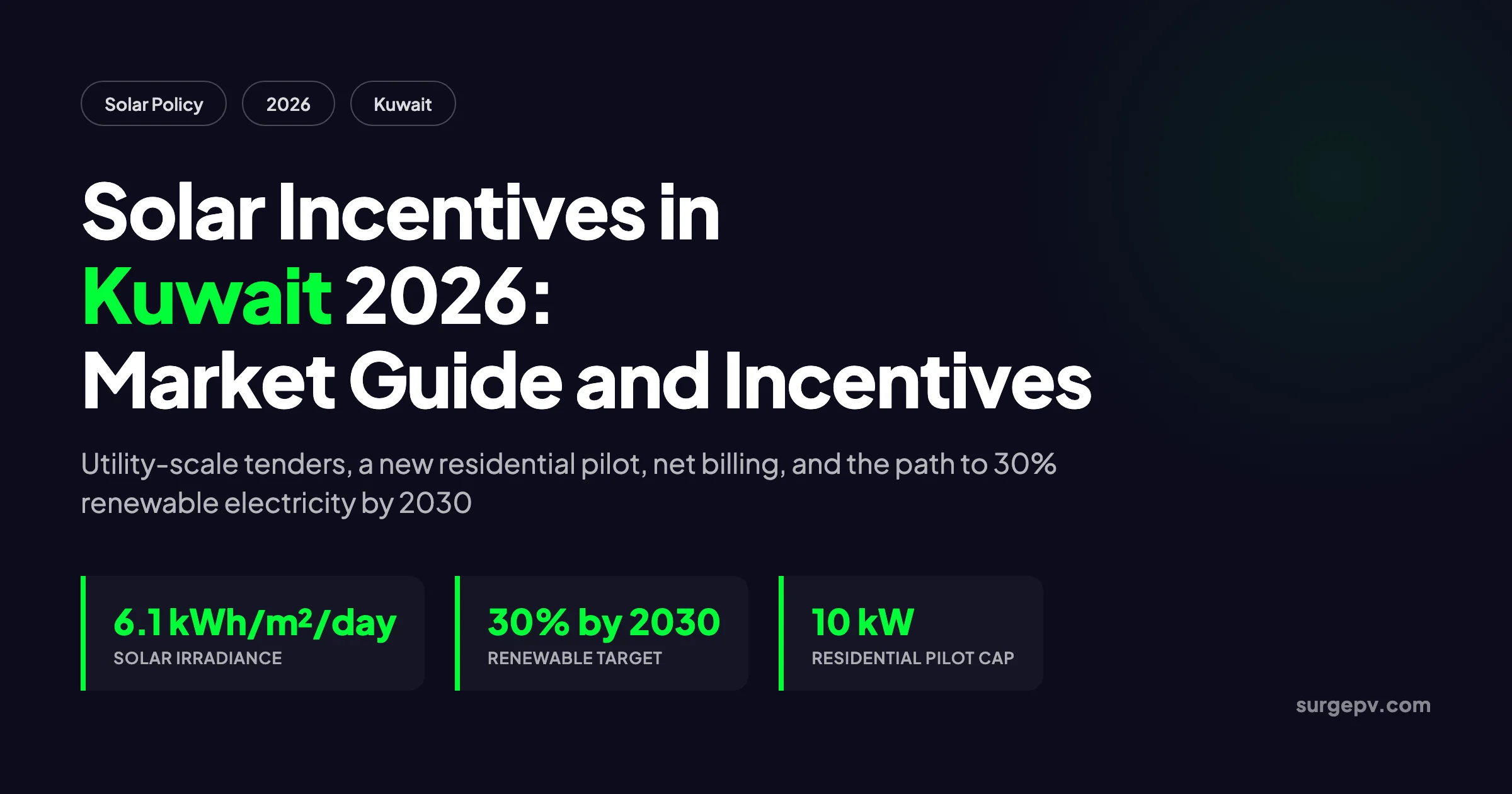
Kuwait has some of the best solar resources on Earth. The country averages roughly 6.1 peak sun hours per day and solar irradiance of about 6.1 kWh/m²/day, according to Deye Inverters (2026). That places it well above most European markets and on par with the sunniest parts of the Gulf.
Market Size and Targets
Despite the excellent resource, deployment has been slow. Kuwait’s total renewable capacity was 114 MW at the end of 2025, unchanged from 2024, according to IRENA data reported by Zawya (2026). By comparison, Saudi Arabia reached 12,332 MW and the UAE reached 7,907 MW in the same year.
The government aims to change that trajectory. Kuwait now targets 30% renewable electricity by 2030 and 50% by 2050, according to Kuwait’s official e-Government portal (2024). Longer-term industry forecasts see Kuwait reaching 2.9 GW of solar by 2030 and over 10 GW by 2035, according to SurgePV Middle East Solar Compliance (2026).
The Subsidy Problem
The biggest barrier to rooftop solar is not sunlight or policy complexity. It is the price of electricity. Residential tariffs are heavily subsidised at roughly KWD 0.002 per kWh, while commercial and industrial rates are significantly higher at KWD 0.015–0.025 per kWh, according to Deye Inverters (2026). Because solar savings are measured against the tariff you avoid, a low tariff means a low value per kilowatt-hour.
For solar professionals, the practical implication is clear: the best short-term opportunities are not residential bill-offset projects. They are utility-scale tenders, commercial and industrial self-consumption, and off-grid or behind-the-meter installations where the avoided cost is higher.
The Legal Foundation: MEW, KAPP, and the 2024 Policy Shift
Kuwait’s renewable energy governance involves three main entities. The Ministry of Electricity, Water and Renewable Energy (MEWRE, formerly MEW) sets policy and procures power. The Kuwait Authority for Partnership Projects (KAPP) manages public-private partnership tenders. The Kuwait Institute for Scientific Research (KISR) leads technical research and pilot programmes.
Key Institutions
| Institution | Role | Relevance to Solar |
|---|---|---|
| MEWRE | Policy, procurement, grid codes | Sets renewable targets, runs residential pilot, signs PPAs |
| KAPP | PPP tender management | Issues utility-scale solar tenders such as Shagaya Phase III |
| KISR | Research and pilots | Tests technology, supports Shagaya development |
| KAPP-qualified developers | Private consortia | Bid and build utility-scale projects |
The March 2024 Policy Announcement
In March 2024, MEWRE announced a strategy that included the 30% by 2030 renewable target, a 10% energy demand reduction target by 2030 compared with 2020, and carbon neutrality by 2060, according to Kuwait’s official e-Government portal (2024). The same announcement confirmed the start of Shagaya Phase II and III, with a combined 5,000 MW of generation capacity plus 2,500 MW of energy systems.
In March 2024, MEWRE also announced a renewable energy policy permitting rooftop solar installations, allowing households to integrate solar with EV charging and other loads, according to MDPI Energies (2026). This set the stage for the 2026 residential pilot.
Utility-Scale Solar: Shagaya and KAPP Tenders
The real action in Kuwait solar is at utility scale. KAPP has issued several tenders, and the Shagaya Renewable Energy Park is the centrepiece of the programme.
Shagaya Renewable Energy Park
Shagaya is located in Jahra Governorate, west of Kuwait City. It was designed as an integrated renewable energy complex with solar PV, concentrated solar power (CSP), wind, and battery storage. The park has been operational since 2019 and is now expanding into multi-gigawatt phases.
By the end of 2024, Kuwait had approximately 50 MW of installed PV capacity and 50 MW of CSP capacity, according to PV Magazine citing IRENA (2025). Most of this capacity is at Shagaya.
Shagaya Phase III: 1.1 GW Solar Tender
In June 2025, KAPP and MEWRE issued a request for proposals for the Al Dibdibah Power and Al Shagaya Renewable Energy Phase III Zone I project. Key terms include:
- Capacity: 1.1 GW solar PV
- Location: Shagaya Renewable Energy Park
- Grid connection: Includes a 400 kV transmission substation
- Contract: 30-year power purchase agreement with MEWRE
- Bidding deadline: Technical and commercial bids due September 2025
- Prequalified bidders: TotalEnergies Renewables, Trung Nam Construction Investment Corporation, ACWA Power with Kuwait’s Alternative Energy Projects Company, EDF Renewables with Abdullah Al Hamad Al Sagar and Korean Western Power, Jinko Power with JERA and National Technology Enterprises Company, and Masdar with Fouad Alghanim & Sons
This tender is one of the largest single solar procurements in Kuwait’s history. Winning bidders will need to deliver financing, engineering, supply, construction, and commissioning.
Other KAPP Activity
Beyond the 1.1 GW tender, KAPP also launched a tender for two solar plants with a combined capacity of 500 MW at Shagaya, according to PV Magazine (2025). These tenders are the main vehicle for foreign developers to enter the Kuwait market.
For EPCs and developers preparing bids, a solar proposal generation platform that can model PPA cash flows, CAPEX schedules, and production profiles under Kuwaiti irradiance and temperature conditions is essential.
Distributed Solar and the 2026 Residential Pilot
Unlike the UAE, Saudi Arabia, or Jordan, Kuwait does not yet have a broad distributed generation framework. The first structured residential pilot began in 2026.
Pilot Programme Rules
According to Deye Inverters market guidance (2026), the 2026 residential pilot includes:
- System size cap: 10 kW
- Grid connection: Allowed through MEWRE-approved process
- Metering: Bi-directional meter with net billing
- Equipment: MEW-approved equipment list required
- Installer: Must be registered with MEWRE
The pilot is limited to selected households and is not an open national programme. MEWRE is using it to test technical integration, grid impact, and billing processes before wider rollout.
What Net Billing Means for Households
Under net billing, exported solar energy is paid at a separate rate set by the utility, while imported energy is billed at the full retail tariff. This is different from net metering, where one exported kilowatt-hour directly offsets one imported kilowatt-hour.
Because Kuwait’s residential import tariff is extremely low, the export payment under net billing is also likely to be low. The result is that household systems must be sized carefully to match on-site consumption rather than maximise generation.
Net Billing vs. Net Metering in Kuwait
The distinction between net billing and net metering is the single most important financial concept for anyone planning distributed solar in Kuwait.
Net Metering
Under net metering, exported kilowatt-hours are credited against imported kilowatt-hours. The customer pays only the net difference. This is the most favourable arrangement for rooftop solar because every unit exported is worth the full retail import rate.
Kuwait does not have a national net metering programme, according to SurgePV Middle East Solar Compliance (2026).
Net Billing
Under net billing, imports and exports are tracked separately. The customer pays the full retail rate for imports and receives a separate, usually lower, payment for exports. This is the model used in Kuwait’s 2026 residential pilot.
The implication is that exported energy is worth less than avoided consumption. A system that produces more than the household uses during the day will export surplus at a low rate, weakening returns.
Design Response
The correct design response is to size for self-consumption, not maximum generation. Match the system to daytime loads such as air conditioning, pool pumps, and EV charging. Add battery storage only if the economics work at Kuwaiti tariff levels.
A generation and financial model that tests net billing against actual hourly consumption patterns can show exactly where the break-even point lies. SurgePV’s generation and financial tool is built for this type of analysis.
Tax, Customs, and Fiscal Incentives
Kuwait does not offer the kind of direct tax credits or capital subsidies common in Europe, the United States, or India. However, several structural factors affect project economics.
No Nationwide Rooftop Subsidy
There is no federal rebate or direct cash subsidy for residential rooftop solar in Kuwait. The 2026 pilot provides a connection pathway but not an upfront payment.
Corporate Tax Environment
Kuwait does not impose a broad corporate income tax on Kuwaiti-owned companies. Foreign companies are generally subject to tax only on income derived from Kuwait, and specific project structures determine the effective rate. Renewable energy projects may benefit from standard business incentives available under PPP and foreign investment frameworks, but there is no dedicated solar tax holiday.
Customs and Import Duties
Kuwait is a member of the Gulf Cooperation Council (GCC) Customs Union. Most goods entering Kuwait face a 5% customs duty, with some exemptions for capital goods and strategic sectors. Solar panels, inverters, and mounting equipment are typically subject to standard import procedures. Project developers should confirm the latest customs classification and any temporary exemptions with KAPP or customs authorities before procurement.
Land and Permitting
Utility-scale projects at Shagaya are developed on government-allocated land through KAPP tenders. Distributed projects require MEWRE approval, municipality permits, and building or electrical inspections depending on location.
Commercial and Industrial Solar Considerations
Commercial and industrial (C&I) solar in Kuwait operates in a different economic world from residential solar. The avoided tariff is higher, and many C&I facilities have large daytime cooling loads that match solar production well.
C&I Economics
Commercial and industrial electricity rates in Kuwait are typically KWD 0.015–0.025 per kWh, according to Deye Inverters (2026). At these rates, rooftop solar can achieve payback in roughly 5–7 years for well-designed systems.
Behind-the-Meter Self-Consumption
Because there is no national net metering, the safest C&I strategy is behind-the-meter self-consumption. The solar system offsets electricity drawn from the grid in real time. Exports, if any, are treated under net billing or special MEWRE arrangements.
Large Load Profiles
Kuwait’s climate creates a strong daytime cooling load for offices, malls, factories, and warehouses. Air conditioning often runs for most of the year, which means high self-consumption ratios and better solar economics.
For C&I installers, accurate load profiling and shadow analysis are critical. A system sized without hourly consumption data will either underperform financially or export too much energy at unfavourable rates.
The Subsidy Challenge: Why Cheap Electricity Slows Rooftop Solar
The most important fact about Kuwaiti solar economics is not a policy. It is a price.
Residential Tariffs
Residential electricity costs roughly KWD 0.002 per kWh, equivalent to about USD 0.0065 per kWh, according to Deye Inverters (2026). That is far below the true economic cost of generating and distributing power. The gap is covered by government subsidies.
Why This Matters
Solar savings are calculated against the tariff you avoid. If you avoid a KWD 0.002 per kWh tariff, every kilowatt-hour saved is worth only KWD 0.002. Even with excellent irradiance, the payback period stretches out. The KDIPA investment guide notes that Kuwait has been considering reducing electricity subsidies to improve fiscal sustainability, according to Kuwait Direct Investment Promotion Authority (2022). If tariffs rise, rooftop solar economics improve quickly.
The Commercial Exception
Commercial and industrial customers pay closer to the economic cost of power. For them, solar is already viable today without waiting for subsidy reform.
How to Size Systems for Kuwait’s Extreme Heat
Kuwait’s climate is one of the harshest environments for solar equipment. Summer ambient temperatures regularly exceed 50°C and can reach 54°C, according to Deye Inverters (2026). Panel surface temperatures can hit 75–80°C.
Temperature Derating
Solar panels lose efficiency as they heat up. A typical temperature coefficient is -0.35% to -0.45% per degree Celsius above 25°C. At 80°C cell temperature, that means a 17–25% output reduction compared with standard test conditions. Modern N-type TOPCon or heterojunction panels with coefficients around -0.29% per degree perform better in these conditions.
Inverter Selection
Standard inverters can derate or shut down above 45°C ambient. For Kuwait, inverters should be rated for operation up to at least 50°C, ideally 60°C, with IP65 protection against dust and sand.
Mounting and Ventilation
Panels should be mounted with at least 15 cm clearance above the roof surface to allow airflow and reduce operating temperature. Tilt angles of 25–30° help with self-cleaning from dust and improve annual yield.
Cleaning and Maintenance
Dust accumulation is significant in Kuwait. Panels should be cleaned every two to three weeks during dusty months. Cable management systems must be rated for high UV and heat exposure.
A solar design platform that applies Kuwait-specific meteorological data and temperature coefficients will produce more accurate production forecasts than generic Gulf assumptions.
Common Mistakes and Misconceptions
Experience from other Gulf markets shows the same errors repeat in Kuwait. Here are the most costly ones.
Assuming Net Metering Exists
Many international installers pitch solar using net metering economics. Kuwait does not have a national net metering programme. The 2026 pilot uses net billing. Size systems for self-consumption, not export.
Ignoring the Subsidy Effect
A system that looks attractive at European or UAE tariffs may be marginal in Kuwait because the avoided residential tariff is so low. Always model savings against the actual customer tariff class.
Underestimating Heat Derating
Using standard test condition output without temperature correction will overestimate annual production by 15–20% in Kuwait. Always apply a local temperature coefficient and meteorological dataset.
Poor Inverter Placement
Installing inverters in direct sun or unventilated enclosures leads to thermal shutdown and premature failure. Inverters and batteries belong in shaded, ventilated locations.
Overlooking Permitting
Even small systems require MEWRE approval in the pilot programme. Utility-scale projects need KAPP tender participation. Never assume a simple connection process.
Conclusion
Kuwait’s solar incentive framework in 2026 is not a stack of rooftop subsidies. It is a two-track market: utility-scale tenders through KAPP, and a small but important residential pilot through MEWRE. The country has world-class solar resources, ambitious long-term targets, and a clear policy direction. But the lack of national net metering and heavily subsidised residential tariffs mean distributed solar must be sized and sold carefully.
For solar professionals, the winning approach is to match the project type to the actual incentive. Bid utility-scale tenders if you have the balance sheet and execution capability. Target C&I self-consumption for faster payback. Treat residential as a pilot market, not a volume play, until tariffs or incentives change.
Three actions to take now:
- Model with real Kuwait data — use local irradiance, temperature coefficients, and tariff classes, not generic Gulf assumptions. SurgePV’s solar financial analysis tool and Clara AI can help.
- Size for self-consumption under net billing — exported energy in Kuwait is worth less than avoided retail purchases, especially for households.
- Prepare for KAPP tenders and C&I opportunities — these are the most realistic near-term revenue streams while the residential market develops.
For regional context, see our Middle East solar compliance guide. For installers expanding in the Gulf, our guide for solar installers covers proposal automation and compliance workflows.
Frequently Asked Questions
What solar incentives are available in Kuwait in 2026?
Kuwait does not offer nationwide rooftop solar subsidies or retail net metering in 2026. The main incentives are utility-scale tenders led by the Kuwait Authority for Partnership Projects (KAPP), a 10 kW residential solar pilot with net billing, and policy targets of 30% renewable electricity by 2030 and 50% by 2050.
Does Kuwait have net metering for residential solar?
No. Kuwait does not have a national retail net metering programme as of 2026. A limited residential pilot launched in 2026 uses net billing, where exported energy is paid at a utility-set rate rather than offsetting imports one-for-one.
What is the maximum size for residential solar in Kuwait?
The 2026 residential pilot programme caps rooftop systems at 10 kW. Participants must use MEW-approved equipment and a MEW-registered installer. Systems are connected through a bi-directional meter under net billing rules.
What is the Shagaya Renewable Energy Park?
Shagaya is Kuwait’s flagship renewable energy complex west of Kuwait City. It hosts solar PV, concentrated solar power (CSP), wind, and battery storage projects. Phase III includes the 1.1 GW Al Dibdibah Power and Al Shagaya Zone I solar tender issued by KAPP in 2025.
What are Kuwait’s renewable energy targets?
Kuwait updated its renewable energy goals in April 2024 to 30% of electricity from renewables by 2030 and 50% by 2050, up from the previous 15% by 2030 target. The country also aims for carbon neutrality by 2060.
How much does electricity cost in Kuwait?
Residential electricity is heavily subsidised at roughly KWD 0.002 per kWh, while commercial and industrial rates are higher, typically KWD 0.015–0.025 per kWh. The low residential tariff is the main reason rooftop solar payback periods remain long for households.
Is solar viable in Kuwait’s extreme heat?
Yes, but equipment selection matters. Summer ambient temperatures exceed 50°C and panel surface temperatures can reach 75–80°C, causing 17–25% output loss. Installers should use panels with low temperature coefficients, inverters rated to 60°C, and elevated mounting for ventilation.
Can foreign companies develop solar projects in Kuwait?
Foreign developers can participate in KAPP-led utility-scale tenders, often through consortia with local partners. The six prequalified bidders for the 1.1 GW Shagaya Phase III tender included TotalEnergies, EDF Renewables, ACWA Power, Masdar, and Jinko Power.
What is the typical solar payback period in Kuwait?
Commercial and industrial projects paying KWD 0.015–0.025 per kWh can achieve payback in 5–7 years. Residential systems face much longer paybacks because subsidised household tariffs are around KWD 0.002 per kWh, so savings per kWh are small.
What is the most common mistake when planning a solar project in Kuwait?
The most common mistake is applying net metering economics to a net billing market. Because exported energy is paid at a rate below the retail import tariff, systems should be sized for high self-consumption rather than maximum generation.
Where this fits
This article is part of SurgePV's Solar Incentives & Policy hub, which works through the topic from first principles to the decisions a project team actually has to make.

