

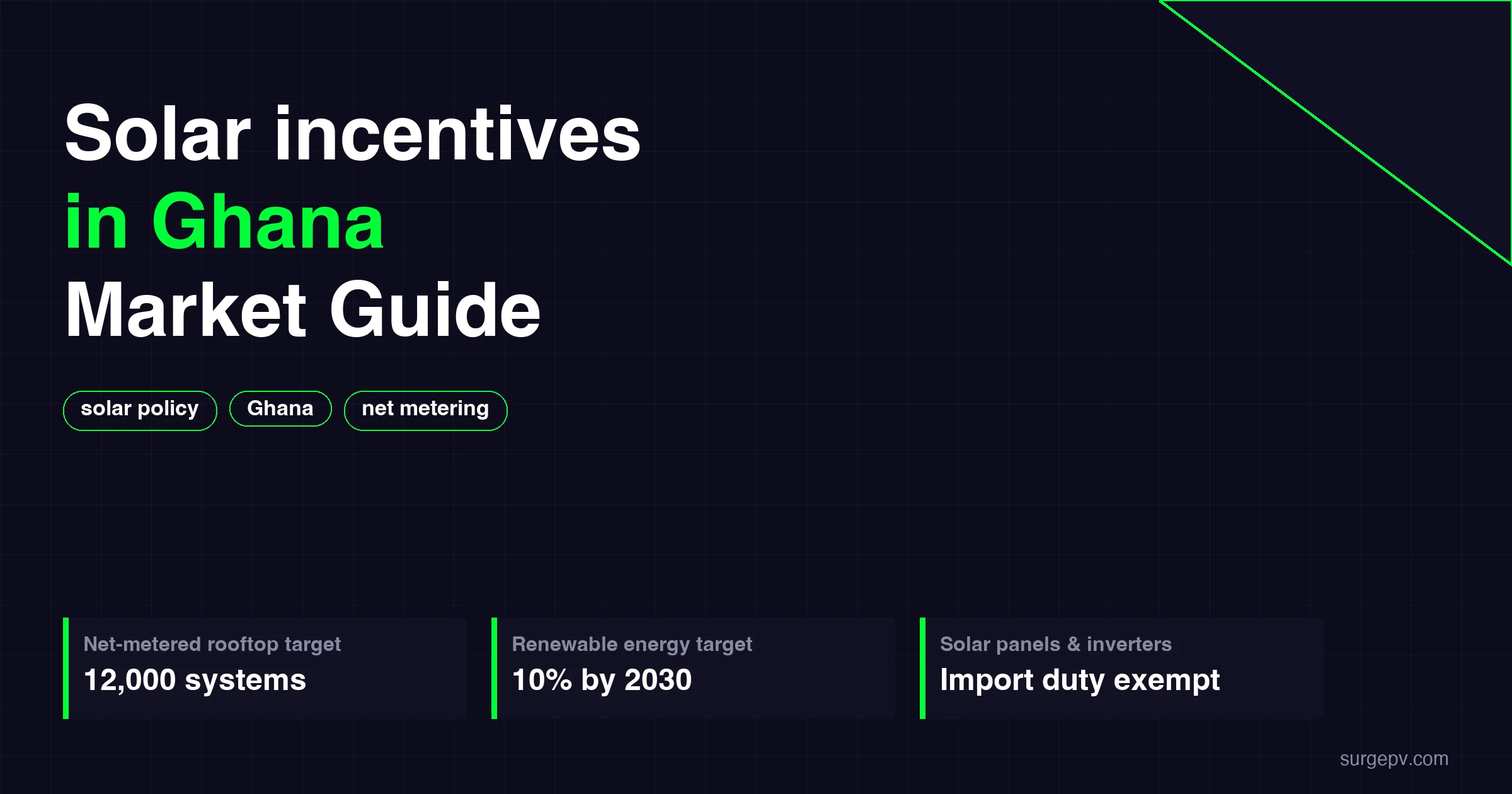
Ghana reached roughly 205 MW of installed solar capacity by the end of 2024 and had another 200 MW under construction, with a stated government target of 400 MW by 2026, according to the Minister of Energy and Green Transition address to Parliament (2025). That is still a small share of a grid dominated by hydro and thermal plants, but the policy direction is clear. The country has a 10 percent renewable energy target by 2030, a functioning net metering code, a feed-in tariff law, and active donor-backed programmes that are bringing down upfront costs.
For installers, EPCs, and property owners, the practical question is not whether Ghana supports solar, but which incentive stack applies to a given project. This guide covers the 2026 legal framework, the real incentives that cut project cost, how net metering and feed-in tariffs work, and the mistakes that waste money. For the broader African context, see our Africa solar compliance guide.
If you are designing systems or writing proposals for Ghanaian clients, a solar design platform that models ECG and NEDCo tariffs, self-consumption ratios, and net metering settlement rules can save hours per project. Model payback and export value automatically, then generate solar proposals in minutes. Check pricing or book a demo to see how SurgePV handles Ghana.
Quick Answer
Ghana’s 2026 solar incentives are a mix of customs relief, net metering, feed-in tariffs, and capital allowances rather than a single cash rebate. Solar panels are generally exempt from import duty and VAT, qualifying inverters receive import duty relief, net metering credits surplus at the retail tariff, and businesses can claim accelerated capital allowances on solar assets.
In this guide:
- Latest 2026 status of every active Ghanaian solar incentive
- The legal foundation: Act 832, the REMP, and the new SREP rollout
- How net metering, feed-in tariffs, and power purchase agreements differ
- Tax and customs incentives: import duty, VAT, and capital allowances
- C&I and utility-scale routes beyond rooftop net metering
- Three real-world stacking scenarios with payback impact
- Common mistakes and how to avoid them
Latest Updates: Ghana Solar Incentives 2026
Ghana’s solar policy environment is more active in 2026 than at any point in the past decade. The government launched the Scaling-Up Renewable Energy Programme in 2025, opened a national net metering web portal, and advanced plans for a Renewable Energy Investment and Green Transition Fund. At the same time, the existing feed-in tariff scheme and import duty exemptions remain the most reliable levers for cutting project cost.
Ghana Solar Incentive Status — Mid-2026
| Incentive | Type | Status | Key Terms |
|---|---|---|---|
| Import duty exemption on solar panels | Customs relief | Active | Panels for RE systems generally exempt; verify HS codes with EC |
| VAT exemption on solar panels | Sales tax relief | Active | Panels and off-grid components; batteries and battery-inverters excluded |
| Import duty exemption on qualifying inverters | Customs relief | Active | Industrial/energy plant, machinery, or equipment |
| Net metering | Surplus credit | Active | Bi-directional meter; credits at retail tariff; annual settlement |
| Feed-in tariff | Guaranteed PPA rate | Active | PURC-approved rates; 10-year guarantee from PPA signature |
| Capital allowances | Income tax deduction | Active | 50% initial + 25% annual for businesses owning solar assets |
| Renewable Energy Fund | Financial support | Established | Managed by Energy Commission; limited public disbursement data |
| REIGT Fund | Green finance facility | Planned/launching | Proposed to mobilise domestic and international capital |
| SREP rooftop programme | Grant-backed deployment | Active | 12,000 net-metered rooftop systems; USD 85 million financing |
Key Changes Since 2025
May 2025 — SREP national launch: The Scaling-Up Renewable Energy Programme officially launched with 35 mini-grids, 1,450 solar home systems, and 12,000 net-metered rooftop PV systems. The programme is backed by USD 85 million in grant financing from the African Development Bank, Climate Investment Funds, SECO, and the Government of Ghana, according to the Ministry of Energy and Green Transition (2025).
National net metering web portal: The Energy Commission launched a central web portal for net metering applications in 2025. The portal tracks applications, registers systems, and acts as a national database for distributed solar installations.
REIGT Fund proposed: Parliament was told that the Renewable Energy Investment and Green Transition Fund would be laid before the House in 2025. The fund is intended to channel fossil-fuel levies, carbon taxes, and donor finance into renewable energy, energy efficiency, and e-mobility projects.
Utility-scale pipeline: The Volta River Authority is developing a 60 MW plant at Bongo, the Bui Power Authority has contracts for 150 MW of additional solar, and the IFC signed a facility with LMI Holding for a 200 MW solar park, according to the 2025 parliamentary address.
Key Takeaway
2026 is a transition year. The most dependable incentives are import duty and VAT exemptions on panels, net metering value, and business capital allowances. Feed-in tariff rates and new funds are real but should be verified before they are built into project finance.
Why Ghana’s Solar Market Matters in 2026
Ghana has some of the best solar resources in West Africa. Large parts of the country receive global horizontal irradiance above 4.5 kWh per square metre per day, and the northern regions have long dry seasons that favour high-capacity-factor PV.
Market Size and Targets
Ghana’s installed solar capacity reached roughly 205 MW by the end of 2024, with another 200 MW under construction and a target of 400 MW by 2026, according to the Minister of Energy and Green Transition (2025). Operational plants include the 50 MW Bui solar farm, the 5 MW Bui floating solar plant, the 17 MW Kaleo plant, the 6.5 MW Lawra plant, the 2.5 MW Navrongo plant, and the 20 MW BXC and Meinergy plants near Winneba.
The 2019 Renewable Energy Master Plan targets 1,363 MW of renewable electricity capacity by 2030, of which 200 MW is meant to come from distributed solar PV net metering, according to the Energy Commission’s Renewable Energy Master Plan (2019). A World Bank institutional analysis estimates that meeting the 10 percent renewable energy target with solar PV alone would require roughly 2,511 MW of new solar by 2030, according to the World Bank (2024).
The Tariff Driver
Ghanaian electricity tariffs are set by PURC and have trended upward for commercial and industrial consumers. Special Load Tariff customers and large institutions face the highest rates, which makes on-site solar valuable because every kilowatt-hour consumed on site avoids the full retail tariff plus levies. Solar is therefore most attractive for factories, hospitals, universities, and households with high daytime consumption.
For solar professionals, the opportunity is to show both generation and bill avoidance at the customer’s actual tariff. That requires hourly load modelling and accurate shading analysis, both of which are built into modern solar design software.
The Legal Foundation: Act 832, the REMP, and SREP
Ghana’s renewable energy framework rests on three main pillars. The Renewable Energy Act creates the market rules, the Renewable Energy Master Plan sets the capacity targets, and the Scaling-Up Renewable Energy Programme provides implementation finance.
Renewable Energy Act, 2011 (Act 832)
Act 832, amended in 2020 by Act 1045, is Ghana’s primary renewable energy law. It establishes:
- A feed-in tariff scheme with guaranteed purchase obligations.
- The Renewable Energy Fund to provide financial incentives, capital subsidies, and feed-in tariff support.
- A licensing regime for renewable energy service providers.
- The authority for the Energy Commission to recommend customs and duty exemptions for renewable energy equipment.
- A mandate for utilities to connect renewable generators to transmission and distribution systems.
Renewable Energy Master Plan
The 2019 Renewable Energy Master Plan is Ghana’s roadmap to 2030. It aims for 1,363 MW of renewable electricity capacity and lays out targets for solar water heaters, lanterns, utility-scale solar, distributed rooftop solar, mini-grids, and solar irrigation. The plan also proposes local manufacturing incentives, including duty and VAT exemptions for materials and machinery used to assemble renewable energy technologies.
Scaling-Up Renewable Energy Programme (SREP)
SREP is the government’s flagship deployment programme. Launched in May 2025, it targets:
- 35 solar mini-grids for island and lakeside communities.
- 1,450 stand-alone solar home systems.
- 12,000 net-metered rooftop solar systems for households, SMEs, and public facilities.
The programme is expected to add about 62.5 MW of distributed renewable capacity and is financed by a USD 85 million grant package from the African Development Bank, Climate Investment Funds, SECO, and the Government of Ghana, according to SECO’s Ghana Net-Metering Project factsheet.
Net Metering in Ghana
Ghana has the most systematic rooftop net metering framework in West Africa. The Energy Commission’s Net Metering Sub-Code, updated in 2023, sets the technical rules, while PURC’s 2022 net metering guidelines govern the billing mechanics.
How Net Metering Works
A customer installs a grid-connected solar PV system and applies for a bi-directional smart meter through the distribution utility. The meter records energy imported from the grid and energy exported from the rooftop system. At billing, the customer pays only the net import, with surplus credits carried forward to future bills.
Key rules:
- Credits are typically calculated at the retail tariff, which makes self-consumed generation the most valuable.
- Credits roll forward within a settlement period, usually 12 months.
- Unused credits at the annual true-up generally expire, so systems should be sized for self-consumption rather than maximum export.
- The customer remains responsible for fixed charges and levies that are not energy-based.
Applications are processed through the Energy Commission’s web portal, and the relevant distribution utility is either the Electricity Company of Ghana (ECG) or the Northern Electricity Distribution Company (NEDCo).
Net Metering Versus Feed-in Tariff
Net metering suits behind-the-meter systems where generation is consumed on site. The feed-in tariff suits generators that sell most or all of their output to the grid under a power purchase agreement. A factory with steady daytime load will usually prefer net metering, while a ground-mounted solar park will use a feed-in tariff or a negotiated PPA.
A well-modelled energy and financial modeling tool can test each compensation scheme against the customer’s actual hourly consumption profile.
Feed-in Tariffs and Utility-Scale Solar
Ghana’s feed-in tariff scheme was created under Act 832 to guarantee a market for renewable electricity. The Public Utilities Regulatory Commission approves rates and reviews them periodically.
Feed-in Tariff Mechanics
- PURC publishes technology-specific feed-in tariff rates.
- The rate applicable when a power purchase agreement is signed is guaranteed for ten years.
- After the initial ten years, rates are reviewed every two years.
- The 2013 solar feed-in tariff was set at roughly 40.21 Ghana pesewas per kWh, according to the IEA policy database.
- Distribution utilities must procure a specified share of renewable energy under the Renewable Energy Purchase Obligation.
Active Utility-Scale Pipeline
Several utility-scale projects are moving forward. The Bui Power Authority is planning 150 MW of additional solar, including an expansion of the existing floating solar plant to 25 MWp, according to Bui Power Authority. The Volta River Authority is developing a 60 MW plant at Bongo, and a 200 MW solar park is being developed with IFC support. These projects typically sell power under long-term PPAs rather than relying on the small-consumer tariff.
Tax, Import Duty, and Fiscal Incentives
Ghana does not offer a direct federal tax credit for homeowners who buy solar panels. The real financial value lies in customs relief, business capital allowances, and long-term bill savings.
Import Duty and VAT Exemptions
Solar panels imported for use in renewable energy systems are generally exempt from import duty and VAT. Stand-alone inverters and solar water pumping equipment also benefit from duty relief as industrial or energy plant, machinery, or equipment. The GIZ guide for C&I renewable energy projects notes that solar batteries and inverters bundled with batteries are not VAT exempt, and batteries usually attract a 20 percent import duty, according to GIZ (2023).
For end users, the practical benefit depends on whether the installer passes the customs savings through. Always confirm the current Harmonised System codes and exemption letters with the Energy Commission before procurement.
Corporate Income Tax and Capital Allowances
Companies that own solar assets can claim capital allowances on the system. The GIZ guide states that plant and machinery qualify for a 50 percent initial allowance and a 25 percent annual allowance on the declining balance, according to GIZ (2023). For a company in the 25 percent corporate tax bracket, a GHS 1,000,000 solar investment can generate roughly GHS 250,000 of tax relief in the first year through the initial allowance alone.
Withholding and VAT on Power Sales
Businesses that sell surplus power back to the grid under a feed-in tariff may be subject to VAT and withholding tax on the energy sale. Proper invoicing and Ghana Revenue Authority registration are essential. The GIZ guide recommends treating the sale of surplus energy as a separate taxable supply.
Commercial and Industrial Solar Incentives
C&I solar in Ghana is usually driven by tariff avoidance, reliability, and accelerated depreciation rather than by residential net metering. The economics are strongest for consumers on the Special Load Tariff or other high-rate schedules.
Self-Consumption and Net Metering
Large factories, hospitals, and universities with steady daytime load can cover 30 to 70 percent of their consumption with rooftop solar. Net metering credits any short-term surplus at the retail tariff, but the annual reset means systems should not be sized to overproduce.
Power Purchase Agreements
Larger C&I consumers can contract directly with independent solar developers under long-term PPAs. The developer owns the plant and sells power to the customer at a fixed or indexed rate. This structure requires no upfront capital from the customer and avoids grid export complications.
Utility-Scale and Captive Generation
Projects above the net metering threshold usually require a generation licence from the Energy Commission and a PPA with a utility or bulk customer. The Renewable Energy Purchase Obligation creates demand from distribution utilities, but procurement timelines depend on PURC approvals and grid capacity.
For C&I installers, the design priorities are different from residential work. Load profiling, demand-charge analysis, and shadow analysis matter more than simple bill offset.
How to Stack Incentives: Three Real-World Scenarios
The following examples are illustrative, based on typical 2026 costs and incentive rates. Actual figures depend on location, tariff, installer quote, and whether the customer is a business or an individual.
Scenario 1 — 5 kW Residential Rooftop, Accra
| Item | Amount |
|---|---|
| Gross installed cost | GHS 85,000 |
| Import duty and VAT exemption benefit | −GHS 12,750 |
| Net cost | GHS 72,250 |
| Annual bill savings (net metering, high self-consumption) | GHS 12,000 |
| Payback | 6.0 years |
Without import duty and VAT relief, the same system would pay back in roughly 8 to 9 years.
Scenario 2 — 150 kW Commercial Rooftop, Tema
| Item | Amount |
|---|---|
| Gross installed cost | GHS 1,800,000 |
| Import duty and VAT exemption on panels and inverters | −GHS 270,000 |
| Capital allowance benefit (25% tax rate, 50% initial allowance) | −GHS 225,000 |
| Net effective cost | GHS 1,305,000 |
| Annual avoided electricity and demand charges | GHS 300,000 |
| Payback | 4.4 years |
The combined customs and tax benefit is the largest single lever for corporate projects.
Scenario 3 — 20 MW Utility-Scale Solar Park, Northern Region
| Item | Amount |
|---|---|
| Gross CAPEX | USD 14,000,000 |
| Import duty and VAT relief | −USD 1,400,000 |
| LCOE with incentives | ~USD 0.045/kWh |
| PPA price | USD 0.055/kWh |
| Project IRR | 12–14% |
Utility-scale economics depend heavily on PPA terms, grid connection cost, and land access.
Common Mistakes and Misconceptions
Even experienced installers lose money in Ghana by misunderstanding how incentives interact. Here are the most common errors.
Assuming Every Component Is Exempt
Only solar panels and qualifying inverters are clearly exempt from import duty and VAT. Batteries, inverters bundled with batteries, and balance-of-system materials may still attract duty and VAT. Verify the current exemption list before quoting.
Oversizing for Export
Net metering credits expire at the annual settlement. A system that exports 40 percent of its annual generation is less valuable than one that consumes 80 percent on site. Size for self-consumption first, export second.
Ignoring the Annual Credit Reset
A system that overproduces all year wastes surplus credits. Model monthly as well as annual production and consumption to avoid this.
Starting Procurement Before Approval
Import duty exemptions are typically applied for before shipment. Retroactive claims are difficult. Submit the exemption request to the Ghana Revenue Authority customs office with the Energy Commission’s recommendation letter before equipment leaves the supplier.
Underestimating Interconnection Time
ECG and NEDCo interconnection queues can take several weeks to a few months, especially in high-growth areas. Meter change-out, inspection, and web portal registration all add time. Build realistic timelines into contracts.
Mixing Up Net Metering and Feed-in Tariff
Net metering offsets imports at the retail tariff. A feed-in tariff pays a fixed rate for all generation. Choosing the wrong structure can cut returns by 20 percent or more.
Conclusion
Ghana’s solar incentive framework in 2026 is a stack built from import duty and VAT exemptions, net metering, feed-in tariffs, and business capital allowances. None of these mechanisms is as simple as a single upfront rebate, but combined they make solar one of the most attractive generation options for households, SMEs, and large consumers with high daytime load.
For solar professionals, the competitive edge is no longer just installation price. It is the ability to model the right compensation scheme, size for self-consumption, and stack tax and customs benefits correctly. Tools like Clara AI and SurgePV’s generation and financial tool can automate that workflow for Ghanaian projects.
Three actions to take now:
- Verify the compensation scheme before sizing — net metering, feed-in tariff, or PPA changes the optimal system size.
- Confirm customs exemptions before procurement — not every component qualifies for duty and VAT relief.
- Size for self-consumption — exported energy in Ghana is worth less than avoided retail purchases.
For installers scaling in Ghana, our guide for solar installers covers proposal automation and compliance workflows. For C&I teams, the commercial solar page explains how SurgePV models demand charges and export value.
Frequently Asked Questions
What solar incentives are available in Ghana in 2026?
Ghana offers import duty and VAT exemptions on qualifying solar panels and inverters, a net metering scheme that credits surplus generation at the retail tariff, a feed-in tariff scheme for utility-scale and commercial generators under the Renewable Energy Act, and accelerated capital allowances for businesses that own solar assets. The Scaling-Up Renewable Energy Programme also supports 12,000 rooftop net-metered systems.
Does Ghana have a solar feed-in tariff?
Yes. The Renewable Energy Act, 2011 (Act 832) established a feed-in tariff scheme under which the Public Utilities Regulatory Commission approves rates for electricity purchased from renewable generators. The approved solar feed-in tariff has historically been around 40 Ghana pesewas per kWh, and the rate applicable when a power purchase agreement is signed is guaranteed for ten years.
How does net metering work in Ghana?
Under Ghana’s net metering rules, a customer with a grid-connected solar system receives a bi-directional meter that records imports and exports. Surplus generation is credited against future consumption at the retail tariff, and credits roll forward within an annual settlement period. Any unused credits at the annual true-up typically expire, so systems are sized for high self-consumption.
Are solar panels exempt from import duty and VAT in Ghana?
Solar panels are generally exempt from import duty and VAT when imported for use in a renewable energy system. Stand-alone inverters and solar water pumping equipment also receive customs relief. Solar batteries and inverters bundled with batteries are not VAT exempt, and batteries usually attract a 20 percent import duty. Always confirm the current exemption list with the Energy Commission before procurement.
What is the typical solar payback period in Ghana?
Well-designed residential and small commercial solar systems in Ghana typically pay back in 5 to 8 years, driven by high irradiance, rising electricity tariffs, and net metering credits. Systems with strong daytime self-consumption and access to import duty exemptions pay back faster, while battery-heavy designs or systems that export most of their output may take longer.
Can commercial and industrial projects access solar incentives in Ghana?
Yes. C&I projects benefit from import duty and VAT relief on qualifying equipment, the feed-in tariff or net metering depending on size and structure, and capital allowances of 50 percent in the first year plus 25 percent annually on the declining balance. Power purchase agreements and utility-scale tenders are also common for larger C&I and independent power producers.
What is the maximum size for a net-metered solar system in Ghana?
Ghana’s net metering code applies to distributed renewable generators connected to the distribution network. While there is no universal residential cap published as a single number, the programme is designed for rooftop and small commercial systems that match on-site load. Larger generators usually move to a feed-in tariff or a negotiated power purchase agreement.
What is the Scaling-Up Renewable Energy Programme (SREP)?
SREP is a government programme launched in 2025 to accelerate renewable energy adoption. It plans to install 35 solar mini-grids, 1,450 stand-alone solar home systems, and 12,000 net-metered rooftop solar systems across Ghana, backed by USD 85 million in grant financing from the African Development Bank, Climate Investment Funds, SECO, and the Government of Ghana.
Do residential customers get a tax credit for solar in Ghana?
No. Ghana does not offer a direct residential tax credit similar to the former United States Investment Tax Credit. Residential buyers benefit mainly from VAT and import duty exemptions on equipment, long-term bill savings through net metering, and any SREP subsidies available in their area.
What are the most common mistakes when claiming solar incentives in Ghana?
The most common mistakes are assuming every component is VAT exempt, designing systems that export too much surplus under net metering, ignoring the annual credit reset, and starting procurement before confirming the current Energy Commission exemption list. Businesses also sometimes overlook the capital allowance documentation required by the Ghana Revenue Authority.
Where this fits
This article is part of SurgePV's Solar Incentives & Policy hub, which works through the topic from first principles to the decisions a project team actually has to make.

