

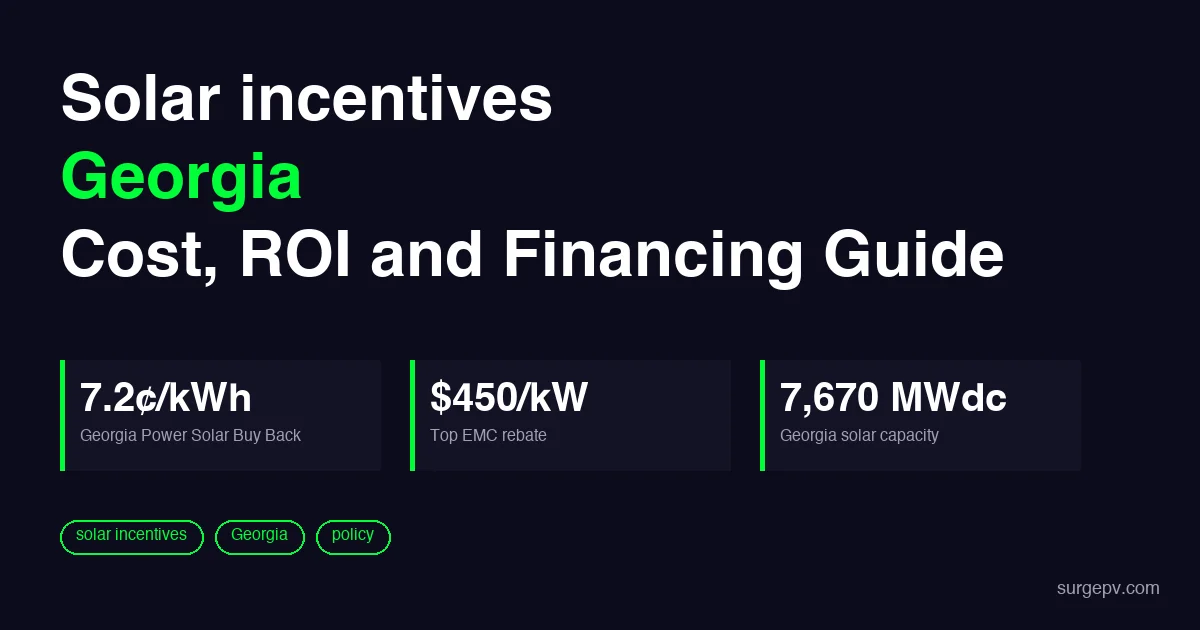
Georgia ranks eighth nationally in installed solar capacity with roughly 7,670 MWdc online, according to SEIA’s May 2026 state profile. The state has become a hub for utility-scale solar and solar manufacturing, yet its residential incentive stack is thinner than most homeowners expect. Georgia has no state income tax credit for rooftop solar, no statewide residential sales tax exemption, and no guaranteed statewide property tax exemption. The federal residential Investment Tax Credit expired for systems placed in service after December 31, 2025.
For installers, EPCs, and homeowners, the lesson is clear: Georgia solar works, but the math is driven by utility-specific export credits, a handful of electric cooperative rebates, and strong self-consumption value. This guide covers every active 2026 incentive, the real dollar value of each, and how to size and finance systems for the Georgia market.
If you are modeling Georgia projects, a solar design platform can capture utility rates, export credit values, and rebate stacking automatically. SurgePV’s solar design software and energy and financial modeling tool let you build Georgia-specific proposals and generate solar proposals in minutes. Check pricing or book a demo to see the workflow.
Quick Answer
Georgia’s 2026 solar incentives are utility-driven, not state-driven. Georgia Power pays roughly 7.2¢/kWh for exported solar through the Solar Buy Back program. Central Georgia EMC, Jackson EMC, GreyStone Power, and Sawnee EMC offer one-time rebates of $300–$450 per kW. There is no state income tax credit, no statewide residential sales tax exemption, and no guaranteed residential property tax exemption. The federal residential tax credit expired on December 31, 2025.
In this guide:
- Latest 2026 status of every active Georgia solar incentive
- How the federal ITC expiration changes the math
- Georgia Power Solar Buy Back and Energy Offset programs
- Electric cooperative rebates and community solar options
- Property tax, sales tax, and HOA protections
- Financing options after the federal residential ITC ended
- Real cost, ROI, and payback numbers for Georgia homeowners
- Common mistakes and how to avoid them
Georgia Solar Incentives at a Glance — 2026
Georgia does not offer one large statewide rebate. The value comes from layering utility programs, understanding export credit rules, and sizing systems for self-consumption. Here is the current status.
| Incentive | Type | 2026 Status | Typical Value |
|---|---|---|---|
| Federal residential ITC | Tax credit | Expired | Section 25D ended December 31, 2025 |
| Georgia state solar tax credit | Tax credit | Not available | No state income tax credit exists |
| Statewide residential sales tax exemption | Tax exemption | Not available | Local county taxes may still apply |
| Statewide residential property tax exemption | Tax exemption | Not guaranteed | Varies by county assessor |
| Georgia Power Solar Buy Back | Export credit | Active, capped | ~7.2¢/kWh; systems ≤10 kW AC |
| Georgia Power Energy Offset | Self-consumption offset | Active, no cap | No export credits; unlimited size |
| Georgia Power Community Solar | Subscription credit | Active | $24/kW/month ($6 income-qualified) |
| Central Georgia EMC solar rebate | Utility rebate | Active | $450/kW, max $4,500 for 10 kW |
| Jackson EMC Sun Power rebate | Utility rebate | Active | $450/kW DC, max $4,500 for 10 kW |
| GreyStone Power solar rebate | Utility rebate | Verify directly | $450/kW AC, max $4,500 for 10 kW |
| Sawnee EMC solar rebate | Utility rebate | Active | $300/kW, max $3,000 for 10 kW |
| Cobb EMC Energy Network / Peak Shaving | Battery/storage rebate | Relaunched 2026 | Varies by program and funding |
| Green Power EMC Cooperative Solar | Community solar | Active | Bill credits for subscribed output |
| GEFA Solar Program | Rebate | Active for public entities | Up to 50% or $50,000 for ≤60 kW |
| USDA REAP grant | Federal grant | Paused early 2026 | Up to 50% for rural small business/agriculture |
| Georgia Home Energy Rebates | Rebate | Active | Up to $16,000 for eligible households |
| HOA solar access protection | Legal protection | Active | Georgia Code § 44-3-235 |
The most important rule for 2026 is that self-consumption is worth more than exports. Georgia Power’s export credit is roughly half the retail rate, so every kilowatt-hour used on-site saves more than one exported.
Georgia’s Solar Market in 2026
Georgia’s solar story is split in two. The state is a national leader in utility-scale solar deployment, with over $9.6 billion in total solar investment and enough capacity to power roughly 893,000 homes, according to SEIA (2026). At the same time, distributed residential solar operates with fewer direct incentives than neighboring North Carolina or Florida.
Electricity Rates and the Case for Self-Consumption
Georgia’s average residential electricity rate climbed from 12.5¢/kWh in 2021 to 14.1¢/kWh in 2024, a 12.8% increase in four years, according to Palmetto market data (2026). Georgia Power residential rates are higher than many cooperative rates, which changes the value of solar by utility territory.
| Utility / Region | Approximate Residential Rate (2024-2025) |
|---|---|
| Georgia Power | ~14.6¢/kWh |
| Cobb EMC | ~11.7¢/kWh |
| Jackson EMC | ~12.0¢/kWh |
| GreyStone Power | ~12.0¢/kWh |
| Sawnee EMC | ~12.6¢/kWh |
| Snapping Shoals EMC | ~12.4¢/kWh |
| Walton EMC | ~13.4¢/kWh |
Source: Palmetto Georgia utility rates analysis (2026).
These rates explain why solar economics are stronger for Georgia Power customers with high daytime usage than for cooperative members with lower base rates, even though cooperatives often offer better upfront rebates.
Georgia Power Solar Buy Back Program
Georgia Power serves roughly 2.4 million customers across most of the state. For residential solar customers, the only export compensation option is the Solar Buy Back program, officially the Renewable and Non-Renewable Instantaneous Netting tariff.
How the Rate Works
The 2026 export credit has two components:
- Solar Avoided Cost Rate: approximately 3.2188¢/kWh
- Public Service Commission adder: 4¢/kWh
- Total export credit: roughly 7.2¢/kWh
Georgia Power’s standard residential retail rate is approximately 13–14.6¢/kWh. An exported kilowatt-hour earns roughly half what a self-consumed kilowatt-hour saves. This is the central design rule for Georgia Power territory: size for self-consumption, not maximum export.
Program Caps and Rules
- Residential systems must be 10 kW AC or smaller.
- Enrollment is first-come, first-served against a statewide cap of 0.2% of Georgia Power’s prior-year peak demand.
- Customers must apply before installation; retroactive enrollment is not allowed.
- Unused monthly credits roll forward to the next month.
- The program is governed by Georgia Power’s RNR-11 Tariff and overseen by the Georgia Public Service Commission.
Source: EnergySage Georgia Power net metering guide (2026) and ExSpenditure Georgia solar incentives analysis (2026).
Energy Offset Program for Larger Systems
Georgia Power customers who need more than 10 kW AC can enroll in the Energy Offset program. This program has no size cap and no enrollment cap, but it offers no export credits. Solar production reduces real-time grid consumption directly. It is the right choice for high-usage homes that can consume most of their solar production on-site.
Electric Cooperative Rebates and Programs
Roughly 4.4 million Georgians are served by one of 41 Electric Membership Cooperatives. EMCs set their own solar rules, and several offer stronger upfront incentives than Georgia Power.
Central Georgia EMC
Central Georgia EMC offers the most valuable upfront residential solar rebate in Georgia:
- $450 per kW of installed solar PV capacity
- Maximum rebate: $4,500 for a 10 kW system
- System must be grid-interconnected and net-metered through Central Georgia EMC
- Installed by a licensed contractor
- Minimum 5-year manufacturer warranty
- $100 application fee
A typical 6 kW system receives $2,700 after installation. Central Georgia EMC also offers the Home Plus Energy Efficiency Loan Program for below-market solar financing.
Jackson EMC
Jackson EMC’s Right Choice Sun Power Rebate Program offers:
- $450 per kW DC for systems up to 10 kW
- Maximum rebate: $4,500
- Contractor must be trained and certified by NABCEP
- System must be certified by the Florida Solar Energy Center
- Separate $525 rebate for solar water heaters
GreyStone Power
GreyStone Power, serving parts of the Atlanta metro area, has offered a one-time rebate of $450 per kW AC for systems up to 10 kW. Funding is allocated first-come, first-served, so homeowners should confirm current availability directly with GreyStone Power before quoting.
Sawnee EMC
Sawnee EMC offers a one-time rebate of $300 per kW for residential PV systems up to 10 kW, with a maximum rebate of $3,000.
Cobb EMC
Cobb EMC’s Energy Network program was relaunched in early 2026 after prior funding rounds were exhausted. It offers rebates for solar-paired upgrades and battery storage, including a Peak Shaving demand-response initiative that compensates members for dispatching home batteries during peak grid demand.
Cooperative Community Solar Through Green Power EMC
Sixteen Georgia EMCs participate in the Green Power EMC community solar network. Members subscribe to blocks of shared solar farm production without installing rooftop equipment. Subscription costs, block sizes, and monthly credit rates vary by cooperative. Participating cooperatives include Central Georgia EMC, Coastal Electric, Coweta-Fayette EMC, Diverse Power, GreyStone Power, Habersham EMC, Jackson EMC, Jefferson Energy, Middle Georgia EMC, Okefenoke REMC, Satilla REMC, Sawnee EMC, Snapping Shoals EMC, Sumter EMC, Tri-County EMC, and Walton EMC.
Source: Palmetto Georgia incentives guide (2026).
Tax Exemptions, Federal Credits, and Legal Protections
Georgia’s tax treatment of residential solar is less generous than many neighboring states. Understanding what does and does not exist prevents bad proposals.
State Income Tax Credit
Georgia does not offer a state income tax credit for residential solar. Unlike Arizona, North Carolina, or South Carolina, there is no statutory credit pathway for homeowners.
Sales Tax Exemption
Georgia does not provide a statewide sales tax exemption for residential solar equipment or installation labor. Equipment purchases are generally subject to state and local sales taxes. Some large commercial or manufacturing projects may qualify for separate economic development exemptions, but those do not apply to typical residential rooftop systems.
Source: U.S. Solar Supplier state sales tax exemption guide (2026).
Property Tax Exemption
Georgia does not have a guaranteed statewide property tax exemption for residential solar. Whether a solar installation increases assessed value depends on the county tax assessor. Some counties may not reassess for solar, while others may. Homeowners should contact their county tax assessor before installation to confirm local treatment.
Some solar marketing materials cite O.C.G.A. § 48-5-48.1 as a property tax exemption. That statute governs Freeport inventory exemptions for manufacturers, not residential solar equipment. Do not rely on it for a home installation.
Federal Residential Clean Energy Credit
The 30% federal Residential Clean Energy Credit under Internal Revenue Code Section 25D expired for homeowner-owned systems placed in service after December 31, 2025. Systems installed and operational before that date can still claim the credit on the 2025 tax return using IRS Form 5695.
Third-party-owned systems, including leases and power purchase agreements, may still access the federal Clean Electricity Investment Credit under Section 48E. The financing company passes part of that value through as lower monthly payments.
Federal Battery Storage Credit
A separate federal credit remains available for battery storage. Homeowners who install a standalone battery of 3 kWh or larger in a primary or secondary residence can claim a 30% credit through 2032. There is no dollar cap. This credit is especially valuable in Georgia because stored solar can offset retail-rate evening usage rather than being exported at ~7.2¢/kWh.
Source: IRS Residential Clean Energy Credit guidance.
HOA Solar Access Rights
Georgia Code § 44-3-235 protects a homeowner’s right to install solar energy systems. A homeowners association may impose reasonable placement restrictions, but it cannot prohibit installation outright or require changes that significantly increase cost or reduce system output.
Financing Options in Georgia
How you pay for solar changes which incentives you capture and how the payback looks.
Cash Purchase
Cash delivers the strongest lifetime return. The owner keeps all utility rebates, export credits, tax exemptions, and long-term bill savings. Without the federal ITC, payback periods in Georgia typically run 10 to 14 years for cash purchases.
Solar Loan
Loans preserve ownership benefits while eliminating upfront cost. Monthly loan payments are often comparable to current utility bills. The main risk is interest cost, which extends payback. Homeowners should compare loan APR against estimated utility rate escalation.
Lease or Power Purchase Agreement
Leases and PPAs require no money down and include maintenance. However, the financing company usually keeps the rebates, export credits, and federal tax benefits. Homeowners get predictable monthly savings but give up long-term ownership value.
Central Georgia EMC Home Plus Loan
Central Georgia EMC members can access the Home Plus Energy Efficiency Loan Program for below-market financing on solar and other energy improvements. This can reduce both upfront cost and lifetime financing cost when combined with the cooperative’s $450/kW rebate.
Cost, ROI, and Payback in Georgia
Installed costs in Georgia vary by system size, roof complexity, and installer. Recent market data points to a range of roughly $2.50 to $3.20 per watt before incentives, according to ExSpenditure (2026) and Palmetto (2026). Georgia homes often need larger systems than the national average because of high air-conditioning loads.
Typical Residential System Economics
| Item | 8 kW System (Georgia Power) | 8 kW System (Central Georgia EMC) |
|---|---|---|
| Gross cost at $2.80/W | $22,400 | $22,400 |
| EMC rebate | $0 | -$3,600 |
| Net upfront cost | $22,400 | $18,800 |
| Annual production | ~11,500 kWh | ~11,500 kWh |
| Annual bill savings at $0.14/kWh (self-consumed) | ~$1,400 | ~$1,200 |
| Annual export credits (~1,500 kWh at $0.072/kWh) | ~$108 | Varies |
| Simple payback | ~14.8 years | ~10.9 years |
These figures assume a cash purchase, a system sized to match daytime usage, and no federal tax credit. Actual payback depends on roof orientation, shading, utility rate structure, financing cost, and whether battery storage is included.
Payback Ranges by Utility Territory
| Utility Territory | Typical Payback (2026, no federal ITC) |
|---|---|
| Georgia Power | 12–16 years |
| Central Georgia EMC | 9–12 years |
| Jackson EMC | 9–12 years |
| GreyStone Power | 10–13 years |
| Sawnee EMC | 10–13 years |
| Cobb EMC (with battery incentives) | 10–14 years |
Public, Rural, and Community Solar Programs
Not all solar incentives in Georgia are for residential rooftops.
GEFA Solar Program
The Georgia Environmental Finance Authority provides rebates exclusively to Georgia cities, counties, and K-12 public schools. The program reimburses up to 50% of the cost of materials, design, and installation, with a maximum reimbursement of $50,000, for ground-mount or rooftop systems up to 60 kW.
Georgia Power Community Solar
Georgia Power residential customers can subscribe to community solar blocks at $24 per kW per month, or $6 per kW per month for income-qualified customers. No rooftop installation is required.
USDA Rural Energy for America Program
USDA REAP provides grants covering up to 50% of solar or battery storage costs and loan guarantees up to 75% for eligible rural small businesses and agricultural producers. As of early 2026, USDA paused acceptance of new REAP grant applications. Applicants should confirm current status with USDA Rural Development before planning around this funding.
Georgia Home Energy Rebates
Administered by GEFA under the federal Inflation Reduction Act, Georgia’s Home Energy Rebates program provides rebates on eligible home energy improvements. Eligible households can receive up to $16,000 depending on income and expected energy savings. While the program primarily covers appliances, insulation, HVAC, and electrical panel upgrades, some solar-adjacent improvements may qualify.
Common Mistakes Georgia Solar Buyers Make
Even in a thin incentive market, poor planning costs money.
Oversizing for Export
Georgia Power credits exports at roughly 7.2¢/kWh, well below the retail rate. A system that produces far more than the household consumes wastes value. Size for daytime self-consumption and annual usage, not maximum generation.
Assuming the Federal ITC Still Applies
The residential ITC ended after 2025. Any proposal assuming a 30% federal credit for a 2026 cash or loan purchase is wrong unless the system was placed in service in 2025.
Missing EMC Rebate Application Deadlines
Cooperative rebates are often first-come, first-served and may require pre-approval or specific contractor certifications. Jackson EMC requires a NABCEP-certified contractor and Florida Solar Energy Center certification. Apply before installation begins.
Ignoring Utility Territory
A homeowner in Georgia Power territory faces completely different economics than a Central Georgia EMC member. Always confirm the utility and its current export credit or rebate rules before quoting.
Assuming Property Tax Exemption
Georgia does not guarantee a residential property tax exemption. Contact the county tax assessor before assuming solar will not increase assessed value.
Missing the Georgia Power Solar Buy Back Application Window
Georgia Power requires enrollment before installation. Retroactive enrollment is not available, and the program has a statewide cap.
Conclusion
Georgia’s solar incentive stack in 2026 is thin but functional. The state offers no income tax credit, no statewide residential sales tax exemption, and no guaranteed residential property tax exemption. The federal residential tax credit is gone. The real value comes from Georgia Power’s Solar Buy Back export credits, electric cooperative rebates, community solar subscriptions, and the strong economics of self-consumption against rising retail rates.
For solar professionals, the competitive edge is accuracy. The proposal that wins in Georgia is the one that models the customer’s actual utility, export credit rate, available rebates, and financing correctly. Sizing for self-consumption rather than maximum export is the single most important design decision.
SurgePV’s design and financial modeling tools let you build Georgia-specific proposals that reflect real utility rates and export credit values. For installers scaling in the state, our guide for solar installers covers proposal automation and compliance workflows.
Three actions to take now:
- Confirm utility territory and program status before quoting — EMC rebates and Georgia Power Solar Buy Back enrollment are time-sensitive and capped.
- Size for self-consumption — exported energy in Georgia Power territory is worth roughly half what on-site usage saves.
- Verify tax treatment locally — county assessors differ on whether solar increases property value, and there is no statewide residential sales tax exemption.
Frequently Asked Questions
What solar incentives are available in Georgia in 2026?
Georgia’s active solar incentives in 2026 include Georgia Power’s Solar Buy Back export credit at roughly 7.2¢/kWh, one-time rebates from Central Georgia EMC ($450/kW), Jackson EMC ($450/kW DC), GreyStone Power ($450/kW AC), and Sawnee EMC ($300/kW), community solar through Green Power EMC and Georgia Power, the GEFA Solar Program for public schools and governments, and federal battery storage credits. There is no state income tax credit, no statewide residential sales tax exemption, and no guaranteed residential property tax exemption. The federal residential solar tax credit expired on December 31, 2025.
Does Georgia have net metering for solar?
Georgia does not have traditional net metering. Georgia Power offers the Solar Buy Back program, which credits exported solar at roughly 7.2¢/kWh instead of the full retail rate. Electric cooperatives set their own export credit rules. The original Georgia Power RNR Monthly Netting pilot, capped at 5,000 customers, filled up in 2021 and is grandfathered for existing participants until 2038.
Is there a state solar tax credit in Georgia?
No. Georgia does not offer a state income tax credit for residential solar. Georgia also does not provide a statewide sales tax exemption for residential solar equipment or a guaranteed statewide property tax exemption for residential systems. Some county assessors may not reassess for solar, but this varies by jurisdiction and must be confirmed locally.
How does the Georgia Power Solar Buy Back program work?
Georgia Power’s Solar Buy Back program, officially the Renewable and Non-Renewable Instantaneous Netting tariff, credits residential customers for exported solar at the Solar Avoided Cost Rate of approximately 3.2188¢/kWh plus a 4¢/kWh Public Service Commission adder, totaling roughly 7.2¢/kWh. Systems must be 10 kW AC or smaller. Enrollment is first-come, first-served against a statewide cap of 0.2% of Georgia Power’s prior-year peak demand, and customers must apply before installation.
What is the best solar rebate in Georgia?
The strongest upfront rebate for Georgia homeowners in 2026 is Central Georgia EMC’s $450 per kW cash rebate, capped at $4,500 for a 10 kW system. Jackson EMC and GreyStone Power offer similar $450/kW rebates, while Sawnee EMC offers $300/kW. These programs are subject to funding availability and may require a licensed or NABCEP-certified contractor.
Does solar increase property taxes in Georgia?
Georgia does not have a guaranteed statewide property tax exemption for residential solar. Whether a solar installation increases assessed value depends on the county tax assessor. Some counties may not reassess for solar, while others may. Homeowners should contact their county tax assessor before installation to understand local treatment.
Are solar batteries incentivized in Georgia?
There is no Georgia state battery rebate, but Cobb EMC’s Energy Network and Peak Shaving programs offer battery storage incentives and demand-response compensation. Federal law still allows a 30% tax credit for standalone battery storage systems of 3 kWh or larger installed in a primary or secondary residence through 2032. Batteries paired with solar are valuable in Georgia because storing solar for evening use avoids buying retail power.
What is the typical solar payback period in Georgia in 2026?
Payback periods for residential solar in Georgia typically range from 10 to 14 years in 2026 after the federal residential tax credit expired. Homes served by electric cooperatives with strong rebates may see payback closer to 8 to 11 years. The exact result depends on utility territory, system size, financing cost, roof conditions, and how much solar is consumed on-site rather than exported.
Can my Georgia HOA stop me from installing solar panels?
No. Georgia Code § 44-3-235 protects a homeowner’s right to install solar energy systems. A homeowners association can impose reasonable restrictions on placement, but it cannot prohibit installation or require changes that significantly increase cost or reduce system output.
What financing options are available for solar in Georgia?
Georgia homeowners can pay cash, use a solar loan, lease through a third-party provider, or sign a power purchase agreement. Central Georgia EMC members may also access the Home Plus Energy Efficiency Loan Program for below-market financing. Cash purchases deliver the highest lifetime savings, while loans preserve ownership benefits with no upfront payment. Leases and PPAs require no money down but usually transfer incentives and SREC ownership to the financing company.
Where this fits
This article is part of SurgePV's Solar Incentives & Policy hub, which works through the topic from first principles to the decisions a project team actually has to make.
