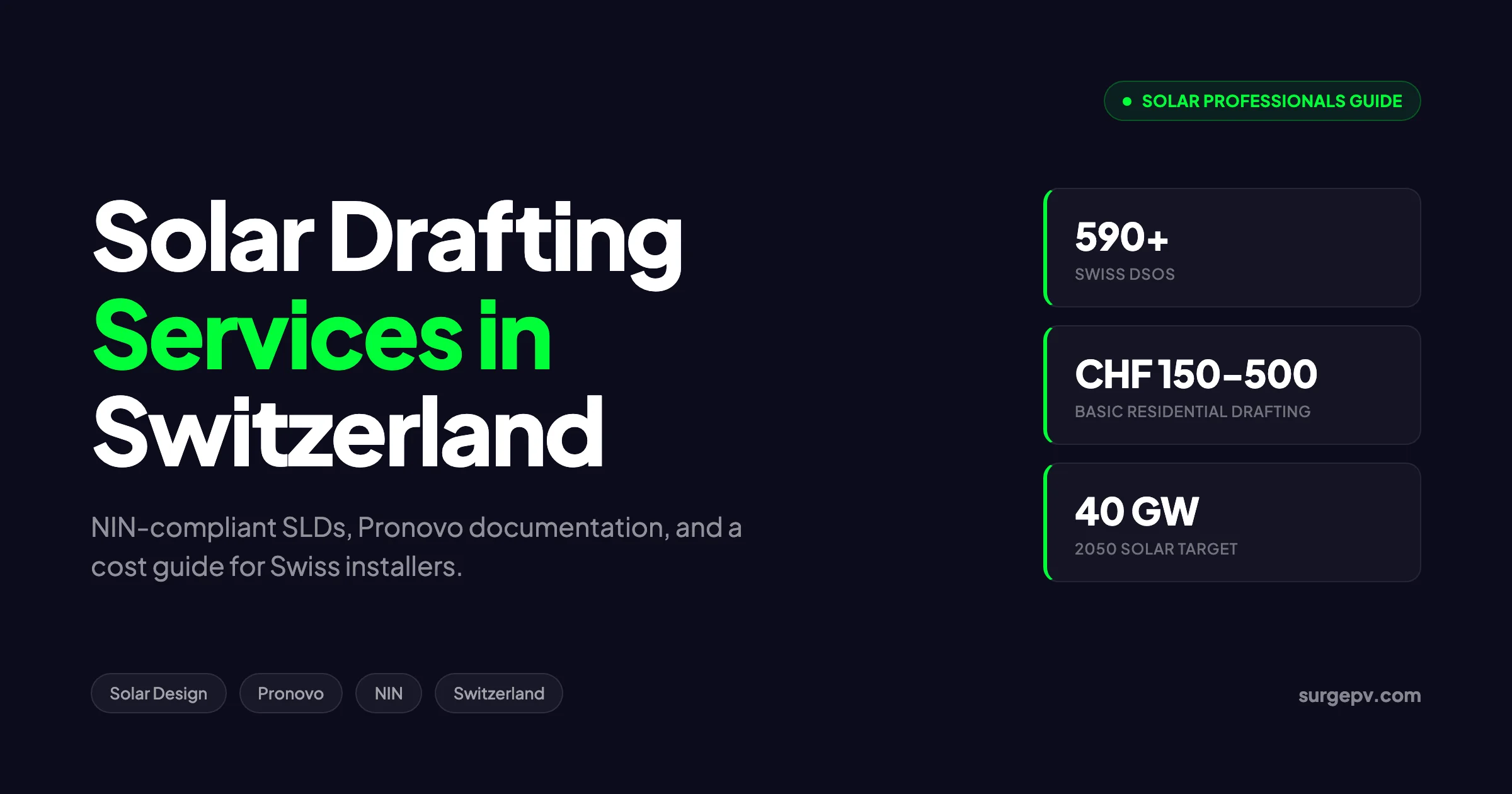
Switzerland installed roughly 1.7 GW of new solar capacity in 2024, pushing total installed capacity past 7 GW, according to Swissolar (2025). The federal plan targets 40 GW by 2050, according to pv magazine (2026). Every one of those megawatts starts with a set of drawings.
For Swiss solar professionals, the question is no longer whether to produce technical documentation. It is whether to hire a solar drafting service, buy solar design platform, or run both together. This guide answers that with real numbers, Swiss regulatory context, and a decision framework built on 10+ years of EPC experience across European markets.
In this guide, you will learn:
- What solar drafting services in Switzerland actually deliver
- Which Swiss rules (Meldepflicht, NIN, ESTI, Pronovo) shape every drawing
- How CAD and BIM standards apply to Swiss solar projects
- What typical deliverables look like and what they cost in 2026
- When manual drafting beats software, and when software wins
- How to choose a provider without overpaying for scope you do not need
Quick Answer
Solar drafting services in Switzerland are technical providers that create NIN-compliant electrical schematics, single-line diagrams, and Pronovo grant documentation for photovoltaic projects. Swiss installers use them for projects needing custom structural work, alpine or ground-mounted plants, or when in-house design capacity is short. Costs run from CHF 150-500 for basic residential drafting to CHF 800-3,000 for full engineering packages. Automated solar design software now handles most residential and commercial rooftops in a few minutes, while manual services remain essential above 150 kWp and for complex sites.
What Are Solar Drafting Services in Switzerland?
Solar drafting services in Switzerland are technical providers, usually staffed by a certified electrician (Elektroinstallateur) or an engineer, who produce the drawings and documentation needed to permit, finance, and connect a photovoltaic system to the Swiss grid.
These services sit between the sales conversation and the physical installation. A homeowner or business agrees to a solar project. The installer then needs a plan set that proves the system is safe, compliant, and economically sound. That plan set is what drafting services produce.
Who Provides Solar Drafting in Switzerland
The Swiss market has four categories of drafting providers:
- In-house design teams at installers — Most established Swiss installers employ drafters or electricians who handle layout, SLDs, and the grid connection request directly.
- Independent electrical engineering offices (Ingenieurbüros) — Small firms that serve multiple installers on a per-project basis, common around Zurich, Bern, and the Romandie.
- Freelance CAD drafters — Individuals who produce drawings remotely. Rates vary and quality control sits with the buyer.
- Software-enabled design services — Platforms like SurgePV that combine automated drafting with human review for complex projects. This hybrid model is the fastest-growing segment in 2026.
What Makes Swiss Solar Drafting Different
Swiss solar drafting is not generic CAD work. Three factors make it distinct.
The DSO landscape is fragmented. Switzerland has roughly 590 distribution network operators (Netzbetreiber), according to UPGRID (2026). Each can have its own connection forms, technical guidelines (Werkvorschriften), and submission portal. A drafter who knows EKZ in Zurich may still need to adapt for Romande Energie or a small municipal utility.
Pronovo documentation drives the grant. Pronovo administers the one-time investment grant (Einmalvergütung, EIV). The small variant (KLEIV) covers systems under 100 kWp and the large variant (GREIV) covers 100 kWp and above. The grant pays out after commissioning, so the registered technical data has to be correct.
Self-consumption now dominates the economics. The classic feed-in tariff (KEV/EVS) is closed to new PV projects. Exported energy is paid at the local Rückliefertarif, which is often around 7 Rp./kWh, while avoided grid electricity is worth far more. Every design must now optimize for self-consumption, not maximum export.
Why Solar Drafting Matters in Switzerland’s 2026 Market
Switzerland’s solar market is scaling fast but unevenly. The country needs sustained annual additions to approach its 40 GW 2050 target. Faster project execution is the lever, and faster execution starts with faster design.
The Bottleneck Is Paperwork, Not Installation
A Swiss installer can mount a residential rooftop in 2-3 days. The slow part is documentation and approvals. The grid connection request to the local Netzbetreiber, the Meldepflicht notification to the canton, the ESTI safety sign-off, and the Pronovo registration each add days or weeks.
A drafting workflow that turns around a residential plan set in one day instead of five can compress the total project timeline by a meaningful margin. At 25 projects per month, faster drafting frees real installation capacity without adding crews.
Commercial Rooftops Are Driving Demand
The commercial and industrial segment is the strongest growth area in Switzerland because large roofs deliver high self-consumption. These projects are more complex than residential. They often involve:
- Multiple roof planes with different tilts and orientations
- Structural checks for industrial buildings with limited reserve capacity
- Larger inverters and sometimes a medium-voltage connection
- Battery storage for peak shaving and self-consumption optimization
- Yield reports to support financing decisions
Each requirement adds deliverables. A simple layout plan is no longer enough. Commercial installers need drafting partners who can produce full engineering packages, or they can use a solar proposal software platform that combines technical drawings with financial modeling.
Alpine and Ground-Mounted Plants Need Specialists
Switzerland streamlined approvals for large solar plants, including high-altitude alpine arrays that produce strong winter yield, according to pv magazine (2026). These projects require:
- Civil and geotechnical drawings for the mounting structure
- Medium-voltage connection design and protection coordination
- Snow and wind load analysis for alpine conditions
- Bankable P50/P90 yield simulations, usually produced in PVsyst
- Grid connection studies coordinated with the DSO and sometimes Swissgrid
No single software platform handles all of this. Large-scale developers in Switzerland use a hybrid model: software for preliminary layout and yield, specialist drafting firms for civil and electrical engineering, and consultants for grid studies. For large commercial solar projects, the same split applies.
Swiss Regulations and Standards for Solar Drafting
Swiss solar drafting does not happen in a regulatory vacuum. Four rules and several bodies govern every drawing.
Meldepflicht and Cantonal Building Law
Most rooftop systems in building and agricultural zones are exempt from a full building permit. They require only a notification (Meldepflicht) to the cantonal authority, provided the array is “sufficiently unobtrusive,” according to CMS (2025).
The notification still needs drawings. A drafter must show the roof, the array layout, and the relevant dimensions so the authority can confirm the system qualifies for the simplified procedure. Heritage zones and visible facades can trigger a full permit, which adds drawings and review time.
NIN: The Wiring Standard
The NIN (Niederspannungs-Installationsnorm) is the Swiss low-voltage installation standard. It governs the electrical design that every grid-connected PV system must follow. The related ordinance, the NIV (Niederspannungs-Installationsverordnung), defines who is allowed to perform and sign off the installation work.
Key drafting requirements under NIN include protection and disconnection devices on the SLD, correct conductor sizing, grounding and bonding, and surge protection placement. A drafter who ignores NIN produces drawings that the inspecting electrician cannot sign.
ESTI: Electrical Safety Oversight
ESTI, the Swiss Federal Inspectorate for Heavy Current Installations, oversees electrical safety and installation permits. Grid-tied PV work must be performed by a holder of the appropriate installation permit, and the installation is subject to a safety verification. Periodic safety inspections then recur on a 10 or 20 year cycle depending on the building category.
For drafting, the practical effect is that the SLD and the electrical documentation must match what a permit holder can actually verify and sign. Sloppy electrical drawings create liability for the installer who signs the safety report.
Pronovo and the One-Time Investment Grant
Pronovo administers the Einmalvergütung (EIV) and issues guarantees of origin. The registration requires accurate system data: module and inverter models, total kWp, orientation, and commissioning date. The grant is filed online at no cost.
Drafting services that produce the Pronovo dossier must enter consistent technical data across the SLD, the equipment schedule, and the registration form. Mismatches between documents are a common cause of processing delays.
Grid Connection and DSO Werkvorschriften
The grid connection request goes to the local Netzbetreiber before commissioning. Each DSO publishes its own technical connection rules (Werkvorschriften) and connection forms. The SLD has to show the point of connection, the metering arrangement, and the protection devices in the format the specific DSO expects.
VSE/AES, the association of Swiss electricity companies, publishes guidelines that many DSOs adopt, which brings some consistency. Even so, verifying your specific DSO’s current requirements before submission is the single most reliable way to avoid a rejection.
CAD, BIM, and Solar Design Standards in Switzerland
Swiss solar drafting operates across three technical platforms: traditional CAD, BIM-integrated workflows, and automated solar design software.
AutoCAD and Electrical CAD
AutoCAD and dedicated electrical CAD tools remain common in Swiss engineering offices for SLDs and detailed schematics.
Strengths:
- Full control over every line and symbol
- Accepted by all Swiss DSOs
- Compatible with legacy project archives
Weaknesses:
- 2-3 hours per SLD for a residential project
- No automated shading or yield analysis
- No financial modeling
- Requires licensed CAD seats and trained drafters
BIM and Building Integration
Building Information Modeling is used for larger Swiss commercial and new-build projects, especially where solar is part of the building envelope. Switzerland has a strong building-integrated photovoltaics (BIPV) tradition, so coordination between the array, the facade, and the structure matters.
BIM is most relevant when:
- The solar system is part of a new building design or a facade
- Structural coordination with architects and structural engineers is required
- The project needs clash detection between arrays, HVAC, and roof structures
For most rooftop retrofits, full BIM is overkill. The simpler CAD or automated-software route is faster and cheaper.
Automated Solar Design Software
Automated platforms like SurgePV generate layout plans, SLDs, and yield reports in minutes. They import satellite imagery, place modules, calculate shading analysis software, size strings, and produce the full plan set with financial modeling for self-consumption and the EIV grant.
For Swiss installers doing 20+ projects per year, software is now the default for standard rooftops. The break-even point against manual drafting is roughly 10-15 projects per month at current subscription prices.
Typical Deliverables from Swiss Solar Drafting Services
When you hire a solar drafting service in Switzerland, the scope varies by project size and complexity. Here is what to expect at each tier.
Tier 1: Basic Residential (3-15 kWp)
| Deliverable | Description | Typical Format |
|---|---|---|
| Site layout plan | Module placement on roof | PDF, DWG |
| Single-line diagram (SLD) | Electrical schematic with protection devices | PDF, DWG |
| Stringing configuration | Module-to-inverter string mapping | PDF, Excel |
| Equipment schedule | Module, inverter, and BOS specifications | PDF, Excel |
| Meldepflicht drawings | Notification set for the canton | |
| Pronovo EIV documents | Registration data for the grant | Pronovo portal format |
Cost: CHF 150-500 per project Turnaround: 2-5 working days
Tier 2: Commercial and Industrial (30 kWp - 150 kWp)
| Deliverable | Description | Typical Format |
|---|---|---|
| All Tier 1 deliverables | Plus expanded scope | — |
| Structural check | Roof load analysis and mounting verification | PDF with engineer sign-off |
| Shading analysis | 3D obstruction modeling and yield impact | PDF, simulation report |
| Yield report | P50/P90 production forecast | PDF with uncertainty analysis |
| Grid connection request | DSO connection forms and SLD | DSO portal format |
| Self-consumption model | Load matching and battery sizing | PDF, Excel |
Cost: CHF 500-1,500 per project Turnaround: 1-3 weeks
Tier 3: Large-Scale and Alpine (Above 150 kWp)
| Deliverable | Description | Typical Format |
|---|---|---|
| All Tier 2 deliverables | Plus expanded scope | — |
| Civil and geotechnical drawings | Foundation design, grading, drainage | PDF, DWG |
| MV connection design | Transformer, switchgear, and protection | PDF, DWG |
| Snow and wind load analysis | Alpine structural verification | PDF with calculations |
| Grid connection study | DSO and Swissgrid coordination | PDF with grid code analysis |
| Full bankable report | P50/P90 with degradation and O&M costs | PDF, Excel model |
Cost: CHF 2,000-8,000+ per project Turnaround: 4-8 weeks
The SLD Is the Critical Deliverable
The single-line diagram is the document the DSO reviews first. It must show:
- The point of connection to the DSO’s network
- The main AC and DC disconnects
- Inverter placement and specifications
- Protection device ratings
- Grounding and bonding points
- The metering arrangement
A missing protection device or an incorrect rating is enough to trigger a rejection. Experienced Swiss drafters know the common rejection reasons for each DSO and format the SLD accordingly.
Solar Drafting Cost in Switzerland: 2026 Pricing Guide
Pricing for solar drafting services in Switzerland depends on project size, complexity, and the drafter’s qualifications. Here are the 2026 market rates.
Per-Project Pricing
| Project Type | Basic Drafting | Full Engineering | Premium (Bankable) |
|---|---|---|---|
| Residential 3-15 kWp | CHF 150-400 | CHF 400-800 | CHF 800-1,200 |
| Residential 15-30 kWp | CHF 250-500 | CHF 500-1,000 | CHF 1,000-1,600 |
| C&I 30-100 kWp | CHF 500-900 | CHF 900-1,800 | CHF 1,800-3,000 |
| C&I 100-150 kWp | CHF 800-1,500 | CHF 1,500-3,000 | CHF 3,000-5,000 |
| Large/alpine >150 kWp | CHF 1,500-3,000 | CHF 3,000-6,000 | CHF 6,000-12,000+ |
Monthly Retainer Pricing
Installers with consistent volume often negotiate monthly retainers:
| Monthly Volume | Retainer Range | Effective Per-Project Cost |
|---|---|---|
| 5-10 projects | CHF 1,000-2,500 | CHF 100-250 |
| 10-20 projects | CHF 2,000-4,500 | CHF 100-225 |
| 20-30 projects | CHF 4,000-7,000 | CHF 130-235 |
| 30+ projects | CHF 6,000-10,000 | CHF 150-300 |
The per-project cost under a retainer can be higher than software-based drafting because retainers include revision rounds, rush requests, and DSO resubmissions.
Software Subscription Comparison
| Software | Annual Cost | Projects/Year | Cost Per Project |
|---|---|---|---|
| SurgePV | CHF 600-1,500 | 50-200 | CHF 3-30 |
| PVsyst | CHF 450-700 | 50-100 | CHF 5-14 |
| Aurora Solar | CHF 4,500-9,000 | 100-300 | CHF 15-90 |
| HelioScope | CHF 3,000-6,000 | 100-200 | CHF 15-60 |
At 50 projects per year, software costs CHF 3-30 per project. Manual drafting costs CHF 150-500. The economic case for software is clear at volume. The case for manual drafting is strongest at low volume or high complexity.
Pro Tip
Do not compare software and manual drafting on price alone. A CHF 300 manual draft that gets rejected by the DSO costs you one to three weeks of delay. A software-generated draft that is correct from the start saves you both the wait and the resubmission. The real cost is total project cycle time, not the drafting invoice.
Manual Drafting vs Solar Design Software in Switzerland
The choice between manual drafting and solar design software is not binary. Most successful Swiss installers use both. The question is where to draw the line.
When Manual Drafting Wins
Manual drafting services are the better choice when:
- The project is above 150 kWp. Software handles layout and yield well, but civil engineering, MV connection design, and grid studies need specialist drafters.
- Custom structural work is required. An old industrial roof, a facade installation, or an alpine ground mount needs a structural engineer, not software.
- A medium-voltage connection is needed. Protection coordination with the DSO requires utility-specific knowledge that software does not automate.
- You do fewer than 5 projects per month. At low volume, a per-project fee beats an annual subscription.
- Bankable reports for project finance are required. Swiss lenders still prefer PVsyst reports with detailed uncertainty analysis for larger plants.
When Software Wins
Solar design software is the better choice when:
- You do 20+ residential or commercial projects per month. The time savings compound quickly. Installers switching to software commonly cut proposal preparation time by 60-80%.
- Speed is a competitive advantage. Same-day turnaround lets you respond to leads while they are still warm.
- You need integrated financial modeling. Self-consumption optimization, battery payback, and EIV grant value can be modeled automatically. Manual drafters rarely do this at all.
- You want to reduce errors. Automated SLD generation removes the protection-device mistakes that cause DSO rejections.
- You need multilingual proposals. A platform can generate client-facing proposals in German, French, or Italian for the relevant Swiss region.
The Hybrid Model
The most common approach among mid-size Swiss installers (50-200 projects per year) is hybrid:
- Software for design and proposals. Layout, shading, SLD, yield, and financial modeling in one platform.
- Manual drafting for structural and MV work. Hire an engineering office for the 10-20% of projects that need it.
- External consultants for grid studies. DSO and Swissgrid coordination for large-scale and alpine projects.
This hybrid model costs roughly CHF 1,200-2,500 per month in software plus CHF 500-1,500 per project for specialist drafting. It is more expensive than pure software but cheaper than pure manual drafting at volume, and it covers every project type.
Top Solar Drafting Options in Switzerland
The Swiss market has providers across four categories. Here is how they compare.
Category 1: Swiss Engineering Offices and Installers
| Provider Type | Typical Region | Strength | Weakness |
|---|---|---|---|
| Installer in-house teams | All cantons | Speed, local DSO knowledge | Capacity limited at peak demand |
| Electrical engineering offices | Zurich, Bern, Romandie | Full-service including structural | Higher cost, longer queues |
| Freelance CAD drafters | Remote | Low cost | Variable quality, no liability cover |
Category 2: Specialist Engineering Firms
These firms handle the large-scale, alpine, and MV work that software cannot automate. They produce civil drawings, structural calculations, and grid connection studies for projects above 150 kWp, and they coordinate directly with the DSO and Swissgrid.
Category 3: Bankable Simulation Software
| Software | Best For | Price/Year | Key Strength |
|---|---|---|---|
| PVsyst | Bankable simulation | CHF 450-700 | Swiss-developed; gold standard for lenders; no design/SLD/proposals |
| Polysun | System simulation incl. storage | CHF 1,000-2,500 | Strong for PV plus heat and battery systems |
Category 4: All-in-One Design Platforms
| Software | Best For | Price/Year | Key Strength |
|---|---|---|---|
| SurgePV | End-to-end installer workflow | CHF 600-1,500 | Auto SLDs, self-consumption modeling, multilingual proposals, EIV data |
| Aurora Solar | Premium residential | CHF 4,500-9,000 | Polished visuals; no Swiss-specific automation |
| HelioScope | Commercial rooftops | CHF 3,000-6,000 | Complex roof modeling; no SLD automation |
Key Takeaway
For Swiss installers doing 20+ projects per year, an all-in-one platform like SurgePV is the most complete solution for standard rooftops. For bankable large-scale reports, PVsyst remains the reference. For custom structural and MV work, specialist engineering offices still have a clear role. The winning setup is usually a hybrid of software plus a trusted engineering partner.
How to Choose a Solar Drafting Service Provider in Switzerland
Selecting a drafting provider is a procurement decision that affects every project timeline. Use this checklist.
Qualification Checklist
| Criterion | Why It Matters | How to Verify |
|---|---|---|
| DSO submission portfolio | DSO rejection is expensive | Ask for 3 recent SLDs accepted by your Netzbetreiber |
| Pronovo EIV experience | Grant delays cost time and money | Ask for examples of completed EIV registrations |
| Installation permit knowledge | ESTI sign-off depends on it | Confirm they work with permit-holding electricians |
| Professional liability insurance | Drafting errors create liability | Request a certificate of insurance |
| Revision policy | Rejections and client changes are normal | Confirm 2-3 revision rounds are included |
| Turnaround guarantee | Project timelines depend on drafting speed | Get written turnaround commitments |
| Language capability | Documents must match the canton’s language | Confirm German, French, or Italian as needed |
Red Flags
- No accepted SLDs to show. Any drafter working in Switzerland should have DSO-accepted SLDs ready.
- Fixed price for all projects. A 5 kWp residential system and a 120 kWp commercial roof cannot cost the same to draft properly.
- No liability insurance. If a drafting error causes a rejection or a safety issue, you need recourse.
- Outdated incentive knowledge. Drafters who still reference the closed KEV feed-in tariff for new projects do not understand the 2026 market.
- No revision allowance. Every project has at least one round of changes. Per-revision charges add up fast.
Questions to Ask Before Signing
- “Can you show me an SLD you submitted to my Netzbetreiber in the last 3 months?”
- “What is your revision policy, and how many rounds are included?”
- “Do you prepare the Pronovo EIV registration, or do I handle that separately?”
- “What is your turnaround for a [X kWp] project, and do you offer rush service?”
- “Do you have professional liability insurance, and what is the coverage?”
- “How do you model self-consumption and battery sizing in your designs?”
Common Mistakes When Outsourcing Solar Drafting in Switzerland
Swiss installers make the same errors repeatedly when hiring drafting services. Here are the costliest ones.
Mistake 1: Treating Drafting as a Commodity
The lowest-price drafter is rarely the cheapest option. A CHF 200 draft with a missing protection device costs you one to three weeks of DSO delay. At several hundred francs per day of project overhead, that “cheap” draft just cost you thousands in carrying costs. Quality drafting is insurance, not overhead.
Mistake 2: Ignoring the Self-Consumption Shift
The feed-in tariff (KEV/EVS) is closed to new PV projects, and exported energy is now paid at a low Rückliefertarif, often around 7 Rp./kWh. Drafters who size systems for maximum export without modeling the load profile are designing for old economics. Every modern Swiss design should maximize self-consumption.
Mistake 3: Separating Drafting from Financial Modeling
A layout plan without a financial model is half a deliverable. Swiss customers now want to see self-consumption value, the EIV grant amount, and battery payback before they sign. Drafting services that produce only technical drawings force you to build the financial case separately. Platforms that integrate both save hours per project. For the underlying economics, see our generation and financial modeling tool.
Mistake 4: Not Checking DSO-Specific Requirements
Switzerland’s roughly 590 DSOs use broadly similar rules, but their connection forms and Werkvorschriften differ. A drafter who works only with one utility may produce SLDs that another rejects on formatting. Verify your drafter has experience with your specific Netzbetreiber.
Mistake 5: Skipping Structural Verification on Commercial Roofs
Swiss building practice requires structural confirmation for rooftop installations on many commercial buildings. A drafting service that produces only electrical drawings leaves you exposed if the roof cannot carry the load. Always confirm structural checks are included for C&I projects, or hire a separate structural engineer.
Pro Tip
The best drafting relationship is a partnership, not a transaction. Share your typical project types, your main DSO, and your customer profile with your drafter at the start. A drafter who understands your workflow will produce better drawings faster than one who treats every project as a blank slate.
When to Use SurgePV for Swiss Solar Drafting
For Swiss installers, the choice between manual drafting and software is increasingly tilted toward automation. Solar design software like SurgePV handles the standard residential and commercial rooftops that make up most of the pipeline, leaving manual drafters for the complex, custom, and large-scale work. If your sales process is proposal-heavy, pairing design with solar proposal software can cut pre-sale preparation time by 60-80%.
SurgePV combines layout, shading, electrical design, yield simulation, and financial modeling in one workflow. It generates SLDs, models self-consumption with hourly load matching, and produces proposals in the language your canton needs. The technical data carries straight into the Pronovo registration.
For installers doing 20+ projects per month, the time savings are substantial. A project that takes 3-4 hours in CAD takes a few minutes in SurgePV. Across 50 projects per month, that difference recovers 100+ hours of capacity.
Design Swiss Solar Projects Faster
See how SurgePV automates SLDs, self-consumption modeling, and multilingual proposals in a single platform.
Book a DemoNo commitment required · 20 minutes · Live project walkthrough
Conclusion
Solar drafting services in Switzerland are shifting from a manual, per-project cost center into a hybrid capability that pairs software automation with specialist engineering. The 2026 market rewards speed, NIN-compliant electrical design, and self-consumption modeling that most standalone drafting services do not provide.
Here are three actions to take this week:
- Audit your current drafting cost per project. Include revision rounds, DSO resubmissions, and delay costs. Compare that total to a software subscription at your volume.
- Verify your drafter’s DSO record. Ask for three recent SLDs accepted by your Netzbetreiber. If they cannot produce them, find a provider who can.
- Test a hybrid workflow. Run your next five residential projects through solar design tools and your next large project through a specialist drafter. Measure total cycle time and cost for each.
Switzerland is targeting 40 GW of solar by 2050. The installers who win are the ones that design faster, comply cleanly, and close more deals. Your drafting strategy is a competitive tool. Use it.
Frequently Asked Questions
What are solar drafting services in Switzerland?
Solar drafting services in Switzerland are technical providers that create NIN-compliant electrical schematics, single-line diagrams (SLDs), layout plans, and Pronovo documentation for photovoltaic systems. They are usually staffed by certified electricians (Elektroinstallateure) or engineers who understand Swiss grid codes and the requirements of the local distribution network operator (Netzbetreiber).
How much do solar drafting services cost in Switzerland?
Basic residential drafting costs CHF 150-500 per project. Full engineering documentation with structural checks, SLDs, and DSO submission packages runs CHF 800-3,000. Monthly retainers for installers with 20+ projects range from CHF 2,000-7,000.
Do I need a building permit for solar drafting in Switzerland?
Most rooftop systems in building and agricultural zones are exempt from a full building permit and only require notification (Meldepflicht) to the cantonal authority, provided the array is sufficiently unobtrusive. Drafting still must produce the notification drawings, the SLD, and the Pronovo grant documentation.
Can solar design software replace manual drafting services in Switzerland?
For residential and commercial rooftops under 150 kWp, largely yes. Software like SurgePV generates layout plans, SLDs, and yield reports in a few minutes. Manual drafting remains essential for ground-mounted alpine plants, custom structural work, and medium-voltage connections requiring DSO protection coordination.
What deliverables should I expect from a Swiss solar drafting service?
Standard deliverables include a site layout plan, a single-line diagram with protection devices, the stringing configuration, an equipment schedule, the Meldepflicht notification drawings, Pronovo EIV registration documents, and a yield report. Larger projects add structural calculations and a grid connection request to the DSO.
What is Pronovo and why does it matter for solar drafting?
Pronovo is the national body that administers Switzerland’s one-time investment grant (Einmalvergütung, EIV) and issues guarantees of origin. Every grant claim needs a registered system with correct technical data. Drafting that omits or misstates the system specifications causes Pronovo processing delays and can reduce the grant payout.
How long does solar drafting take in Switzerland?
A basic residential plan set takes 2-5 working days. Commercial projects with structural checks need 1-3 weeks. Ground-mounted and alpine projects with grid studies take 4-8 weeks. Software-generated drafts for standard rooftops are same-day.
Which authorities review solar drafting documentation in Switzerland?
Three bodies matter. The local distribution network operator (one of roughly 590 Netzbetreiber) reviews the grid connection request and SLD. ESTI oversees electrical safety and installation permits. Pronovo processes the EIV grant. The cantonal building authority handles the Meldepflicht notification.
What is the difference between solar drafting and solar design software?
Solar drafting services produce manual technical drawings, usually in CAD, for a per-project fee. Solar design software automates layout, shading, electrical design, and financial modeling through a subscription. In Switzerland the key difference is speed and integration: software produces a compliant SLD, yield report, and Pronovo data in one pass, while manual drafters bill each revision separately.
Where this fits
This article is part of SurgePV's Solar Design hub, which works through the topic from first principles to the decisions a project team actually has to make.