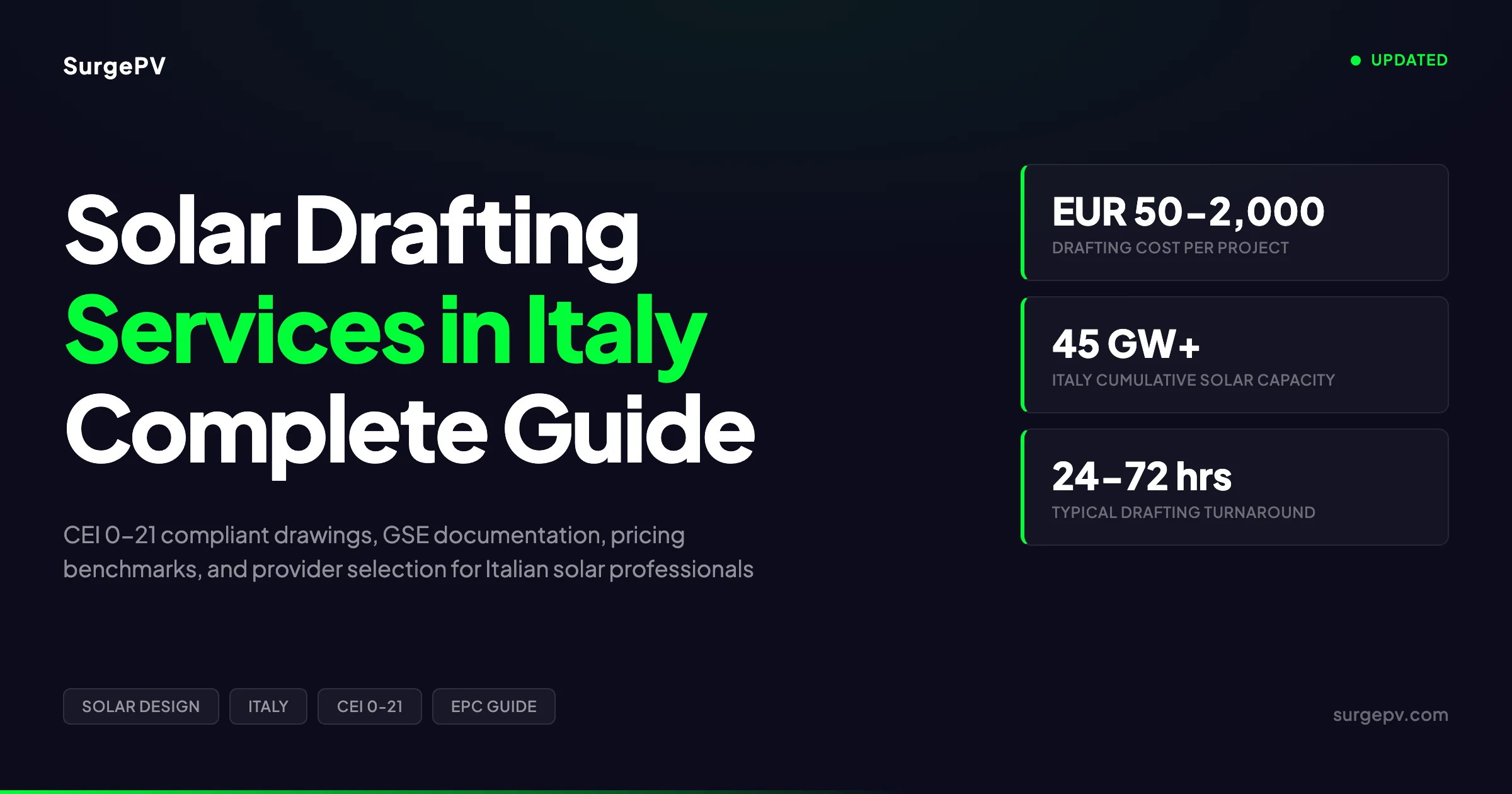
Italy added 1.44 GW of solar capacity in the first quarter of 2026, pushing the national total past 45 GW. That growth is not slowing. The C&I segment grew 24% year-over-year, and utility-scale projects above 10 MW are increasingly common. Every one of those megawatts starts with a drawing.
For Italian solar professionals, the question is no longer whether to produce technical documentation. It is whether to hire a solar drafting service, buy solar design platform, or combine both. This guide answers that question with real numbers, Italian regulatory context, and a decision framework built on 10+ years of EPC experience across European markets.
In this guide, you will learn:
- What solar drafting services in Italy actually deliver
- Which Italian regulations (CEI 0-21, CEI 0-16, GSE) shape every drawing
- How CAD and BIM standards apply to Italian solar projects
- What typical deliverables look like and what they cost in 2026
- When manual drafting beats software, and when software wins
- How to choose a provider without overpaying for scope you do not need
Quick Answer
Solar drafting services in Italy are specialized technical design providers that create CEI 0-21 compliant electrical drawings, single-line diagrams (SLDs), and GSE documentation for photovoltaic projects. Italian EPCs use them for projects that require custom civil engineering, utility-scale grid studies, or when in-house design capacity is limited. The market is shifting: automated solar design software now handles 80% of residential and commercial drafting in a few minutes, while manual services remain essential for complex projects above 1 MW. Costs range from EUR 50-200 per project for basic drafting to EUR 500-2,000 for full engineering documentation with structural calculations and DSO submission packages.
What Are Solar Drafting Services in Italy?
Solar drafting services in Italy are technical providers, usually staffed by a geometra (surveyor), perito industriale (industrial expert), or ingegnere (engineer), who produce the drawings and documentation required to permit, finance, and connect a photovoltaic system to the Italian grid.
These services sit between the sales conversation and the physical installation. A homeowner or business owner agrees to a solar project. The EPC or installer then needs a plan set that proves the system is safe, compliant, and economically viable. That plan set is what drafting services produce.
Who Provides Solar Drafting in Italy
The Italian market has four categories of drafting providers:
- Independent technical studios — Small firms of 2-5 drafters who serve multiple EPCs on a per-project basis. Common in Lombardy, Veneto, and Emilia-Romagna.
- EPC in-house design teams — Larger EPCs like Ethical Power Italia or SOLARTEC Group employ full-time drafters who handle everything from residential rooftops to 10 MW ground mounts.
- Freelance drafters on platforms — Individual drafters listed on Italian engineering marketplaces or general freelance platforms. Rates vary widely. Quality control is the buyer’s responsibility.
- Software-enabled design services — Platforms like SurgePV that combine automated drafting with human review for complex projects. This hybrid model is growing fastest in 2026.
What Makes Italian Solar Drafting Different
Italian solar drafting is not generic CAD work. Three factors make it distinct:
CEI 0-21 compliance is mandatory. Every grid-connected system needs a single-line diagram that shows protection schemes, interface relays, and anti-islanding measures exactly as the Comitato Elettrotecnico Italiano specifies. A drafter who has only worked on German or Spanish projects will miss details that Italian DSOs flag immediately.
GSE documentation is incentive-critical. The Gestore dei Servizi Energetici manages Italy’s renewable energy incentives. Registration requires specific production estimates, self-consumption ratios, and system specifications. Drafting services that do not understand GSE formatting cause delays of 30-90 days.
Post-Scambio economics changed the design brief. Scambio sul Posto (net metering) closed to new applicants on January 1, 2025. The new regime, Ritiro Dedicato, pays roughly EUR 0.08-0.10 per kWh for exported energy versus EUR 0.33 for self-consumed energy. This 70% value gap means every design must now optimize for self-consumption, not maximum production. Drafting services that still size systems for peak output are using outdated logic.
Why Solar Drafting Matters in Italy’s 2026 Market
Italy’s solar market is at a transition point. The country needs 6-7 GW of annual additions to reach its 79 GW target by 2030, according to Italia Solare. Q1 2026 added 1.44 GW, which annualizes to roughly 5.8 GW. That is close, but not enough. The gap will be filled by faster project execution, and faster execution starts with faster design.
The Bottleneck Is Not Installation
Italian EPCs can install a residential rooftop in 2-3 days. The bottleneck is paperwork. Grid connection approvals from E-Distribuzione, Areti, or Unareti take 60-90 days. Municipal permits (CILA, SCIA, or permesso di costruire) add another 2-8 weeks. Every delay in drafting delays everything downstream.
A drafting service that turns around a residential plan set in 24 hours instead of 72 hours can compress the total project timeline by 5-10%. At 30 projects per month, that is 1.5-3 extra projects completed per month without adding installation crews.
The C&I Segment Is Driving Demand
The commercial and industrial segment added 566 MW in Q1 2026, up 24% year-over-year. C&I projects are more complex than residential. They often involve:
- Multiple roof planes with different tilts and orientations
- Structural calculations for industrial buildings with non-standard load capacities
- Medium-voltage connections requiring CEI 0-16 compliance
- Battery storage integration for peak-shaving and self-consumption optimization
- Bankable yield reports for financing through Intesa Sanpaolo, UniCredit, or SACE
Each of these requirements adds deliverables to the drafting scope. A simple layout plan is no longer enough. C&I EPCs need drafting partners who can produce full engineering packages, or they can use a customer-ready solar proposals platform that combines technical drawings with financial modeling.
Utility-Scale Projects Need Specialist Drafters
Utility-scale projects above 1 MW added 560 MW in Q1 2026. These projects require:
- Full civil and geotechnical drawings
- Medium-voltage substation design per CEI 0-16
- Environmental impact assessments
- Bankable P50/P90 simulations, usually produced in PVsyst
- Grid connection studies with TERNA coordination
No single software platform handles all of this. Utility-scale EPCs in Italy typically use a hybrid model: software for preliminary layout and yield analysis, specialist drafting firms for civil and electrical engineering, and external consultants for grid studies. For large commercial solar projects, the same principle applies—software handles the design and financial modeling, while manual drafters cover structural and MV work.
Italian Regulations and Standards for Solar Drafting
Italian solar drafting does not happen in a regulatory vacuum. Four standards and two agencies govern every drawing.
CEI 0-21: The Non-Negotiable Standard
CEI 0-21 is the mandatory technical standard for connecting active users to low-voltage (BT) distribution networks in Italy. It is issued by the Comitato Elettrotecnico Italiano and enforced by every DSO.
Key drafting requirements under CEI 0-21 include:
| Requirement | What the Drafter Must Show |
|---|---|
| Protection schemes | Overcurrent, overvoltage, and ground fault protection on the SLD |
| Interface Protection System (SPI) | Interface relay specifications for grid synchronization and automatic disconnection |
| Anti-islanding | Measures to prevent the system from energizing the grid during outages |
| Voltage limits | Defined tolerances for grid voltage at the point of connection |
| Frequency response | Power limitation starting at 50.2 Hz (updated in the 2019 revision) |
| Power factor control | Reactive power management requirements |
| Harmonic distortion | Limits to prevent grid disturbance |
DSOs reject connection applications with non-compliant SLDs. The rejection is not theoretical. E-Distribuzione, Areti, Unareti, and A2A all have technical review teams that check every diagram against CEI 0-21. A rejected application costs 2-4 weeks of delay.
CEI 0-16: Medium-Voltage Connections
Projects above 100 kW connecting to medium-voltage networks need CEI 0-16 compliance. This standard covers:
- Protection coordination between the plant and the DSO’s substation
- Remote monitoring and control systems (telecontrol/telegestione) for plants above 20 kW
- Fault Ride Through (FRT) requirements
- Voltage dip tolerance profiles
CEI 0-16 drafting is more complex than CEI 0-21. It requires coordination with the DSO’s protection settings, which vary by region and substation. Only experienced drafting services or specialized engineering firms handle this work.
CEI 64-8: Building Electrical Systems
CEI 64-8 governs electrical installations inside buildings. For rooftop solar systems, it affects:
- DC cabling routes and separation from AC circuits
- Grounding and bonding requirements
- Surge protection device placement
- Labeling and signage
A drafting service that produces only the SLD but ignores CEI 64-8 for the internal building wiring creates a liability for the installer.
GSE Registration Requirements
The Gestore dei Servizi Energetici requires specific documentation for incentive registration:
- Annual production estimates aligned with PVGIS or on-site monitoring data
- Self-consumption ratios (now critical post-Scambio)
- System specifications including module and inverter models
- Yield documentation that meets GSE’s validation standards
Drafting services that produce bankable reports for GSE registration must understand how GSE validates production estimates. Overstated yields lead to clawback penalties.
CAD, BIM, and Solar Design Standards in Italy
Italian solar drafting operates across three technical platforms: traditional CAD, BIM-integrated workflows, and automated solar design software.
AutoCAD and SPAC EasySol
AutoCAD remains the dominant drafting platform for Italian electrical engineers. SPAC EasySol by SDProget is a professional CAD-based solar design tool that integrates with AutoCAD workflows. It is popular among drafters who need to produce detailed SLDs with full CEI compliance.
Strengths:
- Full control over every line and symbol
- Accepted by all Italian DSOs
- Compatible with legacy project archives
Weaknesses:
- 2-3 hours per SLD for a residential project
- No automated shading or yield analysis
- No financial modeling
- Requires a licensed AutoCAD seat plus the SPAC EasySol license
BIM and Revit Integration
Building Information Modeling (BIM) is increasingly used for commercial and utility-scale solar projects in Italy. A thesis from Politecnico di Torino demonstrated a BIM-based PV design methodology using Autodesk Revit, Dynamo, and Refinery for parametric modeling and generative design.
Key findings from that research:
- LOD 300 (Level of Detail 300) is the minimum required for reliable PV analysis
- Interoperability between BIM platforms and solar analysis tools is still a challenge
- Two real-world case studies were modeled: a Stellantis industrial facility in San Benigno Canavese and the Ethnographic Museum in Addis Ababa
For Italian solar projects, BIM is most relevant when:
- The solar system is part of a new building design (building-integrated PV)
- Structural coordination with architects and structural engineers is required
- The project needs clash detection between solar arrays, HVAC equipment, and roof structures
Solarius PV by ACCA Software is Italy’s primary BIM-integrated solar design platform. It connects solar design with architectural and structural BIM workflows and provides full Italian standards compliance (CEI 0-21, CEI 64-8).
Automated Solar Design Software
Automated platforms like SurgePV generate CEI 0-21 compliant SLDs in 5-10 minutes. They import satellite imagery, place modules automatically, calculate shading, size strings, and produce the full plan set including financial modeling for Ritiro Dedicato and Ecobonus. For EPCs comparing options, our best solar design software for Italy guide ranks the top platforms by CEI compliance and GSE integration.
For Italian EPCs doing 20+ projects per year, software is now the default. The break-even point is roughly 15 projects per month at current subscription prices.
Typical Deliverables from Italian Solar Drafting Services
When you hire a solar drafting service in Italy, the scope varies by project size and complexity. Here is what you should expect at each tier.
Tier 1: Basic Residential (3-10 kW)
| Deliverable | Description | Typical Format |
|---|---|---|
| Site layout plan | Module placement on roof or ground | PDF, DWG |
| Single-line diagram (SLD) | CEI 0-21 compliant electrical schematic | PDF, DWG |
| Stringing configuration | Module-to-inverter string mapping | PDF, Excel |
| Equipment schedule | Module, inverter, and BOS specifications | PDF, Excel |
| GSE registration docs | Production estimate and self-consumption ratio | GSE portal format |
Cost: EUR 50-200 per project Turnaround: 24-72 hours
Tier 2: Commercial and Industrial (20 kW - 1 MW)
| Deliverable | Description | Typical Format |
|---|---|---|
| All Tier 1 deliverables | Plus expanded scope | — |
| Structural calculations | Roof load analysis and mounting verification | PDF with engineer stamp |
| Shading analysis | 3D obstruction modeling and yield impact | PDF, PVsyst report |
| Bankable yield report | P50/P75/P90 production forecast | PDF with uncertainty analysis |
| CEI 0-16 documentation | MV protection coordination (if applicable) | PDF, DWG |
| Ecobonus documentation | Tax credit calculation and compliance proof | PDF, Excel |
Cost: EUR 300-800 per project Turnaround: 7-14 business days
Tier 3: Utility-Scale (Above 1 MW)
| Deliverable | Description | Typical Format |
|---|---|---|
| All Tier 2 deliverables | Plus expanded scope | — |
| Civil and geotechnical drawings | Foundation design, grading, drainage | PDF, DWG |
| MV substation design | Transformer, switchgear, and protection | PDF, DWG |
| Grid connection study | TERNA coordination and impact analysis | PDF with grid code analysis |
| Environmental assessment | Landscape and biodiversity impact | PDF per EIA requirements |
| Full bankable report | P50/P90 with 20-year degradation and O&M costs | PDF, Excel model |
Cost: EUR 1,500-5,000+ per project Turnaround: 3-6 weeks
The SLD Is the Critical Deliverable
The single-line diagram is the document that every Italian DSO reviews first. It must show:
- The point of connection to the DSO’s network
- The main AC and DC disconnects
- Inverter placement and specifications
- Protection device ratings and settings
- Grounding and bonding points
- Metering arrangement
A missing protection symbol or an incorrect relay specification is enough to trigger a rejection. Experienced Italian drafters know the common rejection reasons for each DSO. E-Distribuzione, for example, is particularly strict about interface relay documentation.
Solar Drafting Cost in Italy: 2026 Pricing Guide
Pricing for solar drafting services in Italy depends on project size, complexity, and the drafter’s qualifications. Here are the 2026 market rates.
Per-Project Pricing
| Project Type | Basic Drafting | Full Engineering | Premium (Bankable) |
|---|---|---|---|
| Residential 3-10 kW | EUR 50-150 | EUR 150-300 | EUR 300-500 |
| Residential 10-20 kW | EUR 100-200 | EUR 250-450 | EUR 450-700 |
| C&I 20-100 kW | EUR 200-400 | EUR 400-700 | EUR 700-1,200 |
| C&I 100 kW - 1 MW | EUR 400-800 | EUR 800-1,500 | EUR 1,500-2,500 |
| Utility >1 MW | EUR 800-1,500 | EUR 1,500-3,000 | EUR 3,000-5,000+ |
Monthly Retainer Pricing
EPCs with consistent volume often negotiate monthly retainers:
| Monthly Volume | Retainer Range | Effective Per-Project Cost |
|---|---|---|
| 5-10 projects | EUR 500-1,200 | EUR 50-120 |
| 10-20 projects | EUR 1,000-2,500 | EUR 50-125 |
| 20-30 projects | EUR 2,000-4,000 | EUR 67-133 |
| 30+ projects | EUR 3,000-6,000 | EUR 100-200 |
The per-project cost under a retainer can actually be higher than software-based drafting because retainers include revision rounds, rush requests, and DSO resubmissions.
Software Subscription Comparison
| Software | Annual Cost | Projects/Year | Cost Per Project |
|---|---|---|---|
| SurgePV | EUR 590-1,400 | 50-200 | EUR 3-28 |
| Solarius PV | EUR 500-900 | 50-100 | EUR 5-18 |
| PVsyst | EUR 450-650 | 50-100 | EUR 5-13 |
| Aurora Solar | EUR 4,500-9,000 | 100-300 | EUR 15-90 |
At 50 projects per year, software costs EUR 3-28 per project. Manual drafting costs EUR 50-200. The economic case for software is clear at volume. The case for manual drafting is strongest at low volume or high complexity.
Pro Tip
Do not compare software and manual drafting on price alone. A EUR 150 manual draft that gets rejected by the DSO costs you 2-4 weeks of delay. A EUR 5 software draft that is CEI 0-21 compliant from the start saves you both time and resubmission fees. The real cost is total project cycle time, not the drafting invoice.
Manual Drafting vs Solar Design Software in Italy
The choice between manual drafting services and solar design software is not binary. Most successful Italian EPCs use both. The question is where to draw the line.
When Manual Drafting Wins
Manual drafting services are the better choice when:
- The project is above 1 MW. Software handles layout and yield well, but civil engineering, MV substation design, and grid connection studies need specialist drafters.
- Custom structural work is required. An old industrial roof with asbestos removal, reinforcement, and non-standard mounting needs a structural engineer, not software.
- CEI 0-16 compliance is needed. MV protection coordination requires DSO-specific knowledge that software does not automate.
- You do fewer than 5 projects per month. At low volume, a per-project drafting fee is cheaper than an annual software subscription.
- Bankable reports for project finance are required. Italian lenders like Intesa Sanpaolo and UniCredit still prefer PVsyst reports with detailed uncertainty analysis for projects above 500 kW.
When Software Wins
Solar design software is the better choice when:
- You do 20+ residential or commercial projects per month. The time savings compound quickly. Italian EPCs switching to software save 60-80% of proposal preparation time.
- Speed is a competitive advantage. Same-day turnaround versus 24-72 hours for manual drafting lets you respond to leads while they are still hot.
- You need integrated financial modeling. Post-Scambio economics require Ritiro Dedicato modeling, self-consumption optimization, and battery ROI analysis. Software does this automatically. Manual drafters do not do it at all.
- You want to reduce errors. Automated CEI 0-21 SLD generation eliminates the protection symbol errors that cause DSO rejections.
- You need Italian-language proposals. Platforms like SurgePV generate client-facing proposals in Italian with Ecobonus calculations built in.
The Hybrid Model
The most common approach among mid-size Italian EPCs (50-200 projects per year) is hybrid:
- Software for design and proposals. Layout, shading, SLD, yield, and financial modeling in one platform.
- Manual drafting for structural and MV work. Hire a geometra or ingegnere for the 10-20% of projects that need it.
- External consultants for grid studies. TERNA coordination and MV impact analysis for utility-scale projects.
This hybrid model costs roughly EUR 1,200-2,500 per month in software subscriptions plus EUR 300-800 per project for specialist drafting. It is more expensive than pure software but cheaper than pure manual drafting at volume, and it covers every project type.
Top Solar Drafting Service Providers and Software Options in Italy
The Italian market has providers across four categories. Here is how they compare.
Category 1: Local Italian Drafting Studios
| Provider Type | Typical Location | Strength | Weakness |
|---|---|---|---|
| Independent geometra studios | Lombardy, Veneto, Emilia-Romagna | Fast turnaround, local DSO knowledge | Limited to basic residential/C&I |
| Regional engineering firms | All regions | Full-service including structural | Higher cost, longer queues |
| Freelance drafters | Remote | Low cost | Variable quality, no liability coverage |
Category 2: EPCs with Design Arms
| Company | Location | Focus | Notes |
|---|---|---|---|
| Ethical Power Italia | Italy-wide | Large-scale EPC | 250 MW pipeline; design included in EPC contract |
| SOLARTEC Group | Italy-wide | Residential, C&I, agrivoltaic | Full-service design and construction |
| CESI | Milan | Technical consulting | Large-scale grid studies and MV design |
Category 3: Italian-Native Software
| Software | Best For | Price/Year | Key Strength |
|---|---|---|---|
| Solarius PV (ACCA) | BIM-integrated design | EUR 500-900 | Native Italian, full CEI compliance, Revit integration |
| SPAC EasySol | CAD-based SLD production | EUR 300-600 | AutoCAD integration, detailed electrical schematics |
| Solergo | Budget Italian compliance | Free-Pro | CEI 0-21 SLDs, basic yield analysis |
Category 4: International Platforms with Italian Support
| Software | Best For | Price/Year | Key Strength |
|---|---|---|---|
| SurgePV | All-in-one Italian EPC workflow | EUR 590-1,400 | Auto CEI 0-21 SLDs, Ritiro Dedicato modeling, Italian language, GSE docs |
| PVsyst | Bankable simulation | EUR 450-650 | Gold standard for Italian lenders; no design/SLD/proposals |
| Aurora Solar | Premium residential | EUR 4,500-9,000 | Polished visuals; no Italian automation, needs AutoCAD for SLDs |
| HelioScope | Commercial rooftops | EUR 3,000-6,000 | Complex roof modeling; no CEI SLD automation |
Key Takeaway
For Italian EPCs doing 20+ projects per year, SurgePV or Solarius PV are the most complete solutions. For bankable utility-scale reports, PVsyst remains mandatory. For pure CAD drafting without simulation, SPAC EasySol is the established choice. Manual drafting studios still have a role for custom structural work and projects above 1 MW.
How to Choose a Solar Drafting Service Provider in Italy
Selecting a drafting provider is a procurement decision that affects every project timeline. Use this checklist.
Qualification Checklist
| Criterion | Why It Matters | How to Verify |
|---|---|---|
| CEI 0-21 portfolio | DSO rejection is expensive | Ask for 3 recent SLDs submitted to E-Distribuzione or Areti |
| GSE documentation experience | Incentive registration delays cost 30-90 days | Ask for GSE registration confirmation screenshots |
| DSO relationships | Familiarity with local submission formats | Ask which DSOs they work with regularly |
| Professional liability insurance | Errors in drafting create liability | Request certificate of insurance |
| Revision policy | Rejections and client changes are normal | Confirm 2-3 revision rounds are included |
| Turnaround guarantee | Project timelines depend on drafting speed | Get written turnaround commitments |
| Language capability | Italian DSOs require Italian documentation | Confirm all deliverables are in Italian |
Red Flags
- No CEI 0-21 examples. Any drafter working in Italy should have compliant SLDs ready to show.
- Fixed price for all projects. A 3 kW residential system and a 500 kW commercial roof cannot cost the same to draft properly.
- No liability insurance. If a drafting error causes a DSO rejection or safety issue, you need recourse.
- Outdated incentive knowledge. Drafters who still reference Scambio sul Posto for new projects do not understand the 2026 market.
- No revision allowance. Every project has at least one round of changes. Per-revision charges add up fast.
Questions to Ask Before Signing
- “Can you show me a CEI 0-21 SLD you submitted to [my DSO] in the last 3 months?”
- “What is your revision policy, and how many rounds are included?”
- “Do you produce GSE registration documentation, or do I need to handle that separately?”
- “What is your turnaround time for a [X kW] project, and do you offer rush service?”
- “Do you have professional liability insurance, and what is the coverage amount?”
- “How do you handle post-Scambio self-consumption optimization in your designs?”
Common Mistakes When Outsourcing Solar Drafting in Italy
Italian EPCs make the same errors repeatedly when hiring drafting services. Here are the most costly ones.
Mistake 1: Treating Drafting as a Commodity
The lowest-price drafter is rarely the cheapest option. A EUR 80 draft with a missing protection symbol costs you 2-4 weeks of DSO delay. At EUR 500 per day of project overhead, that “cheap” draft just cost you EUR 7,000-14,000 in carrying costs. Quality drafting is insurance, not overhead.
Mistake 2: Ignoring the Self-Consumption Shift
Since January 1, 2025, new projects cannot join Scambio sul Posto. The value of exported energy is now EUR 0.08-0.10 per kWh under Ritiro Dedicato, versus EUR 0.33 for self-consumed energy. Drafters who size systems for maximum production without modeling load profiles are designing for 2023 economics, not 2026.
Mistake 3: Separating Drafting from Financial Modeling
A layout plan without a financial model is half a deliverable. Italian customers now need to see Ritiro Dedicato revenue, Ecobonus tax credit value, and battery payback before they sign. Drafting services that produce only technical drawings force you to build the financial case separately. Software platforms that integrate both save 3-4 hours per project. For a deeper look at the economics, see our solar panel ROI Italy guide.
Mistake 4: Not Checking DSO-Specific Requirements
E-Distribuzione, Areti, Unareti, and A2A all use CEI 0-21, but their submission portals and formatting preferences differ. A drafter who works only with E-Distribuzione may produce SLDs that Areti rejects for formatting reasons. Verify your drafter has experience with your specific DSO.
Mistake 5: Skipping Structural Calculations on Commercial Roofs
Italian building codes require structural verification for rooftop installations. A drafting service that produces only electrical drawings leaves you exposed if the roof cannot support the load. Always confirm structural calculations are included for C&I projects, or hire a separate structural engineer.
Pro Tip
The best drafting relationship is a partnership, not a transaction. Share your typical project types, DSO, and customer profile with your drafter at the start. A drafter who understands your workflow will produce better drawings faster than one who treats every project as a blank slate.
When to Use SurgePV for Italian Solar Drafting
For Italian EPCs and installers, the choice between manual drafting and software is increasingly tilted toward automation. Solar design software like SurgePV handles the 80% of projects that are standard residential and commercial rooftops, leaving manual drafters for the 20% that are complex, custom, or utility-scale. If your workflow is proposal-heavy, pairing design with solar proposal software can cut your pre-sale preparation time by 60-80%.
SurgePV is built for the Italian market specifically. It generates CEI 0-21 compliant SLDs automatically, models Ritiro Dedicato economics with hourly self-consumption analysis, and produces Italian-language proposals with Ecobonus calculations. The platform integrates layout, shading, electrical design, yield simulation, and financial modeling in one workflow.
For EPCs doing 20+ projects per month, the time savings are substantial. A project that takes 3-4 hours in AutoCAD takes a few minutes in SurgePV. That difference compounds across 50 projects per month into 100+ hours of recovered capacity.
Design Italian Solar Projects Faster
See how SurgePV automates CEI 0-21 SLDs, Ritiro Dedicato modeling, and Italian-language proposals in a single platform.
Book a DemoNo commitment required · 20 minutes · Live project walkthrough
Conclusion
Solar drafting services in Italy are evolving from a manual, per-project cost center into a hybrid capability that combines software automation with specialist engineering. The 2026 market demands speed, CEI 0-21 compliance, and post-Scambio financial modeling that most standalone drafting services do not provide.
Here are three actions to take this week:
- Audit your current drafting cost per project. Include revision rounds, DSO resubmissions, and delay costs. Compare that total to a software subscription at your volume.
- Verify your drafter’s CEI 0-21 portfolio. Ask for three recent SLDs submitted to your DSO. If they cannot produce them, find a provider who can.
- Test a hybrid workflow. Run your next five residential projects through solar PV design software and your next commercial project through a manual drafter. Measure total cycle time and cost for each. The data will tell you where to draw the line.
Italy’s solar market is adding 6+ GW per year. The EPCs that win are the ones that design faster, comply flawlessly, and close more deals. Your drafting strategy is a competitive weapon. Use it.
Frequently Asked Questions
What are solar drafting services in Italy?
Solar drafting services in Italy are specialized technical providers that create CEI 0-21 compliant electrical drawings, single-line diagrams (SLDs), and GSE documentation for photovoltaic installations. They are typically staffed by geometras, periti industriali, or ingegneri who understand Italian grid codes and DSO requirements.
How much do solar drafting services cost in Italy?
Basic residential drafting costs EUR 50-200 per project. Full engineering documentation with structural calculations, CEI 0-21 SLDs, and DSO submission packages runs EUR 500-2,000. Monthly retainers for EPCs with 30+ projects range from EUR 1,500-6,000.
What is CEI 0-21 and why does it matter for solar drafting?
CEI 0-21 is the mandatory Italian technical standard for connecting generators to low-voltage distribution networks. It defines protection schemes, anti-islanding requirements, interface relay specifications, and voltage limits. Italian DSOs reject non-compliant SLDs, so every drafting deliverable must follow CEI 0-21.
Can solar design software replace manual drafting services in Italy?
For residential and commercial projects under 1 MW, yes. Software like SurgePV generates CEI 0-21 compliant SLDs in a few minutes at roughly EUR 3-5 per project. Manual drafting remains essential for utility-scale projects, custom civil engineering, and MV grid studies requiring CEI 0-16 compliance.
What deliverables should I expect from an Italian solar drafting service?
Standard deliverables include a site layout plan, single-line diagram with CEI 0-21 protection schemes, stringing configuration, equipment schedule, structural calculations for rooftop systems, GSE registration documentation, and bankable yield reports for projects above 100 kW.
How long does solar drafting take in Italy?
A basic residential plan set takes 24-72 hours. Commercial projects with structural calculations require 7-14 business days. Utility-scale projects with full MV studies and bankable reports take 3-6 weeks. Software-generated drafts are same-day.
Which Italian DSOs review solar drafting documentation?
Major DSOs include E-Distribuzione (Enel), Areti (Rome), Unareti (Milan), A2A, and regional operators. Each has slightly different submission formats, but all require CEI 0-21 compliant SLDs for LV connections and CEI 0-16 for MV connections above 100 kW.
What is the difference between solar drafting and solar design software?
Solar drafting services produce manual technical drawings, usually in AutoCAD, for a per-project fee. Solar design software automates layout, shading, electrical design, and financial modeling through a subscription. In Italy, the critical difference is CEI 0-21 SLD automation: some software generates compliant diagrams instantly, while manual drafters charge separately for each SLD revision.
Where this fits
This article is part of SurgePV's Solar Design hub, which works through the topic from first principles to the decisions a project team actually has to make.