Quick Answer
Three patterns dominate in North America, the UK, and Australia, and each one changes who signs the solar agreement. This is the most common arrangement in modern townhouse developments built after 2000. About 30 percent of US townhouse HOAs use this structure. Designers should request a copy before the site survey because the wrong assumption changes the entire approval workflow.
A townhouse roof looks simple from the street and turns into a contract problem the moment you try to put solar on it. Three or four units share one continuous slope, the property line runs through the middle of an array, the HOA owns the shingles, and the front section faces north while the back gets all the sun. Designers who treat a townhouse like a detached single-family home end up with rejected permits, neighbor disputes, and arrays that produce 30 percent less than the solar proposal software output promised.
Three patterns dominate in North America, the UK, and Australia, and each one changes who signs the solar agreement. This is the most common arrangement in modern townhouse developments built after 2000. About 30 percent of US townhouse HOAs use this structure. For the latest details on UK, see Battery Solar System Design UK. For Australia-specific compliance details, see Australia comparisons/lgc-vs-stc. For United Kingdom-specific compliance details, see United Kingdom comparisons/mcs-vs-non-mcs.
This guide covers how to design solar PV for multi-story townhouses where roof ownership is shared. It walks through the legal framework for allocating common roof area, the engineering rules that constrain panel placement on narrow roof sections, the electrical separation required to keep each unit on its own meter, and the specific allocation methods (equal-area, equitable-energy, pro-rata-of-roof-frontage) that hold up in HOA approval and resale.
TL;DR — Townhouse Shared Roof Solar
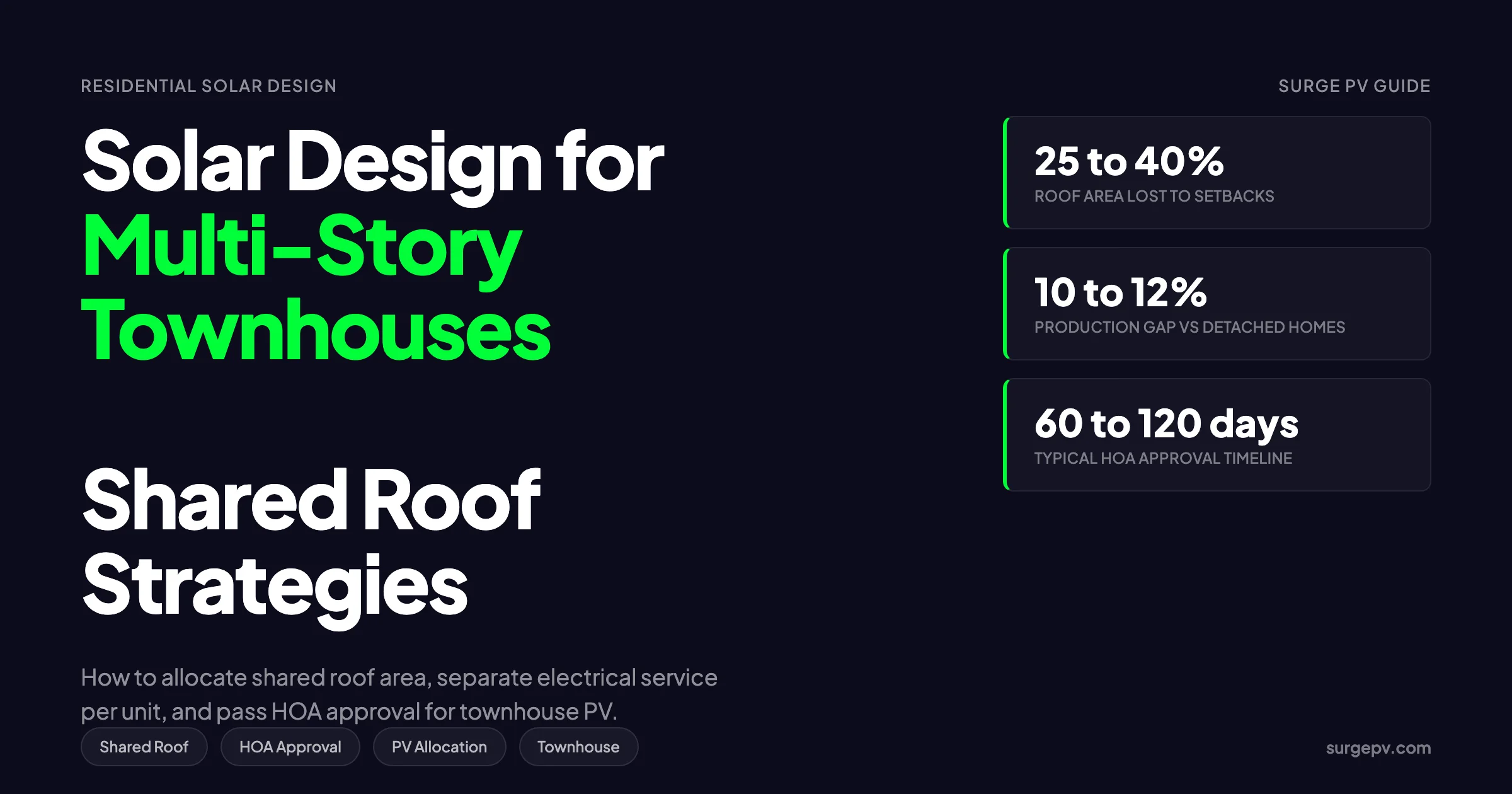
On a shared roof, the only allocation method that survives an HOA challenge is equitable energy allocation: each unit gets the share of usable roof that produces equal annual kWh, calculated from a shade study. Each unit needs its own meter, its own inverter or microinverters, and its own monitoring. Plan for 25 to 40 percent of gross roof area to be unusable after fire-code setbacks, and write a removal-and-reinstallation cost clause into the agreement before the first panel goes up.
What this guide covers:
- Who actually owns the roof in a multi-story townhouse and why that determines the design path
- The four allocation methods used in practice and which one defends best at HOA boards
- Roof geometry constraints that hit townhouse arrays harder than single-family homes
- Electrical architecture options that keep each unit on its own utility meter
- Fire-code setbacks, ventilation clearances, and structural load checks
- HOA approval workflow, required documents, and the legal agreements that bind future owners
- A step-by-step design process and a worked example for a 4-unit townhouse block
Who Owns the Roof on a Multi-Story Townhouse
Before any allocation math begins, the designer needs to confirm the legal ownership structure of the building. Three patterns dominate in North America, the UK, and Australia, and each one changes who signs the solar agreement.
Fee-simple townhouse with party walls. Each unit owner holds title to the land beneath their unit and the roof directly above it. The party walls are shared, but the roof above each unit is private property. This is the simplest case for solar design because the owner can install panels without HOA permission for the roof itself, though architectural review may still apply.
Condominium-style townhouse with common roof. The roof is common element owned by the HOA or owners corporation. Individual unit owners hold title only to the interior airspace. Solar installations require a license or easement from the HOA that grants access to a defined portion of the common roof. This is the most common arrangement in modern townhouse developments built after 2000.
Hybrid with limited common element roof. The roof is technically common property, but each unit has exclusive use rights over the section directly above. The HOA still controls structural decisions and architectural appearance, but the unit owner does not need to share the assigned section with neighbors. About 30 percent of US townhouse HOAs use this structure.
The title document, declaration of covenants, or strata plan will specify which model applies. Designers should request a copy before the site survey because the wrong assumption changes the entire approval workflow. A fee-simple owner can sign their own contract; a common-element installation needs board action and an executed easement.
Pro Tip
Pull the recorded plat or strata plan from the county recorder before the first site visit. The drawings show party-wall locations, easements, and roof boundaries that are not visible from a street-level inspection. This single document prevents most townhouse design disputes.
Why Shared Roof Allocation Is a Design Problem, Not Just a Legal One
Equitable allocation sounds like a real-estate question, but it falls on the solar designer because only the designer has the tools to model it. The HOA board does not own a solar shadow analysis software license. The neighbor in unit 4 does not know that the dormer on unit 1 will throw a shadow across their assigned roof at 2 PM in December.
The allocation decision drives:
- How much DC capacity each unit can install
- Where the conduit runs cross the building
- Which inverters get specified
- How the agreement values each unit’s solar right at resale
Get the allocation wrong and one neighbor ends up with a 3 kW system while the unit next door installs 7 kW on better-oriented roof. That gap creates disputes that end up in court. The designer’s job is to surface the allocation math early, document it with shade modeling, and put the numbers in front of the board before any contract is signed.
This is also where PV design software earns its keep on townhouse projects. A solar design software tool that handles per-unit production breakdowns, irradiance maps across multiple roof zones, and equitable-area calculations cuts the design time on a townhouse block from days to hours.
The Four Allocation Methods
Across HOAs, condo boards, owners corporations, and strata schemes worldwide, four methods of dividing shared roof area appear repeatedly. Each has tradeoffs. Designers should present at least two options to the board with production numbers, not pick one in isolation.
Method 1: Equal Area Allocation
Divide the gross roof area by the number of units. If the building has four units and 1,600 square feet of roof, each unit gets 400 square feet.
When it works: Roofs with uniform pitch, orientation, and zero shading. New construction with no obstructions.
When it fails: Most existing buildings. A 400-square-foot section facing north produces about 50 percent of the kWh that the same area facing south produces. Equal area gives unequal energy.
Defense at HOA boards: Weak. A unit owner whose assigned section is shaded by an adjacent dormer can challenge the allocation as inequitable, and most boards will accept the challenge.
Method 2: Equitable Energy Allocation
Each unit gets the portion of the roof that produces equal annual kWh, calculated from a shade and irradiance study. Unit owners with poorly oriented or shaded roof sections receive a larger area to compensate.
When it works: Almost every existing townhouse block. This is the method that California Civil Code § 714.1 effectively requires and that HOA case law in most US states has upheld.
When it fails: Buildings where one or more roof sections produce zero usable energy because of complete shading or unbuildable orientation. In those cases, the no-production unit is excluded from the allocation entirely or compensated through a virtual net metering arrangement. Also see: Us Residential Solar Market Trends 2026.
Defense at HOA boards: Strong. The shade study is a defensible, repeatable engineering document.
Method 3: Pro-Rata of Roof Frontage
Each unit gets the roof area directly above its unit footprint. A unit that is 20 feet wide gets the 20-foot-wide strip of roof above it.
When it works: Linear townhouse rows with simple, repeating geometry and no shared dormers, valleys, or hip sections that cross unit boundaries.
When it fails: Buildings with hip roofs, shared dormers, or roof penetrations that fall on unit lines. Also fails when one unit’s roof section is shaded by an adjacent unit’s chimney or roof feature.
Defense at HOA boards: Moderate. Easier to explain than equitable energy allocation but produces unequal generation when orientations vary.
Method 4: First-Come-First-Served with Reservation
The first unit to apply receives priority on the best roof area, with each subsequent unit assigned the remaining area. The HOA reserves a notional share for each non-applying unit.
When it works: Almost never as a primary allocation method. It produces the largest disputes and the worst resale outcomes.
When it fails: Most cases. Unit 4 buys their home expecting solar potential, then discovers unit 1 took the entire south-facing slope eight years ago. This is the allocation method most likely to end in litigation.
Defense at HOA boards: Weak unless paired with reserved-area documentation that protects future-applying units.
| Allocation Method | Difficulty to Document | Fairness to All Units | Defensibility | Common Use |
|---|---|---|---|---|
| Equal Area | Low | Low | Weak | New construction only |
| Equitable Energy | Moderate | High | Strong | Recommended default |
| Pro-Rata Frontage | Low | Moderate | Moderate | Simple linear blocks |
| First-Come-First-Served | Low | Low | Weak | Avoid |
For most multi-story townhouse blocks built before 2020, equitable energy allocation is the only method that holds up under scrutiny. The rest of this guide assumes that approach.
Key Takeaway
Equal-area allocation looks fair on a drawing and is unfair in practice. A south-facing 400-square-foot section produces twice the energy of a north-facing 400-square-foot section. Always run an equitable-energy analysis before presenting allocation options to the HOA.
Roof Geometry Constraints Specific to Townhouses
Townhouse roofs are not detached-home roofs scaled down. They have constraints that single-family designers rarely encounter, and ignoring them is the fastest way to a rejected permit.
Narrow Roof Sections
Most townhouses have roof sections between 12 and 22 feet wide per unit. Standard 60-cell modules are about 40 inches wide and 66 inches tall. After fire-code setbacks (more on those below), a 16-foot-wide section yields a usable width of about 10 feet, which fits two columns of portrait modules or three columns of horizontal-orientation modules. The inability to add a third column is the single largest capacity constraint on townhouse arrays.
Shared Valleys and Hips
When two units share a hip line or valley, the roof plane changes orientation across the property boundary. A panel placed within 18 inches of a hip line can extend across the boundary, which creates ownership questions and racking-spec violations. Most racking systems require a minimum 12-inch setback from hip and valley lines for waterproofing.
Penetrations That Cross Unit Boundaries
Plumbing vents, dryer vents, and bathroom fans are often grouped at party-wall locations because builders prefer to stack the wet walls. These penetrations require 24 to 36 inches of clearance per most racking specifications and per IFC 1204.2.1. A row of vents along the party wall can eat 4 feet of usable roof on each side.
Dormers and Skylights
Dormers create shadow patterns that change with the sun’s angle. A dormer on unit 2 can throw a shadow across unit 3’s roof for hours each day in winter. The shade study must include adjacent units’ obstructions, not just the unit being designed.
Structural Load on Older Buildings
Townhouses built before 2000 frequently used 2x4 or 2x6 rafters at 24-inch centers. Many cannot accept the 3 to 5 pounds per square foot of dead load that a flush-mount PV array adds without engineering review. A structural letter is nearly always required for townhouse installations on buildings older than 25 years.
Electrical Architecture for Shared-Roof Townhouse Arrays
The most important rule in townhouse PV design: each unit’s array must terminate at that unit’s utility meter. Sharing an inverter, combining strings across units, or feeding multiple meters from one PV system creates code-compliance problems, billing disputes, and ownership confusion that no agreement can fully solve.
Three architectures handle this cleanly.
Microinverters with Per-Unit Trunk Cables
Each module gets its own microinverter on the back of the panel. Each unit’s modules are wired to a separate trunk cable that runs down to that unit’s interconnection point. This is the cleanest architecture for shared roofs because each unit’s system is electrically independent at the module level.
Pros: Total electrical separation. Easy to expand a single unit later. Module-level monitoring per unit. No DC running across the property line.
Cons: Higher cost per watt (typically $0.20 to $0.35 more than string inverters). Requires roof access for any microinverter replacement.
String Inverters per Unit
Each unit’s modules are wired to a string inverter located on that unit’s exterior wall or in that unit’s electrical room. Strings cannot cross unit boundaries.
Pros: Lower upfront cost. Easier inverter replacement. Centralized fault detection per unit.
Cons: Requires enough modules per unit to make string inverter sizing economical. A 2 kW unit array using a 3 kW inverter wastes capacity. Unit arrays smaller than 3 kW are usually better served by microinverters or microinverters versus string inverters versus optimizers decisions favor module-level electronics. For more on this topic, see Inverter Selection Solar Design Guide.
DC Optimizers with Per-Unit Inverters
Each module gets a DC optimizer for module-level MPPT, but units share an inverter platform with separate channels per unit. This works only when all units sign a single shared-equipment agreement and accept joint maintenance responsibility.
Pros: Better economics than microinverters at higher capacities. Module-level monitoring.
Cons: Shared equipment creates the joint-maintenance problem the architecture was supposed to avoid. Most designers reserve this for buildings where all units are owned by a single entity (rental properties, for example).
For most owner-occupied townhouse blocks, microinverters win because the per-unit electrical separation matches the per-unit ownership structure.
| Architecture | Cost per Watt | Electrical Separation | Best For |
|---|---|---|---|
| Microinverters per unit | $2.80 to $3.40 | Complete | Owner-occupied, mixed unit sizes |
| String inverter per unit | $2.50 to $3.10 | Complete (if strings stay on one roof) | Units with 4+ kW each |
| Shared DC optimizer | $2.60 to $3.20 | Partial | Single-owner rental blocks only |
Pro Tip
Run conduit on the unit owner’s side of the party wall, not across the building. A conduit run that crosses two unit walls turns into an easement question and a future-owner liability. Bring the conduit down inside the assigned roof section, even if the route is longer.
Fire Code Setbacks That Reduce Usable Townhouse Roof
The International Fire Code (IFC) Section 1204 and the International Residential Code (IRC) R324 specify minimum pathways for firefighter access on residential PV roofs. These setbacks apply equally to townhouses and detached homes, but they hit harder on townhouses because the roof sections are smaller.
Standard setback rules (US, IFC 2024):
- 36-inch pathway along at least one ridge from eave to ridge
- 18-inch setback from hips and valleys on each side
- 36-inch pathway around skylights, vents, and roof penetrations
- 4-foot pathway across the roof from eave to eave for buildings over 30 feet tall (most multi-story townhouses)
Effect on a typical 16-foot-wide townhouse roof section:
| Roof Feature | Setback Required | Impact on Usable Area |
|---|---|---|
| Ridge pathway | 36 inches | -3 ft from top |
| Eave clearance | 12 inches | -1 ft from bottom |
| Side hip setback (one side) | 18 inches | -1.5 ft from one side |
| 4-foot cross-roof pathway | 48 inches | -4 ft horizontal |
| Net usable on 16x20 ft section | — | ~75 sq ft (24%) |
A townhouse roof section that looks like 320 square feet on a satellite image often delivers 75 to 200 square feet of usable area after setbacks. This is the math that has to drive the allocation conversation. Designers who quote system size based on gross roof area lose credibility the first time the AHJ rejects the layout.
Some jurisdictions allow reductions for buildings with sprinkler systems or alternative-pathway plans. Check the local AHJ before ruling out a section as too small.
Run Townhouse Allocation Studies in Hours, Not Days
SurgePV models multi-unit roof allocations with per-unit shade, irradiance, and setback constraints, then exports board-ready proposals for each unit owner.
Book a DemoNo commitment required · 20 minutes · Live project walkthrough
For a direct comparison, see Arka 360 vs SurgePV.
The Shade Study That Makes Equitable Allocation Defensible
Equitable energy allocation requires a shade and irradiance study for each potential roof section. The study has to be reproducible, dated, and based on inputs that the HOA can verify. A defensible shade study includes:
Site model inputs:
- Building footprint with party-wall locations marked
- Roof pitch, azimuth, and tilt for each plane
- Adjacent obstructions (trees, neighboring buildings, dormers, chimneys)
- Penetration locations and dimensions
- Cardinal orientation (true north, not magnetic)
Solar inputs:
- Site latitude and longitude (decimal degrees)
- TMY (typical meteorological year) data from the nearest weather station
- Annual sun-path calculation across all 8,760 hours
Output for each candidate roof section:
- Annual irradiance in kWh/m² per section
- Solar access percentage (TSRF or equivalent)
- Estimated annual kWh per kW of installed capacity
- Hours per year of >25 percent shading
The study should compare every candidate section using the same methodology. If section A receives 1,650 kWh/m²/year and section B receives 1,100 kWh/m²/year, the equitable energy allocation gives section B’s owner about 50 percent more square footage to compensate.
Automated shading analysis tools cut this work dramatically. A manual shade study using a Solar Pathfinder takes 4 to 6 hours per roof. A software-based study using LiDAR or aerial imagery handles a 4-unit block in under 30 minutes. Read more on how shading affects solar panels for the underlying physics.
HOA Approval Workflow
Most HOA-managed townhouse blocks require a written application before any solar work begins on a common-element roof. The workflow runs as follows.
Step 1: Submit a Notice of Intent
The unit owner notifies the HOA in writing of the intent to install solar. The notice typically includes the unit address, owner contact information, and proposed installer. Most associations require this 30 to 60 days before the application proper.
Step 2: Solar Site Survey
The installer or designer conducts a solar site survey of the entire shared roof, not just the applicant’s section. The survey produces:
- Roof orientation and pitch maps
- Shade analysis for every candidate roof section
- Equitable energy allocation calculation
- Proposed array layout for the applicant
- Reserved-capacity allocations for non-applying units
Step 3: Application Package
The applicant submits a complete package to the HOA, usually including:
- Solar site survey report
- Equitable allocation calculation
- Engineering drawings (electrical one-line, mechanical attachment, structural review)
- Manufacturer cut sheets for modules, inverters, and racking
- Proof of installer licensing and insurance
- Indemnity and hold-harmless agreement
- Removal-and-reinstallation agreement (binding successors)
- Liability insurance certificate naming the HOA as additional insured
Step 4: Architectural Review and Board Vote
The architectural review committee evaluates the package, often with engineering review by a third party paid for by the applicant. The board votes on approval, typically with 30 to 60 days from complete application to vote.
Step 5: License or Easement Recordation
If approved, the HOA grants a license or easement to use the assigned roof area. The recordable document binds future owners and survives the sale of the unit. This is the document that protects the array when the unit changes hands.
Step 6: Installation and Final Inspection
Installation proceeds under the approved package. The HOA may require a final inspection or photos of the completed work before the license becomes effective.
The complete approval workflow takes 60 to 120 days in most jurisdictions. Designers who quote a 30-day approval window on townhouse projects set themselves up to miss every milestone.
Key Takeaway
The license or easement recorded against the unit is what protects the solar array at resale. Verbal HOA approval and even written board minutes are not enough. The recorded document is the only protection that survives a sale.
Required Legal Agreements
Three documents protect the array, the unit owner, and the HOA. All three should be drafted by a real-estate attorney familiar with the local condo or strata law, not pulled from a generic template.
License or Easement Agreement
Grants the unit owner the right to use a specific portion of the common roof for solar. Recorded against the unit’s title and binds future owners. Should specify:
- Exact roof area allocated (with survey reference)
- Maximum DC capacity allowed
- Right of access for installation, maintenance, and removal
- Term (often perpetual, sometimes 25 years matching system warranty)
- Conditions for HOA termination
Indemnity and Hold-Harmless Agreement
The unit owner agrees to indemnify the HOA against any damage caused by the installation, ongoing maintenance, or removal. Covers:
- Roof leaks attributable to the array
- Damage to neighboring units from electrical faults
- Personal injury during installation or maintenance
- Increased HOA insurance premiums attributable to the array
Removal and Reinstallation Agreement
Binds the unit owner and successors to pay for removal, storage, and reinstallation of the array whenever the HOA needs to perform roof work. Should specify:
- Notice period required from HOA (typically 60 to 120 days)
- Cost responsibility (always the unit owner)
- Storage arrangements during roof work
- Timeline for reinstallation after roof work completes
- Penalty for failure to remove on schedule
Typical removal-and-reinstallation cost runs $1,500 to $4,000 per array. Without this agreement, the HOA can be left choosing between paying for removal or leaving the array in place during roof work that voids the new roof’s warranty.
Production and ROI Modeling for Townhouse Arrays
Townhouse arrays produce less energy per kW than detached-home arrays for two reasons: smaller systems sized to fit narrow roof sections suffer worse inverter loading ratios, and shading from adjacent units’ obstructions is harder to avoid.
A well-designed townhouse array typically produces:
| Region | Single-Family Production (kWh/kW/yr) | Townhouse Production (kWh/kW/yr) | Production Gap |
|---|---|---|---|
| US Southwest | 1,650 | 1,500 | -9% |
| US Northeast | 1,250 | 1,100 | -12% |
| UK | 950 | 850 | -11% |
| Germany | 1,000 | 880 | -12% |
| Australia (NSW) | 1,500 | 1,350 | -10% |
Designers should apply a 10 to 12 percent production penalty when modeling townhouse arrays compared to single-family equivalents. Failing to apply this penalty produces proposals that overpromise and undelivers, which is the leading cause of townhouse-array disputes.
Use a generation and financial tool that models per-unit production, per-unit consumption, and per-unit billing under the local net metering rules. Aggregating production across units produces a number that is correct in total and useless to any individual unit owner.
For a deeper dive on residential design principles that apply to townhouses too, see the how to design a residential solar system guide.
Worked Example: 4-Unit Townhouse Block
Consider a 4-unit townhouse block built in 2008. Each unit is 18 feet wide. The roof runs the full length of the building (72 feet) at 6:12 pitch, with the front slope facing 165° (south-southeast) and the rear slope facing 345° (north-northwest). One large oak tree on the west side of the building shades units 1 and 2 from 7 AM to 11 AM each morning.
Step 1: Roof Inventory
| Plane | Orientation | Gross Area | Notes |
|---|---|---|---|
| Front (south slope) | 165° | 720 sq ft | 4 vent stacks, 2 dormers |
| Rear (north slope) | 345° | 720 sq ft | Excluded from PV |
Only the front slope is suitable for PV. Total gross usable: 720 square feet.
Step 2: Apply Setbacks
| Setback | Area Lost |
|---|---|
| 36-inch ridge pathway (full length) | 216 sq ft |
| 18-inch end setbacks (both ends) | 36 sq ft |
| Vent stack clearances (4 x 36 inches) | 96 sq ft |
| Dormer clearances (2 x 36 inches) | 72 sq ft |
| Net usable area | 300 sq ft |
Step 3: Shade Study Per Unit
| Unit | Section Position | Annual Irradiance (kWh/m²) | Solar Access |
|---|---|---|---|
| 1 (west end) | 0-18 ft | 1,150 | 72% |
| 2 | 18-36 ft | 1,350 | 84% |
| 3 | 36-54 ft | 1,580 | 99% |
| 4 (east end) | 54-72 ft | 1,580 | 99% |
The oak tree shades units 1 and 2 but not 3 and 4. This is the inequity that drives the allocation calculation.
Step 4: Equitable Energy Allocation
Total usable area: 300 sq ft. If split equal-area, each unit gets 75 sq ft. But equal area produces unequal energy.
Calculate energy potential per unit at equal area:
| Unit | Area (sq ft) | Irradiance | kWh Potential per Year |
|---|---|---|---|
| 1 | 75 | 1,150 | ~1,150 kWh |
| 2 | 75 | 1,350 | ~1,350 kWh |
| 3 | 75 | 1,580 | ~1,580 kWh |
| 4 | 75 | 1,580 | ~1,580 kWh |
Now reallocate to equalize energy. Target per unit: average of (1,150 + 1,350 + 1,580 + 1,580) / 4 = 1,415 kWh.
| Unit | Allocated Area (sq ft) | Adjusted kWh |
|---|---|---|
| 1 | 92 sq ft | ~1,410 kWh |
| 2 | 79 sq ft | ~1,420 kWh |
| 3 | 67 sq ft | ~1,410 kWh |
| 4 | 67 sq ft | ~1,410 kWh |
| Total | 305 sq ft | ~5,650 kWh |
(The total slightly exceeds 300 sq ft because the equitable model targets equal energy; in practice the designer rounds to the nearest module count.)
Step 5: Module Count and System Size
Using 400 W modules at 21 sq ft each:
| Unit | Modules | DC Capacity | Annual Production |
|---|---|---|---|
| 1 | 4 | 1.6 kW | ~1,400 kWh |
| 2 | 4 | 1.6 kW | ~1,420 kWh |
| 3 | 3 | 1.2 kW | ~1,410 kWh |
| 4 | 3 | 1.2 kW | ~1,410 kWh |
Each unit installs microinverters and ties into its own meter. Total block production: ~5,640 kWh/year. Each unit produces approximately the same annual energy.
Step 6: Cost and Payback Per Unit
At $3.10 per watt installed (microinverter system, including BOS):
| Unit | System Cost | Federal Credit (none after 2025) | Net Cost | Annual Savings (at $0.16/kWh) | Payback |
|---|---|---|---|---|---|
| 1 | $4,960 | $0 | $4,960 | $224 | 22 yrs |
| 2 | $4,960 | $0 | $4,960 | $227 | 22 yrs |
| 3 | $3,720 | $0 | $3,720 | $226 | 16 yrs |
| 4 | $3,720 | $0 | $3,720 | $226 | 16 yrs |
The payback gap reveals an important truth about equitable energy allocation: it equalizes energy production, not financial returns. Units with worse-oriented or shaded roof require more modules to produce the same kWh, which means higher capital cost and longer payback. This is unavoidable. The board should understand the tradeoff before approving the allocation.
Pro Tip
Present allocation options as a side-by-side comparison: equal-area, equitable-energy, and pro-rata-frontage. Show the kWh, cost, and payback per unit for each option. Boards approve faster when they see the math and pick the tradeoff explicitly, rather than rubber-stamping the engineer’s recommendation.
For the latest details on France, see Agricultural Solar Case Study.
Battery Storage in Shared-Roof Townhouse Designs
Adding storage to a townhouse system follows the same separation rule as PV: each unit needs its own battery tied to its own loads. Sharing a battery across units creates load-sharing complications that no metering arrangement handles cleanly under most utility tariffs.
Storage options for townhouses:
- Wall-mounted units in the garage or utility room. Most common. 5 to 13 kWh capacity per unit. Indoor location avoids shared-wall mounting problems.
- Outdoor enclosures. Possible if the unit has private exterior wall space, but party walls are usually off-limits because they are shared structure.
- Hybrid inverter integration. Pairs well with the per-unit inverter architecture and reduces equipment count.
Avoid central battery rooms shared across units. The metering, ownership, and load-balancing complications outweigh the equipment cost savings every time.
Common Failure Modes
Townhouse solar projects fail in predictable ways. The list below comes from project post-mortems across multiple installers.
Allocation set without a shade study. The designer divides the roof equally, the array goes in, and unit 1 produces 60 percent of what was promised. The fix is to do the shade study first, every time.
Conduit running across party walls. Saves 20 feet of wire and creates a permanent easement question. The fix is to keep all wiring within the unit’s assigned roof and wall space, even if the run is longer.
No removal-and-reinstallation agreement. The HOA needs to reroof in year 8. The owner has moved. The new owner refuses to pay $3,000 for removal. The HOA is stuck. The fix is to record the agreement against the title at installation.
Inverter sized for one unit’s load only. A unit with low electrical demand gets a 7 kW inverter on a 7 kW array, then sells the building, and the new owner has 4 kW of additional load they cannot use. The fix is to consider the unit’s electrical service capacity, not just the roof capacity.
HOA architectural review skipped. The installer treats the HOA approval as a formality, the board rejects the panel finish color, and the installation has to be redone. The fix is to submit aesthetic details (panel color, racking color, conduit routing) for separate architectural review even when solar access laws prevent outright denial.
Country and State Variations
The legal framework around shared-roof solar varies significantly by jurisdiction. A few highlights for designers working across regions.
California (USA). Civil Code § 714.1 prohibits associations from banning solar on common-area roofs and requires equitable allocation. The strongest legal protection in the US.
Florida (USA). Statute 718.113 prohibits condo associations from preventing solar on common roofs but allows reasonable rules. Florida HOAs commonly require board approval and architectural review.
New York (USA). Local Law 92 (NYC) requires solar or green roofs on most new construction. Existing condo board approval still applies for retrofits.
United Kingdom. Leasehold townhouses (most flats above ground floor) require freeholder consent. Permitted Development Rights cover most installations but exclude conservation areas and listed buildings. The Building Safety Act 2022 added additional approval steps for buildings over 18 meters.
Australia. State-level strata laws govern most townhouse and apartment blocks. NSW Strata Schemes Management Act 2015 made solar approvals significantly easier; Victoria and Queensland followed in 2022.
Germany. The Wohnungseigentumsgesetz (WEG) reform of 2020 made it harder for owner associations to block individual solar installations. A simple majority vote now suffices for common-roof solar approval where unanimous consent was previously required. For the latest details on Germany, see Community Solar Projects Germany. For more on this topic, see Community Solar Business Model.
Always confirm the specific framework with local counsel before signing the design contract. A design that works in California may not pass approval in a UK leasehold scheme.
Insurance Implications
Solar arrays on shared roofs change the insurance picture for every unit, not just the unit with the array.
The unit owner needs:
- Property insurance covering the array as personal property or addition to the unit
- General liability covering damage caused by the array
- Workers’ compensation coverage for installation labor
The HOA needs:
- Confirmation that the master policy is not voided by the array
- Additional insured status on the unit owner’s liability policy
- Updated declarations reflecting the modified common element
The other unit owners need:
- Confirmation that their unit insurance is not affected by the neighbor’s array
- Notice of any premium increase and the right to challenge it
Many indemnity agreements specify that any HOA insurance premium increase attributable to the array is the array owner’s responsibility. This clause matters because some carriers add 5 to 15 percent to common-element premiums when PV arrays are present.
Conclusion: Three Action Items for Townhouse Solar Design
- Run the shade study before quoting the system. Equitable energy allocation requires data, and the data takes 30 minutes with the right software. Skip this step and every downstream number is wrong.
- Keep each unit electrically independent. Microinverters or per-unit string inverters tied to each unit’s own meter is the only architecture that survives ownership changes and HOA disputes.
- Record the legal agreements before installation. The license or easement, the indemnity, and the removal-and-reinstallation agreement all need to be recorded against the unit title before the first panel goes up. After installation, the negotiating position to do this disappears.
A townhouse solar project that gets these three things right runs about 30 percent more design effort than a detached home and produces a system that actually delivers the promised energy. A project that skips them produces angry unit owners, contentious HOA meetings, and arrays that lose value at resale.
Frequently Asked Questions
How is shared roof space divided between townhouse units for solar?
The most defensible method is equitable energy allocation: each unit gets a share of the usable roof that produces an equal amount of annual kWh. Equal-area allocation is simpler but unfair when one section of the roof is shaded or oriented poorly. A solar site survey with shade modeling is required by most associations to justify the split.
Can a townhouse owner install solar on a shared roof without HOA approval?
In roughly 25 US states with solar access laws, the HOA cannot ban solar outright, but it can require a written application, a solar site survey showing equitable allocation, an indemnity agreement, and proof of liability insurance. Approval is mandatory before any work begins on the common roof.
Do townhouse solar systems need separate electrical service or can they share inverters?
Each unit must have its own dedicated PV system tied to its own utility meter. Sharing an inverter or combining strings across units creates billing, ownership, and code-compliance problems. Microinverters or per-unit string inverters are the standard answer because they keep generation and consumption isolated by meter.
What is the minimum roof area needed for a 5 kW system on a townhouse?
A 5 kW system using 400-watt panels needs 13 modules and roughly 280-320 square feet of unshaded roof. After accounting for fire-code setbacks (typically 18 inches at ridges and 36 inches around obstructions), a townhouse roof section needs about 400-500 gross square feet of suitable orientation to fit a 5 kW array.
Who pays to remove and reinstall townhouse solar panels for roof repairs?
The homeowner who installed the panels pays. Every shared-roof solar agreement should include a clause binding the panel owner and any future owners of the unit to cover removal, storage, and reinstallation costs whenever the HOA needs to reroof. Typical removal-and-reinstallation cost is $1,500 to $4,000 per array.
How do fire-code setbacks affect townhouse solar designs?
IFC and IRC setbacks reserve a 36-inch pathway along one ridge and 18 inches at the other for firefighter access. On narrow townhouse roof sections, these setbacks can eliminate 25 to 40 percent of the gross roof area, which is why allocation must use net usable area, not total square footage.
Where this fits
This article is part of SurgePV's Solar Design hub, which works through the topic from first principles to the decisions a project team actually has to make.