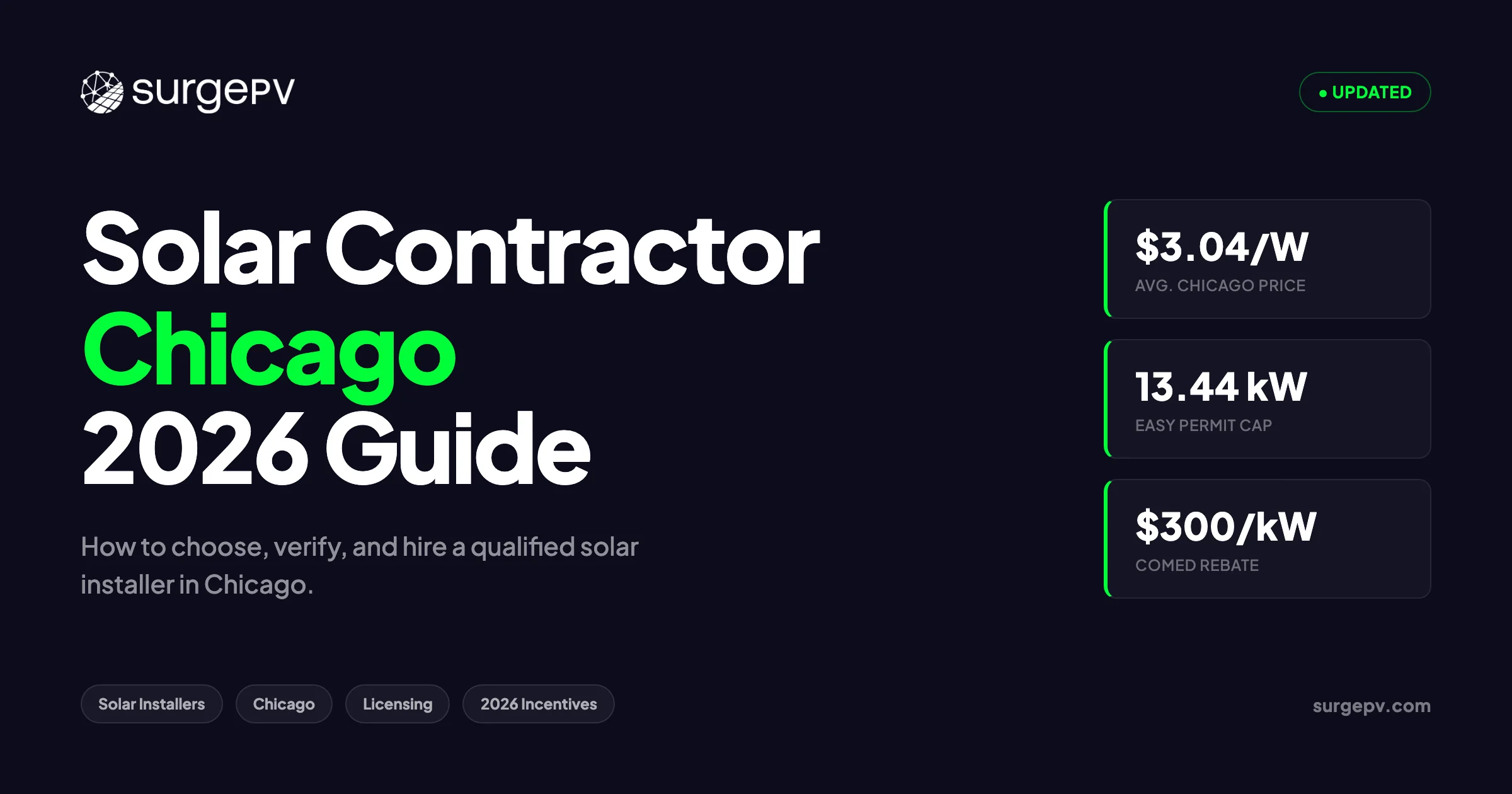
Chicago homeowners who want solar in 2026 face a changed market. The 30% federal residential tax credit is gone. ComEd has shifted new customers to smart solar billing. Permit rules still favor small rooftop systems, but only if your contractor knows the Easy Permit Process. The right installer is no longer just the one with the lowest price. It is the one who can prove they understand Chicago roofs, ComEd paperwork, and the 2026 incentive landscape.
This guide is written for homeowners and small-business owners who are ready to compare contractors but do not want to learn the entire electrical code first. It focuses on the local details that separate a smooth installation from a delayed or underperforming one.
In this guide, you will learn:
- Which licenses and certifications a Chicago solar contractor must hold
- How 2026 federal and Illinois incentive changes affect your project cost
- What the Chicago Easy Permit Process covers and when it applies
- How ComEd’s Smart Solar Billing changes your payback math
- The exact questions to ask before you sign a contract
- Red flags that should make you walk away from a quote
Quick Answer
A qualified solar contractor in Chicago holds an Illinois Commerce Commission Distributed Generation Installer Certification, employs a licensed electrical contractor, and has a track record with ComEd interconnection and Chicago permits. In 2026, expect to pay around $3.04 per watt before incentives, and verify that your quote accounts for the end of the federal residential tax credit and ComEd’s new smart solar billing rules.
Latest Updates: Chicago Solar in 2026
Three changes shape the 2026 Chicago solar market more than any equipment upgrade.
| Change | Status | What It Means for Homeowners |
|---|---|---|
| 30% federal residential ITC | Ended for 2026 installs | Cash purchases no longer qualify for the 30% federal credit. Lease or third-party ownership may still access a commercial credit in some structures. |
| ComEd Smart Solar Billing | Active for new customers since Jan 1, 2025 | Exported solar is credited at roughly 6.8 cents per kWh, not the full retail rate. This lengthens payback compared to old net metering. |
| Chicago Easy Permit Process | Active | Rooftop systems up to 13.44 kW can get same-day approval for $275 if the plan set meets code. |
The federal change is the biggest. For more than a decade, the residential Investment Tax Credit made solar affordable for many Chicago households. Its removal means your contractor must be sharper on state and local incentives. The ComEd billing change means system size and self-consumption matter more than ever. A contractor who simply maximizes annual production without looking at your hourly usage pattern may design a system that exports too much power at a low credit rate.
What “Solar Contractor” Means in Chicago
A solar contractor is not just the crew that mounts panels. In Chicago, the term covers the company responsible for design, equipment procurement, permitting, installation, inspection, utility interconnection, and activation. Some firms do everything in-house. Others subcontract parts of the work, especially roofing or electrical labor.
The City of Chicago and the State of Illinois split oversight. The state certifies the installer. The city licenses the contractor and issues the permit. ComEd, the local utility, approves interconnection. A good contractor coordinates all three.
You will encounter several business models:
- Local EPC contractors handle engineering, procurement, and construction under one roof. They often have the deepest Chicago permit experience.
- National installers bring brand recognition and standardized financing, but response times can lag on local issues.
- Sales-only companies sign customers and pass the work to subcontractors. This is not automatically bad, but you should know who is actually on your roof.
The best fit depends on your roof complexity, financing preference, and how much local accountability you want.
Required Licenses and Certifications
Chicago has stricter contractor requirements than many U.S. markets. Before you sign, confirm the following.
Illinois Commerce Commission Distributed Generation Installer Certification
Illinois requires any installer of distributed generation systems, including rooftop solar, to hold an ICC Distributed Generation Installer Certification. This is not optional. It is the state’s minimum credential for connecting systems to the grid. Ask for the certification number and verify it on the ICC website.
Chicago General Contractor License
The contractor must hold a valid Chicago general contractor license. The city classifies licenses from Class A to Class E based on project size and type. For most residential solar work, a Class A or B license is common. The license must be current and in the company’s name, not an individual employee’s.
Licensed Electrical Contractor
Solar arrays are electrical systems. Chicago requires a licensed electrical contractor to pull the electrical permit. Some solar companies employ their own electrician. Others partner with an electrical contractor. Either way, the licensed electrician must be identified before work starts.
NABCEP Certification
The North American Board of Certified Energy Practitioners offers the PV Installation Professional certification. It is not required by law in Chicago, but it is a strong quality signal. NABCEP-certified installers have passed a rigorous exam and documented hands-on experience.
Insurance and Bonding
Ask for proof of general liability insurance and workers’ compensation coverage. The amounts should match or exceed Chicago’s requirements. If the contractor uses subcontractors, confirm that the subcontractors are also insured.
Pro Tip
Do not accept a verbal assurance. Ask for license numbers, certification numbers, and a certificate of insurance. A professional contractor emails these within minutes.
How Chicago Permitting Works
Permitting is where many projects stall. Chicago offers two paths for rooftop solar.
Easy Permit Process (Express Permit Program)
The Easy Permit Process, also called the Express Permit Program, applies to rooftop PV systems up to 13.44 kW. If your plan set meets the 2018 Chicago Electrical Code and 2019 Chicago Building Code, you can receive same-day approval. The permit fee is $275 as of 2026.
To qualify, your contractor must submit:
- A completed permit application
- Electrical diagrams
- Structural calculations or approval
- Rapid shutdown compliance documentation
- Manufacturer cut sheets for modules and inverters
Most Chicago single-family homes fall under this threshold. A typical 6 kW system is well below 13.44 kW.
Standard Plan Review
Larger systems, commercial projects, or installations on complex roofs must go through standard plan review. This process takes two to eight weeks and requires a deeper structural and electrical review. Your contractor should tell you which path your project will use before you sign.
ComEd Interconnection
After city inspection, your contractor submits an interconnection request to ComEd. ComEd reviews the application, schedules a site visit if needed, and installs a net meter. The timeline varies but typically ranges from two to six weeks after city approval. Contractors with ComEd experience know how to avoid common paperwork rejections.
2026 Costs and Incentives in Chicago
Without the federal residential tax credit, your out-of-pocket cost rises. State and local incentives can still help, but the math is tighter than in previous years.
Typical System Costs
| System Size | Pre-Incentive Cost Range | Notes |
|---|---|---|
| 5 kW | $12,000–$17,000 | Suitable for smaller homes or low usage |
| 6 kW | $15,000–$19,000 | Common starting size for Chicago homes |
| 8 kW | $20,000–$26,000 | Fits average ComEd household with central AC |
| 11.59 kW | ~$35,225 | EnergySage marketplace average for Chicago |
EnergySage reports an average Chicago price of $3.04 per watt and an average system size of 11.59 kW. Your home may need far less. System size should be driven by your annual usage, roof space, shading, and how much you want to offset under the new net billing rules.
Incentives Still Available
| Incentive | Value | Eligibility |
|---|---|---|
| Illinois Solar for All | 70–100% of system cost | Income-qualified households; 2025–2026 budget is $186.3 million |
| ComEd Distributed Generation Rebate | $300 per kW | New distributed generation customers in ComEd territory |
| Adjustable Block Program | Lump-sum REC payment | Varies by block; requires approved vendor |
| Cook County Sun and Save | Bulk-purchase discount | Single-family and small multi-family homes through August 31, 2026 |
The ComEd rebate is straightforward. An 8 kW system receives $2,400. The Adjustable Block Program pays for renewable energy credits up front, but the amount depends on which block is open when you apply. A good contractor will explain the current block price and whether they are an approved vendor.
Payback Without the Federal ITC
Under old full retail net metering and the 30% credit, payback periods in Chicago often landed between 8 and 12 years. With the federal credit gone and export credits reduced to roughly 6.8 cents per kWh, realistic payback periods now stretch toward 12 to 16 years for cash purchases. Leases and power purchase agreements may look more attractive to homeowners who cannot capture upfront incentives, but read the escalator and buyout terms carefully.
How ComEd Smart Solar Billing Affects Your Design
Smart Solar Billing is not net metering. Under net metering, excess kilowatt-hours earned the full retail rate. Under smart solar billing, exported power is credited at the supply and transmission rate, roughly 6.8 cents per kWh, not the delivery charges.
This changes design priorities:
- Self-consumption matters more. A system that produces power when you use it saves you the full retail rate, which can exceed 15 cents per kWh.
- Oversizing is less valuable. Extra production above your usage is worth less than before.
- Battery storage becomes more interesting. A battery lets you store midday solar for evening use, increasing self-consumption.
- Load shifting helps. Running dishwashers, dryers, and EV chargers during sunny hours improves economics.
A contractor who simply divides your annual usage by a production factor is using 2019 logic. In 2026, the best contractors model hourly usage against hourly production and size the system for value, not just kilowatt-hours.
Questions to Ask Every Solar Contractor
Use this list during your first conversation. The answers will tell you whether you are talking to a local expert or a sales script.
- Who holds the ICC DG certification for my project?
- Will a licensed electrical contractor pull the permit, or do you subcontract that?
- How many Chicago installations have you completed in the last 12 months?
- Do you use in-house crews or subcontractors for roof work and electrical work?
- What equipment do you recommend, and why?
- What is the workmanship warranty, and what does it cover?
- How do you handle the ComEd interconnection process?
- What is the total timeline from contract to activation?
- How did you size my system, and what assumptions did you make about my usage?
- What happens if my roof needs repairs before or during installation?
- Can you explain the 2026 incentives I qualify for and when they expire?
- What is the total all-in price, and what could change it?
Listen for specifics. Vague answers like “we handle everything” or “about the same as everyone else” are red flags. The best contractors will name permit timelines, explain inverter choices, and walk through your ComEd bill.
Red Flags That Should Make You Walk Away
Some warning signs are universal. Others are specific to Chicago.
- Pressure to sign today. Reputable contractors do not use one-day discounts.
- No Illinois DG certification. This is a legal requirement, not a nice-to-have.
- No Chicago permit history. If they cannot name the Easy Permit Process, they may not be local.
- No proof of insurance. General liability and workers’ compensation are non-negotiable.
- Guaranteed production without a site visit. A satellite estimate is a starting point, not a contract basis.
- Asking for full payment upfront. Standard practice is a modest deposit with progress payments.
- Promising the 30% federal tax credit for 2026. The residential credit is gone. Anyone who says otherwise is misinformed or dishonest.
- Refusing to put equipment brands in writing. You deserve to know what panels and inverter you are buying.
If a contractor checks more than one of these boxes, get another quote.
Local vs National Installers: What the Data Shows
EnergySage notes that national installers quote about 10% more than local installers on average, based on NREL and National Renewable Energy Laboratory data. That does not mean national companies are always worse. It means you should compare apples to apples.
Local Chicago installers often win on:
- Faster permit and inspection scheduling
- Knowledge of Chicago roof types, including flat roofs and older framing
- Direct relationships with ComEd interconnection staff
- Accountability if something goes wrong
National installers often win on:
- Brand recognition and standardized financing
- Longer track records in multiple states
- Lease and PPA products that may fit some homeowners
The best choice depends on your priorities. If you value speed and local accountability, lean local. If you want a specific financing product only a national brand offers, compare their total cost carefully.
What a Good Chicago Quote Looks Like
A complete quote should include:
- System size in kilowatts DC and AC
- Estimated annual production in kilowatt-hours
- Panel and inverter manufacturer and model numbers
- Mounting system and roof penetration plan
- Total pre-incentive price and price per watt
- All incentives applied and their expected values
- Financing terms, if applicable, including APR and escalator
- Workmanship warranty length and coverage
- Equipment warranties
- Estimated timeline from contract to activation
- Payment schedule
If any of these items are missing, ask for them. A contractor who cannot produce a detailed quote is not ready for your project.
Design and Quote Faster With SurgePV
SurgePV helps solar contractors model hourly production, shade, and payback so your Chicago quote is accurate from the first meeting.
Book a DemoNo commitment required · 20 minutes · Live project walkthrough
Common Mistakes Chicago Homeowners Make
Even smart buyers make these errors.
Focusing Only on Price Per Watt
Price per watt is useful for comparing similar systems, but it ignores equipment quality, warranty, and installer experience. A cheap system with a thin warranty and an inexperienced crew can cost more over 25 years.
Ignoring the Roof
Chicago has harsh winters, freeze-thaw cycles, and a mix of architectural styles. A contractor who does not inspect your roof, attic, and electrical panel before quoting is guessing. Ask how they handle roof penetrations, flashing, and structural loads.
Signing Before Understanding Net Billing
Some homeowners still expect full retail net metering. Make sure your contractor explains Smart Solar Billing and shows how it affects your projected savings. If their proposal assumes full retail net metering, the payback estimate is wrong.
Choosing the First Quote
The EnergySage marketplace recommends comparing at least three quotes. This is especially important in 2026 because incentive structures vary and pricing is less predictable than in past years.
Timeline: From Quote to Activation
A well-run Chicago residential project typically follows this timeline:
- Site assessment and quote: 1–2 weeks
- Contract signed and financing approved: 1–3 weeks
- Permit submitted and approved: 1 day to 8 weeks, depending on Easy Permit or standard review
- Equipment ordered and delivered: 2–6 weeks
- Installation: 1–3 days
- City inspection: 1–2 weeks
- ComEd interconnection and meter swap: 2–6 weeks
- Activation: same day as meter approval
Total timeline ranges from two to five months. Delays usually happen at permitting, equipment delivery, or utility interconnection. A local contractor with experience in all three stages can often shorten the schedule.
Conclusion
Choosing a solar contractor in Chicago in 2026 is harder than it was two years ago, but the fundamentals have not changed. Verify licenses and certifications. Compare at least three detailed quotes. Understand how the end of the federal residential tax credit and ComEd Smart Solar Billing affect your payback. And ask the hard questions before you sign.
Start with three concrete steps:
- Confirm the contractor holds an active ICC DG certification and Chicago contractor license.
- Request a quote that shows pre-incentive cost, incentives, and payback under Smart Solar Billing.
- Ask for three local references with projects completed in the last 12 months.
The right contractor will welcome these questions. The wrong one will rush past them.
Frequently Asked Questions
What license does a solar contractor need in Chicago?
A Chicago solar contractor needs an Illinois Commerce Commission Distributed Generation Installer Certification, a Chicago general contractor license, and a licensed electrical contractor on staff to pull electrical permits.
How much does a solar contractor charge in Chicago in 2026?
Marketplace data shows an average of about $3.04 per watt, which equals roughly $35,225 before incentives for an 11.59 kW system. Smaller systems in the 5–6 kW range often fall between $12,000 and $19,000.
Is the 30% federal solar tax credit still available in 2026?
No. The 30% federal residential Investment Tax Credit was terminated by legislation signed in 2025. Installations completed in 2026 and beyond no longer qualify for the residential credit.
What is Chicago’s Easy Permit Process for solar?
The Express Permit Program covers rooftop PV systems up to 13.44 kW. Eligible projects can receive same-day approval for a $275 permit fee, provided they meet the 2018 Chicago Electrical Code and 2019 Chicago Building Code.
How has ComEd net metering changed in Chicago?
Starting January 1, 2025, new ComEd solar customers are placed on Smart Solar Billing. Exported solar is credited at roughly 6.8 cents per kWh for supply and transmission, not the full retail rate. Systems interconnected before December 31, 2024 are grandfathered under the previous net metering rules.
Should I hire a local Chicago installer or a national company?
Local installers often know Chicago permitting, ComEd interconnection, and neighborhood roof types better. National companies may offer broader financing but can be slower on local paperwork. Get at least three quotes and compare equipment, warranty, and timeline.
What questions should I ask a solar contractor before signing?
Ask who holds the ICC DG certification, whether they use subcontractors, what equipment and inverter they recommend, what the workmanship warranty covers, how they handle ComEd interconnection, and what the total project timeline looks like from permit to activation.
Are there still Illinois solar incentives in 2026?
Yes. Illinois Solar for All offers income-qualified households 70–100% coverage, the ComEd Distributed Generation Rebate pays $300 per kW, and the Adjustable Block Program provides lump-sum renewable energy credit payments.
Where this fits
This article is part of SurgePV's Solar Installation hub, which works through the topic from first principles to the decisions a project team actually has to make.