

Answer
A 500 kW rooftop solar system on a logistics warehouse in Birmingham, UK, produced 612,000 kWh in its first year. The bridge between them is a solar carbon offset calculator — a tool that converts kilowatt-hours into auditable, framework-compliant CO2 savings. A client asking for a 500 kW system often wants two numbers: the financial return and the carbon return.
A 500 kW rooftop solar system on a logistics warehouse in Birmingham, UK, produced 612,000 kWh in its first year. The warehouse’s sustainability team needed that number in a format the CFO could defend to auditors. They needed to know: how many tonnes of CO2 did that production actually offset? What was the net figure after accounting for the carbon embedded in the panels? And how should this appear in the company’s CDP disclosure? Read more about Battery Solar System Design UK.
A 500 kW rooftop solar system on a logistics warehouse in Birmingham, UK, produced 612,000 kWh in its first year. The bridge between them is a solar carbon offset calculator — a tool that converts kilowatt-hours into auditable, framework-compliant CO2 savings.
This is the daily reality for ESG and sustainability professionals. Solar generation data lives in one system. Carbon accounting lives in another. The bridge between them is a solar carbon offset calculator — a tool that converts kilowatt-hours into auditable, framework-compliant CO2 savings.
This guide covers the complete methodology: the formula, the data sources, the embodied carbon subtraction, the ESG reporting frameworks, and the common errors that get companies into trouble with auditors.
TL;DR — Solar Carbon Offset Calculator
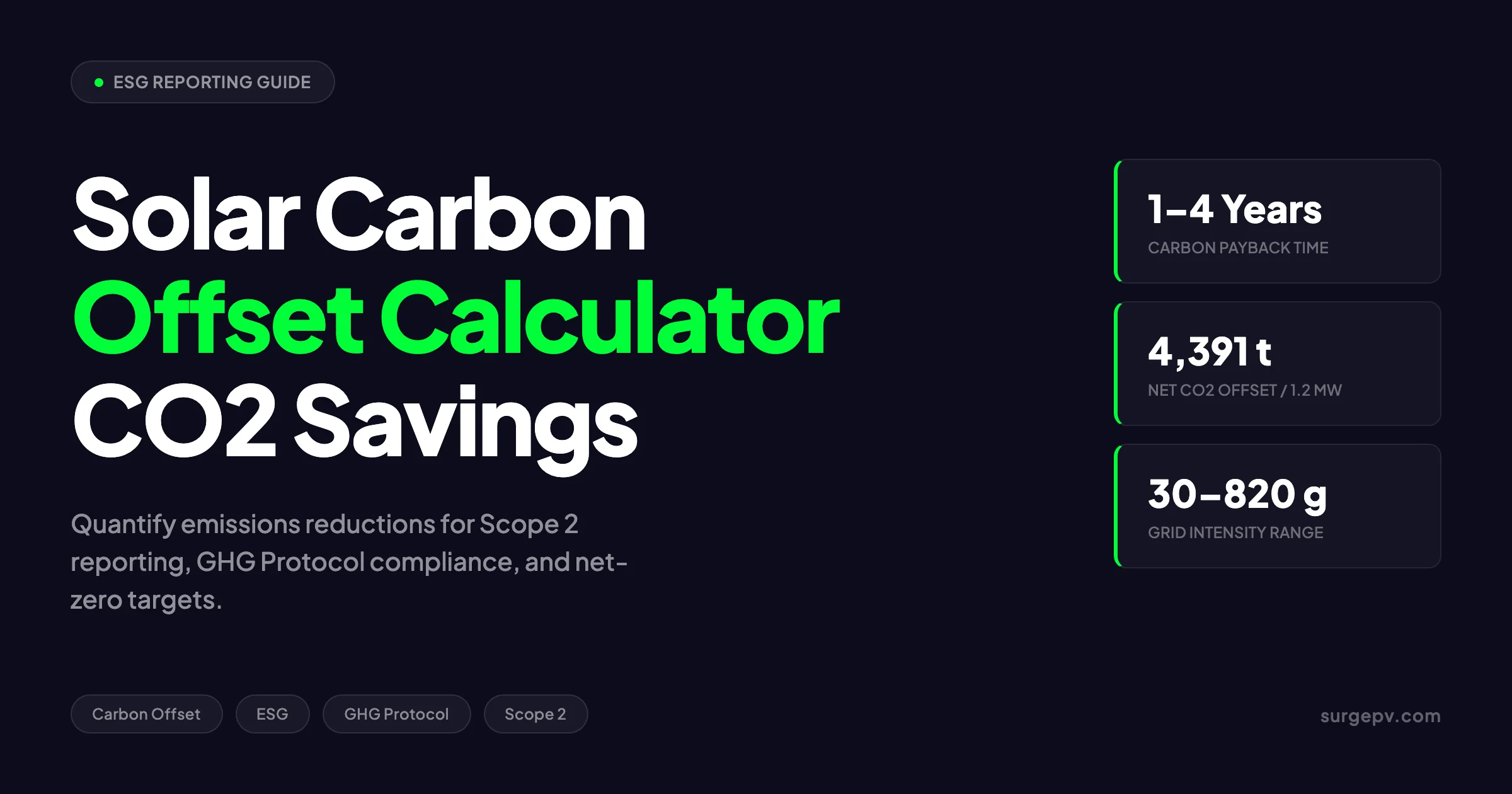
A solar carbon offset calculator multiplies annual solar production (kWh) by local grid carbon intensity (kg CO2/kWh) to calculate gross CO2 offset. Subtract embodied carbon from manufacturing to get net savings. Typical commercial systems achieve carbon payback in 1–4 years. For ESG reporting, use the GHG Protocol Scope 2 guidance and location-based or market-based methods depending on your framework.
In this guide:
- What a solar carbon offset is and how the calculation works
- Grid carbon intensity data by country and region
- The formula: solar production × grid intensity = gross offset
- Embodied carbon in solar panels: manufacturing footprint explained
- Net carbon savings: gross offset minus embodied carbon
- Carbon payback time for solar panels by technology and location
- ESG reporting frameworks: GHG Protocol, SBTi, CDP, GRI
- Carbon offset calculators for commercial solar portfolios
- Scope 2 emissions reduction from on-site solar
- RECs vs carbon offsets vs direct generation: what counts where
- When solar carbon claims mislead: common audit failures
- Case study: commercial building with actual carbon numbers
What Is a Solar Carbon Offset?
A solar carbon offset is the reduction in CO2 emissions achieved when solar-generated electricity displaces electricity that would otherwise have been drawn from the grid. It is not a physical object. It is a measured reduction in emissions attributable to a specific generating asset.
The concept is simple. Every kilowatt-hour of grid electricity carries an emissions factor — the amount of CO2 released to produce it. When a solar system generates one kilowatt-hour on-site, that kilowatt-hour does not need to come from the grid. The emissions that would have occurred do not happen. That avoided emission is the offset.
For solar PV design software users, this calculation is increasingly built into project proposals. A client asking for a 500 kW system often wants two numbers: the financial return and the carbon return. The second number is what this guide teaches you to calculate accurately.
Gross Offset vs Net Offset
Gross offset is the total CO2 avoided by solar generation over a system’s lifetime. It ignores the emissions from manufacturing, transporting, and installing the system.
Net offset subtracts embodied carbon — the emissions locked into the hardware before it generates a single kilowatt-hour. Net offset is the only figure that withstands auditor scrutiny.
Most ESG frameworks require net figures. A company claiming “our solar system offset 500 tonnes of CO2” without subtracting embodied carbon is making a statement that will not survive a third-party verification.
Grid Carbon Intensity by Country and Region
Grid carbon intensity is the foundation of every solar carbon offset calculation. It varies by a factor of 20 between countries. A solar system in Norway displaces almost no CO2 per kWh because the Norwegian grid is already 98% hydro. The same system in India displaces 700–800 g CO2 per kWh because the Indian grid is heavily coal-dependent. Also see: Best Solar Design Software India. For the latest details on India, see 5kW Solar Panel Price in India.
Grid Carbon Intensity Table — Selected Countries (2024–2025)
| Country / Region | Grid Intensity (g CO2/kWh) | Primary Generation Source |
|---|---|---|
| Norway | 30 | Hydro (88%) |
| France | 56 | Nuclear (65%) |
| Sweden | 41 | Nuclear + Hydro |
| Brazil | 120 | Hydro (60%) |
| United Kingdom | 233 | Gas + Wind |
| Germany | 380 | Coal + Wind + Gas |
| Spain | 215 | Wind + Gas + Nuclear |
| Italy | 330 | Gas + Hydro + Solar |
| United States (average) | 386 | Gas + Coal + Nuclear |
| United States (California) | 220 | Gas + Solar + Wind |
| United States (Texas) | 410 | Gas + Wind + Coal |
| United States (West Virginia) | 780 | Coal (90%) |
| China | 570 | Coal (60%) |
| India | 713 | Coal (75%) |
| South Africa | 820 | Coal (85%) |
| Australia | 520 | Coal + Gas |
| Japan | 480 | Gas + Coal + Nuclear |
| Canada (average) | 130 | Hydro + Nuclear |
| Canada (Alberta) | 450 | Gas + Coal |
| Poland | 620 | Coal (70%) |
| Netherlands | 290 | Gas + Wind |
Source: IEA Emissions Factors 2024, EPA eGRID 2023, DEFRA 2024, European Environment Agency. Also see: European Solar Incentives.
These figures change year by year as grids decarbonize. The UK grid intensity fell from 420 g/kWh in 2015 to 233 g/kWh in 2024 — a 45% reduction. This means a solar system installed in the UK in 2015 offsets less CO2 per kWh today than it did when installed, because the grid it displaces is cleaner.
Pro Tip
Always use the most recent grid intensity figure available for your reporting year. Using a 2019 emissions factor for a 2025 report can overstate CO2 savings by 20–40% in countries with rapidly decarbonizing grids. For multi-year reporting, apply the grid intensity of each specific year rather than a single static figure.
Where to Source Grid Carbon Intensity Data
- IEA Emissions Factors Database: Global coverage, updated annually. Best for international portfolios.
- EPA eGRID: US-specific, down to sub-regional level. Use for US commercial portfolios.
- DEFRA/DESNZ: UK government conversion factors. Updated yearly for UK reporting.
- European Environment Agency: EU-wide data with country breakdowns.
- National statistics offices: Most countries publish official figures for corporate reporting.
The Solar Carbon Offset Formula
The basic formula has three variables:
Gross Annual CO2 Offset (kg) = Annual Solar Production (kWh) × Grid Carbon Intensity (kg CO2/kWh)
To calculate net offset over the system lifetime:
Net Lifetime CO2 Offset (kg) = (Gross Annual Offset × System Lifetime × Degradation Factor) – Total Embodied Carbon (kg)
Worked Example: 250 kW Commercial Rooftop System in Manchester, UK
System specifications:
- Capacity: 250 kW
- Annual production (Year 1): 237,500 kWh
- Performance ratio: 82%
- Specific yield: 950 kWh/kWp/year
- Module degradation: 0.5% per year
- System lifetime: 25 years
- Grid carbon intensity: 0.233 kg CO2/kWh
- Module embodied carbon: 900 kg CO2/kW
- Total embodied carbon: 225,000 kg CO2
Year 1 gross offset: 237,500 kWh × 0.233 kg/kWh = 55,338 kg CO2
Lifetime gross offset (with degradation): Year 1: 237,500 kWh Year 2: 236,312 kWh Year 3: 235,131 kWh … Year 25: 213,500 kWh
Total 25-year production: 5,512,000 kWh Total 25-year gross offset: 5,512,000 × 0.233 = 1,284,296 kg CO2
Net lifetime offset: 1,284,296 kg – 225,000 kg = 1,059,296 kg CO2
Carbon payback time: 225,000 kg ÷ 55,338 kg/year = 4.1 years
This system breaks even on carbon in just over four years. For the remaining 21 years, every kilowatt-hour generated is net-positive for the environment.
Adjusting for Grid Decarbonization
The calculation above assumes a static grid intensity. In reality, the UK grid will likely fall to 150 g/kWh or lower by 2050. If you model a declining grid intensity (3% annual reduction), the lifetime gross offset drops to approximately 980,000 kg CO2. The net offset becomes 755,000 kg CO2.
This is not a reason to avoid solar. It is a reason to install solar now, while the grid is still carbon-intensive, rather than waiting.
Embodied Carbon in Solar Panels
Every solar panel carries a carbon debt from its manufacturing. Mining quartz for silicon, refining polysilicon in energy-intensive furnaces, slicing wafers, cell fabrication, module assembly, and transport all emit CO2. The total varies dramatically by manufacturing location and technology.
Embodied Carbon by Module Technology
| Module Type | Embodied Carbon (kg CO2/kW) | Key Driver |
|---|---|---|
| Monocrystalline PERC (China) | 800–1,200 | Coal-heavy grid, polysilicon refining |
| Monocrystalline PERC (Europe) | 500–700 | Cleaner grid, shorter transport |
| Monocrystalline TOPCon | 700–1,000 | Additional process steps |
| Monocrystalline HJT | 600–900 | Lower temperature processing |
| Polycrystalline (legacy) | 1,000–1,500 | Lower efficiency, more material |
| Thin-film CdTe (First Solar) | 300–500 | Lower energy manufacturing |
| Thin-film CIGS | 400–600 | Lower material intensity |
Source: IPCC AR6 WGIII, IEA PVPS Task 12, Fraunhofer ISE LCA studies.
The single biggest factor in embodied carbon is where the polysilicon is refined. China’s Xinjiang region produces approximately 45% of global polysilicon using coal-powered electricity at carbon intensities of 600–800 g/kWh. European polysilicon producers use hydroelectric power at under 50 g/kWh. The difference in embodied carbon between identical modules made with Chinese vs European polysilicon can exceed 400 kg CO2/kW. For Global-specific compliance details, see Global net-metering-by-country.
Key Takeaway
For ESG reporting, request embodied carbon data from your module supplier. Most Tier 1 manufacturers now publish Environmental Product Declarations (EPDs) with cradle-to-gate carbon figures. If your supplier cannot provide this, use the IEA PVPS default values and document your assumption in your methodology note.
What Counts in Embodied Carbon?
A complete embodied carbon assessment includes:
- Raw material extraction: Quartz mining, metallurgical-grade silicon production
- Polysilicon refining: Siemens process or fluidized bed reactor
- Ingot growing: Czochralski process energy
- Wafer slicing: Wire saw energy and kerf loss
- Cell fabrication: Diffusion, passivation, metallization
- Module assembly: Lamination, framing, junction box
- Balance of system: Inverters, mounting, cabling
- Transport: Factory to site, typically 2–5% of total
- Installation: On-site energy and transport
For most commercial calculations, using the module manufacturer’s EPD figure plus 15–20% for balance of system and installation is sufficient for ESG reporting.
Net Carbon Savings: The Full Calculation
Net carbon savings is the only figure that matters for credible ESG reporting. Here is how to build it step by step for a commercial portfolio.
Step 1: Establish System Production
Use actual meter data where available. For new systems, use a solar design platform tool to model production based on:
- Local irradiance (kWh/m²/year from PVGIS, NREL PVWatts, or Solargis)
- System capacity (kW)
- Performance ratio (typically 75–85% for commercial rooftop)
- Tilt and azimuth angles
- Shading losses Shadow analysis software identifies shading issues before installation.
Step 2: Apply Grid Carbon Intensity
Use the most recent official figure for your country or region. For multi-site portfolios, apply the specific grid intensity for each site’s location.
Step 3: Calculate Gross Offset
Multiply annual production by grid intensity for each year of operation.
Step 4: Subtract Embodied Carbon
Add up the embodied carbon for all system components. Amortize this over the system lifetime or calculate payback time separately.
Step 5: Account for Degradation and Replacements
Modules degrade at 0.4–0.7% per year. Inverters typically need replacement once in a 25-year lifetime, adding 5–10% to embodied carbon. Include these in lifetime calculations.
Net Carbon Savings Example: Three-Site Portfolio
| Site | Capacity | Annual Production | Grid Intensity | Gross Offset/Year | Embodied Carbon | Net Offset/Year | Payback |
|---|---|---|---|---|---|---|---|
| Birmingham, UK | 500 kW | 475,000 kWh | 0.233 | 110,675 kg | 450,000 kg | 85,175 kg* | 4.1 years |
| Madrid, Spain | 750 kW | 1,162,500 kWh | 0.215 | 249,938 kg | 675,000 kg | 212,438 kg* | 2.7 years |
| Mumbai, India | 1,000 kW | 1,600,000 kWh | 0.713 | 1,140,800 kg | 1,100,000 kg | 1,065,800 kg* | 1.0 year |
*Net offset in Year 1 after amortizing embodied carbon over 25 years.
The Mumbai site achieves carbon payback in one year because the Indian grid is so carbon-intensive. Every kilowatt-hour generated displaces coal-fired power. The Birmingham site takes four years because the UK grid is already relatively clean.
This creates a counterintuitive result: solar delivers the greatest carbon impact in the dirtiest grids, even if those are not the most financially attractive markets.
Carbon Payback Time for Solar Panels
Carbon payback time is the period from installation until the system’s cumulative gross offset equals its embodied carbon. After payback, all generation is net-positive.
Carbon Payback by Location and Technology
| Location | Grid Intensity | PERC Payback | TOPCon Payback | CdTe Payback |
|---|---|---|---|---|
| Norway | 30 g/kWh | 25–35 years | 20–28 years | 10–15 years |
| France | 56 g/kWh | 12–18 years | 10–15 years | 5–8 years |
| UK | 233 g/kWh | 3–5 years | 2.5–4 years | 1.5–2.5 years |
| Germany | 380 g/kWh | 2–3.5 years | 1.8–3 years | 1–1.8 years |
| US (average) | 386 g/kWh | 2–3.5 years | 1.8–3 years | 1–1.8 years |
| China | 570 g/kWh | 1.5–2.5 years | 1.2–2 years | 0.8–1.3 years |
| India | 713 g/kWh | 1.2–2 years | 1–1.6 years | 0.6–1 year |
Source: Calculated using IEA PVPS Task 12 embodied carbon ranges and IEA grid intensity data.
In high-irradiance, high-grid-intensity locations like India, even the most carbon-intensive manufacturing pathways achieve payback in under two years. In low-carbon grids like Norway, payback can exceed the system lifetime for some technologies — a critical consideration for ESG claims.
Pro Tip
For sites in very clean grids (Norway, France, Sweden), consider thin-film CdTe modules if carbon payback is a priority. Their lower embodied carbon achieves payback in 5–15 years even in these locations, versus 12–35 years for conventional silicon.
Read more about Agricultural Solar Case Study.
ESG Reporting Frameworks
Solar carbon offset data feeds into multiple ESG reporting frameworks. Each has specific rules for how on-site generation is counted, what methodology is required, and what verification standards apply.
GHG Protocol Corporate Standard
The GHG Protocol is the most widely used international accounting tool for government and business leaders to understand, quantify, and manage greenhouse gas emissions. It divides emissions into three scopes:
- Scope 1: Direct emissions from owned or controlled sources (fuel combustion, fleet vehicles)
- Scope 2: Indirect emissions from purchased electricity, heat, or steam
- Scope 3: All other indirect emissions in the value chain
On-site solar directly reduces Scope 2 emissions by displacing purchased grid electricity. The GHG Protocol offers two methods for Scope 2 reporting:
Location-based method: Uses average grid intensity for the geographic location. A company in the UK with a 500 kW solar system uses the UK grid intensity of 0.233 kg/kWh to calculate Scope 2 reduction.
Market-based method: Uses emissions factors from contractual instruments like RECs, GOs, or PPAs. Under this method, on-site generation is treated as zero-emission if the company retains the energy attribute certificates.
Most large companies report both methods. The location-based figure shows the physical emissions impact. The market-based figure shows the contractual position.
Science Based Targets Initiative (SBTi)
SBTi validates corporate emissions reduction targets against climate science. Companies with SBTi-validated targets must report progress annually, including the contribution of on-site renewable generation.
SBTi does not allow companies to count on-site solar as carbon offsets. Carbon offsets are for residual emissions only — the emissions that remain after all reduction measures have been applied. Solar reduces operational emissions directly, which is the preferred pathway.
A company with a near-term SBTi target must demonstrate that its solar generation is reducing Scope 2 emissions in line with its target trajectory. The calculator output feeds directly into this progress report.
CDP (Carbon Disclosure Project)
CDP scores companies on a scale from A to D- across climate, water, and forests. The climate questionnaire asks specifically about renewable energy generation and procurement.
CDP Question CC8.2a asks: “Describe your renewable energy consumption and production.” Companies report:
- Total on-site renewable generation (MWh)
- Percentage of total electricity consumption from renewables
- Renewable energy target and progress
A solar carbon offset calculator provides the CO2 figure that accompanies the MWh figure in CDP responses. CDP’s scoring methodology rewards companies that combine renewable energy data with verified emissions reduction calculations.
GRI 302: Energy and GRI 305: Emissions
The Global Reporting Initiative standards require disclosure of energy consumption within and outside the organization, energy intensity, and emissions by scope. GRI 302-1 requires reporting of total fuel and electricity consumption. GRI 305-2 requires Scope 2 emissions disclosure.
On-site solar generation is reported as a reduction in GRI 305-2 (Scope 2). The solar carbon offset calculator output becomes the verified figure in the GRI sustainability report.
SASB and TCFD
The Sustainability Accounting Standards Board (SASB) and Task Force on Climate-related Financial Disclosures (TCFD) both require energy and emissions data. TCFD’s metrics and targets pillar specifically asks for Scope 1, 2, and 3 emissions data, with progress against targets.
Carbon Offset Calculators for Commercial Portfolios
For companies with multiple solar sites, a spreadsheet calculator is insufficient. Portfolio-level tools are needed that can:
- Import production data from multiple monitoring platforms
- Apply location-specific grid intensity automatically
- Track embodied carbon by system and component
- Generate ESG-framework-compliant reports
- Handle currency and unit conversions
What to Look for in a Calculator
| Feature | Why It Matters |
|---|---|
| Location-specific grid intensity | A single global average overstates or understates savings by 50–300% |
| Time-varying intensity | Grids decarbonize; static assumptions mislead over 25 years |
| Module-level embodied carbon | Different suppliers have 2–3× variation in manufacturing footprint |
| Degradation modeling | 0.5%/year compounds to 12% loss over 25 years |
| Inverter replacement tracking | Second inverter adds 5–10% to lifetime embodied carbon |
| Framework-specific output | GHG Protocol, SBTi, CDP, and GRI each need different formats |
| Audit trail | Every assumption must be documented and defensible |
Built-in vs Standalone Tools
Many solar design platform platforms now include carbon reporting modules. These integrate production estimates with carbon calculations at the design stage, before installation. This is valuable for pre-sales proposals where clients want both financial and carbon ROI.
Standalone carbon accounting platforms ( Watershed, Persefoni, Sinai Technologies) offer deeper ESG framework integration but require production data imports. The ideal workflow is: design tool estimates → monitoring system validates → carbon platform reports.
For solar channel managers and OEMs, offering carbon reporting as a value-added service can differentiate your product. A distributor who provides clients with GHG Protocol-compliant carbon calculations alongside hardware shipments adds measurable value.
Scope 2 Emissions Reduction from On-Site Solar
Scope 2 is where solar carbon offset lives in corporate accounting. Understanding exactly how the reduction is calculated, reported, and verified is essential for sustainability professionals.
The Calculation
Scope 2 Reduction (kg CO2) = Solar Generation (kWh) × Grid Emissions Factor (kg CO2/kWh)
Under the location-based method, the grid emissions factor is the average for the geographic grid region. Under the market-based method, it is the residual mix emissions factor or zero if certificates are retained.
Example: Manufacturing Plant in Ohio
- Annual electricity consumption: 12,000 MWh
- On-site solar generation: 2,400 MWh (20% of consumption)
- Ohio grid intensity (eGRID subregion RFCW): 0.512 kg CO2/kWh
- Location-based Scope 2 before solar: 12,000,000 × 0.512 = 6,144,000 kg CO2
- Location-based Scope 2 after solar: 9,600,000 × 0.512 = 4,915,200 kg CO2
- Scope 2 reduction: 1,228,800 kg CO2/year
If the company retains RECs from the solar system, the market-based Scope 2 reduction is also 1,228,800 kg CO2/year. If the company sells the RECs, the market-based reduction is zero — the buyer of the RECs claims the environmental attribute.
The REC Decision
This is one of the most consequential decisions in solar carbon accounting. When a company sells RECs from its on-site solar:
- It receives revenue from the REC sale (typically $5–$30/MWh in US markets)
- It cannot claim the renewable energy use in market-based Scope 2 reporting
- The buyer of the RECs can claim the renewable energy attribute
When a company retains RECs:
- It forgoes REC revenue
- It can claim 100% of the renewable energy in market-based reporting
- Its Scope 2 emissions figure is lower
Most companies with SBTi targets or aggressive renewable energy goals retain RECs. Companies prioritizing short-term cash flow may sell them. The decision should be documented in the carbon accounting policy.
RECs vs Carbon Offsets vs Direct Generation
Three instruments. Three different purposes. Three different reporting treatments. Confusing them is a common source of audit findings.
| Instrument | What It Represents | Used For | Can Solar Create It? |
|---|---|---|---|
| REC / GO | 1 MWh of renewable generation | Renewable energy claims, RE100, market-based Scope 2 | Yes — retain or sell certificates from on-site solar |
| Carbon Offset | 1 tonne CO2e reduced or removed | Net-zero claims, residual emissions, voluntary carbon markets | No — on-site solar reduces operational emissions directly; it does not create tradable offsets |
| Direct Generation | Physical MWh produced on-site | Location-based Scope 2 reduction, physical emissions accounting | Yes — every kWh generated reduces grid purchases |
What Most Companies Get Wrong
The most common error is claiming that on-site solar generates “carbon offsets.” It does not. Carbon offsets must come from projects outside your operational boundary. A factory cannot sell itself carbon offsets from its own rooftop solar.
On-site solar reduces Scope 2 emissions. That reduction counts toward your emissions inventory. It does not create a separate tradable commodity called a carbon offset.
The second common error is double-counting. A company sells RECs from its solar system to a utility, then also claims the carbon reduction in its Scope 2 inventory. Only one party can claim the environmental attribute. If you sell the REC, you sell the claim.
What Most Get Wrong
Companies routinely conflate “carbon offset” with “emissions reduction.” An emissions reduction is a decrease in your own inventory. A carbon offset is a credit purchased from someone else’s project. Your rooftop solar reduces your emissions. It does not generate offsets. Using the wrong term in CDP or SBTi reporting invites auditor scrutiny and potential score penalties.
When Solar Carbon Claims Mislead
Not all solar carbon claims hold up. Sustainability professionals need to know the red flags that auditors look for.
Misleading Claim 1: Gross Offset Without Embodied Carbon
A company reports that its solar system “offset 1,000 tonnes of CO2” without mentioning that 200 tonnes were emitted during manufacturing. The net figure is 800 tonnes. Reporting gross as net overstates savings by 20–25%.
Audit fix: Always report net offset. Disclose embodied carbon methodology and source.
Misleading Claim 2: Outdated Grid Intensity
A company uses a 2015 grid intensity figure of 420 g/kWh for UK reporting in 2025, when the actual figure is 233 g/kWh. This overstates CO2 savings by 80%.
Audit fix: Use the most recent official figure for the reporting year. Document the source and date.
Misleading Claim 3: Carbon Neutrality Without Scope 1 or 3
A company claims “our facility is carbon neutral because of rooftop solar” while ignoring natural gas heating (Scope 1) and supply chain emissions (Scope 3). Solar only addresses Scope 2.
Audit fix: Carbon neutrality claims must address all material emission scopes. Solar is one component of a broader strategy.
Misleading Claim 4: Double-Counting RECs
A company sells RECs from its solar system and also claims the renewable energy use in its CDP response. Both parties cannot claim the same MWh.
Audit fix: Track REC sales in a registry. If sold, exclude from renewable energy claims.
Misleading Claim 5: Ignoring Degradation
A company calculates lifetime offset using Year 1 production multiplied by 25 years. Modules degrade 0.5% per year. Over 25 years, cumulative production is 12% lower than the naive calculation.
Audit fix: Apply degradation in production modeling. Most monitoring platforms calculate this automatically.
The Contrarian View: Solar Is Not Always Good for Carbon
In grids that are already 95%+ renewable (Norway, Costa Rica, Iceland), installing solar has minimal carbon benefit. The grid is already clean. The embodied carbon from manufacturing may never be paid back within the system lifetime.
This does not mean solar is pointless in these locations. It may still make financial sense, improve energy independence, or provide grid services. But claiming significant carbon reduction is misleading.
The corollary: solar delivers the greatest carbon impact in coal-heavy grids. A megawatt-hour of solar in India displaces 713 kg of CO2. The same megawatt-hour in Norway displaces 30 kg. From a global carbon perspective, installing solar in India, South Africa, or Poland delivers 20–30× the impact of installing it in Norway. For Africa-specific compliance details, see Africa solar compliance.
This creates tension with ESG reporting. A company headquartered in Norway wants to show progress. But its solar installation barely moves the carbon needle. The honest report acknowledges this.
Case Study: Commercial Building With Actual Carbon Numbers
Greenfield Logistics operates a 12,000 m² distribution center near Rotterdam. In 2023, they installed a 1.2 MW rooftop solar system. Here is the complete carbon story, with real numbers.
System Details
- Capacity: 1,200 kW
- Module type: Monocrystalline PERC, 550 W
- Module count: 2,182
- Inverters: 6 × 200 kW string inverters
- Annual production (Year 1): 1,080,000 kWh
- Specific yield: 900 kWh/kWp/year
- Performance ratio: 83%
- System lifetime: 25 years
Embodied Carbon Breakdown
| Component | Quantity | Unit Carbon | Total Carbon |
|---|---|---|---|
| Modules | 1,200 kW | 650 kg/kW | 780,000 kg |
| Inverters | 1,200 kW | 80 kg/kW | 96,000 kg |
| Mounting | 1,200 kW | 120 kg/kW | 144,000 kg |
| Cabling | 1,200 kW | 30 kg/kW | 36,000 kg |
| Transport | — | — | 45,000 kg |
| Installation | — | — | 28,000 kg |
| Total Embodied Carbon | 1,129,000 kg |
Source: Module EPD from manufacturer, inverter LCA from IEA PVPS, BOS from Fraunhofer ISE.
Grid Carbon Intensity
Netherlands grid intensity: 0.290 kg CO2/kWh (EEA 2024). Greenfield uses the location-based method for GHG Protocol reporting.
Year 1 Calculation
- Gross offset: 1,080,000 kWh × 0.290 = 313,200 kg CO2
- Net offset (Year 1): 313,200 – (1,129,000 ÷ 25) = 313,200 – 45,160 = 268,040 kg CO2
- Carbon payback: 1,129,000 ÷ 313,200 = 3.6 years
25-Year Projection
With 0.5% annual degradation and 3% annual grid decarbonization:
| Year | Production (kWh) | Grid Intensity | Gross Offset | Cumulative Gross | Cumulative Net |
|---|---|---|---|---|---|
| 1 | 1,080,000 | 0.290 | 313,200 | 313,200 | -815,800 |
| 5 | 1,058,700 | 0.257 | 272,086 | 1,460,000 | 331,000 |
| 10 | 1,027,100 | 0.222 | 228,016 | 2,680,000 | 1,551,000 |
| 15 | 999,500 | 0.191 | 190,905 | 3,780,000 | 2,651,000 |
| 20 | 972,200 | 0.165 | 160,413 | 4,760,000 | 3,631,000 |
| 25 | 945,100 | 0.142 | 134,204 | 5,520,000 | 4,391,000 |
At the end of Year 5, the system has paid back its embodied carbon. By Year 25, it has delivered a net 4,391 tonnes of CO2 reduction.
ESG Reporting Output
Greenfield reports this data across three frameworks:
GHG Protocol (location-based):
- Baseline Scope 2 (pre-solar): 3,200,000 kg CO2/year
- Post-solar Scope 2: 2,886,800 kg CO2/year
- Reduction: 313,200 kg CO2/year (9.8%)
CDP CC8.2a:
- On-site renewable generation: 1,080 MWh
- % of total electricity from renewables: 42%
- Renewable energy target: 60% by 2028
SBTi Progress:
- Near-term target: 42% Scope 2 reduction by 2030 (baseline 2022)
- Current progress: 9.8% from solar, additional 15.2% from PPA
- On track: Yes
What Greenfield Did Right
- They requested module EPDs before purchase and selected a supplier with below-average embodied carbon.
- They used the current-year grid intensity, not a historical average.
- They modeled degradation and grid decarbonization in their 25-year projection.
- They retained RECs rather than selling them, preserving their market-based claim.
- They documented every assumption in a methodology note attached to their CDP response.
What They Could Improve
The system was sized for roof area, not load. It exports 35% of generation to the grid. From a carbon perspective, every exported kWh still offsets grid electricity — but from a financial perspective, the export price is lower than the avoided purchase price. A battery storage system would increase self-consumption and improve both financial and carbon returns. Read Adding Battery Storage Services for a complete walkthrough.
How to Build Your Own Solar Carbon Offset Calculator
For companies not ready to purchase enterprise software, a robust calculator can be built in a spreadsheet. Here is the structure.
Input Sheet
| Field | Example | Source |
|---|---|---|
| System capacity (kW) | 500 | Design documentation |
| Specific yield (kWh/kWp/year) | 950 | PVGIS / NREL / Solargis |
| Performance ratio (%) | 82% | Design tool output |
| Grid intensity (kg CO2/kWh) | 0.233 | IEA / EPA / DEFRA |
| Module embodied carbon (kg/kW) | 650 | Supplier EPD |
| BOS embodied carbon (kg/kW) | 200 | IEA PVPS default |
| System lifetime (years) | 25 | Warranty / assumption |
| Degradation rate (%/year) | 0.5% | Manufacturer warranty |
| Grid decarbonization (%/year) | 3% | National target / trend |
Calculation Sheet
- Calculate Year 1 production: Capacity × Specific Yield × Performance Ratio
- Calculate each year’s production: Previous year × (1 – Degradation)
- Calculate each year’s grid intensity: Previous year × (1 – Decarbonization)
- Calculate each year’s gross offset: Production × Grid Intensity
- Sum gross offset over lifetime
- Calculate total embodied carbon: (Module + BOS) × Capacity
- Calculate net offset: Gross – Embodied
- Calculate payback: Find the year where cumulative gross ≥ embodied
Output Sheet
- Annual gross and net offset by year
- Cumulative offset chart
- Carbon payback date
- ESG framework summary (GHG Protocol, CDP, SBTi formats)
- Sensitivity analysis (±20% on key inputs)
Model Carbon and Financial ROI in One Platform
SurgePV combines production modeling with carbon reporting. Generate GHG Protocol-compliant Scope 2 calculations alongside your financial proposals.
Book a DemoNo commitment required · 20 minutes · Live project walkthrough
For a direct comparison, see Arka 360 vs SurgePV.
Carbon Offset Calculators: Tool Comparison
Several tools exist for solar carbon calculation. Here is how they compare for commercial use.
| Tool | Best For | Grid Data | Embodied Carbon | ESG Output | Cost |
|---|---|---|---|---|---|
| EPA eGRID | US corporate reporting | US sub-regions | No | GHG Protocol | Free |
| GHG Protocol Tool | Framework compliance | Global | Manual input | GHG, CDP | Free |
| IEA PVPS Carbon Calculator | LCA-focused analysis | Global | Yes (modules) | Limited | Free |
| Watershed | Enterprise portfolios | Global, auto-updated | Yes | GHG, SBTi, CDP | Paid |
| Persefoni | US-focused enterprise | US + global | Yes | GHG, SEC, TCFD | Paid |
| Custom spreadsheet | Small portfolios | Manual | Manual | Custom | Free |
For most commercial solar owners with 1–10 sites, a well-built spreadsheet using IEA grid data and supplier EPDs is sufficient. For portfolios above 50 sites or companies with SBTi targets, an enterprise platform is worth the investment.
The Future of Solar Carbon Accounting
Three trends will reshape how solar carbon is calculated and reported over the next five years.
Hourly Carbon Accounting
Current practice uses annual average grid intensity. But grids vary by hour — coal plants run at night, solar displaces gas at midday. Hourly carbon accounting uses time-varying emissions factors to show that solar generated at noon displaces cleaner gas, while wind generated at night may displace dirtier coal. This changes the carbon value of solar by 10–30% depending on location.
The EnergyTag standard, supported by Google and Microsoft, is driving adoption of hourly matching for 24/7 carbon-free energy claims.
Supply Chain Transparency
Regulators in the EU and US are requiring supply chain emissions disclosure. The Carbon Border Adjustment Mechanism (CBAM) will eventually apply to solar imports. Companies will need to document not just their system’s carbon offset, but the manufacturing footprint of every component. Module suppliers with low-carbon manufacturing (European, US, or hydro-powered) will command premiums.
Scope 3 Pressure
Scope 3 emissions — those in the value chain — are becoming a focus area. For solar installers and EPCs, this means reporting the embodied carbon of every system installed. For commercial solar operators, it means asking suppliers for EPDs and selecting lower-carbon options. The solar carbon offset calculator will expand to become a full lifecycle assessment tool.
Conclusion
A solar carbon offset calculator is not a luxury for sustainability teams. It is a requirement for credible ESG reporting. The calculation is straightforward: production multiplied by grid intensity, minus embodied carbon. The discipline is in using accurate data, applying the right framework, and avoiding the common errors that invite auditor scrutiny.
Key actions for sustainability professionals:
- Request embodied carbon data from every module supplier
- Use current-year grid intensity from official sources
- Report net offset, not gross
- Retain RECs if you need market-based Scope 2 claims
- Document every assumption in a methodology note
- Update calculations annually as grid intensity changes
Solar delivers genuine, measurable carbon reduction. But only when the math is done honestly.
Frequently Asked Questions
How do you calculate carbon offset from solar panels?
Multiply annual solar production in kWh by the grid carbon intensity in kg CO2/kWh. For example, a 500 kW system producing 650,000 kWh/year in the UK (grid intensity 0.233 kg CO2/kWh) offsets 151,450 kg CO2 annually. Subtract embodied carbon from manufacturing (typically 1,000–2,500 kg CO2 per kW installed) to get net savings.
What is the carbon payback time for solar panels?
Carbon payback time is the period needed for a solar system to offset the CO2 emitted during its manufacturing. For monocrystalline silicon panels installed in Europe, this ranges from 1 to 4 years depending on module efficiency, local irradiance, and grid carbon intensity. High-efficiency modules in sunny regions with carbon-intensive grids achieve payback in under 18 months.
What is grid carbon intensity and where do I find it?
Grid carbon intensity measures how much CO2 is emitted per unit of electricity generated in a specific region, expressed in kg CO2/kWh or g CO2/kWh. Sources include the IEA Emissions Factors database, EPA eGRID for US regions, DEFRA for the UK, and the European Environment Agency for EU countries. Values range from under 50 g/kWh (France, Norway) to over 800 g/kWh (South Africa, India).
How does on-site solar reduce Scope 2 emissions?
On-site solar reduces Scope 2 emissions by displacing grid electricity that would otherwise be purchased. Under the GHG Protocol Market-Based method, on-site generation is treated as zero-emission if the company retains the associated energy attribute certificates. Under the Location-Based method, the reduction equals the displaced grid electricity multiplied by local grid carbon intensity.
What is the difference between RECs and carbon offsets?
Renewable Energy Certificates (RECs) represent the environmental attributes of 1 MWh of renewable generation. They are used to claim renewable energy use. Carbon offsets represent 1 tonne of CO2e reduced or removed from the atmosphere. A company can sell RECs from its on-site solar and still claim the carbon reduction, or it can retain RECs to support renewable energy claims. The two instruments serve different reporting purposes. Read Design Commercial Solar System 1MW for a complete walkthrough.
What ESG frameworks require solar carbon reporting?
The GHG Protocol Corporate Standard requires Scope 2 reporting for all major companies. The Science Based Targets initiative (SBTi) mandates that companies with validated targets report progress against baseline emissions, including on-site renewable generation. CDP (formerly Carbon Disclosure Project) scores companies on renewable energy procurement and emissions reduction. GRI 302 and SASB also require energy and emissions disclosure.
Can I count solar generation as carbon offset for net-zero claims?
Only under specific conditions. The GHG Protocol does not allow companies to count on-site renewable generation as carbon offsets for net-zero claims. Carbon offsets must come from projects outside your operational boundary. However, on-site solar directly reduces Scope 2 emissions, which counts toward your emissions inventory reduction. For net-zero claims, use solar to reduce operational emissions and purchase verified carbon offsets only for residual emissions.
How much embodied carbon is in a solar panel?
Embodied carbon in monocrystalline silicon panels ranges from 400 to 1,200 kg CO2e per kW of installed capacity, depending on manufacturing location, polysilicon source, and module efficiency. Panels manufactured in China using coal-heavy grids carry higher embodied carbon (800–1,200 kg/kW) than those made in Europe or the US with cleaner grids (400–700 kg/kW). Thin-film CdTe panels typically have lower embodied carbon at 300–500 kg/kW.
What data do I need for a solar carbon offset calculator?
You need five inputs: (1) system capacity in kW, (2) annual production in kWh (or irradiance data to estimate it), (3) grid carbon intensity for your location in kg CO2/kWh, (4) module embodied carbon in kg CO2/kW, and (5) system lifetime in years. Optional inputs include degradation rate, inverter replacement schedule, and performance ratio for precision modeling.
Why do some solar carbon claims mislead?
Common misleading claims include reporting gross offset without subtracting embodied carbon, using outdated grid intensity figures that overstate savings, claiming carbon neutrality without addressing Scope 1 or 3 emissions, and double-counting RECs sold to others while also claiming the carbon reduction. The most frequent error is ignoring the manufacturing footprint entirely, which can overstate net savings by 10–25% in the first years of operation. Solar proposal software generates professional quotes in minutes.
Where this fits
This article is part of SurgePV's Solar Business & Operations hub, which works through the topic from first principles to the decisions a project team actually has to make.


