

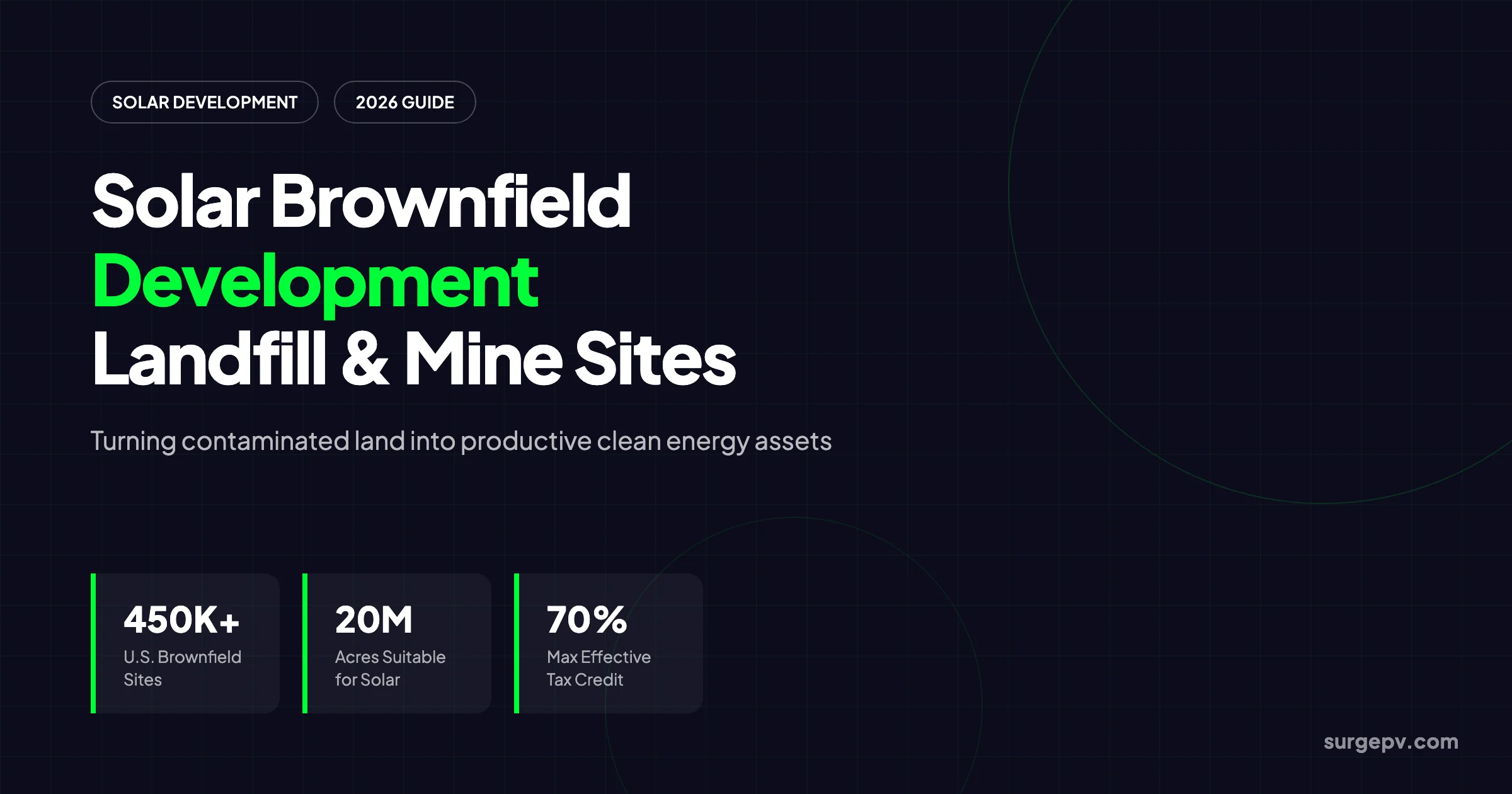
The United States alone has more than 450,000 brownfield sites covering roughly 15 million acres, according to the U.S. Environmental Protection Agency (EPA). Many are closed landfills, abandoned mines, old factories, or industrial waste ponds. Most produce no revenue, cost money to monitor, and carry long-term environmental liability. Solar developers increasingly see them differently. A capped landfill or reclaimed mine can become a brightfield, a solar array that turns a liability into a decades-long source of clean power and lease income.
This guide explains how solar brownfield development works in 2026. We cover landfill and mine site engineering, financial incentives, permitting pitfalls, and the real tradeoffs that separate viable projects from expensive mistakes.
In this guide, you will learn:
- What solar brownfield development is and why it is growing
- The engineering rules that make landfill solar possible
- How mine sites differ from landfills as solar hosts
- The 2026 incentive stack in the United States, Europe, and India
- The biggest risks and how to manage them
- A practical roadmap from site screening to commissioning
- Real brightfield case studies with capacity, cost, and outcome data
Quick Answer
Solar brownfield development installs photovoltaic systems on formerly contaminated or disturbed land such as closed landfills, mines, industrial sites, and ash ponds. These projects, often called brightfields, reuse land with limited development value, preserve greenfield acreage, and can qualify for extra federal and state incentives in the United States, Europe, and India.
What Is Solar Brownfield Development?
A brownfield is property whose expansion, redevelopment, or reuse may be complicated by the presence or potential presence of hazardous substances, pollutants, or contaminants. The EPA definition covers closed municipal landfills, industrial waste sites, former gas stations, ash ponds, and abandoned mines. When these sites host solar photovoltaic systems, the industry calls them brightfields.
Brightfield development is not limited to the United States. The European Union funds landfill and mine reclamation solar through national recovery plans. India is evaluating solar on depleted open-cast coal mines. Australia and the United Kingdom have operating landfill solar farms. The common thread is the same: land with little alternative value becomes productive through solar. While residential solar dominates public attention, utility-scale and commercial solar projects on brownfields are becoming a quiet workhorse of the energy transition.
Types of Brownfield Solar Sites
| Site Type | Typical Condition | Key Engineering Concern |
|---|---|---|
| Closed municipal landfill | Capped with soil, clay, or geomembrane | Cap integrity, settlement, methane, leachate |
| Industrial brownfield | Contaminated soil, old foundations | Remediation status, liability, cap or pavement |
| Coal or metal mine | Disturbed terrain, tailings, pit walls | Slope stability, grading, reclamation bonds |
| Ash pond or coal pile | Coal combustion residuals, liners | Liner protection, groundwater, cap design |
| Former military or Superfund site | Regulated cleanup remedy | Federal and state remedy compatibility |
Each site type demands a different design response. A capped landfill needs a non-penetrating foundation. A mine site may need earthwork and terraces. An ash pond needs liner protection and groundwater monitoring. Treating all brownfields as the same is a common early mistake.
Why Brownfield Solar Is Growing in 2026
Several forces are pushing brightfield development into the mainstream. Land availability for greenfield solar is tightening in many markets. Community opposition to farmland solar is rising. Federal incentives now explicitly reward brownfield and energy-community siting. And a growing body of successful projects has reduced lender and regulator skepticism.
The Scale of the Opportunity
The EPA and the National Renewable Energy Laboratory (NREL) have screened more than 190,000 contaminated land, landfill, and mine sites for renewable energy potential. NREL’s 2013 analysis, Solar Development on Contaminated and Disturbed Lands, identified roughly 20 million acres of such lands that could be suitable for solar photovoltaic or concentrating solar power systems. The Nature Conservancy’s 2023 Mining the Sun report estimated that mine lands and brownfields could supply up to 1.3 million megawatts of solar capacity if fully developed, enough to power most U.S. homes.
The RE-Powering America’s Land Initiative tracking matrix listed 271 solar projects on landfills with 863.7 megawatts of installed capacity as of its latest publication. Massachusetts alone hosts 52% of utility-scale landfill solar projects in the United States, largely because of state-specific incentives and technical assistance programs, according to Massachusetts state energy reports.
Key Market Drivers
- Land-use pressure. Large greenfield solar projects face opposition over farmland loss, habitat fragmentation, and visual impact. Brownfields avoid most of those conflicts.
- Existing infrastructure. Many brownfield sites already have roads, transmission corridors, fencing, and grading. This can cut development time and cost.
- Owner motivation. Municipalities and utilities often own closed landfills and pay ongoing maintenance and monitoring costs. A solar lease converts that liability into revenue.
- Policy support. The U.S. Inflation Reduction Act, the EU Recovery and Resilience Facility, and India’s coal-mine reclamation programs all favor renewable energy on disturbed land.
- Environmental justice. Brownfields are often in or near disadvantaged communities. Brightfields can bring jobs, lower-cost community solar, and tax revenue to those areas.
Landfill Solar: Engineering and Design Rules
Closed landfills are the most mature brightfield category. Hundreds of operating projects show what works. The fundamental constraint is the cap, the multi-layer system that isolates waste, controls methane, sheds stormwater, and prevents human or environmental contact. The EPA and NREL jointly published Best Practices for Siting Solar Photovoltaics on Municipal Solid Waste Landfills to guide developers through the technical and regulatory steps.
Protect the Cap at All Costs
A traditional ground-mount solar foundation uses driven piles or drilled piers. On a landfill, those penetrate the cap and are usually prohibited. Instead, landfill solar uses surface-mounted systems.
Common landfill foundation approaches include:
- Precast concrete ballast blocks. Blocks sit on the cap surface and hold racking down by weight. A typical block weighs 2,000 to 4,000 pounds. The racking manufacturer calculates ballast to resist wind uplift, usually 50% or more above the expected load.
- Low-profile friction systems. Systems such as PowerCap use friction strips on the underside of rails to grip engineered turf or geomembrane covers without penetrations. They work well on side slopes where ballast is impractical.
- Gabion baskets. Wire baskets filled with stone or recycled concrete can anchor racking on steeper or thinner cap sections.
- X-anchors. X-shaped steel structures spread loads and anchor in shallow cover soils without deep penetration.
The choice depends on cap type, slope, bearing capacity, wind load, and panel tilt. A geotechnical investigation is mandatory. Designers can import survey data into commercial solar system design software to test layout options before finalizing racking and foundation selection.
Settlement and Slope
Landfills settle as waste decomposes and compresses. Settlement can continue for decades, and it is rarely uniform. Differential settlement tilts racking, stresses modules, and creates ponding. A landfill settlement analysis identifies stable zones for arrays and predicts how much adjustment may be needed over the project life.
Designers also prefer slopes under 5 degrees for ballasted systems. Steeper side slopes require low-profile friction systems or lighter arrays. Snow and ice loading add weight on sloped arrays and must be included in foundation calculations.
Methane, Leachate, and Gas Wells
Closed landfills produce landfill gas, primarily methane and carbon dioxide, for years after closure. Solar arrays must not block gas extraction wells, flare stations, or leachate removal pipes. Workers need personal gas monitors. Electrical equipment must meet hazardous area requirements where methane concentrations could exceed safety limits.
Access roads and array spacing must leave room for cap maintenance, vegetation control, and landfill monitoring. A solar design that ignores ongoing landfill obligations will create conflicts during operations.
Stormwater and Erosion
Solar panels intercept rainfall and concentrate runoff at the panel edges. On a soil cap, this can cause erosion along drip lines and undermine ballast. Designers specify erosion control matting, gravel pads under drip lines, vegetated cover, or engineered turf systems to protect the cap surface. Stormwater must be routed around the cap without damaging drainage layers.
Mine Site Solar: From Coal Pits to PV
Mine lands differ from landfills in important ways. They are not capped waste containment systems. Instead, they are disturbed terrain left behind after coal, metal, mineral, or aggregate extraction. Solar on mine lands can use more conventional foundations, but slope, stability, and reclamation rules dominate the design.
Types of Mine Solar Sites
- Reclaimed surface mines. Flat or terraced areas that have been backfilled, graded, and revegetated can host standard fixed-tilt or tracker arrays.
- Tailings impoundments. Ponds or piles of finely ground waste rock often need liners or caps before solar is safe. Low-profile or ballasted systems are common.
- Inactive pit walls and benches. Steep slopes usually rule out conventional arrays but may suit building-integrated or flexible laminate applications.
- Coal ash ponds. These share many landfill constraints: liners, caps, groundwater monitoring, and contamination liability.
Engineering Priorities for Mine Solar
Slope stability comes first. A geotechnical engineer must verify that terraces, embankments, and tailings piles can support array loads, construction traffic, and wind loads. Unstable fill or saturated tailings can disqualify a site.
Grading and earthwork may be needed to create buildable pads. This adds cost and can trigger additional permitting. Mine sites also need erosion and sediment control during construction because disturbed soils are prone to runoff.
Grid infrastructure is often a hidden advantage. Many mines had dedicated transmission lines or substations to serve extraction operations. Reusing that infrastructure can reduce interconnection cost and time. However, old substations may need upgrades to handle two-way power flow.
Reclamation Bonds and Liability
Mine operators in most jurisdictions post reclamation bonds to guarantee cleanup. A solar developer entering a mine site must understand how the bond transfers, what reclamation standards apply, and whether the project extends or modifies the bond. Liability for pre-existing contamination must be addressed in the lease or purchase agreement. Environmental insurance is common.
Financial Incentives and Policy Stack
Brightfield economics depend heavily on incentives. In the United States, the Inflation Reduction Act of 2022 created the most favorable policy environment to date, according to Rocky Mountain Institute (RMI) brightfields analysis. Europe and India offer parallel programs.
United States Federal Incentives
The Investment Tax Credit (ITC) under Section 48 starts at 30% for most solar projects. Brownfield projects can stack additional bonuses:
| Incentive | Value | Qualifying Condition |
|---|---|---|
| Base ITC | 30% | Most solar projects under 1 MWAC or meeting prevailing wage and apprenticeship rules |
| Energy Communities bonus | +10% | Project located on a brownfield, in a coal transition area, or adjacent to a closed coal mine or retired coal plant |
| Low-Income Communities bonus | +10% | Project located in a qualified low-income census tract or on Tribal land |
| Low-Income Economic Benefit bonus | +20% | Project provides financial benefit to low-income households, typically through community solar |
A brownfield community solar project in a qualifying low-income area can theoretically reach a 70% investment tax credit when the base and bonuses are combined. In practice, many projects capture 40–50% through the Energy Communities and one low-income bonus. For developers designing shared solar offerings, SurgePV’s community solar design guide explains subscriber allocation, bill credit modeling, and low-income benefit structures.
State and Local Programs
Massachusetts leads the United States in landfill solar deployment. Its Solar Massachusetts Renewable Target (SMART) program offers Brownfield and Landfill Adders that increase the per-kilowatt-hour payment for projects on qualifying sites. The Landfill Adder typically pays more than the Brownfield Adder because landfill engineering challenges are greater.
Other notable state programs include:
- New Jersey. Renewable Portfolio Standard includes a brownfield carve-out. Community solar programs give preference to landfills, brownfields, and parking lots.
- Maryland. Large brownfield solar projects are excluded from the state’s net-metering cap.
- New York. Brownfield Cleanup Program offers tax credits and liability protections. Proposed rules would exempt certain landfill solar projects from State Environmental Quality Review Act requirements.
- Rhode Island. The Renewable Energy Fund has supported brownfield solar grants, including the 3.43 MW Cranston landfill project.
- Illinois. The state issues permits for solar development on non-hazardous solid waste landfills and provides No Further Remediation letters to reduce liability.
Europe and India
The European Union Recovery and Resilience Facility directs member states to use funds for clean energy and land restoration. Italy committed €1.5 billion in PNRR funds to agri-photovoltaic and brownfield solar projects. Germany has tested solar on the Leppe landfill since 2009. The United Kingdom has operating landfill solar farms at Elstow (5.5 MW) and elsewhere.
In India, the Just Transition framework for coal regions is gaining traction. A 2025 study in Environmental Research Letters estimated that the 50 largest open-cast coal mines in India could host up to 28.3 GW of solar capacity. Coal India Limited has committed to 3 GW of solar power, including projects on reclaimed mining areas.
Brightfield Economics: Greenfield vs Brownfield
Brownfield projects rarely win on capital cost alone. They win when all value streams are stacked together. The table below compares a hypothetical 10 MW greenfield project with a 10 MW brownfield landfill project in the United States in 2026.
| Cost or Value Item | Greenfield Reference | Brownfield Landfill |
|---|---|---|
| Land lease | $300–$1,000/acre/year | $100–$500/acre/year, often municipal |
| Site preparation | Standard grading | Cap protection, access roads, erosion control |
| Foundation | Driven piles or ground screws | Ballast blocks or low-profile systems |
| EPC premium vs greenfield | Baseline | +10–30% |
| Environmental studies | Limited | Phase I/II, settlement, methane, cap review |
| Permitting timeline | 12–24 months | 24–48 months |
| Effective ITC after bonuses | 30% | 40–50%+ |
| Avoided land-use conflict | No | Often significant |
| Community solar revenue premium | Baseline | Can qualify for low-income bonuses |
The brownfield project may cost $0.10–$0.40 more per watt upfront, but incentives and cheaper land can close or reverse the gap. The decisive factor is usually development risk. A greenfield project with strong opposition and permit delays can end up more expensive than a well-screened brownfield project.
When Brownfield Solar Makes Sense
Brownfield solar is most attractive when several conditions align:
- The site has a stable cap or remediated surface with documented environmental status.
- Transmission capacity exists within one to two miles.
- The landowner accepts a long-term lease with clear liability allocation.
- The project can qualify for at least one federal or state incentive bonus.
- Local zoning and environmental regulators have prior brightfield experience.
When these conditions are missing, the project can become a long and expensive permitting exercise.
The Real Challenges and Tradeoffs
Brightfield development is not automatically profitable. The same contamination and disturbance that make land cheap also create cost, risk, and delay. Developers who treat brownfield sites like flat farmland often fail.
Higher Upfront Costs
Brownfield solar typically costs 10–30% more per watt than comparable greenfield projects. Added costs include:
- Environmental site assessments and remediation oversight
- Specialized ballasted or low-profile racking
- Cap protection, access roads, and stormwater controls
- Methane monitoring and hazardous-area electrical equipment
- Extended permitting and legal review
- Higher contingency reserves
A 2022 fact sheet from the American Clean Power Association noted that fixed-tilt ballasted systems can produce about 15% less energy than single-axis tracker systems on greenfield sites because trackers are usually incompatible with landfill caps. That energy penalty must be modeled in revenue projections.
Liability and Permitting Risk
Under the U.S. Comprehensive Environmental Response, Compensation, and Liability Act (CERCLA), parties who become involved with contaminated property can be held liable for cleanup costs. A solar developer that disturbs a cap or spreads contamination can become a responsible party. Most developers mitigate this through environmental insurance, indemnity clauses, and careful construction protocols.
Permitting can take up to four years on complex sites. A project may need approval from the EPA, state environmental agencies, local zoning boards, utility interconnection departments, and landfill regulators. Early engagement with all agencies is essential. Once permits are in hand, solar proposal software helps developers present clear financial and technical summaries to investors, off-takers, and community stakeholders.
The Community Question
Brownfields are often in or near environmental justice communities. That creates both opportunity and obligation. Residents may welcome jobs and clean energy, or they may distrust another industrial reuse of a polluted site. Genuine community engagement, local hiring, and community solar subscription preferences can convert skepticism into support.
A Common Misconception
Myth: Any Cheap Contaminated Lot Works for Solar
Reality: Only a small share of brownfield sites are technically and financially viable. A site needs adequate acreage, flat or gently sloped terrain, transmission access, a stable cap or remediated surface, clear liability terms, and community support. Most screened sites fail on at least one of these criteria.
Step-by-Step Development Roadmap
Brightfield projects follow a phased process. Skipping steps leads to rework, permit rejection, or construction cost overruns.
Phase 1: Site Screening
Start with public databases. In the United States, the EPA RE-Powering Mapper screens sites for solar, wind, and biomass potential. State environmental agencies maintain brownfield and landfill inventories. Screen for:
- At least 5 to 10 usable acres for distributed projects, or 50+ acres for utility scale
- Slope generally under 5 degrees
- Proximity to transmission lines or substations, ideally within two miles
- Known cap, liner, or remediation status
- Single or cooperative landowner
- No active conflicting uses
Phase 2: Environmental and Geotechnical Due Diligence
Commission a Phase I Environmental Site Assessment to identify recognized environmental conditions. On landfills, add a settlement analysis, cap integrity review, and methane assessment. On mines, add slope stability and tailings characterization. These studies determine whether the site is buildable and what foundation type is appropriate.
Phase 3: Preliminary Design and Interconnection
Develop a conceptual layout with setbacks for gas wells, monitoring points, access roads, and drainage. Submit a preliminary interconnection request to the utility. Run energy production modeling with the actual proposed tilt, azimuth, and inter-row spacing. For landfill sites, the tilt is often reduced to limit ballast weight, which reduces yield.
Phase 4: Permitting and Agreements
Secure land control through lease, easement, or purchase. Negotiate liability indemnification, insurance, and post-closure care obligations. File permits with environmental regulators, local zoning authorities, and the utility. Community solar projects may need subscriber management plans and low-income benefit commitments.
Phase 5: Engineering Procurement and Construction
Use cap-friendly construction methods: smaller vehicles, plywood roadways, precast ballast, and strict erosion control. Train crews on methane safety and contamination protocols. Monitor cap integrity during construction. Document as-built conditions for regulators and insurers.
Phase 6: Operations and Maintenance
O&M on landfill solar includes vegetation management without deep roots, cap inspections, erosion repair, gas monitoring, and electrical maintenance. Access must remain open for landfill monitoring. O&M contracts on brightfields are often more expensive than on greenfield sites.
Brightfield Case Studies
Real projects show the range of brightfield economics and engineering.
Cranston Sanitary Landfill, Rhode Island, USA
The 3.5 MW community solar farm at Cranston Sanitary Landfill was built on ClosureTurf, an engineered turf cover installed in 2015, as documented in a 2023 landfill solar engineering case study. The project uses more than 9,700 low-profile solar panels ballasted with concrete blocks. It demonstrates that engineered turf covers can support commercial-scale solar while protecting the cap. Nautilus Solar Energy and ISM Solar developed the project, which supplies electricity to over 2,500 Rhode Island residents through community solar subscriptions.
Mount Olive Landfill, New Jersey, USA
The 25.6 MW solar project at Mount Olive was the largest solar farm constructed on a landfill through 2023. It uses ballasted racking on a closed landfill. The design team minimized array tilt to reduce concrete ballast requirements while still shedding snow. The project demonstrates that very large landfill solar arrays are feasible with careful cap protection and wind-load engineering.
Elstow Landfill, Bedford, United Kingdom
Bedford Borough Council converted a former landfill at Elstow into a 5.5 MW solar farm with approximately 12,000 photovoltaic modules. The array sits on the landfill’s southern slope and powers local infrastructure, including electric vehicle charging points. Wiser Environment served as principal consultant for feasibility and permitting. The project shows how local governments can use landfill solar to meet climate targets and generate revenue.
Sunnyside Energy, Houston, Texas, USA
The planned Sunnyside Energy project in Houston will install 70 MW of solar on a 240-acre former landfill. The project is designed to power 12,000 homes and include a community garden, biodigester, and electric vehicle charging. It represents one of the largest landfill solar developments under development in the United States and is explicitly framed as an environmental justice and community revitalization initiative.
Indian Open-Cast Coal Mines
A 2025 study in Environmental Research Letters evaluated solar potential on India’s 100 largest open-cast coal mines. The authors estimated that the 50 largest mines could host up to 28.3 GW of solar capacity across roughly 180,000 acres. When avoided carbon dioxide and air pollution damages are included, 49 mine sites showed lower social costs of solar generation than the Pavagada Solar Park benchmark in Karnataka. Coal India has announced plans for 3 GW of solar on reclaimed mining areas.
Software and Design Tools for Brownfield Solar
Brightfield projects demand precise design because constraints are tighter and mistakes are costlier. Solar design software helps developers model terrain, shading, energy yield, and financial returns before committing capital.
For landfill projects, engineers need tools that can import topographical surveys, model cap slopes, and compare fixed-tilt ballast layouts against low-profile alternatives. Solar shading analysis is especially important on landfills because side slopes, berms, and gas well structures can create unexpected inter-row shading. For mine sites, designers need grading simulation, geotechnical load inputs, and interconnection capacity analysis. For all brownfield projects, financial modeling must include incentive stacking, liability reserves, and higher O&M costs.
SurgePV’s solar design software lets EPCs and developers lay out arrays on imported site plans, run shading and yield analysis, and produce customer-ready proposals. For commercial and utility-scale brightfield developers, generation and financial modeling tools help compare project scenarios and incentive stacks before permitting begins.
For Indian projects on mine land or industrial brownfields, detailed engineering and permit design support from partners such as Heaven Designs can complement early-stage design tools with PE-stamped deliverables and feasibility studies.
Frequently Asked Questions
What is solar brownfield development?
Solar brownfield development installs photovoltaic arrays on previously developed, disturbed, or contaminated land such as closed landfills, mine sites, old industrial plants, and ash ponds. These projects are often called brightfields because they convert underused brownfields into clean energy assets while preserving undeveloped greenfield land.
Can you build solar on a closed landfill?
Yes. Closed landfills are one of the most common brightfield sites. Projects use ballasted or low-profile racking systems that do not penetrate the protective cap. Engineers must account for landfill settlement, methane gas, leachate systems, and stormwater runoff, but hundreds of operating projects prove the approach is viable.
What is a brightfield?
A brightfield is a solar energy project built on a brownfield, landfill, mine, or other contaminated site. The term contrasts with greenfield solar and emphasizes converting a liability into a productive clean energy asset.
What incentives support solar brownfield development?
In the United States, the Inflation Reduction Act offers a 10% Energy Communities bonus tax credit and up to 20% in low-income community bonuses. States such as Massachusetts, New Jersey, Maryland, and New York add carve-outs, grants, or liability protections. Europe and India also fund landfill and mine reclamation solar through national recovery plans and coal transition programs.
Why are brownfields good for solar?
Brownfields are often flat, unshaded, near transmission, and already owned by public entities. They avoid conflicts with agriculture and housing, and they can turn maintenance liabilities into lease revenue. Solar is one of the few economically productive uses for capped landfills and remediated industrial sites.
What are the main risks of brownfield solar projects?
Risks include cap or contamination damage, higher engineering and permitting costs, environmental liability, landfill settlement, methane migration, and longer development timelines. Proper environmental due diligence, non-penetrating foundations, and early regulator engagement reduce these risks.
How much does brownfield solar cost compared with greenfield solar?
Brownfield solar can cost 10–30% more per watt than greenfield solar because of specialized ballast, cap protection, environmental studies, and permitting. However, incentives, cheap land leases, and avoided greenfield opposition can offset the premium. Stackable IRA bonuses can cut effective capital cost by 40–50% or more.
Can solar be built on active mine sites?
Solar is usually installed on depleted or reclaimed mine lands rather than active extraction areas. Tailings piles, former pit walls, and reclaimed terraces can host arrays if they are stable, properly graded, and connected to grid infrastructure. Reclamation bonds and mine safety rules must be satisfied first.
What racking is used for landfill solar?
Landfill solar typically uses ballasted fixed-tilt racking with precast concrete blocks, low-profile friction-based systems, gabion baskets, or X-anchor foundations. Driven piles are rarely allowed because they can pierce the landfill cap or geomembrane.
How do I know if a brownfield site is suitable for solar?
Start with EPA RE-Powering maps or national brownfield databases, then screen for acreage, slope under 5%, transmission proximity, land ownership, contamination status, and community support. A Phase I environmental site assessment, geotechnical study, and preliminary interconnection request follow.
Conclusion
Solar brownfield development turns some of the least loved land in any community into productive clean energy infrastructure. The opportunity is large, the incentives are stronger than ever, and the engineering playbook is proven. But brightfields are not easy projects. They demand stricter environmental controls, specialized foundations, longer permitting timelines, and honest community engagement.
If you are evaluating a landfill or mine site for solar, start with three concrete actions:
- Run the site through a public screening tool and confirm transmission distance, slope, and ownership before spending money on detailed studies.
- Commission a Phase I environmental assessment and geotechnical review early; these determine whether the project is buildable and what foundation type to use.
- Model incentives, higher O&M, and energy penalties together so the financial picture reflects the real project, not a greenfield assumption.
Brightfield solar will not replace greenfield solar, but it is becoming an essential part of the land-use strategy for any developer serious about scaling in a world where land, permits, and public acceptance are all tightening.
Where this fits
This article is part of SurgePV's Solar Incentives & Policy hub, which works through the topic from first principles to the decisions a project team actually has to make.

