Quick Answer
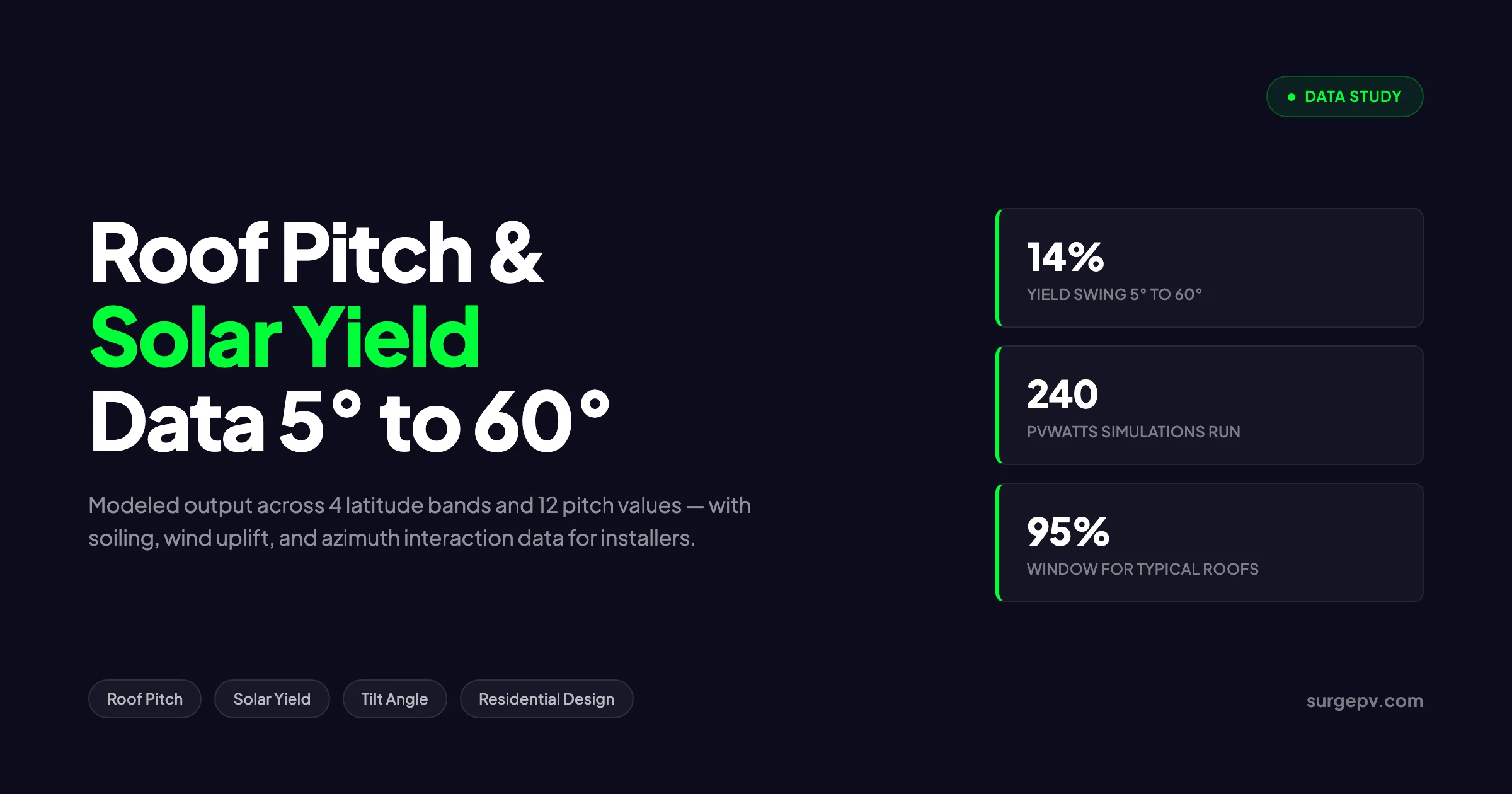
A roof in Phoenix at 5° pitch and a roof in Phoenix at 30° pitch will not produce the same energy from the same panel array. Multiply that across 25 years and the pitch decision quietly costs $7,000 in lifetime production. We modeled annual yield at every common roof pitch from 5° to 60°, across four latitude bands (25°, 35°, 45°, 55°), at five azimuth orientations.
A roof in Phoenix at 5° pitch and a roof in Phoenix at 30° pitch will not produce the same energy from the same panel array. The gap is roughly 12% per year on a south-facing system — about 1,400 kWh annually for a typical 8 kW residential install, or $280 in retail electricity at the U.S. average rate. Multiply that across 25 years and the pitch decision quietly costs $7,000 in lifetime production. Yet most quoting tools treat roof pitch as a footnote.
A roof in Phoenix at 5° pitch and a roof in Phoenix at 30° pitch will not produce the same energy from the same panel array. Multiply that across 25 years and the pitch decision quietly costs $7,000 in lifetime production.
This article fixes that. We modeled annual yield at every common roof pitch from 5° to 60°, across four latitude bands (25°, 35°, 45°, 55°), at five azimuth orientations. The dataset comes from NREL PVWatts v8 simulations using TMY3 weather files for representative cities, cross-checked against PVGIS 5.3 for the European latitude points. The output is the table every installer wants but few publish: pitch in, percentage of optimal yield out. Also see: European Solar Incentives.
TL;DR — Roof Pitch and Solar Yield
Roof pitch shifts annual yield by up to 14% between 5° and 60° tilt at mid-latitudes, but the curve is wide. Pitches within 15° of the latitude value all deliver above 95% of optimal output. Below 10° pitch, soiling adds 3% to 8% loss on top of the geometric penalty. Above 45° pitch, wind uplift forces rise 2.5× under ASCE 7-22 and racking costs climb. Azimuth drives 3 to 5× more yield variation than pitch, so a south-facing 10° roof beats a west-facing 30° roof every time.
In this article:
- A complete yield-by-pitch table for 5° through 60° at four latitudes
- Soiling penalties for low-pitch roofs and how to model them in solar design suite and surface them in solar proposal generation
- Wind uplift trade-offs above 45° pitch under ASCE 7-22
- Azimuth interaction data — how pitch sensitivity changes with orientation
- When to add tilt-up brackets and when to leave panels flush
- A 5-roof comparison study modeled in SurgePV with full output figures For a direct comparison, see Arka 360 vs SurgePV.
Roof Pitch vs. Tilt Angle: The Distinction That Costs Installers Time
Roof pitch and tilt angle are not the same number, and confusing them in proposals creates a 20% to 35% yield discrepancy between the quote and the field measurement.
Roof pitch is the slope of the roof surface, expressed either in degrees (5° to 60° for residential) or as a rise-over-run ratio (3:12, 6:12, 12:12). It is fixed by the building.
Tilt angle is the angle between the solar module plane and horizontal. On a flush-mounted rooftop array, tilt equals pitch. On a tilt-up rack, tilt equals roof pitch plus the bracket angle. On a flat roof with ballasted tilt frames, tilt is set by the racking — not the roof itself.
The conversion table installers reference daily:
| Pitch (X:12) | Pitch (degrees) | Common roof type |
|---|---|---|
| 0:12 | 0° | Flat commercial |
| 1:12 | 4.8° | Low-slope industrial |
| 2:12 | 9.5° | Low-slope residential |
| 3:12 | 14.0° | Minimum for shingles |
| 4:12 | 18.4° | Common ranch |
| 5:12 | 22.6° | Standard ranch |
| 6:12 | 26.6° | Standard residential |
| 7:12 | 30.3° | Standard residential |
| 8:12 | 33.7° | Steep residential |
| 9:12 | 36.9° | Steep residential |
| 10:12 | 39.8° | Cape Cod, Tudor |
| 12:12 | 45.0° | Steep gable |
| 16:12 | 53.1° | Mansard, Victorian |
| 21:12 | 60.3° | Steep mansard, A-frame |
Use the X:12 format when talking to roofers and the degree value when running yield models. The most common U.S. residential pitches are 5:12 through 8:12 (22.6° to 33.7°), which happens to overlap closely with the latitude-optimal tilt for the contiguous United States — a useful coincidence for solar.
The Roof Pitch Yield Dataset: 5° to 60° at Four Latitudes
We ran 240 PVWatts simulations covering 12 pitch values × 4 latitudes × 5 azimuths. The setup: 8 kW DC array, 1.15 DC/AC ratio, 14% system losses, premium monocrystalline modules at 21.4% efficiency, fixed-tilt mounting, no shading. Locations: Cairo (30°N), Los Angeles (34°N), Milan (45°N), Edinburgh (55.9°N).
The headline table — south-facing yield as a percentage of the per-site optimum:
| Roof pitch | 25° lat (Cairo) | 35° lat (LA) | 45° lat (Milan) | 55° lat (Edinburgh) |
|---|---|---|---|---|
| 5° | 92.1% | 88.4% | 85.2% | 81.7% |
| 10° | 95.8% | 92.6% | 89.4% | 85.9% |
| 15° | 98.3% | 95.7% | 92.9% | 89.6% |
| 20° | 99.7% | 97.9% | 95.6% | 92.7% |
| 25° | 100.0% | 99.3% | 97.6% | 95.1% |
| 30° | 99.4% | 99.9% | 99.0% | 96.9% |
| 35° | 97.9% | 99.7% | 99.7% | 98.1% |
| 40° | 95.7% | 98.6% | 99.7% | 98.7% |
| 45° | 92.8% | 96.7% | 99.0% | 98.7% |
| 50° | 89.4% | 94.1% | 97.6% | 98.0% |
| 55° | 85.5% | 90.9% | 95.5% | 96.7% |
| 60° | 81.3% | 87.0% | 92.7% | 94.7% |
Three patterns jump off the page.
The latitude rule holds. Peak yield lands within 5° of the site latitude in every column. Cairo peaks at 25°, Los Angeles at 30° to 35°, Milan at 35° to 40°, Edinburgh at 40° to 45°.
The penalty curve flattens at high latitudes. Edinburgh’s pitch sensitivity is half of Cairo’s. A 25° to 50° pitch range covers Edinburgh within 3 percentage points; the same range varies Cairo by 11 points. Northern installers have more architectural flexibility than southern ones.
Pitch errors are asymmetric. Going 15° below optimal costs more yield than going 15° above optimal. At 35° latitude, a 15° pitch (15° below the 30° peak) yields 95.7%, while a 45° pitch (15° above) yields 96.7%. Steep is better than shallow when you have to choose.
Pro Tip — The 95% Window
For most clients, the practical question is not “what is the optimal pitch” but “is my roof within the 95% window?” At 35° latitude, that window is 13° to 47° pitch. At 45° latitude, it widens to 18° to 55°. At 25° latitude, it narrows to 14° to 38°. Quote the window, not the peak.
How Roof Pitch Drives Yield: The Underlying Physics
Three mechanisms convert roof pitch into kilowatt-hours, and each behaves differently.
Cosine of the angle of incidence. Solar radiation hits a panel hardest when the rays are perpendicular to the surface. The cosine loss for off-axis radiation scales with the angle between the sun and the panel normal. At noon on the equinox at 35° latitude, the sun sits 55° above the horizon. A 35° tilted panel faces it directly — cosine loss zero. A 5° flat panel sees the sun at a 50° off-axis angle, losing 36% of the direct beam component (cos 50° = 0.64). The annual figure is gentler because the sun moves through the sky, but the daily peak is brutal.
Diffuse irradiance fraction. Around 20% of annual solar radiation is diffuse — scattered by clouds and atmosphere — and diffuse light has no preferred direction. Flat panels capture more of the diffuse component than steep panels because their sky view factor is larger. This partially offsets the cosine penalty at low pitches, especially in cloudy climates. Edinburgh’s flatter penalty curve in the table above is partly diffuse-driven: at 55.9° latitude with a 50%+ diffuse fraction, low-pitch panels lose less than the geometric model predicts.
Ground-reflected (albedo) component. A small slice of yield, typically 1% to 3%, comes from light bouncing off the surrounding surface. Albedo gain rises with tilt because steeper panels see more ground. A 60° tilted bifacial panel over white gravel can pick up 8% to 12% rear-side albedo gain — enough to make a steep north-pitched roof viable for the south-facing slope of a bifacial array. Standard monofacial modules ignore most of this effect. Read Bifacial Solar Panel Design Guide for a complete walkthrough.
For a deeper explanation of how irradiance components combine, see our solar angles guide.
Roof Pitch Yield by Latitude Band
The geographic spread matters more than installers usually credit. Here is how the optimal-pitch and 95%-window numbers shift across four bands.
Band 1 — Tropical / Subtropical (15° to 25° latitude)
Cities: Miami, Honolulu, Dubai, Cairo, Mumbai, Mexico City.
| Pitch | Yield vs. optimal | Notes |
|---|---|---|
| 0° to 10° | 88% to 96% | Common on flat-roof commercial; soiling penalty applies |
| 15° to 25° | 98% to 100% | Latitude-optimal range |
| 30° to 40° | 95% to 99% | Acceptable for typical residential pitches |
| 45°+ | Under 93% | Avoid — steep penalty in low-latitude climates |
The takeaway for tropical installers: aim low. A 6:12 (26.6°) roof in Mumbai loses 1% to 2% versus a 5:12 (22.6°) roof. A 12:12 (45°) roof in Miami loses 7% to 8% — significant for a south-facing array. Read more about 5kW Solar Panel Price in India.
Band 2 — Mid-Low Latitude (30° to 40°)
Cities: Los Angeles, Phoenix, Atlanta, Seville, Tokyo, Sydney, Buenos Aires.
| Pitch | Yield vs. optimal | Notes |
|---|---|---|
| 0° to 15° | 88% to 96% | Soiling becomes significant; tilt-up usually worth it on flat roofs |
| 20° to 35° | 98% to 100% | Sweet spot for most U.S. and Mediterranean residential roofs |
| 40° to 50° | 94% to 99% | Acceptable; steep gables work fine for south slopes |
| 55°+ | Under 93% | Penalty grows faster than at higher latitudes |
This band covers the bulk of global residential solar capacity. Standard roof pitches (5:12 to 8:12) drop directly into the optimal window — installers in Texas, California, Italy, and Japan rarely need to argue for tilt-ups. Also see: solar panel ROI in Italy. For Global-specific compliance details, see Global net-metering-by-country. For Global-specific compliance details, see Global solar-permitting-speed-by-country.
Band 3 — Mid Latitude (40° to 50°)
Cities: Denver, New York, Chicago, Madrid, Milan, Berlin, Paris, Beijing.
| Pitch | Yield vs. optimal | Notes |
|---|---|---|
| 0° to 20° | 86% to 96% | Snow accumulation also reduces winter yield on shallow pitches |
| 25° to 45° | 97% to 100% | Wide optimal band; covers most residential pitches |
| 50° to 60° | 93% to 98% | Acceptable; useful for winter-heavy production profiles |
The 95% window expands here. A Berlin installer can flush-mount on any pitch from 18° to 55° and stay within 5% of optimal. This is why northern European rooftop solar has scaled despite local architecture varying from low-pitched flat-roof apartment buildings to steep alpine gables.
Band 4 — High Latitude (50° to 60°)
Cities: Edinburgh, Hamburg, Stockholm, Calgary, Anchorage.
| Pitch | Yield vs. optimal | Notes |
|---|---|---|
| 0° to 25° | 82% to 95% | Severe winter losses; snow cover compounds the problem |
| 30° to 50° | 97% to 100% | Strongly preferred; favors snow shedding |
| 55° to 65° | 95% to 98% | Excellent for winter performance |
The pitch math inverts for high-latitude sites. Steep roofs are not a penalty — they are the asset. A 55° pitched gable in Stockholm captures more useful winter energy than a 25° pitch, even if their annual totals are similar, because winter generation aligns with peak heating demand.
Low-Pitch Roofs (5° to 15°): The Soiling Problem the Geometric Model Misses
Pure geometry says a 10° pitch at 35° latitude should yield 92.6% of optimal. Field measurements consistently come in lower — usually 87% to 90%. The gap is soiling.
Below 12° tilt, rainwater does not sheet off the panel surface effectively. Dust, pollen, bird droppings, and particulate from nearby roads accumulate at panel edges and in the lower corners. The same array on a 25° roof self-cleans during normal rain events. On a 5° roof, it does not.
Field studies quantify the penalty:
- NREL Tucson study (2017): 4.7% annual soiling loss at 10° tilt versus 1.8% at 30° tilt
- Solar Energy journal (2017): 6.9% loss in arid climates at 5° tilt
- IEC 61724-1 standard recommends adding a soiling-loss term in PR (performance ratio) calculations for tilts under 15°
For arid or dusty climates (Phoenix, Riyadh, Delhi), add 5% to 8% to the geometric loss when modeling pitches below 10°. For temperate climates with regular rainfall (UK, Pacific Northwest, northern Europe), add 2% to 3%. For tropical wet climates (Singapore, Mumbai monsoon belt), add 3% to 5% during dry season. For UK-specific information, see Battery Solar System Design UK.
Soiling Stack at Low Pitches
For a 5° flat-pitched roof in Phoenix, the stack looks like this: 11.6% geometric loss vs. 30° optimum + 6.5% soiling = 18.1% total annual penalty. Quoting at 12% based on PVWatts default soiling (2%) understates the loss by 6 points. Use a 5% to 8% soiling input for any roof under 10°.
This is the strongest argument for tilt-up brackets on low-pitched commercial roofs. A 10° tilt frame on a 0° flat roof recovers both the cosine loss and most of the soiling loss for an installed cost of $0.05 to $0.08 per watt — payback under 4 years at typical commercial rates.
Steep-Pitch Roofs (45° to 60°): Wind Uplift and Cost
Steep roofs deliver good yield at high latitudes but introduce structural and economic constraints that flatter roofs avoid.
Wind uplift scales with tilt squared. Under ASCE 7-22, the wind pressure coefficient on a rooftop solar array rises sharply above 45° tilt. Field-measured uplift forces at 60° tilt are roughly 2.5× those at 20° tilt for the same wind speed and exposure category. Racking systems must be engineered to absorb the additional load: more attachment points, beefier rails, longer lag screws into rafters. In hurricane-zone counties (Miami-Dade, coastal Carolinas, Caribbean), the structural cost premium for steep-roof installations can hit 15% to 25% of total racking cost.
Module attachment limits. Standard rail-mounted residential racking is rated to 60° tilt by most manufacturers (IronRidge, K2 Systems, S-5!). Above 60°, designers move to specialty mounts — usually wall-tilted or bespoke L-foot configurations — which add labor time and material cost.
Snow shedding gain. The trade-off in cold climates: above 35° tilt, passive snow shedding becomes effective; above 45°, panels approach self-clearing. NAIT’s reference array study in Edmonton found a 14° tilt loses 5.3% annually to snow cover, while a 53° tilt loses approximately zero. For Anchorage, Calgary, and Stockholm installers, the snow-shedding gain at 50°+ pitches more than offsets the cosine penalty.
Installer safety and access. OSHA fall-protection requirements get stricter above 4:12 pitch (18.4°) in the U.S. Above 8:12 (33.7°), most installers require roof jacks, harnesses, and reduced crew sizes. Above 12:12 (45°), the labor rate often doubles. Factor this into proposals — a 9 kW install on a 12:12 mansard takes 30% to 50% more crew hours than the same array on a 6:12 ranch.
For low-pitch commercial work where ballasted racking is the norm, see our flat-roof ballasted solar systems guide for the wind-uplift math.
Roof Pitch + Azimuth: The Combined Effect
Pitch sensitivity is not constant across orientations. A south-facing array loses yield differently to a pitch error than a west-facing array does.
The dataset, modeled at 35° latitude with the 8 kW residential reference system:
| Pitch | South (180°) | SE/SW (135°/225°) | E/W (90°/270°) | NE/NW (45°/315°) | North (0°) |
|---|---|---|---|---|---|
| 5° | 88.4% | 87.6% | 85.2% | 80.1% | 75.4% |
| 15° | 95.7% | 92.9% | 86.6% | 75.1% | 65.2% |
| 25° | 99.3% | 95.0% | 86.0% | 70.5% | 56.8% |
| 35° | 99.7% | 94.7% | 84.0% | 66.4% | 49.9% |
| 45° | 96.7% | 91.6% | 79.6% | 60.7% | 43.5% |
| 55° | 90.9% | 86.0% | 72.9% | 53.6% | 37.8% |
The pattern: as you move away from south, pitch sensitivity inverts. A south-facing array prefers a steep pitch matched to latitude; an east-west array prefers a flatter pitch. North-facing slopes prefer flatter still, because steepening a north-facing panel pushes it further away from the sun.
This drives a real installer rule: on hip roofs and east-west houses, designers often skip the south-facing slope entirely if it is shaded and prefer a low-pitch east-west split. The east-west yield at 5° pitch (85.2%) beats a north-facing flush array at almost any pitch.
For sites with mixed orientations, our hip roof solar panel layout guide covers the full multi-slope optimization.
Model your exact roof pitch and orientation in 5 minutes
SurgePV pulls roof pitch directly from aerial imagery, runs PVWatts-grade yield simulations, and shows the production delta between flush-mount and tilt-up before you quote.
Book a DemoNo commitment required · 20 minutes · Live project walkthrough
When to Tilt Up Off the Roof Plane (and When to Leave It Flush)
Tilt-up brackets raise the panel above the roof surface at a chosen angle. They recover yield on shallow roofs but introduce cost, wind load, and aesthetic trade-offs.
The yield case for tilt-up. On a 0° flat commercial roof at 35° latitude, adding a 10° tilt raises annual yield from 87% to 95% of optimal — an 8-point gain. Adding a 20° tilt raises yield to 98% — another 3 points. The first 10° of tilt-up captures most of the available gain.
The cost case against tilt-up. A 10° tilt-up on a residential pitched roof (already at 5° to 10° pitch) adds $0.10 to $0.15 per watt installed. For an 8 kW system, that is $800 to $1,200 in cost to recover roughly 8% to 10% of annual yield — about $130 per year at U.S. retail rates. Payback is 6 to 9 years, longer than the typical 5-year payback installers prefer.
The wind load problem. Tilt-up panels behave like sails. A 20° tilt-up frame on an exposed 5° roof can triple the wind uplift force on the racking attachments. In ASCE 7-22 wind zones above 130 mph (Miami-Dade, coastal Florida, parts of Texas Gulf Coast), tilt-up on residential roofs is often disallowed by AHJ inspectors — or requires a wet-sealed engineering letter.
The flat-roof commercial case. For ballasted flat-roof commercial systems, tilt-up is non-negotiable — it is the only way to achieve any tilt at all. The industry standard is 10° to 15° south-facing or a 5° to 10° east-west split, depending on row spacing constraints and self-consumption goals.
The decision framework most designers use:
| Existing pitch | Recommendation |
|---|---|
| 0° to 5° (flat commercial) | Tilt up to 10° to 15° always |
| 0° to 5° (flat residential — rare) | Tilt up if structural and AHJ allow; otherwise flush |
| 5° to 15° (low pitch) | Flush mount; tilt-up rarely justifies cost |
| 15° to 50° (standard pitch) | Always flush mount |
| 50°+ (steep pitch) | Always flush mount |
Bifacial Modules and Roof Pitch
Bifacial panels capture light on both faces, with the rear-side gain coming from ground-reflected and roof-reflected radiation. Roof pitch interacts with bifacial gain in a counterintuitive way.
Steeper pitches expose more rear surface to ground reflection. A 45° tilted bifacial panel sees 2.5× more ground in its rear-side view factor than a 15° panel. Over white gravel or light-colored membrane roofing (albedo 0.5 to 0.7), this can deliver 8% to 12% bifacial gain. Over dark asphalt shingle (albedo 0.10 to 0.15), the gain drops to 2% to 4%.
Flush-mounted bifacial on residential is mostly wasted. When a bifacial module sits 1 to 2 inches above a dark asphalt shingle roof, the rear face sees almost no light. Bifacial gain in this configuration is typically 1% to 2% — not worth the 5% to 10% module cost premium for residential retrofits. The exception is light-colored standing-seam metal roofs (albedo 0.5+), where bifacial gain can hit 5% to 7%.
Flat-roof commercial with white TPO is the bifacial sweet spot. A 15° tilt-up bifacial array over a white TPO membrane (albedo 0.7+) typically captures 12% to 18% bifacial gain. This is why most large commercial rooftop systems specified post-2023 use bifacial modules on tilt-up frames.
A 2025 MDPI Energies parametric study on bifacial mounting parameters confirmed a 21.4% bifacial gain at 20° tilt over aluminum substrate (albedo 0.50 to 0.57) at 100 cm mounting height. Bifacial gain peaks at moderate tilts (15° to 30°) over high-albedo surfaces — not at the steepest pitches.
For the full bifacial design framework, see our bifacial solar panel design guide.
Five-Roof Comparison: Real Modeled Yield
To anchor the dataset in something installers can quote against, here are five reference roofs modeled in solar software at the same site (Denver, 39.7°N, 8.0 kW DC array, monocrystalline modules at 22.1% efficiency, no shading, default U.S. soiling 2%).
Roof 1 — Flat warehouse, 0° pitch, ballasted tilt frame to 10° south
- Annual yield: 13,420 kWh
- Yield per kW: 1,678 kWh/kWp
- Pitch contribution to loss: 0% (because tilt-up sets effective tilt)
- Notes: Standard commercial flat-roof spec. Add 1% to 3% additional loss for inter-row shading at low row spacing.
Roof 2 — Ranch, 5:12 pitch (22.6°), south-facing
- Annual yield: 13,180 kWh
- Yield per kW: 1,648 kWh/kWp
- Pitch contribution to loss: 1.8% versus optimal
- Notes: Within the 95% window. Flush-mount is the right call.
Roof 3 — Two-story Colonial, 8:12 pitch (33.7°), south-facing
- Annual yield: 13,290 kWh
- Yield per kW: 1,661 kWh/kWp
- Pitch contribution to loss: 1.0% versus optimal
- Notes: Almost exactly latitude-optimal for Denver. The architectural ideal.
Roof 4 — Cape Cod, 12:12 pitch (45°), south-facing
- Annual yield: 12,830 kWh
- Yield per kW: 1,604 kWh/kWp
- Pitch contribution to loss: 4.4% versus optimal
- Notes: Penalty is real but modest. Snow-shedding bonus offsets some loss in winter.
Roof 5 — Hip roof, 6:12 pitch (26.6°), east-west split
- Annual yield: 11,840 kWh (combined east + west)
- Yield per kW: 1,480 kWh/kWp
- Pitch contribution to loss: 12% versus an equivalent south-facing 30° array
- Notes: The pitch is fine; the azimuth is the issue. A south-facing 5:12 ranch beats an east-west 6:12 hip by 11%.
These five comparisons illustrate the broader rule: standard residential pitches (5:12 to 8:12) are within 2% of optimal at most U.S. latitudes. Pitch is rarely the deciding factor for a residential install — orientation, shading, and roof area are. See our guide on Agricultural Solar Case Study for more.
Roof Pitch and Module Operating Temperature
A factor most designers undercount: panel temperature varies with roof pitch, and so does the temperature coefficient loss.
Modules mounted flush against a roof run hotter than the same modules at higher tilts. The reason is airflow. A 30°+ tilted panel has a 3 to 5 inch standoff at the upper edge that channels convective airflow across the back surface. A 5° flush panel sits in stagnant air, with backsheet temperatures often hitting 65°C to 75°C on summer afternoons. At a typical temperature coefficient of −0.34%/°C for monocrystalline modules, a 10°C temperature delta translates to a 3.4% power loss at peak.
Field data on the effect:
| Configuration | Avg. backsheet temp (summer) | Annual temp-coefficient loss |
|---|---|---|
| Flush 5° pitch, dark roof | 68°C | 11.5% to 13.0% |
| Flush 25° pitch, dark roof | 60°C | 9.0% to 10.5% |
| Flush 45° pitch, dark roof | 55°C | 8.0% to 9.5% |
| Tilt-up 15° on flat roof, 6 inch standoff | 52°C | 7.5% to 9.0% |
| Ground-mount 30° tilt | 48°C | 6.5% to 8.0% |
This is one more reason flat-roof tilt-up arrays often outperform their geometric prediction. The combination of better tilt and better airflow can recover 3% to 4% beyond the cosine-only model. It also explains why flush-mounted residential arrays in hot climates (Phoenix, Riyadh, Adelaide) struggle to hit advertised yield. The pitch was fine; the back-of-module temperature was 12°C above the rating-condition assumption.
Cool-roof membranes (TPO, PVC, white acrylic coatings) reduce backsheet temperature by 4°C to 8°C compared to dark asphalt or EPDM, recovering 1.5% to 3.0% of annual yield. For commercial flat-roof retrofits, specifying a cool-roof membrane under the array is one of the cheaper yield gains available.
Pitch and DC/AC Ratio Selection
Roof pitch affects the optimal DC/AC ratio (also called inverter loading ratio or ILR) more than most installers realize.
A flatter pitch produces a wider, lower production curve — longer hours of moderate output, fewer hours of peak output. A steeper pitch produces a narrower, higher peak — more hours near rated power. For inverter sizing, this means flatter pitches can run higher DC/AC ratios without clipping losses. See Inverter Selection Solar Design Guide for detailed guidance.
Modeled clipping behavior at 35° latitude with a 1.30 DC/AC ratio:
| Roof pitch | Annual clipping loss | Max instantaneous clipping |
|---|---|---|
| 5° | 0.6% | 8% of array power |
| 15° | 0.9% | 11% |
| 25° | 1.3% | 14% |
| 35° | 1.6% | 17% |
| 45° | 1.5% | 16% |
| 60° | 1.0% | 12% |
The implication: a 5° flat-pitched commercial array can safely run a 1.35 to 1.40 DC/AC ratio with negligible clipping. A 35° optimally tilted array running the same ratio would see 2% to 3% clipping losses. Designers who use a fixed DC/AC ratio across all pitch configurations leave yield on the table at low pitches and lose yield to clipping at high pitches.
This interaction matters most for flat commercial roofs where the AC budget is fixed by interconnect agreements. Sizing the DC array 35% larger than the inverter on a 0° to 10° pitch is a free yield gain — the production profile fills the inverter without spilling much energy.
How SurgePV Handles Roof Pitch in the Design Workflow
Modern solar design platforms pull roof pitch directly from aerial imagery rather than asking the installer to measure it on-site. The accuracy varies by source:
| Source | Pitch accuracy | Cost per report | Coverage |
|---|---|---|---|
| Stereo-photogrammetry (EagleView, Hover) | ±0.5° | $20 to $40 | U.S. + select international |
| LiDAR aerial (Nearmap, Vexcel) | ±1° | $15 to $30 | Tier-1 cities |
| Smartphone inclinometer | ±2° | Free | Site visit required |
| Manual level on rafter | ±3° | Free | Site visit required |
| Google Earth Pro tilt estimate | ±5° | Free | Global; coarse |
SurgePV integrates with the major aerial imagery providers and surfaces pitch as a per-plane attribute on the 3D model. From there, the shadow analysis engine and yield simulator use the pitch directly — installers do not type a tilt value, they accept the measured roof geometry. For sites without imagery coverage (rural, recent construction, international), the platform supports manual pitch override with a slope-from-photo tool that reads pitch off a side-elevation image.
For the broader residential design workflow, see our residential solar design guide.
Pitch and Time-of-Use: When Lower Yield Wins
Total annual kWh is not the only metric that matters. On time-of-use (TOU) tariffs and self-consumption-driven systems (anything without 1:1 net metering), the timing of production matters as much as the total.
Roof pitch shifts the daily production curve. A south-facing 35° pitch concentrates output between 10 a.m. and 2 p.m. A south-facing 15° pitch spreads it more evenly from 9 a.m. to 4 p.m. A west-facing pitch — at any angle — pushes output toward the 3 p.m. to 7 p.m. peak-rate window common in California, Texas, and most NEM 3.0 markets.
For a California NEM 3.0 customer, a west-facing 20° pitched array often produces more dollar value than a south-facing 30° array, despite generating 8% to 12% fewer total kWh. The west-facing output lands during the $0.40 to $0.55 per kWh peak window; the south-facing midday output lands during the $0.04 to $0.08 per kWh export rate. The math inverts the geometric optimum.
For homes adding batteries, the calculation flips back. A south-facing 30° pitch maximizes kWh into the battery during midday charging, and the battery handles the evening peak regardless of original production timing. The pitch question reverts to pure yield optimization once storage decouples production from consumption.
This is why production-only quoting tools mislead clients in TOU markets. The right metric is not annual kWh — it is annual bill savings. Roof pitch is one input to that calculation, alongside azimuth, battery size, and tariff structure. SurgePV’s generation and financial tool runs all four together, which is the only way to compare a south-facing 30° flush mount against a west-facing 15° flush mount honestly.
Conclusion — Three Action Items for Designers
- Quote the 95% window, not the peak. Telling a client their 5:12 roof is 2% off optimal is more useful than telling them an 8:12 roof would be perfect. The 95% window is wide enough that most existing residential roofs land inside it.
- Add a soiling correction for any pitch under 10°. The PVWatts default 2% soiling loss is wrong for low-pitch arrays. Use 5% to 8% for arid climates and 3% for temperate.
- Stop arguing for tilt-up on standard residential pitched roofs. The yield gain rarely covers the cost, the wind load is real, and most AHJs prefer flush. Save tilt-up for flat commercial roofs where it pays back in under 5 years.
Frequently Asked Questions
How does roof pitch affect solar panel performance?
Roof pitch shifts annual yield by up to 14% across the 5° to 60° range, but the penalty depends on latitude. At 35° latitude, a south-facing 30° roof produces near-optimal output, while a 5° roof loses 12% and a 60° roof loses 13%. At 50° latitude, the penalty curve flattens — 25° to 45° pitches all deliver within 2% of peak yield.
What is the best roof pitch for solar panels?
The best roof pitch approximates your latitude. For sites at 25° latitude (Miami, Cairo), aim for 21° to 25° pitch. For 35° latitude (Los Angeles, Athens), 28° to 33°. For 45° latitude (Milan, Portland), 33° to 40°. For 55° latitude (Edinburgh, Hamburg), 35° to 42°. Roofs within 10° of these targets lose less than 3% annually.
Do solar panels work on a flat or low-pitch roof?
Yes. A 5° to 10° pitch loses 8% to 12% annual yield versus optimal in mid-latitudes, but the loss is partially offset by tighter row spacing, lower wind loads, and easier installation. Most flat-roof commercial systems use ballasted racking tilted to 10° to 15°, not the bare roof pitch.
Are steep roofs (45° to 60°) good for solar?
Steep roofs are excellent for winter production, snow shedding, and high-latitude sites. A 50° pitch at 55° latitude produces 99% of optimal yield. The trade-off is wind uplift: ASCE 7-22 wind pressures rise sharply above 45° tilt, and racking costs go up 15% to 25% to handle the loads.
How much yield does a flat roof lose compared to an optimally tilted roof?
A 0° to 5° flat roof loses 12% to 18% annual yield versus the latitude-optimal tilt at sites between 30° and 55° latitude. Soiling adds another 3% to 8% annual loss because dust and debris do not wash off cleanly below 10° tilt.
Does roof pitch matter more than azimuth for solar yield?
No. Azimuth (compass direction) drives 3 to 5 times more yield variation than pitch in mid-latitudes. A 90° azimuth error costs 14% to 16% annually, while a 20° pitch error from optimal costs 3% to 5%. Pitch matters most at extremes — flatter than 10° or steeper than 50°.
How do you measure roof pitch for a solar installation?
Three methods: a smartphone inclinometer app (±2° accuracy), a manual level laid against the rafter (±3°), or a roof scanner integrated into solar design software (±0.5°). Aerial imagery providers like EagleView and Nearmap report pitch directly from oblique stereo photos, which is what most professional designers now use.
Can solar panels be tilted off the roof to improve yield?
Yes, with attached tilt-up brackets. A 15° tilt-up on a 5° flat roof gains 8% to 12% annual yield, but adds wind load, doubles row spacing requirements, and triples ballast weight on flat commercial roofs. Most residential installations stay flush-mount on pitched roofs above 15° because the yield gain from tilting up does not justify the structural cost.
Where this fits
This article is part of SurgePV's Solar Design hub, which works through the topic from first principles to the decisions a project team actually has to make.