Quick Answer
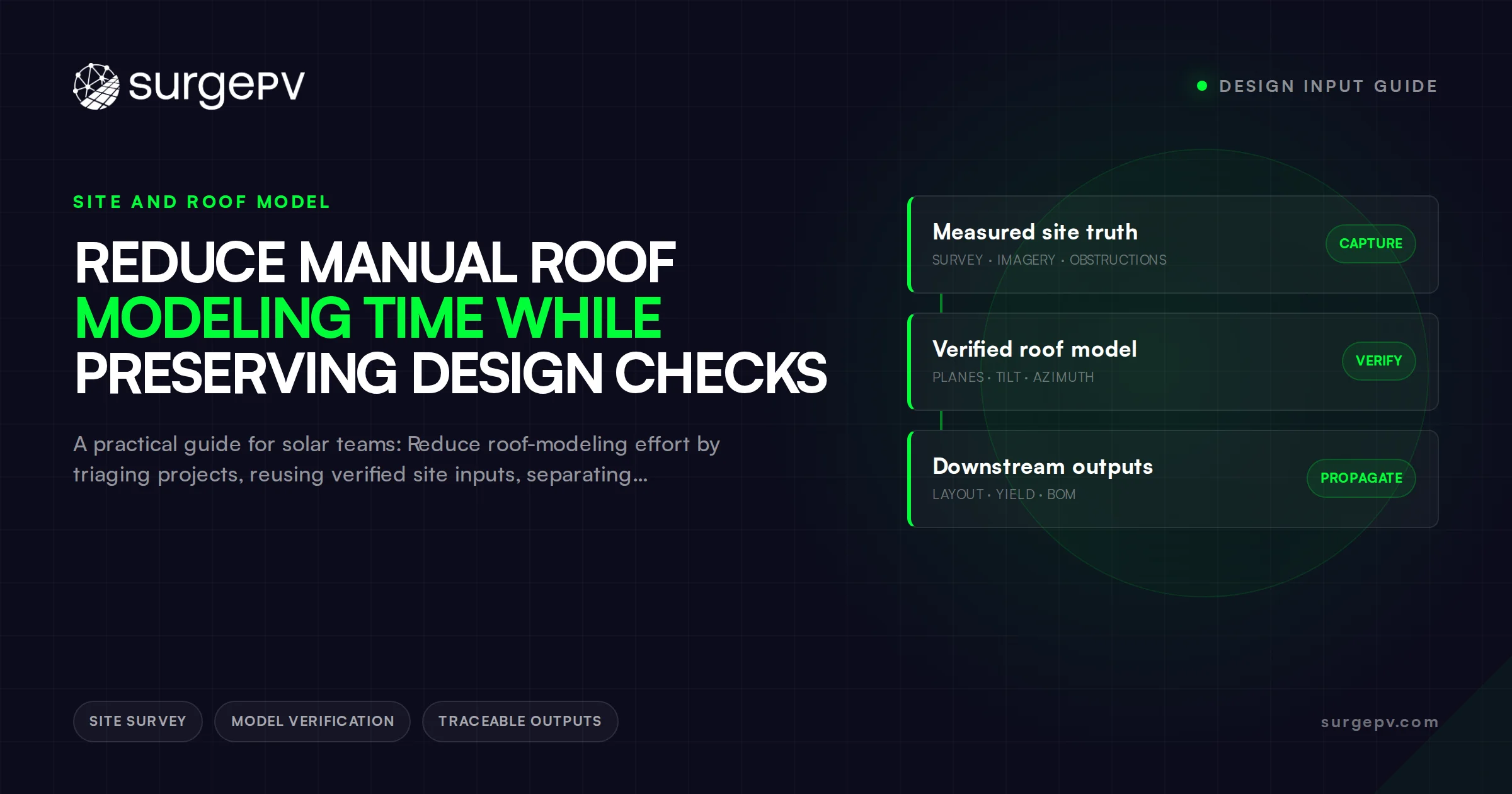
Reduce roof-modeling effort by triaging projects, reusing verified site inputs, separating preliminary geometry from survey-confirmed geometry, and reviewing the few measurements that change layout feasibility.
Roof modeling becomes slow when every opportunity receives the same treatment, whether it is a simple gable roof or a building crowded with setbacks, dormers, skylights, and access constraints. The remedy is not to skip checks; it is to decide which check is necessary at which point in the sale.
Direct Answer
Reduce roof-modeling effort by triaging projects, reusing verified site inputs, separating preliminary geometry from survey-confirmed geometry, and reviewing the few measurements that change layout feasibility.
Why this review belongs in the project workflow
Manual roof modeling for solar is most useful when it leaves a traceable decision rather than an isolated image, spreadsheet, or conversation. Solar proposals combine site facts, design assumptions, modeled outputs, and commercial information. A change in one can make another less reliable. The workflow should therefore show what is confirmed, what is estimated, and what must be revisited before release.
The article is desk research for installers and EPCs. It is not engineering advice, a site survey, or a guarantee of production, approval, savings, cost, or delivery outcomes. Use applicable local rules, equipment documentation, utility requirements, and qualified review for the project at hand.
Sort opportunities before drawing
A practical queue starts with a complexity triage. Put clear, regular roofs with current imagery and a simple objective in one lane. Route roofs with visible equipment, unusual geometry, limited access information, or high commercial stakes to a deeper review lane. The triage record should say why a project was assigned, not merely label it “easy.” That makes the team’s speed repeatable rather than dependent on a designer’s memory.
A useful working question at this stage is: “What fact would make this manual roof modeling for solar decision different?” For manual roof modeling for solar, the answer should be placed in the project record with its source, date, and owner. That approach directs attention to material uncertainty instead of adding a generic approval step.
For a manual roof modeling for solar sales and design team, for manual roof modeling for solar, the value is shared language. In manual roof modeling for solar, the person preparing the customer material can see the current status, while the person responsible for technical review can see which assumption is driving the conversation. For manual roof modeling for solar, no public resource can determine the right answer for an individual site; local requirements, manufacturer documentation, and competent project review still govern the work.
For manual roof modeling for solar, make the check observable: state the input, the method used to evaluate it, the reviewer, and the condition that would force a revision. In manual roof modeling for solar review, the next person needs an intelligible record rather than a finished image with no decision trail.
The manual roof modeling for solar record should also distinguish an operational choice from a technical conclusion. In a manual roof modeling for solar workflow, the team may advance a qualified opportunity while marking a site fact as unresolved; it should not silently turn that unresolved fact into a final representation.
Capture source dates
A roof outline has a source and a date. Record whether it came from customer photos, imagery, plans, field measurements, or a prior drawing. A fast preliminary model can be useful if it is plainly called preliminary. Trouble starts when a salesperson sees an early outline, treats it as confirmed, and builds a customer commitment around an unverified usable area.
For a manual roof modeling for solar sales and design team, for manual roof modeling for solar, the value is shared language. In manual roof modeling for solar, the person preparing the customer material can see the current status, while the person responsible for technical review can see which assumption is driving the conversation. For manual roof modeling for solar, no public resource can determine the right answer for an individual site; local requirements, manufacturer documentation, and competent project review still govern the work.
In manual roof modeling for solar work, this is also a communication practice. A customer can accept that a preliminary model has limits when those limits are described before a commitment is implied. In manual roof modeling for solar, vague confidence creates a later trust problem; a named assumption creates a path to resolve it.
For manual roof modeling for solar, make the check observable: state the input, the method used to evaluate it, the reviewer, and the condition that would force a revision. In manual roof modeling for solar review, the next person needs an intelligible record rather than a finished image with no decision trail.
The manual roof modeling for solar record should also distinguish an operational choice from a technical conclusion. In a manual roof modeling for solar workflow, the team may advance a qualified opportunity while marking a site fact as unresolved; it should not silently turn that unresolved fact into a final representation.
Model constraints before modules
The fastest way to redraw a roof is to start with panel placement. Begin with roof boundaries, features, access paths, setbacks, and zones that require confirmation. Only then evaluate possible array areas. This sequence gives a reviewer a clear place to challenge geometry without forcing them to reverse-engineer a finished-looking layout.
In manual roof modeling for solar work, this is also a communication practice. A customer can accept that a preliminary model has limits when those limits are described before a commitment is implied. In manual roof modeling for solar, vague confidence creates a later trust problem; a named assumption creates a path to resolve it.
Keep manual roof modeling for solar action proportionate. A simple, well-documented roof may only need a targeted confirmation. A complicated site or a material commercial decision may require more evidence. The important point is that the level of review is deliberate and visible.
For manual roof modeling for solar, make the check observable: state the input, the method used to evaluate it, the reviewer, and the condition that would force a revision. In manual roof modeling for solar review, the next person needs an intelligible record rather than a finished image with no decision trail.
The manual roof modeling for solar record should also distinguish an operational choice from a technical conclusion. In a manual roof modeling for solar workflow, the team may advance a qualified opportunity while marking a site fact as unresolved; it should not silently turn that unresolved fact into a final representation.
Automate repetition, not judgment
Software can reduce copying and help centralize a roof model, layout, and project record. Solar Designing describes SurgePV’s design workflow. The appropriate human review remains site- and project-specific: imagery may not show a parapet, a service route, equipment replacement plan, or a local requirement. Automation should surface these decisions, not conceal them.
Keep manual roof modeling for solar action proportionate. A simple, well-documented roof may only need a targeted confirmation. A complicated site or a material commercial decision may require more evidence. The important point is that the level of review is deliberate and visible.
A useful working question at this stage is: “What fact would make this manual roof modeling for solar decision different?” For manual roof modeling for solar, the answer should be placed in the project record with its source, date, and owner. That approach directs attention to material uncertainty instead of adding a generic approval step.
For manual roof modeling for solar, make the check observable: state the input, the method used to evaluate it, the reviewer, and the condition that would force a revision. In manual roof modeling for solar review, the next person needs an intelligible record rather than a finished image with no decision trail.
The manual roof modeling for solar record should also distinguish an operational choice from a technical conclusion. In a manual roof modeling for solar workflow, the team may advance a qualified opportunity while marking a site fact as unresolved; it should not silently turn that unresolved fact into a final representation.
Measure the uncertainty that matters
Not every dimension carries equal consequence. Focus field questions on values that can move the array boundary, change clearances, affect row spacing, or alter access. A short photo request with a landmark can be better than an unfocused “send roof photos” email. If a critical measurement is unknown, write that condition next to the early layout rather than embedding it in an internal note.
A useful working question at this stage is: “What fact would make this manual roof modeling for solar decision different?” For manual roof modeling for solar, the answer should be placed in the project record with its source, date, and owner. That approach directs attention to material uncertainty instead of adding a generic approval step.
For a manual roof modeling for solar sales and design team, for manual roof modeling for solar, the value is shared language. In manual roof modeling for solar, the person preparing the customer material can see the current status, while the person responsible for technical review can see which assumption is driving the conversation. For manual roof modeling for solar, no public resource can determine the right answer for an individual site; local requirements, manufacturer documentation, and competent project review still govern the work.
For manual roof modeling for solar, make the check observable: state the input, the method used to evaluate it, the reviewer, and the condition that would force a revision. In manual roof modeling for solar review, the next person needs an intelligible record rather than a finished image with no decision trail.
The manual roof modeling for solar record should also distinguish an operational choice from a technical conclusion. In a manual roof modeling for solar workflow, the team may advance a qualified opportunity while marking a site fact as unresolved; it should not silently turn that unresolved fact into a final representation.
Build a feedback loop from redraws
Review rework by cause: stale imagery, missing site feature, unclear intake, change in scope, or a misunderstanding of a rule. The Department of Energy’s Solar Energy Technologies Office is a credible public starting point for solar context, but team-specific time claims need retained internal evidence. Use the categories to improve inputs, not to claim an unsupported universal time saving.
For a manual roof modeling for solar sales and design team, for manual roof modeling for solar, the value is shared language. In manual roof modeling for solar, the person preparing the customer material can see the current status, while the person responsible for technical review can see which assumption is driving the conversation. For manual roof modeling for solar, no public resource can determine the right answer for an individual site; local requirements, manufacturer documentation, and competent project review still govern the work.
In manual roof modeling for solar work, this is also a communication practice. A customer can accept that a preliminary model has limits when those limits are described before a commitment is implied. In manual roof modeling for solar, vague confidence creates a later trust problem; a named assumption creates a path to resolve it.
For manual roof modeling for solar, make the check observable: state the input, the method used to evaluate it, the reviewer, and the condition that would force a revision. In manual roof modeling for solar review, the next person needs an intelligible record rather than a finished image with no decision trail.
The manual roof modeling for solar record should also distinguish an operational choice from a technical conclusion. In a manual roof modeling for solar workflow, the team may advance a qualified opportunity while marking a site fact as unresolved; it should not silently turn that unresolved fact into a final representation.
Bring manual roof modeling for solar into one reviewable solar workflow
See how SurgePV can help a team keep manual roof modeling for solar inputs, modeled outputs, and customer-ready manual roof modeling for solar materials connected.
Book a DemoA practical manual roof modeling for solar release checklist
Before using manual roof modeling for solar work in a proposal or handoff, ask: is the manual roof modeling for solar source data current enough for the decision; does the current manual roof modeling for solar project record identify relevant unknowns; have dependent outputs been reviewed; and does the customer-facing material state meaningful manual roof modeling for solar limitations? Answering those questions explicitly is more valuable than adding confidence language after the fact.
For an integrated manual roof modeling for solar workflow, review the relevant Solar Designing page and decide how the team will define its own release conditions. SurgePV can support connected manual roof modeling for solar design and proposal work; it does not replace site verification, engineering judgment, or jurisdiction-specific review.
Frequently Asked Questions
What is a preliminary solar roof model?
It is an early representation of roof geometry and usable area used for planning, with its data source, date, and unresolved constraints clearly stated.
Which roofs need a deeper review?
Roofs with complex geometry, visible obstructions, incomplete site data, unusual access, or material commercial risk should move to a deeper review lane.
Can software replace a site survey?
No. Software can organize and accelerate modeling work, but project-specific verification and local requirements still apply.
Ready to make manual roof modeling for solar easier to review?
Book a personalized SurgePV demo to explore a connected manual roof modeling for solar design, analysis, and proposal workflow.
Book a Free Demo