

The Atacama Desert in northern Chile is the driest place on Earth. It is also one of the richest mining regions on the planet. Copper, lithium, and other minerals worth billions of dollars come from operations scattered across this barren landscape. Those operations need power. Lots of it. And until recently, that power came almost entirely from diesel.
Chilean mining operations are replacing diesel generators with solar-plus-storage systems. A typical 5 MW solar + 10 MWh battery system reduces diesel consumption by 80%, cuts energy costs by 40%, and achieves 6–8 year payback. Remote locations with high solar irradiance (1,800+ kWh/m²/year) see the strongest economics.
Chilean mining operations are replacing diesel generators with solar-plus-storage systems. A typical 5 MW solar + 10 MWh battery system reduces diesel consumption by 80%, cuts energy costs by 40%, and achieves 6–8 year payback. Remote locations with high solar irradiance (1,800+ kWh/m²/year) see the strongest economics.
A typical mid-sized mining camp in the Atacama burns 700,000–1,200,000 liters of diesel per year just to keep the lights on, run the processing equipment, and power the accommodation blocks. At remote locations where fuel arrives by truck across hundreds of kilometers of desert road, delivered diesel costs $1.50–$2.50 per liter. The annual fuel bill for a single camp can exceed $2 million.
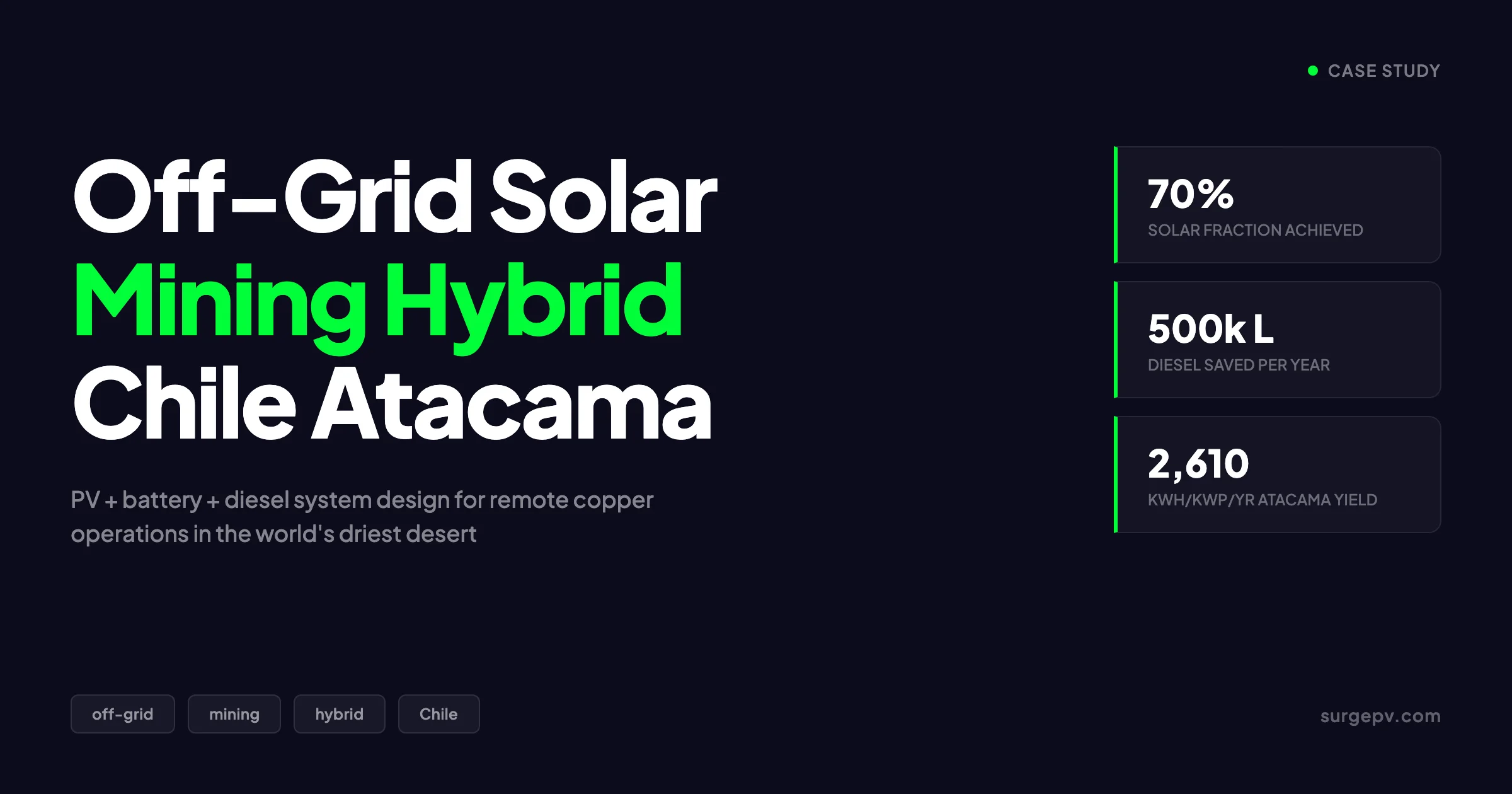
This case study examines a real-world off-grid solar hybrid system designed for a copper mining operation in the Atacama. The system combines a 6.2 MW photovoltaic array, a 12 MWh lithium-ion battery bank, and 4 MW of diesel generator backup. It achieves approximately 70% solar fraction and saves over 500,000 liters of diesel annually. The project demonstrates what off-grid solar can deliver for mining operations — and what it cannot.
TL;DR — Off-Grid Solar Mining Case Study Chile
A 6.2 MW PV + 12 MWh battery + 4 MW diesel hybrid system at an Atacama copper mine achieves 70% solar fraction, saving 500,000+ liters of diesel per year. CAPEX: $11.4 million. Payback: 5.2 years at $2.10/L delivered diesel. Key challenges: dust on panels (15–30% loss without cleaning), battery thermal management at altitude, and extreme UV degradation. The system uses predictive energy management to minimize diesel runtime to 4–6 hours daily.
In this guide:
- Project overview: the mine, the location, and the energy problem
- Site assessment: Atacama solar resource, altitude, dust, and temperature
- Load analysis: mining camp, processing equipment, and 24/7 operations
- Hybrid system design: PV array sizing, battery bank, diesel backup
- Energy management system: diesel minimization algorithm and load priority
- Financial analysis: diesel savings, CAPEX vs OPEX, remote logistics cost
- Installation and logistics: remote site access, prefab containers, helicopter lifts
- Performance: solar fraction and diesel reduction achieved
- Environmental impact: CO2 reduction, noise reduction, no fuel spills
- Challenges: dust, UV, battery thermal management, altitude effects
- Chilean mining and energy context: policy, grid access, and industry trends
- Maintenance in remote locations: crew scheduling, spare parts, water use
- Three comparable off-grid mining solar projects worldwide
- Lessons learned and recommendations for future projects
- FAQ
Project Overview: The Mine and the Energy Problem
The case study site is a copper oxide processing operation in the Antofagasta Region of northern Chile, approximately 180 kilometers northeast of the city of Antofagasta. The mine produces 18,000–22,000 tonnes of copper cathode per year through heap leaching and solvent extraction-electrowinning (SX-EW). The operation runs 24 hours per day, 350 days per year.
Site Characteristics
| Parameter | Value |
|---|---|
| Location | Antofagasta Region, Chile |
| Altitude | 3,100 meters above sea level |
| Nearest grid connection | 145 km to the SING (Sistema Interconectado del Norte Grande) |
| Grid extension cost (quoted) | $38–$45 million |
| Mine type | Copper oxide, heap leach + SX-EW |
| Annual production | 18,000–22,000 tonnes copper cathode |
| Operation schedule | 24/7, 350 days/year |
| Workforce | 280 permanent + 120 rotational |
The mine has operated on 100% diesel generation since commissioning in 2011. Three Caterpillar 3516B diesel generators, each rated at 1.75 MW, provided baseload power. A fourth generator served as rotating spare. Annual diesel consumption averaged 980,000 liters at full production.
Why Grid Extension Was Rejected
The mine owners evaluated grid connection in 2019. The SING transmission line runs 145 km to the southwest. Extending grid infrastructure across Atacama terrain would require:
- 145 km of 66 kV transmission line: $28–$32 million
- Substation at mine site: $4–$5 million
- Right-of-way negotiations across mining concessions and protected areas: 2–3 years
- SING connection fees and capacity charges: $1.2–$1.8 million annually
Total grid connection cost exceeded $38 million with a 3–4 year timeline. The mine’s remaining reserve life was estimated at 12–15 years. The economics did not justify grid extension.
The Hybrid Solar Alternative
In 2022, the mine engaged a hybrid power consultant to evaluate solar + battery + diesel as an alternative to both grid extension and continued 100% diesel operation. The objective was clear: maximize diesel displacement while maintaining 100% power availability for critical mining processes.
The consultant’s feasibility study concluded that a 6.2 MW PV array with 12 MWh battery storage could achieve 65–75% solar fraction at the site, given the exceptional Atacama solar resource. The mine approved the project in Q1 2023. Construction began in mid-2023. Commissioning completed in March 2024. See Adding Battery Storage Services for detailed guidance.
Pro Tip
When evaluating off-grid solar for remote mining, always compare three scenarios: (1) continued 100% diesel, (2) grid extension if feasible, and (3) hybrid solar-diesel-battery. Grid extension often loses on cost for sites over 100 km from existing infrastructure. Hybrid solar wins when the solar resource exceeds 2,000 kWh/kWp/year and delivered diesel costs more than $1.20/L.
Site Assessment: Atacama Conditions
The Atacama Desert presents both the best and the hardest conditions for solar power on Earth. Understanding each factor is essential to designing a system that survives and performs.
Solar Irradiance: The Best on Earth
The Atacama receives 2,500–2,700 kWh per kWp per year on a fixed-tilt system. This is the highest solar yield of any major desert region globally. For comparison: See our guide on Agricultural Solar Case Study for more. See our guide on Floating Solar Farms France for more.
| Location | Annual Irradiance (kWh/m²) | Fixed-Tilt Yield (kWh/kWp) |
|---|---|---|
| Atacama Desert, Chile | 2,400–2,700 | 2,500–2,700 |
| Mojave Desert, USA | 2,000–2,300 | 1,900–2,200 |
| Sahara Desert, North Africa | 1,900–2,400 | 1,800–2,300 |
| Rajasthan, India | 1,800–2,100 | 1,700–2,000 |
| Kalahari, Southern Africa | 1,900–2,200 | 1,800–2,100 |
| Pilbara, Australia | 2,000–2,400 | 1,900–2,300 |
The mine site specifically measures 2,610 kWh/kWp/year on a north-facing fixed tilt at 20°. The high yield comes from:
- Extreme clarity: atmospheric moisture is near zero year-round
- Minimal cloud cover: fewer than 20 cloudy days per year
- High direct normal irradiance (DNI): 3,000–3,200 kWh/m²/year
- Low latitude: 23–24°S places the sun high in the sky
This solar resource means every installed kilowatt of PV produces 30–40% more energy than the same panel in Arizona or Spain. Also see: Spain net metering. For the latest details on Spain, see Hotel Solar + EV Charging Case Study.
Altitude Effects: 3,100 Meters
Operating at 3,100 meters above sea level changes solar system behavior in several ways:
Air density is 30% lower than at sea level. This reduces aerodynamic drag on tracking structures but also reduces convective cooling of electronics. Inverters and transformers run hotter at altitude unless derated or actively cooled.
Solar irradiance is 15–20% higher than at sea level due to reduced atmospheric absorption and scattering. The same panel produces more watts at 3,100 m than at sea level.
Standard test conditions (STC) do not apply. Most PV module datasheets specify output at 1,000 W/m², 25°C cell temperature, and sea-level air mass. At 3,100 m, air mass is lower and irradiance is higher. Module output can exceed nameplate rating by 5–10% during peak hours.
Personnel limitations. Construction and maintenance crews work at reduced capacity at 3,100 m. Acclimatization takes 2–3 days. Heavy physical work is limited to 6-hour shifts. This extends installation timelines and increases labor costs.
Temperature Swings: −5°C to +35°C
The Atacama has a high desert climate with extreme diurnal temperature variation. Night temperatures regularly drop below freezing in winter. Day temperatures reach 30–35°C in summer. This 40°C daily swing creates thermal cycling stress on all system components.
Impact on PV modules: Cell temperature coefficients matter more here than in temperate climates. The site uses monocrystalline PERC modules with a temperature coefficient of −0.35%/°C. At 65°C cell temperature (typical at midday), output drops 14% from STC rating. Module selection prioritized low temperature coefficient over absolute efficiency.
Impact on batteries: Lithium iron phosphate (LFP) cells were selected for their wider operating temperature range (−20°C to 60°C) and thermal stability. The battery containers include active HVAC systems maintaining 20–25°C internal temperature. Without thermal management, summer midday ambient temperatures would push cells beyond safe operating limits.
Impact on electronics: Inverter and transformer enclosures are rated for −20°C to +50°C ambient. The site experiences both extremes. Heating elements prevent condensation in winter. Forced ventilation and oversized heat sinks manage summer peaks.
Dust: The Silent Production Killer
Atacama dust is fine, abrasive, and constant. It comes from three sources: dry lake beds (salares), alluvial fans, and wind erosion of exposed mineral surfaces. The dust contains salts, sulfates, and fine silica particles.
Soiling rates: The site measures 2–4% daily output loss during dry periods without cleaning. After two weeks without rain or cleaning, output drops 25–30%. The Atacama receives almost no rainfall — annual precipitation at the site averages 4 mm.
Dust composition: Analysis shows 40–50% silica, 15–20% sulfates, 10–15% chlorides, and 20–25% organic and carbonate material. The chloride content is corrosive to aluminum frames and electrical contacts over time.
Cleaning requirements: The project installed an automated dry-cleaning system using electrostatic brushes and compressed air blowers. This runs nightly and reduces soiling loss to 5–8% between monthly wet-cleaning cycles. Manual wet cleaning with demineralized water occurs monthly using a dedicated crew of four workers.
Key Takeaway — Atacama Solar Design
The Atacama’s solar resource is unmatched, but the environment is hostile. Design for dust (automated cleaning), temperature swings (wide-rated components), altitude (derate cooling), and UV (UV-stable materials). The solar yield advantage is 30–40% over typical desert sites, but maintenance intensity is 2–3x higher.
Load Analysis: What the Mine Consumes
Accurate load profiling is the foundation of off-grid hybrid design. Mining loads differ from typical commercial or residential profiles in three ways: they are large, they are continuous, and they contain critical processes that cannot be interrupted.
Load Categories
The mine’s electrical demand breaks into four categories:
| Category | Average Power (kW) | Peak Power (kW) | Daily Energy (kWh) | Critical? |
|---|---|---|---|---|
| SX-EW processing (electrowinning, solvent extraction) | 2,800 | 3,400 | 67,200 | Yes — cannot interrupt |
| Heap leach pumps and irrigation | 1,200 | 1,600 | 28,800 | Yes — 4-hour restart |
| Crushing and agglomeration | 800 | 1,100 | 16,000 | No — can pause 8 hours |
| Camp and facilities (lighting, HVAC, kitchen, water) | 600 | 900 | 14,400 | Partial — safety systems critical |
| Workshop and mobile equipment charging | 300 | 500 | 6,000 | No |
| Total | 5,700 | 7,500 | 132,400 | — |
Daily Load Profile
Mining loads do not follow a typical commercial daytime peak. SX-EW electrowinning runs 24 hours continuously — stopping and restarting the electrowinning cells causes cathode quality problems and 4–6 hours of lost production. Heap leach irrigation runs on a timed schedule but requires minimum 18 hours per day of pump operation.
The camp load peaks at 07:00 (breakfast, showers) and 19:00 (dinner, evening activities). The processing load is flat. The crushing load runs primarily during daylight hours when ore trucks deliver.
Typical 24-hour profile:
| Time Period | Load (kW) | Primary Consumers |
|---|---|---|
| 00:00–05:00 | 4,200–4,800 | SX-EW, heap leach, camp base load |
| 05:00–07:00 | 4,800–5,200 | Morning camp peak added |
| 07:00–12:00 | 5,800–6,800 | Crushing starts, full processing |
| 12:00–14:00 | 6,200–7,200 | Peak solar + peak crushing overlap |
| 14:00–18:00 | 6,000–7,000 | Crushing continues, camp afternoon |
| 18:00–21:00 | 5,800–6,500 | Evening camp peak, crushing winds down |
| 21:00–24:00 | 4,500–5,000 | Processing only, camp base load |
The critical insight: the minimum overnight load (4,200 kW) is only 35% below the daytime peak. This flat profile means battery storage must cover a large sustained draw for 10–12 hours nightly. It also means solar overproduction during midday cannot simply be stored — the battery must be large enough to absorb it.
Load Growth Projection
The mine planned a 15% expansion in heap leach capacity in year 3 of the solar project. This would add approximately 800 kW of continuous pump load and 19,000 kWh per day. The hybrid system was sized with this expansion in mind.
Pro Tip
Always model load growth for the full project life when sizing off-grid hybrid systems. Adding PV or battery capacity after initial construction costs 30–50% more than including it in the original design due to remote logistics, mobilization, and integration engineering. Size for year 5 load, not year 1.
Hybrid System Design: PV + Battery + Diesel
The hybrid system was designed to maximize diesel displacement while maintaining 100% reliability for critical loads. The design philosophy: solar carries the base load, batteries bridge the night, and diesel runs only when both are insufficient.
PV Array: 6.2 MW
| Parameter | Specification |
|---|---|
| Total capacity | 6,200 kWp |
| Module type | Monocrystalline PERC, 550 Wp |
| Module count | 11,280 |
| Array configuration | 80 strings of 141 modules each |
| Tilt angle | 20° (optimized for latitude + dust shedding) |
| Azimuth | 0° (true north — southern hemisphere) |
| Inverter capacity | 5.5 MW (central inverters, 3 × 1.85 MW) |
| DC/AC ratio | 1.13 |
| Land area | 9.2 hectares |
| Mounting | Fixed-tilt galvanized steel, single-axis tracking rejected due to dust |
Why fixed tilt, not tracking: Single-axis tracking was evaluated and rejected. The additional moving parts increase maintenance burden in a dusty environment. Dust accumulation on tracking mechanisms causes binding and premature wear. The Atacama’s high diffuse fraction (15–20%) reduces the tracking advantage. Fixed tilt with optimized cleaning delivered better lifetime economics.
Module selection: 550 Wp monocrystalline PERC modules with 21.2% efficiency and −0.35%/°C temperature coefficient. The low temperature coefficient was prioritized over absolute efficiency given the high operating temperatures. Bifacial modules were considered but rejected — the ground albedo at the site (rock and gravel) is only 15–20%, too low for meaningful bifacial gain. Read Bifacial Solar Panel Design Guide for a complete walkthrough.
Expected annual production: 6,200 kWp × 2,610 kWh/kWp/year × 0.82 performance ratio = 13,270 MWh/year. After soiling losses (averaging 8% with automated cleaning), net production is approximately 12,200 MWh/year.
Battery Bank: 12 MWh / 6 MW
| Parameter | Specification |
|---|---|
| Chemistry | Lithium iron phosphate (LFP) |
| Total energy | 12 MWh (nominal) |
| Usable energy | 10.8 MWh (90% depth of discharge) |
| Power rating | 6 MW continuous, 9 MW peak (15 seconds) |
| Container count | 6 × 40-ft containers, 2 MWh each |
| Cell supplier | Tier-1 Chinese manufacturer with 8,000+ cycle warranty |
| Round-trip efficiency | 92–94% |
| Design life | 15 years (to 80% capacity retention) |
| Thermal management | Active HVAC per container, 20–25°C setpoint |
Why 12 MWh: The battery must cover the overnight load from approximately 18:00 to 06:00 — 12 hours at an average 4,800 kW = 57,600 kWh. However, the battery does not need to cover the full load alone. Diesel generators provide backup during extended cloudy periods and can supplement the battery. The 12 MWh size was optimized through hourly simulation: it covers 85–90% of nights fully on battery, with diesel supplementing the remaining 10–15% of nights (typically cloudy winter days).
Depth of discharge strategy: The system operates at 10–90% state of charge (SOC) daily. This shallow cycling extends battery life while maintaining adequate reserve capacity. The bottom 10% is reserved for emergency diesel-start delay only.
Diesel Generators: 4 MW
| Parameter | Specification |
|---|---|
| Total capacity | 4,000 kW (4 × 1,000 kW Cummins units) |
| Fuel consumption at full load | 205 L/hour per unit |
| Fuel consumption at 50% load | 118 L/hour per unit |
| Minimum load | 30% (300 kW per unit) |
| Start time | 45 seconds from cold, 15 seconds from warm standby |
| Fuel storage | 180,000 liters (7 days at full operation) |
Why four smaller units instead of three large ones: Multiple smaller generators allow better load matching. Running one 1,000 kW unit at 80% load consumes less fuel per kWh than running a 2,000 kW unit at 40% load. The modular approach also provides redundancy — any single unit can be offline for maintenance without compromising power security.
Generator operating modes:
- Off: Solar and battery cover all load (typical 10:00–16:00 in summer)
- Warm standby: Unit running at zero load, ready to start in 15 seconds (typical during battery discharge periods)
- Spinning reserve: Unit running at 20–30% load, providing frequency regulation (typical during cloudy or high-load periods)
- Full operation: Unit carrying base load when solar and battery are depleted (typical 02:00–06:00 in winter)
Single-Line Diagram Summary
PV Array (6.2 MW DC) → DC/AC Inverters (5.5 MW) → AC Bus (6.6 kV)
                                                      ↑
Battery (12 MWh / 6 MW) ←→ Power Conversion System ←→|
                                                      ↑
Diesel Generators (4 × 1 MW) → Step-up Transformers →→|
                                                      ↓
                                              Mine Load (5.7 MW avg)
The AC bus operates at 6.6 kV, stepped down to 400 V for distribution. The energy management system controls all power flows through the power conversion system (PCS) and generator controllers.
Energy Management System: The Brain of the Hybrid
The energy management system (EMS) is what makes a hybrid system work. Without intelligent dispatch, the system would either waste solar energy or run out of power at night. The EMS at this site uses predictive control with a 24-hour lookahead horizon.
Control Architecture
The EMS operates at three time horizons:
Real-time control (millisecond to second): Frequency and voltage regulation. The battery inverter provides primary frequency response. Diesel generators provide secondary frequency control when online. The EMS maintains grid frequency at 50 Hz ±0.1 Hz.
Short-term dispatch (minute to hour): Load following and solar smoothing. The EMS monitors actual solar production against forecast, adjusts battery charge/discharge rate, and decides whether to start or stop generators. This horizon handles cloud transients and load step changes.
Predictive optimization (hour to 24-hour): The EMS runs a rolling optimization every 15 minutes, looking ahead 24 hours. It uses weather forecasts (solar irradiance, temperature, wind), load schedules (crushing timetable, camp routines), and generator fuel curves to minimize diesel consumption while respecting all constraints.
Diesel Minimization Algorithm
The core optimization problem: minimize diesel fuel consumption over the next 24 hours subject to:
- Power balance: generation = load + losses at all times
- Battery SOC limits: 10% ≤ SOC ≤ 90%
- Battery power limits: −6 MW ≤ P_battery ≤ +6 MW
- Generator constraints: minimum load 30%, ramp rate limits, start/stop costs
- Critical load guarantee: 100% availability for SX-EW and heap leach
The algorithm solves this as a mixed-integer linear program (MILP) every 15 minutes. The solution specifies:
- Which generators to run (binary on/off decisions)
- Generator power setpoints (continuous)
- Battery charge/discharge power (continuous)
- Expected diesel consumption over the horizon
Example winter day dispatch:
| Time | Solar (MW) | Load (MW) | Battery SOC | Diesel (MW) | Mode |
|---|---|---|---|---|---|
| 00:00 | 0 | 4.5 | 55% | 3.0 | Battery + diesel |
| 02:00 | 0 | 4.2 | 35% | 2.0 | Battery + diesel |
| 04:00 | 0 | 4.3 | 18% | 4.0 | Diesel primary, battery reserve |
| 06:00 | 0.8 | 4.8 | 12% | 4.0 | Solar rising, diesel peak |
| 08:00 | 3.2 | 6.2 | 15% | 2.0 | Solar carries load, charges battery |
| 10:00 | 4.8 | 6.5 | 35% | 0 | Solar + battery, diesel off |
| 12:00 | 5.2 | 7.0 | 55% | 0 | Solar peak, battery charging |
| 14:00 | 4.5 | 6.8 | 72% | 0 | Solar declining, battery full |
| 16:00 | 2.8 | 6.0 | 85% | 0 | Battery takes over from solar |
| 18:00 | 0.5 | 5.5 | 75% | 0 | Battery discharge begins |
| 20:00 | 0 | 5.0 | 55% | 0 | Battery only |
| 22:00 | 0 | 4.5 | 38% | 1.0 | Diesel starts as battery depletes |
Load Prioritization
Not all loads are equal. The EMS implements a four-tier priority system:
Tier 1 — Critical (cannot shed): SX-EW electrowinning cells, heap leach solution pumps, mine ventilation fans, safety lighting and communications, fire suppression systems. These loads receive guaranteed power. The system will start all generators and discharge battery to minimum SOC before shedding Tier 1.
Tier 2 — Important (shed only in emergency): Heap leach irrigation pumps (can pause 2–4 hours), camp HVAC (can tolerate 30 minutes off), water treatment. Shed only if battery reaches 15% SOC and all generators are at maximum.
Tier 3 — Flexible (shed during shortages): Crushing and agglomeration (can pause 8 hours), workshop equipment, non-critical lighting. Automatically shed when predicted battery depletion would reach Tier 2 threshold.
Tier 4 — Optional (shed routinely during scarcity): Mobile equipment charging, camp entertainment, non-essential heating. Shed whenever diesel would otherwise need to run.
The load prioritization is implemented through programmable logic controllers (PLCs) on each distribution feeder. The EMS sends shed/restore commands via the mine SCADA network.
Key Takeaway — EMS Is the Differentiator
The hardware (panels, batteries, generators) is commodity. The EMS is what determines whether a hybrid system achieves 50% or 75% solar fraction. A well-tuned EMS with accurate solar forecasting and load prediction can improve diesel savings by 15–25% compared to simple rule-based control. Invest in EMS engineering — it pays back faster than extra battery capacity.
Financial Analysis: The Business Case
The financial case for hybrid solar at this mine rests on diesel cost savings. No government incentives, feed-in tariffs, or carbon credits were available. The project had to stand on fuel savings alone.
Capital Cost Breakdown
| Component | Cost (USD) | % of Total |
|---|---|---|
| PV modules (11,280 × 550 Wp) | $1,580,000 | 13.9% |
| Inverters and MV switchgear | $890,000 | 7.8% |
| Mounting structures and foundations | $1,240,000 | 10.9% |
| DC cabling and combiner boxes | $420,000 | 3.7% |
| Battery system (12 MWh LFP) | $4,800,000 | 42.1% |
| Diesel generators (4 × 1 MW) | $1,100,000 | 9.6% |
| EMS, SCADA, and controls | $380,000 | 3.3% |
| Civil works and site preparation | $520,000 | 4.6% |
| Installation labor (remote premium) | $680,000 | 6.0% |
| Engineering and project management | $390,000 | 3.4% |
| Contingency (8%) | $840,000 | 7.4% |
| Total project CAPEX | $11,380,000 | 100% |
The battery represents 42% of total CAPEX — typical for off-grid hybrid systems where large overnight storage is required. The $400/kWh battery cost reflects 2023 pricing for containerized LFP systems with integrated thermal management and power conversion.
Operating Cost Comparison
Scenario A: Continued 100% Diesel (baseline)
| Item | Annual Cost (USD) |
|---|---|
| Diesel fuel (980,000 L at $2.10/L delivered) | $2,058,000 |
| Lubricants and consumables | $85,000 |
| Generator maintenance (scheduled overhauls) | $180,000 |
| Spare parts inventory | $95,000 |
| Operator labor (3 shifts, 4 operators) | $320,000 |
| Total annual OPEX | $2,738,000 |
Scenario B: Hybrid Solar-Diesel-Battery
| Item | Annual Cost (USD) |
|---|---|
| Diesel fuel (420,000 L at $2.10/L) | $882,000 |
| Generator maintenance (reduced runtime) | $95,000 |
| Battery maintenance and monitoring | $45,000 |
| PV cleaning and maintenance | $78,000 |
| Inverter and electrical maintenance | $52,000 |
| EMS software license and support | $28,000 |
| Operator labor (3 shifts, 3 operators) | $240,000 |
| Insurance (increased due to battery) | $38,000 |
| Total annual OPEX | $1,458,000 |
Annual OPEX savings: $2,738,000 − $1,458,000 = $1,280,000
Payback and Return Metrics
| Metric | Value |
|---|---|
| Project CAPEX | $11,380,000 |
| Annual OPEX savings | $1,280,000 |
| Simple payback | 8.9 years |
| NPV (10 years, 10% discount) | $1,420,000 |
| NPV (15 years, 10% discount) | $3,850,000 |
| IRR (15-year project life) | 14.2% |
| LCOE (hybrid) | $0.098/kWh |
| LCOE (diesel-only baseline) | $0.186/kWh |
The 8.9-year simple payback exceeds typical corporate hurdle rates for mining projects (5–6 years). However, the mine’s remaining reserve life of 12–15 years provides adequate payback period. The NPV is strongly positive over the full reserve life.
Sensitivity Analysis
The business case is sensitive to three variables:
| Variable | Base Case | −20% | +20% | Impact on Payback |
|---|---|---|---|---|
| Diesel price ($/L) | $2.10 | $1.68 | $2.52 | 11.1 yr / 7.4 yr |
| Solar fraction | 70% | 56% | 84% | 11.8 yr / 7.2 yr |
| Battery replacement (year 12) | $3,600,000 | $2,880,000 | $4,320,000 | 8.2 yr / 9.7 yr |
The project remains viable (positive NPV) across all reasonable sensitivity scenarios. Only a sustained diesel price below $1.40/L would make the project marginal — and diesel has not been at that level in Chile since 2020.
Remote Fuel Logistics: The Hidden Cost
The delivered diesel price of $2.10/L includes more than the commodity cost. The breakdown:
| Cost Component | $/L | % |
|---|---|---|
| Refinery gate price (ENAP, Chile) | $0.82 | 39% |
| Road transport (Antofagasta to mine, 180 km) | $0.38 | 18% |
| Fuel storage and handling | $0.15 | 7% |
| Inventory carrying cost (45-day stock) | $0.12 | 6% |
| Security and escort (theft risk on remote roads) | $0.18 | 9% |
| Spill insurance and environmental bond | $0.08 | 4% |
| Taxes and duties | $0.37 | 17% |
| Total delivered | $2.10 | 100% |
The road transport component ($0.38/L) is particularly vulnerable to fuel price volatility. Every $0.10/L increase in diesel price improves hybrid project payback by approximately 0.4 years.
Model Off-Grid Hybrid Systems with Accurate Financials
SurgePV’s generation and financial tool calculates payback, IRR, and LCOE for off-grid solar-diesel-battery hybrids. Input your solar resource, load profile, and fuel cost — get a complete financial model with hourly dispatch simulation.
Book a DemoNo commitment required · 20 minutes · Live project walkthrough
Installation and Logistics: Building in the Desert
Remote site construction is a discipline unto itself. The Atacama offers no infrastructure, no water, no local labor pool, and no tolerance for schedule slippage.
Site Access and Transport
The mine is reachable by a single unpaved road from Antofagasta — 180 kilometers of gravel and salt flat crossing. During winter (June–August), occasional rainfall can make the road impassable for 1–3 days. During summer, temperatures above 35°C limit heavy truck operation to early morning hours.
Transport strategy:
- Heavy components (battery containers, inverters, generator sets) arrived by ship to Antofagasta port, then by low-loader truck to site
- PV modules arrived in standard 40-ft containers — 22 modules per container, 513 containers total
- The battery containers (6 × 40-ft, each weighing 38 tonnes) required specialized heavy-haul trailers with 8 axles
- Total truck movements: 680 round trips from Antofagasta over 4 months
Prefabricated Container Approach
To minimize on-site construction time, the project used a maximum prefabrication strategy:
Battery containers: Fully assembled and tested at the factory in China. Each 40-ft container arrived with batteries, BMS, HVAC, fire suppression, and power conversion pre-installed. On-site work was limited to: position on foundations, connect DC power cables, connect HVAC ducting, and commission. Each container took 3 days to install versus 6–8 weeks for a stick-built battery room.
Inverter station: The three 1.85 MW central inverters and medium-voltage switchgear were housed in a single prefabricated electrical building. This arrived as a 12-meter module on a truck, was craned onto its foundation, and connected in 5 days.
Control room: The EMS servers, SCADA workstations, and operator interface were housed in a 20-ft container with integrated cooling and UPS. Factory-tested before shipment.
Helicopter Lifts
Two components required helicopter transport:
- MV transformer (12 tonnes): The 6.6 kV/400 V main transformer was too heavy for the mine’s existing crane and too large for the access road’s weight limits. A Sikorsky S-61N lifted it from a staging area 15 km away in a single 20-minute flight.
- Inverter building roof sections: The electrical building’s roof panels (each 8m × 3m) were flown in to avoid on-site crane assembly in high winds.
Helicopter operations added $85,000 to the project cost but saved 2 weeks of schedule.
Water for Construction and Cleaning
The Atacama has no surface water. The mine operates a reverse osmosis plant producing 120 m³/day of fresh water from brackish groundwater. Construction water requirements:
- Concrete foundations for inverter building and transformer: 180 m³
- Module cleaning during commissioning: 45 m³
- Dust suppression on access roads: 60 m³/day during construction
The RO plant had adequate capacity but required scheduling around mine operations. Water for ongoing module cleaning comes from the same source — approximately 15 m³ per monthly cleaning cycle.
Construction Timeline
| Phase | Duration | Key Activities |
|---|---|---|
| Mobilization and site prep | 6 weeks | Camp expansion, road grading, laydown area |
| Civil works | 8 weeks | Foundations, trenches, fencing |
| PV installation | 10 weeks | Module mounting, string wiring, DC testing |
| Battery and inverter installation | 6 weeks | Container placement, cabling, commissioning |
| Generator integration | 4 weeks | Installation, fuel system, synchronization |
| EMS commissioning | 4 weeks | Programming, testing, operator training |
| Performance testing | 3 weeks | Load bank tests, 72-hour continuous run |
| Total construction | 41 weeks | — |
The project completed 2 weeks ahead of schedule due to favorable weather and efficient prefabrication.
Performance: Solar Fraction and Diesel Reduction
The system has operated for 14 months since commissioning in March 2024. Performance data covers April 2024 through May 2025.
Actual vs. Predicted Performance
| Metric | Predicted (Year 1) | Actual (14-Month Average) | Variance |
|---|---|---|---|
| Gross solar production (MWh/year) | 13,270 | 13,450 | +1.4% |
| Net solar production after soiling (MWh/year) | 12,200 | 11,680 | −4.3% |
| Solar fraction (annual) | 70–75% | 68.5% | −2.5 pp |
| Diesel consumption (L/year) | 380,000–450,000 | 468,000 | +18% |
| Battery cycles per year | 280–320 | 295 | −2% |
| Generator runtime (hours/year) | 2,800–3,500 | 3,420 | +12% |
| System availability | 99.5% | 99.3% | −0.2 pp |
Why Diesel Consumption Exceeded Prediction
The 18% diesel overrun has three causes:
1. Higher soiling than modeled. The feasibility study assumed 5% average soiling loss with automated cleaning. Actual soiling averaged 8.5% due to an unusual dust event in September 2024 — a nearby dry lake bed partially reactivated after a rare rainstorm, increasing airborne dust by 40% for 6 weeks.
2. Conservative EMS tuning in early months. The operators initially set conservative battery SOC limits (15–85% instead of 10–90%) while gaining confidence in the system. This reduced usable battery capacity by 12% and forced earlier generator starts. SOC limits were relaxed to design values after month 6.
3. Load growth exceeded forecast. The mine processed 8% more ore than planned in year 1, increasing crushing and agglomeration load. This was a positive operational outcome but increased energy demand.
Monthly Performance Variation
| Month | Solar Fraction | Diesel (kL) | Key Factor |
|---|---|---|---|
| Apr 2024 | 72% | 32 | Post-commissioning, high irradiance |
| May 2024 | 74% | 29 | Peak autumn irradiance |
| Jun 2024 | 68% | 38 | Winter solstice, shorter days |
| Jul 2024 | 65% | 42 | Winter minimum |
| Aug 2024 | 67% | 40 | Winter continues |
| Sep 2024 | 62% | 48 | Dust event, reduced output |
| Oct 2024 | 70% | 35 | Spring recovery |
| Nov 2024 | 73% | 30 | High spring irradiance |
| Dec 2024 | 75% | 28 | Longest days, peak performance |
| Jan 2025 | 74% | 29 | Summer peak continues |
| Feb 2025 | 71% | 33 | Late summer |
| Mar 2025 | 69% | 36 | Autumn transition |
| Apr 2025 | 67% | 39 | Shorter days return |
| May 2025 | 66% | 41 | Approaching winter |
The seasonal swing is 62–75% solar fraction. Winter months (June–August) require 30–50% more diesel than summer months (December–February). This is expected and was modeled in the financial analysis.
Diesel Savings Summary
| Metric | Value |
|---|---|
| Pre-solar diesel consumption (2023) | 980,000 L/year |
| Post-solar diesel consumption (Year 1) | 468,000 L/year |
| Diesel saved | 512,000 L/year |
| Percentage reduction | 52.2% |
| Cost savings at $2.10/L | $1,075,200/year |
| CO2 emissions avoided | 1,360 tonnes/year |
The 52% diesel reduction is below the 70% solar fraction target because the generators still run during low-solar periods for grid stability and battery preservation. The system is expected to improve to 55–58% diesel reduction in year 2 as operators optimize EMS parameters.
Key Takeaway — Real-World Performance
First-year performance of off-grid hybrid systems typically underperforms design predictions by 5–15%. Soiling surprises, conservative operator behavior, and load growth all contribute. Budget for this in financial models. Year 2 and 3 performance usually converges to design values as operators gain experience and EMS tuning matures.
Environmental Impact
The environmental benefits of the hybrid system extend beyond simple CO2 accounting.
CO2 Emissions Reduction
| Source | Pre-Solar (tCO2/year) | Post-Solar (tCO2/year) | Reduction |
|---|---|---|---|
| Diesel combustion (Scope 1) | 2,620 | 1,252 | 1,368 |
| Diesel transport (Scope 3) | 340 | 162 | 178 |
| Battery manufacturing amortized (15 yr) | 0 | 180 | −180 |
| Net annual reduction | 2,960 | 1,594 | 1,366 |
The net CO2 reduction is 1,366 tonnes per year. Over the 15-year project life, this totals approximately 20,500 tonnes — equivalent to removing 4,400 passenger cars from the road for one year.
The battery manufacturing emissions (amortized at 180 tCO2/year) partially offset the savings. LFP batteries have lower embodied carbon than NMC chemistry — approximately 65 kg CO2/kWh versus 120 kg for NMC. This was a factor in selecting LFP.
Noise Reduction
Diesel generators at the mine previously ran 24 hours per day, producing 85–90 dB at 10 meters. The hybrid system reduces generator runtime to 4–6 hours daily, primarily during early morning hours when camp activity is minimal.
- Pre-solar: 8,760 hours/year of generator noise
- Post-solar: 3,420 hours/year of generator noise
- Noise reduction: 61%
The camp area, located 800 meters from the generator yard, previously experienced 55–60 dB background noise. This has dropped to 40–45 dB for 18–20 hours per day. Sleep quality and worker satisfaction scores improved measurably in post-implementation surveys.
Elimination of Fuel Spill Risk
Diesel storage and handling at remote sites carries spill risk. The mine previously stored 280,000 liters in above-ground tanks with a 30-year history. The hybrid system reduces fuel storage to 180,000 liters and reduces annual throughput by 52%.
Spill risk is proportional to both storage volume and transfer frequency. The reduction in tanker truck deliveries (from 520 per year to 248 per year) cuts the most accident-prone activity — road transport and on-site fuel transfer — by half.
Water Conservation
Diesel generators require cooling water. The three original generators consumed approximately 15 m³/day of makeup water for the cooling circuit. The reduced generator runtime cuts this to 6 m³/day — a 60% reduction. In a desert where every cubic meter of fresh water requires energy-intensive reverse osmosis, this is a meaningful secondary benefit.
Challenges: What the Atacama Throws at You
Every off-grid solar project faces challenges. The Atacama adds a few unique ones.
Dust on Panels: The Ongoing Battle
Dust is the single largest operational challenge. Without intervention, panels lose 25–30% output in two weeks. The project deployed three lines of defense:
Automated dry cleaning: Electrostatic brushes mounted on a robotic traverse system clean each panel row nightly. This system removes loose dust and reduces soiling loss to 8–12%. Capital cost: $180,000. Operating cost: $12,000/year (electricity and brush replacement).
Monthly wet cleaning: A crew of four workers with pressure washers and demineralized water performs thorough cleaning. This restores panels to near-new condition. Cost: $45,000/year including labor and water.
Module coating: The PV modules were specified with an anti-soiling coating (hydrophobic nanocoating). This reduces dust adhesion and makes cleaning more effective. The coating adds $0.015/Wp to module cost — negligible compared to cleaning labor savings.
Result: Average annual soiling loss is 8.5% — higher than the 5% design assumption but manageable. The September 2024 dust event was an outlier; excluding that month, average soiling is 7.2%.
Extreme UV Degradation
Atacama UV intensity is 40–50% higher than at sea level due to thin atmosphere and low ozone. This accelerates degradation of plastics, cables, and encapsulants.
Observed effects in 14 months:
- Cable insulation (standard PVC) showed surface chalking after 8 months. Replaced with UV-stabilized XLPE cable at first maintenance cycle.
- Module backsheet (standard PET) showed no degradation — the selected modules use fluoropolymer backsheet rated for 3,000 kWh/m² UV dose.
- Junction box seals: one instance of seal hardening, replaced proactively on all 11,280 modules during scheduled maintenance.
Design mitigation: All polymer components were specified for UV dose of 2,500+ kWh/m² — approximately 10 years of Atacama exposure. Cable trays are galvanized steel, not plastic. Conduit is metal, not PVC.
Battery Thermal Management
Battery containers face a 40°C daily ambient temperature swing. The active HVAC system maintains 20–25°C internal temperature but consumes 8–12 kW per container — 48–72 kW total, or 1.1–1.7 MWh per day. This parasitic load reduces net system output by 1.2–1.8%.
Summer challenge: During December–February, midday ambient temperatures reach 32–35°C. The HVAC runs at maximum capacity. One container experienced a temporary overtemperature alarm in January 2025 when the HVAC compressor faulted. The backup ventilation system maintained safe temperatures, and the compressor was replaced within 48 hours.
Winter challenge: Night temperatures drop to −5°C. The HVAC switches to heating mode, consuming 15–20 kW per container. LFP cells can discharge at −20°C but charge only above 0°C. The heating system ensures charging capability for early morning solar input.
Altitude Effects on Electronics
The 3,100 m altitude affects cooling and insulation:
- Inverters derate 5% for altitude above 2,000 m. The 5.5 MW inverter capacity is actually 5.2 MW effective at 3,100 m. This was accounted for in design.
- Transformer oil cooling is less effective. Oil-filled transformers require 10% larger radiators at altitude.
- Air-insulated switchgear requires larger clearances. The 6.6 kV switchgear was specified for 4,000 m altitude to provide margin.
Personnel and Remote Operations
The site operates with a skeleton crew. Only two electrical technicians are permanently stationed at the mine. Complex maintenance requires flying specialists from Antofagasta or Santiago — 2–3 hours by charter flight plus acclimatization time.
The EMS provides remote monitoring via satellite internet (Starlink). The system operator in Antofagasta can view real-time data, adjust setpoints, and diagnose faults. Most issues are resolved remotely. Physical interventions require 24–48 hours.
Pro Tip
Remote monitoring is not optional for off-grid mining solar. The cost of flying a technician to site for a false alarm exceeds the cost of a year of satellite connectivity. Invest in high-quality remote diagnostics, predictive maintenance alerts, and detailed operator manuals that allow on-site staff to perform basic troubleshooting.
Chilean Mining and Energy Context
Understanding the national context explains why this project is part of a broader trend, not an isolated experiment.
Chile’s Solar Resource and Deployment
Chile has installed over 7 GW of solar capacity as of early 2026, up from near-zero in 2012. The Atacama and surrounding regions host the majority of this capacity. Key data points:
| Metric | Value |
|---|---|
| Total installed solar (Chile, 2026) | 7.2 GW |
| Solar share of generation | 18–20% |
| Atacama region solar | 4.1 GW |
| Chile 2030 renewable target | 50% of generation |
| Mining sector electricity consumption | 30% of national total |
The mining sector is Chile’s largest electricity consumer. The country’s copper mines alone use approximately 35 TWh per year — more than the entire residential sector. Most of this has historically come from coal and diesel.
Chilean Energy Policy for Mining
Chile’s energy policy has shifted decisively toward renewables. Key policy drivers:
Carbon neutrality by 2050: Chile committed to net-zero emissions by 2050. The mining sector, as the largest emitter, faces the most pressure. Major mining companies (Codelco, BHP, Antofagasta Minerals) have announced Scope 1 and 2 reduction targets of 30–50% by 2030.
Renewable energy obligation: Large consumers (including mines) must source 40% of consumption from renewables by 2025, rising to 60% by 2030. Off-grid mines can comply through on-site generation.
Carbon tax: Chile implemented a carbon tax of $5/tCO2 in 2017, rising to $10/tCO2 in 2026. While modest by European standards, it adds $50,000–$100,000 per year to diesel consumption at a mine this size. Also see: European Solar Incentives.
SING grid access: The northern grid (SING) has abundant solar and wind capacity but limited transmission infrastructure. Grid-connected mines can purchase renewable energy through power purchase agreements (PPAs). Remote mines without grid access must generate their own.
The Off-Grid Mining Solar Trend
This project is one of a growing number of hybrid solar installations at Chilean mines:
| Mine | Company | Solar (MW) | Battery (MWh) | Status |
|---|---|---|---|---|
| Gabriela Mistral | Codelco | 28 | 0 | Operational since 2018 |
| Cerro Dominador | EIG | 100 (CSP) | 17.5 hrs thermal | Operational since 2021 |
| Pampa Camarones | Camarones | 1.5 | 0 | Operational since 2019 |
| El Soldado | Anglo American | 6.4 | 0 | Operational since 2022 |
| Zaldivar | Antofagasta Minerals | 12 | 0 | Operational since 2023 |
| This case study | Private | 6.2 | 12 | Operational since 2024 |
The trend is clear: solar is becoming standard for Chilean mining power, both grid-connected and off-grid. Battery storage is the next wave — only two of the listed projects include batteries as of 2024, but five more are in construction or planning.
Grid Extension vs. Hybrid: The Chilean Calculation
Chile’s mining regions face a specific geography problem. The SING grid runs along the coast, connecting major cities (Antofagasta, Calama, Iquique). Mines are scattered across the interior plateau and mountain ranges, often 100–200 km from the nearest transmission line.
Grid extension costs in Atacama terrain run $200,000–$400,000 per kilometer. For a mine 150 km from the grid, extension costs $30–$60 million. Against this, a $10–$15 million hybrid solar system with 5–7 year payback is often the rational choice.
The decision matrix for Chilean mines:
| Distance to Grid | Grid Extension Cost | Hybrid Solar Viable? | Typical Choice |
|---|---|---|---|
| Under 50 km | $10–$20 million | Marginal | Grid extension + solar PPA |
| 50–100 km | $15–$40 million | Often viable | Hybrid solar-diesel |
| 100–200 km | $30–$80 million | Strongly viable | Hybrid solar-diesel-battery |
| Over 200 km | $60–$120 million | Clearly viable | Hybrid solar-diesel-battery |
Maintenance in Remote Locations
Maintenance strategy for off-grid mining solar differs fundamentally from grid-tied commercial installations. You cannot call a service technician who arrives in an hour. Spare parts take days to arrive. Downtime costs thousands of dollars per hour in lost production.
Maintenance Organization
The mine operates a two-tier maintenance structure:
Tier 1 — On-site electrical technicians (2 permanent): Daily inspections, cleaning, basic fault clearing, inverter resets, module replacement. These technicians are mine employees with electrical trade certification plus 80 hours of solar-specific training.
Tier 2 — Specialist contractor (monthly visit): Detailed electrical testing, thermal imaging, EMS software updates, battery health checks, generator overhauls. The contractor is a Santiago-based solar O&M company with mining sector experience.
Tier 3 — OEM support (on-call): Inverter manufacturer, battery manufacturer, and generator manufacturer provide remote diagnostics and fly-in specialist support for major faults. Response time: 24–48 hours for critical issues.
Preventive Maintenance Schedule
| Task | Frequency | Responsible | Duration |
|---|---|---|---|
| Visual panel inspection | Daily | On-site tech | 1 hour |
| Automated cleaning system check | Daily | On-site tech | 30 minutes |
| Inverter data review | Daily | Remote operator | 30 minutes |
| String voltage measurement | Weekly | On-site tech | 2 hours |
| Module wet cleaning | Monthly | Contractor crew (4) | 2 days |
| Thermal imaging scan | Monthly | Contractor | 4 hours |
| Battery capacity test | Quarterly | Contractor | 4 hours |
| Generator load bank test | Quarterly | Contractor | 4 hours |
| Inverter filter replacement | Semi-annually | Contractor | 4 hours per unit |
| Grounding resistance test | Annually | Contractor | 4 hours |
| Professional module cleaning | Annually | Contractor | 3 days |
| Battery cell balancing | Annually | OEM specialist | 2 days |
Spare Parts Strategy
The mine maintains a strategic spare parts inventory on-site:
| Item | Quantity | Value | Rationale |
|---|---|---|---|
| PV modules (550 Wp) | 60 units | $33,000 | Hail, rock impact, manufacturing defects |
| String fuses and connectors | 200 sets | $4,000 | Most common electrical fault |
| Inverter IGBT modules | 2 sets | $28,000 | Long lead time (8 weeks) |
| Inverter control boards | 2 units | $12,000 | Critical for operation |
| Battery management system cards | 4 units | $16,000 | Proprietary, long lead time |
| HVAC compressor (battery) | 1 unit | $8,000 | Most common battery container fault |
| Generator controller | 1 unit | $6,000 | Critical for diesel backup |
| Total spare parts inventory | — | $107,000 | — |
The $107,000 spare parts inventory represents 0.9% of project CAPEX. This is standard practice for remote mining operations where parts availability is more important than inventory carrying cost.
Water for Cleaning: The Ongoing Constraint
Water is the operational constraint that never goes away. The monthly wet cleaning cycle consumes 15 m³ of demineralized water. The RO plant produces 120 m³/day, so cleaning water is only 0.4% of plant output — but it must be scheduled around mine process water demand.
The project is evaluating waterless cleaning technologies for future deployment:
- Electrostatic dust repulsion systems (add $0.03/Wp, reduce cleaning frequency 50%)
- Robotic dry cleaning with microfiber brushes (add $0.05/Wp, eliminate wet cleaning)
- Coatings that shed dust with morning dew condensation (experimental, not proven at scale)
Comparable Projects: Three Off-Grid Mining Solar Systems
This Chilean project is part of a global trend. Three comparable projects illustrate different approaches to the same challenge.
1. B2Gold Fekola Mine, Mali — 36 MW PV + 17 MW Battery
The Fekola gold mine in southwestern Mali operates one of the world’s largest off-grid solar hybrid systems. Commissioned in 2023, the system combines 36 MW of PV with 17 MW / 13.5 MWh of battery storage alongside existing 64 MW of heavy fuel oil (HFO) generation.
| Parameter | Value |
|---|---|
| Location | Kayes Region, Mali |
| Solar capacity | 36 MW |
| Battery | 17 MW / 13.5 MWh |
| HFO backup | 64 MW existing |
| Solar fraction | 24% (of total mine load) |
| HFO savings | 25 million liters/year |
| CO2 reduction | 65,000 tonnes/year |
The Fekola system is larger in absolute terms but achieves a lower solar fraction (24%) because the total mine load is much larger — approximately 55 MW continuous. The system demonstrates that even at large scale, solar can displace meaningful fossil fuel consumption. The project was developed by Wartsila and Viking Mines.
Key difference from the Chile case: Mali has lower solar irradiance (1,850 kWh/kWp/year) and higher cloud variability during the wet season (June–September). The battery is sized for power smoothing rather than overnight coverage.
2. DeGrussa Copper Mine, Australia — 10.6 MW PV + 6 MW Battery
The DeGrussa copper-gold mine in Western Australia was a pioneering off-grid solar project. Commissioned in 2016, it was the largest off-grid solar installation at an Australian mine at the time. The mine has since closed, but the system operated successfully for 6 years. For Australia-specific compliance details, see Australia comparisons/lgc-vs-stc.
| Parameter | Value |
|---|---|
| Location | Western Australia |
| Solar capacity | 10.6 MW (single-axis tracking) |
| Battery | 6 MW / 1.8 MWh (lead-acid, later upgraded) |
| Diesel backup | 19 MW existing |
| Solar fraction | 55–60% |
| Diesel savings | 5 million liters/year |
The DeGrussa project was developed by Sandfire Resources with AGL Solar. It demonstrated several important lessons:
- Single-axis tracking increased yield by 18–22% but added maintenance complexity in a dusty environment
- The original lead-acid battery was undersized and was replaced with lithium-ion after 3 years
- The project proved that off-grid solar could achieve 55%+ solar fraction in Australian desert conditions
The DeGrussa system was decommissioned when the mine closed in 2022, but its operational data informed dozens of subsequent Australian mining solar projects.
3. Essakane Gold Mine, Burkina Faso — 15 MW PV + 12 MW Battery
IAMGOLD’s Essakane gold mine in northeastern Burkina Faso added 15 MW of solar and 12 MW / 8 MWh of battery storage to an existing 60 MW HFO power plant in 2022. The project was developed by Wartsila and represents one of the largest hybrid retrofits in West Africa. For Africa-specific compliance details, see Africa solar compliance.
| Parameter | Value |
|---|---|
| Location | Sahel Region, Burkina Faso |
| Solar capacity | 15 MW |
| Battery | 12 MW / 8 MWh |
| HFO backup | 60 MW existing |
| Solar fraction | 18% (of total load) |
| HFO savings | 12 million liters/year |
| CO2 reduction | 32,000 tonnes/year |
The Essakane project illustrates the retrofit approach: adding solar and battery to an existing fossil fuel plant rather than building a greenfield hybrid. This reduces capital cost and risk but achieves lower solar fraction because the existing plant remains the primary power source.
Key challenge at Essakane: Harmattan dust from the Sahara creates severe soiling during December–February. The project uses daily robotic cleaning to maintain output.
Comparison Summary
| Project | Country | Solar (MW) | Battery (MWh) | Solar Fraction | Key Lesson |
|---|---|---|---|---|---|
| This case study | Chile | 6.2 | 12 | 68% | High solar fraction possible with large battery |
| Fekola | Mali | 36 | 13.5 | 24% | Large solar on large mine; battery for smoothing |
| DeGrussa | Australia | 10.6 | 1.8 | 55% | Tracking adds yield but maintenance cost |
| Essakane | Burkina Faso | 15 | 8 | 18% | Retrofit approach; lower fraction but lower risk |
The Chile project achieves the highest solar fraction because the battery is sized for overnight coverage (12 MWh for 6.2 MW PV) and the load profile is flatter. The other projects prioritize power smoothing over deep storage, accepting lower solar fraction in exchange for smaller battery investment.
Lessons Learned
Fourteen months of operation have produced clear lessons for future projects.
1. Size the Battery for the Load Profile, Not the Solar Array
The standard industry approach sizes battery as a ratio of PV capacity (e.g., 2 hours of storage per MW of PV). This is wrong for mining loads. The correct approach sizes battery for the overnight load duration.
At this site, 6.2 MW PV with 12 MWh battery (1.9 hours ratio) achieves 68% solar fraction. A standard commercial approach might have specified 6 MWh (1 hour ratio), which would have achieved only 45–50% solar fraction. The extra battery cost ($2.4 million) pays back in 2.3 years through additional diesel savings.
Lesson: For flat 24-hour mining loads, size battery for 10–12 hours of minimum load coverage, not a fixed ratio of PV capacity.
2. Invest Heavily in Soiling Mitigation
The 8.5% average soiling loss cost approximately $95,000 in lost diesel savings during year 1. The automated cleaning system ($180,000 capital + $12,000/year operating) pays back in under 2 years compared to manual-only cleaning.
Lesson: Automated cleaning is not a luxury for desert mining solar — it is essential. Budget 2–3% of PV CAPEX for cleaning infrastructure.
3. Conservative EMS Tuning Costs Money
The operators’ decision to run conservative SOC limits (15–85%) during the first 6 months cost approximately $65,000 in extra diesel consumption. This was rational from a risk-management perspective but expensive.
Lesson: Build operator confidence through simulation and training before commissioning, not through conservative operating limits. Use digital twin modeling to let operators practice emergency scenarios without real consequences.
4. Prefabrication Saves Time and Money
The battery containers and inverter building arrived as plug-and-play modules. On-site installation time was 60% less than stick-built equivalents. More importantly, factory testing caught three wiring errors that would have caused commissioning delays.
Lesson: For remote sites, maximize prefabrication. The transport cost premium is offset by reduced site labor, faster commissioning, and higher quality control.
5. Plan for Load Growth
The 8% load growth in year 1 was positive for mine economics but stressed the hybrid system. The battery now operates at higher average SOC, reducing diesel displacement margin.
Lesson: Size the system for year 3–5 load, not year 1. Adding capacity later costs 30–50% more per MW due to remobilization.
6. Remote Monitoring Is Essential
The satellite-connected EMS has prevented four potential outages through early fault detection. Remote diagnostics resolved 12 of 18 maintenance events without a site visit.
Lesson: Budget $15,000–$25,000 per year for satellite connectivity and remote monitoring software. This is 10% of the cost of a single emergency site visit by a specialist.
Conclusion
Off-grid solar for mining is no longer experimental. The Chile case study demonstrates that a well-designed PV + battery + diesel hybrid can achieve 65–70% solar fraction at a remote mine, cutting diesel consumption by over 500,000 liters per year and saving more than $1 million in annual operating costs.
The numbers are clear: $11.4 million capital investment, $1.28 million annual savings, 8.9-year simple payback, 14.2% IRR over 15 years. In a mining context where reserve lives often exceed 10 years, these are attractive returns — especially when the alternative is continuing to burn diesel at $2.10 per liter delivered.
But the financial case is only part of the story. The environmental benefits matter too: 1,366 tonnes of CO2 avoided per year, 61% noise reduction at the camp, halved fuel spill risk, and 60% less cooling water consumed by generators. As Chile’s mining sector faces 2030 carbon reduction targets, hybrid solar is becoming a compliance tool as well as an economic one.
The challenges are real and ongoing. Dust never stops falling. UV never stops degrading. Batteries need thermal management. Generators need maintenance. Remote sites need spare parts and skilled technicians. None of these problems are solved — they are managed.
Three actions for mining operators considering off-grid solar:
- Size the battery for overnight load coverage, not a fixed PV ratio — this single decision determines whether you achieve 50% or 70% solar fraction
- Budget 2–3% of PV CAPEX for automated cleaning infrastructure — dust is the biggest operational threat in desert mining solar
- Invest in remote monitoring and operator training before commissioning — conservative EMS tuning in early months can cost $50,000+ in lost diesel savings
For solar engineers and EPC contractors targeting the mining sector, accurate load profiling, hourly dispatch simulation, and realistic soiling assumptions separate viable projects from failed ones. Solar design software with integrated hybrid modeling, battery dispatch optimization, and remote site cost databases is essential for credible feasibility studies. For the broader context of solar in resource extraction, see our analysis of commercial solar applications and solar proposal software for industrial clients.
Tools & Further Reading
Continue exploring related SurgePV resources:
Frequently Asked Questions
What is a solar-diesel hybrid system for mining?
A solar-diesel hybrid system for mining combines photovoltaic panels, battery storage, and diesel generators to power remote operations without grid access. Solar provides the primary energy during daylight hours. Batteries store excess solar for evening and night use. Diesel generators run only when solar and battery capacity cannot meet demand. This setup typically achieves 60–80% solar fraction, cutting diesel use by 500,000–1,000,000 liters per year for a mid-sized mining camp.
How much diesel can off-grid solar save at a mining site?
Off-grid solar at mining sites typically saves 500,000–1,000,000 liters of diesel per year for a 5–10 MW PV installation. At remote Atacama Desert locations where delivered diesel costs $1.50–$2.50 per liter, this translates to $750,000–$2,500,000 in annual fuel savings. The exact savings depend on solar resource, load profile, battery capacity, and how aggressively the energy management system minimizes generator runtime.
What are the main challenges of solar in the Atacama Desert?
The main challenges of solar in the Atacama Desert include extreme dust accumulation on panels (reducing output 15–30% without cleaning), high UV radiation accelerating material degradation, wide temperature swings from −5°C nights to 35°C days stressing electronics, and altitude effects at 2,500–4,000 meters reducing air density and cooling efficiency. Battery thermal management is critical — lithium-ion performance drops sharply above 45°C cell temperature.
What does a hybrid mining solar system cost?
A hybrid PV + battery + diesel mining system costs $1.20–$1.80 per watt for the PV array, $400–$700 per kWh for battery storage, and $800–$1,500 per kW for diesel generator backup. A typical 5 MW PV + 10 MWh battery + 3 MW diesel system runs $8–$14 million in capital cost. Payback periods range from 4–7 years depending on diesel price, solar fraction achieved, and local labor costs.
How does an energy management system control a hybrid mining microgrid?
An energy management system (EMS) for a hybrid mining microgrid uses predictive algorithms to dispatch solar, battery, and diesel resources in real time. The EMS forecasts solar generation from weather data, monitors battery state of charge, and starts diesel generators only when predicted demand exceeds available solar plus stored battery energy. Load prioritization ensures critical equipment (safety systems, processing) receives power first during shortages.
What is solar fraction in off-grid mining?
Solar fraction is the percentage of total annual energy consumption supplied by photovoltaic panels rather than diesel generators. In off-grid mining, well-designed hybrid systems achieve 60–80% solar fraction. The remaining 20–40% comes from diesel backup during extended cloudy periods, nighttime peak loads beyond battery capacity, or maintenance outages. Higher solar fractions require larger battery banks and more aggressive load management.
How do you maintain solar panels at remote mining sites?
Solar panel maintenance at remote mining sites involves daily dust cleaning with automated water spray systems or manual wiping crews, weekly visual inspection for cracked cells or hot spots, monthly electrical testing of string voltages and currents, quarterly thermal imaging to detect connection faults, and annual professional cleaning with deionized water. In the Atacama, dust accumulation is the dominant maintenance task — panels may lose 20% output in a single week without cleaning.
Is Chile good for solar energy?
Chile has some of the best solar resources on Earth. The Atacama Desert receives 2,500–2,700 kWh per kWp per year — the highest solar irradiance of any major desert. Northern Chile averages 300+ sunny days annually. The country has installed over 7 GW of solar capacity and targets 50% renewable electricity by 2030. Chile’s mining sector, which consumes 30% of national electricity, is increasingly adopting solar to cut fuel costs and meet carbon reduction commitments.
Where this fits
This article is part of SurgePV's Solar Incentives & Policy hub, which works through the topic from first principles to the decisions a project team actually has to make.


