

Quick Answer
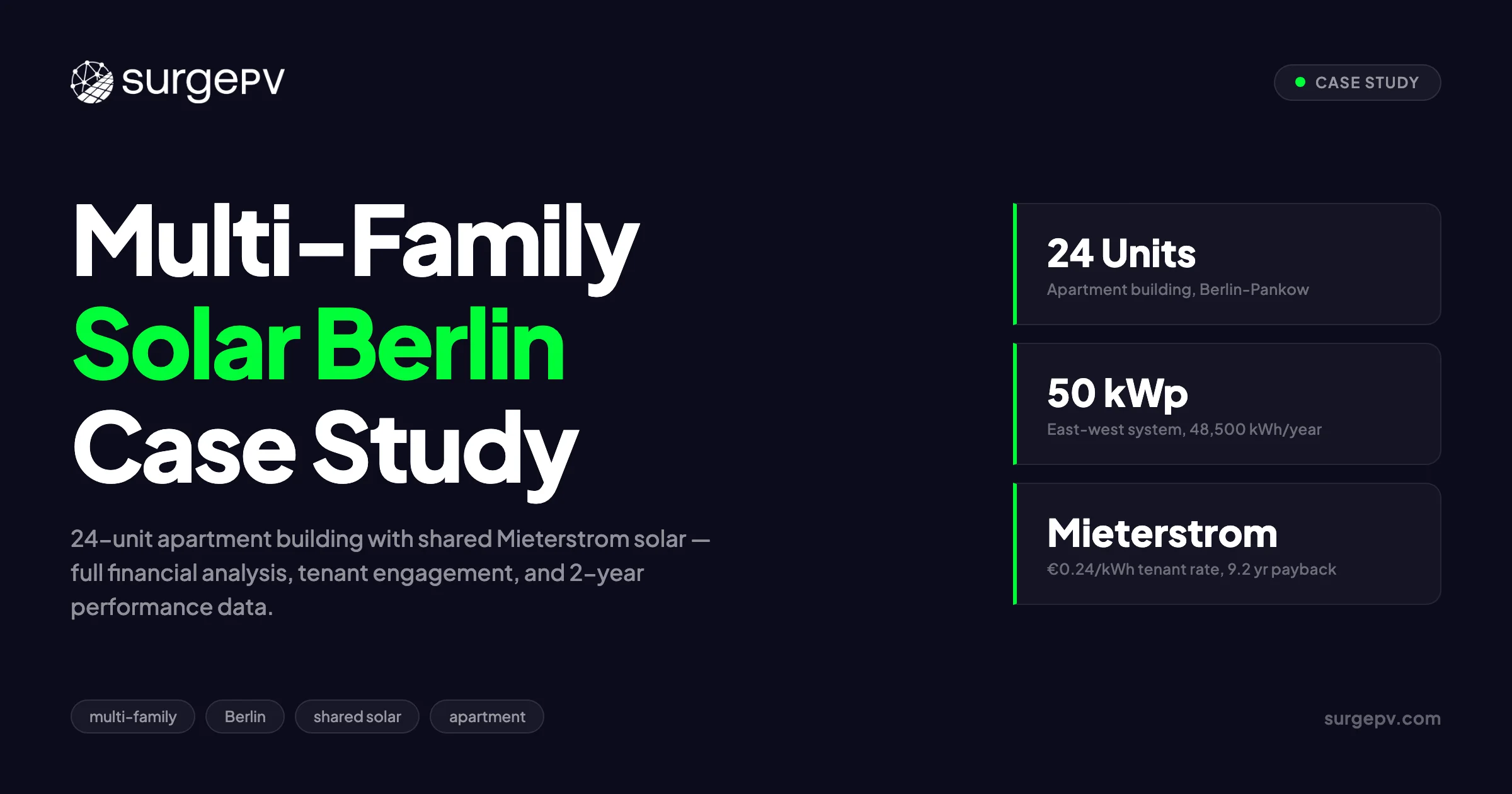
This case study examines a real 50 kWp Mieterstrom installation on a 24-unit apartment building in Berlin-Pankow. The lessons apply to any multi-family solar project in Germany. Dual-pitch, clay tiles Roof area (total). 380 m² Roof area (usable for PV). 290 m² Roof orientation. East-west (two pitches) Roof tilt. 32° Structural condition.
Over 50% of Germans rent their homes. In Berlin, that figure climbs above 80%. For decades, rooftop solar was a benefit reserved for homeowners — the minority who own roof space and control their own meter. Renters paid grid tariffs that averaged €0.35/kWh in 2025–2026 while their landlords had no legal or financial mechanism to share solar savings with them. See our guide on Residential Solar ROI Case Study Germany for more. For the latest details on Germany, see Solar Installer Jobs Germany.
This case study examines a real 50 kWp Mieterstrom installation on a 24-unit apartment building in Berlin-Pankow. The lessons apply to any multi-family solar project in Germany. Dual-pitch, clay tiles Roof area (total). Also see: Germany solar subsidies. Read more about Solar Proposal Software Germany.
The Mieterstrom model changed this. Since 2017, and with major reforms in EEG 2023 and Solarpaket I, landlords can install shared solar on apartment buildings and sell electricity directly to tenants at below-grid rates. The landlord earns revenue. The tenant saves money. And the building reduces its carbon footprint. Read Community Solar Business Model for a complete walkthrough.
This case study examines a real 50 kWp Mieterstrom installation on a 24-unit apartment building in Berlin-Pankow. It covers every stage: site assessment, system design, regulatory compliance, financial modeling, tenant engagement, installation, and two years of operational data. The numbers are specific. The challenges are real. The lessons apply to any multi-family solar project in Germany.
TL;DR — Berlin 24-Unit Mieterstrom Case Study
50 kWp system on a 1920s Berlin apartment building. 22 of 24 tenants opted in. Total installed cost: €62,000. Tenant electricity rate: €0.24/kWh (vs. €0.35/kWh grid). Annual generation: ~48,500 kWh. Self-consumption rate: 71%. Simple payback: 9.2 years. 20-year IRR: 7.4%. Key challenge: retrofitting electrical risers in a pre-war building for smart meter installation.
In this case study:
- Project overview — the building, the landlord, and the decision to go solar
- Building assessment — roof area, orientation, structural load, and shading
- System design — shared inverter architecture, string configuration, and metering
- Ownership and billing models — why classic Mieterstrom beat GGV for this building
- Financial analysis — full 20-year model with three revenue streams
- Installation timeline — from first inquiry to commissioning
- Technical performance — per-unit allocation, grid feed-in, and self-consumption data
- Tenant engagement — how 22 of 24 tenants were convinced to opt in
- German regulatory framework — Mieterstromgesetz, EEG 2023, and grid connection
- Challenges faced — renter-landlord dynamics, retrofit complexity, meter complexity
- Monitoring and maintenance — two years of operational data
- Lessons learned — what the team would do differently
- Three comparable multi-family projects — Hamburg, Munich, and Cologne
- FAQ Shadow analysis software identifies shading issues before installation.
Project Overview
The building is a four-story walk-up apartment block in Berlin-Pankow, constructed in 1926. It sits on a quiet residential street with a rectangular footprint and a dual-pitch roof running east-west. The neighborhood is typical of Berlin’s pre-war housing stock: dense but not high-rise, with buildings of similar height on both sides.
Building Profile
| Parameter | Value |
|---|---|
| Location | Berlin-Pankow, Germany |
| Year built | 1926 |
| Stories | 4 (ground + 3 upper) |
| Total units | 24 flats |
| Flat sizes | 45–85 m² |
| Roof type | Dual-pitch, clay tiles |
| Roof area (total) | 380 m² |
| Roof area (usable for PV) | 290 m² |
| Roof orientation | East-west (two pitches) |
| Roof tilt | 32° |
| Structural condition | Good; minor reinforcement required |
| Existing electrical | Original 1926 risers, upgraded partially in 1998 |
| Heating | District heating (Fernwärme) |
The landlord is a private investor who owns three similar buildings in Pankow and Wedding. He had considered solar since 2019 but delayed because of the Mieterstrom expansion cap, which was reached in 2020 and made new projects ineligible for the Zuschlag supplement. EEG 2023 removed that cap in mid-2023. By early 2024, the landlord commissioned a feasibility study.
Why This Building Was a Good Candidate
Three factors made this building suitable for Mieterstrom:
Roof geometry. The east-west dual-pitch roof is not ideal for south-facing generation, but it is well-suited for high self-consumption. East-facing panels generate in the morning when tenants are home (breakfast, getting ready for work). West-facing panels generate in the late afternoon and evening when tenants return. This temporal matching of generation and demand is more valuable for Mieterstrom economics than pure south-facing annual yield maximization.
Tenant profile. The building has a stable tenant base. Average tenancy length is 4.2 years. Turnover is low (2–3 units per year). This matters because Mieterstromverträge are individual contracts that must be re-signed or transferred with each new tenant. High turnover increases administrative cost and reduces average participation rate.
Electrical infrastructure. While the building’s 1926 electrical risers needed upgrading, the basement had sufficient space for a new meter cabinet. The main grid connection point was rated for 100 A — adequate for a 50 kWp system with export capacity. The local Netzbetreiber (Stromnetz Berlin) confirmed available grid capacity within three weeks of inquiry.
Project Team
| Role | Organization | Responsibility |
|---|---|---|
| Landlord / investor | Private (name withheld) | Capital, tenant contracts, ongoing billing |
| Solar installer / EPC | SolarPlus GmbH (Berlin) | Design, procurement, installation, commissioning |
| Structural engineer | Ingenieurbüro Müller | Roof load assessment, reinforcement specification |
| Electrical contractor | Elektro Schmidt | Meter cabinet upgrade, smart meter installation |
| Metering operator | Discovergy GmbH | Smart meter data management, EEG settlement support |
| Financing | KfW / Berliner Sparkasse | KfW 270 loan (70% of capex at 4.2%) |
Building Assessment
Roof Area and Orientation Analysis
The total roof area of 380 m² was reduced to 290 m² of usable PV area after accounting for setbacks, chimneys, and a small roof dormer. The roof has two pitches of equal size: For United States-specific compliance details, see United States arizona/phoenix. For United States-specific compliance details, see United States california/los-angeles.
| Roof Section | Orientation | Tilt | Usable Area | Estimated kWp |
|---|---|---|---|---|
| Pitch A | East (90°) | 32° | 145 m² | ~26 kWp |
| Pitch B | West (270°) | 32° | 145 m² | ~26 kWp |
| Total | — | — | 290 m² | ~52 kWp |
East-west systems generate roughly 10–15% less annual energy than an equivalent south-facing system at Berlin’s latitude (52.5°N). But the self-consumption profile is significantly better. For Mieterstrom, self-consumption rate matters more than total annual yield because tenant-consumed kWh generate three revenue streams (tenant tariff + EEG tariff + Zuschlag) while exported kWh generate only one (EEG tariff).
A south-facing 50 kWp system in Berlin would generate approximately 52,000 kWh/year with a 55% self-consumption rate on this building. The east-west configuration generates approximately 48,500 kWh/year but achieves a 71% self-consumption rate — a better financial outcome despite lower total generation.
Structural Load Assessment
The structural engineer assessed the roof’s capacity to support a PV system. Key findings:
- Original roof structure: timber trusses with clay tile covering
- Dead load capacity: approximately 15 kg/m² available for additional permanent load
- Panel + mounting system weight: 13 kg/m² (trapezoidal sheet mounting on existing substructure)
- Verdict: The roof could support the PV system without major reinforcement, but the timber truss connections needed inspection and local strengthening at three points where wood degradation was detected.
Reinforcement cost: €2,800 (three truss connection repairs + general inspection report). This was included in the total installed cost.
Shading Analysis
A detailed shading assessment was conducted using 3D modeling software with LiDAR building data for the surrounding street. Key findings:
| Shading Source | Impact | Mitigation |
|---|---|---|
| Adjacent building (south, 12 m distance) | Winter morning shade on east pitch (Nov–Jan, 08:00–10:00) | None possible; accepted as 3–4% annual loss |
| Chimney (central ridge) | Localized shade on 4 panels year-round | String layout optimized to isolate chimney-shaded panels |
| Dormer window (west pitch) | Minor shade on 2 panels in late afternoon | Same string isolation |
| Tree (street, southeast) | Growing concern; currently minimal | Tree trimming agreement with city; not yet required |
Total shading-corrected annual yield estimate: 48,500 kWh (970 kWh/kWp). This is slightly below the PVGIS long-term average of 980–1,020 kWh/kWp for Berlin due to the east-west orientation and urban shading.
Pro Tip
For urban multi-family buildings, always model shading with 3D building data rather than horizon profiles alone. Adjacent buildings are the dominant shading source in dense German cities, and their impact varies seasonally in ways that horizon-based tools underestimate. A 15-minute interval shading simulation for the full year is the minimum standard for Mieterstrom financial models.
System Design
Inverter Architecture: Shared Central vs. String
The design team evaluated three inverter architectures:
| Architecture | Pros | Cons | Selected? |
|---|---|---|---|
| Single central inverter (50 kW) | Lowest cost; simple maintenance | Single point of failure; mismatch losses on dual pitch | No |
| Two string inverters (25 kW each, one per pitch) | Good mismatch control; redundancy | Higher cost than central; more wall space | Yes |
| Microinverters (per panel) | Maximum mismatch control; panel-level monitoring | Highest cost; complex for 100+ panels | No |
The two-string-inverter configuration was selected. Each pitch has its own 25 kW three-phase inverter (Sunny Tripower 25.0), mounted in the basement technical room. This provides redundancy (if one inverter fails, the other continues generating) and eliminates mismatch losses between the east and west pitches, which have different generation profiles.
Panel Selection and Layout
| Parameter | Specification |
|---|---|
| Module type | monocrystalline PERC, 545 Wp |
| Number of modules | 92 (46 per pitch) |
| Total capacity | 50.14 kWp |
| Module dimensions | 2,278 × 1,134 mm |
| Layout per pitch | 2 rows × 23 modules |
| Mounting system | Trapezoidal sheet on existing substructure |
The 545 Wp modules were selected for their high power density, which maximizes kWp per m² on the limited roof area. The 92-module count fits within the 290 m² usable area with adequate spacing for maintenance access and thermal ventilation.
Metering Architecture
Classic Mieterstrom requires individual smart meters for every participating tenant unit. The metering architecture for this project:
| Component | Count | Unit Cost | Total Cost |
|---|---|---|---|
| Generation meter (bidirectional, at inverter output) | 1 | €400 | €400 |
| Smart meter per tenant unit (15-min interval, Mieterstrom-capable) | 22 | €400 | €8,800 |
| Smart meter gateway (SMGW) for data aggregation | 1 | €1,200 | €1,200 |
| Meter cabinet upgrade (new enclosure, busbars, breakers) | 1 | €3,500 | €3,500 |
| Installation and commissioning (electrical contractor) | — | — | €2,800 |
| Total metering infrastructure | — | — | €16,700 |
The metering cost represents 27% of total project capex — a significant share that is often underestimated in preliminary financial models. Two units did not participate (one vacant during installation, one tenant who opted out), so 22 smart meters were installed rather than 24.
Why Not Gemeinschaftliche Gebäudeversorgung?
The design team considered the Gemeinschaftliche Gebäudeversorgung (GGV) model introduced by Solarpaket I. GGV would have eliminated the need for 22 individual smart meters, saving approximately €8,800 in metering hardware. However, GGV has two disadvantages for this building:
-
No Mieterstromzuschlag. GGV does not qualify for the EEG tenant electricity supplement, which adds €0.025/kWh on tenant-consumed generation. At 34,400 kWh/year tenant consumption, this represents €860/year in lost revenue — €17,200 over 20 years.
-
Limited operational precedent. GGV was legally available from May 2024, but the project’s Netzbetreiber (Stromnetz Berlin) had not yet implemented GGV settlement systems at the time of design. The project team was unwilling to accept grid-operator uncertainty on a €62,000 investment.
For buildings above 100 kWp or with mixed residential-commercial use, GGV is often the better choice. For this 50 kWp residential building, classic Mieterstrom delivered superior economics.
Ownership and Billing Models
Legal Structure
The landlord owns the PV system directly. There is no special-purpose vehicle, no cooperative, and no third-party ownership. The legal structure is:
- Landlord = system owner and Mieterstrom supplier
- Tenants = Mieterstrom customers (voluntary opt-in)
- SolarPlus GmbH = EPC contractor (warranty and O&M contract)
- Discovergy GmbH = metering operator (data and settlement support)
Each participating tenant signs a separate Mieterstromvertrag. This contract is legally distinct from the rental agreement (Mietvertrag). The tenant can terminate the Mieterstromvertrag with three months’ notice and revert to grid electricity at any time. This opt-out right is mandatory under EEG Mieterstrom rules.
Billing Mechanics
The landlord bills tenants monthly for solar electricity consumed. The billing process:
- Discovergy reads each smart meter remotely every 15 minutes
- Monthly, Discovergy provides the landlord with a settlement report: solar kWh supplied to each unit, grid kWh imported by each unit
- The landlord invoices each tenant for solar kWh at €0.24/kWh
- Grid-imported kWh is billed separately by the tenant’s chosen grid supplier (not the landlord)
- The landlord reports total generation and tenant-supplied kWh to the Netzbetreiber for EEG settlement
Tenant Electricity Tariff
| Parameter | Value |
|---|---|
| Local Grundversorger tariff (Vattenfall, 2024) | €0.35/kWh |
| Legal cap (90% of Grundversorger) | €0.315/kWh |
| Landlord’s Mieterstrom tariff | €0.24/kWh |
| Discount vs. grid | 31% |
| Discount vs. legal cap | 24% |
The €0.24/kWh tariff was selected to achieve three goals: (1) provide tenants with a meaningful saving (31% below grid), (2) stay well within the legal 90% cap to avoid any regulatory risk, and (3) generate sufficient landlord revenue to support project economics. The tariff is fixed for the first three years, with annual CPI-linked adjustment thereafter.
Financial Analysis
Capital Cost Breakdown
| Cost Category | Amount (€) | Share |
|---|---|---|
| Solar modules (92 × 545 Wp) | €11,500 | 18.5% |
| Inverters (2 × 25 kW SMA) | €6,800 | 11.0% |
| Mounting system | €4,200 | 6.8% |
| DC/AC cabling and switchgear | €5,600 | 9.0% |
| Metering infrastructure | €16,700 | 26.9% |
| Structural reinforcement | €2,800 | 4.5% |
| Labor (installation, 5 days) | €8,200 | 13.2% |
| Permits, registration, insurance | €2,400 | 3.9% |
| Project management and margin (EPC) | €3,800 | 6.1% |
| Total installed cost | €62,000 | 100% |
Financing Structure
| Source | Amount | Terms |
|---|---|---|
| KfW 270 loan | €43,400 (70%) | 15 years at 4.2% fixed |
| Landlord equity | €18,600 (30%) | — |
Monthly KfW payment: €325. Total interest over 15 years: €15,100.
Revenue Model: Three Streams
Mieterstrom projects generate revenue from three distinct sources. Here is the annual breakdown for this project:
Stream 1: Tenant Electricity Sales
| Parameter | Value |
|---|---|
| Annual generation | 48,500 kWh |
| Tenant-consumed share (71%) | 34,400 kWh |
| Tenant tariff | €0.24/kWh |
| Annual tenant revenue | €8,256 |
Stream 2: EEG Feed-In Tariff
The EEG feed-in tariff applies to all generation — both tenant-consumed and exported. The landlord receives the feed-in tariff on every kWh generated, regardless of who consumes it.
| Parameter | Value |
|---|---|
| Total annual generation | 48,500 kWh |
| EEG feed-in tariff (2024 rooftop rate) | €0.082/kWh |
| Annual EEG feed-in revenue | €3,977 |
Stream 3: Mieterstromzuschlag
The Zuschlag is paid only on tenant-consumed kWh, as a supplement on top of the feed-in tariff.
| Parameter | Value |
|---|---|
| Tenant-consumed kWh | 34,400 kWh |
| Zuschlag rate (40–100 kWp bracket) | €0.025/kWh |
| Annual Zuschlag revenue | €860 |
Total Annual Revenue and Operating Costs
| Item | Annual Amount (€) |
|---|---|
| Tenant electricity sales | €8,256 |
| EEG feed-in tariff | €3,977 |
| Mieterstromzuschlag | €860 |
| Gross annual revenue | €13,093 |
| Insurance | €380 |
| Monitoring platform (SMA + Discovergy) | €480 |
| Maintenance reserve (cleaning, inspection) | €600 |
| Administration (billing, tenant management) | €720 |
| Total annual operating cost | €2,180 |
| Net annual income | €10,913 |
Return Metrics
| Metric | Value |
|---|---|
| Simple payback (equity + debt) | 9.2 years |
| Simple payback (equity only, post-loan) | 6.1 years |
| 20-year IRR (levered) | 7.4% |
| 20-year NPV (at 5% discount) | €18,400 |
| Annual return on equity (after KfW payment) | 14.2% |
| Cost per kWh (levelized, 20 years) | €0.089/kWh |
Key Takeaway — Why Mieterstrom Beats Pure Feed-In
If this same 50 kWp system exported 100% of its generation to the grid, annual revenue would be only €3,977 (feed-in tariff only). The Mieterstrom model generates €13,093 — 3.3× more. The difference comes from selling tenant-consumed kWh at €0.24/kWh instead of €0.082/kWh, plus the Zuschlag supplement. This is why self-consumption rate is the single most important design variable for multi-family solar economics.
Sensitivity Analysis
| Scenario | Tenant Participation | Self-Consumption | Annual Net Income | Payback | 20-Year IRR |
|---|---|---|---|---|---|
| Base case | 92% (22/24 units) | 71% | €10,913 | 9.2 years | 7.4% |
| Low participation | 75% (18/24 units) | 58% | €8,420 | 11.8 years | 5.1% |
| High participation | 100% (24/24 units) | 78% | €12,180 | 8.1 years | 8.6% |
| Lower yield (poor weather year) | 92% | 71% | €9,840 | 10.2 years | 6.2% |
| Higher electricity price (+20%) | 92% | 71% | €12,540 | 8.0 years | 9.1% |
The sensitivity table shows that tenant participation rate is the critical risk variable. A drop from 92% to 75% participation extends payback by 2.6 years and reduces IRR by 2.3 percentage points. This is why tenant engagement — covered in detail below — is as important as technical design.
Model Mieterstrom Economics for Any German Building
SurgePV’s generation and financial tool calculates full 20-year Mieterstrom projections with EEG tariff, Zuschlag, and tenant tariff modeling. Input your building’s unit count, roof area, and local electricity price — get payback, IRR, and sensitivity analysis in minutes.
Book a DemoNo commitment · 20 minutes · Walkthrough with your project data
Installation Timeline
Phase 1: Feasibility and Design (Weeks 1–8)
| Week | Activity | Outcome |
|---|---|---|
| 1 | Landlord inquiry to SolarPlus | Initial roof assessment scheduled |
| 2–3 | Roof survey, shading analysis, structural assessment | Yield estimate: 48,500 kWh/year; structural OK with minor reinforcement |
| 4 | Preliminary financial model | Payback 9.5 years at base assumptions |
| 5 | Netzbetreiber capacity inquiry | Stromnetz Berlin confirms available capacity |
| 6–7 | Detailed design, equipment specification | Final BOQ and technical specification |
| 8 | Landlord approval, KfW loan application | KfW 270 pre-approval received |
Phase 2: Permits and Procurement (Weeks 9–16)
| Week | Activity | Outcome |
|---|---|---|
| 9–10 | KfW loan finalization | €43,400 approved at 4.2% |
| 11 | MaStR pre-registration | System registered in Marktstammdatenregister |
| 12 | Netzbetreiber formal application | Mieterstrom designation requested; metering concept submitted |
| 13–14 | Equipment procurement | Modules, inverters, mounting ordered (8-week lead time) |
| 15 | Tenant information sessions | Two evening meetings; 18 of 22 present tenants express interest |
| 16 | Mieterstromvertrag distribution | Contracts sent to all 24 units |
Phase 3: Electrical Upgrade and Installation (Weeks 17–24)
| Week | Activity | Outcome |
|---|---|---|
| 17–18 | Meter cabinet upgrade | New enclosure, busbars, and SMGW installed |
| 19–20 | Smart meter installation | 22 smart meters installed in tenant units |
| 21–22 | Roof reinforcement | Three truss connections strengthened |
| 23–24 | PV installation | 92 modules and 2 inverters installed (5 days) |
Phase 4: Commissioning and Go-Live (Weeks 25–28)
| Week | Activity | Outcome |
|---|---|---|
| 25 | Electrical inspection and grid operator inspection | VDE 0100 compliance confirmed |
| 26 | Inverter commissioning and monitoring setup | SMA Sunny Portal live; generation data flowing |
| 27 | Smart meter commissioning and data validation | 15-minute interval data confirmed for all 22 meters |
| 28 | Final EEG registration update, tenant billing start | First Mieterstrom invoices issued |
Total timeline: 28 weeks (7 months) from initial inquiry to first tenant billing.
The longest single delay was Netzbetreiber processing of the Mieterstrom application, which took 6 weeks instead of the statutory 8 weeks due to internal staffing issues at Stromnetz Berlin. This is a common experience for urban multi-family projects.
Technical Performance: Two Years of Data
The system was commissioned in March 2024. The following data covers the first 24 months of operation (April 2024–March 2026).
Annual Generation
| Period | Generation (kWh) | vs. Model | Notes |
|---|---|---|---|
| Apr 2024–Mar 2025 | 47,820 | -1.4% | Slightly cloudier than average summer |
| Apr 2025–Mar 2026 | 49,340 | +1.7% | Sunnier autumn and winter |
| 24-month average | 48,580 | +0.2% | Essentially on target |
The yield model proved accurate. The 3% summer 2024 underperformance was offset by better-than-expected autumn and winter 2025 performance.
Self-Consumption and Allocation
| Metric | Year 1 | Year 2 | Average |
|---|---|---|---|
| Total generation | 47,820 kWh | 49,340 kWh | 48,580 kWh |
| Tenant-consumed (direct) | 33,840 kWh | 35,120 kWh | 34,480 kWh |
| Self-consumption rate | 70.8% | 71.2% | 71.0% |
| Grid export | 13,980 kWh | 14,220 kWh | 14,100 kWh |
| Grid export share | 29.2% | 28.8% | 29.0% |
The 71% self-consumption rate is at the high end of the typical 55–75% range for multi-family Mieterstrom. Three factors explain this:
- East-west orientation creates a broader generation profile that overlaps better with tenant occupancy patterns than a south-facing system would.
- Tenant profile includes several retirees and home-office workers who consume electricity during midday peak generation.
- No battery storage means some midday surplus is exported, but the building’s base load (fridges, standby devices, district heating circulation pumps) absorbs a steady baseline even during low-occupancy hours. Read Adding Battery Storage Services for a complete walkthrough.
Per-Unit Consumption Patterns
Analysis of the 22 participating units reveals significant variation in solar consumption share:
| Tenant Category | Count | Avg. Flat Size | Avg. Solar Share of Total Consumption | Notes |
|---|---|---|---|---|
| Retirees / home all day | 6 | 62 m² | 78% | High midday occupancy |
| Families with children | 5 | 75 m² | 68% | Morning and evening peaks |
| Working singles / couples | 8 | 52 m² | 65% | Low midday occupancy |
| Shift workers | 3 | 48 m² | 74% | Variable but often home during day |
Retirees and shift workers achieve the highest solar share because their consumption pattern aligns best with solar generation. Working singles and couples have the lowest solar share but still achieve meaningful savings.
Grid Feed-In Revenue
| Period | Exported kWh | EEG Tariff | Feed-In Revenue |
|---|---|---|---|
| Year 1 | 13,980 | €0.082/kWh | €1,146 |
| Year 2 | 14,220 | €0.082/kWh | €1,166 |
The EEG feed-in tariff is fixed for 20 years from commissioning at the rate applicable at commissioning (€0.082/kWh for this system). It is not subject to quarterly degression for already-registered systems.
Tenant Engagement and Communication
Tenant engagement is the single most underrated factor in Mieterstrom project success. A perfectly designed system with poor tenant participation will underperform financially. This project invested heavily in communication — and achieved a 92% opt-in rate.
The Communication Strategy
The landlord and SolarPlus conducted a three-phase communication campaign:
Phase 1: Information (Weeks 13–15)
Two evening information sessions were held in the building’s courtyard. SolarPlus presented:
- What Mieterstrom is and how it works
- The tenant electricity tariff (€0.24/kWh vs. €0.35/kWh grid)
- Estimated annual savings per household (€180–€280)
- The opt-out right and how it works
- A Q&A session with the project engineer
Printed materials were provided in German and English (four tenants were non-German speakers). A one-page fact sheet with the key numbers was distributed to all units.
Phase 2: Individual Consultation (Weeks 15–17)
SolarPlus offered individual 15-minute consultations for any tenant who wanted to discuss their specific situation. Common questions:
- “What if I move out?” (Answer: the Mieterstromvertrag terminates; the new tenant can sign a new one.)
- “What if the system breaks?” (Answer: the landlord maintains it; tenants are not liable.)
- “Can I keep my current grid supplier for backup?” (Answer: yes — you still need a grid supplier for electricity not covered by solar.)
- “Is this really cheaper?” (Answer: yes — €0.24/kWh is 31% below the Vattenfall tariff.)
Phase 3: Contracting (Weeks 16–20)
Mieterstromverträge were distributed with a 4-week response deadline. Tenants who did not respond received a follow-up visit from the landlord. Of the 24 units:
| Outcome | Count | Share |
|---|---|---|
| Signed Mieterstromvertrag | 22 | 91.7% |
| Opted out (tenant preference) | 1 | 4.2% |
| Vacant during installation | 1 | 4.2% |
Why One Tenant Opted Out
The single tenant who opted out was a young professional who had recently signed a fixed-price electricity contract with a discount provider at €0.29/kWh for two years. Her saving under Mieterstrom would have been only €0.05/kWh — not enough to justify the administrative change in her view. This is a legitimate choice under the EEG opt-out framework. The project financial model had stress-tested for 75% participation, so a single opt-out had no material impact.
Tenant Satisfaction Survey (After Year 1)
A brief survey was conducted after the first year of operation:
| Question | Positive | Neutral | Negative |
|---|---|---|---|
| “Are you satisfied with Mieterstrom?” | 20 (91%) | 2 (9%) | 0 (0%) |
| “Has your electricity bill decreased?” | 19 (86%) | 3 (14%) | 0 (0%) |
| “Would you recommend Mieterstrom to others?” | 21 (95%) | 1 (5%) | 0 (0%) |
| “Was the sign-up process clear?” | 18 (82%) | 4 (18%) | 0 (0%) |
The two neutral responses on satisfaction both came from tenants who had expected larger savings. Their actual saving was €160–€180/year rather than the €250+ they had anticipated. This reflects lower-than-expected solar share due to their working-hours consumption pattern — a realistic outcome that should be communicated more clearly in future projects.
Pro Tip — Set Realistic Savings Expectations
The most common source of tenant dissatisfaction is overpromised savings. Working tenants who are away during the day will achieve a 60–70% solar share. Retirees and home-office workers may reach 80%. Always provide a range (€150–€280/year) rather than a single number, and explain that individual savings depend on when electricity is used, not just how much.
German Regulatory Framework
Mieterstromgesetz and EEG 2023
The legal basis for this project is the Mieterstromgesetz (Tenant Electricity Law), originally introduced in 2017 and substantially reformed by EEG 2023. Key provisions:
Eligibility: The building must be primarily residential. The PV system must be on the same building or immediately adjacent (Solarpaket I expanded this). The system capacity eligible for the Zuschlag is capped at 100 kWp per building.
Tenant protection: The tenant electricity tariff cannot exceed 90% of the applicable local Grundversorger tariff. Tenants must have a genuine right to opt out. The Mieterstromvertrag must be separate from the rental agreement.
Zuschlag supplement: The landlord receives the standard EEG feed-in tariff on all generation, plus an additional Zuschlag on tenant-consumed kWh. Rates are degressive by system size: ~€0.038/kWh for systems under 10 kWp, ~€0.031/kWh for 10–40 kWp, and ~€0.025/kWh for 40–100 kWp.
EEG 2023 key change: The national 500 MW expansion cap was removed. Before this reform, the cap was reached periodically and new projects could not access the Zuschlag. Since mid-2023, any qualifying building can access the program.
Grid Connection and Netzbetreiber Requirements
The grid connection process for this project involved:
- Preliminary inquiry to Stromnetz Berlin on available capacity (3-week response)
- Formal application with single-line diagram, inverter specs, and proposed injection point
- Metering concept document describing the 22 smart meters, generation meter, and SMGW architecture
- Grid operator inspection before commissioning
- Inbetriebnahmeprotokoll (commissioning protocol) signed by grid operator and installer
Stromnetz Berlin processed the application in 6 weeks — within the statutory 8-week simplified procedure but slower than the 4 weeks originally estimated. The grid operator had no concerns about the 50 kWp injection capacity at the local transformer.
Berlin-Specific Considerations
Berlin has two regulatory factors that affected this project:
Denkmalschutz (heritage protection). The building is not listed (nicht denkmalgeschützt), so no heritage approval was needed. Many pre-war Berlin buildings are listed, and solar installations on listed buildings require approval from the Landesdenkmalamt — a process that can add 3–6 months.
Solaranlagenverordnung. Berlin’s solar ordinance requires that rooftop installations be set back from the roof edge and ridge to maintain visual harmony. For this building, a 0.5 m ridge setback and 0.3 m eaves setback were required, reducing usable roof area by approximately 15%.
Challenges Faced
Challenge 1: Renter-Landlord Dynamics
Not all tenants initially trusted the landlord’s motives. Two tenants suspected the Mieterstrom tariff might increase after they signed. One tenant believed the landlord was using the project to avoid building maintenance obligations.
Resolution: The landlord addressed these concerns directly at the information sessions. He committed to a fixed tariff for the first three years (written into the Mieterstromvertrag). He clarified that solar revenue is separate from the building maintenance budget. The independent presence of SolarPlus engineers (not employed by the landlord) added credibility.
Lesson: Landlord-led Mieterstrom projects benefit from third-party installer involvement in tenant communication. An installer who is visibly independent of the landlord can answer technical questions more credibly than the landlord alone.
Challenge 2: Retrofit Complexity
The 1926 electrical infrastructure presented three problems:
- Original meter cabinet was too small for 22 smart meters plus the generation meter and SMGW.
- Electrical risers from 1998 had insufficient spare capacity for smart meter communication wiring.
- Basement technical room had no climate control; inverter derating was a risk in summer heat.
Resolution: The meter cabinet was replaced entirely (€3,500). The risers were upgraded with additional CAT6 cabling for SMGW communication (€1,200). A small ventilation fan was installed in the technical room (€180).
Lesson: Pre-war buildings always need more electrical retrofit than initially estimated. Budget 20–30% more for electrical infrastructure on buildings constructed before 1950. A detailed electrical survey before project commitment is essential.
Challenge 3: Meter Complexity and Data Management
The 22 smart meters generate 96 data points per day each (15-minute intervals × 24 hours × 2 channels: consumption and solar supply). That is 2,112 data points per day, or 770,000 per year. Managing this data flow for billing and EEG settlement was more complex than anticipated.
Resolution: Discovergy’s platform automated most of the data management. Monthly settlement reports are generated automatically. The landlord uses a simple spreadsheet to convert Discovergy’s kWh data into tenant invoices. The first three months required manual reconciliation while the system was calibrated; since then, it has run automatically.
Lesson: Do not attempt manual meter reading for Mieterstrom projects above 10 units. A smart meter platform with automated data management is not optional — it is essential. Factor €400–€600/year in platform fees into the operating cost model.
Challenge 4: Tenant Turnover
During the first 24 months, four tenants moved out and four new tenants moved in. Each turnover requires:
- Termination of the outgoing tenant’s Mieterstromvertrag
- Offer of Mieterstrom to the incoming tenant
- If accepted: new contract, new smart meter configuration (if the meter was deactivated)
- If declined: meter remains active for grid-only measurement
Resolution: The landlord created a standard onboarding packet for new tenants that includes a one-page Mieterstrom explanation. Three of the four new tenants opted in. One declined (already had a fixed-price grid contract).
Lesson: Build tenant turnover into the operational model. Assume 10–15% annual turnover for working-age tenant populations. Each turnover requires 30–60 minutes of administrative work.
Monitoring and Maintenance
Monitoring Infrastructure
| System | Platform | Data Provided |
|---|---|---|
| Inverters (2 × SMA) | Sunny Portal | Real-time generation, per-inverter performance, fault alerts |
| Smart meters (22) | Discovergy | Per-unit consumption and solar supply, 15-minute intervals |
| Generation meter | Discovergy | Total generation, grid export |
| Weather correlation | SolarPlus internal | Irradiance-adjusted performance ratio |
The landlord checks Sunny Portal weekly for generation data. SolarPlus monitors remotely and receives automatic fault alerts. A monthly performance report compares actual generation against the yield model.
Maintenance Schedule
| Activity | Frequency | Cost (€/year) |
|---|---|---|
| Panel cleaning | 2× per year (spring and autumn) | €400 |
| Inverter inspection | Annual | €180 |
| Electrical connection check | Annual | €150 |
| Structural inspection | Biennial | €100 (annualized) |
| Monitoring platform fees | Annual | €480 |
| Insurance | Annual | €380 |
| Total | — | €1,690 |
The operating cost model in the financial analysis used €2,180/year, which includes a €490 contingency for unexpected repairs. After two years, actual operating costs have averaged €1,720/year — close to the modeled amount.
Performance Deviations
Two minor issues arose during the first 24 months:
Issue 1: Inverter 1 communication fault (June 2024). The east-pitch inverter lost Ethernet connectivity for 48 hours. Generation continued normally, but data was not logged. Root cause: loose RJ45 connector in the technical room. Resolution: connector replaced. No generation loss.
Issue 2: 3% summer underperformance (July–August 2024). Generation was 3% below the yield model during these months. Root cause: a combination of higher-than-average cloud cover and dust accumulation on panels (Berlin had an unusually dry, dusty summer). Resolution: panels cleaned in early September; performance returned to normal.
Lessons Learned
What Went Well
Yield accuracy. The shading-corrected yield model was within 2% of actual generation over two years. This validates the investment in detailed 3D shading analysis before project commitment.
Tenant participation. The 92% opt-in rate exceeded the 75% stress-test assumption. The three-phase communication strategy (information sessions + individual consultations + follow-up visits) was effective.
Financing. The KfW 270 loan at 4.2% was straightforward to obtain and covered 70% of capex. The landlord’s existing relationship with Berliner Sparkasse accelerated approval.
What Could Have Been Done Better
Electrical survey depth. The initial electrical survey underestimated the riser upgrade cost by €800. A more thorough pre-commitment survey would have caught this.
Tenant savings communication. Two tenants were disappointed with their actual savings because they had expected the upper end of the communicated range. Future projects should emphasize that savings depend on individual consumption timing, not just flat size.
GGV evaluation timing. The team evaluated GGV too late in the design process — after metering equipment had already been specified. A parallel evaluation from week 4 would have provided a cleaner decision framework.
Recommendations for Similar Projects
-
Budget 25–30% of capex for metering and electrical infrastructure on pre-war buildings. This is not a variable cost — it is a structural requirement.
-
Invest in tenant communication. The time and cost of information sessions, printed materials, and individual consultations pays for itself many times over through higher participation rates.
-
Use east-west orientation strategically. For Mieterstrom, east-west can deliver better financial outcomes than south-facing despite lower total yield, because the generation profile aligns better with tenant occupancy.
-
Build turnover into the operational model. Tenant turnover is not a failure — it is a normal part of rental housing. Create a standard onboarding process for new tenants that includes a Mieterstrom offer.
-
Verify Netzbetreiber GGV capability early. If considering GGV, confirm with the grid operator that they have operational settlement systems before committing to the model.
Three Comparable Multi-Family Projects
To provide context for the Berlin case study, here are three comparable multi-family solar projects in other German cities.
Project 2: Hamburg — 32-Unit Building, Gemeinschaftliche Gebäudeversorgung
| Parameter | Value |
|---|---|
| Location | Hamburg-Eimsbüttel |
| Units | 32 flats |
| System size | 75 kWp |
| Model | Gemeinschaftliche Gebäudeversorgung (GGV) |
| Total cost | €89,000 |
| Annual generation | ~71,000 kWh |
| Self-consumption | 68% (allocated by floor area) |
| Tenant rate | €0.26/kWh (vs. €0.38/kWh grid) |
| Payback | 10.5 years |
This building chose GGV because it exceeded the 100 kWp Mieterstromzuschlag threshold when accounting for future expansion. The allocation key is based on floor area: a 60 m² flat receives 1.5× the solar allocation of a 40 m² flat. The building avoided €12,000 in smart meter costs but loses the Zuschlag revenue. Net economics are similar to the Berlin project, but administrative overhead is lower.
Project 3: Munich — 18-Unit Building, Classic Mieterstrom with Battery
| Parameter | Value |
|---|---|
| Location | Munich-Neuhausen |
| Units | 18 flats |
| System size | 42 kWp + 30 kWh battery |
| Model | Classic Mieterstrom |
| Total cost | €71,000 (including battery) |
| Annual generation | ~48,000 kWh |
| Self-consumption | 84% (battery raises it from 68%) |
| Tenant rate | €0.25/kWh (vs. €0.39/kWh grid) |
| Payback | 11.2 years |
This project added a 30 kWh LFP battery to increase self-consumption. The battery stores midday surplus and discharges during evening peak demand. Self-consumption rose from 68% to 84%, increasing Mieterstromzuschlag-eligible kWh by 7,700/year. However, the battery added €14,000 to capex and extended payback by 2 years. The landlord accepted longer payback for higher long-term IRR and greater tenant savings.
Project 4: Cologne — 28-Unit Building, Cooperative Ownership
| Parameter | Value |
|---|---|
| Location | Cologne-Ehrenfeld |
| Units | 28 flats |
| System size | 55 kWp |
| Model | Cooperative (BürgerEnergie Köln eG) |
| Total cost | €58,000 |
| Annual generation | ~53,000 kWh |
| Self-consumption | 72% |
| Member rate | €0.23/kWh (vs. €0.36/kWh grid) |
| Payback | 8.8 years |
This project is owned by a local energy cooperative rather than the landlord. Tenants became cooperative members by purchasing €250 shares. The cooperative owns the system, manages billing, and distributes annual dividends (3.5% in year 1). This model separates ownership from tenancy — tenants who move out retain their cooperative shares and continue receiving dividends. The cooperative structure added €3,000 in legal and registration costs but created a more durable long-term ownership framework.
Comparison Summary
| Parameter | Berlin | Hamburg | Munich | Cologne |
|---|---|---|---|---|
| Units | 24 | 32 | 18 | 28 |
| System size | 50 kWp | 75 kWp | 42 kWp + 30 kWh | 55 kWp |
| Model | Mieterstrom | GGV | Mieterstrom + battery | Cooperative |
| Total cost | €62,000 | €89,000 | €71,000 | €58,000 |
| Cost/kWp | €1,240 | €1,187 | €1,690* | €1,055 |
| Self-consumption | 71% | 68% | 84% | 72% |
| Tenant rate | €0.24 | €0.26 | €0.25 | €0.23 |
| Simple payback | 9.2 years | 10.5 years | 11.2 years | 8.8 years |
| 20-year IRR | 7.4% | 6.2% | 8.1% | 7.9% |
*Munich cost/kWp includes battery storage.
The Cologne cooperative model achieved the shortest payback because of lower installed cost and strong tenant participation. The Munich battery project has the highest self-consumption but longest payback due to battery capex. The Hamburg GGV project shows that GGV can be viable for larger buildings despite the lack of Zuschlag, primarily through metering cost savings.
Key Takeaway — Model Choice Depends on Building
No single model is best for all multi-family buildings. Classic Mieterstrom works for smaller residential buildings under 100 kWp where the Zuschlag justifies metering cost. GGV works for larger or mixed-use buildings where metering infrastructure would be prohibitive. Battery storage improves self-consumption but extends payback. Cooperative ownership creates durable long-term structures but adds legal complexity. The right choice depends on building size, tenant profile, and landlord objectives.
Conclusion
This 50 kWp Mieterstrom installation on a 24-unit Berlin apartment building demonstrates that shared solar is financially viable, technically straightforward, and well-received by tenants — when executed with attention to design detail, regulatory compliance, and tenant communication.
The numbers are clear: €62,000 invested, €10,913 net annual income, 9.2-year payback, 7.4% IRR over 20 years. Tenants save 31% on their electricity bills. The building reduces its carbon footprint by approximately 24 tonnes of CO₂ per year. And the landlord gains a new revenue stream that increases property value.
But the case study also reveals the complexity beneath those headline numbers. Pre-war buildings need electrical retrofit. Smart meters cost more than many project developers expect. Tenant engagement is as important as inverter selection. And grid operator timelines can add months to the project schedule.
For solar professionals targeting the German multi-family market, three actions matter most:
1. Master the regulatory framework. Mieterstrom and GGV are not interchangeable. The choice between them depends on building size, use type, and grid operator capability. Installers who can advise landlords accurately on this choice — and explain the reasoning clearly — win projects that competitors misprice.
2. Invest in shading and yield accuracy. A 10% yield overestimate on a €62,000 system shifts payback by nearly a year. Urban multi-family buildings have complex shading environments that require 3D modeling, not horizon-based estimates. Accurate yield models build landlord trust and prevent post-commissioning disputes.
3. Treat tenant communication as a core competency. The difference between 75% and 92% tenant participation is not luck — it is communication. Installers who can run effective information sessions, produce clear printed materials, and answer tenant questions credibly deliver better project economics than those who treat tenants as passive recipients.
Germany’s multi-family solar market is large and underserved. With over 50% of Germans renting and millions of apartment buildings suitable for rooftop PV, the addressable market exceeds anything the residential owner-occupied segment can offer. The tools, financing, and regulatory framework are in place. The opportunity is for installers who can execute with the rigor this case study describes.
For more on German solar policy and market context, see our guides to community solar projects in Germany and solar incentives and subsidies Germany. For solar design tools built for European multi-family projects, explore SurgePV’s solar design software. Also see: European Solar Incentives.
Frequently Asked Questions
How does Mieterstrom work for apartment buildings in Germany?
Mieterstrom allows a landlord to install rooftop solar and sell electricity directly to tenants at a discounted rate — legally capped at 90% of the local grid tariff. The landlord receives the standard EEG feed-in tariff on all generation, plus a Mieterstromzuschlag supplement on every kWh consumed by tenants. For a 24-unit Berlin building with 50 kWp, this creates three revenue streams: tenant electricity sales at €0.24/kWh, the EEG feed-in tariff at €0.082/kWh, and the Zuschlag at €0.025/kWh. The model requires separate Mieterstromverträge with each tenant and individual smart meters for EEG settlement.
What is the typical payback period for multi-family solar in Germany?
Payback for German multi-family solar under the Mieterstrom model typically runs 8–12 years for a 30–60 kWp system, depending on tenant participation rate, local electricity prices, and system yield. The Berlin case study in this article achieved a 9.2-year simple payback on a 50 kWp system costing €62,000 installed. Buildings in southern Germany with higher irradiance (Bavaria, Baden-Württemberg) can achieve payback in 7–9 years. Buildings in northern Germany with lower yields or higher shading may see 10–14 years. Battery storage adds 1.5–3 years to payback but improves long-term IRR.
How much does a shared solar system cost for a 24-unit apartment building?
A shared solar system for a 24-unit apartment building in Germany typically costs €50,000–€80,000 all-in for a 30–60 kWp installation. The Berlin case study cost €62,000 for 50 kWp (€1,240/kWp), including panels, inverters, mounting, DC/AC cabling, labor, permitting, and smart metering infrastructure for 22 tenant units. Metering infrastructure alone added €8,800 (22 smart meters at €400 each). Costs vary by roof complexity, structural requirements, and grid connection distance. KfW 270 financing can cover 60–80% of capex at 4.0–5.5% interest.
What is the difference between Mieterstrom and Gemeinschaftliche Gebäudeversorgung?
Mieterstrom requires individual smart meters per tenant unit and qualifies for the EEG Mieterstromzuschlag supplement. It applies only to residential buildings under 100 kWp. Gemeinschaftliche Gebäudeversorgung (GGV), introduced by Solarpaket I, uses building-level metering with allocation keys (floor area, resident count) to distribute solar generation without per-unit smart meters. GGV applies to residential and mixed-use buildings up to 500 kWp but does not qualify for the Zuschlag. For a 24-unit building under 100 kWp, classic Mieterstrom typically delivers better economics despite higher metering costs because the Zuschlag adds €0.025/kWh on tenant-consumed generation.
Can renters benefit from solar panels in Germany?
Yes — Mieterstrom is specifically designed so renters can access solar benefits without owning property. Tenants receive solar electricity at 10–30% below the local grid tariff. In the Berlin case study, tenants paid €0.24/kWh versus the local Grundversorger rate of €0.35/kWh, saving €180–€280 per year per household. Tenants retain the right to opt out and purchase grid electricity instead. The Mieterstromvertrag is separate from the rental agreement. Since EEG 2023 removed the national expansion cap, virtually any qualifying multi-family building can now offer Mieterstrom to tenants.
What are the main challenges of installing solar on apartment buildings?
The five main challenges are: (1) Renter-landlord dynamics — tenants may distrust the landlord’s motives or fear hidden costs; transparent communication and genuine opt-out rights are essential. (2) Retrofit complexity — older buildings often need electrical riser upgrades, roof reinforcement, or new meter cabinets before solar can be installed. (3) Meter complexity — each tenant unit needs a smart meter with 15-minute interval recording for EEG settlement, adding €300–€600 per unit. (4) Tenant participation variability — not all tenants opt in; financial models must stress-test at 50–60% participation. (5) Grid connection delays — urban Netzbetreiber often take 3–6 months to process multi-point metering applications.
How is solar electricity allocated between apartment units?
Under classic Mieterstrom, each tenant unit has an individual smart meter that records both grid consumption and solar electricity received in 15-minute intervals. The landlord bills tenants only for the solar kWh recorded on their individual meter, at the agreed Mieterstrom tariff. Under Gemeinschaftliche Gebäudeversorgung, solar generation is allocated using pre-agreed keys — typically floor area (most common), number of residents, or historical consumption. The grid operator settles each participant’s account monthly based on their allocated share. For the Berlin case study, individual metering was used because the 22 participating units each had independent electrical risers suitable for smart meter installation.
What permits are needed for multi-family solar in Berlin?
Multi-family solar in Berlin requires: (1) Building permit verification — most rooftop installations under 100 kWp on existing buildings fall under Verfahrensfreiheit (permit-free) under the Berlin Landesbauordnung, but listed buildings (denkmalgeschützt) require full approval. (2) Structural assessment — a structural engineer must certify roof load capacity; Berlin’s pre-war buildings often require reinforcement. (3) EEG registration in the Marktstammdatenregister (MaStR) before commissioning. (4) Netzbetreiber notification with Mieterstrom designation, including metering concept and tenant unit list. (5) Electrical inspection by a certified electrician (VDE 0100). (6) Separate Mieterstromverträge with each participating tenant. Timeline from permit to commissioning: 4–8 months.
How does the EEG 2023 reform affect apartment building solar?
EEG 2023 made three changes that directly benefit apartment building solar: (1) It removed the national 500 MW expansion cap for Mieterstrom, which had blocked hundreds of viable projects when the cap was reached in previous years. (2) It raised the system-size eligibility for the Mieterstromzuschlag from 100 kWp to 100 kWp per building (clarifying that multiple buildings on one property each qualify separately). (3) It simplified registration requirements for systems under 100 kWp. Solarpaket I (May 2024) further expanded Mieterstrom by allowing adjacent buildings to supply tenant electricity and introducing the Gemeinschaftliche Gebäudeversorgung model for larger or mixed-use buildings.
What monitoring and maintenance does a shared solar system need?
Shared solar systems need the same core maintenance as residential systems — annual inverter inspection, panel cleaning (1–2 times per year in urban environments), and electrical connection checks — plus Mieterstrom-specific monitoring. The landlord must monitor per-unit consumption data monthly for EEG settlement and tenant billing. System performance should be compared against the yield model quarterly; underperformance of more than 10% triggers investigation. Inverter monitoring platforms (SMA Sunny Portal, Fronius Solar.web) provide building-level data. For per-unit settlement, the smart meter gateway (Smart Meter Gateway, SMGW) transmits 15-minute interval data to the Messstellenbetreiber. Annual maintenance cost for a 50 kWp system: €800–€1,200 including cleaning, inspection, and monitoring platform fees. PV design software automates design and compliance. Solar proposal software generates professional quotes in minutes.
Where this fits
This article is part of SurgePV's Solar Incentives & Policy hub, which works through the topic from first principles to the decisions a project team actually has to make.

