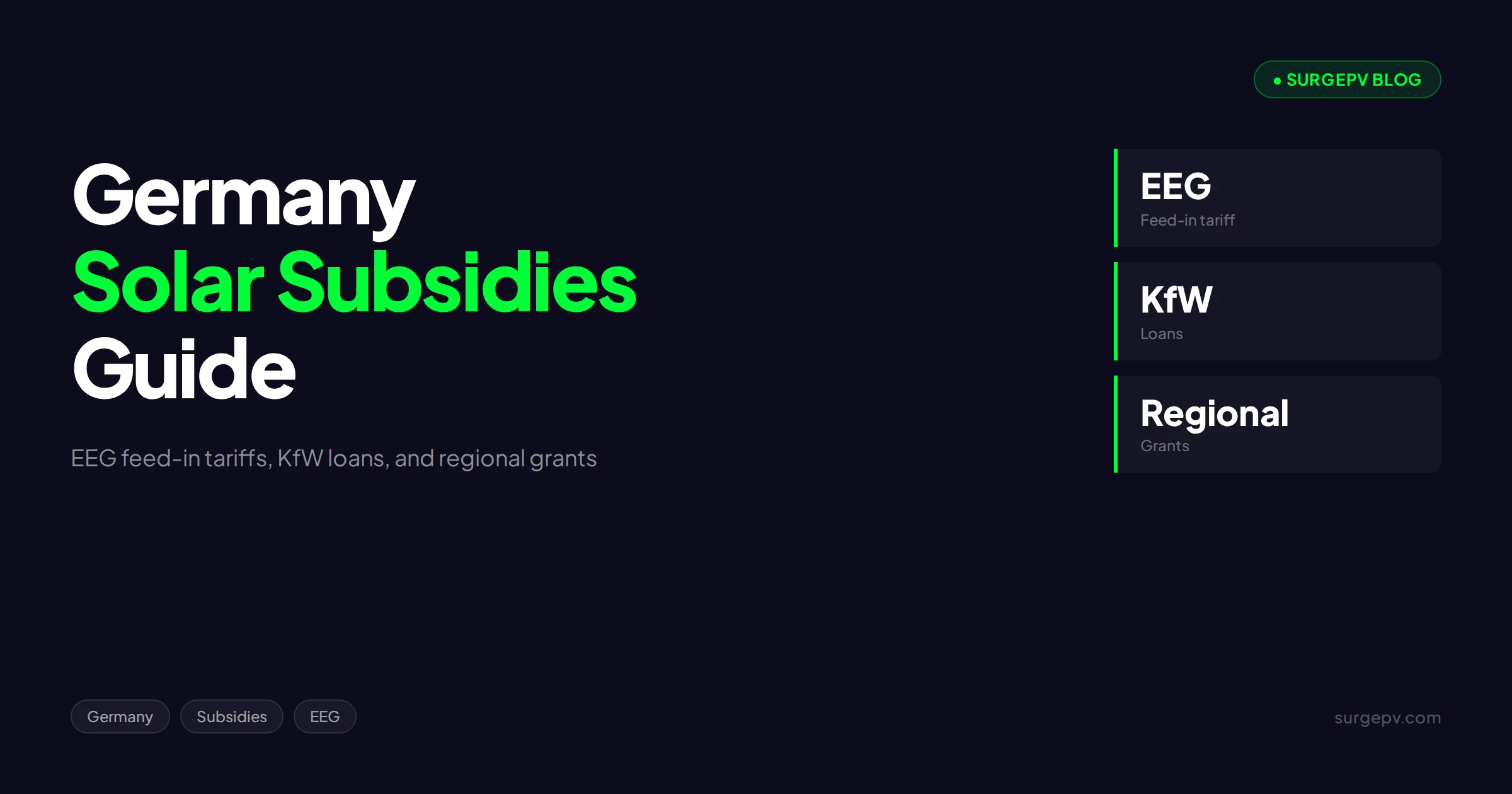
Germany passed 100 GW of installed solar capacity in 2025, and the national target stands at 215 GW by 2030. The era of generous feed-in payments is over, but the subsidy question is not. In 2026, the money flows through different channels: the EEG feed-in tariff, KfW loans, regional grants, and tax treatment.
We structure solar project financing for a living, and we still see the same 2 mistakes. Homeowners assume the subsidies ended years ago, and installers assume their clients already know the rules. Both assumptions cost real money, because the remaining programs still shift project economics by double-digit percentages.
This guide covers germany solar subsidies 2026 from end to end: current EEG rates, KfW loan programs, state-level grants, commercial incentives, and the registration sequence. We also flag the tradeoffs, because not every subsidy is worth the paperwork.
Quick Answer — Germany Solar Subsidies 2026
Solar subsidies in Germany in 2026 rest on 4 instruments: the EEG feed-in tariff at roughly 7–12 ct/kWh depending on system size, fixed for 20 years from commissioning; low-interest KfW 270 loans for renewable energy; regional grants that vary by Bundesland; and tax benefits for commercial systems. The residential VAT exemption ended in 2023, and systems over 100 kW must sell through direct marketing.
TL;DR — Germany Solar Subsidies 2026
Germany targets 215 GW of solar by 2030 (BMWK), so support continues at lower rates. A small rooftop earns about 8 ct/kWh on exported power while grid electricity costs 30+ ct/kWh. The real 2026 subsidy is that gap: every self-consumed kWh is worth roughly 4 times an exported one.
In this guide:
- What changed in German solar policy for 2026
- EEG feed-in tariff rates, degression, and the 20-year lock
- KfW 270 and other loan programs, with terms and timing rules
- Regional and state-level grants by Bundesland
- Commercial incentives: tax allowances, auctions, and KfW financing
- The registration and application sequence, step by step
- Direct marketing versus the feed-in tariff, and when each wins
- ROI math for 2026, plus the application mistakes that kill returns
Latest Updates: Germany Solar Policy 2026
German solar policy moves on schedules, not headlines. Here is where each major instrument stands in 2026.
EEG rates continue their scheduled decline. The feed-in tariff steps down on a regular degression schedule, roughly 0.5–1% per adjustment. The rate a system locks in depends on its commissioning date, and that rate then holds for 20 years.
The residential VAT exemption ended in 2023. Homeowners should budget standard VAT on hardware and installation unless their tax advisor confirms a specific exception. This change raised upfront residential costs and pushed more weight onto financing structure.
The 100 kW direct marketing threshold stays in force. New systems above 100 kW cannot take the classic feed-in tariff. They must sell power on the market and receive a market premium instead.
Regional programs remain patchwork. Bundesländer and municipalities fund storage bonuses, wallbox support, and tenant-electricity add-ons, but budgets are capped and windows open seasonally. There is no single national grant portal that covers everything.
Program Status Table — 2026
| Instrument | Status in 2026 | Key Condition |
|---|---|---|
| EEG feed-in tariff | Active (statutory) | Regular degression steps; 20-year lock |
| KfW 270 loan | Active | Apply before signing the construction contract |
| Residential VAT exemption | Ended (2023) | Standard VAT applies to most purchases |
| Direct marketing | Mandatory over 100 kW | Aggregator contract required |
| Regional grants | Varies by state | Capped budgets, seasonal windows |
Two context points matter for timing. First, Germany needs to roughly double installed capacity between 2025 and 2030 to hit 215 GW, so the political commitment to solar is not in question. Second, the financial commitment is shifting from operating subsidies (per-kWh payments) toward capital-side support (loans, tax treatment, grants).
The build pace behind the 215 GW target explains why support continues. Germany added over 16 GW of new capacity in 2024 and needs a similar run rate every year through 2030. When deployment lags the corridor, the political response has been administrative relief like simpler permits, not new per-kWh money.
Solarpaket I, the 2024 solar package, also keeps working in the background. Plug-in balcony systems up to 800 W of inverter output now register through a simplified process, and tenant-electricity rules no longer force building owners into full supplier licenses. Neither change pays a subsidy directly, but both widen the customer base installers can serve.
What has not changed is the legal backbone: the EEG remains statutory law, so tariff entitlements cannot be cancelled retroactively. Systems commissioned under a given rate keep that rate for their full support period. That stability is why German solar debt remains some of the cheapest project debt in Europe.
If you want the program-by-program detail from earlier cycles, our Germany solar subsidies guide covers grant stacking and battery bonuses in depth. For business projects, commercial solar incentives in Germany walks through KfW 270, tax allowances, and auctions. This guide is the 2026 structural update: what remains, what changed, and how to sequence it.
One more trend deserves attention. Wholesale power prices turned negative for a record number of hours in 2024 and 2025 as solar penetration climbed, and EEG rules pause payments during sustained negative price periods. That dynamic shapes the direct marketing question later in this guide.
The EEG Feed-in Tariff: How It Works in 2026
The Renewable Energy Sources Act (EEG) has paid German solar owners for exported electricity since 2000. A feed-in tariff is a state-set price per kWh, paid by the grid operator, fixed for 20 years from the commissioning date. Our glossary entry on feed-in tariffs explains the mechanism in general terms.
In 2026, rates sit in the 7–12 ct/kWh band depending on system size and export mode. Small systems earn the most per kWh. Larger systems earn progressively less, and anything above 100 kW leaves the tariff system entirely.
EEG Rates by System Size — 2026
| System Size | Partial Export (with self-consumption) | Full Export |
|---|---|---|
| Up to 10 kWp | ~8 ct/kWh | ~12 ct/kWh |
| 10–40 kWp | ~7 ct/kWh | ~10 ct/kWh |
| 40–100 kWp | ~5.5–6 ct/kWh | — |
| Over 100 kWp | Direct marketing required | Direct marketing required |
Approximate 2026 ranges; the exact rate depends on the commissioning month. Source: Bundesnetzagentur.
Two export modes exist. Partial export (Überschusseinspeisung) pays the tariff only for surplus power after self-consumption. Full export (Volleinspeisung) pays a higher rate for every kWh generated, but you buy your own consumption back from the grid at retail prices.
The higher full-export rate looks attractive until you run the numbers. A household paying 32 ct/kWh for grid power loses far more on each self-consumed kWh than the roughly 4 ct/kWh premium it gains. For homes with meaningful daytime load, partial export almost always wins on 20-year cash flow.
Take a 10 kWp system producing 10,000 kWh per year in a household that consumes 3,500 kWh during solar hours. Under partial export, the owner avoids about €1,120 of grid purchases and earns roughly €520 on the 6,500 exported kWh. Under full export at the 12 ct rate, the same system earns €1,200, but the household buys its 3,500 kWh back for €1,120.
The partial route leaves roughly €1,500 more per year in the household budget on these assumptions. The premium rate never compensates for surrendering the retail-price offset. Run this comparison on the client’s actual load profile before ticking the export-mode box, because the answer flips only for very low-consumption buildings.
Degression and the 20-Year Lock
The tariff you receive is fixed at commissioning and guaranteed for 20 years plus the commissioning year. New systems face a rate that steps down on a regular schedule, roughly 0.5–1% per adjustment, as deployment targets are met.
The BNetzA publishes the applicable rates and adjusts them against a deployment corridor. When installations run ahead of the corridor, degression accelerates; when they lag, it slows. The mechanism is mechanical, which makes future rates reasonably predictable a few quarters out.
The lock matters more than the rate level. A guaranteed 8 ct/kWh for 20 years is a state-backed annuity, and German banks treat it as near-sovereign collateral when underwriting loans. In our financing work, the EEG revenue line is the floor that makes a residential deal bankable, not the upside.
Waiting has a cost, but it is smaller than most people assume. A 2% lower tariff on a 10 kWp system exporting 4,000 kWh per year costs about €130 over the full 20-year term. Module price drops often outweigh degression, so timing a purchase around tariff steps alone rarely makes sense.
Who Pays, and Why It Is Stable
The grid operator pays the tariff and settles through the EEG equalization mechanism. Since mid-2022, the scheme is funded from the federal budget rather than a consumer surcharge on electricity bills.
That funding shift removed the most unpopular part of the EEG and stabilized the program politically. The tariff is statutory, not budget-capped, so it cannot run out of money the way grant programs do. The Bundesnetzagentur (BNetzA) publishes current rates and registers every system.
Small plug-in systems deserve a footnote here.
Balcony solar up to 800 W can opt into the EEG tariff. Most owners skip the paperwork, because feed-in revenue on 800 kWh per year barely covers the effort. For plug-in systems, self-consumption is the entire business case.
The Contrarian View on the Tariff
Here is our honest take after structuring hundreds of these deals. The feed-in tariff is no longer the reason to buy solar in Germany, and treating it as one produces bad system designs.
At 8 ct/kWh, export revenue on a typical home system is €300–€500 per year. That is a safety net, not an investment case. The investment case is avoided retail purchases at 30+ ct/kWh, which means design for load match first and size the array to daytime consumption, not to roof area.
Installers who still sell “what the government pays you” are selling 2015 economics. The 2026 pitch is “what you stop paying your utility,” with the tariff as downside protection. We will quantify this in the ROI section.
KfW Loans and Grants for Solar
KfW (Kreditanstalt für Wiederaufbau) is Germany’s state-owned development bank. It does not hand out solar grants the way it did a decade ago, but it remains the cheapest source of solar debt in the country. For most 2026 projects, KfW is a financing instrument, not a giveaway.
KfW 270: The Core Renewable Energy Loan
The flagship program is KfW 270 (Erneuerbare Energien – Standard). It funds solar PV, battery storage, and other renewable assets for homeowners, businesses, and project developers.
| Feature | KfW 270 Terms |
|---|---|
| Loan amount | Up to 100% of eligible investment costs |
| Maximum per project | Up to €150 million |
| Interest | Below market, set by creditworthiness and term |
| Term | 5–30 years |
| Repayment-free start | 1–3 years available |
| Application route | Through your house bank (Hausbank) |
| Deadline rule | Before signing the construction contract |
The last row is the one that trips people up. KfW 270 is void if you sign the supply or construction contract first. The application must go in before commitment, through your bank, and approval typically takes 2–6 weeks.
The interest advantage is real but modest in 2026. On a €20,000 residential loan over 12 years, a KfW rate roughly 2 percentage points below a commercial bank saves about €2,500–€3,500 in total interest. For commercial projects at €500,000 and up, the saving scales into 5 figures and often decides between competing bids.
The repayment-free start years matter more than the rate for cash-flow-sensitive projects. A commercial system commissioned in March produces revenue from commissioning day, and 1–2 years without principal payments lets the EEG income build a buffer before amortization begins. We structure almost every KfW-backed deal with that buffer in place.
What the Bank Actually Asks For
KfW applications ride on your house bank’s credit process, so expect standard lending documents. Households provide income proof, businesses provide financial statements, and everyone provides the installer quote plus the planned system’s technical data. The bank assesses creditworthiness; KfW refinances the loan and sets the program terms.
Bring the yield and payback simulation with the quote. A bankable document showing 20-year EEG revenue next to the debt service schedule shortens the credit conversation. We have seen that document rescue borderline applications more than once.
What KfW Does Not Do Anymore
Earlier cycles featured direct repayment grants for solar and storage under KfW programs. Those have been restructured, suspended, or exhausted at various points, and budgets have repeatedly run dry mid-year. Treat any grant as a bonus, never as a line your project depends on.
The durable KfW value proposition in 2026 is cheap long-dated debt. That suits the EEG structure well: a 20-year tariff annuity pairs naturally with a 15–20-year loan tenor, and the debt service coverage stays comfortable even when export prices disappoint.
One tradeoff deserves honesty. A KfW loan is still debt, and it sits on your credit file. Households with access to cheap mortgage refinancing should compare effective rates before defaulting to KfW, because the promotional rate is not always the lowest available money.
State Development Banks Stack on Top
Most Bundesländer run their own promotional banks, such as NRW.BANK or LfA Bayern, and several co-finance solar alongside KfW. Terms change annually, and some programs require the state application to precede the KfW one. Your house bank handles KfW paperwork but rarely volunteers state options, so ask explicitly.
Our practical advice: get the KfW term sheet before finalizing system size. The approved amount and tenor often change the optimal design, and resizing after approval means reapplying. Tools like our solar generation and financial tool let you test loan tenor and rate scenarios against yield before you commit.
Regional and State-Level Solar Incentives
Below the federal level, germany solar incentives fragment into 16 state programs plus hundreds of municipal schemes. The pattern is consistent: capped annual budgets, seasonal application windows, and strict sequencing rules.
Typical State Program Types
| Program Type | Typical Value | Common Conditions |
|---|---|---|
| Battery storage bonus | €200–€500 per kWh | Minimum capacity, smart-grid ready |
| Wallbox / EV charger bonus | €300–€1,200 | Paired with PV, controllable charging |
| Tenant-electricity (Mieterstrom) support | Varies | Multi-family buildings |
| Municipal PV grant | €100–€300 per kWp | City residents only, small budgets |
| Commercial energy-efficiency grants | Project-based | Often via state development bank |
Bavaria, Berlin, North Rhine-Westphalia, and Baden-Württemberg run the most active programs, but availability shifts quarter to quarter. In recent cycles, Bavaria has funded storage paired with new PV, Berlin has paid per-kWp bonuses on rooftop systems, and North Rhine-Westphalia has run battery vouchers through its state programs. Exact rates and budgets reset annually, and some states paused programs entirely when funds ran out.
The federal database at Förderdatenbank indexes national, state, and EU programs and is the only reliable single starting point. Verify the current cycle there before quoting any figure to a client.
How to Work the Regional Layer
Three rules keep regional money accessible. Apply in the window, which for most states means Q1, and apply before installation starts, because retroactive applications fail almost everywhere. Finally, confirm the stack: some states prohibit combining their grant with specific federal instruments for the same cost item.
Here is a perspective from the financing side that rarely gets said. Regional grants of €500–€2,000 move project IRR by well under 1 percentage point on a residential system. They are worth collecting, but they should never drive the design.
We have watched homeowners add an oversized battery to qualify for a storage bonus, then lose more on the battery’s weak arbitrage economics than the bonus paid. Design for the load, then collect whatever the state offers for that design. If a bonus happens to align, take it; if it requires distorting the system, skip it.
Municipal Quirks Worth Checking
Some municipal utilities pay small one-off grants or offer interest-free loans for local residents. Others run solar obligations on new buildings that effectively guarantee installer demand. Your grid operator’s website and the city climate office are the fastest sources, and most programs publish short summaries in plain language.
For installers, municipal programs are a sales asset. A proposal that lists the client’s city grant, with the application deadline, reads like found money. Few competitors bother to track 50 municipal schemes, so the one who does wins the comparison.
Tracking is half the job. The Förderdatenbank sends no useful alerts, so installers we work with assign one person to check state portals monthly and keep a shared list of open windows. That 30 minutes per month routinely converts into €1,000 or more of extra value per customer during the spring windows.
Commercial Solar Incentives in Germany
Commercial and industrial projects access a wider incentive set than residential ones. The tradeoff is more complexity: tax structuring, market rules, and auction mechanics replace the simple homeowner checklist.
The Commercial Incentive Stack
| Instrument | What It Provides | Who Qualifies |
|---|---|---|
| EEG feed-in tariff | Fixed export rate, 20 years | Systems up to 100 kW |
| Market premium (Marktprämie) | Premium over market price via direct marketing | Systems over 100 kW |
| Investment allowance (§7g EStG) | Deduct a share of planned investment cost early | Small and mid-size businesses |
| Depreciation options | Straight-line or, when available, declining-balance | All business systems |
| Input VAT recovery | Reclaim VAT on purchase as input tax | VAT-registered businesses |
| KfW 270 | Low-interest long-term debt | All commercial borrowers |
| State grants | Storage, efficiency, tenant-electricity | Varies by Bundesland |
The investment allowance (Investitionsabzugsbetrag) under §7g EStG lets eligible businesses deduct up to 50% of the anticipated investment cost from taxable profit before the purchase. Combined with depreciation on the asset itself, the tax effect can cover a substantial share of capex in the first years. Exact eligibility and percentages depend on business size and current law, so confirm with a Steuerberater before modeling it into a pitch.
VAT treatment is a cash-flow point many first-time commercial buyers miss. A VAT-registered business reclaims the 19% input VAT on the system, which means commercial prices are effectively net of VAT. Residential buyers since 2023 have no equivalent recovery.
Tenant Electricity Adds a Revenue Layer
The Mieterstrom model lets building owners sell solar power directly to tenants, with an EEG surcharge paid on top of the agreed tenant price. Solarpaket I simplified the licensing burden that previously made this impractical for smaller landlords. Tenants typically demand a modest discount to grid prices, but the arrangement still returns several cents per kWh more than plain export.
Multi-family and mixed-use buildings are the natural fit. The economics hinge on metering infrastructure and tenant contracts, so they reward early planning more than any other commercial model.
Auctions for Larger Projects
Ground-mount and large rooftop systems above roughly 1 MW compete in technology-specific tenders run by the BNetzA. Bidders name their required rate, and the cheapest bids win 20-year market premium contracts.
Auction volumes have been consistently oversubscribed, which pushed winning bid values down. For EPCs, that compresses merchant headroom and makes construction cost per kWp the decisive variable. Accurate yield simulation before bidding is not optional at these margins.
There is also a hedging argument that never appears in subsidy tables. A C&I rooftop that covers 30% of a factory’s consumption fixes that slice of electricity cost for 25 years. In a market where industrial power prices swung violently between 2021 and 2024, that price certainty has real balance-sheet value beyond the measured IRR.
Selling Commercial Deals on Subsidy Economics
Commercial clients decide on IRR and payback, not on grant headlines. The winning proposal shows the full stack: export revenue under the applicable route, tax effects, KfW debt terms, and self-consumption savings against the site’s tariff.
That is a documentation problem as much as an engineering one. We see C&I bids lost because the financial model lived in a separate spreadsheet that nobody trusted. Solar proposal software that carries the design data straight into the financial tables removes that credibility gap.
For the deeper program detail, see our guide to commercial solar incentives in Germany.
How to Register and Apply for Subsidies
The German subsidy process rewards sequence discipline. Do things in the wrong order and money is forfeited, usually permanently.
The Sequence, Step by Step
- Grid connection application. Contact your local distribution system operator (DSO) before installation. The DSO confirms the connection point and any capacity constraints.
- Financing applications. Submit KfW 270 through your house bank before signing any construction contract. Submit state grant applications in their windows, also before starting work.
- Install and commission. Your installer completes the system and the DSO sets the meter and export configuration.
- MaStR registration. Register the system in the Marktstammdatenregister (MaStR), the federal core energy market data registry, within the required deadline after commissioning. Registration happens on the MaStR portal, run by the BNetzA.
- EEG documentation. Submit commissioning and registration documents to your grid operator, which then activates tariff payments.
- Direct marketing contract. For systems over 100 kW, sign with an aggregator or direct marketer before commissioning, or revenue pauses.
Keep 5 documents ready through the whole process: the installer quote, the grid connection confirmation, the commissioning protocol, the meter details from the DSO, and the MaStR registration certificate. Every subsidy body asks for some subset of these 5. Mismatched data between them is the top cause of processing delays.
One simplification is worth knowing. Plug-in balcony systems up to 800 W follow a reduced registration path and usually need no DSO pre-approval. Full rooftop systems get no such shortcut, so budget the grid application into your project timeline from the first customer conversation.
Timing Expectations
| Step | Typical Duration | Common Delay |
|---|---|---|
| DSO connection confirmation | 2–8 weeks | Transformer capacity checks |
| KfW approval | 2–6 weeks | Missing quotes or signatures |
| MaStR registration | 1–2 weeks | Data mismatches with DSO records |
| First EEG payment | 1–3 months | Incomplete commissioning documents |
The DSO step comes first for a reason. Grid capacity is not guaranteed, and in some regions the DSO requires transformer upgrades or export limitation before approving a connection. Discovering that constraint after signing a KfW loan creates exactly the kind of sequencing mess this section exists to prevent.
Late MaStR registration is the most expensive paperwork error. Payments only flow once the registration and DSO documentation line up, and delays can permanently reduce the effective support period. Installers who handle registration for clients remove this risk and close deals faster.
What Installers Should Own
Homeowners do not want to learn what MaStR is, and they should not have to. The installer who bundles grid application, registration, and subsidy paperwork into the offer removes the 3 biggest friction points in German residential solar.
That bundling starts at the design stage. A proposal that already shows the applicable tariff rate, the KfW financing case, and the net cost after VAT answers the client’s next 5 questions before they ask. Our solar design software workflow is built around exactly that handoff from design to financeable document.
Direct Marketing vs. Feed-in Tariff: Which to Choose
For systems above 100 kW, the question is settled: direct marketing (Direktvermarktung) is mandatory. For everyone else, it is a genuine choice, and the default answer surprises people.
How Each Route Works
The feed-in tariff pays a fixed rate per exported kWh for 20 years. Direct marketing sells your power on the wholesale exchange, usually through an aggregator, and pays the realized market price. A market premium (Marktprämie) then tops up the difference between the average market price and a technology-specific reference value set by the BNetzA.
The premium calculation works like a contract for difference. If the monthly average market value of solar falls below the reference value, the premium covers the gap; if prices rise above it, you keep the market revenue. The structure caps your downside near tariff level while leaving some upside open.
| Factor | Feed-in Tariff | Direct Marketing |
|---|---|---|
| Revenue predictability | Fixed for 20 years | Floats with market prices |
| Admin burden | Near zero | Aggregator contract, billing, telemetry |
| Fees | None | Aggregator fee per kWh |
| Negative price risk | Payments pause in sustained negative hours | Same exposure |
| Upside in price spikes | None | Partial, via market premium structure |
| Availability | Systems up to 100 kW | Mandatory over 100 kW, optional below |
Our Take: The Tariff Is Underpriced, Not Overpriced
The contrarian position here is that small-system owners overestimate direct marketing. After aggregator fees, telemetry costs, and billing effort, the net uplift for a 20 kW rooftop is close to zero in a normal price year. The tariff’s zero-administration annuity is worth more than its face value suggests.
There is also a structural headwind: solar now floods the German midday market, which depresses exactly the hours when your system exports. Analysts call this price cannibalization, and it worsens each year as capacity grows toward 215 GW. Merchant revenue gets riskier while the fixed tariff stays fixed.
EEG rules cut remuneration during sustained negative wholesale price periods, and those hours are multiplying. Germany logged a record count of negative price hours in 2024 and 2025, almost all clustered around sunny midday peaks. Every new GW of solar makes the next GW’s exports worth less at the margin.
From the financing side, we underwrite merchant exposure at conservative captured-price assumptions, and banks haircut it further. Fixed EEG revenue passes credit committees at face value. That difference alone settles the question for most sub-100 kW projects.
Direct marketing earns its place in 2 situations. Systems forced into it by size, obviously. And sites with flexible loads or storage that can shift exports out of the midday trough into evening price peaks, where the premium structure rewards the flexibility.
If you do choose an aggregator, compare 3 things: the per-kWh fee, the telemetry hardware cost, and the contract length. Fees of a few tenths of a cent per kWh sound trivial until you multiply by 20 years of exports. A 0.2 ct/kWh fee difference on a 500 kW commercial system exporting 300,000 kWh per year adds up to roughly €12,000 over the contract life.
Calculating Solar ROI in Germany in 2026
The 2026 ROI equation is simple. Annual benefit equals self-consumed kWh times your retail tariff, plus exported kWh times the EEG rate, minus operating costs. Germany has no net metering, so the 2 revenue lines are never equal: exported energy is always worth less than avoided purchases.
Worked Example: 10 kWp Bavarian Rooftop
Assume 1,000 kWh per kWp per year, a 32 ct/kWh retail tariff, and an 8 ct/kWh EEG rate. System cost is €15,000 including VAT, and the battery variant adds €7,000 for 10 kWh.
| Scenario | Self-Consumption | Annual Benefit | System Cost | Simple Payback |
|---|---|---|---|---|
| No battery | 30% (3,000 kWh) | €960 saved + €560 export = €1,520 | €15,000 | ~9.9 years |
| With 10 kWh battery | 60% (6,000 kWh) | €1,920 saved + €320 export = €2,240 | €22,000 | ~9.8 years |
| Full export | 0% | 10,000 kWh × 12 ct = €1,200 | €15,000 | ~12.5 years |
Illustrative figures; site yield, tariff, and consumption pattern move results by ±20%.
The table carries an uncomfortable truth for battery sellers. At 2026 hardware prices, the battery variant barely improves payback despite doubling self-consumption, because the added capex eats the arbitrage gain. Batteries in Germany now sell on backup value, price-spike protection, and autonomy preference, not on pure ROI.
The second lesson sits in the full-export row. The 12 ct rate looks generous until you compare it against 32 ct avoided purchases. Export-maximizing designs forfeit the most valuable kWh in the system.
Over 20 years the cumulative picture softens the payback figures. The no-battery case returns roughly €30,000 in lifetime benefit against €15,000 invested, even before electricity price inflation. That is a real return of 3–4% annualized, comparable to a conservative bond portfolio, with the tariff annuity as the stabilizer.
Notice what the model does not need: aggressive electricity price inflation. Even at a flat 32 ct/kWh retail rate, the system clears its cost with margin. Any retail price increase over the next decade is upside, and German retail prices have risen faster than general inflation for most of the past 20 years.
Sensitivity analysis matters more than point estimates. Shift the retail tariff 3 ct, the self-consumption ratio 10 points, or the yield 5%, and payback on the example system swings by 1.5–2.5 years. Show clients the range, not the single number, and label every assumption.
Where ROI Models Go Wrong
The 2 inputs that move payback most are yield and self-consumption ratio, and both are estimation problems. A 5% shading error on a 10 kWp system shifts annual output by 500 kWh and payback by roughly half a year.
This is why we treat design accuracy as a financial control. Good solar shadow analysis software models obstructions on the actual 3D roof and removes the yield guesswork. The generation and financial tool then computes payback, IRR, and NPV from the same model.
We build solar software for exactly this workflow, and our first-hand observation after years of deal flow is consistent. German residential deals in 2026 are won or lost on the self-consumption assumption. Clients have been burned by 70% self-consumption promises on battery-less systems.
Model 25–35% without storage, show the sensitivity, and you win the trust argument along with the deal. The installer with the honest number beats the installer with the optimistic one more often than the market admits.
Common Subsidy Application Mistakes
Most subsidy losses in Germany are self-inflicted. The same errors repeat across thousands of applications every year, and almost all of them are preventable with a checklist.
| Mistake | Consequence | Fix |
|---|---|---|
| Signing the construction contract before KfW approval | KfW 270 void | Apply through your bank first |
| Late MaStR registration | Delayed or lost tariff payments | Register within the deadline after commissioning |
| Choosing full export on a high-load home | Lower lifetime revenue | Compare export modes on real load data |
| Assuming the VAT exemption still applies | Budget shortfall of 19% | Confirm current VAT treatment pre-purchase |
| Missing state grant windows | Grant forfeited for the year | Track windows from Q1 |
| No direct marketing contract for a >100 kW system | Revenue pause after commissioning | Sign aggregator before energization |
| Sizing the array to roof, not load | Weak ROI despite subsidies | Design for self-consumption first |
| Chasing a grant with a distorted design | Grant worth less than the design penalty | Collect grants only on the right design |
The sequencing errors at the top of the table are the painful ones because they are irreversible. A voided KfW application cannot be reinstated after the contract exists. The design errors at the bottom are quieter: they do not disqualify anything, they just compound into worse 20-year economics.
One more mistake deserves its own line: subsidy figures in sales proposals age fast, because EEG rates step down and grant budgets empty. A proposal quoting last quarter’s tariff is a credibility liability. Revalidate every subsidy number within days of sending, or use solar proposal software that keeps the financial tables tied to current inputs.
A final pattern: subsidy knowledge concentrated in 1 person’s head. When that estimator leaves the company, quotes start carrying stale rates and missed windows. Document the programs you quote, with sources and check dates, in the same place as your proposal templates.
Model German Subsidy Scenarios in SurgePV
Design the system, simulate yield with 3D shading, and produce a proposal with payback, IRR, and tariff scenarios in one cloud workspace.
Book a DemoNo commitment required · 20 minutes · Live project walkthrough
Conclusion
Solar subsidies in Germany in 2026 are narrower than their reputation and more durable than the headlines suggest. The EEG feed-in tariff still guarantees 20-year revenue, KfW still lends below market, and the states still write checks for storage and chargers. The framework rewards prepared buyers and disciplined installers, and it punishes paperwork mistakes more than bad hardware choices.
What changed is where the value sits. Export payments at 7–12 ct/kWh are the floor, not the return. The return is avoiding 30+ ct/kWh retail purchases, which puts design quality and honest self-consumption modeling at the center of every deal.
For homeowners, the practical takeaway is sequencing: financing first, installation second, registration immediately after. For installers, the opportunity is advisory. The companies winning German residential work in 2026 are the ones that show the subsidy math clearly, handle the paperwork, and quote numbers that survive contact with the client’s bank.
From the financing seat, our closing advice is consistent across every German deal we review. Treat the EEG tariff as collateral, treat self-consumption as the return, and treat grants as windfalls rather than foundations. Projects built on that order of priorities survive degression, negative price hours, and the next policy cycle without restructuring.
The 3 actions that protect subsidy value in 2026:
- Apply for KfW 270 through your bank before signing any construction contract.
- Register in MaStR immediately after commissioning, and keep DSO documents aligned.
- Design for self-consumption, then collect the grants that fit that design.
For the earlier program detail, see our Germany solar subsidies guide and the commercial deep-dive on germany solar incentives for businesses. When you are ready to turn subsidy math into client-ready numbers, solar design software from SurgePV carries the project from roof model to bankable proposal. The subsidy framework will keep shifting; the design fundamentals will not.
Frequently Asked Questions
The questions below mirror the structured FAQ data for this guide.
What is the EEG feed-in tariff in Germany in 2026?
The EEG feed-in tariff pays solar system owners for excess energy fed to the grid. In 2026, rates range from roughly 7–12 euro cents per kWh depending on system size, but the rate decreases monthly. The tariff is fixed for 20 years from commissioning.
What is KfW and how does it help solar installations?
KfW is Germany’s state-owned development bank. It offers low-interest loans and repayment grants for solar installations, energy efficiency, and battery storage. Programs like KfW 270 provide financing for residential and commercial renewable energy.
Are solar subsidies still available in Germany in 2026?
Yes, but the structure has changed. The EEG feed-in tariff is lower than in previous years, and the VAT exemption for residential solar ended in 2023. KfW loans, regional grants, and tax benefits for commercial systems remain.
How do I apply for solar subsidies in Germany?
Register your system with the Bundesnetzagentur (BNetzA), connect to the grid with your local utility, and submit EEG documentation through your grid operator. For KfW loans, apply through your bank before signing the construction contract.
What is the difference between EEG direct marketing and the feed-in tariff?
The feed-in tariff pays a fixed rate for exported solar energy. Direct marketing requires selling energy on the market, usually through an aggregator, and receiving a market premium. Systems over 100 kW must use direct marketing.
Do commercial solar projects get different incentives in Germany?
Yes. Commercial systems can use EEG feed-in tariffs or direct marketing, claim investment tax allowances under German tax law, and apply for KfW loans. Some states offer additional grants for commercial and industrial projects.
For program-specific detail, see the sections above or the earlier guides linked in the conclusion.