

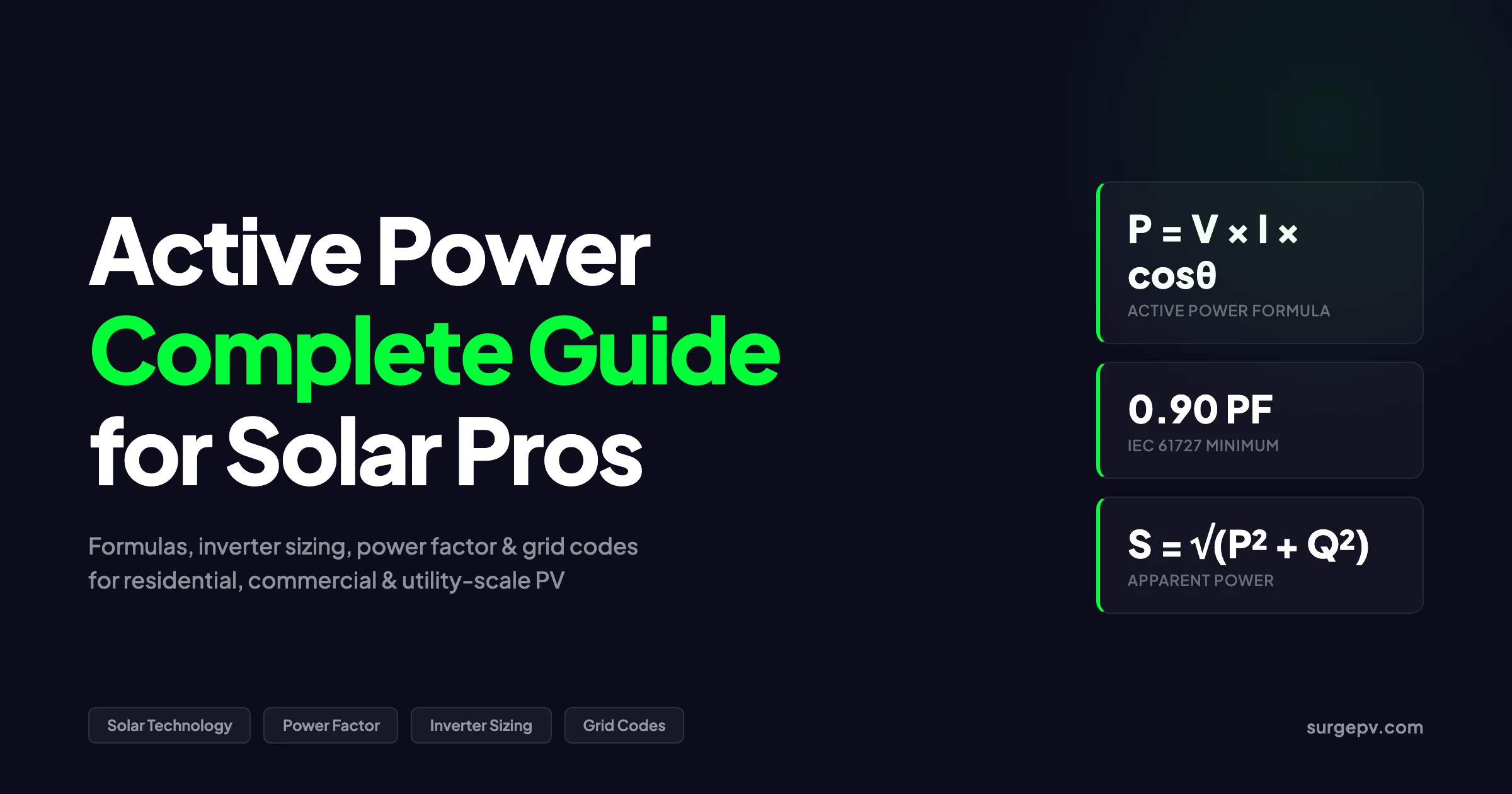
Every solar professional has seen an inverter datasheet. Most look at the kW rating, check the efficiency curve, and move on. That is a mistake. The kW figure is only one-third of the power story. The other two-thirds — reactive power and apparent power — determine whether your inverter trips, your cables overheat, or your client pays utility penalties.
Global solar capacity reached 2.1 TW in 2025. At that scale, grid operators care deeply about power quality. Active power management is no longer a niche concern for utility engineers. It is a standard design requirement for every grid-tied system from 5 kW residential to 500 MW solar farms. Misunderstanding active power costs EPC contractors money in change orders, utility rejection, and oversized equipment.
This guide covers the full technical picture. You will learn the exact difference between active, reactive, and apparent power. You will see worked calculations for single-phase and three-phase systems. You will understand why inverter datasheets list kVA alongside kW, and when the kVA figure matters more. You will get practical sizing rules, grid code requirements, and real case studies from projects that got it wrong — and right.
TL;DR — Active Power in Solar Systems
Active power is the real electrical power that performs useful work in a solar system, measured in watts (W). IEC 61727 requires grid-tied PV inverters to maintain a power factor of at least 0.90 when output exceeds 50% of rated capacity. Modern inverters manage both active and reactive power to comply with grid codes.
In this guide:
- The exact difference between active power, reactive power, and apparent power
- How to calculate active power for single-phase and three-phase solar systems
- Why solar inverters must manage active power curtailment for grid stability
- How power factor drops when PV is added to a site — and how to fix it
- When to size inverter apparent power (kVA) instead of just active power (kW)
- Practical design mistakes that cost EPC contractors money
- How solar design suite helps model active power before installation
What Is Active Power?
Active power is the portion of electrical power that performs useful work. It is the power that turns a motor, heats a resistor, or lights a LED. In solar systems, it is the real AC output from the inverter that runs loads, feeds the grid, or charges batteries.
The physics are straightforward. Electrical power is the product of voltage and current. But voltage and current can be out of phase. When they are perfectly in phase, every ampere of current does work. When they are out of phase, some current flows without doing work. The component that does work is active power.
Single-Phase Formula
For a single-phase AC circuit, active power is calculated as:
P = V_rms × I_rms × cosθ
Where:
- P = active power in watts (W)
- V_rms = root-mean-square voltage in volts (V)
- I_rms = root-mean-square current in amperes (A)
- cosθ = power factor (dimensionless, 0 to 1)
The power factor, cosθ, represents the phase angle between voltage and current waveforms. A power factor of 1.0 means voltage and current are perfectly in phase. A power factor of 0.8 means 20% of the current is out of phase and does not contribute to useful work.
Three-Phase Formula
Solar systems above 15 kW are typically three-phase. The formula for active power in a balanced three-phase system is:
P = √3 × V_L × I_L × cosθ
Where:
- P = active power in watts (W)
- √3 ≈ 1.732 (the square root of 3)
- V_L = line-to-line voltage in volts (V)
- I_L = line current in amperes (A)
- cosθ = power factor
This formula assumes a balanced load where all three phases carry equal current. Most commercial and utility-scale solar inverters produce balanced three-phase output, so this assumption holds in practice.
Units and Scale
Active power uses a hierarchy of units that solar professionals work with daily:
| Unit | Symbol | Scale | Typical Application |
|---|---|---|---|
| Watt | W | 1 | Small DC loads, panel output |
| Kilowatt | kW | 1,000 W | Residential inverters, single-phase systems |
| Megawatt | MW | 1,000,000 W | Commercial solar farms, utility substations |
| Gigawatt | GW | 1,000,000,000 W | National capacity statistics |
A 10 kW residential system producing 8.5 kW at noon is delivering 8,500 watts of active power. That is the real power available to run the home’s appliances or export to the grid. The inverter might be rated at 10 kW AC active power, but its actual output varies with irradiance, temperature, and system losses.
Active Power in Solar System Design
In solar design, active power is the figure that matters for energy yield calculations. A 100 kW DC array with a 1.2 DC/AC ratio and 97% inverter efficiency might deliver 77 kW of active AC power at standard test conditions. That 77 kW figure — not the 100 kW DC nameplate — is what you use when sizing the grid connection, estimating revenue, or modeling payback.
Solar PV design software models active power output hour by hour. It factors in irradiance, temperature derating, soiling, shading, and inverter efficiency curves to produce an accurate annual active energy yield in kWh. That yield number is what feeds into financial models and utility interconnection applications. Guessing it from DC nameplate capacity alone introduces errors of 15–25%.
Active Power vs Reactive Power vs Apparent Power
The three types of electrical power form a mathematical relationship known as the power triangle. Understanding this triangle is essential for every solar professional who sizes inverters, specifies cables, or negotiates with utilities.
The Power Triangle
The fundamental relationship is:
S = √(P² + Q²)
Where:
- S = apparent power in volt-amperes (VA)
- P = active power in watts (W)
- Q = reactive power in volt-amperes reactive (VAR)
This is a right triangle. Active power and reactive power are the two legs. Apparent power is the hypotenuse. You cannot add P and Q directly — they are orthogonal quantities. Apparent power is always equal to or greater than active power.
Active Power (P)
Active power is the real work. It is the power that performs mechanical motion, generates heat, or produces light. In a solar system, it is the power the inverter delivers to the grid or local loads. It is measured in watts (W) or kilowatts (kW).
Active power is what utilities bill for in kWh. It is what your revenue meter counts. It is what the grid operator dispatches. Every financial model in solar is built on active energy (kWh) production.
Reactive Power (Q)
Reactive power does no useful work. It oscillates between the source and the load, establishing magnetic fields in motors and transformers. It is measured in volt-amperes reactive (VAR) or kilovolt-amperes reactive (kVAR).
Reactive power is not “wasted” power in the sense of being lost. It is necessary for the operation of inductive loads like motors, transformers, and fluorescent ballasts. But it does require current to flow, and that current causes resistive losses (I²R heating) in cables and transformers. Utilities must size their infrastructure to carry both active and reactive current, so they care about reactive power even though they do not bill for it directly.
Apparent Power (S)
Apparent power is the total power capacity required to deliver a given amount of active power. It is the vector sum of active and reactive power. It is measured in volt-amperes (VA) or kilovolt-amperes (kVA).
Apparent power is what determines the physical size of cables, transformers, and inverters. A system delivering 100 kW of active power with a 0.90 power factor requires 111 kVA of apparent power capacity. The extra 11 kVA is not doing work, but it is occupying cable ampacity and transformer capacity. That is why utilities and equipment manufacturers specify in kVA, not just kW.
Power Factor
Power factor is the ratio of active power to apparent power:
PF = P / S = cosθ
Power factor ranges from 0 to 1. A power factor of 1.0 means all apparent power is active power — no reactive component. A power factor of 0.80 means 80% of the apparent power does real work, and 20% is reactive.
Solar inverters typically operate at or near unity power factor (1.0) by default. But modern grid-tied inverters can be programmed to operate at leading or lagging power factors to support grid voltage. This capability is increasingly required by grid codes.
Comparison Table
| Property | Active Power (P) | Reactive Power (Q) | Apparent Power (S) |
|---|---|---|---|
| What it does | Performs useful work | Supports magnetic fields | Total capacity required |
| Unit | W, kW, MW | VAR, kVAR, MVAR | VA, kVA, MVA |
| Measured by | Wattmeter | VAR meter | Volt-ammeter |
| Utility bills for | Yes (kWh) | No (usually) | No (capacity charges sometimes) |
| Solar inverter relevance | Output rating | Grid support capability | Physical sizing limit |
| Typical solar value | 0.8–1.0 of S | Near zero (unity PF) | 1.0–1.2 of P |
The Beer Analogy
A common teaching analogy helps visualize the relationship. Imagine a glass of beer:
- The drinkable beer is active power — the part you actually consume
- The foam is reactive power — present, necessary for the structure, but not what you drink
- The full glass is apparent power — the total capacity needed to hold both
A full glass with mostly foam gives you little drinkable beer. A full glass with no foam is all drinkable beer. In electrical terms, a system with low power factor delivers little active power for its apparent power capacity. Utilities and equipment designers prefer “full glasses” with minimal foam — high power factor systems.
Common Mistakes Reading Inverter Datasheets
Installers make three common errors when interpreting inverter specifications:
1. Confusing kW with kVA. The kW rating is active power output. The kVA rating is apparent power capacity. A 100 kW inverter rated at 110 kVA can deliver 100 kW at 0.91 PF, but only 90 kW at 0.82 PF. If your site has a poor power factor, the kW output must drop to stay within the kVA limit.
2. Ignoring power factor range. Many inverters specify a power factor range of 0.8 leading to 0.8 lagging. This means the inverter can operate at PF = 0.8, but at that power factor, the active power output is only 80% of the apparent power rating. A 100 kVA inverter at 0.8 PF delivers only 80 kW of active power.
3. Forgetting that cables and transformers see kVA. You size conductors and switchgear based on current, and current is determined by apparent power (S = V × I), not active power. A 100 kW load at 0.80 PF draws 25% more current than a 100 kW load at 1.0 PF. Size cables for the current, not the kW.
For a deeper technical definition, see our glossary entry on active and reactive power.
Active Power Calculation for Solar Systems
Accurate active power calculation is the foundation of proper inverter sizing, cable specification, and grid interconnection design. Here are worked examples for the two configurations solar professionals encounter most often.
Single-Phase Example
A residential solar system in Europe operates at 230 V single-phase. The inverter output current is 15 A, and the power factor is 0.95.
P = V × I × cosθ
P = 230 V × 15 A × 0.95
P = 3,277.5 W ≈ 3.28 kW
This is the active power delivered to the home or grid. The apparent power is:
S = V × I = 230 V × 15 A = 3,450 VA = 3.45 kVA
The reactive power is:
Q = √(S² - P²) = √(3.45² - 3.28²) = √(11.90 - 10.76) = √1.14 ≈ 1.07 kVAR
The power factor of 0.95 means 95% of the apparent power is active power. The remaining 5% is reactive power. For a residential system with modern electronics, this is a good power factor. Older homes with induction motors or fluorescent lighting might have site power factors of 0.80–0.85 before solar is added.
Three-Phase Example
A commercial solar system operates at 400 V line-to-line three-phase. The line current is 25 A per phase, and the power factor is 0.90.
P = √3 × V_L × I_L × cosθ
P = 1.732 × 400 V × 25 A × 0.90
P = 1.732 × 400 × 25 × 0.90
P = 1.732 × 9,000
P = 15,588 W ≈ 15.6 kW
The apparent power is:
S = √3 × V_L × I_L = 1.732 × 400 V × 25 A = 17,320 VA = 17.3 kVA
The reactive power is:
Q = √(S² - P²) = √(17.3² - 15.6²) = √(299.3 - 243.4) = √55.9 ≈ 7.5 kVAR
At 0.90 power factor, 90% of the apparent power is active power. The 10% reactive component is typical for commercial sites with motor loads, HVAC equipment, and transformers.
Quick-Reference Formula Table
| System Type | Formula | Variables |
|---|---|---|
| Single-phase | P = V × I × cosθ | V = phase voltage, I = phase current |
| Three-phase (balanced) | P = √3 × V_L × I_L × cosθ | V_L = line voltage, I_L = line current |
| Three-phase (per phase) | P = 3 × V_ph × I_ph × cosθ | V_ph = phase voltage, I_ph = phase current |
| From apparent power | P = S × cosθ | S = apparent power (VA) |
| From reactive power | P = √(S² - Q²) | Q = reactive power (VAR) |
Conductor Sizing: Why Apparent Power Matters
A critical error in solar design is sizing conductors based on active power (kW) rather than apparent power (kVA). The current in a conductor is determined by apparent power, not active power.
I = S / (√3 × V_L) for three-phase systems
For the three-phase example above (17.3 kVA at 400 V):
I = 17,300 VA / (1.732 × 400 V) = 17,300 / 692.8 = 25 A
If you sized the cable for 15.6 kW (active power only), you might calculate:
I = 15,600 W / (1.732 × 400 V) = 15,600 / 692.8 = 22.5 A
Using 22.5 A instead of 25 A for cable sizing means selecting a smaller conductor. At 25 A actual current, that undersized cable will run hotter than designed, accelerating insulation degradation and potentially violating electrical code.
5 Calculation Errors That Lead to Undersized Cables
-
Using kW instead of kVA for current calculation. Always divide apparent power by voltage to get current. Active power divided by voltage gives a lower, incorrect current figure.
-
Ignoring power factor in load calculations. If the site has a 0.85 power factor, a 100 kW load draws 147 A at 400 V three-phase, not 125 A. That 22 A difference is the difference between a 35 mm² and a 50 mm² cable.
-
Selecting inverter at minimum PF requirement, not actual site PF. IEC 61727 requires 0.90 PF. But if the site PF is 0.85, the inverter must be sized for 0.85, not 0.90. Using 0.90 for sizing when the site needs 0.85 means the inverter will be undersized.
-
Forgetting that power factor correction capacitors need switching. Fixed capacitor banks over-correct at light load, causing leading power factor. Leading PF is as problematic as lagging PF. Use switched or variable capacitor banks for sites with variable load.
-
Neglecting harmonic currents. Inverters with poor output filters generate harmonic currents that add to the fundamental current. THD (total harmonic distortion) of 5% increases RMS current by approximately 0.125%. Over long cable runs, this extra heating matters.
Solar design software automates these calculations. It models actual voltage drop, power factor, and harmonic content for the specific inverter and cable selections in your project. Manual spreadsheet calculations miss these interactions.
Active Power and Solar Inverters
Modern solar inverters are sophisticated power electronics devices. They do more than convert DC to AC. They manage active power output, regulate reactive power, respond to grid frequency events, and comply with complex interconnection standards.
Modern Inverter Capabilities
| Capability | Description | Typical Specification |
|---|---|---|
| Active power range | Real power output adjustment | 0–100% of rated kW |
| Power factor range | Reactive power injection/absorption | 0.8 leading to 0.8 lagging |
| Frequency-watt response | Active power reduction on over-frequency | Mandatory per IEEE 1547-2018 |
| Volt-VAR response | Reactive power adjustment on voltage deviation | Utility-programmable curves |
| Ramp rate control | Maximum active power change rate | 1–10%/minute typical |
| Night mode reactive power | VAR support when PV is not generating | Available in some utility-scale inverters |
IEEE 1547-2018 Frequency-Watt Control
IEEE 1547-2018, the standard for interconnection and interoperability of distributed energy resources in North America, mandates frequency-watt control. This requires the inverter to reduce active power output when grid frequency rises above a threshold.
The standard frequency-watt curve typically operates as follows:
- 59.5–60.0 Hz: Normal operation, 100% active power
- 60.0–60.5 Hz: Linear reduction from 100% to 0% active power
- Above 60.5 Hz: Zero active power output
This means a 100 kW inverter must be capable of reducing its active power output to zero within 0.5 Hz of frequency rise. The inverter must respond within 0.5 seconds of detecting the frequency excursion.
The purpose is grid stability. When generation exceeds load, frequency rises. By reducing active power output, solar inverters help bring frequency back down. This is active power curtailment in response to a grid condition, not a fault.
IEC 61727 Power Factor Requirement
IEC 61727, the international standard for photovoltaic systems utility interface, specifies a minimum power factor requirement:
Power factor ≥ 0.90 when active power output exceeds 50% of rated capacity
This means a 100 kW inverter producing more than 50 kW must maintain a power factor of at least 0.90. The inverter must either naturally operate at this power factor or be capable of power factor correction to achieve it.
In practice, most modern inverters operate near unity power factor (1.0) at full load. The 0.90 requirement is a minimum that accommodates older or less sophisticated inverter designs. However, many grid operators now require power factor in the 0.95–1.0 range as a condition of interconnection.
How Inverters Reduce Active Power
When a grid frequency event or utility command requires active power reduction, the inverter has several mechanisms:
1. DC voltage regulation. The inverter shifts its maximum power point tracking (MPPT) away from the optimal voltage, reducing DC power harvest from the array. This is the most common method for gradual curtailment.
2. Duty cycle modulation. The inverter reduces the PWM duty cycle, effectively clipping the AC output waveform. This wastes DC power as heat in the inverter but responds instantly.
3. String disconnection. Some large inverters can disconnect individual DC strings, reducing the available DC power. This is slower but more efficient than duty cycle clipping.
50 MW Solar Farm Curtailment Scenario
Consider a 50 MW solar farm in California. At noon on a spring day, the farm is producing 48 MW active power. A sudden loss of a major transmission line causes grid frequency to rise from 60.0 Hz to 60.3 Hz.
Under IEEE 1547-2018 frequency-watt settings:
- Frequency deviation: 60.3 - 60.0 = 0.3 Hz
- Linear reduction slope: 100% / 0.5 Hz = 200% per Hz
- Required reduction: 0.3 Hz × 200% = 60% of output
- Active power after reduction: 48 MW × (1 - 0.6) = 19.2 MW
The farm must curtail 28.8 MW of active power within 0.5 seconds. The inverter control system executes this automatically. The lost energy is not recovered. Over a year, frequency-based curtailment might reduce annual energy yield by 0.5–2.0% depending on grid stability in that region.
This is why accurate active power modeling matters for revenue projections. PV proposal software that includes grid code curtailment modeling produces more realistic yield forecasts than simple irradiance-based calculations.
Power Factor in Solar PV Systems
Power factor is one of the most misunderstood concepts in solar design. Many installers assume that because solar inverters operate at unity power factor, adding PV to a site improves power factor. The opposite is often true.
Typical Power Factor Values
| Load Type | Typical Power Factor | Notes |
|---|---|---|
| Resistive heating | 1.00 | Purely resistive, no reactive component |
| Incandescent lighting | 1.00 | Resistive load |
| LED lighting | 0.90–0.95 | Driver electronics introduce some reactance |
| Induction motor (full load) | 0.85–0.90 | Highly inductive |
| Induction motor (light load) | 0.50–0.70 | PF drops significantly at partial load |
| Transformer (no load) | 0.10–0.20 | Magnetizing current is highly reactive |
| Transformer (full load) | 0.95–0.98 | Load current dominates |
| HVAC chiller | 0.80–0.90 | Large inductive motors |
| Computer/server load | 0.90–0.99 | Power supply power factor correction |
| Solar inverter (default) | 0.99–1.00 | Near-unity by design |
| Solar inverter (VAR mode) | 0.80–1.00 | Programmable per grid code |
Why PV Worsens Site Power Factor
This is counterintuitive but mechanically straightforward. Consider a commercial site with the following daily load profile before solar:
- Active power demand: 500 kW
- Reactive power demand: 250 kVAR (from motors, transformers, HVAC)
- Apparent power: √(500² + 250²) = 559 kVA
- Power factor: 500 / 559 = 0.89
Now add a 300 kW solar system operating at unity power factor:
- Active power from grid: 500 - 300 = 200 kW
- Reactive power from grid: 250 kVAR (unchanged — solar inverters do not supply reactive power by default)
- Apparent power from grid: √(200² + 250²) = 320 kVA
- New power factor: 200 / 320 = 0.63
The power factor dropped from 0.89 to 0.63. The site now draws a much higher proportion of reactive power relative to active power. The utility sees a poorer power factor and may apply penalties.
How to Calculate New Site Power Factor After PV Installation
The formula for post-PV power factor is:
PF_new = (P_load - P_PV) / √((P_load - P_PV)² + Q_load²)
Where:
- P_load = site active power demand (kW)
- P_PV = solar active power output (kW)
- Q_load = site reactive power demand (kVAR)
This formula assumes the solar inverter operates at unity power factor and does not supply reactive power. If the inverter is programmed to supply reactive power (Q_PV), the formula becomes:
PF_new = (P_load - P_PV) / √((P_load - P_PV)² + (Q_load - Q_PV)²)
Utility Power Factor Penalties
Many utilities impose power factor penalties when site power factor falls below a threshold, typically 0.85 or 0.90. The penalty is usually a surcharge on the kWh rate or a demand charge based on kVA instead of kW.
| Utility Type | Typical PF Threshold | Penalty Structure |
|---|---|---|
| European utilities (IEC 61727) | 0.90 | Surcharge on kWh below threshold |
| North American utilities | 0.85–0.90 | Demand charge based on kVA |
| Industrial tariffs | 0.95 | Strict kVA demand charges |
| Residential tariffs | No penalty | Small loads exempt |
A site that drops from 0.89 PF to 0.63 PF after solar installation could face penalty charges of 5–15% on its electricity bill. This erodes the solar savings and creates a customer complaint.
Solutions for Poor Power Factor After PV Installation
1. Program inverter for power factor correction. Modern inverters can operate at a programmed power factor. Setting the inverter to 0.90 lagging means it supplies reactive power to offset the site’s inductive demand. This requires inverter capacity margin — an inverter running at full kW cannot also supply kVAR.
2. Install capacitor banks. Fixed or switched capacitor banks supply leading reactive power to offset lagging reactive power from motors. A 50 kVAR capacitor bank costs €800–€2,000 installed and can correct power factor from 0.63 to 0.90 in the example above.
3. Oversize the inverter for kVA, not kW. If the site needs 100 kW active power and 50 kVAR reactive power compensation, the inverter must be sized for the apparent power: √(100² + 50²) = 112 kVA. A 100 kW / 110 kVA inverter is marginal. A 125 kW / 140 kVA inverter provides comfortable margin.
For financial modeling of power factor correction costs and savings, use the PV generation and financial modeling to build complete project economics.
Apparent Power and Inverter Sizing
The most expensive mistake in inverter sizing is selecting by kW alone. Apparent power (kVA) determines the actual current capacity, and current is what heats cables, trips breakers, and saturates transformers.
Inverter Sizing Comparison Table
| Project Size | Active Power (kW) | At PF 0.90 | At PF 0.85 | At PF 0.80 | Recommended Inverter kVA |
|---|---|---|---|---|---|
| Residential (5 kW) | 5 kW | 5.6 kVA | 5.9 kVA | 6.3 kVA | 6–8 kVA |
| Small commercial (50 kW) | 50 kW | 55.6 kVA | 58.8 kVA | 62.5 kVA | 60–70 kVA |
| Commercial (100 kW) | 100 kW | 111.1 kVA | 117.6 kVA | 125.0 kVA | 120–140 kVA |
| Industrial (500 kW) | 500 kW | 555.6 kVA | 588.2 kVA | 625.0 kVA | 600–700 kVA |
| Utility (5 MW) | 5,000 kW | 5,556 kVA | 5,882 kVA | 6,250 kVA | 6,000–7,000 kVA |
The “Recommended Inverter kVA” column includes a 10–15% margin above the calculated kVA. This margin accommodates voltage variation, harmonic currents, and future power factor correction requirements.
How to Read Inverter Datasheets
Inverter datasheets list multiple ratings. Here is how to interpret them:
- Maximum AC active power (kW): The highest real power the inverter can deliver continuously. This is the headline number marketers use.
- Maximum AC apparent power (kVA): The highest total power the inverter can deliver. This is the physical limit. At PF 0.90, active power cannot exceed 90% of this kVA rating.
- Power factor range: The range of power factor the inverter can operate at. “0.8 leading to 0.8 lagging” is common. “1.0” means no reactive power capability.
- Maximum AC current (A): The highest RMS current the inverter output can sustain. This is derived from kVA and voltage: I = S / (√3 × V).
Worked Example: 100 kW Project at 0.90 PF
A commercial site requires 100 kW active power. The site power factor is 0.90. The utility requires the solar system to maintain site PF at or above 0.90.
Apparent power required:
S = P / PF = 100 kW / 0.90 = 111.1 kVA
If you select a 100 kW inverter with a 110 kVA apparent power rating, the inverter is undersized. At 100 kW output and 0.90 PF, the inverter needs 111.1 kVA. The 110 kVA inverter will current-limit or derate.
Correct selection: 110 kW active power rating / 125 kVA apparent power rating. This provides:
- 111.1 kVA required / 125 kVA rated = 89% inverter utilization at full load
- Margin for voltage variation (±5%)
- Margin for harmonic currents
- Margin for future power factor correction to 0.95 (would require 105 kVA)
4 Consequences of Sizing by kW Alone
-
Inverter current limiting. The inverter hits its current limit (determined by kVA) and reduces active power output below the kW rating. The system underperforms, and the owner loses energy revenue.
-
Cable overheating. Cables sized for kW-based current carry higher actual current (kVA-based). The extra heating accelerates insulation aging and can create fire hazards.
-
Breaker nuisance trips. Circuit breakers trip on overcurrent, not over-kW. A breaker sized for 100 kW at 1.0 PF sees 25% more current at 0.80 PF and may trip under normal load.
-
Utility interconnection rejection. The utility engineer reviews the interconnection application for kVA, not kW. An undersized inverter that cannot meet the site’s apparent power requirement will be rejected.
Cloud solar design software performs automatic kVA sizing checks. It flags when your selected inverter is undersized for the site’s power factor and suggests alternatives with adequate kVA margin.
Active Power Curtailment and Grid Codes
Active power curtailment is the deliberate reduction of real power output from a solar system. It is not a fault. It is a controlled response to grid conditions, mandated by interconnection standards.
IEEE 1547-2018 vs IEC 61727 Comparison
| Requirement | IEEE 1547-2018 (North America) | IEC 61727 (International) |
|---|---|---|
| Frequency-watt control | Mandatory | Recommended |
| Volt-watt control | Optional (utility-set) | Not specified |
| Power factor requirement | Utility-specific | ≥ 0.90 at >50% output |
| Ramp rate limits | Mandatory (utility-set) | Not specified |
| Ride-through requirements | Low/high voltage and frequency | Basic voltage ride-through |
| Active power control | Must support remote commands | Basic frequency response |
| Reactive power capability | Mandatory (VAR support) | Not mandatory (PF only) |
IEEE 1547-2018 is the more demanding standard. It requires frequency-watt response, voltage ride-through, and reactive power support as mandatory capabilities. IEC 61727 sets a minimum power factor requirement but does not mandate the full suite of active power control functions.
Frequency-Watt Curve
The frequency-watt curve defines how much active power the inverter must reduce as frequency rises above nominal. The standard IEEE 1547-2018 curve has these regions:
| Frequency (Hz) | Active Power Output | Response |
|---|---|---|
| < 59.5 | 0% (trip) | Must disconnect within 0.16 s |
| 59.5 – 60.0 | 100% | Normal operation |
| 60.0 – 60.5 | 100% → 0% | Linear reduction |
| > 60.5 | 0% | Must cease energizing within 0.5 s |
In Europe, the equivalent curve operates at 50 Hz nominal:
| Frequency (Hz) | Active Power Output | Response |
|---|---|---|
| < 47.5 | 0% (trip) | Immediate disconnect |
| 47.5 – 50.0 | 100% | Normal operation |
| 50.0 – 51.5 | 100% → 0% | Linear reduction |
| > 51.5 | 0% | Must disconnect |
Some European grid operators (Germany, Denmark) require more aggressive curves. The German BDEW guideline requires active power reduction starting at 50.2 Hz with a slope of 40% per Hz. This means at 50.5 Hz, the inverter must reduce output by 12%.
German Grid Operator 15% Curtailment Example
A 10 MW solar farm in Bavaria is interconnected to the local distribution network. The grid operator (Bayernwerk) issues a curtailment command via the ripple control system, requiring 15% active power reduction during a grid congestion event.
- Normal active power output: 9.2 MW (midday, clear sky)
- Curtailment requirement: 15% reduction
- Curtailed active power: 9.2 MW × 0.15 = 1.38 MW
- New active power output: 9.2 - 1.38 = 7.82 MW
The inverter control system receives the curtailment signal and shifts the MPPT operating point to reduce DC power harvest. The lost energy is not compensated. Over the year, grid-operator-mandated curtailment in Germany typically reduces solar farm revenue by 1–3%.
This is why shadow analysis matters for yield estimation. A system that is already partially shaded has less headroom before curtailment bites into the unshaded, high-value production hours. Solar shadow analysis software models this interaction by combining shading loss with curtailment probability.
Practical Design Guidance for Solar EPCs
The theory is clear. The application is where projects succeed or fail. Here is a practical checklist and common error list for EPC contractors designing active power systems.
Pre-Installation Checklist
| Check | Action | Verification |
|---|---|---|
| Site power factor | Measure with power quality analyzer | Record PF at 25%, 50%, 75%, 100% load |
| Load profile | Collect 15-minute interval data for 1 year | Identify peak kW and peak kVA |
| Utility requirements | Request interconnection agreement | Note PF requirements, curtailment terms |
| Inverter kVA rating | Verify ≥ P / PF_min | Include 10% margin for voltage variation |
| Cable sizing | Calculate at S = P / PF, not P alone | Check ampacity at actual current |
| Transformer sizing | Size for kVA, not kW | Verify no-load and full-load losses |
| Capacitor bank need | Calculate Q_correction = P × (tanθ₁ - tanθ₂) | Size for target PF (typically 0.95) |
| Grid code compliance | Verify standard (IEEE 1547, IEC 61727) | Check frequency-watt and volt-VAR settings |
| Revenue meter | Confirm meter measures kWh and kVARh | Verify billing is kWh-based or kVA-demand |
| Monitoring system | Plan for active power, reactive power, PF | Set alerts for PF < 0.90 |
6 Design Errors Related to Power Management
1. Sizing inverter by DC nameplate, not AC active power. A 100 kW DC array with 1.2 DC/AC ratio needs an 83 kW AC inverter. Sizing the inverter at 100 kW AC means overspending on inverter capacity that the array cannot fill.
2. Ignoring site power factor in commercial projects. Residential sites have PF near 1.0. Commercial sites have PF of 0.80–0.90. Failing to measure site PF before designing the solar system leads to post-installation surprises.
3. Selecting inverter at minimum PF requirement, not actual site PF. IEC 61727 requires 0.90 PF. But if the site PF is 0.85, the inverter must be sized for 0.85, not 0.90. Using 0.90 for sizing when the site needs 0.85 means the inverter will be undersized.
4. Forgetting that power factor correction capacitors need switching. Fixed capacitor banks over-correct at light load, causing leading power factor. Leading PF is as problematic as lagging PF. Use switched or variable capacitor banks for sites with variable load.
5. Neglecting inverter VAR mode losses. When an inverter supplies reactive power, the current increases while active power stays constant. This increases I²R losses in the inverter and cables. A 100 kW inverter at 0.90 PF (100 kW active, 48 kVAR reactive) has 11% higher current than at 1.0 PF. Cable losses increase by 23% (1.11²).
6. Failing to commission power factor settings. Inverters ship with default unity power factor. If the site needs VAR support, the installer must program the power factor setpoint during commissioning. Many installers skip this step, leaving the inverter at 1.0 PF and the site with poor power factor.
Project Rejected: Inverter Sized at 100 kW for 100 kVA Load
A 500 kW commercial project in Texas was rejected by the utility interconnection engineer. The EPC had specified a 500 kW inverter for a 500 kVA load. The site power factor was 0.85.
The error: The inverter needed to deliver 500 kVA at 0.85 PF, which requires 500 × 0.85 = 425 kW active power. But the inverter also needed to support the site’s reactive power. The correct sizing was 500 kVA / 0.85 = 588 kVA apparent power capacity. The 500 kW / 550 kVA inverter was undersized by 7%.
The fix: The EPC upgraded to a 550 kW / 620 kVA inverter. The extra cost was €4,200. The delay was 3 weeks. The utility approved the revised application. The project was commissioned successfully.
The lesson: Always size inverters for kVA, not kW. The kW rating is the active power output. The kVA rating is the physical limit. When power factor is below 1.0, kVA is the binding constraint.
How to Model in SurgePV
SurgePV’s design suite includes active power modeling in the electrical design module. Enter the site load profile, measured power factor, and utility requirements. The software calculates:
- Required inverter kVA rating
- Cable sizes based on apparent power current
- Capacitor bank size for power factor correction
- Annual energy yield with curtailment losses
- Revenue impact of power factor penalties
The model updates in real time as you change inverter selections, power factor setpoints, or load assumptions. This prevents the iterative spreadsheet errors that plague manual calculations.
Model Active Power Before You Build
SurgePV’s design suite calculates active power, reactive power, and power factor for every project — so your inverter sizing and grid compliance are right the first time.
Book a DemoNo commitment required · 20 minutes · Live project walkthrough
Real-World Examples and Case Studies
Theory is validated by practice. Here are three real projects where active power management made the difference between success and failure.
2 MW Ground-Mount in Spain — Curtailment Saved from Grid Rejection
A 2 MW solar farm in Andalusia was initially designed with standard inverters and no curtailment capability. The Spanish grid operator (Red Eléctrica) rejected the interconnection application because the region already had high PV penetration and the local substation lacked capacity for full 2 MW export during low-load periods.
The problem: The grid operator required active power curtailment to 70% of rated capacity during specified hours (10:00–14:00, March–September). The original inverters could not support this.
The solution: The EPC replaced the inverters with models supporting active power curtailment via remote control signal. The inverters were oversized to 2.2 MW DC / 2.0 MW AC to maximize production during non-curtailment hours.
The result:
| Metric | Original Design | Revised Design |
|---|---|---|
| DC capacity | 2.0 MWp | 2.2 MWp |
| AC active power | 2.0 MW | 2.0 MW |
| Curtailment hours | Not supported | 10:00–14:00, Mar–Sep |
| Annual curtailment loss | N/A (rejected) | 8.2% |
| Annual active energy yield | N/A | 3,850 MWh |
| Revenue at €0.065/kWh | N/A | €250,250 |
The project was approved and commissioned. The 8.2% curtailment loss was offset by the higher DC/AC ratio (1.1 vs 1.0) during non-curtailment hours. The EPC’s decision to specify curtailment-capable inverters was the difference between a built project and a rejected application.
German Commercial Site — Before/After Power Factor Correction
A 250 kW rooftop system was installed on a manufacturing facility in Stuttgart. The site had a pre-solar power factor of 0.88. The solar inverters operated at unity power factor.
Before solar:
| Parameter | Value |
|---|---|
| Active power | 400 kW |
| Reactive power | 215 kVAR |
| Apparent power | 454 kVA |
| Power factor | 0.88 |
| Utility penalty | None |
After 250 kW solar (no PF correction):
| Parameter | Value |
|---|---|
| Active power from grid | 150 kW |
| Reactive power from grid | 215 kVAR (unchanged) |
| Apparent power from grid | 263 kVA |
| Power factor | 0.57 |
| Utility penalty | €180/month (kVA demand charge) |
The power factor dropped to 0.57. The utility applied a kVA demand charge that increased the monthly electricity bill by €180. Over a year, the penalty was €2,160 — enough to extend the solar payback by 6 months.
After capacitor bank installation:
A 150 kVAR switched capacitor bank was installed at the main distribution panel. The capacitors supplied leading reactive power to offset the site’s lagging reactive power.
| Parameter | Value |
|---|---|
| Active power from grid | 150 kW |
| Reactive power from grid | 65 kVAR (215 - 150) |
| Apparent power from grid | 164 kVA |
| Power factor | 0.91 |
| Utility penalty | None |
The capacitor bank cost €3,800 installed. The payback on the capacitor bank alone was 1.8 years from penalty avoidance. The solar payback returned to the original projection.
500 kW Italian Rooftop — Fixed Power Factor with Capacitor Bank
A 500 kW rooftop system in Milan was designed for a logistics warehouse with extensive HVAC and conveyor motor loads. The site power factor was 0.82. The utility (A2A) required a minimum power factor of 0.90.
The EPC installed a 200 kVAR fixed capacitor bank at the point of interconnection. The capacitors were sized using the formula:
Q_c = P × (tanθ₁ - tanθ₂)
Where:
- P = 500 kW (solar active power)
- θ₁ = cos⁻¹(0.82) = 34.9° → tanθ₁ = 0.698
- θ₂ = cos⁻¹(0.95) = 18.2° → tanθ₂ = 0.329
Q_c = 500 × (0.698 - 0.329) = 500 × 0.369 = 184.5 kVAR
The EPC selected a 200 kVAR bank for margin. The installed cost was €4,500.
Result:
| Parameter | Without Capacitors | With Capacitors |
|---|---|---|
| Site power factor | 0.82 | 0.95 |
| Utility requirement | 0.90 | 0.90 |
| Compliance | No | Yes |
| Penalty risk | €220/month | None |
| Capacitor cost | — | €4,500 |
| Penalty payback | — | 20 months |
The project passed utility inspection on the first visit. The EPC avoided the change order and delay that would have resulted from a failed inspection.
Solar software suite with integrated power factor modeling would have flagged this requirement during the design phase. The capacitor bank would have been in the original bill of materials, not a post-design add-on.
Conclusion and Next Steps
Active power is the real work in a solar system. It is what the meter counts, what the utility bills for, and what the revenue model depends on. But active power cannot be designed in isolation. It exists in a triangle with reactive power and apparent power, and the relationships between the three determine inverter sizing, cable selection, grid compliance, and project economics.
The key takeaways for solar professionals:
- Size inverters for kVA, not kW. The kVA rating is the physical limit that determines current, cable size, and transformer capacity.
- Measure site power factor before designing. Do not assume residential power factor applies to commercial sites. A site at 0.82 PF needs fundamentally different inverter sizing than a site at 0.98 PF.
- Include grid code curtailment in yield models. Frequency-watt and utility-mandated curtailment can reduce annual energy yield by 1–8%. Models that ignore this overstate revenue.
- Specify power factor correction when needed. Capacitor banks are inexpensive insurance against utility penalties and interconnection rejection.
Three actions for your next project:
- Measure before you model. Use a power quality analyzer to record site power factor, active power, and reactive power at 15-minute intervals for at least one week. Design from measured data, not assumptions.
- Size inverter kVA with margin. Select inverter apparent power rating at least 10% above the calculated requirement. This margin covers voltage variation, harmonic currents, and future power factor changes.
- Model curtailment and penalties in your financial model. Use solar design software that includes grid code curtailment and utility penalty modeling. A proposal that ignores these factors will underperform, and the client will notice.
For detailed project modeling, solar PV design software calculates active power, reactive power, and power factor for every configuration. For client proposals that include these technical details in clear, visual format, solar proposal software generates investor-ready documents with full power quality analysis.
Frequently Asked Questions
What is the difference between active power and reactive power?
Active power is the real power that performs useful work, measured in watts. Reactive power is the power that oscillates between source and load without doing work, measured in volt-amperes reactive. Together they form apparent power.
How do you calculate active power in a three-phase solar system?
Use the formula P = √3 × V_L × I_L × cosθ, where V_L is line voltage, I_L is line current, and cosθ is the power factor.
Why does power factor drop when solar PV is added to a site?
Solar inverters typically operate near unity power factor. When they displace utility power, the site’s overall reactive power demand stays the same while active power from the grid drops, lowering the ratio of active to apparent power.
What is active power curtailment in solar inverters?
It is the deliberate reduction of real power output by the inverter in response to grid frequency events or utility requests, required by standards like IEEE 1547-2018.
How do you size a solar inverter for apparent power, not just active power?
Divide the active power by the power factor to get the required apparent power in kVA. For example, a 100 kW load at 0.90 PF needs 111 kVA of inverter capacity.
What grid codes regulate active power output from solar PV systems?
IEEE 1547-2018 in North America and IEC 61727 in Europe both set requirements for active power control, frequency response, and minimum power factor.
Can a solar inverter provide both active power and reactive power?
Yes. Modern grid-tied inverters convert DC to AC active power and can also inject or absorb reactive power to support grid voltage and power factor.
What happens if a solar system produces more active power than the inverter rating?
The inverter will clip the output at its maximum active power rating. Excess DC power from the array is wasted as heat, reducing system efficiency.
Where this fits
This article is part of SurgePV's Solar Technology hub, which works through the topic from first principles to the decisions a project team actually has to make.
