Pros
Cons
TL;DR: AutoCAD for solar is Autodesk’s industry-standard CAD platform adapted for PV system design through third-party plugins like PVcase and PVComplete. It is licensed separately by Autodesk, before any plugin subscription. It delivers unmatched construction-document precision and scales to utility-scale projects, but it requires 2 to 3 hours of manual work per SLD, has no native shading analysis, and carries a 3 to 6 month learning curve. For large EPCs with existing CAD teams and utility-scale or architectural integration requirements, AutoCAD remains the right tool. For commercial EPCs and residential installers needing speed, SurgePV — the leading solar PV design software — automates SLDs in 5–10 minutes at $1,499/user/year with zero CAD training required.
Author: Keyur Rakholiya Title: Contributing Writer, SurgePV | MD & CEO, Heaven Green Energy Limited Expertise: 1+ GW solar projects delivered, 20+ design software platforms tested, 10+ years EPC operations Published: 2026-03-08 Last Updated: 2026-03-08 Review Methodology: Official Autodesk AutoCAD documentation, AutoCAD 2026 release notes, PVcase/PVComplete/Virto.CAD product documentation, G2 verified reviews (4.5/5, 5,000+ reviews), comparison of published product information against purpose-built solar platforms
Who This Review Is For
This AutoCAD for solar review helps:
- Solar EPCs evaluating AutoCAD for commercial and utility-scale projects
- Engineers assessing AutoCAD vs purpose-built solar CAD software
- Design leads comparing AutoCAD plugin costs vs all-in-one solar platforms
- Solar CAD designers researching workflow automation options
- Teams asking whether AutoCAD is worth the cost and learning curve
Who should skip this review:
- Residential-only installers (Aurora Solar or SurgePV will serve you better)
- Teams with no existing CAD expertise (6-month ramp-up is not justified for small volumes)
- Organizations running fewer than 10 commercial projects per month (cost-benefit does not hold)
What Is AutoCAD for Solar?
AutoCAD is Autodesk’s flagship computer-aided design (CAD) platform, launched in 1982 and continuously updated since. AutoCAD 2026 is the current version, released January 2026 with AI-powered Smart Blocks, significantly faster startup performance, and improved cloud connectivity.
AutoCAD itself has no solar-specific features. What practitioners call “AutoCAD for solar” is the combination of AutoCAD’s precision drafting engine with third-party solar plugins that layer in PV-specific calculations, array layout tools, and electrical documentation capabilities.
Company Background
| Detail | Info |
|---|---|
| Developer | Autodesk, Inc. |
| Founded | 1982 |
| Headquarters | San Francisco, CA |
| Current Version | AutoCAD 2026 (released January 2026) |
| Platform | Desktop (Windows/Mac), AutoCAD web app, AutoCAD mobile |
| G2 Rating | 4.5/5 (5,000+ verified reviews) |
| Market Position | Industry-standard CAD platform worldwide |
The Plugin Ecosystem
AutoCAD needs a solar plugin to function as a solar design tool. The major options:
| Plugin | Developer | Best For | Pricing |
|---|---|---|---|
| PVcase | PVcase | Utility-scale, C&I | Custom (contact sales) |
| PVComplete (PVCAD) | PVComplete (Autodesk-built) | Rooftop + ground mount | Not published |
| Virto.CAD | Virto Solar | Large commercial, utility | Contact for pricing |
| PV Rocket | Third party | General solar | Available via Autodesk App Store |
| SOL CAD PV (Avila) | Avila Solar | General solar | Yearly plan; 30-day free trial |
PVcase is the market leader with 1,500+ customers across 75+ countries and 4 TW+ of projects handled annually.
Core Value Proposition
AutoCAD excels at one thing most solar-specific platforms cannot match: construction-document precision at any project scale. The DWG file format is accepted by jurisdictions globally. When an Authority Having Jurisdiction (AHJ) requires AutoCAD files, there is no substitute. When a project requires tight integration with architectural or structural CAD drawings, AutoCAD’s shared file format eliminates translation errors.
For everything else — shading analysis, energy simulation, proposals, CRM — you need either a plugin or a separate tool.
AutoCAD for Solar Pricing & License Cost
AutoCAD License Price 2026
AutoCAD is licensed separately by Autodesk on a subscription basis. There is no perpetual license option (Autodesk discontinued perpetual licenses in 2021). We have not reproduced Autodesk subscription figures here because we could not verify them against Autodesk’s own published pricing page. Check autodesk.com for current AutoCAD, AutoCAD LT and AEC Collection subscription terms.
| Product | Licensing | Includes |
|---|---|---|
| AutoCAD | Licensed separately by Autodesk | AutoCAD + AutoCAD LT + web/mobile apps |
| AutoCAD LT | Licensed separately by Autodesk | 2D drafting only, no 3D or APIs |
| Autodesk AEC Collection | Licensed separately by Autodesk | AutoCAD + Revit + Civil 3D + 10 more apps |
Important: AutoCAD LT Is Not Sufficient for Solar
AutoCAD LT lacks 3D modeling, API access, and plugin support. Most solar plugins (PVcase, PVComplete, Virto.CAD) require AutoCAD full, not LT. Budget for the full AutoCAD subscription at minimum, priced by Autodesk.
Plugin Pricing
Plugin costs sit on top of the AutoCAD base license. None of the major solar plugins publish list pricing, so each one has to be quoted by its vendor:
| Plugin | Pricing Model | Published Price |
|---|---|---|
| PVComplete (PVCAD) | Quoted by vendor | Not published |
| PVcase | Custom, contact sales | Not published |
| Virto.CAD | Contact for pricing | Not published |
| SOL CAD PV | Yearly plan | Not published; 30-day free trial |
Key finding: because neither Autodesk’s subscription nor any of the solar plugins is quotable from a published list price here, the AutoCAD route has to be priced by request. Get a written quote for the AutoCAD subscription and for the plugin before comparing it with an all-in-one platform.
Total Cost of Ownership
The structural point matters more than any single figure. The AutoCAD route means several separate licences and subscriptions, bought from different vendors on different renewal cycles, plus a separate simulation tool for energy modeling. An all-in-one platform is a single subscription.
| Workflow | Software Licensing | SLD Time per Project |
|---|---|---|
| AutoCAD Standard (no plugin) | Autodesk subscription only | 2–3 hours (manual) |
| AutoCAD + PVComplete | Autodesk subscription + plugin quote | 30–45 min (plugin-assisted) |
| AutoCAD + Aurora Solar | Autodesk subscription + Aurora subscription | 2–3 hours manual SLD |
| SurgePV (all-in-one) | From $1,499/user/year | 5–10 min (automated) |
For reference on the one comparison tool above that does publish a list price: Aurora Solar publishes list pricing of $159 per user per month for Basic, or $135 per user per month billed annually, and $259 per user per month for Premium, or $220 per user per month billed annually, with Enterprise quoted per project by sales (aurorasolar.com/pricing/, checked 21 September 2026).
Hidden Cost: Labor
Manual SLD creation at 2 to 3 hours per project is engineering time you pay for whatever your software costs. For a 20-project month that is 40 to 60 hours of engineer time on top of the software line item. Purpose-built solar platforms that automate SLDs remove that task from the workflow.
Volume Pricing & Team Discounts
Autodesk offers:
- Annual billing discount: available when you commit annually rather than monthly; Autodesk publishes the current terms
- Team/enterprise licensing: Available via Autodesk account — contact Autodesk sales for 5+ seats
- Education: Free for students and educators through the Autodesk Education Community
- Startup program: Autodesk Fusion 360 Startup gives qualifying startups access to Autodesk tools
Is AutoCAD Free? Free Trial
AutoCAD is not free for commercial use.
Free options available:
- 30-day free trial: Autodesk offers a full-featured 30-day free trial of AutoCAD.
- AutoCAD web app: Limited free tier available at web.autocad.com — basic DWG viewing and 2D drafting only. Not sufficient for solar design work.
- Student/Educator: Free 1-year renewable license through Autodesk Education.
- SOL CAD PV plugin: 30-day free trial of the Avila Solar plugin for AutoCAD.
- PV Rocket: Available free on the Autodesk App Store for basic features.
Reality check: The 30-day trial is useful for evaluating workflows before committing to the annual subscription. For teams already using AutoCAD internally, the plugin trial periods are more relevant than the AutoCAD trial itself.
Core Features & Capabilities
AutoCAD 2026 Base Capabilities
AutoCAD 2026 ships with notable improvements over previous versions:
- AI-powered Smart Blocks: Automatically recognizes and places blocks intelligently based on drawing context
- Faster startup performance: Autodesk reports improved load times in the 2026 release; see Autodesk’s release notes for the specifics
- Geographic Location tool: Sets real-world coordinates for solar angle studies
- Cross-platform: Desktop (Windows/Mac), web app, mobile app
- Industry-standard DWG format: Accepted by every major jurisdiction globally
- 2D/3D CAD drafting: Precision drafting for construction documents at any scale
What AutoCAD 2026 does NOT include natively:
- Solar array layout automation
- Shading loss calculations
- Energy production estimates
- Electrical NEC compliance checks
- Single line diagram generation
- Proposal tools or CRM
AutoCAD Solar Design Features (With Plugins)
When paired with a solar plugin, AutoCAD can handle:
Array Layout:
- Automated PV array placement on rooftop, ground-mount, carport, and floating systems
- Module placement optimization within defined boundaries
- Automatic roof obstruction and setback detection
- Topography integration for sloped terrain
Electrical Design:
- String plan generation based on inverter configurations
- Wire sizing and stringing calculations
- Single line diagram (SLD) creation
- Voltage drop calculations — automatic and adjustable per circuit
- Conductor, conduit, and grounding system sizing (AC and DC)
- NEC-compliant electrical documentation (plugin-specific)
- Bill of Materials (BOM) generation
Site Analysis:
- Distance measurements between modules, inverters, and BOS equipment
- Google Earth image capture and scaling
- Wind zone calculations
- Export to PVsyst for advanced energy simulation
Documentation Output:
- Construction-ready drawing sets
- Permit packages in DWG and PDF
- BOM in Excel or PDF
- As-built documentation
AutoCAD Solar Design Workflow (100 kW Commercial Project)
| Step | AutoCAD (No Plugin) | AutoCAD + PVComplete | SurgePV |
|---|---|---|---|
| Array layout | 3–4 hours (manual) | 30–45 min | 20–30 min |
| Shading analysis | Not available | Plugin-dependent | Included (automated) |
| SLD creation | 2–3 hours (manual) | 45–60 min | 5–10 min (automated) |
| Energy modeling | Not available (PVsyst export) | Available | Included |
| Proposal generation | Not available | Not available | 15–20 min |
| Total | 5–7 hours (+PVsyst separately) | 1.5–2 hours | 45–60 min |
| Additional tools needed | PVsyst, proposal tool, CRM | Proposal tool, CRM | None |
When AutoCAD Is the Right Tool
If your project requires integration with an architect’s existing CAD drawings, or if the AHJ explicitly requires DWG file submission, AutoCAD with a quality plugin is the correct choice. For everything else, purpose-built solar software is faster and cheaper at scale.
AutoCAD Solar Design Capabilities by Project Type
Residential Rooftop
AutoCAD verdict: Not recommended.
Residential projects rarely need CAD-level documentation precision. The 3 to 6 month learning curve, the separate Autodesk subscription, and the lack of native proposals or CRM make AutoCAD overkill for residential volume. Aurora Solar, SurgePV, or OpenSolar handle residential work in a single platform. OpenSolar is free of charge (opensolar.com, checked 21 September 2026).
Commercial Rooftop (100 kW–2 MW)
AutoCAD verdict: Viable with the right plugin.
Mid-to-large commercial projects where construction documentation needs to integrate with building permit packages benefit from AutoCAD. Plugins like PVComplete handle the solar-specific calculations. The tradeoff is design time: the AutoCAD route keeps several steps manual that purpose-built platforms automate.
Utility-Scale (2 MW+)
AutoCAD verdict: Strong fit for large EPCs with CAD teams.
PVcase has built its business here — 1,500+ customers, 4 TW+ annual project volume. Utility-scale projects involve complex terrain, multiple subarrays, tracker systems, and large engineering teams working in parallel on the same drawing set. AutoCAD’s collaboration features and precision at scale are genuine advantages.
Architectural Integration
AutoCAD verdict: Best available option.
When solar is integrated into building design from the start — BIPV, architectural facades, carport canopies requiring structural drawings — AutoCAD’s shared DWG environment with architects and structural engineers removes file-format friction. No solar-specific platform can replicate this.
User Reviews & Feedback
G2 Overall Rating
4.5 / 5 stars — 5,000+ verified reviews (G2.com)
AutoCAD’s G2 score reflects its established reputation across engineering disciplines — not solar-specific feedback. Most reviewers are mechanical, civil, or electrical engineers using AutoCAD for general design work. Solar-specific feedback comes primarily from plugin reviews and community forums.
Top Praised Features (Solar Context)
| Feature | What Users Say |
|---|---|
| Precision documentation | “Legendary accuracy for construction documents” — DWG is accepted everywhere |
| Drafting control | “Unmatched detail control — you can define exactly what gets drawn” |
| Architectural integration | “Seamless with existing building plans — no file-format translation issues” |
| Plugin flexibility | “PVcase lets us handle massive utility-scale jobs that other solar tools can’t” |
| Training resources | “Hours of tutorials available — AutoCAD is the most documented CAD tool on earth” |
Top Criticisms (Solar Context)
| Issue | What Users Report | Severity |
|---|---|---|
| Manual SLD workflows | “Paying for a full-year subscription for a tool we only use 2 to 3 hours per project for SLDs” | High |
| No native solar features | “Every solar-specific task requires a plugin; AutoCAD alone does not do solar” | High |
| Cost | “AutoCAD plus a plugin plus PVsyst is three separate line items before any other software” | High |
| Learning curve | “3–6 months before a new hire is productive — not acceptable for smaller teams” | High |
| Not cloud-native | “Desktop-first means limited real-time collaboration with remote teams” | Medium |
| Proposal gap | “We still need Aurora or another tool just for proposals — AutoCAD can’t do it” | Medium |
User Quotes
“PV Rocket meets all of my photovoltaic solar design needs. It has been made to speed up the drafting and design process for solar designers. I no longer need to spend hours calculating.” — Autodesk App Store reviewer
“Used Virto Solar to design the biggest single rooftop solar project in Africa. From PV designs to as-built plans and documentation, it worked absolutely perfect.” — Virto.CAD case study
“Paying for a full-year subscription for a tool we only use 2 to 3 hours per project for SLDs.” — G2 reviewer
Pros & Cons
Pros
1. Industry-Standard Precision — Accepted Everywhere
AutoCAD’s DWG format is the universal standard for engineering documentation. Jurisdictions, utilities, EPCs, and financiers worldwide accept AutoCAD drawings without question. No solar-specific platform can match this level of universal credibility.
2. Plugin Ecosystem Depth
PVcase (1,500+ customers, 4 TW+ annual project volume), PVComplete (Autodesk-built), Virto.CAD, PV Rocket, and SOL CAD PV cover every major solar project type. None of them publishes list pricing, so each is quoted by the vendor. Teams can choose the plugin that matches their workflow and project scale.
3. Utility-Scale Scalability
Unlike many purpose-built solar platforms that struggle beyond 5–10 MW or lack tracker/terrain tools, AutoCAD with PVcase handles utility-scale projects without project-size limits. The 4 TW+ annual volume through PVcase is the clearest proof point.
4. Architectural Workflow Integration
When solar is part of a broader architectural project — BIPV, structural canopies, building facades — AutoCAD’s shared DWG environment with architects and structural engineers is irreplaceable. File-format friction disappears entirely.
5. AutoCAD 2026 AI Enhancements
Smart Blocks AI, startup performance work, and connected design capabilities in AutoCAD 2026 extend the base platform beyond earlier versions. Autodesk’s published release notes are the reference for exactly what changed; we have not reproduced a startup-speed figure here because we could not verify one against Autodesk’s own documentation.
6. G2 4.5/5 from 5,000+ Reviews
The most-reviewed CAD tool on G2 — strong signal of platform stability, industry trust, and product maturity.
Cons
1. Zero Native Solar Features — Plugin Required
AutoCAD without a plugin cannot do shading analysis, energy modeling, SLD generation, or array layout automation. Every solar-specific capability requires a paid third-party plugin. This is not a limitation you can work around — it is a structural constraint of the platform.
2. Manual SLD Workflows Take 2–3 Hours Per Project
Without a plugin (or with a basic plugin), a skilled engineer needs 2 to 3 hours to produce a single line diagram manually. At scale, this is 40 to 60 hours per month for a 20-project operation, which is time purpose-built automation removes from the workflow.
3. Several Separate Licences to Buy and Renew
| Component | Published Price |
|---|---|
| AutoCAD | Licensed separately by Autodesk |
| Solar plugin (PVComplete, PVcase, etc.) | Not published |
| PVsyst (energy simulation) | Not published |
PVsyst does not publish list pricing, and neither do the AutoCAD solar plugins, so this stack cannot be totalled from published figures. The structural point stands on its own: it is three vendors, three contracts, and three renewal dates. SurgePV covers design, electrical, shading, and proposals in one subscription at $1,499/user/year.
4. Steep Learning Curve — 3–6 Months
AutoCAD requires prior CAD proficiency. New hires without CAD backgrounds need 3–6 months of training before becoming productive. This is unacceptable for smaller solar teams or rapidly growing companies.
5. No Proposals or CRM
AutoCAD is a design and documentation tool — full stop. Proposal generation, sales pipeline management, customer communication, and financial modeling require entirely separate tools. For teams doing design-to-proposal workflows, AutoCAD is one piece of a much larger software stack.
6. Desktop-Centric — Limited Cloud Collaboration
AutoCAD is primarily desktop software. The web app provides limited functionality. Real-time collaboration on active project files is constrained compared to cloud-native platforms like SurgePV, Aurora Solar, or HelioScope.
AutoCAD vs SurgePV
SurgePV and AutoCAD serve fundamentally different use cases. This comparison helps you understand where each belongs.
Head-to-Head Feature Comparison
| Category | AutoCAD for Solar | SurgePV | Winner |
|---|---|---|---|
| SLD Generation | 2–3 hours manual (or plugin-assisted 45 min) | 5–10 min automated | SurgePV |
| Shading Analysis | Plugin-dependent (or separate PVsyst) | Native, included | SurgePV |
| Energy Modeling | Plugin or PVsyst export | Native, included | SurgePV |
| Proposal Generation | Not available | Included | SurgePV |
| Construction Precision | Industry-standard — unmatched | Not CAD-level | AutoCAD |
| Utility-Scale | Native — no project size limits | Limited vs AutoCAD+PVcase | AutoCAD |
| Architectural Integration | Native DWG format | Not available | AutoCAD |
| Cloud-Based | Partially (desktop-primary) | Fully cloud-native | SurgePV |
| Carport Solar Design | Plugin-dependent | Native | SurgePV |
| Learning Curve | 3–6 months | 2–3 weeks | SurgePV |
| Annual Cost (per user) | Not published (Autodesk subscription plus a quoted plugin) | From $1,499/year (all-in) | SurgePV |
| NEC 690 Compliance | Plugin-dependent | Automated | SurgePV |
| Bankable Accuracy | Engineering-grade (no ±% vs PVsyst) | ±3% vs PVsyst (documented) | SurgePV |
Workflow Time Comparison (100 kW Commercial Project)
| Step | AutoCAD + Plugin | SurgePV |
|---|---|---|
| Site import and roof design | 30–45 min | 20–30 min |
| Array layout | 30–45 min | 15–20 min |
| Shading analysis | 30–60 min (plugin) or separate PVsyst | Included — automated |
| SLD generation | 45–60 min (plugin) | 5–10 min automated |
| Energy report | Separate PVsyst session | Included |
| Proposal | Not available (separate tool) | 15–20 min |
| Total | 2.5–4 hours + separate tools | 45–60 min |
| Additional tools | PVsyst, proposal software, CRM | None |
Licensing at Scale — 3-Person Design Team
Only one column of this comparison can be built from published prices, so we have not produced a savings figure.
| Scenario | Published Annual Cost |
|---|---|
| AutoCAD × 3 | Not published (licensed separately by Autodesk) |
| AutoCAD + PVComplete × 3 | Not published |
| AutoCAD + PVComplete + PVsyst × 3 | Not published |
| SurgePV × 3 users (all-in) | $4,497/year |
The difference that is verifiable is structural: the AutoCAD route means three separate vendors, three contracts and three renewal cycles per seat, while the all-in-one route is one subscription per user.
See How AutoCAD’s Manual Workflows Compare in Real Time
Book a 20-minute live demo to see SurgePV’s automated SLD generation, shading analysis, and proposal tools side by side with AutoCAD’s manual workflow.
Book a DemoNo commitment required · 20 minutes · Live project walkthrough
When AutoCAD Wins
- AHJ requires DWG files: No solar platform substitutes for native AutoCAD output
- Architectural integration: BIPV and structural projects where architects are working in the same DWG environment
- Utility-scale 10 MW+: PVcase + AutoCAD handles project complexity and team size that solar-specific platforms struggle with
- Existing CAD team: If your engineers already know AutoCAD, the learning cost is near zero
When SurgePV Wins
- Commercial EPCs doing 5–50 projects/month: SLD generation, shading analysis and proposals are automated rather than drafted by hand
- Teams without CAD backgrounds: 2–3 week onboarding vs 3–6 months for AutoCAD
- Full workflow in one platform: Design, shading, electrical, proposals — no separate tools
- Bankable documentation: Documented ±3% vs PVsyst accuracy for financier approval
- Teams that want one predictable line item: $1,499/user/year all-in, rather than an Autodesk subscription plus a separately quoted plugin
AutoCAD Alternatives
Purpose-Built Solar CAD Software
If you are evaluating AutoCAD specifically for solar CAD design workflows, these alternatives are worth considering:
SurgePV — Best for Commercial EPCs Automated SLDs, shadow analysis, carport design, and proposals in one cloud platform. From $1,499/user/year. 2–3 week onboarding. Documented ±3% accuracy vs PVsyst for bankable projects.
PVcase — Best AutoCAD Plugin If you want to stay in the AutoCAD environment, PVcase is the market leader with 1,500+ customers and 4 TW+ annual project volume. PVcase does not publish list pricing; contact sales.
HelioScope — Best for Energy Simulation Cloud-based energy modeling with strong simulation depth. Better for simulation-focused workflows than construction documentation.
Aurora Solar — Best for Residential Sales Strong residential sales platform with automated shading and proposals. Better for high-volume residential than commercial engineering.
RatedPower — Best for Automated Utility-Scale Automated utility-scale layout generation without manual CAD work. Strong alternative to AutoCAD + PVcase for teams that don’t need custom engineering.
PV*SOL — Best for European Simulation Depth German-engineered simulation software with strong European dataset coverage. Complementary to AutoCAD (different use case) rather than a direct replacement.
AutoCAD vs Solar CAD Software: The Core Tradeoff
| Priority | AutoCAD Path | Purpose-Built Path |
|---|---|---|
| Maximum precision | Win | Lose |
| Speed at scale | Lose | Win |
| Learning curve | Lose | Win |
| All-in-one workflow | Lose | Win |
| Utility-scale complexity | Win | Lose |
| Architectural integration | Win | Lose |
| Total annual cost | Lose | Win |
Who Should Use AutoCAD for Solar?
AutoCAD Is the Right Choice When:
1. Large EPCs with Existing CAD Infrastructure If your team already uses AutoCAD for civil, mechanical, or electrical engineering projects, adding solar design through a plugin is a zero-ramp-up investment. The platform, the file format, and the workflows are already established.
2. Utility-Scale Projects (10 MW+) PVcase + AutoCAD handles project complexity, multi-subarray coordination, terrain integration, and large-team collaboration that purpose-built solar platforms struggle to match above certain scale thresholds.
3. AHJ Mandates DWG Submission Some jurisdictions explicitly require AutoCAD DWG files. There is no substitute. If your local AHJ or utility requires AutoCAD format, you need AutoCAD.
4. Architectural and Structural Integration Projects BIPV, canopy structures, building facades — anywhere the solar designer needs to work in the same CAD environment as the architect and structural engineer, AutoCAD’s shared DWG format eliminates file-translation errors and version-control issues.
5. Engineering Firms Serving Multiple Industries Firms doing solar as one part of a broader engineering practice (civil, MEP, structural) benefit from having AutoCAD serve all disciplines rather than paying for a separate solar-specific platform.
AutoCAD Is the Wrong Choice When:
1. Small and Mid-Size Residential Installers The separate Autodesk subscription, the 3 to 6 month learning curve, and the lack of proposals or CRM make AutoCAD overkill. Aurora Solar, SurgePV, or OpenSolar are better suited to this workflow, and OpenSolar is free of charge (opensolar.com, checked 21 September 2026).
2. Teams Prioritizing Speed If your design volume is high and speed is the bottleneck, AutoCAD’s manual workflows are a structural disadvantage. Automated solar design software takes the manual SLD and array-layout steps out of the workflow entirely.
3. Teams Without CAD Expertise Hiring a CAD-proficient designer costs more than a solar-specialist. Training an existing employee takes 3–6 months. For companies without existing CAD teams, the ramp-up cost is rarely justified against purpose-built alternatives.
4. All-in-One Workflow Requirements AutoCAD produces drawings — it does not generate proposals, manage leads, track project status, or produce financial models. If your team needs one platform to handle the full workflow from design to signed contract, AutoCAD requires a parallel software stack.
Frequently Asked Questions
What is AutoCAD for solar?
AutoCAD for solar combines Autodesk’s AutoCAD drafting platform with specialized solar plugins (PVcase, PVComplete, Virto.CAD, PV Rocket) to handle PV system design. AutoCAD itself has no native solar features — the plugins add array layout, SLD generation, wire sizing, and energy export capabilities. AutoCAD 2026 is the current version, released January 2026.
How much does AutoCAD for solar cost?
AutoCAD is licensed separately by Autodesk, and solar plugins are an additional cost on top. PVComplete, PVcase and Virto.CAD do not publish list pricing, so each has to be quoted by the vendor. We have not reproduced an Autodesk subscription figure or a plugin figure here because we could not verify either against the vendor’s own published pricing.
SurgePV offers all-in-one solar design tools, covering design, electrical, shading, and proposals, at $1,499/user/year with no additional plugins required.
Is AutoCAD free for solar designers?
No. AutoCAD requires a paid subscription for commercial use, licensed separately by Autodesk. Autodesk offers a 30-day free trial, a limited web app, and free access for students and educators. Some plugins like SOL CAD PV offer 30-day free trials.
What can AutoCAD do for solar PV system design?
With the right plugin, AutoCAD handles automated array layout, module placement, roof obstruction detection, string planning, wire sizing, SLD creation, voltage drop calculations, BOM generation, and PVsyst export for energy simulation. Without a plugin, AutoCAD can only produce manual 2D/3D drawings — no solar-specific calculations.
What are the best solar CAD software alternatives to AutoCAD?
The best AutoCAD alternatives depend on your workflow. SurgePV is the strongest all-in-one alternative for commercial EPCs, with automated SLDs, native shading analysis, carport design, and proposals at $1,499/user/year. PVcase is the best option if you want to stay in the AutoCAD environment. Aurora Solar suits residential sales. RatedPower suits automated utility-scale layout. HelioScope suits simulation-focused teams.
How does solar design automation compare to AutoCAD manual workflows?
Solar design automation platforms (SurgePV, Aurora Solar) generate SLDs, shading reports, and proposals automatically. AutoCAD without a plugin requires the array layout, the SLD and the energy model to be produced manually or in a separate tool. With a plugin like PVComplete, the array layout and SLD steps become plugin-assisted rather than fully manual, but proposals and CRM still need a separate tool.
Who are AutoCAD solar designers and what do they use it for?
AutoCAD solar designers are typically engineers at mid-to-large EPCs, engineering firms, and utility-scale developers. They use AutoCAD for construction-document precision, architectural integration, AHJ-compliant permit packages, and large-scale project documentation. They are not the same audience as residential solar installers or sales-focused teams — AutoCAD’s cost and complexity serve professional engineering workflows, not high-volume residential sales.
Final Verdict
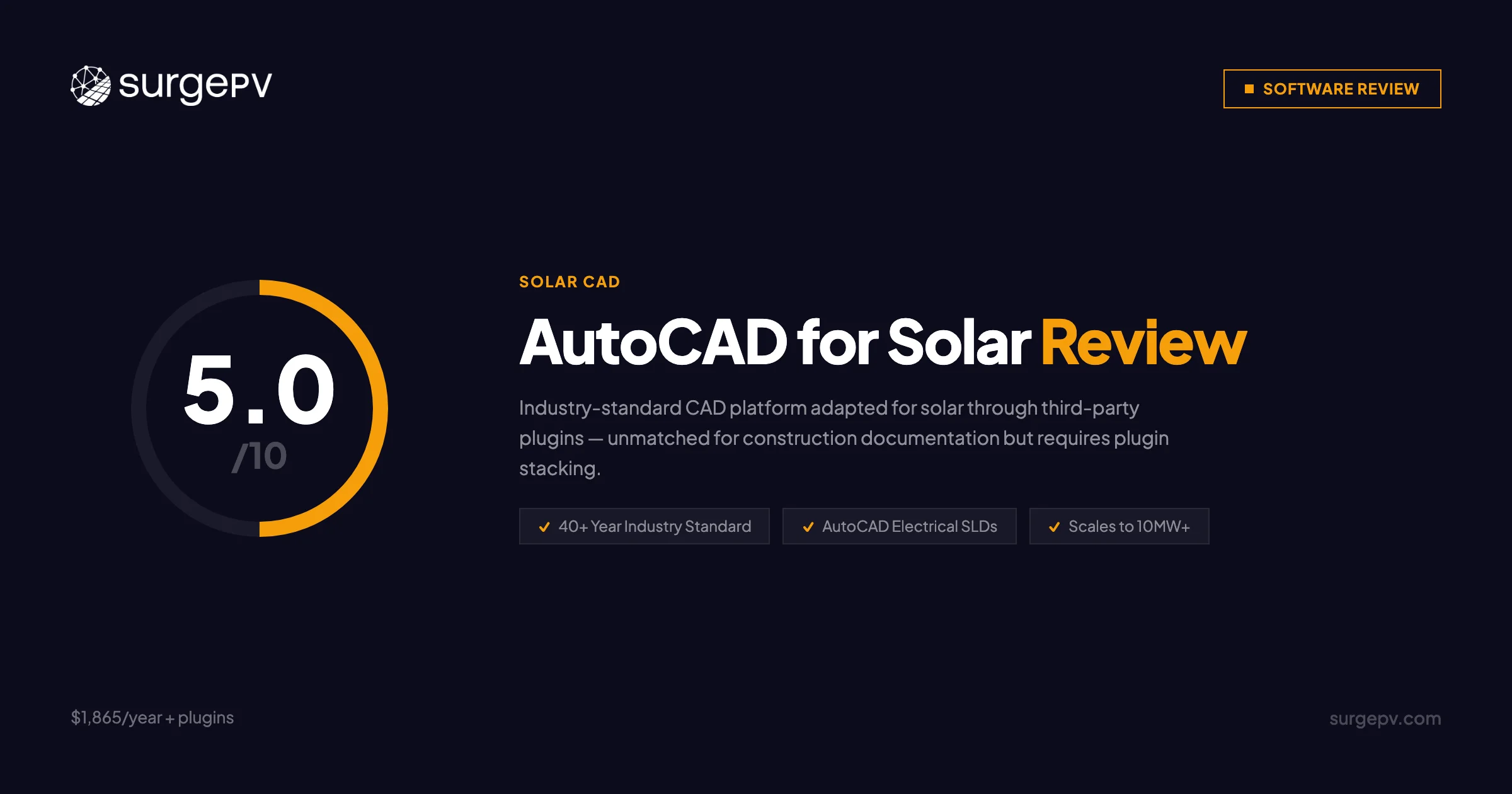
AutoCAD for solar earns a 5/10 rating — not because it is a bad product, but because it is the wrong tool for most solar workflows.
AutoCAD is the right tool for a specific set of needs: large EPCs with established CAD teams, utility-scale projects above 10 MW, AHJ requirements for DWG files, and architectural integration projects. For those use cases, AutoCAD with PVcase or PVComplete is the correct choice and no purpose-built solar platform substitutes.
For most other solar workflows, including commercial EPCs doing 5 to 50 projects monthly, teams without existing CAD expertise, organizations needing proposals alongside design, and teams where speed is the primary constraint, AutoCAD’s manual workflows, steep learning curve, and multi-vendor licensing are structural disadvantages.
The decision factors:
| Decision Factor | AutoCAD Reality |
|---|---|
| Annual cost (with plugin) | Not published; Autodesk subscription plus a quoted plugin |
| SLD time (with plugin) | 45–60 min |
| SLD time (without plugin) | 2–3 hours |
| Learning curve | 3–6 months |
| Proposal tool included | No |
| Shading analysis included | No (plugin or PVsyst) |
SurgePV covers design, automated SLDs, shadow analysis, and solar proposal platform at $1,499/user/year, in one subscription.
Bottom line: If your team is asking whether to adopt AutoCAD for solar design, the answer is yes only if you have existing CAD infrastructure, handle utility-scale complexity, or have explicit AHJ requirements for DWG files. For everyone else, choose a purpose-built solar design suite that automates what AutoCAD requires engineers to do manually.
Take the Next Step
See how SurgePV’s automated solar design compares to AutoCAD’s manual CAD workflows in a live project.
- Book a demo — See automated SLD generation and shading analysis in action
- Compare platforms — Full comparison of solar design software options
- SurgePV pricing — All-inclusive pricing with no plugin add-ons required
- Shadow analysis software — See how SurgePV’s native shading works vs AutoCAD+plugin
Switching from AutoCAD? SurgePV provides dedicated onboarding, data migration support, and team training — typical ramp-up is 2–3 weeks vs 3–6 months for AutoCAD.
Related Resources
Platform Comparisons:
- PVcase Review — The best AutoCAD plugin for solar, reviewed in depth
- HelioScope Review — Cloud-based energy simulation platform comparison
- Aurora Solar Review — Residential sales platform comparison
- PVsyst Review — Advanced energy simulation software review
Feature Deep Dives:
- Solar Designing — SurgePV’s complete design capabilities overview
- Shadow Analysis Software — Automated shading analysis without CAD plugins
- Solar Proposal Software — Proposal generation that AutoCAD cannot provide
- Generation and Financial Tool — ROI and payback modeling
Educational Resources:
- Best Solar Software — Complete platform comparison guide
- Commercial Solar Solutions — Commercial project features and workflow
- Solar Installers — Resources for solar installation teams
This AutoCAD for solar review was written by Keyur Rakholiya, Contributing Writer at SurgePV and MD & CEO of Heaven Green Energy Limited, using the cited public sources. All claims about SurgePV are verified against official product documentation. All AutoCAD information is sourced from official Autodesk documentation, AutoCAD 2026 release notes, PVcase/PVComplete/Virto.CAD product pages, and G2 verified reviews. We disclose that SurgePV publishes this review and disclose our company affiliation transparently.
Review last updated: March 8, 2026 | Next review: June 2026
About the Contributors

CEO & Co-Founder · SurgePV
Keyur Rakholiya is identified by SurgePV as its CEO and a company co-founder. His SurgePV author page lists only role information that can be tied to the public profile below; credentials, project totals, testing claims, media appearances, and speaking engagements are not asserted without retained evidence.

Editorial contributor · SurgePV
Rainer Neumann is credited as an editorial contributor on SurgePV content. This profile does not assert engineering credentials, project totals, software-testing experience, education, speaking engagements, or media citations because independent verification evidence is not retained in the publication record.
