Pros
Cons
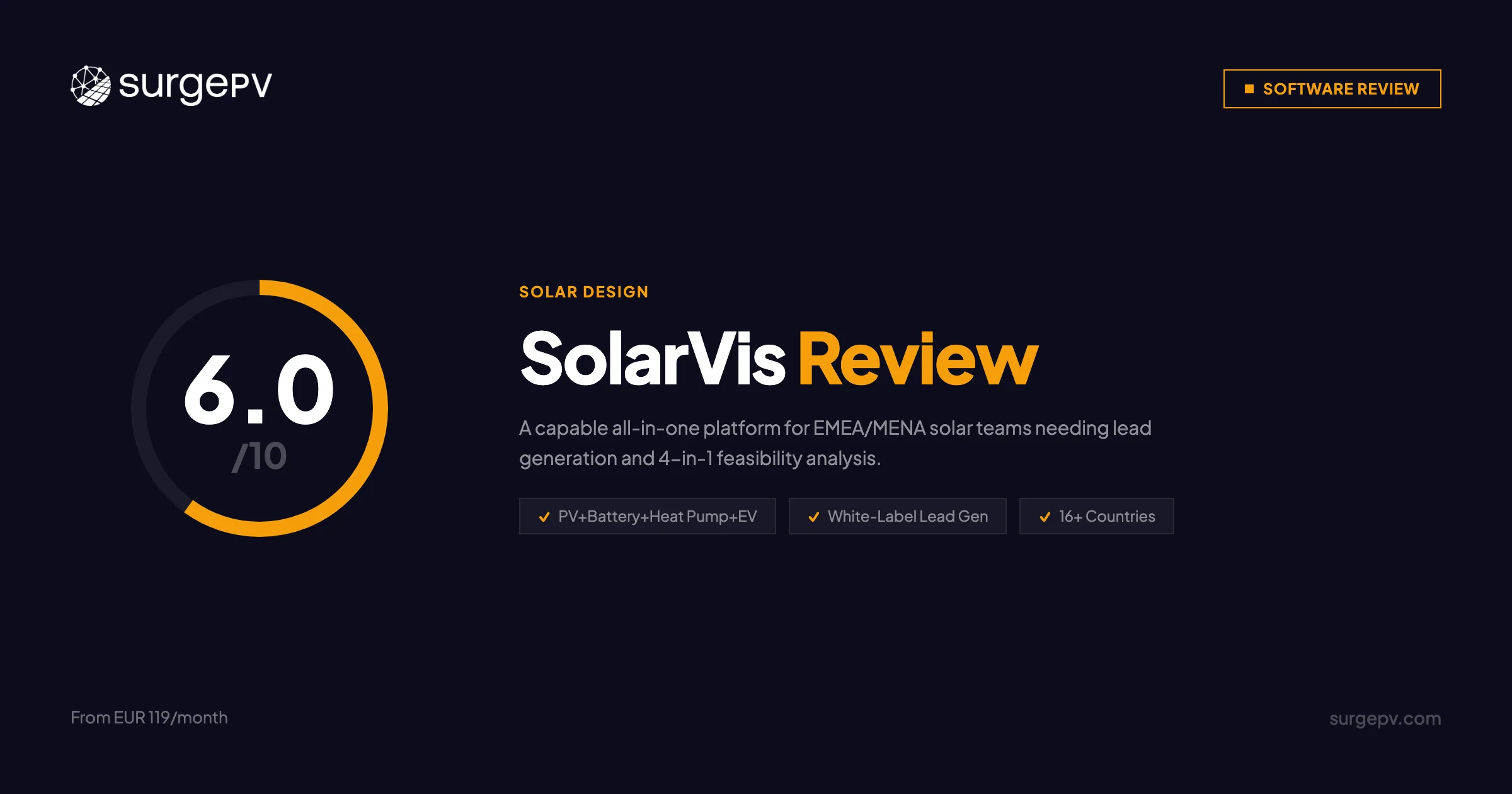
TL;DR: SolarVis is an all-in-one B2B SaaS platform for solar companies in EMEA and MENA, combining lead generation, 3D design, 4-in-1 feasibility analysis, CRM, and project management. Pricing starts at EUR 119/month for the Sales Engine. The platform’s standout differentiator is 4-in-1 feasibility covering PV, Battery, Heat Pump, and EV Charger — no other platform in this category does all four. The main problem: zero verified third-party reviews on any major platform as of early 2026. For EMEA teams that need white-label lead generation and multi-technology feasibility, SolarVis has a compelling offer. For teams wanting proven solar design software with documented accuracy and complete electrical engineering, SurgePV delivers a more established workflow.
Author: Keyur Rakholiya Title: Contributing Writer, SurgePV | MD & CEO, Heaven Green Energy Limited Expertise: 1+ GW solar projects delivered, 20+ design software platforms tested, 10+ years EPC operations Published: 2026-03-08 Last Updated: 2026-03-08 Review Methodology: Official SolarVis documentation (solarvis.co/en, January 2026), competitive platform testing, EMEA market analysis. No verified G2, Capterra, or TrustRadius reviews were available for this product at the time of writing.
Who This Review Is For
This SolarVis review helps:
- Solar EPCs and installers in EMEA/MENA evaluating an all-in-one platform
- Companies wanting built-in white-label lead generation for their website
- Teams needing 4-in-1 feasibility (PV + Battery + Heat Pump + EV Charger)
- Buyers comparing SolarVis vs Aurora Solar, SurgePV, or OpenSolar
- Dealer networks looking for centralized project management across multiple entities
Who should skip this review:
- US or Canada-focused installers (SolarVis has no North American support)
- Utility-scale operations (SolarVis does not support utility-scale projects)
- Teams needing e-signature, payment processing, or email marketing
- Solo installers on tight budgets (entry pricing is EUR 119/month with a 10-project cap)
What Is SolarVis?
SolarVis is a cloud-based B2B SaaS platform built for solar energy companies. It covers the full commercial workflow: lead capture on your website, 3D roof design with satellite imagery, multi-technology feasibility analysis, white-label proposals, CRM pipeline management, and post-installation project tracking.
Founded in 2019 at METU Technopolis in Ankara, Turkey, SolarVis was built by Samet Yıldırım (CEO) and Enes Berk Karahançer — both electrical engineering graduates from Middle East Technical University. The company secured $3.3 million in angel funding in September 2023 from investors Ahmet Cezayırlıoğlu and Enis Fakioglu.
Company Background
| Detail | Info |
|---|---|
| Founded | 2019 |
| Headquarters | METU Technopolis, Ankara, Turkey |
| Founders | Samet Yıldırım (CEO), Enes Berk Karahançer |
| Funding | $3.3M angel round (September 2023) |
| Countries | 16+ |
| Languages | 13 |
| Customers | 1,000+ companies |
| Feasibility Reports | 420,000+ (per official website, unverified) |
| Projects Managed | 10,200+ (per official website, unverified) |
Core Value Proposition
SolarVis positions itself as the platform that replaces five separate tools: a lead capture widget, a design tool, a feasibility calculator, a CRM, and a project tracker. The 4-in-1 feasibility — covering PV, Battery Storage, Heat Pump, and EV Charger in a single analysis — is its clearest differentiator. No major competitor currently offers all four in one feasibility engine.
Target Market
Primary customers:
- Solar installers (residential and commercial) in EMEA/MENA
- EPC companies operating across Europe and the Middle East
- Solar manufacturers managing dealer networks
- Financial institutions offering solar financing (Akbank and Is Bankasi are listed partners)
- Engineering offices serving multiple clients
Geographic focus: Europe and MENA. The platform supports 13 languages including Arabic, German, French, Italian, Dutch, Polish, Portuguese, Spanish, and Turkish.
What SolarVis does not support:
- Utility-scale solar design
- North American regulatory compliance (NEC, AHJ, NEM 3.0)
- LIDAR-based site surveys
- Mobile apps (iOS or Android)
SolarVis Pricing & Cost
SolarVis has two separate product lines, each with independent pricing. You subscribe to one or both depending on your needs.
SolarVis Sales Engine Pricing
| Plan | Monthly | Annual | Projects/Month |
|---|---|---|---|
| Start | EUR 119/month | EUR 99/month (EUR 1,188/year) | 10 |
| Grow | EUR 299/month | EUR 249/month (EUR 2,988/year) | 30 |
| Scale | EUR 499/month | EUR 409/month (EUR 4,908/year) | 60 |
| Enterprise | Custom | Custom | Unlimited |
Solar Lead Generator Pricing
| Plan | Monthly | Annual | Leads/Month |
|---|---|---|---|
| Start | EUR 199/month | EUR 159/month | 50 |
| Grow | EUR 499/month | EUR 409/month | 150 |
| Scale | EUR 999/month | EUR 819/month | 500 |
| Enterprise | Custom | Custom | Unlimited |
Annual billing saves approximately 20% on both product lines. VAT is included. No setup fees.
Project Cap Risk
The per-project limit matters more than the headline price. A growing team closing 15–20 projects per month immediately outgrows the Start plan and needs the Grow plan at EUR 299/month. Calculate your actual monthly project volume before choosing a tier.
SolarVis Cost vs Competitors
| Platform | Annual Cost (entry) | Notes |
|---|---|---|
| SolarVis Start (Sales only) | EUR 1,188/year | 10 projects/month cap |
| SolarVis Grow (Sales only) | EUR 2,988/year | 30 projects/month cap |
| SurgePV | From $1,499/user/year | No per-project limits |
| OpenSolar | Free / $2,388/year Pro | Unlimited projects on Pro |
| Arka360 Basic | $1,699/year | CRM included, India/US focus |
The per-project pricing model creates a cost scaling risk as project volume grows. Seat-based pricing (SurgePV, Aurora Solar) is more predictable for growing teams.
Total Cost for Both Modules
If you need both the Sales Engine and Lead Generator:
| Combination | Annual Cost |
|---|---|
| SolarVis Start + Start (Sales + Leads) | EUR 4,284/year |
| SolarVis Grow + Grow (Sales + Leads) | EUR 7,908/year |
| SurgePV (per user, all-in-one) | From $1,499/user/year |
Pro Tip
Request a demo and use the 7-day trial before committing to annual billing. The Lead Generator is a separate subscription — confirm the website integration (iframe or subdomain) works on your existing site before paying for a full year.
Is SolarVis Free? Free Trial
SolarVis is not free and has no permanent free tier.
A 7-day free trial is available for the Sales Engine (proposal software). No credit card is required, and there are no setup fees. No free trial is listed for the Lead Generator module.
Seven days is tight for a thorough evaluation, especially for a team that needs to configure dealer structures, set up CRM stages, and test the website lead generator integration. OpenSolar offers an unlimited-project free tier with no time limit. Most competing platforms offer 14–30 day trials.
Core Features & Capabilities
3D Design and Feasibility Analysis
SolarVis offers browser-based 3D roof modeling using satellite imagery. The design workflow:
- Select address via Google Maps
- Draw roof outline on satellite imagery
- Auto panel placement with irradiation optimization
- Real-time shading analysis
- 4-in-1 feasibility calculation output
The 4-in-1 feasibility is the product’s most distinctive feature. A single analysis produces outputs for:
- Photovoltaic (PV) system
- Battery storage
- Heat pump integration
- EV charger sizing
Most competitors handle PV and battery. No major alternative currently includes Heat Pump and EV Charger in the same feasibility engine. For European installers competing in the energy services market — where customers increasingly ask about combined PV and heat pump systems — this is a real workflow advantage in the sales conversation.
Feasibility output includes:
- Financial forecasts (ROI, payback period)
- Energy savings estimates
- System sizing recommendations
- White-label reports with company branding
Material Database
SolarVis maintains a database of 100,000+ products: panels, inverters, batteries, and balance-of-system components. This is one of the larger component libraries in the mid-market segment, reducing manual product entry and keeping proposals current with the actual product catalog.
White-Label Lead Generator
This is SolarVis’s second major differentiator. An embeddable lead capture widget is installed on your own website — either as an iframe or on a company-branded subdomain.
How it works:
- Visitor lands on your website
- Enters their address via Google Maps
- Draws their roof outline on satellite imagery
- Provides consumption data
- Verifies identity via SMS OTP
- Receives a pre-feasibility report under your company branding
The lead is automatically created in the SolarVis CRM with contact details, pre-feasibility data, and OTP-verified status. Competitors including SurgePV and Aurora Solar do not offer this as a built-in module.
Lead Generator Is a Separate Subscription
The Lead Generator costs EUR 199/month (Start, 50 leads) in addition to the Sales Engine subscription. If your website generates more than 50 qualified solar leads per month, you will need the Grow plan at EUR 499/month. Budget for both if you need full platform coverage.
Proposals and Sales Engine
Proposals generate directly from design and feasibility data — no manual re-entry. Output includes:
- White-label PDF proposals with company branding
- Sharing via SMS, email, and WhatsApp
- Financial modeling (ROI, payback, savings)
- Bill of Materials (BoM) in proposal output
SolarVis does not support lease/PPA modeling, MACRS depreciation, or US utility rate databases. The financial modeling covers European and MENA financing structures: cash purchase and loan financing.
CRM and Pipeline Management
The built-in CRM includes:
- Deal pipeline with stage tracking
- Automated follow-up sequences
- BoM management
- Lead-to-project conversion workflow
- Document storage
This is a functional CRM, not just a contact list. Small to mid-size teams without an existing CRM investment benefit from having this built into the same platform as design and proposals.
Project Management
Post-sale project tracking uses a Kanban board:
- Task assignment to team members
- Milestone management
- Installation workflow tracking
- Document storage
- Post-sales monitoring
Dealer Network Management
SolarVis supports multi-dealer organizational structures. From a single account, you can:
- Manage multiple dealer entities with separate branding
- Assign and monitor projects across the network
- Apply role-based access permissions per entity
- Customize proposals per dealer
Most competitors support team roles but not multi-entity dealer hierarchies at this level. For solar manufacturers managing an installer network across several countries, this is a practical differentiator.
Technical Specifications
| Specification | Detail |
|---|---|
| Deployment | Cloud-based SaaS, browser-only |
| Mobile App | None |
| Offline Mode | Not available |
| Languages | 13 (Arabic, Azerbaijani, Czech, German, English, Estonian, French, Italian, Dutch, Polish, Portuguese, Russian, Spanish, Turkish) |
| Currencies | All currencies supported |
| API | Available |
| Security | Independent safety inspections, penetration testing, SMS OTP login |
| Partnerships | Akbank, Is Bankasi, Arcelik, Solino Energy/IBT |
What SolarVis Does Not Include
Design limitations:
- No utility-scale design
- No LIDAR site surveys
- No bifacial panel modeling or tracker simulation
- No detailed electrical calculations (SLD, wire sizing, conduit fill)
- No PVsyst integration
Sales and financial:
- No e-signature
- No payment processing
- No email or SMS marketing campaigns
- No lease/PPA modeling
- No MACRS or US tax credit calculations
- No US utility rate database
Integrations:
- No CAD import/export
- No BIM integration
- No accounting software sync (QuickBooks, Xero)
- No Zapier
Mobile and field:
- No iOS or Android app
- No offline mode
- No field service app
User Reviews & Feedback
This is the most significant weakness in the SolarVis evaluation. No independent user review data is available.
Review platform status (March 2026):
| Platform | Status |
|---|---|
| G2 | Listed, 0 reviews |
| Capterra | Not listed |
| TrustRadius | Not listed |
The only available user feedback is from testimonials on the SolarVis website itself:
- “Process thousands of leads per year easily”
- “Significant time savings in sales processes”
- “Greater customer interest with transparent feasibility analyses”
- “Quick CRM integration capabilities”
These are unverified and represent the most favorable possible framing. Without independent reviews, buyers have no third-party view of software performance under real project volumes, support responsiveness, or platform reliability.
What the Absence of Reviews Means
SolarVis serves 1,000+ companies across 16+ countries. At that scale, the absence of any G2 or Capterra reviews is unusual. It likely reflects a customer base concentrated in EMEA markets where English-language software review platforms see lower engagement. Regardless of the reason, buyers with peer-review requirements in their vendor selection process will not be able to satisfy those requirements. Ask SolarVis directly for customer references before committing to an annual subscription.
For comparison, Arka360 has 129 verified G2 reviews. Aurora Solar has 600+. The lack of independent validation is a real procurement risk.
Pros & Cons
Pros
1. 4-in-1 Feasibility Analysis — No Competitor Equivalent
SolarVis is the only platform that runs feasibility analysis for PV, Battery, Heat Pump, and EV Charger in a single workflow. European installers selling energy services — where customers often ask about combined PV plus heat pump or EV integration — have a concrete single-tool answer with no equivalent from competitors.
2. White-Label Lead Generator With OTP Verification
The embedded lead capture widget turns your website into an automated pre-qualification engine. Leads arrive with consumption data, roof drawings, and OTP-verified contact details. Aurora Solar, SurgePV, and OpenSolar do not include this as a built-in module at any price.
3. 100,000+ Material Database
One of the larger component libraries available in a mid-market platform. Reduces time spent on manual product entry and keeps proposals aligned with actual catalog availability across 16+ countries.
4. 13 Languages — Native EMEA/MENA Support
Arabic, German, French, Italian, Turkish, Dutch, Polish, and more. For companies serving customers in multiple European or MENA countries, native language support reduces sales friction meaningfully.
5. Dealer Network Management Built In
Multi-entity dealer management with centralized oversight, per-entity branding, and role-based permissions. Most competitors support team roles but not dealer hierarchy structures. Useful for manufacturers and distributors managing installer networks.
6. Financially Backed Company
$3.3M angel funding in September 2023. The platform has organizational backing for continued product development — it is not a bootstrapped tool at risk of sunset.
7. API Access Included, No Setup Fees
Clean pricing with no hidden setup costs. API access enables custom integrations for teams with existing business systems.
Cons
1. Zero Verified Third-Party Reviews
The most significant weakness. No G2, Capterra, or TrustRadius reviews means buyers have no independent view of software reliability, support quality, or real-world performance. This is a procurement risk for any organization with peer-review vendor requirements.
2. No Mobile App or Offline Mode
Browser-only. Field teams cannot access project data or update job status from a mobile device without a stable internet connection. Arka360, Aurora Solar, and others provide mobile apps.
3. Per-Project Pricing Creates Scaling Risk
Entry plan caps at 10 projects per month. Growing teams quickly hit limits and jump to higher tiers. At 40+ projects/month, SurgePV’s seat-based pricing becomes more cost-competitive than SolarVis’s tiered model.
4. No Electrical Engineering Documentation
No SLD generation, wire sizing, voltage drop calculations, or permit-ready electrical drawings. Commercial EPCs producing electrical documentation for permitting will need separate tools. SurgePV’s solar design software generates automated SLDs in 5–10 minutes without additional software costs.
5. No US or North America Support
No NEC compliance, no AHJ support, no NEM 3.0 modeling, no US utility rate database. Teams with any US project volume need a different tool.
6. No Utility-Scale Capabilities
Residential and commercial (C&I) only. Utility-scale ground mount is not supported.
7. Limited Integration Ecosystem
No Zapier, no accounting software sync, no CAD import/export. API access is available but requires custom development for most integrations.
8. 7-Day Trial Is Insufficient
Seven days is not enough time to fully evaluate CRM configuration, proposal templates, lead generator installation, and dealer structures. Most platforms offer 14–30 day trials.
See How SurgePV Compares
Complete design-to-proposal workflow with automated SLDs, documented shadow analysis, and no per-project pricing limits.
Book a DemoNo commitment required · 20 minutes · Live project walkthrough
SolarVis vs SurgePV
Both platforms target solar EPCs and installers, but with different geographic focus, pricing models, and feature priorities.
Head-to-Head Feature Comparison
| Category | SolarVis | SurgePV | Winner |
|---|---|---|---|
| 3D Roof Design | Satellite imagery, auto placement | Satellite imagery, auto placement | Tie |
| Shading Analysis | Real-time, accuracy not documented | Shadow analysis with documented method | SurgePV |
| 4-in-1 Feasibility | PV + Battery + Heat Pump + EV | PV + Battery | SolarVis |
| Electrical Engineering | Not available | Automated SLD, wire sizing | SurgePV |
| White-Label Lead Generator | Built-in (separate subscription) | Not included | SolarVis |
| Dealer Network Management | Built-in | Not included | SolarVis |
| Proposal Generation | White-label, SMS/email/WhatsApp | Complete solar proposal software | Tie |
| CRM | Built-in | Integrates with existing CRM | SolarVis |
| Material Database | 100,000+ products | Extensive library | SolarVis |
| Language Support | 13 languages | English primary | SolarVis |
| Geographic Coverage | EMEA/MENA (16+ countries) | International | SurgePV |
| US Market Support | Not supported | Full 50-state coverage | SurgePV |
| Utility-Scale | Not supported | Not supported | Tie |
| Mobile App | None | None | Tie |
| Third-Party Reviews | 0 verified reviews | Established track record | SurgePV |
| Pricing Model | Per-project + per-lead caps | Per seat, no project limits | SurgePV |
Where SolarVis Wins
Multi-technology feasibility: If your customers ask about combined PV plus heat pump or PV plus EV charger systems, SolarVis produces a single feasibility report covering all four technologies in one interaction.
Lead generation: The white-label website widget with OTP-verified pre-qualification is a real conversion tool. Most competitors do not offer this at all.
Dealer management: Multi-entity structures with centralized oversight, per-entity branding, and role-based permissions. Right structure for manufacturers and distributors.
Language localization: 13 languages covering most of Europe and MENA. If your team or customers work in Arabic, French, Turkish, or Polish, the native language support reduces friction immediately.
Where SurgePV Wins
Electrical engineering: SurgePV’s solar design software generates automated SLDs in 5–10 minutes. SolarVis has no electrical engineering capabilities. For commercial EPCs, this is often the difference between a permit-ready deliverable and a project that requires additional documentation work.
Shadow analysis: SurgePV’s shadow analysis uses a documented methodology. SolarVis mentions real-time shading but does not publish accuracy data. For projects requiring financier approval, documented accuracy carries weight that unquantified claims do not.
US coverage: 50-state support, 3,000+ utilities, NEC compliance. SolarVis does not operate in the US market.
Third-party validation: Zero SolarVis reviews vs hundreds for SurgePV. For procurement teams requiring peer-review evidence before purchase, this is a material difference.
Pricing predictability: Per-seat pricing with no project caps vs SolarVis’s tiered per-project model. At high project volumes, SurgePV is more cost-competitive.
Workflow Time Comparison (30 kW Commercial Rooftop)
| Step | SolarVis | SurgePV |
|---|---|---|
| Roof design | 20–30 min | 20–30 min |
| Shading analysis | Included | Included |
| 4-in-1 feasibility | 10–15 min | PV + Battery only |
| Electrical documentation | Not available | 5–10 min (automated SLD) |
| Proposal generation | 15–20 min | 15–20 min |
| Total | 45–65 min (no electrical docs) | 55–75 min (complete, permit-ready) |
SolarVis Alternatives
SurgePV — Best for Complete Design-to-Proposal Workflow
SurgePV covers 3D design, automated shadow analysis, electrical engineering documentation, and professional proposals without per-project limits. Best for: commercial EPCs, international teams, US market operations. From $1,499/user/year. See solar software overview for full feature details.
Aurora Solar — Best for US Residential Sales Teams
Aurora Solar is the dominant platform in US residential solar sales. Strong roof modeling, detailed production simulation, and polished proposal output. Limited presence outside the US. Contact sales for pricing.
OpenSolar — Best Free Option
OpenSolar offers a permanent free tier for solo installers with unlimited projects. Commercial features on paid plans from around $199/month. Strong international coverage. No built-in lead generator.
Arka360 — Best for India Market With Built-in CRM
Arka360 combines design, proposals, and a native CRM targeting India and US markets. 129 verified G2 reviews. Starts at $199/month ($1,699/year annual). No equivalent of SolarVis’s lead generator or 4-in-1 feasibility.
PVCase — Best for CAD-Based Utility-Scale Design
PVCase is a CAD-integrated platform for commercial ground mount and utility-scale projects. Not comparable for residential workflows or lead generation.
HelioScope — Best for Engineering-Heavy Simulations
HelioScope targets engineers needing detailed production simulations. Strong simulation accuracy, limited on sales and proposal output. No lead generation.
Who Should Use SolarVis?
Best Fit for SolarVis
1. Solar companies in Europe and MENA The platform is purpose-built for these markets: 13 languages, EMEA-specific regulatory alignment, all-currency support, and bank partnerships in Turkey and the broader region.
2. Companies wanting website-based lead generation If you run paid search or content marketing campaigns and want automated lead capture embedded on your website, the SolarVis Lead Generator fills this gap. Most competitors do not offer this built-in.
3. Installers expanding into multi-technology energy services If you sell or plan to sell combined PV plus heat pump plus EV charger solutions, the 4-in-1 feasibility gives you a single tool for a complete multi-technology consultation.
4. Manufacturers or distributors managing dealer networks Multi-entity management with per-dealer branding, centralized oversight, and role-based permissions supports scalable dealer oversight for companies with 10–50 active installer relationships.
5. Mid-size installation teams without an existing CRM The combined CRM, design, feasibility, and project tracking in one platform reduces tool-switching for teams at this scale that have not yet invested in a standalone CRM.
Who Should Look Elsewhere
US and Canada installers: SolarVis does not support North American markets, NEC compliance, or US utility rate structures.
Teams needing electrical documentation: No SLD generation, wire sizing, or permit-ready electrical output. Commercial EPCs producing drawings for permitting need a different tool.
Solo installers on tight budgets: EUR 119/month with a 10-project cap is a meaningful monthly cost for a single-person operation. OpenSolar’s free tier or SurgePV’s per-seat pricing may offer better value.
Organizations requiring peer-reviewed social proof: Zero G2 or Capterra reviews means no independent vendor validation is available. Organizations with formal vendor review requirements will not be able to satisfy those requirements with SolarVis’s current review profile.
Teams needing utility-scale: Not supported. PVCase or RatedPower are the right tools for large ground-mount projects.
Frequently Asked Questions
How much does SolarVis cost?
SolarVis has two product lines. The Sales Engine costs EUR 119/month (Start, 10 projects), EUR 299/month (Grow, 30 projects), or EUR 499/month (Scale, 60 projects). Annual billing saves roughly 20%. The Lead Generator costs EUR 199/month (Start, 50 leads), EUR 499/month (Grow, 150 leads), or EUR 999/month (Scale, 500 leads). Enterprise plans with unlimited usage are available with custom pricing. VAT is included. No setup fees.
Is SolarVis free?
No. SolarVis has no permanent free tier. A 7-day free trial is available for the Sales Engine. No free trial is listed for the Lead Generator. Billing is monthly or annual.
What countries does SolarVis support?
SolarVis operates in 16+ countries, primarily in Europe and MENA. The platform supports 13 languages including Arabic, German, French, Italian, Turkish, Dutch, Polish, Portuguese, Spanish, and Russian. SolarVis does not support US or Canadian market operations (no NEC compliance, AHJ support, or US utility rate data).
Does SolarVis have a mobile app?
No. SolarVis is browser-only with no iOS or Android app and no offline mode. Field teams need an active internet connection to access the platform.
What is the SolarVis 4-in-1 feasibility analysis?
The 4-in-1 feasibility produces a single analysis covering four technologies in one customer interaction: Photovoltaic (PV) system, Battery Storage, Heat Pump integration, and EV Charger sizing. Each output includes financial projections, ROI estimates, and payback period. No major competitor currently offers all four in a single feasibility engine.
Does SolarVis have user reviews on G2 or Capterra?
As of March 2026, SolarVis has zero verified reviews on G2 and is not listed on Capterra or TrustRadius. The only available user feedback is from testimonials on the official SolarVis website, which are unverified. Ask SolarVis directly for customer references before committing to an annual subscription.
Who are SolarVis’s main competitors?
The main SolarVis alternatives are SurgePV (complete design-to-proposal with electrical engineering), Aurora Solar (US residential leader), OpenSolar (free tier, international), Arka360 (India/US with built-in CRM and 129 G2 reviews), and PVCase (utility-scale CAD-based design).
Can SolarVis handle commercial solar projects?
Yes. SolarVis supports commercial (C&I) projects including 3D design, shading analysis, and multi-technology feasibility. It does not support utility-scale design, detailed electrical engineering documentation, or US regulatory compliance (NEC, AHJ).
Final Verdict
SolarVis Executive Summary
Strengths:
- 4-in-1 feasibility (PV + Battery + Heat Pump + EV) — unique in the segment
- White-label lead generator with OTP-verified pre-qualification
- Dealer network management for multi-entity organizations
- 13-language support for EMEA/MENA markets
- 100,000+ material database
- $3.3M funded, financially backed company
Weaknesses:
- Zero verified third-party reviews — no independent social proof
- No mobile app, no offline mode
- No electrical engineering capabilities (SLD, wire sizing)
- Per-project pricing caps that scale costs with volume growth
- No US/North America support
- 7-day trial is insufficient for proper evaluation
Rating: 6 out of 10
SolarVis earns this rating for a genuinely differentiated feature set — particularly the 4-in-1 feasibility and white-label lead generator — in a geographic market where it is purpose-built to operate. The score is held back by the complete absence of independent user reviews, no electrical engineering documentation, and a per-project pricing model that creates scaling risk.
Decision Framework
Choose SolarVis when:
- Your operations are in Europe or MENA
- You need 4-in-1 feasibility for energy services selling (PV + heat pump + EV)
- You want a white-label lead generator embedded on your website
- You manage a dealer network across multiple entities
- You serve customers in multiple European languages
Choose SurgePV when:
- You need complete design-to-proposal workflow with electrical documentation
- You operate in US or international markets beyond EMEA/MENA
- You need documented shadow analysis accuracy for bankable projects
- You want per-seat pricing without per-project volume caps
- You require independent peer-review validation before purchasing
Choose OpenSolar when:
- You want a free tier to start without monthly cost
Choose Arka360 when:
- India is your primary market and you want built-in CRM with 129+ verified reviews
Take the Next Step
See how SurgePV’s complete solar design software workflow compares to SolarVis on your actual project types.
- Book a demo — Live walkthrough with your project types, no commitment
- Compare platforms — All platform comparisons in one place
- Pricing — Per-seat pricing with no per-project limits
- Shadow analysis — Documented accuracy for bankable projects
Related Resources
Platform Comparisons:
- Arka360 Review — India/US all-in-one with built-in CRM
- Aurora Solar Review — US residential market leader
- OpenSolar Review — Best free tier option globally
- HelioScope Review — Engineering-focused simulation tool
Feature Deep Dives:
- Solar Design Software — Complete solar software workflow overview
- Shadow Analysis Software — Shading analysis with documented accuracy
- Solar Proposal Software — Proposal generation comparison
- Generation and Financial Tool — ROI and payback modeling
Best Solar Software Rankings:
- See our best solar design software rankings.
This SolarVis review was written by Keyur Rakholiya, Contributing Writer at SurgePV and MD & CEO of Heaven Green Energy Limited, with 1+ GW of solar project experience and hands-on testing of 20+ design software platforms. All SolarVis information is sourced from official documentation (solarvis.co/en, January 2026). No verified G2, Capterra, or TrustRadius reviews were available for SolarVis at the time of writing. We maintain editorial independence and disclose our company affiliation with SurgePV transparently.
Review published: March 8, 2026 | Next review: June 2026
About the Contributors

Co-Founder · SurgePV
Akash Hirpara is Co-Founder of SurgePV and at Heaven Green Energy Limited, managing finances for a company with 1+ GW in delivered solar projects. With 12+ years in renewable energy finance and strategic planning, he has structured $100M+ in solar project financing and improved EBITDA margins from 12% to 18%.

Content Head · SurgePV
Rainer Neumann is Content Head at SurgePV and a solar PV engineer with 10+ years of experience designing commercial and utility-scale systems across Europe and MENA. He has delivered 500+ installations, tested 15+ solar design software platforms firsthand, and specialises in shading analysis, string sizing, and international electrical code compliance.
