Pros
Cons
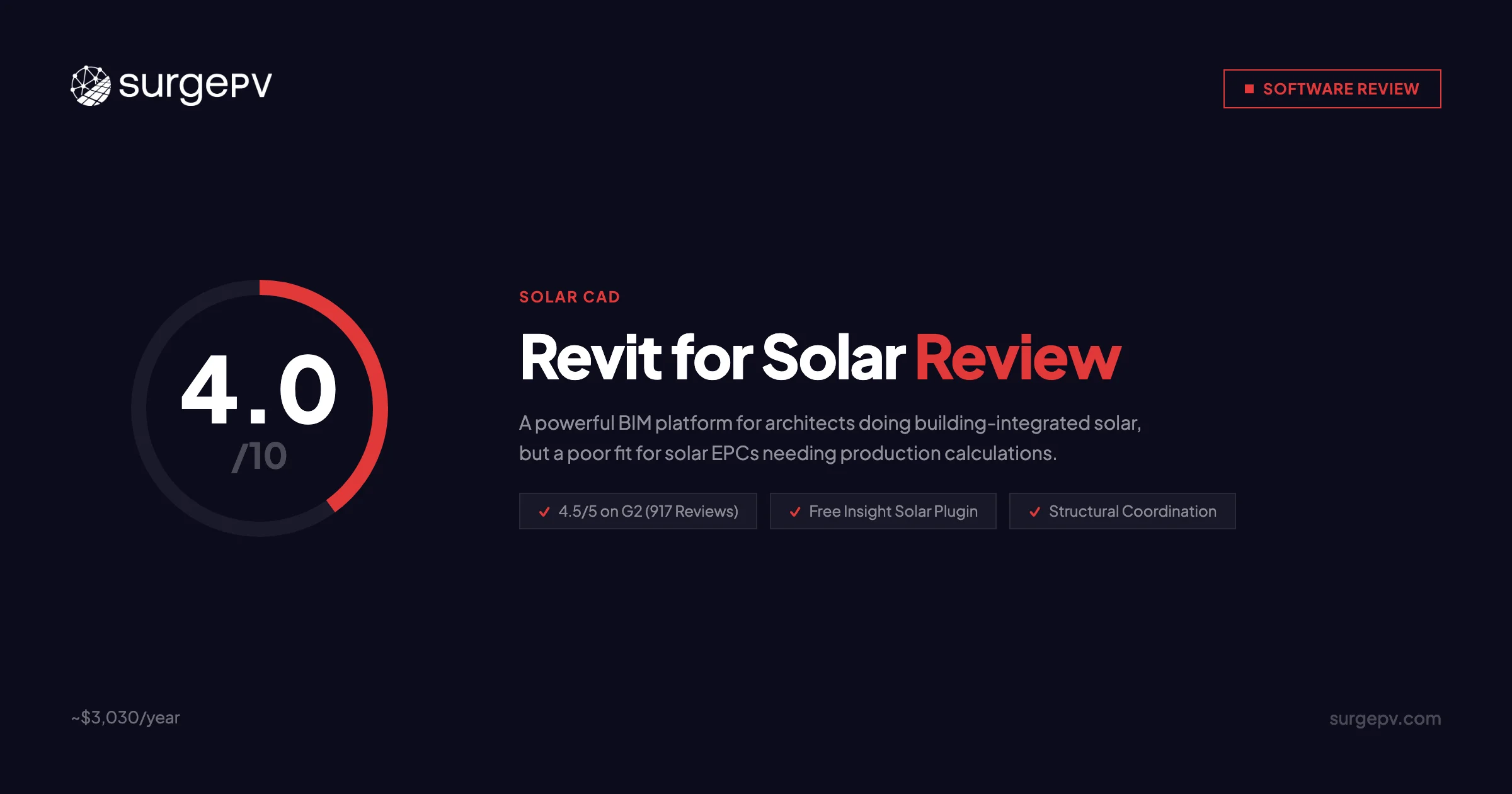
TL;DR: Revit is Autodesk’s BIM platform used by architects for building coordination — not purpose-built solar software. At $3,030/year with a 6–12 month learning curve and year-one costs reaching $18,000+ including hardware and training, it delivers real value only when BIM deliverables are mandated or multi-discipline coordination is required. Based on 917 G2 reviews (4.5/5 overall), users praise the BIM capabilities but the reviewer base is overwhelmingly architects and structural engineers, not solar professionals. For building-integrated PV feasibility during architectural design, Revit works. For solar EPCs needing automated panel layout, production calculations, SLD generation, and proposals, SurgePV — the leading solar design software — covers the full workflow in a fraction of the time and cost.
Author: Keyur Rakholiya Title: Contributing Writer, SurgePV | MD & CEO, Heaven Green Energy Limited Expertise: 1+ GW solar projects delivered, 20+ design software platforms tested, 10+ years EPC operations Published: 2026-03-08 Last Updated: 2026-03-08 Review Methodology: Official Autodesk Revit documentation, 917 G2 verified reviews (G2.com/products/autodesk-revit), 470+ Capterra reviews, competitive testing against purpose-built solar platforms
Who This Review Is For
This Revit for solar review helps:
- Architects and building designers evaluating Revit for solar feasibility analysis
- Solar EPCs asked by clients to deliver BIM-compatible project documentation
- MEP engineers assessing Revit for building-integrated PV (BIPV) projects
- Teams comparing Revit vs AutoCAD, SketchUp, or dedicated solar tools for their workflow
Who should skip this review:
- Solar installers who just need to design rooftop systems and generate proposals (Revit is overkill)
- Ground-mount utility-scale developers (Revit lacks the simulation depth)
- Teams with no BIM expertise on staff (6–12 month learning curve makes adoption expensive)
What Is Revit for Solar?
Revit is Autodesk’s Building Information Modeling platform. It is the industry standard for architectural design, structural engineering, and MEP coordination on complex buildings. Solar analysis is a secondary capability, delivered through the Insight plugin.
The key word is secondary. Revit was not designed for solar EPCs. Its solar tools address one specific question architects ask early in a project: “How much solar potential does this building have?” That is a different question from “How do I design, engineer, and sell a 500 kW rooftop system?”
Company & Platform Background
| Detail | Info |
|---|---|
| Developer | Autodesk, Inc. |
| Founded | 1997 (Revit Technology Corporation); acquired by Autodesk 2002 |
| Platform type | Desktop BIM (Windows only) |
| Solar tool | Insight plugin (free for subscribers) |
| G2 rating | 4.5/5 (917 reviews) |
| Capterra rating | 4.6/5 (470+ reviews) |
| Primary users | Architects, structural engineers, MEP engineers |
What Revit’s Solar Tools Actually Do
Revit’s solar capabilities through the Insight plugin include:
- Sun path visualization — shows solar movement across the year for any location
- Shading analysis — identifies shading from surrounding structures and building geometry
- Solar radiation calculation — calculates energy received per building surface
- Annual PV potential analysis — estimates energy production potential with basic payback period
- Color-coded solar mapping — visual heat map of solar potential across the building envelope
- Parametric panel families — work plane-based panel placement on roofs, walls, and floors
What Revit Cannot Do for Solar
This list matters more than the feature list above:
- ❌ No automated panel layout optimization
- ❌ No production calculations (kWh output, performance ratio, specific yield)
- ❌ No string design or electrical calculations
- ❌ No SLD generation
- ❌ No wire sizing or conduit fill calculations
- ❌ No customer proposals or financial modeling
- ❌ No permit package generation
- ❌ No cloud-based access (desktop only)
- ❌ No Mac support
For a solar installer or EPC, this list represents the core of daily work.
Revit Pricing & License Cost
Revit License Price 2026
| Plan | Annual Cost | Who It’s For |
|---|---|---|
| Revit | ~$3,030/year | Architects, MEP engineers, full BIM users |
| AEC Collection | $3,675/year | Full Autodesk AEC software suite |
| Revit LT | ~$560/year | Simplified drafting — lacks MEP tools needed for solar |
| Architecture Collection | Varies | Contact Autodesk sales |
Prices are in USD and reflect Autodesk’s 2026 subscription pricing. Regional pricing varies.
Total Cost of Ownership (Year 1)
The subscription price understates the real cost. Revit requires high-performance hardware and significant training investment.
| Cost Component | Amount |
|---|---|
| Revit subscription | ~$3,030/year |
| Workstation hardware (32–64GB RAM, professional GPU) | $2,000–$5,000 |
| Training (courses, onboarding) | $3,000–$10,000 |
| Year 1 total | $8,000–$18,000+ |
Hidden Cost Alert
Autodesk’s AEC cloud credit system can add significant costs for large projects. Models with 200+ apartments may require 200+ cloud credits per analysis run — approximately $300+ AUD per run in Australian pricing. Verify current cloud credit costs for your region before budgeting.
Revit vs Solar-Specific Software: Annual Cost Comparison
| Workflow | Annual Cost |
|---|---|
| Revit alone | ~$3,030/year |
| Revit + AutoCAD (for SLD work) | ~$5,030/year |
| Revit + full required stack for solar EPCs | $8,000–$18,000+ year 1 |
| SurgePV (all-in-one, 3-user plan) | From $1,499/user/year |
Is Revit Free? Free Trial
Revit is not free. Autodesk offers a 30-day free trial that provides full access to Revit’s features.
Who can get Revit free:
- Students and educators: Free through the Autodesk Education Community
- Startups: Autodesk offers limited free access through some startup programs
Insight plugin: Free for all Revit subscribers. Solar and energy analyses no longer require cloud credits as of Revit 2023.1+. Lighting analysis still consumes cloud credits.
Access path: Autodesk account → All Products and Services → Revit → Updates & Add-ons.
Pro Tip
If you only need to evaluate solar potential on a building model you already have in Revit, the Insight plugin is free. The problem is that this analysis is the beginning of a solar project, not the full workflow. You will still need separate tools for detailed PV design, electrical engineering, and proposals.
Core Features & Capabilities
We evaluated Revit’s solar capabilities across five categories based on official Autodesk documentation, 917 G2 reviews, and direct comparison against purpose-built solar platforms.
Solar Analysis Features
Revit’s solar analysis lives under the Analyze tab in the ribbon. The workflow is:
- Open building model
- Select Analyze → Solar Analysis
- Set location, date range, and analysis parameters
- Run cloud-based analysis via Insight Model Viewer
- View color-coded solar radiation maps on building surfaces
What works well: The visual heat map of solar potential is genuinely useful for architects making early orientation decisions. Comparing solar exposure across roof sections, facades, and overhangs within the design environment is faster than exporting to a separate tool.
What doesn’t work: This analysis tells you where solar potential exists. It does not tell you how much energy a PV system will generate, what it will cost, how to string the inverters, or what the permit drawings should look like.
BIM Integration & Coordination
This is where Revit genuinely excels.
Parametric panel families: Revit uses work plane-based families to place solar panels on roofs, walls, and floors. Panels can have custom material parameters and update automatically when the underlying geometry changes. This is valuable for building-integrated photovoltaics (BIPV) where panels are part of the architectural envelope.
Multi-discipline coordination: Revit enables structural engineers to verify roof load capacity, MEP engineers to route conduit and electrical runs, and architects to confirm aesthetic integration — all in a shared model. For large commercial or institutional projects where BIM coordination is required by contract, this is the right tool.
Data exchange formats:
- gbXML — building energy model exchange
- IFC — open BIM standard, compatible with most engineering tools
- Integration with Autodesk Forma for wind and solar analysis
Insight Carbon Analysis: Built into Revit 2023.1+, this tool tracks lifecycle carbon and building performance including heating, cooling, lighting, and energy generation. Useful for net-zero certification processes.
What Revit Cannot Do for Solar EPCs
A direct assessment for professional solar designers:
| Solar EPC Task | Revit | Notes |
|---|---|---|
| Automated panel layout | ❌ | Manual placement only |
| Production calculations (kWh) | ❌ | No generation modeling |
| String design | ❌ | Not available |
| SLD generation | ❌ | Requires AutoCAD separately |
| Wire sizing | ❌ | Not available |
| Proposal generation | ❌ | Not available |
| Permit packages | ❌ | Requires additional tools |
| Financial modeling | ❌ | Not available |
| Cloud access | ❌ | Desktop only |
| Mac support | ❌ | Windows only |
For anyone using solar software daily to design and sell systems, this table is the review.
How to Use Revit for Solar Design
The Recommended Workflow
Revit works best as the first step in a larger toolchain, not as a standalone solar design tool.
Stage 1 — Feasibility (Revit):
- Load or create the building BIM model
- Run Insight solar analysis to generate radiation maps
- Identify viable roof surfaces and potential shading sources
- Confirm structural capacity via integrated structural model
- Export gbXML or IFC to solar engineering tools
Stage 2 — Detailed Design (Dedicated Solar Software):
- Import building geometry into SurgePV, PVsyst, or Aurora Solar
- Run accurate production simulations with real weather data
- Perform shadow analysis with hourly precision
- Complete string design and electrical calculations
- Generate SLDs and permit-ready documentation
Stage 3 — Proposal & Sale:
- Generate client proposals with financial modeling
- Apply solar proposal software for interactive client presentations
- Export permit packages for AHJ submission
The Honest Workflow Reality
Most solar EPCs using Revit are doing so because the owner or general contractor requires BIM deliverables — not because Revit makes solar design faster. If BIM deliverables are not required, using Revit adds time and cost without adding solar design capability.
Hardware Requirements
Revit is hardware-intensive. The published minimum specs are a starting point, not a practical target:
| Component | Minimum | Practical for Solar Projects |
|---|---|---|
| RAM | 8GB | 32–64GB |
| CPU | 2.5GHz | 3.0GHz+ multi-core |
| GPU | DirectX 11 | NVIDIA Quadro or equivalent |
| Storage | 30GB HDD | SSD required for large models |
| OS | Windows 10 64-bit | Windows 11 recommended |
Large solar projects (300+ panels, complex rooflines) will require hardware at the higher end of this range.
Revit Solar Plugin: Insight Deep Dive
The Insight plugin is the core of Revit’s solar analysis capability.
What Insight Includes
Solar Analysis:
- Solar radiation heat maps per surface
- Annual solar hours calculation
- PV potential estimates with basic payback period
- Direct access from Analyze tab (no separate download needed after 2023.1+)
Energy Analysis:
- Heating and cooling load calculations
- Lighting analysis (requires cloud credits)
- Lifecycle carbon tracking
- Building performance benchmarking
Integration:
- Cloud-based processing via Autodesk servers
- Results viewable in Insight Model Viewer (browser-based)
- Data export to gbXML for third-party energy tools
Insight Limitations for Solar
The Insight plugin’s solar analysis is a feasibility tool, not a design tool:
- Results are approximations, not bankable production estimates
- No module-level modeling (temperature, mismatch, soiling)
- No irradiance dataset selection (TMY, P50, P90)
- No performance ratio or specific yield output
- No inverter or string configuration tools
- Results cannot be used directly for permit applications or investor reports
For bankable production estimates, export from Revit and run analysis in PVsyst or SurgePV.
Skip the 6-Month Learning Curve
SurgePV gives you automated SLD generation, production calculations, and proposals in a platform solar professionals learn in 2–3 weeks.
Book a DemoNo commitment required · 20 minutes · Live project walkthrough
User Reviews & Feedback
Overall Ratings
| Platform | Score | Review Count |
|---|---|---|
| G2 | 4.5/5 | 917 reviews |
| Capterra | 4.6/5 | 470+ reviews |
| TrustRadius | ~4.0/5 | Varies |
Important context: The vast majority of Revit reviewers are architects and structural engineers evaluating Revit as a BIM platform — not solar professionals evaluating it as a solar design tool. High ratings reflect BIM capabilities, not solar workflow suitability.
Top Praised Features (G2)
| Rank | Feature | Notes |
|---|---|---|
| 1 | Multi-discipline coordination | BIM core capability |
| 2 | Parametric modeling | Family-based design flexibility |
| 3 | Clash detection | Multi-discipline conflict resolution |
| 4 | Documentation quality | Professional drawing production |
| 5 | Industry standard compatibility | IFC, gbXML, DWG interoperability |
Top Criticisms (User Reviews)
| Rank | Issue | Severity |
|---|---|---|
| 1 | Steep learning curve | ⚠️ CRITICAL — 6–12 months reported |
| 2 | High cost and license fees | High |
| 3 | Hardware requirements | High — $2,000–$5,000 workstation |
| 4 | Complex interface for simple tasks | Medium |
| 5 | No Mac support | Medium |
| 6 | Rendering quality | Low–Medium |
User Quotes
“Revit is fantastic for coordination but the learning curve is very steep. Plan for at least six months before your team is productive.” — G2 Reviewer, Architecture firm
“The solar analysis tools are good for early-stage feasibility but you’ll need to take those results into PVsyst for anything bankable.” — TrustRadius Reviewer, MEP Engineer
“Hardware costs are significant. Don’t underestimate the workstation requirements for large projects.” — Capterra Reviewer, Building Designer
Pros & Cons
✅ Pros
1. Industry-Standard BIM Platform ⭐ GENUINE STRENGTH
Revit is the most widely adopted BIM platform globally. For projects where BIM deliverables are contractually required — large commercial builds, institutional projects, public sector work — Revit is often the only platform that satisfies owner requirements. 4.5/5 on G2 (917 reviews), 4.6/5 on Capterra (470+ reviews).
2. Insight Solar Analysis Is Free for Subscribers
Since Revit 2023.1+, solar and energy analyses no longer consume cloud credits. For firms already subscribed to Revit, solar feasibility analysis adds no incremental cost. This is a genuine value point for architectural teams exploring solar integration.
3. Structural Coordination for Roof Loading
Revit allows structural engineers to verify roof load capacity within the same model. For large commercial rooftop installations where roof loading analysis is required for permits, this coordination capability reduces back-and-forth between disciplines.
4. Multi-Discipline Clash Detection
Clash detection between solar electrical conduit runs, structural members, and mechanical systems is difficult to do in standalone solar tools. Revit handles this within a shared federated model.
5. gbXML and IFC Data Exchange
Two-way data exchange with energy analysis tools (EnergyPlus, DesignBuilder, IES VE) via gbXML, and open BIM exchange via IFC. Useful when solar data needs to flow into broader building energy certification processes (LEED, BREEAM, NABERS).
⚠️ Cons
1. No Solar Production Calculations ⚠️ CRITICAL
Revit cannot calculate how much energy a PV system will generate. No kWh output, no performance ratio, no P50/P90 estimates. This is the single most important output for any solar project — and Revit doesn’t produce it.
2. No Electrical Engineering Capability ⚠️ CRITICAL
No SLD generation, no string design, no wire sizing, no conduit fill calculations. Every solar project requiring a permit needs electrical documentation. With Revit, you need AutoCAD or a dedicated tool on top — adding $2,000+/year and hours per project.
3. No Proposals or Financial Modeling ⚠️ CRITICAL
No way to generate a client proposal, calculate payback period, model financing scenarios, or produce a financial model within Revit. For solar sales teams, this alone disqualifies it as a standalone platform.
4. 6–12 Month Learning Curve (High severity)
Professional proficiency in Revit takes 6–12 months. This is not a user interface issue — it reflects the complexity of BIM workflows, family creation, view management, and project templates. For a solar company hiring a designer specifically to use Revit, this represents months of reduced productivity.
5. Desktop-Only, Windows-Only (High severity)
No cloud access, no browser-based workflow, no Mac support. In a world where field teams, clients, and remote colleagues expect to view project data from any device, this is a structural limitation.
6. Total Cost Far Exceeds Subscription Price (High severity)
$3,030/year is the starting point, not the true cost. Add $2,000–$5,000 for workstation hardware and $3,000–$10,000 for training, and year-one cost reaches $8,000–$18,000+ per user. At that investment, the tool needs to deliver proportional value — and for solar-only workflows, it does not.
Revit vs SurgePV
An honest comparison for solar EPCs weighing BIM-based workflows against purpose-built solar design software.
Feature Comparison
| Feature | Revit | SurgePV | Winner |
|---|---|---|---|
| Solar radiation analysis | ✅ Color-coded surface maps | ✅ Full simulation with real weather data | SurgePV |
| Automated panel layout | ❌ Manual only | ✅ Automated optimization | SurgePV |
| Production calculations (kWh) | ❌ Not available | ✅ Full generation modeling | SurgePV |
| Shadow analysis | ✅ Shading from building geometry | ✅ ±3% vs PVsyst (documented) | SurgePV |
| SLD generation | ❌ Requires AutoCAD | ✅ Automated in 5–10 min | SurgePV |
| Wire sizing | ❌ Not available | ✅ Included | SurgePV |
| Customer proposals | ❌ Not available | ✅ Branded proposals | SurgePV |
| Financial modeling | ❌ Not available | ✅ ROI, payback, IRR | SurgePV |
| BIM coordination | ✅ Multi-discipline | ❌ Solar-specific | Revit |
| Cloud-based | ❌ Desktop only | ✅ Full cloud | SurgePV |
| Mac support | ❌ Windows only | ✅ Browser-based | SurgePV |
| Learning curve | 6–12 months | 2–3 weeks | SurgePV |
| Year 1 cost | $8,000–$18,000+ | From $1,499/user | SurgePV |
Workflow Time Comparison (100 kW Commercial Rooftop)
| Step | Revit Workflow | SurgePV |
|---|---|---|
| Solar feasibility analysis | 2–4 hours | Included in design |
| Panel layout | 3–5 hours (manual BIM families) | 15–30 min (automated) |
| Production calculation | ❌ Export to PVsyst — 1–2 hours | 10–15 min |
| SLD generation | ❌ AutoCAD — 2–4 hours | 5–10 min (automated) |
| Client proposal | ❌ Separate tool — 2–3 hours | 15–20 min |
| Total | 10–18 hours | 45–75 min |
| Additional tools needed | AutoCAD, PVsyst/simulation tool, proposal tool | None |
At scale — 50 commercial projects per month — the Revit workflow adds 450–850 hours of engineering time compared to SurgePV. At $75/hour, that is $33,750–$63,750 in labor cost per month.
When to Use Revit vs SurgePV
Use Revit when:
- Owner or GC requires BIM deliverables (IFC, Revit model)
- Multi-discipline coordination (structural, MEP, architecture) is central to the scope
- Project budget exceeds $10M and BIM coordination time is justified
- Your firm already uses Revit daily for building design and solar is an add-on service
Use SurgePV when:
- You are a solar EPC or installer (this covers 95% of commercial solar projects)
- Fast turnaround on design, electrical documentation, and proposals is required
- You need permit-ready SLDs and electrical calculations
- Budget and learning curve matter
- You do not have BIM deliverable requirements
Revit vs AutoCAD for Solar
This comparison deserves its own section because it is a common decision point.
| Factor | Revit | AutoCAD | Notes |
|---|---|---|---|
| Annual cost | ~$3,030 | ~$2,000 | Both require subscription |
| Solar analysis | ✅ Insight plugin | ❌ None | Revit has solar tools |
| SLD drafting | ❌ (use AutoCAD separately) | ✅ Manual drafting | AutoCAD is the standard for solar SLDs |
| 3D BIM | ✅ Full BIM | ❌ 2D/3D CAD only | Revit is the right choice for BIM |
| Learning curve | 6–12 months | 1–3 months | AutoCAD is faster to learn |
| Hardware requirements | High | Moderate | AutoCAD runs on lower-spec hardware |
| Mac support | ❌ | ❌ | Both Windows-only for full feature set |
The practical answer: AutoCAD is more useful for solar-specific permit documentation (SLD drafting, layout plans). Revit is more useful when solar is part of a BIM building design project. Neither replaces dedicated solar design software for production calculations and proposals.
For solar EPCs who currently pay $2,000/year for AutoCAD SLD drafting: SurgePV’s automated SLD generation eliminates that cost entirely and produces permit-ready output in 5–10 minutes without drafting skills.
Revit Alternatives
PVsyst
The industry standard for detailed PV simulation. PVsyst produces bankable production estimates used by financiers and investors worldwide. It lacks Revit’s BIM coordination but is far more accurate for energy modeling. Best for simulation engineers and consultants who need IEC-compliant energy yield assessments. See the PVsyst review for full analysis.
SurgePV
Purpose-built solar design software covering the complete EPC workflow: satellite-based design, shadow analysis, production simulation, automated SLD generation, wire sizing, client proposals, and financial modeling — in one cloud-based platform. Starts at $1,499/user/year. Learning curve is 2–3 weeks versus Revit’s 6–12 months.
HelioScope
Cloud-based solar design platform from Folsom Labs (now part of Autodesk). Strong simulation accuracy and a cleaner interface than Revit for solar-specific work. Popular among engineering-focused teams. See the HelioScope review for comparison.
Aurora Solar
Strong residential and commercial solar design platform with automated roof detection and built-in proposals. Better suited for sales-driven solar companies than technical engineering firms. More accessible than Revit for teams without BIM expertise.
SketchUp with Solar Plugins
SketchUp provides 3D modeling at lower cost and complexity than Revit. Paired with plugins like PVcase or EasySolar, it handles solar layout and basic shading analysis. A viable middle ground for firms wanting 3D visualization without full BIM investment.
Sefaira
Energy analysis tool that integrates with Revit and SketchUp for early-stage design optimization. Better suited for the solar feasibility analysis use case than using Revit’s native Insight plugin. Useful for architects who want to compare solar scenarios quickly without running full Revit analyses.
DesignBuilder
Comprehensive building performance simulation using EnergyPlus as its engine. Works well with Revit exports (gbXML) for detailed energy modeling including solar. Better than Revit’s Insight for building energy certification work.
Who Should Use Revit for Solar?
✅ Best Fit for Revit
1. Architects Integrating Solar into Building Design Firms designing commercial buildings, institutional projects, or residential developments where solar is part of the architectural concept. Revit’s Insight plugin handles solar feasibility assessment within the design workflow at no added cost (for existing Revit subscribers).
2. MEP Engineers on BIM-Coordinated Projects Engineering teams working on large projects with BIM requirements. When structural, mechanical, and electrical disciplines are coordinating in a shared Revit model, keeping the solar analysis within the same environment avoids file conversion and coordination overhead.
3. BIPV (Building-Integrated Photovoltaics) Design Projects where solar panels are part of the building envelope (solar facades, transparent PV skylights, solar roof tiles). Revit’s parametric family system handles this better than any dedicated solar tool.
4. Teams with Existing Revit Expertise Firms that already use Revit daily for building design and occasionally add solar as a service. The Insight plugin adds solar capability without a new platform subscription.
❌ Who Should Not Use Revit for Solar
1. Solar EPCs and Installers The core daily workflow — design, simulate, document, propose — is not supported by Revit. You will need multiple additional tools to complete a project, costing more time and money than starting with a purpose-built platform.
2. Ground-Mount and Utility-Scale Developers Revit has no ground-mount layout tools, no tracker simulation, no DC/AC ratio optimization. PVcase, SAM, or PVsyst serve this segment far better.
3. Residential Solar Sales Teams No proposals, no financial modeling, no real-time design for client presentations. Aurora Solar or SurgePV handle this workflow completely.
4. Teams Without BIM Background The 6–12 month learning curve is not a warning to dismiss. It is real. Teams without existing BIM experience will spend significant time and money on training before becoming productive.
Frequently Asked Questions
What is Revit for solar design?
Revit is Autodesk’s BIM platform with solar feasibility analysis capabilities through the Insight plugin. It handles solar radiation mapping, sun path visualization, and basic PV potential estimates for buildings under design. It is not purpose-built for solar EPCs and lacks production calculations, SLD generation, and proposals.
How much does Revit cost for solar use?
Revit costs approximately $3,030/year for a standalone subscription. The AEC Collection is $3,675/year. Year 1 total cost of ownership reaches $8,000–$18,000+ when hardware and training are included.
For comparison, SurgePV pricing starts at $1,499/user/year with all features included and no additional hardware requirements.
Is Revit free for solar design?
No. Revit requires a subscription (~$3,030/year). The Insight solar analysis plugin is free for subscribers. Autodesk offers a 30-day free trial and free access for students and educators through the Education Community.
What is the Revit solar plugin?
The Insight plugin is Revit’s solar and energy analysis tool. It provides solar radiation heat maps, PV potential estimates, sun path visualization, and carbon analysis. Free for subscribers since Revit 2023.1+. Access it from Analyze → Solar Analysis in the Revit ribbon.
How to use Revit for solar design?
The recommended workflow: design or import your building model in Revit → run Insight solar analysis to identify viable surfaces → export via gbXML or IFC to dedicated solar design software (SurgePV, PVsyst) → complete detailed PV engineering, electrical documentation, and proposals in the solar tool.
Revit vs AutoCAD for solar — which is better?
For solar EPCs, neither is ideal. AutoCAD is more practical for SLD drafting at lower cost ($2,000/year vs $3,030/year) with a shorter learning curve. Revit adds solar feasibility analysis within BIM. Dedicated solar design software handles the full workflow — design, simulation, SLDs, proposals — more efficiently than either.
What are the best Revit alternatives for solar design?
For solar installers and EPCs: SurgePV (full workflow, from $1,499/user/year), Aurora Solar (residential focus), HelioScope (engineering-focused simulation). For BIM-integrated energy analysis: Sefaira, DesignBuilder, IES VE. For detailed simulation: PVsyst (industry standard for bankable reports).
Is Revit good for solar panel design?
Revit is good for solar feasibility analysis within architectural BIM — not for solar panel design in the EPC sense. It cannot produce panel layouts with production calculations, SLDs, or proposals. For 95% of commercial solar projects, a purpose-built solar platform delivers better outcomes at lower cost and time.
Final Verdict
Revit for Solar: Executive Summary
Where Revit delivers value:
- ✅ Solar feasibility analysis within BIM (Insight plugin, free for subscribers)
- ✅ Multi-discipline coordination for complex commercial buildings
- ✅ BIPV design using parametric panel families
- ✅ Structural load verification in the same model
- ✅ BIM deliverable compliance for owner/GC requirements
- ✅ 4.5/5 G2 rating from 917 reviews (as a BIM platform)
Where Revit falls short for solar:
- ❌ No production calculations — the most important solar output
- ❌ No SLD generation or electrical engineering
- ❌ No proposals or financial modeling
- ❌ $8,000–$18,000+ year-1 cost per user
- ❌ 6–12 month learning curve
- ❌ Desktop-only, Windows-only
- ❌ Requires AutoCAD, PVsyst, and proposal tools alongside it
The Decision Framework
Choose Revit when:
- BIM deliverables are contractually required
- Multi-discipline coordination (structural + MEP + architectural) is central
- Your firm already uses Revit for building design and solar is an add-on
- Project scope is large commercial or institutional (over $10M construction value)
Choose SurgePV when:
- You are a solar EPC, installer, or solar-focused engineering firm
- Fast, complete workflows matter (design → SLD → proposal in under 2 hours)
- You need permit-ready electrical documentation without AutoCAD
- You are not bound to BIM deliverable requirements
Value Analysis
A solar EPC running 20 commercial projects per month faces this comparison:
| Option | Annual Software | AutoCAD | Simulation Tool | Proposal Tool | Labor (10 extra hrs/project) | Total |
|---|---|---|---|---|---|---|
| Revit + required stack | $3,030 | $2,000 | $2,400 | $2,400 | $180,000 | ~$190K |
| SurgePV (all-in-one) | $1,499/user | $0 | $0 | $0 | $0 | $1,499/user |
The math favors purpose-built solar tools for every EPC that is not contractually required to deliver BIM models. Revit is the right tool for a specific job. That job is BIM, not solar design.
Take the Next Step
See how SurgePV handles the complete solar workflow — from automated panel layout through to permit-ready SLDs and client proposals — without the learning curve or hardware costs of Revit.
- Book a demo — see SurgePV with your project types, not a canned demo
- Compare platforms — detailed comparisons across solar design platforms
- SurgePV pricing — transparent pricing with no feature gating
- Solar design capabilities — complete solar design software feature overview
Related Resources
Platform Comparisons:
- HelioScope Review — simulation-focused solar design platform
- PVsyst Review — industry-standard simulation for bankable reports
- Arka360 Review — all-in-one platform with built-in CRM
Feature Deep Dives:
- Solar Designing — complete design capabilities overview
- Shadow Analysis — shading analysis tools and methodology
- Solar Proposals — proposal generation for solar EPCs
- Generation & Financial Tool — ROI, payback, and financial modeling
Educational Resources:
- Solar Design Software Guide — complete comparison of solar design platforms
- Commercial Solar Solutions — commercial project design guide
This Revit for solar review was written by Keyur Rakholiya, Contributing Writer at SurgePV and MD & CEO of Heaven Green Energy Limited, with 1+ GW of solar project experience and hands-on testing of 20+ design software platforms. All information about Revit is sourced from official Autodesk documentation and 917 verified G2 reviews (G2.com/products/autodesk-revit). We maintain editorial independence and disclose our company affiliation transparently.
Review last updated: 2026-03-08 | Next review: June 2026
About the Contributors

General Manager · Heaven Green Energy Limited
Nimesh Katariya is General Manager at Heaven Green Energy Limited, where he oversees solar design and project delivery operations. With 8+ years of experience and 400+ solar projects delivered across residential, commercial, and utility-scale sectors, he specialises in permit design, sales proposal strategy, and project management.

Content Head · SurgePV
Rainer Neumann is Content Head at SurgePV and a solar PV engineer with 10+ years of experience designing commercial and utility-scale systems across Europe and MENA. He has delivered 500+ installations, tested 15+ solar design software platforms firsthand, and specialises in shading analysis, string sizing, and international electrical code compliance.
