Solar sales is not a typical sales job. You're selling a product that most customers want but few fully understand - one with a 25-year lifespan, a complex financing landscape, and a significant upfront cost. Getting it right requires technical literacy, patient qualification, and the ability to build genuine trust in a market that has attracted more than a few bad actors. Get it right, and it pays exceptionally well.
The solar market in Europe and the US is growing faster than the sales talent pipeline. Companies across the UK, Germany, Italy, and Spain are actively hiring sales reps - both residential and commercial - and paying competitive salaries plus commission to keep them. For someone with a sales background who wants to work in a sector with genuine purpose and long-term growth, solar is one of the best options available right now.
What you'll learn in this chapter
- What solar sales actually involves day-to-day
- How to break in from a non-solar background
- How compensation and commission structures work
- The differences between residential and commercial sales
- The full solar sales process from lead to signed contract
- The tools solar salespeople use
- How to progress from rep to head of sales
- Red flags that reveal a company isn't worth joining
What Solar Sales Actually Involves
The public image of solar sales is door-to-door canvassing. The reality is more varied and, in most established companies, more professional than that. Solar sales roles fall into three distinct categories, each with different dynamics, skills, and earning potential.
Residential Door-to-Door and Canvassing
Field sales - knocking on doors, working event leads, canvassing neighbourhoods - is the entry point at many residential solar companies. It's high-volume, rejection-heavy work that demands energy, persistence, and thick skin. Reps typically work a defined territory, generating their own leads through canvassing while also working inbound leads assigned by the company.
The day-to-day: arrive at a territory early afternoon (homeowners are more receptive after work), work the streets for 3–4 hours, book appointments for site visits, conduct the occasional same-day site visit and same-day close if the customer is ready. A productive canvassing rep books 2–4 qualified appointments per day; a top performer books 6–8. Closing rate from appointment to contract typically runs 25–40% at established companies with strong pre-qualification.
Inbound Residential Sales
At more established companies with lead generation infrastructure - paid search, referral programs, comparison sites, dealer networks - residential sales reps work inbound leads rather than canvassing. The customer has already expressed interest; the rep's job is qualification, site visit, proposal, and close.
This model is less physically demanding than D2D but more dependent on lead quality and company marketing spend. When the lead pipeline is strong, inbound reps can close 8–12 systems per month. When marketing dries up, earnings suffer - which is why base salary matters more in inbound roles than in D2D, where you control your own prospecting activity.
Commercial B2B Solar Sales
Commercial solar sales - selling to businesses, commercial property owners, local authorities, housing associations, and industrial operators - is a fundamentally different role from residential. Deal values are larger (£50,000–£1M+ per project), sales cycles are longer (1–12 months), and the buying decision involves multiple stakeholders: operations director, finance director, facilities manager, sometimes a board-level sign-off.
B2B solar reps typically develop a defined territory or vertical market, do a combination of outbound prospecting and inbound response, and manage a pipeline of 10–30 active opportunities at any time. The skills required overlap with residential sales but add consultative selling ability, financial modeling literacy, and the patience to work long-cycle deals without losing momentum.
Pro Tip
If you're entering solar sales for the first time, starting in residential gives you faster feedback loops - more prospects, more pitches, more closes, more learning per week. Once you have 12–24 months of residential experience, moving to commercial is a natural step up in earning potential and deal complexity.
Breaking In with No Solar Experience
Solar companies hire salespeople for their ability to sell, not their prior solar knowledge. If you can demonstrate a record of closing deals in a relevant sales environment, you can get an interview. The solar product knowledge comes with training.
Backgrounds That Transfer Well
General B2C or D2D sales: If you've sold anything door-to-door - utilities, telecoms, home improvement - you already have the prospecting stamina and rejection tolerance that solar D2D requires. The pitch is different; the mechanics are the same.
Real estate: Site assessment, homeowner psychology, long sales cycles, managing deals through paperwork and financing - all of it transfers. Real estate agents who pivot to solar often find residential sales easier than their previous role, with higher per-deal commission in active markets.
Financial services / insurance: Experience selling complex, high-value, long-commitment products with detailed financial analysis is directly relevant to solar. Solar customers ask similar questions: is this the right investment for me, what are the risks, how do I finance it?
Construction and home improvement: Selling kitchens, windows, roofing, or home extensions gives you direct experience with homeowner decision-making for high-ticket home investments. Solar is the same emotional and financial territory.
Account management / B2B: If you've managed client relationships, written proposals, and worked complex sales cycles in any sector, commercial solar B2B is a natural move.
What to Expect in Onboarding
A well-run solar company provides 2–4 weeks of structured onboarding: product knowledge (PV systems, inverters, battery storage, grid connection), proposal software training, financing options and how to present them, objection handling scripts, and shadowing experienced reps. Some companies include technical design training - being able to walk a customer through a basic roof design during the site visit dramatically increases close rates.
The companies worth joining have this infrastructure. The ones to avoid throw you into a territory with a brochure and a wish.
Earning Structure: Base, Commission, and OTE
Solar sales compensation varies more than almost any other role. Here's how the structures actually work and what you can realistically expect.
The Standard Structure
Most established solar sales roles combine a base salary with commission on closed deals. The base provides income stability; the commission rewards performance. The ratio varies by market and role type:
- Residential D2D: Low base (£18,000–£25,000 / €20,000–€28,000) + uncapped commission. Total comp depends almost entirely on personal performance. Top D2D reps earn 3–5x their base in commission.
- Inbound residential: Higher base (£24,000–£35,000 / €28,000–€38,000) + commission. More stable but less commission upside.
- Commercial B2B: Highest base (£30,000–£50,000 / €35,000–€55,000) + deal-based commission, often structured as a percentage of deal value (1–3% is common). Large deals produce large commission cheques.
Earnings Table by Region and Experience
| Market | Entry (0–1 yr) | Experienced (2–4 yr) | Senior / Top Performer | Commercial B2B OTE |
|---|---|---|---|---|
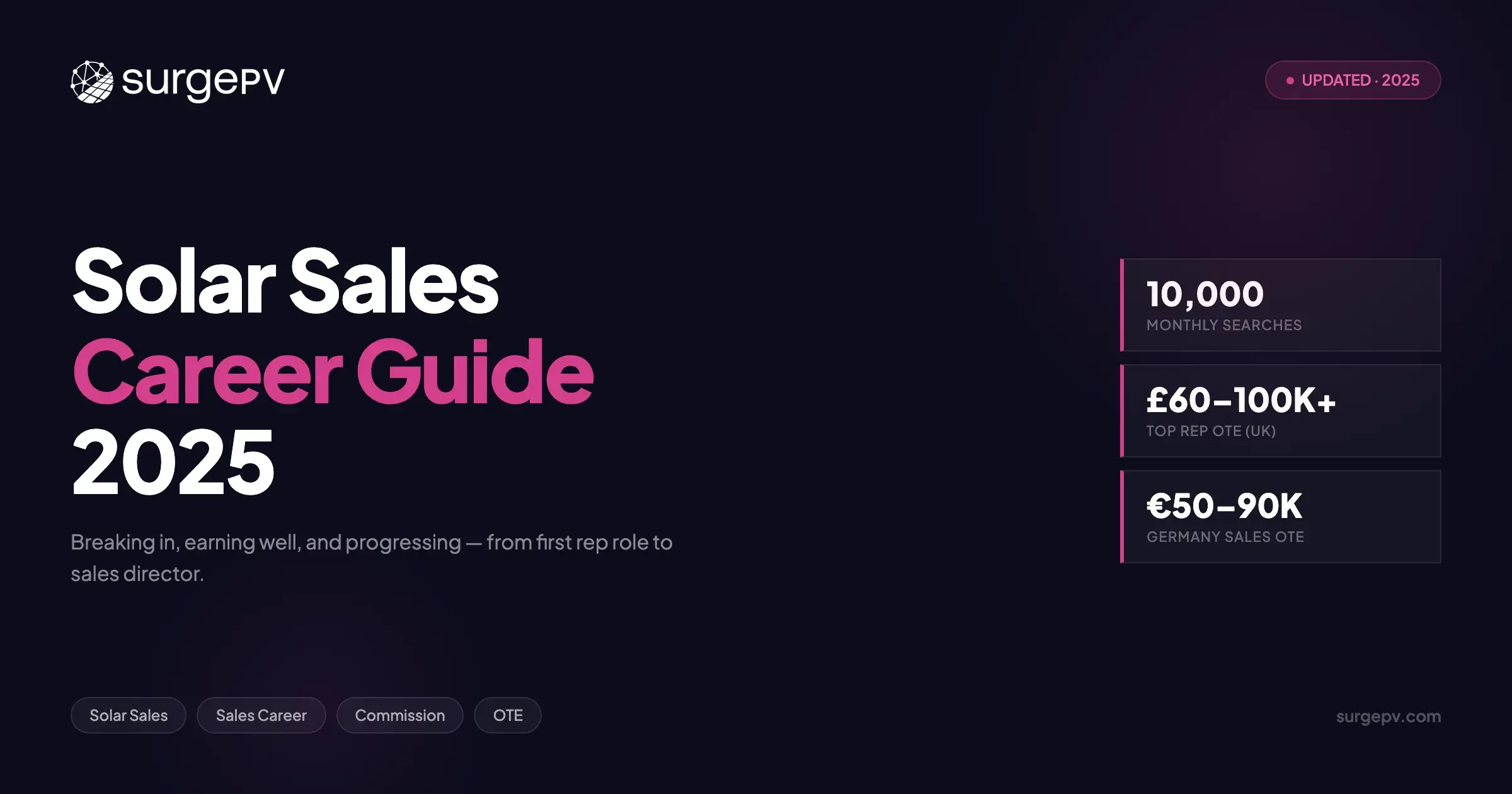
| United Kingdom | £28,000–£40,000 OTE | £45,000–£65,000 OTE | £70,000–£100,000+ | £60,000–£120,000 |
| Germany | €30,000–€42,000 OTE | €45,000–€65,000 OTE | €65,000–€90,000+ | €60,000–€110,000 |
| Italy | €24,000–€34,000 OTE | €35,000–€50,000 OTE | €50,000–€70,000+ | €50,000–€85,000 |
| Spain | €22,000–€32,000 OTE | €32,000–€48,000 OTE | €48,000–€65,000+ | €45,000–€80,000 |
| United States | $50,000–$75,000 OTE | $75,000–$110,000 OTE | $110,000–$160,000+ | $90,000–$180,000 |
OTE = On-Target Earnings (base + commission at 100% of target). Top performers regularly exceed OTE. All figures are gross, before tax.
Commission Structures to Understand
Per-watt commission: Common in residential solar, particularly in the US. The rep earns a fixed amount per watt of installed capacity (e.g., $0.20–$0.50/W). On a 10 kWp system, that's $2,000–$5,000 commission per deal. Higher-margin deals don't pay more, which can cause reps to push volume over value.
Per-deal flat commission: A fixed amount per closed deal regardless of system size. Simple and easy to understand but can incentivize reps to prioritize easy small deals over complex larger ones.
Percentage of deal value: Common in commercial roles. 1–3% of contract value. Aligns rep incentives with company revenue. A £200,000 commercial deal at 2% = £4,000 commission. Straightforward math; good alignment.
Margin-based commission: The rep earns a percentage of the gross margin rather than the revenue. This is the most aligned structure for the company - reps are rewarded for protecting margin, not just closing at any price. Some reps dislike it because they feel less control, but it produces the best outcomes for all parties.
Key Takeaway
When evaluating a solar sales job, the base salary matters as much as the commission potential. A commission-only role puts all financial risk on you and is a red flag that the company either has poor lead quality or high turnover. A good solar sales role has a base that covers your living costs and commission that rewards performance above that floor.
Residential vs. Commercial Solar Sales
The choice between residential and commercial solar sales is one of the most important career decisions a solar rep makes. The skills overlap, but the experience is quite different.
Residential Solar Sales
Deal size: £8,000–£25,000 per system (UK), €8,000–€22,000 (Europe). Some battery-storage add-on deals push higher.
Sales cycle: 1–4 weeks from first contact to signed contract.
Decision maker: Single homeowner or couple. One decision, relatively fast.
Volume: 4–12 closed deals per month for a good rep.
Emotional drivers: Energy bill savings, energy independence, environmental values, home improvement.
Residential sales is high-volume, relationship-driven work. Customers are making a significant personal financial decision and need to trust the person selling to them. The best residential solar reps are warm, clear communicators who listen well and don't pressure - high-pressure tactics produce short-term closings and long-term cancellations and chargebacks.
Commercial Solar Sales
Deal size: £50,000–£2M+ per project.
Sales cycle: 1–3 months for SME, 4–18 months for large C&I or public sector.
Decision makers: Multiple stakeholders - operations, finance, facilities, sometimes board-level.
Volume: 1–4 closed deals per month; higher value per deal.
Drivers: Operational cost reduction, sustainability commitments, ROI and payback, regulatory compliance.
Commercial sales requires a more consultative approach. You're building relationships over months, navigating internal approval processes, and presenting to people who will scrutinize the financial model. The ability to run a credible solar financial model and present accurate ROI and payback projections is not optional - commercial buyers have finance teams who will check your numbers.
Which to Choose?
If you're starting out and want fast learning and immediate feedback on your sales skills: start with residential. If you have a B2B background and are patient with longer cycles: commercial from the start is viable. If you want the highest earnings potential at a senior level: commercial - deal sizes and commission per sale are materially higher.
The Solar Sales Process: Lead to Close
Understanding the full sales process from first contact to signed contract is the foundation of effective solar sales. Each stage has specific objectives and common failure points.
Stage 1: Lead Qualification
Not every lead is worth pursuing. Qualifying before you invest time in a site visit saves hours and prevents wasted proposals. Key qualification criteria:
- Roof ownership (rented properties usually cannot install solar without landlord consent)
- Roof condition and age (a roof needing replacement within 5 years is a barrier)
- Current energy consumption (customers with very low bills get poor ROI and are less likely to convert)
- South or southwest orientation (east/west acceptable; north-facing primary roof is a problem)
- No planning restrictions (listed buildings, conservation areas, certain estates)
- Decision-maker present (selling to someone who needs to "check with their partner" slows the cycle significantly)
Stage 2: Site Visit
The site visit is where you gather the data for the design and build personal trust with the customer. What it involves:
- Roof inspection: orientation, pitch, condition, shading, access points
- Electrical assessment: consumer unit condition, available space, meter type
- Energy consumption review: 12 months of energy bills, usage patterns, EV or heat pump plans
- Customer goals conversation: are they primarily motivated by cost savings, energy independence, or sustainability?
Reps who use solar proposal software with on-site design capability can sometimes produce a preliminary design and ballpark proposal during the visit - this shortens the sales cycle significantly and avoids the "I'll send you the proposal and follow up next week" dead zone where customers lose momentum and competitors intervene.
Stage 3: Proposal
A professional solar proposal includes: the system design (roof layout, panel specification, inverter selection), the energy simulation (annual yield, self-consumption), the financial analysis (upfront cost, payback period, 25-year savings projection), the financing options (cash, loan, lease, PPA), and the company's installation credentials and warranty terms.
The proposal is a sales document as much as a technical document. A proposal that clearly shows the customer their expected return - in their currency, with their bill numbers - is significantly more persuasive than a generic system specification sheet. This is where the design and proposal tools a company uses directly affect close rates. A well-designed, visually clear proposal from purpose-built solar design software converts better than a spreadsheet export with a cover page.
Stage 4: Financing Conversation
Most residential customers ask about financing options. The rep needs to understand and present clearly: outright purchase (best long-term return, high upfront cost), solar loan (zero deposit options, spread cost, customer owns the system), and in some markets, lease or PPA options (lower upfront, monthly payment, company retains ownership). Directing customers to the right financing option for their situation - rather than the one with the highest commission - builds trust and reduces post-sale cancellations.
Stage 5: Objection Handling
The most common objections in solar sales and how to address them honestly:
- "The payback period is too long." Show the actual numbers - total lifetime savings vs. upfront cost. For most UK and European customers, the payback period is 7–12 years with a 25-year system life. The question is whether the investment makes sense; the numbers usually speak for themselves.
- "I want to get other quotes." Legitimate - encourage it. A confident solar company competes on value, not by preventing comparison. Offer to help the customer know what to compare.
- "Solar doesn't work in cloudy weather." Factually incorrect - panels generate in diffuse light, just at lower output. Share actual yield data for the customer's location.
- "What if something goes wrong?" Address warranty terms (panel manufacturer, inverter manufacturer, installation workmanship), MCS accreditation (UK), and the company's service track record directly.
Stage 6: Close and Contract
The close in solar sales is not a pressure tactic - it's a natural conclusion of a process where the customer has enough information and trust to make a decision. The most effective closing approach is a direct question: "Based on what we've discussed, does this make sense for you?" followed by silence. Customers who are ready will say yes or raise a final concern. Address the concern; ask again.
Contract and installation timeline commitments should be clear and realistic. Overpromising on installation dates is one of the most common causes of customer dissatisfaction and cancellations before install. Set honest expectations; deliver on them.
Win More Solar Deals with Better Proposals
SurgePV lets solar sales reps design systems and generate professional client proposals on the spot - at the site visit or the same day. Close faster with proposals that show real numbers, real designs, and real financial projections.
See SurgePV in ActionNo commitment · 20 minutes · Live proposal walkthrough
Tools Solar Salespeople Use
The tools you use directly affect your productivity and close rate. Here's what a well-equipped solar sales rep works with:
CRM (Customer Relationship Management)
HubSpot, Salesforce, or a solar-specific CRM manages your pipeline: leads, follow-up tasks, proposal status, and contract tracking. CRM discipline - logging every call, setting every follow-up - separates reps who consistently hit target from those who lose deals to forgotten callbacks.
Solar Design and Proposal Software
The most important tool for conversion. Software like SurgePV allows reps to model the customer's roof using satellite imagery, run shading analysis and energy simulation, and produce a professional proposal with financial projections - all within a single platform. Reps who can generate a same-day proposal while the customer's interest is high close at significantly higher rates than those who send a follow-up proposal 48 hours later.
The solar proposals chapter in our Sales Hub covers proposal best practices in detail.
Finance and Calculator Tools
A good payback calculator, ROI model, or financing comparison tool lets the rep answer the customer's core financial question - "is this worth it for me?" - with specific, credible numbers rather than generic claims. The SurgePV financial modeling tool combines generation simulation with financial analysis to produce customer-ready figures.
Scheduling and Appointment Tools
Calendly or company scheduling software for booking site visits and proposals. Reducing friction in the appointment-booking process increases show rates. A direct booking link in an email or SMS converts better than asking the customer to call to schedule.
Communication Tools
WhatsApp and SMS for customer follow-up - response rates from text are dramatically higher than from email alone. Video call tools (Zoom, Teams) for remote proposals and follow-ups, particularly in commercial sales.
Career Progression: Rep to Head of Sales
Solar sales has a clear progression ladder. Here's what each level looks like, with realistic salary expectations:
Solar Sales Career Ladder
Head of Sales / Commercial Director
10+ years | UK: £70,000–£100,000+ | Germany: €75,000–€120,000+
Sales Manager / Regional Sales Manager
6–10 years | UK: £50,000–£75,000 OTE | Germany: €55,000–€85,000 OTE
Senior Sales Rep / Key Account Manager
3–6 years | UK: £45,000–£80,000 OTE | Germany: €50,000–€85,000 OTE
Commercial Solar Sales Rep
2–4 years residential → commercial pivot | UK: £40,000–£65,000 OTE | Germany: €45,000–€70,000 OTE
Residential Solar Sales Rep (Experienced)
1–3 years | UK: £35,000–£65,000 OTE | Germany: €38,000–€65,000 OTE
Junior Solar Sales Rep / Trainee
0–1 year | UK: £28,000–£40,000 OTE | Germany: €30,000–€42,000 OTE
Junior Solar Sales Rep (0–1 Year)
At this level, you're learning the product, the process, and the customer. Most companies have structured onboarding with a defined ramp period (typically 60–90 days) before full quota applies. Focus: hit your appointment and close targets, learn the objections, learn the financing landscape. Don't try to shortcut the learning phase - the reps who take time to understand the product in the first 3 months consistently outperform those who start winging it immediately.
Residential Solar Sales Rep (1–3 Years)
You know the product, handle objections confidently, and close consistently at or above target. At this stage you're optimizing: your conversion rate from appointment to proposal, from proposal to close, and the average deal value (upselling battery storage, EV charging, monitoring). The best residential reps at this level also generate their own referrals - past customers who recommend them to friends add incremental leads at zero acquisition cost.
Commercial Solar Sales Rep (2–5 Years)
The natural step up from residential is commercial, either at the same company (if they have a commercial division) or by moving to a commercial-focused installer or developer. This pivot requires understanding business energy procurement, commercial financing structures, and multi-stakeholder sales. The income uplift is real - commercial deals are 5–50x the size of residential.
Sales Manager
After 4–7 years as a rep, the progression to sales management is based on demonstrated leadership as much as sales performance. Managing a team of 5–15 reps requires very different skills: coaching, pipeline forecasting, CRM discipline, hiring and onboarding, and creating an environment where the team performs consistently rather than in hero-and-zero swings. The transition from top individual contributor to effective manager is one the industry struggles with - many excellent reps make poor managers because the skills don't overlap as much as companies assume.
Head of Sales / Commercial Director
At this level, the role is strategic: setting market and channel strategy, managing key commercial relationships, representing the company at industry events, reporting to the CEO or board on revenue performance. Earnings are high; so are the expectations. The best heads of solar sales combine genuine market knowledge with commercial discipline and the ability to hire and develop the team beneath them.
Pro Tip
The reps who make the best managers are those who have documented and systematized their own process - their qualification script, their proposal structure, their objection playbook. If you can only explain what you do intuitively, you can't teach it. Start writing your process down in your first year. By year three, you have a playbook that makes you an obvious management candidate.
Red Flags: Companies and Roles to Avoid
The solar industry has a higher proportion of poor employers than most professional sales environments. The growth of the sector has attracted companies that see solar as a high-ticket item to push rather than a long-term product to sell responsibly. Here's what to watch for:
Commission-Only with No Base Salary
If a company offers no base salary, they're putting all financial risk on you. This is a warning that either: the lead quality is poor and close rates are too low to support a base salary, or the company has high turnover and can't justify the payroll risk on new hires. Commission-only sounds attractive when the OTE is quoted high - but you have no income floor if leads dry up or your territory underperforms in a slow quarter. Demand a base salary that at minimum covers your living costs before joining any solar sales role.
Unrealistic OTE Claims in Job Postings
"£200,000 OTE for first-year reps" is a recruiting lie. It's not impossible, but it describes the absolute top 1% of performance in the best markets. If a company is leading with extraordinary earnings claims to recruit, they either have poor close rates and are spinning the opportunity, or they're compensating with high OTE claims for a product that's genuinely hard to sell. Ask for the median OTE of current reps, not the maximum.
High-Pressure Close Tactics
Companies that train you to close on the first visit regardless of customer readiness, prevent customer comparison shopping, or use urgency tactics ("this price is only available today") produce short-term closings at the cost of long-term reputation. In most European markets, customers have a 14-day cooling-off right for distance sales. A company that relies on pressure tactics sees high cancellation rates in that window. That's a business problem that eventually becomes your problem - clawbacks, restructured commission, and market reputation damage.
Inflated Performance Projections
A company that routinely overstates energy yield, understates payback periods, or misrepresents the financial return to win deals is creating future liability - for itself and for you. In the UK, FCA consumer protection rules and the Consumer Rights Act apply. In Germany, EU consumer protection applies. Salespeople who knowingly make misrepresentations have personal liability exposure. This is not theoretical - solar mis-selling cases have resulted in company prosecutions and individual fines. If the design tool the company uses produces unrealistic yield estimates, that's a structural problem you can't work around.
High Visible Turnover
Check LinkedIn for the company's current team. If most sales reps have been there under 12 months, or if you see a pattern of short tenures from multiple ex-employees, that's a significant signal about the culture and management quality. The best solar sales companies retain their reps - the market is competitive enough that good reps have options and leave bad employers quickly.
No Structured Training or Onboarding
Solar is a technical product with complex financing. A company that doesn't invest in training its sales team either doesn't care about product accuracy (dangerous) or believes the sales process is so simple that anyone can do it without preparation (wrong). Either way, you'll be less effective than you could be and more likely to make claims you can't back up.
Key Takeaway
The solar companies worth joining have structured onboarding, a base salary that covers your living costs, realistic OTE targets based on actual team performance, a proposal process built on accurate design and simulation data, and reps who stay for more than 12 months. Ask to speak to a current rep during the interview process. Their experience tells you more than the job description.
Close More Solar Deals with Professional Proposals
SurgePV's solar proposal software gives your sales team accurate system designs, real energy simulations, and client-ready proposals - everything needed to present with confidence and close faster.
Book a DemoNo commitment required · 20 minutes · Live proposal walkthrough
Frequently Asked Questions
Can I get into solar sales with no solar experience?
Yes. Solar companies hire for sales ability, not solar knowledge. If you have a track record in B2C sales, real estate, financial services, construction, or any high-ticket consultative selling role, you have the foundation. Solar product knowledge takes 4–8 weeks of onboarding to develop. The companies worth joining provide structured training. The ones to avoid hand you a territory and expect you to figure it out.
How much can you earn in solar sales?
Earnings vary significantly by market, role, and performance. In the UK, on-target earnings for residential reps range from £28,000 at entry level to £80,000–£100,000+ for senior reps. Germany runs €30,000–€90,000+ OTE by experience level. Commercial B2B roles pay higher OTEs - £60,000–£120,000 in the UK, €60,000–€110,000 in Germany. See the full breakdown in the earnings table above. Always ask for the median OTE of current reps, not just the stated maximum.
What's the difference between residential and commercial solar sales?
Residential solar sales involves smaller deal values (£8,000–£25,000), shorter cycles (1–4 weeks), and a single decision-maker (the homeowner). Commercial involves larger deals (£50,000–£2M+), longer cycles (1–18 months), and multiple stakeholders. Residential gives faster feedback and higher volume; commercial gives larger commission per deal and higher career earnings potential at senior levels.
Is door-to-door solar sales worth doing?
D2D can generate strong earnings for the right person at the right company. The key question is whether the company operates ethically - transparent pricing, accurate performance projections, no high-pressure close tactics. D2D at an ethical solar company is a legitimate career start and develops prospecting discipline that transfers to any future sales role. D2D at a company that trains you to overcome all objections regardless of customer fit is damaging to your professional reputation and potentially to customers. Do your due diligence on the company before accepting any D2D role.
What are red flags in solar sales jobs?
Watch out for: commission-only with no base salary, unrealistic earnings claims (£200K OTE for first-year reps), training to close on first visit regardless of customer readiness, inflated energy yield projections, high visible staff turnover on LinkedIn, and no structured onboarding. The best solar sales companies have clear training, realistic OTE targets, accurate proposal tools, and reps who stay for multiple years. Ask to speak to a current rep before accepting any offer.
About the Contributors

Co-Founder · SurgePV
Nirav Dhanani is identified by SurgePV as a company co-founder. His SurgePV author page lists only role information that can be tied to the public profile below; credentials, project totals, conversion results, and market-expansion claims are not asserted without retained evidence.
