

Quick Answer
They get built by EPC contractors — single entities that absorb the risk, coordinate the workflow, and deliver operational plants. Understanding how EPC contractors work separates installers who attach panels from teams that deliver bankable assets. Solar adopted the model as projects scaled beyond simple residential rooftop installations into multi-megawatt commercial and utility-scale systems.
The global solar EPC market was valued at $246.41 billion in 2025 and is projected to reach $259.58 billion in 2026, growing at a 5.3% CAGR according to industry market data. That scale reflects a simple reality: most commercial and utility-scale solar projects do not get built by project owners managing separate designers, suppliers, and construction crews. They get built by EPC contractors — single entities that absorb the risk, coordinate the workflow, and deliver operational plants. For Global-specific compliance details, see Global net-metering-by-country.
They get built by EPC contractors — single entities that absorb the risk, coordinate the workflow, and deliver operational plants. Understanding how EPC contractors work separates installers who attach panels from teams that deliver bankable assets.
Understanding how EPC contractors work separates installers who attach panels from teams that deliver bankable assets. Whether you are a sales professional vetting a partner, a project owner evaluating bids, or an installer considering whether to expand into full EPC services, this guide covers every layer of the model.
TL;DR — What Is EPC in Solar?
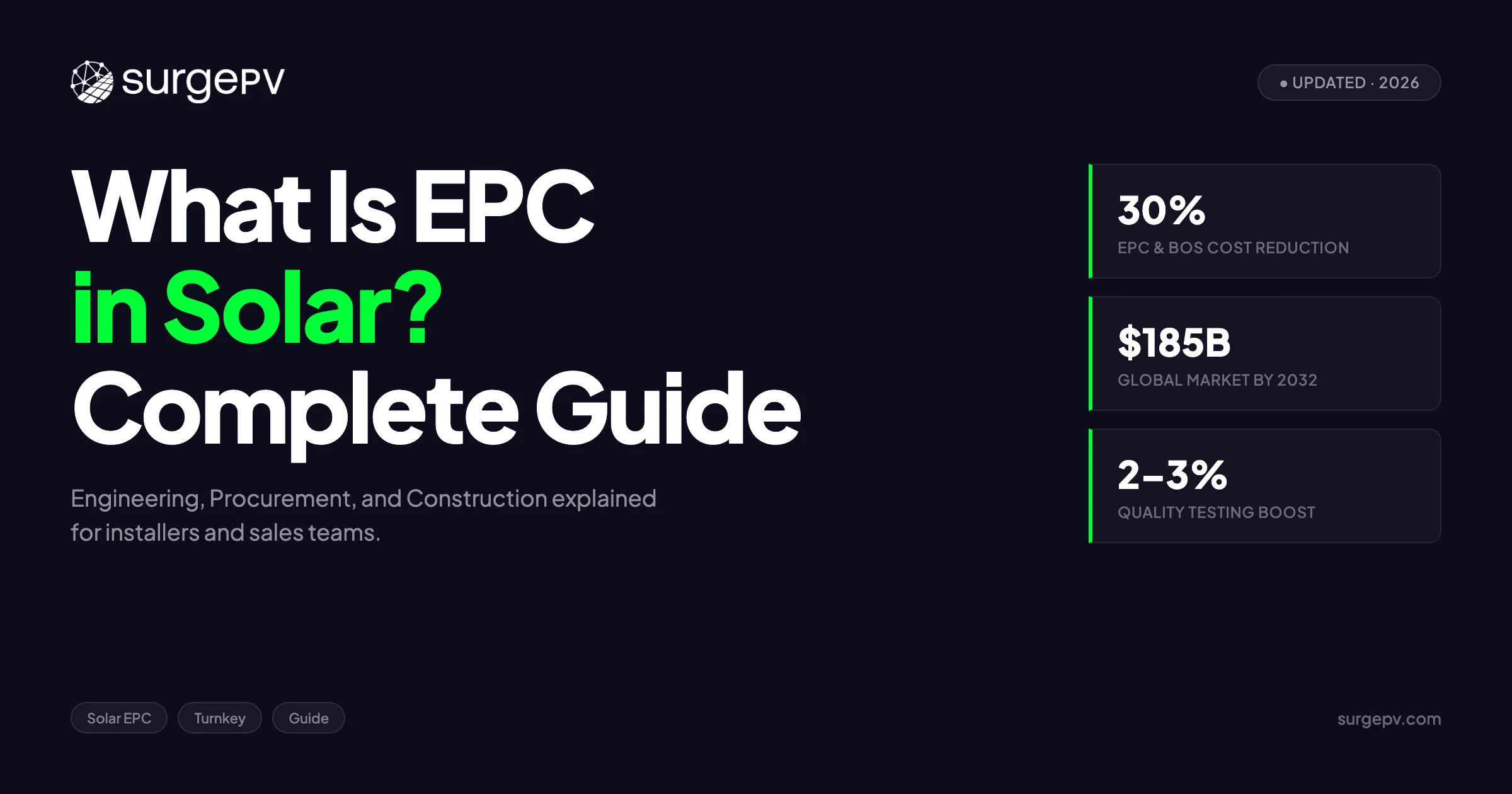
EPC stands for Engineering, Procurement, and Construction. A solar EPC contractor delivers turnkey solar projects from design through commissioning under a single contract, bearing responsibility for cost, schedule, and performance. The global solar EPC market exceeds $259 billion in 2026. IRENA found that EPC and balance-of-system soft costs drove roughly 30% of total installed cost reductions for utility-scale solar between 2010 and 2024 (IRENA, 2025).
What this guide covers:
- The exact scope of engineering, procurement, and construction in solar projects
- How EPC differs from design-build, EPCM, and self-perform delivery models
- Solar EPC contract structures: fixed-price, cost-plus, and hybrid models
- What liquidated damages and performance guarantees mean in practice
- How to evaluate a solar EPC contractor using an objective scorecard
- Global solar EPC market size, top companies, and regional pricing
- The sales-to-EPC handoff and why design accuracy drives margins
- Common EPC risks and mitigation strategies
- How PV design software and solar shadow analysis software streamline EPC workflows
What Does EPC Mean in Solar?
EPC means Engineering, Procurement, and Construction. In solar energy, an EPC contractor accepts single-point responsibility for all three phases under one contract. The owner signs one agreement and receives an operational plant. No separate contracts with designers, equipment vendors, or installation crews.
The EPC model originated in oil and gas and power generation, where complex infrastructure projects require tight coordination between engineering disciplines, equipment vendors, and construction crews. Solar adopted the model as projects scaled beyond simple residential rooftop installations into multi-megawatt commercial and utility-scale systems.
PwC notes that EPC contracts are sometimes called “turnkey” construction contracts, with the contractor delivering a complete facility for a guaranteed price by a guaranteed date (PwC, 2024). That definition matters in practice. When an inverter fails in year three, the owner calls the EPC. The EPC handles the warranty claim. They do not blame the electrical subcontractor or the distributor.
Many installers claim EPC status but subcontract engineering or buy equipment through a third party. They are not true EPCs. Single-point accountability is the differentiator.
| Phase | Solar-Specific Scope | Key Deliverable |
|---|---|---|
| Engineering | Site assessment, structural calc, electrical design, energy modeling, permitting | Permit-ready plan set |
| Procurement | Module and inverter sourcing, BOS logistics, freight, warehousing, quality inspection | Itemized BOM with warranties |
| Construction | Installation, wiring, testing, commissioning, grid interconnection, safety compliance | Operational plant with LDs passed |
Each pillar carries distinct risks. Engineering errors show up as change orders during construction. Procurement mistakes delay schedules by weeks. Construction defects trigger warranty claims years later. The EPC model exists to consolidate those risks under one entity.
For sales teams, the distinction is practical. A dealer who partners with a true EPC can promise turnkey delivery. A dealer who uses fragmented subcontractors must manage gaps themselves. Gaps create cost overruns. Cost overruns kill margins and reputations.
The Three Phases of Solar EPC in Detail
Engineering Phase
Pre-construction engineering begins with feasibility. The EPC studies shade patterns, roof structural loads, and soil conditions. They run topographic surveys and geotechnical tests when ground-mounts are involved.
Feasibility sets the boundaries for everything that follows. IRENA notes that independent quality testing under EPC contracts can boost PV system performance by 2–3% (IRENA, 2017). That gain comes from rigorous engineering review. Good EPCs do not rush this phase. They produce permit-ready plan sets before procurement begins.
Engineering deliverables typically include:
- Site survey and solar resource assessment
- Shade analysis and obstruction modeling
- Structural engineering calculations for roof or ground mount
- Electrical single-line and three-line diagrams
- String configuration tables
- Conduit routing and grounding plans
- Permit drawings compliant with local AHJ and NEC or IEC standards
- Interconnection application documentation
The engineering phase for a 1 MW commercial project typically runs 4–8 weeks. Rushed engineering leads to field changes. Field changes delay commissioning. Delayed commissioning pushes projects past incentive deadlines. For more on this topic, see Design Commercial Solar System 1MW.
Using solar PV design software during the engineering phase cuts plan-set revision cycles. Designers see clashes before they reach the field. Module layouts adjust to vents, skylights, and structural members automatically. Physics-based solar shadow analysis software prevents underperformance claims.
Procurement Phase
Procurement strategy separates professional EPCs from amateurs. Bankable Tier-1 modules are non-negotiable for financed projects. Inverter matching depends on voltage windows, string sizing, and future clipping analysis.
Tier-1 status means the manufacturer has supplied modules to 6 different projects over 1.5 MW each, financed by 6 different banks, in the past 2 years. The list changes quarterly. EPCs must track it. Using outdated Tier-1 lists has killed deals at the closing table.
Balance-of-system selection — racking, wiring, combiner boxes — must align with the structural calculation. Freight scheduling and customs handling add complexity on international projects. Warehousing strategy matters too. Equipment staged on site too early risks theft. Equipment arriving late idles crews. The EPC must synchronize delivery with the construction schedule.
Procurement lead times vary by equipment category and market conditions:
| Equipment Category | Typical Lead Time | Key Variables |
|---|---|---|
| Solar modules (Tier-1) | 2–8 weeks | Manufacturer capacity, shipping lane availability |
| String inverters | 4–10 weeks | Model popularity, semiconductor supply chain |
| Central inverters | 8–16 weeks | Custom configuration, factory backlog |
| Mounting systems | 2–5 weeks | Regional supplier proximity, order size |
| Transformers and switchgear | 8–20 weeks | Utility specification, custom builds |
IRENA found that modules and inverters accounted for 60% of total installed cost reduction over 2010–2024 (IRENA, 2025). EPC and balance-of-system soft costs accounted for roughly 30%. Equipment prices dropped because manufacturing scaled. Soft costs dropped because EPCs improved logistics and design efficiency.
Three procurement errors destroy margins:
- Accepting non-bankable modules. A 2-cent/W savings on non-Tier-1 panels can void project financing. The owner cannot close the loan. The EPC must rebid with compliant equipment.
- Ignoring freight Incoterms. Ex-works pricing looks cheap until ocean freight and duties arrive. The EPC must model total landed cost. FOB, CIF, and DDP terms produce wildly different outcomes.
- Mismatching inverter voltage windows. A 1,500 V inverter on a 1,000 V module string wastes capacity and voids warranties. Design software must validate voltage ranges before procurement begins.
For more on European procurement specifically, see our guide on solar procurement challenges in Europe. Also see: European Solar Incentives.
Construction Phase
Construction management demands OSHA compliance, subcontractor coordination, and daily safety briefings. The EPC schedules inspections and utility witness tests. They manage the interconnection application timeline.
Construction is where engineering errors become expensive. A mis-labeled conduit run can cost $5,000 to fix after walls are closed. A racking layout that ignores roof penetrations creates leaks. A string wired in reverse polarity damages the inverter.
Three scope-gap errors appear again and again:
- Skipping structural sign-off. A roof that looks fine may lack the load capacity for ballasted racking. Engineers must stamp the structural calc.
- Assuming inverter compatibility. Not every string inverter works with every module voltage. Mismatching Voc and Vmp ranges creates commissioning failures.
- Omitting as-built documentation. Utilities and tax authorities require as-builts. Missing drawings delay Permission to Operate.
NREL warns that construction should not begin until engineering is sufficiently complete to avoid delays and rework. Bidding a 3-year versus 2-year construction EPC contract has direct cost implications.
The construction phase for a 1 MW commercial rooftop typically runs 4–8 weeks. Utility-scale ground-mount projects take 6–12 months depending on terrain, weather windows, and grid connection complexity.
Commissioning and Handoff
Commissioning verifies that the installed system matches the design specifications and is safe to energize. Key tests include IV curve testing on each string, thermal imaging to identify hot spots, insulation resistance testing on DC wiring, string-level voltage and current measurements, inverter startup and grid synchronization checks, and monitoring system configuration.
Acceptance testing includes insulation resistance checks, inverter startup sequences, utility witness tests, and PVSyst back-casting. The EPC must prove the system produces within a defined tolerance of the model. Typical tolerance is 95% of predicted production. Some aggressive contracts demand 98%. For software options, see 7 Best PVsyst Alternatives in.
That narrow band leaves little room for modeling error. When estimates match reality, owners do not invoke performance guarantees. When estimates miss, the EPC pays liquidated damages.
The handoff from EPC to O&M is the final test of professionalism. Organized EPCs deliver a binder with warranties, as-builts, test reports, and training logs. Disorganized EPCs leave a pile of invoices. Owners remember which type they received.
EPC vs. Other Project Delivery Models
EPC vs design-build solar is a common search because the differences are subtle. The choice determines who bears risk, who controls procurement, and how change orders flow.
| Factor | EPC | Design-Build | EPCM | Design-Bid-Build | Self-Perform |
|---|---|---|---|---|---|
| Single-point accountability | Yes | Yes | No (agent) | No | No |
| Owner procurement involvement | Minimal | Minimal | High | High | Full |
| Best for | Utility and C&I turnkey | Fast-track residential | Owner with in-house PM | Public-sector bids | Large developer with full team |
| Risk allocation | Contractor bears cost and schedule | Shared | Owner bears most | Owner bears most | Owner bears all |
| Change order frequency | Lower | Moderate | Higher | Highest | Low (internal) |
| Price certainty | Highest (fixed price) | Moderate | Low | Low | Full control |
EPC locks price and schedule. The contractor quotes a fixed sum. They absorb cost overruns. This model suits utility and C&I projects where financing requires budget certainty. Lenders prefer EPC contracts because they can underwrite against a fixed number.
Design-build shares risk differently. One entity handles design and construction, but pricing may adjust as details emerge. Speed matters more than price lock. Fast-track residential projects often use this model when the owner needs energization before a tax deadline.
EPCM — Engineering, Procurement, Construction Management — makes the contractor an agent, not a principal. The owner buys equipment directly. The owner holds the contracts. The EPCM manages on behalf of the owner. This model suits developers with in-house procurement teams and strong credit.
Design-bid-build splits every phase. An engineer designs. Bidders compete on construction. The owner coordinates both. Public-sector projects often require this structure for transparency and competitive bidding rules.
Self-perform means the project owner manages separate contracts for engineering, equipment supply, and installation using internal staff. Self-perform can reduce cost on large projects but requires experienced in-house project management. For most commercial and utility-scale solar projects, the EPC model is faster because it eliminates handoff delays between engineering and procurement.
A developer with a 10-MW site chooses EPCM because they want to direct-procure modules. They have existing supplier relationships. They accept the risk of price volatility.
A residential dealer chooses EPC because they need turnkey execution. They do not have staff to manage 20 subcontractors or negotiate Incoterms with overseas factories.
Risk allocation drives the decision. EPC contractors price risk into their bids. They add contingency for unknown site conditions. They buffer module price swings. That buffer raises the initial quote. It also caps the owner’s exposure.
Sales professionals should know which model their EPC partner uses. A dealer selling EPC can promise fixed pricing. A dealer selling design-build must warn clients that final costs may shift. Mismatched expectations create disputes.
For more on project management workflows, see our solar project management guide.
Solar EPC Contract Structures and Pricing
Turnkey solar project delivery depends on contract structure. The wrong structure transfers risk to the party least able to bear it.
Fixed-Price Contracts
Fixed-price EPC contracts are the industry standard. The contractor quotes a lump sum. They execute everything inside that number.
If steel tariffs rise, the EPC eats the difference. If labor takes longer, the EPC absorbs the cost. NREL recommends fixed-price, turnkey EPC contracts with a full wrap-around performance guarantee to mitigate cost-escalation and delay risks (NREL, 2020).
Owners love fixed pricing because budgets do not drift. Financiers love it because debt service is predictable.
Contractors price it carefully. They build contingency into every line item. A typical contingency reserve is 8–12% of direct costs for commercial projects and 12–18% for utility-scale projects where unknown site conditions create more risk.
Cost-Plus Contracts
Cost-plus contracts work when commodity volatility makes fixed pricing impossible. The owner pays actual costs plus a fee.
This model is rare in utility solar but common in residential custom work. Hybrid models use fixed pricing for labor and cost-plus for modules when module prices are swinging.
Cost-plus shifts risk to the owner. The contractor has less incentive to control costs. The owner must audit invoices. This structure only works when the owner has strong project controls and trusts the contractor’s procurement process.
Liquidated Damages
Liquidated damages are pre-agreed penalties. The EPC pays them for missing schedule or performance targets.
A typical delay LD clause might charge $500–$2,000 per day for delay past the Commercial Operation Date. Performance LDs reduce payment if year-one production falls under 95% of the guarantee.
Three contract traps catch inexperienced owners:
- Vague scope boundaries. “Electrical work” is not specific. The contract must list conduit, wiring, switchgear, and monitoring.
- Missing LD caps. Unlimited liquidated damages expose the EPC to catastrophic liability. Cap LDs at 10–15% of contract value.
- No defined acceptance-test protocol. How do you prove the plant works? The contract must specify irradiance conditions, test duration, and allowable deviation.
Performance Guarantees
A performance guarantee is a contractual promise that the plant will produce a minimum kWh in year one. The guarantee is backed by liquidated damages. If actual production falls short, the EPC pays the owner the difference.
Guarantees usually last 1–3 years. After that, the owner relies on manufacturer warranties and O&M contracts. The guarantee threshold is typically 95% of the energy model prediction. Some aggressive contracts demand 98%, leaving almost no room for modeling error.
EPC Pricing by Project Type and Region
| Project Type | US Pricing ($/Wdc) | India Pricing ($/Wdc) | Europe Pricing (€/Wdc) |
|---|---|---|---|
| Residential turnkey (under 10 kW) | $1.50–$3.00 | $1.00–$1.80 | €1.20–€2.00 |
| Commercial rooftop (100 kW–1 MW) | $1.00–$1.80 | $0.60–$1.00 | €0.80–€1.40 |
| Utility-scale ground mount (5+ MW) | $0.50–$1.20 | $0.30–$0.60 | €0.60–€1.00 |
| Community solar | $0.80–$1.40 | $0.50–$0.90 | €0.70–€1.20 |
These figures include equipment, labor, engineering, and the EPC contractor’s margin. Actual pricing depends on location, equipment selection, site conditions, and prevailing labor rates. US residential pricing is higher because soft costs dominate smaller projects. Indian utility pricing is lower due to competitive labor markets and localized supply chains. For India-specific information, see 5kW Solar Panel Price in India. Read more about Solar Energy India.
Sales reps who understand contract structures sell more confidently. They explain why their EPC partner quotes $1.10/W instead of $0.90/W. The difference is risk absorption. Cheap quotes often come from contractors who left contingency out. Those contractors disappear when problems arise.
How to Evaluate and Select a Solar EPC Contractor
Choosing an EPC contractor partner is the most consequential decision a dealer or project owner makes. A bad EPC destroys reputations. A good one builds repeat business.
| Criterion | What to Ask | Red Flag | Green Flag |
|---|---|---|---|
| Safety record | What is your TRIR? | Above industry average of 2.8 | TRIR under 1.5 with documented programs |
| Financial bonding | Can you provide a performance bond? | No surety backing | Bond capacity exceeding your project value |
| Track record | How many projects in my size range? | No references in past 2 years | 10+ similar projects completed |
| Software stack | Do you accept digital plan sets and BOMs? | PDF-only workflows | Integrated design-to-proposal workflow |
| Warranty terms | What is your workmanship warranty period? | Less than 5 years | 10-year workmanship warranty |
| LD history | Have you paid liquidated damages in past 3 years? | Multiple instances | Zero or one isolated incident |
| Financial health | Can you share audited financials? | Declining revenue or litigation | Strong balance sheet, growing backlog |
SEIA notes that Conti Solar achieved 4 years without a recordable injury, recording a TRIR of 0.00 (SEIA, 2019). That level of discipline reflects in every aspect of project delivery. Safe contractors are organized contractors. Organized contractors hit schedules.
A sales team vets 3 EPCs for a 2-MW portfolio. Two accept CAD files and digital BOMs. One demands printed PDFs and manual data entry. The team eliminates the PDF-only EPC. Integration with solar software platform is not a luxury. It is a signal of operational maturity.
Financial bonding matters on C&I and utility projects. A performance bond guarantees the owner that the EPC can complete the job even if the contractor goes bankrupt. No bond means no safety net. Owners and lenders often require bonds on projects over $1 million.
Workmanship warranties reveal confidence. A 2-year warranty suggests the EPC expects problems. A 10-year warranty suggests they trust their crews and materials. Five years is the minimum acceptable term for commercial work.
Liquidated damages history is uncomfortable to discuss. Ask anyway. An EPC that paid LDs twice in three years has systemic scheduling or engineering issues. One incident may be bad luck. Two is a pattern.
The best solar EPC company for your deal is not always the cheapest. It is the one with the lowest total cost of ownership. That includes change orders, delay costs, and warranty claims. A $0.05/W premium upfront often saves $0.15/W in avoided problems.
Dealers should visit active job sites. Look for clean cable management. Check that safety gear is worn. Talk to subcontractors. A site visit reveals more than any brochure or credentials packet.
Global Solar EPC Market: Size, Trends, and Key Players
The solar EPC market is large, global, and consolidating. Understanding the market structure helps project owners evaluate bids and EPCs position themselves competitively.
Market Size and Growth
The global solar EPC market was valued at $246.41 billion in 2025 and is projected to reach $259.58 billion in 2026, heading toward an estimated $317.6 billion by 2030. Growth is driven by utility-scale expansion, hybrid solar-plus-storage projects, and distributed commercial rooftop programs across Asia, the Middle East, and the Americas. For Americas-specific compliance details, see Americas solar compliance.
India represents one of the fastest-growing EPC markets. Cumulative installed solar PV capacity reached 150.26 GW as of March 2026. India added a record 44.6 GW of solar capacity in FY 2025–26 alone — the highest ever for a single financial year.
In the US, average utility-scale solar project size has grown from 15 MW a decade ago to 90 MW today, driving demand for specialized large-scale EPC capability.
Leading Solar EPC Contractors
| Company | Region | Capacity/Track Record | Notable Strength |
|---|---|---|---|
| Sterling & Wilson Renewable Energy | Global | 21.4 GW solar across 28 countries | World’s largest solar EPC outside China |
| L&T Construction (PT&D) | India/Global | 22 GWp renewable EPC experience | Infrastructure-backed; floating solar and BESS |
| SOLV Energy | United States | 13.6+ GW utility-scale solar | #1 US solar EPC contractor |
| ReNew Power | India | ~15.6 GW renewable energy | Largest Indian renewable IPP with in-house EPC |
| Hartek Group | India | 10 GW+ grid-connected solar | 3rd largest solar EPC in India |
| Tata Power Solar | India | 6.4 GW+ installed | Vertically integrated with module manufacturing |
| PowerChina | Global | RMB 147.893 billion contracts (Jan–Feb 2026) | Major Middle East and Africa presence |
| Mahindra Susten | India | 1.65 GWp+ operational | Strong in industrial and commercial segments |
Key Industry Trends in 2026
Solar-plus-storage integration. EPC contractors are increasingly bundling Battery Energy Storage Systems with solar PV. Major contracts now routinely include hybrid solar-plus-storage scopes. PowerChina won a landmark contract for 2.1 GW solar plus 7.75 GWh battery storage in the UAE — one of the largest such projects globally. Read Adding Battery Storage Services for a complete walkthrough.
Vertical integration. Companies with in-house module manufacturing (Adani, Tata Power Solar, Waaree, Vikram Solar) gain cost and supply-chain advantages.
Infrastructure conglomerates entering solar. Traditional civil EPC players like L&T, KEC International, and Ashoka Buildcon use their balance sheets and execution capabilities to capture large-scale solar park contracts.
Project scale inflation. Both in India and the US, average project sizes have increased dramatically, favoring EPCs with ultra-large-scale execution experience.
Domestic content requirements. In markets like India and the US, tariffs and local content rules are reshaping procurement strategies, pushing EPCs toward localized supply chains.
The Sales-to-EPC Handoff: Why Design Accuracy Matters
The handoff from sales to EPC is the critical transition. Accurate site data, shade analysis, production estimates, and equipment specs must transfer cleanly. A missing roof dimension or wrong azimuth estimate forces engineering rework.
NREL warns that construction should not be allowed to begin until engineering is sufficiently complete to avoid delays and rework (NREL, 2020). Rushed engineering leads to field changes. Field changes delay commissioning. Delayed commissioning pushes projects past incentive deadlines.
Design accuracy prevents change orders. A mis-modeled roof condition or undetected obstruction adds 2–4 weeks. That delay pushes the project past utility net-metering caps or tax credit windows. Past deadlines kill project economics.
A sales rep uses solar proposal software to send a branded PDF with module layout and financials. The EPC receives the same file. Engineering rework drops by 40%. Permits submit in 5 days instead of 12.
The generation and financial tool in the proposal gives the EPC a verified production estimate. They do not second-guess the numbers. Trust in the sales handoff accelerates every downstream step.
Typical C&I Turnkey Timeline
| Week | Phase | Key Milestone |
|---|---|---|
| 1–2 | Sales handoff | Site data, shade report, equipment spec locked |
| 3–6 | Engineering | Permit-ready plan set submitted |
| 7–10 | Procurement | Modules, inverters, BOS ordered and staged |
| 11–18 | Construction | Installation, wiring, testing complete |
| 19–20 | Commissioning | Utility witness test, PTO granted |
Dealers who compress the handoff phase gain weeks. Those who skip steps lose months. The EPC cannot build faster than the information they receive.
Pre-construction meetings help. Bring the sales rep, the EPC project manager, and the lead installer together. Review the site photos. Confirm roof access. Verify electrical service capacity. These 30 minutes prevent days of rework.
For more on commercial system design workflows, see our commercial solar system design guide.
Common EPC Risks and How to Mitigate Them
Solar project risk management covers four categories. Understanding them helps EPCs protect margins and helps owners evaluate bids.
Schedule Risk
Permit delays, supply chain disruptions, and weather cause schedule overruns. The average 50 MW solar project that hits a delay costs approximately $2M in overruns, according to construction monitoring data from Percepto. Roughly 20% of all planned solar capacity misses its intended commissioning date.
Mitigation: Build 15–20% schedule contingency into the project timeline. Place equipment orders during the engineering phase so they arrive before construction mobilizes. Pre-qualify suppliers with track records of on-time delivery.
Cost Overrun Risk
Material price spikes, change orders, and underestimated labor hours erode margins. EPC contractors price risk into their bids. A contractor who leaves contingency out will quote lower but fail when conditions change.
Mitigation: Use fixed-price contracts with defined scope boundaries. Document every change order with cost and schedule impact before work proceeds. Track actual spend against the EPC budget at least weekly during construction.
Technical Risk
Design errors, site surprises, and equipment failures create technical problems. A mis-labeled conduit run costs $5,000 to fix after walls are closed. An inverter failure in year three triggers warranty claims and customer frustration.
Mitigation: Complete all shading analysis, structural review, and AHJ feedback before releasing the design for procurement. Commission systematically — test every string, verify every connection, document every step. A thorough commissioning process prevents callbacks.
Procurement Risk
Non-bankable modules, freight cost surprises, and mismatched equipment specifications create procurement failures. Equipment arriving late idles crews. Wrong equipment requires returns and reorders.
Mitigation: Validate the full bill of materials against the design before placing orders. Use design software that auto-generates BOMs from the 3D model to eliminate transcription errors. Track Tier-1 manufacturer status quarterly.
Why Engineering Accuracy Drives EPC Margins
Remote site assessment via satellite and lidar reduces truck rolls. An EPC can evaluate 20 sites in the time it once took to visit 3. Satellite imagery identifies obstructions. Lidar confirms roof pitch and height. Remote data is not perfect. It is good enough to disqualify bad leads before engineers spend time on them.
3D modeling and string sizing inside solar design platform cut plan-set revision cycles. Designers see clashes before they reach the field. Module layouts adjust to vents, skylights, and structural members automatically.
Physics-based solar shading analysis tool prevents underperformance claims. An accurate shade model means production estimates hold up in year-one reality. When estimates match reality, owners do not invoke performance guarantees. When estimates miss, the EPC pays liquidated damages.
Shade analysis is not a nice-to-have. It is insurance against warranty claims.
An EPC uses automated BOM generation tied to the 3D model. The BOM feeds procurement directly. No manual copy-paste means no ordering errors. The warehouse receives the exact count of rail clips and mid-clamps. Procurement teams do not guess.
Engineering accuracy is margin protection. Every hour of rework is an hour not billed. Every change order is a conversation the EPC did not plan. Every performance shortfall is a liability that erodes profit.
Sales teams who feed accurate data into engineering protect the entire chain. A good site survey, a clear photo set, and a precise shade report let engineers design right the first time. First-time-right design is the cheapest design.
Cut EPC Rework by 40% With Connected Design
SurgePV links 3D modeling, shadow analysis, and proposals in one workspace — reducing engineering time and improving EPC bid accuracy.
Book a DemoNo commitment required · 20 minutes · Live project walkthrough
Conclusion
EPC contractors absorb the risk that sinks projects. They engineer, procure, and build under one contract. The global market exceeds $259 billion in 2026 and continues to grow as solar projects scale and complexify.
For project owners, the EPC model offers single-point accountability, fixed-price certainty, and performance guarantees that make projects bankable. For installers and sales teams, understanding EPC scope, contract terms, and evaluation criteria closes better deals and protects reputations.
Three actions will improve your EPC outcomes:
- Vet before you sign. Inspect job sites, review safety records, and verify bonding capacity before selecting an EPC partner. The lowest bid is rarely the best bid.
- Invest in design accuracy. Accurate site data, shade reports, and production estimates handed cleanly from sales to engineering prevent the change orders and delays that destroy margins.
- Understand your contract. Know what liquidated damages cover, what the performance guarantee requires, and where scope boundaries sit. Ambiguity creates disputes.
The EPC model works because it aligns incentives. The contractor only gets paid when the plant works. That alignment is why EPC dominates commercial and utility-scale solar — and why understanding it is essential for anyone serious about the industry.
Frequently Asked Questions
What does EPC stand for in solar energy?
EPC stands for Engineering, Procurement, and Construction. It is a single-contract project delivery model where one contractor handles the complete solar installation process — from system design and engineering through equipment sourcing and physical construction — delivering a fully operational plant to the project owner. The EPC contractor bears responsibility for cost, schedule, and performance.
What is the difference between a solar EPC and a solar installer?
A solar installer typically handles only the physical construction phase — mounting panels, running conduit, and connecting wiring. A solar EPC contractor manages all three phases: engineering (design and permits), procurement (equipment sourcing), and construction (installation and commissioning). The EPC provides single-point accountability under one contract. An installer does not. Many companies call themselves EPCs but subcontract engineering or buy equipment through distributors rather than managing the full chain themselves.
How much does a solar EPC contractor charge per watt?
Solar EPC pricing varies by project scale and region. In the US, residential turnkey EPC typically ranges from $1.50–$3.00/Wdc. Commercial rooftop EPC runs $1.00–$1.80/W for systems between 100 kW and 1 MW. Utility-scale ground-mount EPC ranges from $0.50–$1.20/Wdc depending on site complexity and labor market. In India, utility-scale EPC bids can run under $0.40/Wdc. European bids often exceed $1.00/Wdc due to labor and regulatory costs. These figures include equipment, labor, engineering, and the EPC contractor’s margin.
What is the difference between EPC and design-build in solar?
In an EPC contract, the contractor delivers a turnkey plant for a fixed price by a fixed date, absorbing cost and schedule risk. In a design-build contract, one entity handles design and construction but pricing may adjust as details emerge, sharing risk between owner and contractor. EPC is preferred for utility and commercial projects where financing requires budget certainty. Design-build is faster and suits residential projects where speed matters more than price lock. EPCM (Engineering, Procurement, Construction Management) makes the contractor an agent who manages on the owner’s behalf, with the owner holding equipment contracts and bearing most risk.
What should I look for when choosing a solar EPC contractor?
Evaluate five criteria: (1) Safety record — ask for TRIR data and OSHA incident history. (2) Financial stability — request a performance bond and review surety backing. (3) Track record — verify completed projects in your size range and technology type. (4) Software integration — confirm they accept digital plan sets and BOMs rather than PDF-only workflows. (5) Warranty and LD terms — a workmanship warranty under 5 years or a history of paying liquidated damages are red flags. Visit active job sites to inspect cable management, safety gear usage, and crew organization. Also see: Us Residential Solar Market Trends 2026.
Can solar design software replace an EPC contractor?
No. Solar design software speeds engineering, improves accuracy, and connects sales to engineering workflows. It automates BOM generation, shade analysis, and production modeling. But it does not replace construction crews, procurement relationships, or the physical installation work. Software makes EPCs faster and more accurate. It does not make them optional. Boots on the roof still matter. Wires still need proper torque specs. Commissioning still requires qualified technicians.
What are liquidated damages in a solar EPC contract?
Liquidated damages (LDs) are pre-agreed financial penalties written into the EPC contract. The contractor pays them for missing schedule milestones or performance targets. A typical delay LD charges $500–$2,000 per day past the Commercial Operation Date. Performance LDs reduce payment if year-one production falls below a guaranteed threshold, usually 95% of the predicted output. LD caps typically range from 10–15% of total contract value to protect the contractor from catastrophic liability while still motivating on-time, on-spec delivery.
What is the typical timeline for a solar EPC project?
Timelines scale with project size. A residential system (under 10 kW) takes 6–18 weeks from contract to commissioning. A commercial rooftop project (100 kW–1 MW) runs 3–6 months. A utility-scale ground-mount project (5+ MW) takes 12–24 months. The engineering phase typically runs 4–8 weeks, procurement 6–12 weeks (overlapping with engineering), construction 4–16 weeks depending on size, and commissioning 1–3 weeks. The biggest schedule risks are permit rejection cycles (adds 2–4 weeks per revision), equipment lead times (2–16 weeks depending on market conditions), and utility interconnection queue delays (4–12 weeks for commercial, 12–24 months for large utility projects).
Where this fits
This article is part of SurgePV's Solar Business & Operations hub, which works through the topic from first principles to the decisions a project team actually has to make.

