
Quick Answer
A common proposal rule of thumb claims that trackers add 20 percent. In Rajasthan, a tracker adds 27 percent and pays back its premium in under 4 years. The module price floor of approximately 0.10 USD/W (BNEF Module Price Index, February 2026) and current tracker pricing are baked in.
A common proposal rule of thumb claims that trackers add 20 percent. In Rajasthan, a tracker adds 27 percent and pays back its premium in under 4 years. The module price floor of approximately 0.10 USD/W (BNEF Module Price Index, February 2026) and current tracker pricing are baked in.
Every ground-mount solar project above 500 kW faces the same early decision. Do you rack the modules at a fixed tilt and accept the simpler CAPEX profile? Or do you add motors, controllers, and maintenance liability in exchange for higher yield?
A common proposal rule of thumb claims that trackers add 20 percent. That number collapses on real sites. In Bavaria, a tracker adds closer to 18 percent, and the LCOE still loses to fixed tilt because the electricity price is too low. In Rajasthan, a tracker adds 27 percent and pays back its premium in under 4 years. The hardware is identical. The site determines the outcome.
This guide is for installers, EPC engineers, C&I developers, and channel managers sizing ground-mount projects from 1 MW to 100 MW. It is not for residential homeowners; rooftop trackers do not exist in any commercially viable form. Every number here is sourced from NREL, LBNL, IRENA, Lazard, or operating fleet data. The module price floor of approximately 0.10 USD/W (BNEF Module Price Index, February 2026) and current tracker pricing are baked in.
TL;DR — Tracker vs fixed tilt solar in 2026
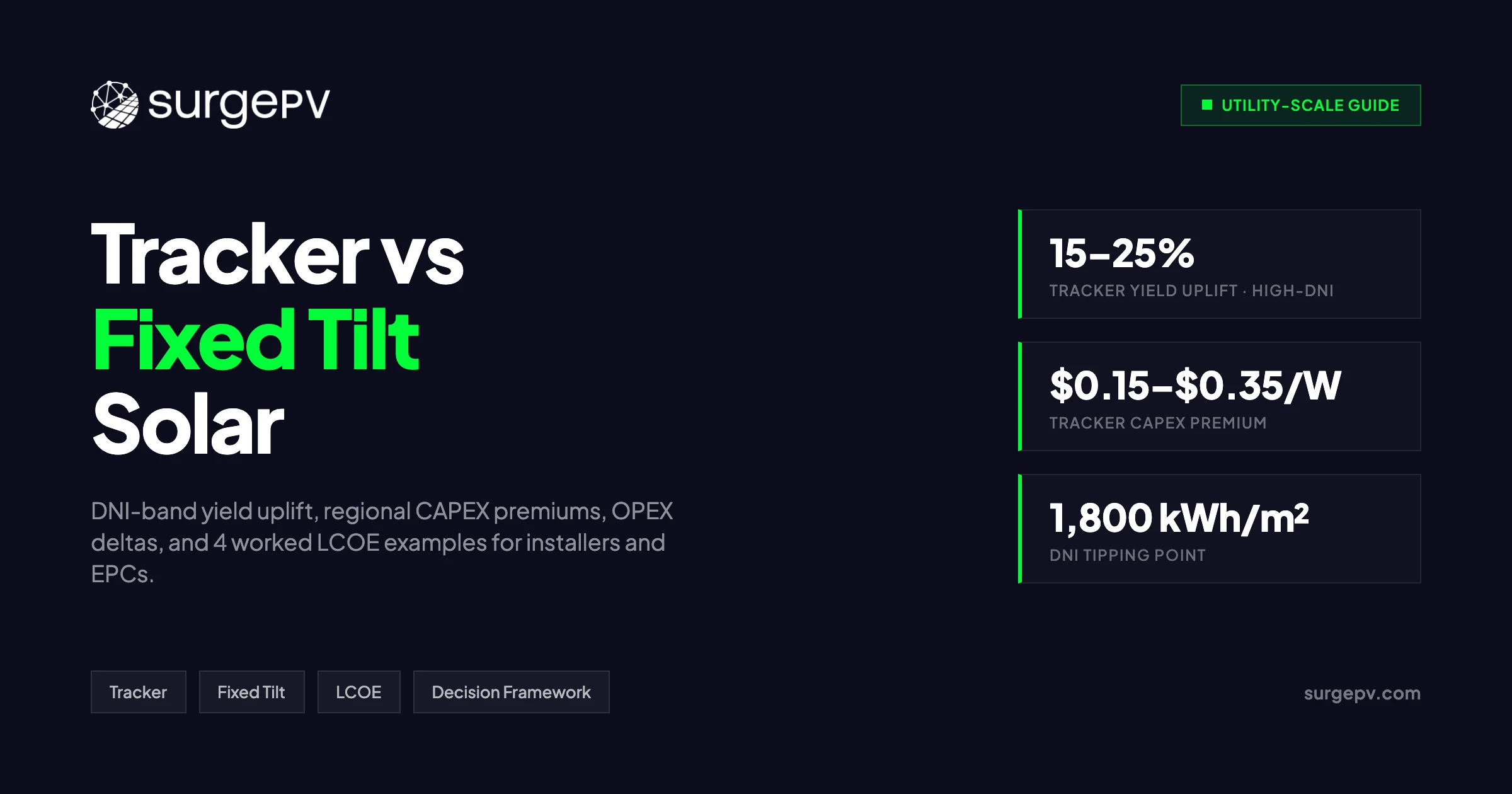
Single-axis trackers add 15 to 25 percent annual yield over fixed tilt at high-DNI sites (above 2,000 kWh per square metre per year), but only 4 to 8 percent at low-DNI sites. Crossover for ground-mount C&I happens around 1 MW project size and 1,800 kWh per square metre per year of GHI. Trackers carry an extra 80 to 120 USD per kW CAPEX and 3 to 5 USD per kW per year OPEX. Fixed tilt wins almost everywhere below latitude 50 degrees with low DNI, on rooftops, on slopes above 10 percent, and on snow-prone sites without aggressive O&M. Run the LCOE for your specific site before committing.
In this guide:
- Why this decision matters and who it is for
- How trackers and fixed-tilt mounts work
- DNI-band yield uplift table
- CAPEX comparison by region
- OPEX, downtime, and lifetime motor replacement
- LCOE matrix: 4 sites x 3 mount types
- Land use, GCR, and backtracking
- The 7-question decision framework
- 4 worked ROI examples (US, Spain, Germany, India)
- 5 failure modes where trackers do not pay back
- 2026 outlook: bifacial, terrain-following trackers, AI stow Also see: Germany solar subsidies. Also see: Spain net metering. Also see: Best Solar Design Software India.
Tracker vs Fixed Tilt Solar: How the Two Mounts Work
Fixed-tilt arrays hold modules at a constant angle, while single-axis trackers rotate east to west and dual-axis trackers add elevation control. All tracker types are ground-mount only because residential rooftops cannot support the mechanical load or rotation geometry. Standard certifications include IEC 62817 and UL 3703.
A fixed-tilt racking system bolts PV modules to a frame set at a fixed angle, typically latitude minus 5 to 15 degrees for annual optimization. The structure is static. No moving parts. No controllers. No motors. Tilt angles are chosen during design and never change. Fixed tilt dominates residential rooftop solar, commercial carports, and ground-mount sites where simplicity or site constraints rule out tracking. Read Commercial Solar Carport Design Guide for a complete walkthrough.
A horizontal single-axis tracker (HSAT) rotates modules around a north-south axis. The row tilts east in the morning, flattens at solar noon, and tilts west in the evening. HSAT captures more direct-beam irradiance throughout the day because the module surface stays closer to perpendicular to the sun vector. HSAT is the dominant tracker architecture globally. Approximately 70 percent of new US utility-scale capacity in 2024 used HSAT ([LBNL Utility-Scale Solar 2025](https://emp.lbl.gov/utility-scale-solar)). For Global-specific compliance details, see Global net-metering-by-country.
A tilted single-axis tracker (TSAT) also rotates east-west, but the rotation axis is tilted toward the equator rather than horizontal. TSAT boosts winter capture at latitudes above 35 degrees. It is less common than HSAT because it adds structural complexity without proportional yield gain in most markets.
A dual-axis tracker controls both azimuth (compass direction) and elevation (tilt angle). It tracks the sun precisely across the sky. Yield gains over HSAT are 5 to 10 percent, but CAPEX and OPEX are substantially higher. Dual-axis trackers are rare in flat-panel PV outside concentrated solar power (CSP) or high-albedo demonstration sites.
Vertical-axis trackers rotate around a vertical pole. They are niche products, mostly used in agrivoltaic or bifacial research installations where back-side capture geometry matters more than standard front-side optimization. See Bifacial Solar Panel Design Guide for detailed guidance.
All trackers must meet IEC 62817:2014, the design qualification standard for PV trackers. This standard defines mechanical durability, environmental testing, wind stow protocols, and control system reliability requirements. Bankable projects in most markets require IEC 62817 certification. In the US, UL 3703 serves as the parallel safety evaluation standard. Fixed-tilt racking falls under UL 2703 and standard structural codes (ASCE 7-22, Eurocode 1, AS/NZS 1170).
Trackers are ground-mount only. Residential rooftops lack the structural capacity, the unshaded rotation envelope, and the maintenance access. Small C&I ground-mount sites under 500 kW rarely justify the per-unit tracker cost. The economics start to work at roughly 1 MW and above, a threshold we return to in the worked examples.
DNI-Band Yield Uplift Table
Tracker yield gain scales directly with Direct Normal Irradiance. At under 1,200 kWh per square metre per year, a horizontal single-axis tracker adds 8 to 15 percent annual energy. Above 2,400 kWh per square metre per year, the gain reaches 28 to 35 percent. Dual-axis systems add 5 to 10 percent more but rarely justify their cost in flat-panel utility PV.
Direct Normal Irradiance (DNI) is the key variable. DNI measures the solar energy arriving on a surface perpendicular to the sun’s rays. When DNI is high, the sun’s path is predictable and the direct beam dominates. Tracking captures that beam for more hours of the day. When DNI is low, diffuse sky radiation dominates. Diffuse light comes from all directions. A tracker cannot track scattered photons. The gain shrinks.
The table below ties DNI bands to real cities and observed HSAT uplift ranges. Data draws on NREL SAM modelling, IEA PVPS reports, and LBNL Utility-Scale Solar 2025 capacity-factor analysis.
| DNI Band (kWh/m²/yr) | Climate Type | Named City Anchors | HSAT Uplift vs Fixed | Dual-Axis Uplift vs Fixed |
|---|---|---|---|---|
| Under 1,200 | Low-DNI / High diffuse | Hamburg (DE), London (UK), Seattle (US) | 8–15% | 18–25% |
| 1,200–1,600 | Moderate-DNI / Mixed | Munich (DE), Paris (FR), Rome (IT) | 15–20% | 25–32% |
| 1,600–2,000 | High-DNI / Clear | Madrid (ES), Athens (GR), Sydney (AU) | 20–28% | 32–40% |
| 2,000–2,400 | Very High-DNI / Arid | Phoenix (US), Dubai (AE), Jaipur (IN) | 25–30% | 38–45% |
| Above 2,400 | Extreme-DNI / Desert | Rajasthan desert (IN), Mojave (US), Atacama (CL) | 28–35% | 40–50% |
Source: NREL SAM / NSRDB; IEA PVPS; LBNL Utility-Scale Solar 2025; MDPI Energies review.
Notice the Hamburg-to-Atacama spread. A tracker in Hamburg adds 8 to 15 percent. A tracker in the Atacama adds 28 to 35 percent. Both use the same motor and controller. The hardware cost is similar. The revenue difference is massive. DNI-band analysis replaces the “+20% rule” in any serious proposal.
Latitude and diffuse fraction also matter. High-latitude sites (above 50 degrees) have long summer days but low winter sun angles. Fixed tilt at steep angles captures winter irradiance well. Tracking adds less marginal value. Sites with high diffuse fractions, coastal, humid, or cloudy climates, see smaller tracking gains because diffuse radiation is omnidirectional. The angle of incidence (AOI) loss on fixed tilt is lower under diffuse conditions, so tracking’s AOI advantage shrinks.
Shoulder-hour generation is another factor. Trackers extend productive hours earlier in the morning and later in the evening. In markets with time-of-delivery (TOD) PPA structures that pay a premium for morning or evening generation, common in California, Spain, and some Indian state tenders, this shoulder-hour capture can add material revenue beyond the raw kWh gain. Fixed-tilt arrays peak hard at solar noon and taper faster. Trackers flatten the generation curve. For India-specific information, see 5kW Solar Panel Price in India.
CAPEX Comparison: Tracker vs Fixed Tilt 2026
In 2024, US utility-scale total installed costs for single-axis trackers reached rough parity with fixed-tilt systems at scale, while most other markets still see a tracker premium of 0.07 to 0.12 USD per watt. Module prices at roughly 0.10 USD per watt (BNEF Module Price Index, February 2026) mean tracker mechanical costs now represent a larger share of total project CAPEX than in 2021.
The CAPEX story changed recently. For years, trackers carried a clear per-watt premium. In 2024, total installed costs inverted in the US at utility scale. Tracker manufacturers (Nextracker, Array Technologies, FTC Solar) scaled production aggressively. Fixed-tilt steel and labor costs rose with commodity prices. At 100 MW+ scale, the marginal cost of adding a tracker motor and torque tube fell below the fixed-tilt structural premium in some procurement contexts.
| Region | Fixed Tilt ($/Wdc) | HSAT ($/Wdc) | Dual-Axis ($/Wdc) | Tracker Premium ($/W) |
|---|---|---|---|---|
| United States | ~$1.35 | ~$1.22 | ~$1.60–$1.80 | HSAT often lower at scale |
| European Union | ~€0.85–€1.00 | ~€0.95–€1.10 | ~€1.20–€1.50 | €0.07–€0.10 typical |
| Australia | ~A$1.10–$1.30 | ~A$1.20–$1.45 | ~A$1.50–$1.80 | A$0.10–$0.15 |
| India | ~$0.55–$0.70 | ~$0.65–$0.80 | ~$0.90–$1.10 | $0.08–$0.12 |
| MENA | ~$0.50–$0.65 | ~$0.60–$0.75 | ~$0.80–$0.95 | $0.07–$0.12 |
Sources: LBNL Utility-Scale Solar 2025; NREL ATB 2024; IRENA RPGC 2024; Wood Mackenzie 2025.
The US inversion is notable. At utility scale, trackers are now the default because total installed costs reached parity while also delivering higher yield. For C&I projects under 10 MW, the story differs. Smaller projects do not capture the same procurement discounts. Tracker EPCs charge premium rates for non-standard project sizes. Fixed tilt often wins on CAPEX alone below 5 MW.
Module pricing matters. At a 0.10 USD/W module floor, tracker mechanics, controllers, and installation labor become a larger percentage of total project cost. A tracker premium of 0.10 USD/W was trivial when modules cost 0.50 USD/W. At 0.10 USD/W, that same 0.10 USD/W premium is a 100 percent markup on the module line item. Project finance sensitivity to tracker CAPEX has increased as module costs fell.
Labor and logistics vary by region. India’s tracker premium is low (~0.08 to 0.12 USD/W) because labor is cheap and tracker manufacturing is local (Nextracker India, Sterling and Wilson). Australia’s premium is high because remote site logistics and high wages inflate mechanical installation costs. European premiums reflect regulatory compliance, CE marking, and higher steel costs. For Australia-specific compliance details, see Australia comparisons/lgc-vs-stc.
OPEX, Downtime, and Failure Rates
Trackers add 1 to 4 USD per kW per year in OPEX over fixed tilt due to mechanical maintenance, motor service, controller firmware updates, and alignment checks. Plant availability for well-maintained tracker fleets stays above 99.5 percent. Budget one to two motor replacements per tracker row over a 25-year project life.
Fixed-tilt O&M is simple. Clean modules. Trim vegetation. Inspect connections. Replace inverters and optimizers on schedule. Moving parts, motors, and controllers are absent.
Trackers introduce mechanical complexity. Motors rotate rows. Bearings wear. Controllers process sensor data and issue position commands. Firmware requires updates. Alignment drifts over time and must be recalibrated.
| O&M Category | Fixed Tilt ($/kW-yr) | HSAT ($/kW-yr) | Delta ($/kW-yr) |
|---|---|---|---|
| Module cleaning & vegetation | $3.36 | $3.36 | $0.00 |
| System inspection & monitoring | $1.18 | $1.84 | +$0.66 |
| Module / inverter / parts replacement | $4.56 | $5.04 | +$0.48 |
| Tracker-specific maintenance | $0.00 | $2.00–$4.00 | +$2.00–$4.00 |
| Soft costs (land, tax, insurance, admin) | $7.22 | $7.22 | $0.00 |
| Total | ~$16.32 | ~$17.46–$20.46 | +$1.14–$4.14 |
Sources: NREL Solar Futures Study / Feldman et al. 2021; EIA AEO2025.
Tracker-specific maintenance includes motor and actuator replacement, bearing lubrication, torque tube inspection, and controller diagnostics. NREL’s 2020 benchmark placed utility one-axis tracking O&M at 17.46 USD/kW-yr versus 16.32 USD/kW-yr for fixed tilt, a 1.14 USD/kW-yr delta. EIA AEO2025 Case 16 (150 MW SAT) lists 20.23 USD/kW-yr, which includes a more conservative inverter reserve and unscheduled repair allowance.
Failure rates from operating fleets: kWh Analytics and DNV field data show tracker availability typically above 99.5 percent when maintenance is performed per manufacturer specification. Mean Time Between Failures (MTBF) for tracker drive motors runs 3 to 5 years in IEC 62817 reference conditions. Mean Time To Repair (MTTR) for a motor swap is 2 to 4 hours per row. Decentralized-row architectures (Nextracker) isolate failures to single rows. Centralized-drive architectures (Array Technologies) use fewer parts but a single motor failure can affect multiple rows.
Wind stow loss is small but real. When wind speeds exceed the operating threshold (typically 18 to 22 m/s), trackers automatically move to a flat stow position to reduce wind load. DNV analysis across US tracker fleets shows annual wind stow loss at a median of 0.05 percent, under 0.10 percent in almost all cases. Snow loads trigger a different stow logic: some tracker designs tilt to steep angles to shed snow. Others flatten. The choice affects winter availability in cold climates.
Terrain loss is more material. DNV’s Solar Risk Assessment 2021 found median terrain loss of 2.1 percent on uneven east-west grades. Trackers need flat ground. A 5-degree cross-slope can reduce tracking accuracy and trigger increased motor wear. Terrain-following tracker designs are emerging to address this, but they add cost and are not yet mainstream.
LCOE Matrix: 4 Sites × 3 Mount Types
At high-DNI sites, single-axis tracker LCOE typically lands 5 to 10 USD per MWh below fixed tilt. At low-DNI sites, fixed tilt wins by 5 to 15 USD per MWh. The crossover sits near 1,800 kWh per square metre per year of GHI. Dual-axis trackers rarely beat horizontal single-axis trackers on LCOE in standard flat-panel utility PV.
Levelized Cost of Energy (LCOE) is the metric lenders and offtakers care about. It folds CAPEX, OPEX, degradation, financing cost, and energy yield into a single cost per MWh. A lower LCOE means a more bankable project.
The matrix below models four real sites under identical financing assumptions: 25-year project life, 70/30 debt/equity, real WACC of 3.3 to 5.5 percent, 0.5 to 0.7 percent annual degradation, and no tax credits for cross-market comparability.
| Site | Fixed Tilt ($/MWh) | HSAT ($/MWh) | Dual-Axis ($/MWh) | Notes |
|---|---|---|---|---|
| Texas (ERCOT, high DNI) | $42–$52 | $36–$44 | $48–$58 | Tracker strongly favored; Lazard 2025 utility range $38–78/MWh |
| Spain (Andalusia/Extremadura) | €32–€40 | €28–€34 | €38–€46 | Spanish solar PPA ~€30–35/MWh; tracker is default for over 5 MW |
| Germany (Bavaria, low DNI) | €45–€55 | €48–€60 | €62–€78 | Fixed tilt often wins; EEG ground-mount tender ~4.66–5.00 ct/kWh |
| India (Rajasthan) | $28–$34 | $24–$30 | $32–$40 | Lowest-cost solar globally; CERC approved ₹2.45/kWh |
Sources: Lazard LCOE+ v18 (Jun 2025); LBNL 2025; Wood Mackenzie Oct 2025; Fraunhofer ISE / BNetzA; CERC/MNRE.
Texas and Rajasthan show the classic tracker win. High DNI, flat terrain, large project scale, and competitive PPA markets make the yield gain worth the CAPEX and OPEX premium. Spain is similar. Mediterranean solar farms above 5 MW have used HSAT as the default since 2019.
Germany inverts the pattern. Bavarian DNI is roughly 1,100 kWh/m²/yr. The diffuse fraction is high. EEG tender winning bids are 4.66 to 5.00 ct/kWh (€46.6 to 50/MWh). Tracker LCOE at €48 to 60/MWh exceeds the revenue floor. Fixed tilt at €45 to 55/MWh sits closer to breakeven. Trackers in Germany are rare outside demonstration or agrivoltaic pilots.
That mismatch explains why the “+20% rule” fails. A yield gain of 18 percent is irrelevant if the cost structure and electricity price do not support it. German C&I developers should default to fixed tilt unless a specific site condition (unusual albedo, steep south-facing slope, or private PPA above EEG rates) changes the math. Solar shadow analysis software and site-specific financial modelling are essential here. Rule-of-thumb assumptions will mislead.
Dual-axis trackers underperform HSAT on LCOE in all four sites. The extra 5 to 10 percent yield fails to cover the extra CAPEX and mechanical complexity. Dual-axis remains a niche for concentrated PV, research installations, and sites with extreme albedo where back-side capture geometry matters.
Land Use, GCR, and Backtracking
Fixed tilt at 0.45 GCR needs roughly 4 to 5 acres per MW. Single-axis trackers at 0.35 GCR need 6 to 8 acres per MW. Backtracking algorithms reduce row-to-row shading losses but cannot eliminate the land premium. Land lease economics often kill the tracker case before LCOE is even calculated.
Ground Coverage Ratio (GCR) is the ratio of module area to total land area. A GCR of 0.50 means modules cover half the site. Higher GCR means denser arrays and less land per MW. Lower GCR means more spacing, less shading, and more land.
| Metric | Fixed Tilt | 1-Axis Tracking | Dual-Axis Flat Panel |
|---|---|---|---|
| Direct land use — small under 20 MW | 5.5 acres/MWac | 6.3 acres/MWac | 9.4 acres/MWac |
| Direct land use — large over 20 MW | 5.8 acres/MWac | 9.0 acres/MWac | — |
| Generation-weighted direct land use | 3.2 acres/GWh/yr | 2.9 acres/GWh/yr | 4.1 acres/GWh/yr |
| Capacity per km² — small | ~45 MWac/km² | ~39 MWac/km² | ~26 MWac/km² |
| Rule-of-thumb land premium | Baseline | +10–20% acreage | +30–50% acreage |
Source: NREL Ong et al. 2013 (NREL/TP-6A20-56290).
Trackers need wider row spacing. A fixed-tilt row at 25-degree tilt casts a shadow with a predictable geometry. A tracker row rotates through the day, changing the shadow length and direction. To avoid inter-row shading during morning and evening hours, tracker rows are spaced farther apart. This pushes GCR down to 0.30 to 0.40, versus 0.40 to 0.50 for fixed tilt.
Backtracking is the algorithmic fix. Instead of tracking the sun directly when rows would shade each other, the controller backs off the tracking angle to keep modules unshaded. Backtracking sacrifices some direct-beam capture to avoid diffuse shading losses. A well-tuned backtracking algorithm recovers 2 to 5 percent of annual energy versus naive tracking with no backtracking. Poor backtracking, or no backtracking, costs more energy than the spacing saves.
Backtracking quality differentiates tracker suppliers. Nextracker, Array Technologies, and Soltec each use proprietary algorithms. Some optimize for maximum annual energy. Others optimize for minimum LCOE. A few offer terrain-aware backtracking that adjusts for east-west grade. Ask for the backtracking model before specifying a tracker brand.
Land lease economics are critical. In markets where land is expensive or scarce, Japan, the Netherlands, parts of Northern Europe, the 20 to 50 percent land premium can erase the tracker yield advantage. In desert markets where land is cheap or free (Rajasthan, MENA, Australia outback), the land penalty is irrelevant. Always model land cost as a line item in LCOE from the start, not as an afterthought.
The 7-Question Decision Framework
Use this checklist in a 10-minute client call. Six to seven positive answers justify a horizontal single-axis tracker. Four to five positive answers make the case marginal and require sensitivity analysis. Under four positive answers, fixed tilt is the lower-risk choice with simpler O&M and lower CAPEX exposure.
| # | Question | If YES | If NO |
|---|---|---|---|
| 1 | Is the project over 500 kW (ideally over 1 MW)? | Proceed to Q2 | Fixed tilt wins — tracker per-unit costs too high |
| 2 | Is site DNI over 1,500 kWh/m²/yr (or over 4.5 kWh/m²/day)? | Proceed to Q3 | Fixed tilt likely lower LCOE — model both |
| 3 | Is terrain slope under 5° cross-grade (EW) and under 15° longitudinal (NS)? | Proceed to Q4 | Fixed tilt or terrain-following tracker only |
| 4 | Is land cost per acre low relative to energy revenue? | Proceed to Q5 | Fixed tilt — high land cost favors denser GCR |
| 5 | Is the PPA flat-rate or does TOD reward morning/evening generation? | Proceed to Q6 | Fixed tilt may suffice if no TOD premium |
| 6 | Can O&M team reach site within 2–4 hours for unscheduled repairs? | Proceed to Q7 | Fixed tilt — remote sites penalize tracker downtime |
| 7 | Does the design tool model both structures with site-specific financials? | HSAT justified — model and defend | Get better software before committing |
Outcome logic: 6 to 7 YES → Strong HSAT case. 4 to 5 YES → Marginal — run sensitivity. Under 4 YES → Fixed tilt or reconsider project economics.
Question 1 is about scale. Below 500 kW, tracker hardware and installation do not amortize across enough kilowatts. The fixed cost of controllers, communication networks, and commissioning is spread over too small a denominator.
Question 2 is about DNI. The 1,500 kWh/m²/yr threshold is a practical lower bound. Below it, yield gains are too small to cover the CAPEX and OPEX premium. Above 1,800 kWh/m²/yr, the tracker case strengthens rapidly.
Question 3 is about terrain. Standard trackers need flat ground. A 5-degree east-west cross-slope introduces tracking error and accelerates mechanical wear. Terrain-following trackers handle up to 15 percent grades, but they are more expensive and less proven.
Question 4 is about land economics. In high-rent districts, fixed tilt’s denser GCR wins. In desert or rural sites, land is cheap and the tracker land penalty is trivial.
Question 5 is about revenue structure. TOD PPAs that pay premium rates for morning and evening generation reward tracker’s shoulder-hour capture. Flat-rate PPAs do not.
Question 6 is about O&M logistics. A failed motor on a remote site can sit unrepaired for days. Each day of downtime costs energy. Fixed tilt has no motor to fail.
Question 7 is about process. If your design workflow requires switching between AutoCAD, PVsyst, and Excel, you are introducing error. Solar design suite that models both structures in one tool, yield, LCOE, IRR, and NPV side-by-side, closes that gap. For software options, see 7 Best PVsyst Alternatives in.
Model Tracker vs Fixed Tilt Side-by-Side in 20 Minutes
SurgePV’s generation and financial tool builds yield, LCOE, IRR, and NPV for both structures from the same site data — so you can present a defensible recommendation in your next proposal.
Book a DemoNo commitment required · 20 minutes · Live project walkthrough
Worked ROI Examples: 4 Real Markets
The same tracker hardware produces radically different financial outcomes depending on DNI, electricity price, and financing cost. These four examples show actual IRR, NPV, payback, and LCOE for fixed-tilt versus HSAT at real sites. All assume 25-year life, 0.5 percent annual degradation, and 70/30 debt/equity.
Example 1 — US Texas (West Texas, 100 MW utility, ERCOT merchant)
| Parameter | Fixed Tilt | HSAT |
|---|---|---|
| Plant size | 100 MWac / 134 MWdc (ILR 1.34) | 100 MWac / 134 MWdc |
| DNI | ~2,200 kWh/m²/yr | ~2,200 kWh/m²/yr |
| Specific yield | ~1,750 kWh/kWp/yr | ~2,200 kWh/kWp/yr (+26%) |
| CAPEX | ~$1.35/Wdc | ~$1.22/Wdc |
| OPEX | ~$16/kW-yr | ~$20/kW-yr |
| Revenue (merchant / PPA) | $29–43/MWh (LevelTen Q3 2025 ERCOT ~$43.5/MWh) | Same |
| LCOE (no tax credits) | ~$48/MWh | ~$42/MWh |
| LCOE (with commercial ITC/PTC) | ~$34/MWh | ~$30/MWh |
| IRR (project) | ~8.5–10.5% | ~10.5–12.5% |
| NPV (25 yr, 6% discount) | ~$18–28M | ~$28–42M |
| Payback | ~7–9 years | ~6–8 years |
| Tracker premium payback | — | ~3–5 years |
West Texas offers ideal tracker conditions. DNI at 2,200 kWh/m²/yr is among the highest in the continental US. Terrain is flat. Wind is high but manageable with proper stow logic. ERCOT merchant prices, while volatile, average high enough to make the 26 percent yield gain extremely valuable.
The LBNL 2024 finding that US utility tracker total installed costs reached parity with fixed tilt ($1.22/Wdc versus $1.35/Wdc) means the HSAT option here wins on both CAPEX and yield. That is rare globally. It explains why approximately 70 percent of new US utility-scale solar uses tracking. The incremental IRR uplift from choosing HSAT over fixed tilt is 1.5 to 2.5 percentage points, material in a market where basis risk and congestion already compress returns.
The tracker premium payback of 3 to 5 years is well inside project finance tenor. Most lenders will underwrite that. The 25-year NPV delta of roughly 10 to 14 million USD on a 100 MW plant is the difference between a project that gets built and one that remains unbuilt.
For EPCs bidding into ERCOT RFPs, modelling tracker versus fixed-tilt side-by-side is now standard practice. SurgePV’s PV generation and financial modeling accepts ERCOT nodal price curves, PTC/ITC toggle, and Texas-specific O&M assumptions in one workflow.
Example 2 — Spain Andalusia (50 MW merchant + 5 MW C&I)
| Parameter | Fixed Tilt | HSAT |
|---|---|---|
| Plant size | 50 MWp (utility) + 5 MWp (C&I) | 50 MWp + 5 MWp |
| DNI | ~2,000 kWh/m²/yr | ~2,000 kWh/m²/yr |
| Specific yield | ~1,700 kWh/kWp/yr | ~2,100 kWh/kWp/yr (+24%) |
| Tracker premium | — | €0.04–0.07/Wp |
| Revenue (PPA) | €30–35/MWh | Same |
| LCOE | ~€38/MWh | ~€32/MWh |
| IRR (project) | ~7.5–9.0% | ~9.5–11.5% |
| Payback | ~8–10 years | ~6–8 years |
| Tracker premium payback | — | ~4–7 years |
Spain is the European market where trackers are most clearly justified. Andalusia and Extremadura see DNI near 2,000 kWh/m²/yr. The Mediterranean climate brings low soiling, moderate wind, and minimal snow. Spanish solar PPA prices at €30 to 35/MWh are tight. Every Euro of LCOE matters.
The 5 MW C&I segment is where Spanish installers face real pressure. At 5 MW, the project is too small to capture the full utility-scale procurement discount. Tracker EPCs may quote a higher per-watt premium than at 50 MW. Fixed tilt becomes competitive again. This is the mid-scale C&I gap that utility-focused design tools often ignore. A 5 MW ground-mount C&I site in Seville should be modelled with actual quotes, not scaled-down 50 MW assumptions.
HSAT has been the default for Spanish utility solar above 5 MW since 2019. The 4 to 7 year tracker premium payback fits comfortably inside Spanish project finance structures. For C&I sites under 5 MW, run the numbers. Fixed tilt may surprise you.
Example 3 — Germany Bavaria (20 MW C&I, EEG-feed-in or PPA)
| Parameter | Fixed Tilt | HSAT |
|---|---|---|
| Plant size | 20 MWp (ground-mounted, EEG tender) | 20 MWp |
| DNI | ~1,100 kWh/m²/yr | ~1,100 kWh/m²/yr |
| Specific yield | ~950 kWh/kWp/yr | ~1,120 kWh/kWp/yr (+18%) |
| Tracker premium | — | €0.07–0.10/Wp |
| Revenue (EEG) | €46.6–50/MWh (ground-mount tender) | Same |
| LCOE | ~€50/MWh | ~€55–60/MWh |
| IRR (project) | ~5.5–7.0% | ~4.5–6.0% |
| Payback | ~10–13 years | ~11–15 years |
| Tracker premium payback | — | May never reach parity |
Bavaria is the counter-example. Low DNI (1,100 kWh/m²/yr). High diffuse fraction. Short winter days. EEG tender winning bids at 4.66 to 5.00 ct/kWh set a revenue ceiling that trackers cannot beat.
The 18 percent yield gain sounds respectable. But the €0.07 to 0.10/Wp tracker premium, higher OPEX, and German labor costs push HSAT LCOE to €55 to 60/MWh, above the €46.6 to 50/MWh revenue floor. Fixed tilt at ~€50/MWh is closer to breakeven. Trackers in Germany are rare outside agrivoltaic pilots or research installations.
That mismatch explains why the “+20% rule” fails. A yield gain of 18 percent is irrelevant if the cost structure and electricity price do not support it. German C&I developers should default to fixed tilt unless a specific site condition (unusual albedo, steep south-facing slope, or private PPA above EEG rates) changes the math. Solar shadow analysis software and site-specific financial modelling are essential here. Rule-of-thumb assumptions will mislead.
Example 4 — India Rajasthan (200 MW PPA, MNRE compliance)
| Parameter | Fixed Tilt + Bifacial | HSAT + Bifacial |
|---|---|---|
| Plant size | 200 MWp | 200 MWp |
| DNI | ~2,400+ kWh/m²/yr | ~2,400+ kWh/m²/yr |
| Albedo | ~0.30–0.35 (desert sand) | ~0.30–0.35 |
| Specific yield | ~1,850 kWh/kWp/yr | ~2,350 kWh/kWp/yr (+27%); bifacial adds +8–12% on tracker |
| CAPEX | ~$0.60/Wdc | ~$0.72/Wdc |
| OPEX | ~$10/kW-yr | ~$14/kW-yr |
| Revenue (PPA) | ~$26/MWh (CERC ₹2.45/kWh) | Same |
| LCOE | ~$28/MWh | ~$24/MWh |
| IRR (project) | ~12–14% | ~14–17% |
| Payback | ~5–6 years | ~4–5 years |
| Tracker premium payback | — | ~2.5–4 years |
Rajasthan is the global benchmark for low-cost tracker solar. DNI above 2,400 kWh/m²/yr. Desert albedo of 0.30 to 0.35 amplifies bifacial gain. Flat terrain. Low labor costs. Aggressive EPC competition. The result is that HSAT plus bifacial is the dominant design for Indian utility-scale solar.
The bifacial stack matters here. Bifacial modules on fixed tilt capture reflected light from the ground. On trackers, the module height and rotation geometry increase rear-side irradiance. The combined effect is a 20 to 30 percent total gain over monofacial fixed tilt, not just the tracker’s 27 percent, but an additional 8 to 12 percent from bifaciality.
At 2.5 to 4 years, tracker premium payback in Rajasthan is the shortest of any major market. Indian lenders underwrite tracker projects routinely. MNRE compliance requirements (domestic content, DCR rules) do not restrict tracker imports. Most major tracker manufacturers have Indian production or assembly.
For EPCs bidding SECI or NHM tenders, modelling bifacial plus tracker accurately is critical. The solar design tool must handle albedo inputs, rear-side shading, and tracker row spacing to avoid under-promising or over-promising yield.
When Trackers Do Not Pay Back: 5 Failure Modes
Trackers fail financially when DNI is low, terrain is uneven, snow loads are high, projects are small, or electricity prices are depressed. These five conditions cover most tracker losses in operating fleets. Review all five against your site before specifying hardware to avoid stranded mechanical CAPEX.
1. Low-DNI cloudy sites. Northern Europe, the UK, the Pacific Northwest, and parts of Japan see DNI under 1,400 kWh/m²/yr. Diffuse radiation dominates. Tracking gains shrink to 4 to 8 percent. The CAPEX and OPEX premium cannot recover. Fixed tilt wins on LCOE. See our guide on Battery Solar System Design UK for more.
2. Sloped or rocky terrain above 10 percent grade. Standard trackers need flat ground. East-west cross-slopes above 5 degrees introduce tracking error and accelerated mechanical wear. Terrain-following trackers exist but add cost and complexity. On hilly sites, fixed tilt on graded benches is usually cheaper and more reliable.
3. Heavy snow loads. Trackers in snow regions face a dilemma. Flat stow sheds snow poorly. Steep stow avoids snow accumulation but sacrifices energy capture. Some tracker manufacturers offer high-tilt stow modes, but these reduce annual yield by 2 to 5 percent in winter. Fixed tilt at 30 to 40 degrees sheds snow naturally. In Minnesota, Ontario, and Hokkaido, fixed tilt is the safer choice.
4. Sub-1 MW projects. The fixed costs of tracker controllers, communication networks, and commissioning do not scale down. At 500 kW, the per-watt tracker premium can exceed 0.20 USD/W, double the utility-scale rate. Fixed tilt’s simplicity wins on both CAPEX and OPEX. The economic crossover for ground-mount C&I is typically around 1 MW at high-DNI sites.
5. Low PPA or merchant power markets. Trackers need revenue to justify their cost. In markets with depressed electricity prices, whether from oversupply, regulatory caps, or falling wholesale rates, the yield gain produces little incremental value. Germany’s EEG tender at 4.66 ct/kWh is the textbook example. Even a 25 percent yield gain is worthless if the revenue per MWh is below the tracker LCOE.
2026 Outlook: Bifacial, Terrain-Following, AI Stow
Three trends are reshaping tracker economics in 2026. Bifacial modules plus trackers now deliver 20 to 30 percent combined gain over monofacial fixed tilt. Terrain-following tracker rows open non-flat sites. AI-controlled stow and yield-optimization algorithms are reducing wind and soiling losses.
Bifacial plus tracker stacking is the most important trend. Bifacial modules capture reflected light on the rear side. On trackers, module height and variable tilt increase rear-side irradiance compared to fixed tilt. In high-albedo environments, desert sand, snow, white gravel, the combined gain reaches 20 to 30 percent over monofacial fixed tilt. NREL ATB 2024 models bifacial energy gains of 5 to 15 percent under real-world conditions. On trackers, the upper end of that range is more likely. For EPCs, this means bifacial modules should be the default specification on tracker projects in 2026.
Terrain-following trackers address the flat-ground constraint. Traditional trackers need grading, cutting and filling earthwork to create a level pad. Grading costs 0.05 to 0.15 USD/W on hilly sites. Terrain-following tracker rows ride the natural contour, reducing or eliminating grading. Slope tolerance ranges from 10 percent (early designs) to 20 percent (latest Soltec and Nextracker offerings). This opens sites that were previously tracker-prohibitive. The trade-off is higher structural cost and less mature bankability data. Lenders are watching.
AI stow and yield optimization are moving from pilot to product. Traditional stow logic uses simple wind-speed thresholds: if wind over 22 m/s, go flat. AI stow models use weather radar, microclimate sensors, and machine learning to predict gusts before they arrive. The tracker pre-emptively stows, reducing peak wind loads and allowing faster return to tracking after the event. Early deployments show 0.02 to 0.05 percent annual energy recovery versus threshold-based stow. Yield-optimization algorithms also adjust tracking angles for soiling patterns, cloud-edge effects, and inverter clipping, adding 0.5 to 2 percent annual energy.
SurgePV’s customer-ready solar proposals integrates bifacial yield modelling, terrain slope inputs, and weather data for site-specific tracker versus fixed-tilt comparison — no plug-ins, no Excel handoffs. For EPCs comparing multiple sites, all-in-one solar software that runs both structures in a single workflow eliminates the cut-and-paste errors that erode margin.
Conclusion
Installers and EPCs evaluating tracker versus fixed-tilt on their next ground-mount project should focus on three actions: replace the flat “+20%” rule with DNI-band analysis, run full LCOE models instead of yield-only comparisons, and size projects honestly against the 1 MW C&I crossover threshold. See our guide on Agricultural Solar Case Study for more.
- Replace the “+20% rule” with DNI-band analysis. Use the table in this guide to set realistic yield expectations by site. A tracker in Hamburg and a tracker in Rajasthan are not the same product.
- Run LCOE, not just yield. Yield gain is only half the equation. Model CAPEX, OPEX, land cost, financing, and degradation in one tool. If your workflow requires exporting from CAD to a spreadsheet, you are introducing error.
- Size the project honestly. Below 1 MW at high-DNI sites, fixed tilt is usually the right call. Between 1 and 10 MW, model both. Above 10 MW in sunny climates, HSAT is the default, but still verify with site-specific numbers.
Load your site into cloud solar design software that models both structures side-by-side. Present the comparison to your client as a single, defensible recommendation. Run the LCOE for both configurations before you submit your next proposal.
Frequently Asked Questions
Is a solar tracker worth it compared to fixed tilt?
A single-axis tracker is worth it when site DNI is above 1,800 kWh per square metre per year, ground is reasonably flat (under 10 percent slope), the project size is above 1 MW, and OPEX budget covers an extra 3 to 5 USD per kW per year. Below those thresholds, fixed tilt usually wins on LCOE despite the lower yield. The 7-question framework in this guide gives a binary checklist for any specific site.
How much more energy does a solar tracker produce vs fixed tilt?
A horizontal single-axis tracker (HSAT) produces 15 to 25 percent more annual energy than fixed tilt at high-DNI sites (above 2,000 kWh per square metre per year), 8 to 15 percent more at mid-DNI sites (1,400 to 1,800), and only 4 to 8 percent more at low-DNI sites (below 1,400). Dual-axis trackers add another 5 to 10 percent on top, but rarely justify the cost outside concentrated PV. The DNI-band table in this article replaces the flat “+20%” rule with site-specific numbers.
What is the payback period for a solar tracker?
At high-DNI sites with current 2026 module and tracker prices, single-axis tracker payback typically lands between 6 and 9 years. Fixed tilt at the same site usually pays back in 5 to 7 years. The crossover depends on DNI, electricity tariff, and OPEX assumptions; under low-DNI conditions trackers may never reach IRR parity with fixed tilt. In extreme-DNI markets like Rajasthan, tracker premium payback can drop to 2.5 to 4 years.
What is the LCOE difference between fixed tilt and tracker solar?
At a high-DNI utility site, single-axis tracker LCOE typically lands 5 to 10 USD per MWh below fixed tilt despite higher CAPEX. At low-DNI sites, the relationship inverts: fixed tilt LCOE comes in 5 to 15 USD per MWh below tracker. The tipping point is roughly 1,800 kWh per square metre per year of GHI. The 4-site LCOE matrix in this guide shows the exact range for Texas, Spain, Germany, and India.
Do solar trackers work for residential and small C&I systems?
Trackers are rarely cost-effective below 500 kW. Residential roofs cannot host them, and small C&I sites usually lack the land area, soil suitability, and OPEX budget to justify the mechanical complexity. The economic crossover for ground-mount C&I is typically around 1 MW at high-DNI sites. Above 1 MW, model both options with site-specific data.
What is GCR for trackers vs fixed tilt?
Ground Coverage Ratio (GCR) for fixed-tilt arrays typically runs 0.40 to 0.50, requiring roughly 4 to 5 acres per MW. Single-axis trackers operate at lower GCR (0.30 to 0.40) to reduce row-to-row shading, requiring 6 to 8 acres per MW. Backtracking algorithms partly mitigate the land-use penalty by allowing tighter spacing without shading loss. Land lease cost often determines whether the GCR penalty is material.
What is the failure rate of solar trackers?
Operating fleet data from kWh Analytics and DNV show tracker availability typically above 99.5 percent over a 25-year project life when properly maintained. Motor and actuator replacements are budgeted at 1 to 2 events per tracker over project life. Controller failures are rare but trigger row-level downtime until the spare is installed. Mean Time Between Failures (MTBF) for drive motors is 3 to 5 years per IEC 62817 reference values. Wind stow loss is under 0.10 percent annually.
Should I choose a horizontal or tilted single-axis tracker?
Horizontal single-axis trackers (HSAT) dominate above latitude 25 degrees and below 35 degrees. Tilted single-axis trackers (TSAT) make sense at higher latitudes (35 to 50 degrees) where a fixed equator-facing tilt boosts winter capture. Above 50 degrees latitude, fixed tilt is usually the right answer. HSAT is the default for utility-scale solar in the US, Spain, India, and MENA. TSAT sees limited use in Southern Europe and parts of China.
Where this fits
This article is part of SurgePV's Solar Incentives & Policy hub, which works through the topic from first principles to the decisions a project team actually has to make.

