

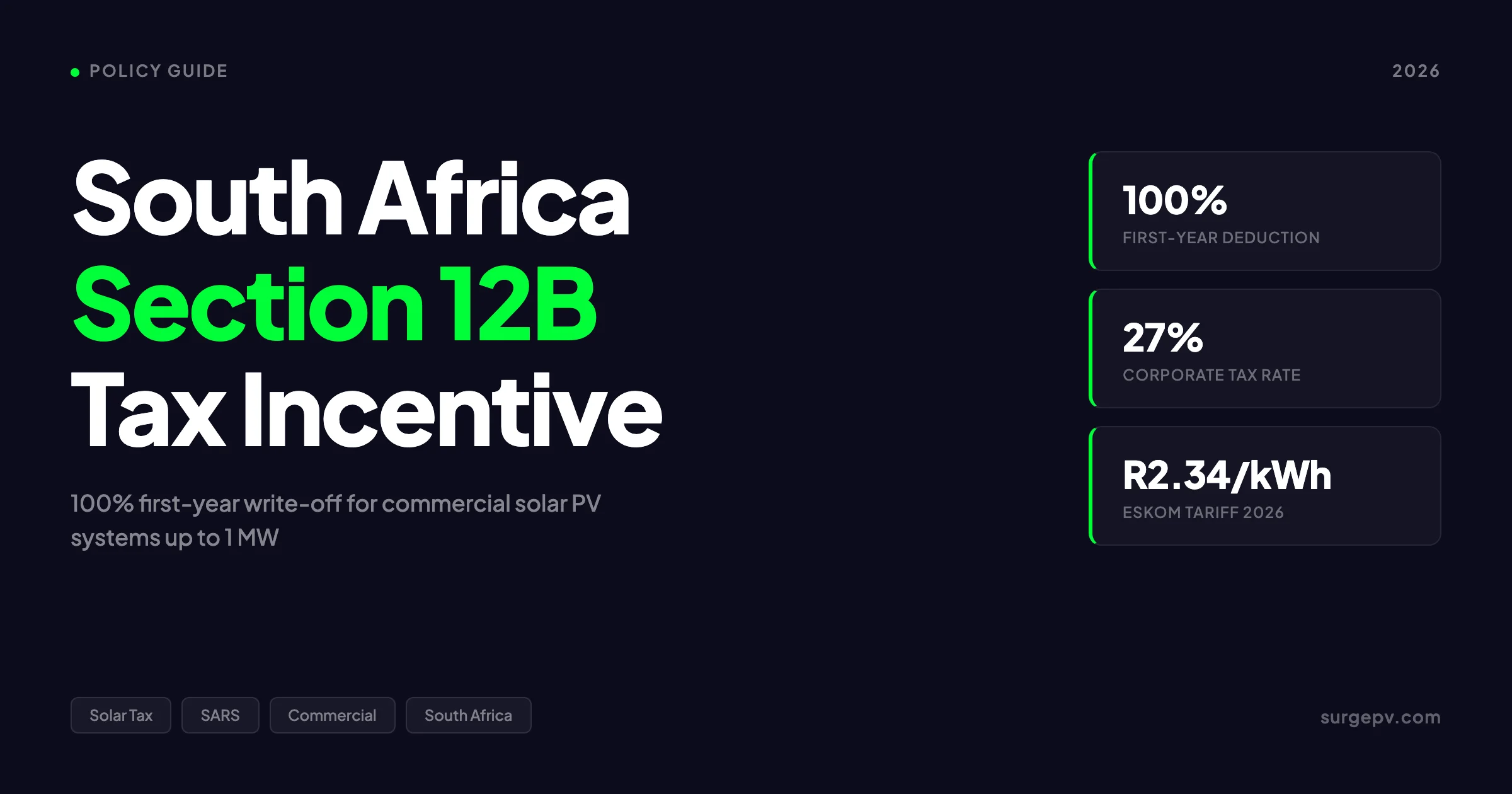
Most articles about South Africa’s solar tax incentive still headline the 125% rate. They are out of date. The temporary 125% enhancement expired on 28 February 2025. It is not coming back. What remains is Section 12B itself, a permanent accelerated depreciation rule that lets businesses write off 100% of qualifying solar costs in year one. For Africa-specific compliance details, see Africa solar compliance. For South Africa-specific compliance details, see South Africa comparisons/solar-designing.
That 100% rate is not a consolation prize. At South Africa’s 27% corporate tax rate, it still shaves roughly one quarter off the net cost of a commercial solar system. Combined with Eskom tariff increases that have compounded by 1,571% since 2000, it shortens payback periods to 4-7 years for well-designed commercial installations.
South Africa added 928 MW of solar in Q1 2026 alone. The C&I segment now accounts for roughly 70% of new rooftop installations nationally, according to market data from the Africa Solar Industry Association. For installers serving this market, Section 12B is the single most important financial argument to put in front of a commercial client. Installers who use solar design platform to model accurate production and savings can close deals faster by showing clients their real net cost after tax. The right solar software turns tax complexity into a competitive advantage.
This guide covers the full picture: what Section 12B is, how it differs from the expired Section 12BA, who qualifies, which costs are deductible, the exact claim process, real ROI calculations, and the mistakes that void claims. For a broader view of how South Africa compares to other markets, see our country-by-country solar tax guide.
In this guide:
- Current status: Section 12B vs. 12BA vs. 6C in 2026
- How Section 12B works (mechanics, rates, thresholds)
- Who qualifies and who does not
- Which costs are deductible (with real cost examples)
- The 125% story: what Section 12BA was and why it ended
- Step-by-step guide to claiming the deduction
- Real ROI examples for 50 kW, 250 kW, and 800 kW systems
- What most installers get wrong about tax claims
- VAT stacking with Section 12B
- Why Eskom tariff increases make 2026 the best year yet for commercial solar
Quick Answer
Section 12B of South Africa’s Income Tax Act lets businesses deduct 100% of qualifying solar PV costs in the first year for systems up to 1 MW. The temporary 125% bonus under Section 12BA expired on 28 February 2025 and was not renewed. At the 27% corporate tax rate, a R2,000,000 solar system delivers an R540,000 tax reduction in year one, cutting net system cost by 27%. Combined with Eskom tariff increases of 8-13% per year, commercial payback periods now fall between 4 and 7 years.
For more on this topic, see Design Commercial Solar System 1MW.
Section 12B Status in 2026: What Changed, What Stayed
South Africa’s solar tax landscape changed sharply in early 2025. Three incentives existed in parallel during 2023 and 2024. By mid-2026, only one survives. This places South Africa in a different position from markets with layered national and regional incentives, such as those covered in our solar tax credits country-by-country guide.
Solar Tax Incentive Status Table — May 2026
| Incentive | Deduction | Eligibility | Status |
|---|---|---|---|
| Section 12B (solar PV ≤ 1 MW) | 100% in year 1 | Businesses carrying on trade | Active — permanent |
| Section 12B (solar PV > 1 MW) | 50% / 30% / 20% over 3 years | Businesses carrying on trade | Active — permanent |
| Section 12BA | 125% in year 1 | Assets brought into use Mar 2023 – Feb 2025 | Expired 28 Feb 2025 |
| Section 6C | 25% rebate, max R15,000 | Individual residential taxpayers | Expired 29 Feb 2024 |
Section 12B Is Permanent
Section 12B has been part of the Income Tax Act since 2006. It was expanded in 2015 to include all renewable energy technologies, and in 2023 the accelerated 100% first-year rate was confirmed for solar PV systems of 1 MW or less. The 2025 Budget Speech confirmed that Section 12B is a standing provision, not a temporary program, with no expiry date. SARS publishes detailed guidance on qualifying criteria in its IT39 Guide on Allowances and Deductions for electricity-generating assets.
Section 12BA was different. It was introduced as a crisis-response measure. The logic was sound: South Africa’s electricity grid was under severe strain, and businesses were installing solar at record pace. Treasury wanted to accelerate that trend. The 125% deduction ran for two years, from 1 March 2023 to 28 February 2025. It applied to all qualifying renewable energy assets, regardless of size.
When the 2025 Budget Speech was delivered, Section 12BA was not renewed. Treasury’s position, outlined in the explanatory memorandum, was that the temporary measure had served its purpose. This mirrors a broader global trend: temporary solar incentives are being allowed to expire while permanent frameworks remain, as we have seen with the US residential ITC and the European solar tax credit landscape in 2026. Load shedding had moderated, grid-connected capacity had grown, and the permanent Section 12B framework was sufficient to maintain business investment. Also see: European Solar Incentives.
Key Takeaway
Section 12B is permanent. Section 12BA is dead. Any article that tells you to claim 125% under Section 12B is conflating two separate tax rules. In 2026, the maximum statutory deduction is 100% of qualifying cost, and it applies only to business-use assets.
What About the 1 MW Threshold?
Some confusion persists about the 1 MW cap. For systems of 1 MW or less, Section 12B grants a 100% deduction in the year the asset is brought into use. For systems above 1 MW, the deduction splits across three years: 50% in year one, 30% in year two, and 20% in year three. This threshold matters most for industrial and utility-scale projects. For the vast majority of commercial rooftop installations (50-500 kW), the 100% rate applies in full.
How Section 12B Actually Works
Section 12B is an accelerated capital allowance. It is not a tax credit — unlike an investment tax credit which directly reduces tax liability — and it is not a rebate. It works by letting you deduct the full qualifying cost of a renewable energy asset from your taxable income faster than ordinary wear-and-tear depreciation.
The ordinary rule for plant and machinery under Section 11(e) of the Income Tax Act spreads deductions over several years based on asset lifespan. A typical solar panel system might be depreciated over 10-12 years under normal wear-and-tear rules. Section 12B compresses that to one year for systems of 1 MW or less. This is a form of accelerated depreciation, similar to MACRS bonus depreciation in the United States but applied through South Africa’s Income Tax Act.
The Math in Practice
Take a manufacturing business in Gauteng that installs a 200 kW rooftop system at a total cost of R1,800,000. At this scale, using a solar design platform to optimize panel layout and shade analysis can improve yield by 3-5% — the difference between a marginal project and a strong one.
Under ordinary depreciation, that business might claim R150,000 per year for 12 years. At 27% tax, that saves R40,500 per year — R486,000 total, but stretched over more than a decade.
Under Section 12B, the business claims the full R1,800,000 in year one. At 27% tax, that saves R486,000 immediately — in the same tax year the system is commissioned.
The total tax saved is the same. The timing is what changes. A rupee today is worth more than a rupee in ten years, and in solar economics, that front-loaded saving improves cash flow, shortens payback, and reduces financing costs.
In Simple Terms
Section 12B does not give you free money. It lets you claim your solar costs sooner. If you spend R1 million on a system, you still spent R1 million. But instead of spreading the tax deduction over 10 years, you claim it all in year one. That means a bigger tax refund now, which improves your cash flow and shortens the time it takes for the system to pay for itself.
Deduction Rates by System Type and Size
| System Type | Size | Deduction Schedule |
|---|---|---|
| Solar PV | ≤ 1 MW | 100% in year 1 |
| Solar PV | > 1 MW | 50% (Y1), 30% (Y2), 20% (Y3) |
| Wind, hydro, biomass | Any | 50% (Y1), 30% (Y2), 20% (Y3) |
| Solar thermal | Any | 50% (Y1), 30% (Y2), 20% (Y3) |
The accelerated schedule for solar PV under 1 MW reflects a deliberate policy choice by Treasury. Solar PV is the fastest-deploying renewable technology for South African businesses, and the 100% rate was designed to match deployment speed with tax recognition speed.
Brought Into Use: The Critical Date
SARS measures the deduction year from the date the asset is “brought into use,” not the date it is purchased or installed. For a solar PV system, “brought into use” means the system has been commissioned, is generating electricity, and is connected to the facility’s electrical infrastructure. The commissioning date on the Certificate of Compliance (CoC) is the most defensible evidence of this date.
A system installed in December 2025 but commissioned in January 2026 falls into the 2026 tax year. A system installed in February 2026 and commissioned in March 2026 falls into the 2027 tax year. This distinction matters because tax years do not align with calendar years for every business. Most South African companies use February as their tax year-end.
Who Qualifies for Section 12B in 2026
Section 12B applies to any taxpayer carrying on a trade. The term “trade” is broad and includes virtually any business activity that generates income.
Eligible Entities
| Entity Type | Tax Return | Qualification |
|---|---|---|
| Private company | ITR14 | Yes — full qualification |
| Public company | ITR14 | Yes — full qualification |
| Sole proprietor | ITR12 | Yes — full qualification |
| Partnership | Partners claim share | Yes — proportionate share |
| Trust (engaged in trade) | ITR12T | Yes — if used in trade |
| CC (Close Corporation) | ITR14 | Yes — treated as company |
The Three Core Requirements
Requirement 1: Ownership. The taxpayer must own the asset or have acquired it under an instalment credit agreement. Pure operating leases do not qualify because the lessee does not own the asset. Finance leases may qualify if they meet the ownership test under the Income Tax Act.
Requirement 2: Brought into use. The asset must be commissioned and generating electricity during the tax year of assessment. A system sitting in a warehouse, or one that is installed but not yet connected to the grid, does not qualify until it is operational.
Requirement 3: Used for trade. The electricity generated must be used in the production of income. This is the most frequently misunderstood requirement.
A retail store powering its shop floor qualifies. A factory running its production line qualifies. A farm powering irrigation pumps qualifies. A logistics warehouse powering cold storage qualifies. These are all examples of commercial solar use cases that meet the trade requirement.
A private residence with no business activity does not qualify. A homeowner who installs solar purely for personal use does not qualify.
The Grey Area: Mixed-Use Properties
Many South African businesses operate from premises that also contain private living space. A shop with a flat above it. A farm with a farmhouse on the same property. A workshop with a residence attached.
In these cases, the cost must be apportioned. If the solar system powers both the shop and the flat, only the portion used for the shop qualifies. The apportionment must be reasonable and defensible. Common methods include:
- Floor area ratio: Calculate the percentage of total floor area used for business.
- Consumption ratio: Measure the percentage of total electricity consumed by business operations.
- Time-based apportionment: For assets used at different times of day for different purposes.
Common Mistake
Some business owners install a solar system that powers both their shop and their home, then claim the full cost under Section 12B. SARS routinely disallows the private-use portion on audit. The safe approach is to install separate meters or maintain detailed consumption logs that prove the business-use percentage. A qualified tax practitioner should sign off on the apportionment method before the claim is filed.
What About Residential Solar?
Homeowners who are not engaged in trade generally cannot claim Section 12B. The individual residential solar rebate under Section 6C expired on 29 February 2024 and was not extended. As of 2026, a salaried employee who installs solar at their primary residence has no national-level solar tax benefit.
The only residential path is through mixed-use. If a homeowner is a sole proprietor using a portion of their home exclusively for business, the business-use portion of the system cost may qualify. The same applies to rental property owners: if the solar system powers a rental property, the cost qualifies because rental income is trade income.
What Costs Qualify (and What Does Not)
Section 12B covers the direct costs of acquiring and installing qualifying renewable energy assets, plus integral supporting structures and foundations. The scope is narrower than many installers assume.
Qualifying Costs
| Cost Category | Example Items | Status |
|---|---|---|
| Solar PV panels | Modules, frames, junction boxes | Qualifying |
| Inverters | String inverters, hybrid inverters, microinverters | Qualifying |
| Batteries | Lithium-ion storage paired with PV generation | Qualifying |
| Mounting and racking | Rails, clamps, ballast, tilt kits | Qualifying |
| Cabling and wiring | DC and AC cables, connectors, combiner boxes | Qualifying |
| Supporting structures | Steel frames, concrete foundations integrated with the system | Qualifying |
| Installation labour | EPC labour, mounting, connection, commissioning | Qualifying |
| Delivery and freight | Transport of equipment to site | Qualifying |
Non-Qualifying Costs
| Cost Category | Example Items | Status |
|---|---|---|
| Standalone batteries | Battery-only systems without solar generation | Not qualifying |
| Grid-only distribution | DB boards not connected to the solar system | Not qualifying |
| Aesthetic upgrades | Roof painting, structural repairs unrelated to solar | Not qualifying |
| Land costs | Purchase of land for ground-mount systems | Not qualifying |
| Maintenance contracts | O&M agreements, cleaning services | Not qualifying |
The Battery Question
Batteries are the most debated qualifying cost. SARS has clarified that batteries installed as part of an integrated solar PV generation system qualify under Section 12B. The battery stores electricity that the panels generate. It is functionally part of the generation asset.
Standalone batteries that draw power exclusively from the grid and store it for backup do not qualify. They are not part of a renewable energy generation system. SARS Binding Private Ruling 231, which previously allowed some standalone battery claims, was withdrawn in 2023, as noted in Forvis Mazars’ renewable energy tax update. The current position is that storage must be part of a generation system.
For installers, the practical implication is clear: when selling a battery to a commercial client, ensure it is specified as part of the solar PV system. The invoice should describe it as an integrated component, not a separate backup unit.
Pro Tip
Itemize invoices carefully. SARS often queries claims over R500,000 and requests a breakdown of hardware versus labour costs. Separating panels, inverters, batteries, mounting, and installation labour on the invoice makes the claim defensible. Bundling everything into a single line item invites delays and potential disallowance.
Cost Examples for Common System Sizes
| System Size | Typical Total Cost | Qualifying Under 12B |
|---|---|---|
| 20-50 kW (small commercial) | R400,000 - R900,000 | Full cost |
| 50-150 kW (medium commercial) | R900,000 - R2,500,000 | Full cost |
| 150-500 kW (large commercial) | R2,500,000 - R7,000,000 | Full cost |
| 500-1,000 kW (industrial) | R7,000,000 - R13,000,000 | Full cost (100% in Y1) |
| 1-5 MW (utility-scale) | R13,000,000+ | 50% / 30% / 20% over 3 years |
These cost ranges reflect 2026 market pricing for commercial rooftop installations in South Africa, including hardware, installation, and commissioning. Prices vary by region, roof type, and system complexity.
The 125% Deduction (Section 12BA): What It Was and Why It Mattered
Section 12BA deserves its own section because it is still the most searched term in South African solar tax queries. Most people who type “125% solar deduction South Africa” are looking for something that no longer exists. Understanding what it was, why it was created, and why it ended helps installers communicate honestly with clients.
Origin: Load Shedding and the 2023 Energy Crisis
South Africa’s electricity grid reached a breaking point in 2022-2023. Eskom implemented record levels of load shedding — Stage 6 and above — crippling businesses across the country. The government faced two options: build new generation capacity (which takes years) or incentivize businesses to install their own (which takes months).
Treasury chose the latter. In the 2023 Budget Speech, the Minister of Finance announced a temporary enhancement to Section 12B: businesses could deduct 125% of the cost of qualifying renewable energy assets brought into use between 1 March 2023 and 28 February 2025. The policy was designed to be a two-year sprint.
How 12BA Worked
Under Section 12BA, a business that installed a R2,000,000 solar system could deduct R2,500,000 from taxable income in year one, as KPMG outlined in its 2023 tax brief. At 27% tax, that saved R675,000 — more than the R540,000 saved under the standard Section 12B rate. The extra R135,000 was a direct government subsidy embedded in the tax code.
The 125% rate applied to all qualifying renewable energy assets, with no capacity cap. A 50 kW rooftop system and a 10 MW ground-mount farm both qualified for the same 125% rate.
Why It Was Not Renewed
The March 2025 Budget Speech delivered the verdict: Section 12BA was not extended. Treasury’s reasoning, as outlined in the Budget Review, was threefold.
First, the crisis had eased. Load shedding dropped from Stage 6 in 2023 to intermittent Stage 1-2 in 2024, and by early 2025 grid stability had improved. The emergency justification for a crisis-response incentive had weakened.
Second, the cost to the fiscus was significant. Section 12BA deductions reduced tax revenue at a time when South Africa’s fiscal position remained constrained. Treasury had to balance energy policy goals against revenue needs.
Third, the permanent Section 12B framework was deemed sufficient. A 100% first-year write-off for systems under 1 MW still delivers strong financial incentives without the additional fiscal cost of a 125% rate.
The Recoupment Trap
Section 12BA contained a recoupment clause that catches some business owners by surprise. If you claimed the 125% deduction and then sell the qualifying asset before 1 March 2026, you face a potential recoupment of 25% of the original purchase price recovered in the sale. This clawback provision was designed to prevent businesses from claiming the enhanced deduction and immediately flipping the asset.
For installers, this means any client who claimed 12BA and is now considering selling or relocating their system needs to model the recoupment impact. The 25% recoupment is calculated on the sale proceeds, not the original cost.
What Most Guides Miss
The 125% rate was never part of Section 12B itself. It was a separate provision called Section 12BA. Many websites and even some installer training materials still refer to “125% Section 12B deductions” — a phrase that is legally inaccurate and misleading to clients. The correct formulation is: Section 12B offers 100% (permanent); Section 12BA offered 125% (expired).
Real Numbers: Section 12B ROI in 2026
Theory is useful. Numbers decide deals. The following examples model actual South African commercial solar projects with Section 12B applied. All figures use 2026 market data, including Eskom tariff rates and system costs.
Assumptions
| Parameter | Value | Source |
|---|---|---|
| Corporate tax rate | 27% | South Africa National Treasury |
| Eskom tariff (2026/27) | ~R2.34/kWh average | NERSA-approved tariff schedule |
| Annual Eskom increase | 8-10% effective | NERSA MYPD6 corrections |
| Solar system cost | R8-12 per watt installed | 2026 C&I market average |
| System degradation | 0.5% per year | Tier 1 panel warranty baseline |
| VAT rate | 15% | Standard VAT |
Case Study 1: 50 kW Retail Store in Durban
Mandla runs a furniture store in Durban’s industrial zone. His monthly Eskom bill averages R28,000. After a solar design platform assessment, his roof can fit a 50 kW system that offsets roughly 85% of daytime consumption.
| Item | Amount |
|---|---|
| System size | 50 kW |
| Total installed cost | R550,000 |
| Annual electricity savings (Year 1) | R285,600 |
| Section 12B deduction | R550,000 |
| Tax saving at 27% | R148,500 |
| Input VAT recoverable | R71,739 |
| Net system cost after tax + VAT | R329,761 |
| Simple payback period | 1.2 years |
| 20-year NPV (10% discount) | R2,840,000 |
SurgePV Analysis
This payback is aggressive because the 85% daytime consumption match means almost every kWh generated is used on-site at the full retail tariff. For commercial clients with high daytime load profiles — retail, manufacturing, cold storage — Section 12B combined with strong self-consumption produces payback periods under 2 years. That is better than most equipment investments a business will make this decade.
For a direct comparison, see Arka 360 vs SurgePV.
Case Study 2: 250 kW Manufacturing Plant in Johannesburg
A precision engineering firm in Germiston runs CNC machines from 6 AM to 6 PM. The factory’s average monthly bill is R145,000. A 250 kW rooftop system with a 200 kWh battery covers 70% of daytime load and provides backup during load shedding. Using Clara AI to optimize the battery dispatch schedule can improve self-consumption by 8-12% compared to simple time-of-use charging.
| Item | Amount |
|---|---|
| System size | 250 kW + 200 kWh battery |
| Total installed cost | R2,800,000 |
| Annual electricity savings (Year 1) | R1,216,000 |
| Section 12B deduction | R2,800,000 |
| Tax saving at 27% | R756,000 |
| Input VAT recoverable | R365,217 |
| Net system cost after tax + VAT | R1,678,783 |
| Simple payback period | 1.4 years |
| Backup value (load shedding avoided) | ~R200,000/year |
| 20-year NPV (10% discount) | R12,400,000 |
The backup value is not a line item on the Eskom bill, but it is real. For a manufacturing facility, one hour of downtime during a critical production run can cost more than a month’s electricity. The battery stores solar energy for use when the grid fails.
Case Study 3: 800 kW Food Processing Facility in the Western Cape
A fruit packing and cold storage facility in Paarl runs refrigeration 24/7. The facility’s average monthly bill is R380,000. An 800 kW system with 400 kWh battery storage covers 55% of total consumption, with the highest self-consumption during daylight refrigeration cycles. Read Adding Battery Storage Services for a complete walkthrough.
| Item | Amount |
|---|---|
| System size | 800 kW + 400 kWh battery |
| Total installed cost | R8,500,000 |
| Annual electricity savings (Year 1) | R2,510,000 |
| Section 12B deduction | R8,500,000 |
| Tax saving at 27% | R2,295,000 |
| Input VAT recoverable | R1,108,696 |
| Net system cost after tax + VAT | R5,096,304 |
| Simple payback period | 2.0 years |
| 20-year NPV (10% discount) | R28,700,000 |
This facility crosses the threshold where the solar financial modeling becomes essential. At 800 kW, small errors in production modeling — 2% yield loss from suboptimal tilt, 3% from inverter clipping, 1% from soiling — compound into material revenue differences. The difference between a well-modeled 800 kW system and a poorly modeled one is roughly R180,000 per year in lost savings.
Real-World Example
A cold storage client in Limpopo installed a 350 kW system in 2024 based on a desktop estimate that assumed 90% self-consumption. Actual self-consumption was 62% because the refrigeration cycle did not align with solar production peaks. The client was exporting 38% of generation at the municipal feed-in tariff of R0.85/kWh — one-third of the retail rate. A proper financial modeling pass with 15-minute interval data would have caught the mismatch before procurement. The lesson: always model with interval data, not monthly averages.
The Combined Effect: Section 12B + Input VAT
Many installers present Section 12B in isolation. The full tax benefit is larger when you stack it with input VAT recovery. A VAT-registered business recovers input VAT on the purchase and installation costs via the VAT201 return, typically within 1-2 months of installation. The Section 12B deduction is claimed separately on the annual income tax return. These two benefits do not reduce each other.
Understanding payback period is essential when presenting solar to commercial clients. For the 250 kW manufacturing example above:
- Total cost: R2,800,000
- Input VAT recovered: R365,217
- Section 12B tax saving: R756,000
- Total tax benefit: R1,121,217
- Net cost: R1,678,783
- Effective net cost as a percentage of gross: 60%
That 40% effective discount comes from two separate tax mechanisms, not one. Installers who only mention Section 12B leave money on the table.
Step-by-Step Guide to Claiming Section 12B
The claim process is straightforward, but precision matters. SARS audits Section 12B claims more frequently than standard deductions, and poor documentation is the leading cause of disallowance.
Step 1: Install and Commission the System
Have the system installed by a qualified PV installer registered with the Department of Employment and Labour or an equivalent body. The installer must issue an Electrical Certificate of Compliance (CoC) in terms of the Electrical Installation Regulations, 2009. The CoC date is your “brought into use” date.
Step 2: Itemize the Invoice
Request an itemized invoice that separates:
- Solar PV panels (quantity, wattage per panel, total kW)
- Inverters (model, capacity)
- Batteries if applicable (capacity, chemistry)
- Mounting and racking
- Cabling and electrical components
- Installation labour
- Delivery and freight
Bundled invoices create problems. If the claim is queried, you need to prove which portions of the total cost relate to qualifying assets.
Step 3: Gather Supporting Documents
Collect the following before filing:
- Itemized VAT invoice
- Proof of payment (bank statement or EFT confirmation)
- Electrical Certificate of Compliance (CoC)
- System specification sheet (panel datasheets, inverter specs)
- Photos of the installed system
- Fixed asset register entry (record the asset in your books)
- Apportionment calculation (if mixed-use property)
Step 4: Record the Asset in Your Fixed Asset Register
Enter the solar system as a fixed asset in your accounting records. The asset description should reference “Renewable Energy Asset — Section 12B” to make the tax treatment clear to your accountant and to SARS auditors.
Step 5: File Your Tax Return
The deduction is claimed in the annual income tax return:
- Companies: ITR14 — claim in the capital allowances schedule
- Sole proprietors: ITR12 — claim in the business income section
- Trusts: ITR12T — claim in the trade income section
Your tax practitioner completes the relevant schedule showing the date commissioned, equipment cost, and Section 12B deduction claimed. The deduction is entered as a 100% write-off in the year the asset was brought into use.
Step 6: Handle SARS Queries
Claims over R500,000 often trigger a SARS query letter. The most common requests are:
- Proof that the asset was brought into use during the claimed tax year
- A detailed cost breakdown
- Proof that the asset is used for trade
- The CoC and photos of the installation
Respond within the deadline (typically 21 business days). Delays in response can lead to provisional assessment, where SARS disallows the deduction and issues an additional assessment. Reversing a provisional assessment requires objection and appeal, which takes months.
Step 7: Maintain Records for at Least 7 Years
SARS can audit tax returns going back 5 years. Keep all Section 12B documentation — invoices, proof of payment, CoC, photos, correspondence — for at least 7 years. Digital copies are acceptable, but originals should be retained if possible.
Key Takeaway
The difference between a smooth Section 12B claim and a contested one is documentation. Installers who provide itemized invoices, CoCs, and system specs as standard deliverables make their clients’ tax claims easy. Installers who deliver a single bundled invoice and a handshake make their clients vulnerable to disallowance.
What Most Installers Get Wrong About Tax Claims
After reviewing hundreds of commercial solar proposals across markets, five misconceptions recur in the South African market.
Misconception 1: “Section 12B Means 125%”
This is the most common error. Section 12B is the permanent provision. It offers 100% for systems up to 1 MW. Section 12BA was the temporary enhancement that offered 125%, as Webber Wentzel detailed in its analysis. They are separate sections of the Income Tax Act. Conflating them confuses clients and exposes installers to misrepresentation risk.
Misconception 2: “Any Business Can Claim”
The trade requirement is real and enforceable. A dormant company with no taxable income cannot create a deduction out of thin air. The deduction reduces taxable income. If there is no taxable income, there is no tax to save. For start-ups and loss-making businesses, Section 12B creates an assessed loss that can be carried forward, but the immediate cash benefit is deferred.
Misconception 3: “Batteries Always Qualify”
Batteries qualify only when they are part of a solar generation system. A client who installs a battery that charges exclusively from the grid does not qualify for Section 12B on that battery. The installer specification must describe the battery as part of the solar PV system, not as a standalone backup unit.
Misconception 4: “Tax Savings Are Guaranteed”
Section 12B is an accelerated depreciation, not a tax credit. The value of the deduction depends on the taxpayer’s marginal tax rate. A company at 27% saves 27 cents per rand of qualifying cost. A small business trust at a lower effective rate saves less. The savings are real, but they are proportional to tax liability.
Misconception 5: “The Installer Handles the Tax Claim”
Installers design, procure, and install solar systems. They do not file tax returns. The tax claim is the client’s responsibility, filed through their accountant or tax practitioner. Installers who promise to “handle the Section 12B claim” are overstepping. The correct role is to provide documentation that makes the client’s claim straightforward.
Tradeoff: Itemized Invoices vs. Bundled Pricing
Some installers prefer bundled pricing because it is simpler to quote and easier to sell. The tradeoff is that bundled invoices weaken Section 12B claims. Itemized invoices cost more administrative effort but protect the client’s tax position. Our view: always itemize. The extra 30 minutes of invoice formatting is worth it when SARS queries a R2,000,000 claim.
2026 Eskom Tariffs: Why Section 12B Matters More Than Ever
Section 12B is a tax benefit. Its value is amplified by the cost it offsets: electricity bills that have risen faster than almost any other business input in South Africa.
Eskom Tariff History: 1,571% Since 2000
Eskom’s average Homelight tariff was roughly R0.14 per kWh in 2000. In 2026, it is approximately R2.34 per kWh. That is a 1,571% increase over 26 years — an effective compound annual growth rate of roughly 11.5%. Inflation over the same period averaged 5%. Eskom tariffs have more than doubled in real terms.
The NERSA-approved increases for the current multi-year price determination (MYPD6) are:
| Period | Approved Increase | Effective Increase |
|---|---|---|
| 2025/26 | 12.74% | ~12.74% |
| 2026/27 | 5.36% | ~8.76% (after corrections) |
| 2027/28 | 6.19% | ~6.19% |
These headline figures do not capture the full story. Eskom has restructured tariffs to recover more fixed costs through base charges. The Generation Capacity Charge (GCC) rate has increased from 20% to 30% of the proposed tariff value. For businesses on certain tariffs, this means the variable energy rate falls while the fixed charge rises — a structure that penalizes low-consumption users and rewards high self-consumption.
The Payback Math in a Rising-Tariff World
A commercial solar system’s payback period shortens as electricity tariffs rise. The system produces electricity at a fixed cost (the installation cost, amortized over its lifetime). As grid tariffs climb, the savings per kWh increase, and the time to recover the initial investment drops.
In 2023, a well-designed 200 kW commercial system in Gauteng had a simple payback of roughly 6-7 years. By 2026, with tariff increases compounding, the same system pays back in 4-5 years. With Section 12B applied, the net cost is lower, and the payback drops to 1.5-2.5 years.
Key Takeaway
Every Eskom tariff increase makes existing solar assets more valuable. A system installed in 2024 at R2.00/kWh offset value now offsets R2.34/kWh. That is a 17% improvement in savings without touching the hardware. For businesses that deferred solar decisions, the cost of waiting is higher than the cost of installing.
The Structural Shift: From Crisis to Strategy
South Africa’s commercial solar market has moved beyond the crisis-driven installations of 2022-2023. Load shedding has moderated, but grid stability remains uncertain. The SAWEM (South African Wholesale Electricity Market) is scheduled to launch in April 2026, which will allow private generators to sell power into a competitive wholesale market.
For C&I solar owners, SAWEM creates a new revenue stream: export sales at wholesale prices. A facility that generates more than it consumes during daylight hours can sell the surplus into the grid. This transforms solar from a cost-avoidance tool into a revenue-generating asset. Section 12B accelerates the depreciation of that asset, improving the upfront economics.
Why 2026 Is the Window
Three forces converge in 2026 that make this the optimal year for commercial solar investment:
-
Section 12B is confirmed permanent. There is no expiry deadline forcing rushed decisions. Businesses can plan properly, model thoroughly, and install when ready.
-
Eskom tariffs are still rising. The MYPD6 framework guarantees increases through 2027/28. Delaying installation means paying more for grid electricity while the solar asset that could replace it gets more expensive to finance.
-
Solar hardware costs have stabilized. After supply chain volatility in 2021-2023, panel and inverter prices have settled. The R8-12 per watt range for C&I installations is sustainable and competitive.
How SurgePV Helps South African Installers Quantify Section 12B
For solar installers working with South African commercial clients, the proposal is where tax benefits turn into signed contracts. A proposal that says “you may be eligible for tax benefits” loses to a proposal that says “your net system cost after Section 12B and VAT recovery is R1,678,783, with a 1.4-year payback.”
The difference is specificity. Clients do not buy possibilities. They buy numbers.
SurgePV’s solar proposal tools lets installers build proposals that embed Section 12B calculations directly into the financial summary. The solar financial analysis tool models production, self-consumption, and savings with 15-minute interval data — the level of granularity that separates accurate payback estimates from optimistic guesses.
For solar installers serving the South African market, the workflow is: model the roof and shading with satellite imagery, size the system to match the client’s daytime load profile, generate a solar proposal software with Section 12B net cost and payback included, and close the deal with defensible numbers.
Model Solar ROI with Tax Benefits Built In
Show clients their real net cost after Section 12B and VAT — not just the sticker price.
Book a DemoNo commitment required · 20 minutes · Live project walkthrough
2026 and Beyond: Will the 125% Come Back?
The question every South African solar installer hears: will Treasury bring back the 125%?
The short answer is probably not. The longer answer requires understanding Treasury’s incentives.
Treasury’s Position
The 2025 Budget Review made clear that Section 12BA was always intended as a temporary crisis measure. Its non-renewal was a deliberate policy choice, not an oversight. Treasury’s fiscal constraints — a debt-to-GDP ratio above 70% and persistent revenue shortfalls — make expensive new tax incentives unlikely in the near term.
Industry Lobbying
The South African Photovoltaic Industry Association (SAPVIA) and related business groups have lobbied for an extension or reinstatement of enhanced solar incentives. Their argument is that South Africa’s renewable energy targets (6 GW utility-scale + 6 GW distributed by 2030) require sustained private investment, and the permanent Section 12B rate alone may not be enough to maintain the current pace of deployment.
As of May 2026, no formal proposal for a new enhanced incentive has been tabled in Parliament. The 2026 Budget Speech, delivered in February, confirmed the status quo.
What Is More Likely
Three policy directions are more probable than a return of the 125% rate:
-
Net metering reform. Eskom and municipalities have resisted full net metering for years. A standardized, national net metering framework that compensates exported solar at fair rates would improve solar economics without costing Treasury a rand in tax revenue.
-
Grid connection facilitation. The biggest bottleneck in South African solar is not incentives — it is grid connection. Reducing permitting timelines, standardizing connection applications, and expanding grid capacity would unlock more projects than any tax enhancement.
-
Municipal feed-in tariffs. Several municipalities (City of Cape Town, City of Johannesburg, eThekwini) already offer feed-in tariffs for exported solar. Expanding and standardizing these programs would create a revenue stream for solar owners that complements self-consumption savings.
SurgePV Analysis
The South African solar market does not need a 125% tax giveaway to thrive. It needs three things: stable grid access, fair export tariffs, and honest information. Section 12B at 100% is already one of the most generous business solar incentives in the world. Installers who frame it correctly — as a 27% effective discount delivered in year one — will close more deals than those who promise a dead 125% rate.
Frequently Asked Questions
What is Section 12B solar tax incentive in South Africa?
Section 12B is a provision in South Africa’s Income Tax Act that allows businesses to claim accelerated depreciation on qualifying renewable energy assets. For solar PV systems of 1 MW or less, businesses can deduct 100% of the qualifying cost in the first year. For systems above 1 MW, the deduction is spread over 3 years (50% / 30% / 20%).
Is the 125% solar tax deduction still available in 2026?
No. The 125% deduction was a temporary enhancement under Section 12BA, which expired on 28 February 2025 and was not renewed in the March 2025 Budget Speech. New installations in 2026 qualify for Section 12B at 100% for systems up to 1 MW, not 125%.
Who qualifies for Section 12B solar tax deduction?
Any taxpayer carrying on a trade qualifies, including registered companies, sole proprietors, partnerships, and trusts engaged in business. The solar asset must be owned (or on an instalment credit agreement), brought into use during the tax year, and used to generate taxable income. Homeowners without business use generally do not qualify.
Do batteries qualify under Section 12B?
Yes, if the batteries form part of an integrated solar PV generation system. Per SARS guidance, storage assets that generate and store solar electricity qualify. Standalone batteries that only store grid power generally do not qualify, as they are not part of a generation asset.
Can homeowners claim Section 12B for residential solar?
Generally no. Section 12B requires the asset to be used “for trade.” A primary residence with no business or rental income does not qualify. However, if a homeowner is a sole proprietor using part of the home for business, or if the property generates rental income, the proportional business-use portion may qualify.
What costs are deductible under Section 12B?
Qualifying costs include solar PV panels, inverters (DC and AC), mounting structures, cabling and wiring, DC combiner boxes, supporting foundations and steel structures integrated with the system, delivery costs, and installation labour. Non-qualifying items include standalone storage without generation, distribution boards not part of the solar system, and purely aesthetic upgrades.
Can I claim both input VAT and Section 12B for the same solar system?
Yes. VAT-registered businesses can reclaim input VAT on the purchase and installation costs via the VAT201 return within 1-2 months of installation. The Section 12B deduction is claimed separately on the annual income tax return (ITR14). These two benefits do not offset each other and stack.
What happens if I sell the asset after claiming Section 12B or 12BA?
Under standard Section 12B rules, selling a qualifying asset triggers normal recoupment based on proceeds received. For Section 12BA claims specifically, if you sell the asset before 1 March 2026, you face a potential recoupment of 25% of the original purchase price recovered in the sale.
How long does Section 12B take to reduce my actual tax bill?
The 100% deduction is claimed in the year the system is commissioned (brought into use), which is the tax year of your annual income tax return. For a company with a February year-end, a system commissioned in January 2026 reduces the tax return filed in 2026. If the deduction creates an assessed loss, that loss can be carried forward.
What documentation does SARS require for a Section 12B claim?
SARS requires: (1) an itemized VAT invoice separating hardware from labour, (2) proof of payment, (3) an Electrical Certificate of Compliance (CoC), (4) system specifications including panel wattages and inverter capacity, (5) a fixed asset register entry, and (6) photos of the installed system. Claims over R500,000 often trigger a SARS query, so detailed records are essential.
Conclusion: Three Actions for South African Solar Businesses
Section 12B is South Africa’s most durable solar incentive. It survived the expiry of its 125% cousin because it did not need a crisis to justify itself. A 100% first-year write-off for commercial solar is sound tax policy that rewards productive investment while reducing grid strain.
For solar businesses operating in South Africa in 2026, three actions matter most.
-
Audit your client documentation. Every commercial proposal you send should include a clear statement of Section 12B eligibility, a net-cost-after-tax estimate, and a checklist of required documentation. Clients who understand the tax benefit in advance file cleaner claims and refer more business.
-
Model with interval data, not rules of thumb. A self-consumption estimate that is 10% too optimistic turns a 2-year payback into a 3.5-year payback. Use 15-minute interval load data and production modeling to build proposals that survive scrutiny.
-
Track policy changes quarterly. The SAWEM launch, municipal feed-in tariff updates, and potential Section 12B amendments all affect commercial solar economics. Subscribe to Treasury budget updates, SARS guidance releases, and NERSA tariff determinations. The installer who knows the policy first wins the client.
Where this fits
This article is part of SurgePV's Solar Incentives & Policy hub, which works through the topic from first principles to the decisions a project team actually has to make.
