

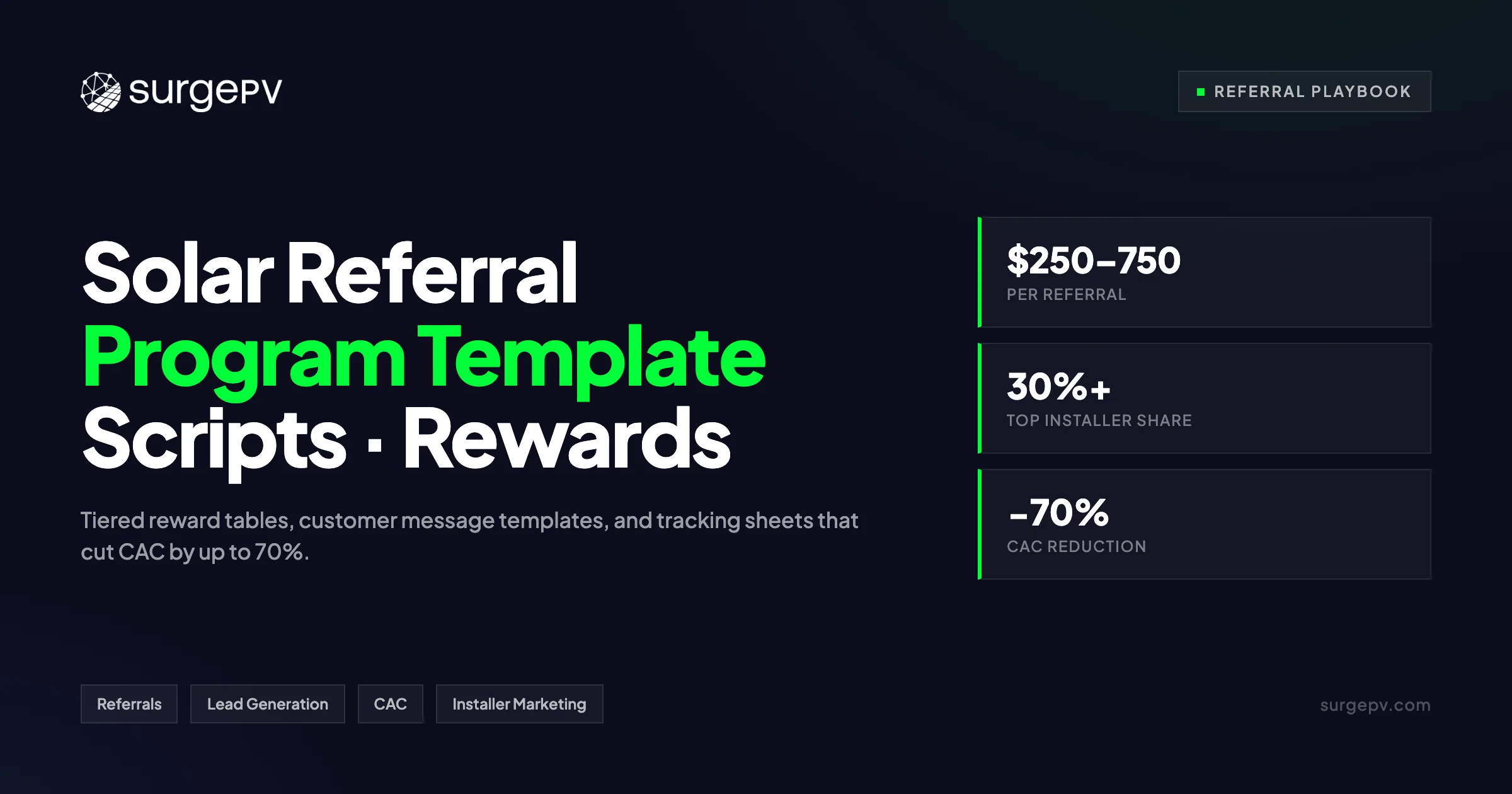
Customer acquisition cost in residential solar now runs $0.84 to $0.87 per watt (Wood Mackenzie/SEIA, Q4 2024). On a typical 8 kW system, that is $6,720 to $6,960 to acquire one customer before a single panel ships. Purchased leads close at 5 to 8 percent. Referrals close at 35 to 50 percent. The cost per referred customer is roughly $500. The math is simple.
Customer acquisition cost in residential solar now runs $0.84 to $0.87 per watt (Wood Mackenzie/SEIA, Q4 2024). On a typical 8 kW system, that is $6,720 to $6,960 to acquire one customer before a single panel ships. NREL’s SEEDS study of 1,662 solar adopters found 80 percent make referrals.
Yet most installers treat referrals as a happy accident. They finish an install. They say “tell your friends.” Then they hope. NREL’s SEEDS study of 1,662 solar adopters found 80 percent make referrals. Most installers capture fewer than 10 percent. The gap is not reluctance. It is enablement. Customers do not refer because they lack the right words, the right timing, and the right reward.
This guide gives you a complete solar referral program template. You get tiered reward structures. You get word-for-word rep scripts. You get customer message templates, a tracking spreadsheet, a financial model, and a follow-up cadence. Every piece is built for installers who want referrals to generate 30 to 40 percent of new leads, not 5 percent. For more on this topic, see Solar Racking Design Guide.
TL;DR — Solar Referral Program Template
Referrals close at 35 to 50 percent. Purchased leads close at 5 to 8 percent. The cost per referred customer is roughly $500. Total CAC runs $3,000 to $10,000 (SEIA). This guide delivers a complete program template: tiered rewards, rep scripts, customer messages, tracking spreadsheets, and a follow-up cadence. Top EPCs already pull 30 percent of leads from referrals. The average installer simply never built the system to capture them.
In this guide:
- What a solar referral program is and why most installers get it wrong
- How much to pay for referrals by system size and market
- The complete one-pager template you can hand to every customer
- Word-for-word scripts for in-person, phone, text, and email asks
- Copy-and-paste customer message templates for email, text, and social media
- A tracking spreadsheet and follow-up cadence that costs nothing
- The financial model showing why referrals deliver 4x ROI versus paid ads
- When to ask, how often to follow up, and what to do when customers say no
What Is a Solar Referral Program?
A solar referral program is a structured incentive system that turns existing customers into active lead sources. The customer introduces a friend, neighbor, or colleague. When that referral signs a contract, the referrer receives a reward such as cash, a bill credit, a gift card, or a donation to a cause. A real program has clear rules, tracked outcomes, and consistent rep execution.
The key word is structured. A sign on the truck that says “Refer a Friend” is not a program. It is a decoration. A real program has clear rules, simple sharing mechanics, tracked outcomes, and consistent rep execution. Without structure, referrals happen by luck. With structure, they happen by design. Solar software that automates follow-up and tracks status turns a manual process into a repeatable system.
Most solar companies already have the raw material for a strong program. A 2024 Forbes Home survey of 1,000 U.S. solar owners found 90 percent satisfaction and 83 percent willingness to recommend (McKinsey, 2025). Nielsen found 92 percent of consumers trust recommendations from friends and family over any form of advertising. The willingness exists. The mechanism does not.
The NREL SEEDS study surveyed 1,662 solar adopters across four U.S. states. Eighty percent reported making referrals. The median was 3 referrals per adopter. The study also found a critical detail. Most referrals happened during installation or within 30 days of activation. After six months, referral activity dropped sharply. Timing is not everything. But it is most of it.
The referral enablement problem. Solar installers do not have a referral problem. They have a referral enablement problem. The 80 percent of satisfied customers who never refer are not unwilling. They are unequipped. They do not know what to say. They do not know when to say it. They do not know what their friend will receive. Solar proposal tools that produces shareable designs and instant financial projections turns every customer into a confident advocate. A homeowner who can forward a professional PDF with a 3D roof render and a 25-year savings model has social currency. The referral stops being an awkward favor. It becomes useful information.
Single-sided versus double-sided. A single-sided program rewards only the referrer. A double-sided program rewards both the referrer and the new customer. Double-sided programs consistently outperform single-sided ones because they remove the social cost of referring. The customer is no longer asking a favor. They are giving a gift. Tesla’s program historically offered $400 off solar for the buyer plus credits for the referrer. EnergySage offers $250 to the referrer when the referred user goes solar, as of 2025. The pattern is consistent. Reduce friction for both parties.
Referrals versus word of mouth. Word of mouth is organic and untracked. A neighbor sees panels on a roof and calls the installer. Referrals are active and measured. A customer forwards a link, sends a text, or brings a name to their rep. The difference is attribution. Without attribution, you cannot optimize. Without optimization, you cannot scale.
How Much Should a Solar Company Pay for Referrals?
The right reward depends on your gross margin per install, your CAC by channel, and what competitors offer. The industry benchmark is 5 to 10 percent of gross margin per install. For a residential installer with 20 percent gross margin on a $25,000 system, that range is $250 to $500. Tiered rewards based on system size align incentives with value.
The right reward depends on three things: your gross margin per install, your CAC by channel, and what competitors offer. Pay too little and customers ignore the program. Pay too much and you attract referral hunters who optimize for rewards rather than fit.
The industry benchmark is 5 to 10 percent of gross margin per install. For a residential installer with 20 percent gross margin on a $25,000 system, that range is $250 to $500. For a high-margin installer or a commercial project, the number climbs. The goal is simple. The referrer should feel genuinely rewarded. You should still spend less than your next-best lead source.
The tiered reward structure. One flat rate for every system size leaves money on the table. A customer who refers a $45,000 commercial project deserves more than one who refers a $15,000 residential system. Tiered rewards align incentives with value.
| System Type | Size Range | Referrer Reward | New Customer Reward |
|---|---|---|---|
| Small residential | Under 6 kW | $250 | $250 |
| Standard residential | 6 to 10 kW | $500 | $250 |
| Large residential / battery | 10+ kW or battery add-on | $750 | $500 |
| Small commercial | 25 to 100 kW | $1,000 | $500 |
| Large commercial | 100+ kW | $2,000 to $2,500 | $1,000 |
The “per referral” bonus. Option One Solar adds a $1,000 bonus for every 5 referrals that sign, as of 2025. This creates a milestone effect. Customers who hit 2 or 3 referrals push for 5. Wolf Track Energy uses a two-step model: $25 per qualified lead plus $500 per signed contract, as of 2025. This rewards effort even when the referral does not close. It keeps customers engaged during longer sales cycles.
Non-cash alternatives. Cash is not the only currency. Some installers offer:
- Bill credits applied to the referrer’s solar loan or utility bill
- Free monitoring upgrades or extended warranties
- Charity donations in the referrer’s name
- VIP installation priority for the referrer’s next project
A1A Solar hosts dinner parties for customers and neighbors. The customer gets social recognition. The installer gets a room of warm prospects. High Noon Solar uses neighborhood door hangers that tap the “keeping-up-with-the-Joneses” effect. The reward is not always money. Sometimes it is status, community, or convenience.
UK and European notes. In the UK, cash referral fees are common and unregulated for residential solar. In Germany, some installers offer “Nachbarschaftsrabatt” (neighborhood discounts) where both parties receive a percentage off. VAT treatment of referral rewards varies by country. Consult your accountant on whether rewards count as discounts, commissions, or marketing expenses. Also see: Germany solar subsidies. Also see: European Solar Incentives. For Europe-specific compliance details, see Europe solar compliance.
The Solar Referral Program One-Pager Template
Every customer should receive a single-page handout or PDF at activation. The one-pager answers every question before the customer has to ask it. It should include the reward tiers, how the process works, what the customer can share, and the rules. Email it as a PDF at PTO. Hand it out during the final walkthrough. Repetition across channels increases recall.
Every customer should receive a single-page handout or PDF at activation. Not a link buried in an email. A physical or digital one-pager they can forward, print, or show a neighbor. The one-pager answers every question before the customer has to ask it.
One-Pager Template — Copy and Customize
[Your Company] Solar Referral Program
Give $250. Get $250.
When you refer a friend, neighbor, or colleague who goes solar with us, you both win. They get $250 off their installation. You get $250 cash when their system is activated.
How it works:
- Share your unique referral link or give us their name.
- We contact them for a free consultation and custom design.
- When they sign and their system goes live, we send your reward.
What you can share:
- Your personalized referral link (text, email, social)
- Your solar proposal PDF with 3D roof design and savings model
- Your monitoring app showing real-time production
Reward tiers:
- Small system (under 6 kW): $250 each
- Standard system (6 to 10 kW): $500 you, $250 them
- Large system or battery (10+ kW): $750 you, $500 them
Rules:
- Referral must be a new customer (not already in our pipeline).
- Reward paid within 14 days of system activation (PTO).
- No limit on referrals. Five signed referrals = $1,000 bonus.
Questions? Call [number] or email [email].
Why the one-pager works. It removes every point of friction. The customer knows exactly what to say, what their friend gets, and when they get paid. The inclusion of a shareable proposal PDF is intentional. Solar design tools that produces bankable, professional proposals gives customers something tangible to forward. A 3D roof render with shading analysis and a 25-year financial model is more persuasive than a verbal recommendation. The customer becomes a credible advisor, not just a name-dropper.
Digital versus physical. Email the one-pager as a PDF at PTO. Print it on card stock and hand it to the homeowner during the final walkthrough. Text a shortened link to the one-pager 7 days after activation. Repetition across channels increases recall. One touch is forgettable. Three touches are memorable.
Word-for-Word Referral Ask Scripts for Reps
The ask is where most referral programs fail. Reps feel awkward, worry about seeming pushy, or forget entirely. The fix is scripting, not motivation. When the words are practiced, the ask becomes routine. This section gives you four scripts for in-person, phone, text, and email asks, plus objection handlers.
The ask is where most referral programs die. Reps feel awkward. They worry about seeming pushy. They forget entirely. The fix is not motivation. It is scripting. When the words are practiced, the ask becomes routine.
Script 1: In-person at final walkthrough (post-install)
“[Name], the system is live and your first bill should drop by about [X] percent. Most of our customers tell us their neighbor asks about the panels within the first month. When that happens, or if you already know someone thinking about solar, we have a referral program that gives both of you $250. Can I leave you with a card that has your personal referral link on it?”
Script 2: Phone call 14 days after activation
“Hi [Name], I’m calling to check how your first bill looked. [Pause for response.] Great to hear. I also wanted to remind you about our referral program. If you know anyone who has been considering solar, we give you $500 and them $250 when they sign. No forms to fill out, just send me their name or forward them this link. Who comes to mind first?”
Script 3: Text message 30 days after activation
“Hi [Name], hope the new system is treating you well. Quick note, our referral program is active: give $250, get $250. If anyone asks about your panels, just send them this link: [short URL]. Your neighbor saves money and you get paid when they go live. Thanks again for choosing us.”
Script 4: Email 90 days after activation (re-engagement)
“Subject: Your solar savings update + a $500 opportunity
Hi [Name],
Your system has been running for 3 months. Based on your production data, you’ve saved approximately $[X] so far.
We wanted to remind you about our referral program. Know someone still paying full price to the utility? Send them our way. They get $250 off. You get $500 when their system is activated.
[Referral link]
Best, [Rep name]“
Handling objections.
“I don’t know anyone interested.”
“That’s fair. Most people don’t think about solar until someone they know goes first. Would you mind keeping one of our referral cards on your fridge? When your neighbor asks about the panels, and they will, you’ll have the details ready.”
“I don’t want to seem pushy.”
“I get that. The program is designed so you’re giving them a discount, not asking for a favor. They save $250. You get $500. It’s a gift, not a sales pitch.”
The Sandler upfront contract. Sandler Training teaches an “upfront contract.” It sets expectations before the meeting starts. During the initial consultation, say: “If we deliver the savings we model today, would you introduce us to one neighbor when the system goes live?” This plants the seed before installation. The post-install ask becomes a fulfillment of a prior agreement, not a cold request.
Customer Message Templates They Can Copy and Paste
Customers want to refer, but they do not want to write marketing copy. Give them pre-written messages for every channel. Each message should sound like the customer wrote it, not like corporate spam. Include a personal result, a specific process detail, and a soft opt-out to reduce social pressure.
Customers want to refer. They do not want to write marketing copy. Give them pre-written messages for every channel. The message should sound like the customer wrote it, not like corporate spam.
Template 1: Text to a friend
“Hey, remember I was looking into solar? We got ours installed last month and our bill dropped [X] percent. The company has a referral deal right now, you get $250 off if you sign up, and I get $500. Want me to connect you? They did a free 3D design of our roof first. Took 30 minutes.”
Template 2: Facebook or LinkedIn post
“Our solar panels have been live for [X] weeks. First utility bill was [X] percent lower than last year. The installer did a full 3D roof design and walked us through the payback before we signed. If anyone is curious about going solar, they have a referral program, you get $250 off and I get a thank-you bonus. DM me and I’ll send the link.”
Template 3: Email to a colleague or neighbor
“Subject: Solar update + a discount if you’re interested
Hi [Name],
I wanted to share a quick update. We had solar installed [X weeks/months] ago and our utility bill is down [X] percent from this time last year.
The installer, [Company Name], did a great job. They mapped our roof in 3D, ran shading analysis, and gave us a proposal with exact payback and savings numbers before we committed. No pressure, just data.
They have a referral program. If you decide to get a free consultation, you get $250 off the install and I get a bonus when your system goes live. Here’s the link: [URL]
No worries if you’re not ready, just thought I’d share since you mentioned being interested.
[Customer name]“
Template 4: Neighborhood group or Nextdoor post
“Hi neighbors, we just had solar installed on [Street Name] and I wanted to share our experience. The team was professional, the install took one day, and our first bill was [X] lower than last year. They did a free 3D design and savings model before we signed anything. If anyone on the block is considering solar, they have a neighborhood referral deal. Message me and I’ll send the details.”
Why these work. Each template includes a personal result, a specific process detail, and a soft opt-out. The personal result builds credibility. The process detail reduces the friend’s perceived risk. The opt-out removes the referrer’s social pressure. Combined, they turn a sales request into a genuine recommendation.
The proposal as a shareable asset. The most effective referral tool is not a message template. It is the proposal itself. When a customer receives a professional PDF with a 3D roof layout, shading simulation, and 25-year financial model, they forward it. Solar proposal software that generates these documents in under 30 minutes gives every customer a shareable asset. The neighbor sees the same quality of analysis the customer saw. It is not a rough estimate. It is a bankable design. That visual credibility does more than any script.
Turn every proposal into a referral magnet
SurgePV generates 3D roof designs, shading reports, and financial models in minutes — the exact assets your customers want to share with neighbors.
Book a DemoNo commitment required · 20 minutes · Live project walkthrough
For a direct comparison, see Arka 360 vs SurgePV.
Referral Tracking and Follow-Up Cadence
You cannot improve what you do not track. A referral program without tracking is a black box. For small installers, a simple spreadsheet with nine columns is enough. For larger volumes, use CRM automation triggered at PTO with reminders at 7, 14, 30, 90, and 180 days.
You cannot improve what you do not track. A referral program without tracking is a black box. You know some referrals came in. But you do not know from whom, when they were asked, or which channel worked best.
The tracking spreadsheet. For installers doing under 50 installs per month, a spreadsheet is sufficient. Here is the structure:
| Customer Name | Install Date | PTO Date | Date Asked | Referral Name | Channel | Status | Reward Paid | Notes |
|---|---|---|---|---|---|---|---|---|
| John Smith | 2026-03-01 | 2026-03-15 | 2026-03-20 | Sarah Lee | Text | Contract signed | $500 | Neighbor across street |
| Maria Garcia | 2026-02-10 | 2026-02-25 | 2026-03-05 | Tom Brown | Consultation booked | — | Colleague at office |
The key field is “Date Asked.” If this column is empty, the rep has not made the ask. Review the sheet weekly. Empty cells mean lost revenue.
The follow-up cadence. One ask is not enough. Customers are busy. They forget. A structured cadence triples referral volume without annoying anyone.
| Touchpoint | Timing | Channel | Action |
|---|---|---|---|
| Touch 1 | Day of PTO | In person | Hand referral one-pager during final walkthrough. Make the verbal ask. |
| Touch 2 | 7 days post-PTO | Text | Send short message with referral link and savings snapshot. |
| Touch 3 | 14 days post-PTO | Phone | Check first bill. Remind about program. Ask for one name. |
| Touch 4 | 30 days post-PTO | Send referral message templates and proposal PDF they can forward. | |
| Touch 5 | 90 days post-PTO | Re-engage with production data: “You’ve saved $X so far.” | |
| Touch 6 | 180 days post-PTO | Seasonal check-in with updated savings + referral reminder. |
CRM automation. For installers with CRM integration, trigger the sequence automatically at PTO. The rep’s only manual step is the in-person ask at walkthrough. Everything else runs on autopilot. For solar installers using HubSpot or Salesforce, a simple workflow trigger sends the email sequence and logs referral status without rep intervention. Salesforce data shows reps spend only 30 percent of their time selling. Automation recaptures the other 70 percent for revenue-generating work.
The “solar advocate” segment. Namasté Solar identifies the top 20 percent of customers who refer more than one person. These “solar advocates” are marked in the CRM and receive proactive marketing. An advocate who referred two people in 2025 is your highest-probability source in 2026. Treat them differently. Send them holiday cards. Invite them to company events. Offer them higher-tier rewards. A small group of advocates can produce 50 percent of your referral volume.
The Financial Case: CAC, ROI, and Break-Even
Referrals are not a nice-to-have. They are a financial imperative. Referred customers cost about $500 total, while purchased leads cost $1,875 to $6,000 per signed deal. Referral programs deliver 4 times the ROI of digital advertising. Referred customers also have 25 percent higher lifetime value and 37 percent higher retention.
Referrals are not a nice-to-have. They are a financial imperative. The numbers below show why.
CAC by lead source.
| Lead Source | Cost per Acquisition | Close Rate | Cost per Signed Deal |
|---|---|---|---|
| Purchased leads (aggregator) | $150 to $300 per lead | 5 to 8% | $1,875 to $6,000 |
| Google Ads | $80 to $200 per lead | 10 to 15% | $533 to $2,000 |
| Door-to-door | $30 to $80 per appointment | 15 to 25% | $120 to $533 |
| Inbound / SEO | $20 to $50 per lead | 10 to 20% | $100 to $500 |
| Customer referrals | ~$500 total | 35 to 50% | $500 to $1,000 |
The referral column looks different because the “cost per lead” concept does not apply. You are not buying a lead. You are paying a reward after the contract is signed. The $500 is a variable cost tied to revenue, not a speculative marketing spend. If the referral does not close, you pay nothing.
The 4x ROI argument. Harvard Business Review reports that referral programs deliver 4 times the ROI of digital advertising (2024). Referred customers have 25 percent higher lifetime value (Harvard Business Review, 2024) and 37 percent higher retention (Deloitte). McKinsey found that word-of-mouth marketing generates more than twice the sales of paid advertising. In solar, where a 2024 Forbes Home survey found 90 percent customer satisfaction, the conditions for word-of-mouth are ideal. The failure is operational, not market-driven.
Break-even analysis. Assume you pay $500 per referral. Your average residential install generates $5,000 in gross margin. One referral costs 10 percent of margin. If you run a double-sided program with $250 to the new customer, your total cost is $750. That is 15 percent of margin. You still retain 85 percent of gross margin on a customer who costs $0 in upfront marketing. Compare that to a purchased lead where you spend $2,000 to $4,000 in marketing before a single signature.
The payback period. If an installer does 20 installs per month and moves referral share from 10 percent to 30 percent, they add 4 referral-based installs monthly. At $500 reward per install, the monthly program cost is $2,000. The marketing savings versus purchased leads is $6,000 to $20,000 per month. The program pays for itself in the first month.
Scale math. An installer with 500 active customers who achieves the NREL median of 3 referrals per adopter has 1,500 potential introductions. At a 20 percent sign rate — conservative for warm referrals — that is 300 new customers. At $500 reward each, total program cost is $150,000. At $5,000 gross margin per install, total gross margin is $1,500,000. Net program profit: $1,350,000. Most installers never do this math. The ones who do build their entire growth strategy around referrals.
When Should You Ask for a Referral?
The optimal window is 14 to 30 days post-activation, when the customer has received their first reduced utility bill and still feels excited about the system. NREL’s SEEDS study found most referrals happen during installation or within the first month. After six months, referral rates drop by more than half.
Timing determines whether the ask lands or bounces. Ask too early, before the system is live, and the customer has no proof to share. Ask too late, after six months, and the excitement has faded.
The optimal window is 14 to 30 days post-activation. By then the customer has received their first reduced utility bill. They have proof. They are still excited about the new system. Their neighbors are asking questions. The NREL SEEDS study found most referrals happen during installation or within the first month after activation. After six months, referral rates drop by more than half.
The Sandler post-sell step. Sandler Training includes a dedicated “post-sell” step in its sales methodology. The referral ask is not an afterthought. It is a formal stage of the process. The rep builds the ask into the upfront contract at the first meeting. The question is simple: “If we deliver the savings we model today, would you introduce us to one neighbor when the system goes live?” This frames the referral as a logical next step in a proven process, not a favor extracted after the fact.
The bill-triggered ask. The most powerful referral trigger is not a calendar date. It is the first utility bill showing savings. When a customer opens a bill that is 40 to 60 percent lower than last year, they feel validated. That is the moment to text, call, or email. “Hi [Name], saw your first bill came in. How did it look?” When they respond with enthusiasm, the referral ask follows naturally.
The monitoring share. Modern solar monitoring apps let customers share production data. When a customer posts a screenshot of their app showing 95 percent offset, that is a referral. Encourage it. Send a text at 60 days: “Your system has produced [X] kWh so far. If you share your monitoring dashboard with a neighbor, mention our referral link and you’ll both get rewarded.” Solar shadow analysis software produces visual reports. Customers naturally want to share them. The data proves their investment was sound.
The re-engagement window. Some customers will not refer in the first 90 days. Life gets busy. That does not mean the opportunity is gone. Re-engage at 6 months and 12 months with a production summary. “Your system has saved you $[X] in its first year. Know anyone who would like the same result?” Annual touchpoints keep the program alive without becoming intrusive.
What not to do. Do not ask at contract signing. The customer has not experienced the product. Do not ask at installation. The system is not yet producing. Do not ask only once. Repetition across multiple channels moves the needle. NREL found 80 percent of solar adopters make referrals. Texas Tech research found 83 percent of satisfied customers are willing to refer, but only 29 percent actually do. Most were simply never asked.
Conclusion
Referrals measure how well you enable customers to advocate. Eighty percent of solar adopters refer, but the average installer captures fewer than 10 percent because they never built the system to harvest them. The gap is operational discipline. Top performers script the ask, track outcomes, and follow up at 30, 90, and 180 days.
Referrals are not a marketing channel. They are a measure of how well you enable your customers to advocate. The data is clear. Eighty percent of solar adopters refer. Close rates run 35 to 50 percent. Acquisition costs sit near $500. Yet the average installer captures less than 10 percent of this potential because they never built the system to harvest it.
The gap between top EPCs and everyone else is not product quality. It is operational discipline. Top performers treat referrals as a core sales process, not a side project. They script the ask. They track the outcome. They follow up at 30, 90, and 180 days. They give customers shareable assets. These include professional proposals, monitoring data, and message templates. A vague “tell your friends” becomes a concrete action.
Three actions will move the needle this quarter:
- Build the one-pager today. Use the template in this guide. Customize your reward tiers. Email it to every customer at PTO. Hand it to them in person during the final walkthrough. Do not wait for perfect branding. A plain one-pager sent today outperforms a designed one-pager stuck in review for a month.
- Script the ask and practice it. Reps who improvise the referral ask avoid it. Reps with a script deliver it. Run role-play sessions until the words feel natural. Track “Date Asked” in your spreadsheet. Review weekly. Make referral asks part of your weekly sales huddle. What gets inspected gets done.
- Tie proposal quality to referral volume. A customer who receives a generic PDF quote has nothing to share. A customer who receives a 3D roof design with shading analysis and a 25-year financial model has an asset. Solar design software that produces bankable proposals is not a design tool. It is a referral engine. When a neighbor sees the same quality of analysis that convinced the original customer, trust is instant. The sales cycle shortens. The close rate rises.
The next step is to audit your last 20 installs. How many received a referral one-pager? How many were asked in person? How many were followed up at 30 and 90 days? The gaps in that audit are your roadmap. Fix them. Referrals will become your largest, cheapest lead source within 12 months.
Frequently Asked Questions
A solar referral program rewards existing customers for introducing new leads to your installation company. Residential installers typically pay $250 to $750 per signed referral. The best time to ask is within 30 days of system activation. Track referrals with a simple five-column spreadsheet or CRM automation triggered at PTO.
What is a solar referral program and how does it work?
A solar referral program is a structured system that rewards existing customers for introducing new leads to your installation company. The customer receives a cash reward, bill credit, or gift card when their referral signs a contract. The best programs include a clear reward structure, simple sharing tools, and automated follow-up so reps never forget to ask.
How much should a solar company pay for a referral?
Residential installers typically pay 250 to 750 USD per signed referral, with tiered rewards based on system size. A 5 kW system might earn 250 USD, while a 12 kW system with battery storage earns 750 USD. Commercial referrals range from 1,000 to 2,500 USD. The rule of thumb is 5 to 10 percent of your gross margin per install. Read Adding Battery Storage Services for a complete walkthrough.
When is the best time to ask solar customers for referrals?
The optimal ask window is within 30 days of system activation, when the homeowner sees their first reduced utility bill. NREL research shows 80 percent of solar adopters make referrals, but most happen during or immediately after installation. Asking after six months produces sharply lower response rates.
How do you track solar referrals without expensive software?
A simple spreadsheet handles tracking for small installers. Use five columns: customer name, referral name, date asked, contract status, and reward paid. For larger volumes, a CRM automation triggered at PTO with a 30, 90, and 180-day reminder sequence replaces manual tracking.
What percentage of solar sales should come from referrals?
Top-performing EPCs generate 30 percent or more of total leads from referrals. The average installer sits below 10 percent. NREL’s SEEDS study found 80 percent of solar adopters make referrals. Texas Tech research found 83 percent of satisfied customers are willing to refer, but only 29 percent actually do. Most were simply never asked.
Where this fits
This article is part of SurgePV's Solar Sales & Proposals hub, which works through the topic from first principles to the decisions a project team actually has to make.


