

Answer
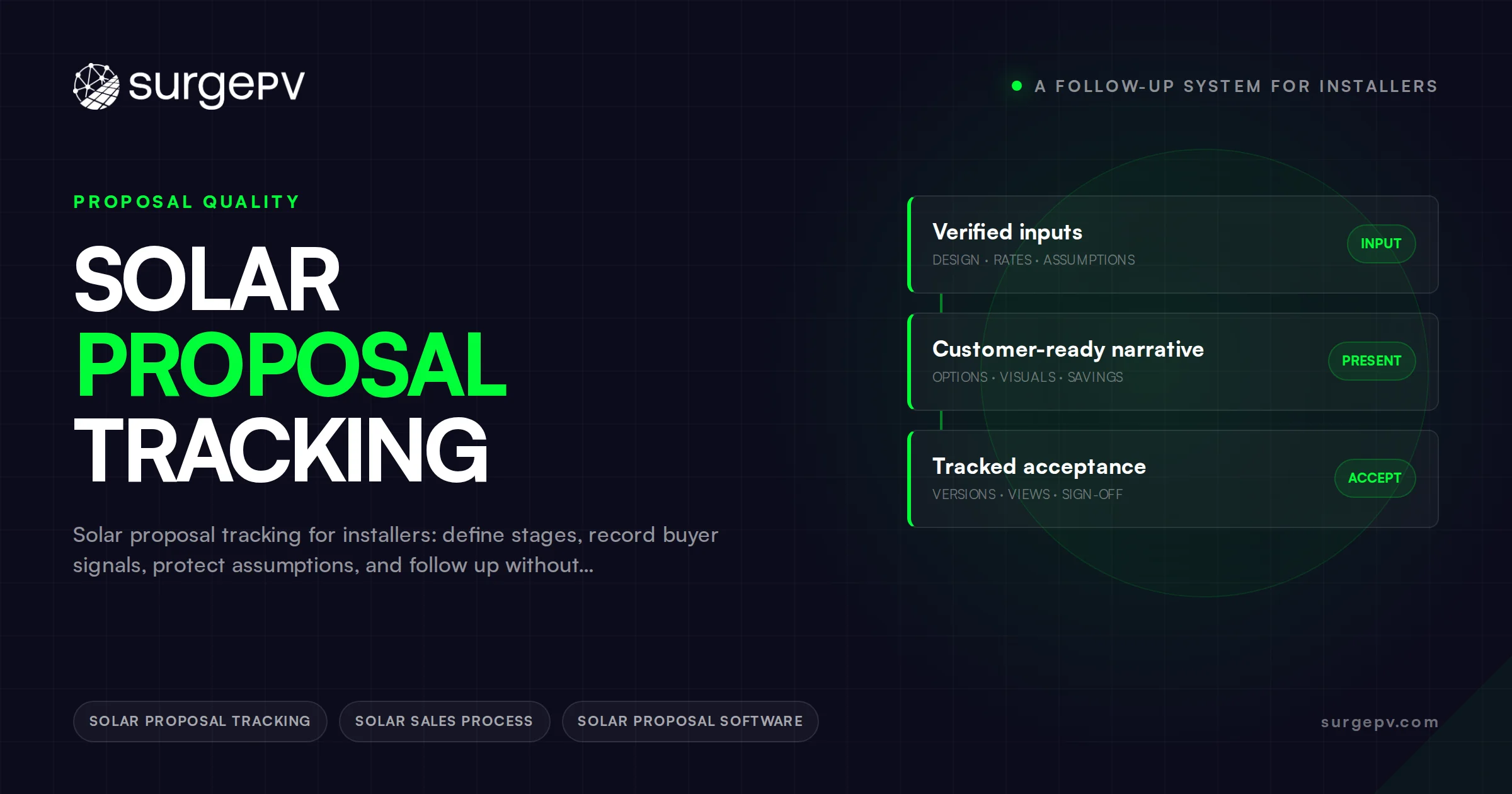
Solar proposal tracking works when an installer records the proposal version, recipient, assumptions, next agreed action, and a reason for every stage change. An open or view signal can guide a follow-up, but it does not prove buying intent.
Solar proposal tracking should answer one practical question: what does the buyer need to decide next, and what information must the installer verify before acting? For installers and EPCs, a sent PDF is not a reliable sales stage. A proposal may be opened by a homeowner, forwarded to a finance contact, downloaded by a facilities manager, or ignored because an assumption is unclear. Tracking is useful only when it turns those possibilities into a clear, respectful next action.
This guide is for teams that already produce proposals and want a disciplined way to manage versions, buyer conversations, and handoffs. It does not promise that email opens, document views, or a faster follow-up will improve close rates. Those outcomes depend on project fit, price, trust, financing, timing, and many conditions outside a tracking system.
Direct Answer
Track the current proposal version, its recipient, the production and financial assumptions it contains, the agreed next action, and the person responsible for it. Treat viewing data as a conversation prompt, not proof of intent.
Start With a Proposal Stage Definition
Many sales pipelines fail at the first label. “Proposal sent” can mean a preliminary illustration was emailed, a priced scope was discussed live, a revised option is waiting for utility information, or a final commercial offer is awaiting signature. Those are different states with different risks.
Use a small set of definitions that the sales and design teams can apply consistently:
| Stage | What must be true | Useful next action |
|---|---|---|
| Draft in preparation | Inputs are still being checked | Resolve missing site, bill, or equipment data |
| Proposal delivered | A specific version reached the recipient | Confirm receipt and agree a review time |
| Proposal under review | The buyer has an identified question or review process | Answer the named question with the current version |
| Revision requested | A scope, assumption, or option must change | Record change request and its owner |
| Decision pending | Buyer has a defined decision path | Follow the agreed decision date, not a generic cadence |
The definition protects the customer as well as the installer. A preliminary layout should not become a final commitment simply because it was sent. The proposal record should state what is modeled, what remains subject to survey, engineering, interconnection, pricing, or contract review, and which version contains that explanation.
Track the Proposal Version Before Tracking Engagement
Document engagement data is only useful when the team knows which document was viewed. A revised module count, a changed tariff assumption, or a different financing option can make an earlier version misleading. Give each customer-facing proposal a stable version label and link it to the design revision that supplied its figures.
At minimum, record these fields in the project record:
- customer and recipient name;
- proposal version and delivery date;
- design revision and system configuration;
- production-data source and model assumptions;
- electricity tariff, financing, and incentive assumptions;
- open conditions and exclusions;
- next action, due date, and owner.
The U.S. Department of Energy explains that solar project results depend on location, design, equipment, and operating conditions; no proposal should collapse those variables into an unsupported certainty. Its public resources are useful background for solar development, while the actual project record must rely on current site, utility, manufacturer, and contract information. See the Solar Energy Technologies Office for that context.
When the data changes, do not overwrite history silently. Mark the older proposal superseded, state why it changed, and identify whether the customer has received the replacement. This keeps a sales representative from following up on a savings figure or layout that the design team no longer recognizes.
Use View Signals Carefully
Proposal tools can show that an email was delivered or that a document link was opened. Those signals are limited. Image blocking, forwarded links, shared mailboxes, mobile previews, and automated security scanners can all produce incomplete or misleading activity. A customer can also read a proposal carefully without generating a useful signal.
The safe use of a view signal is simple: use it to choose a helpful question. For example: “I wanted to check whether the production assumptions and the two system options were clear. Would a 15-minute review help?” That is more useful than “I saw you opened the proposal,” which can sound intrusive and tells the buyer nothing about the decision.
Do not assign a public meaning to internal engagement metrics. A viewed proposal is not a qualified lead, a forecasted sale, or evidence that a team’s proposal software performs better than another product. Those claims would need retained evidence beyond this desk-research guide.
Build Follow-Ups Around the Buyer’s Decision
The most useful follow-up changes with the buyer’s job. A residential prospect may need clarification on monthly bills, available roof area, financing, or installation timing. A commercial buyer may need an internal business case, a facilities review, consumption data, insurance input, or a procurement path. Sending the same reminder to each group creates noise.
Before the proposal is delivered, ask one direct question: “What will you need to review this with your team or household?” Record the answer. It might be a cash-flow comparison, a shading explanation, a construction schedule, a technical appendix, or a call with another stakeholder. That answer becomes the next task.
For a commercial project, distinguish decision support from a promise. The Generation & Financial Tool can help teams connect yield and financial scenarios, but its results depend on inputs and assumptions. Explain those inputs in plain language. If an electricity price, demand charge, incentive, or financing term has not been verified, label it as an assumption and say what will confirm it.
Keep Sales and Design in the Same Record
Proposal tracking is often treated as a sales-only activity. In solar, it cannot be. The document contains design-derived information: array size, equipment, shading treatment, annual production, scope, and financial assumptions. If the sales pipeline and the design record disagree, the customer receives a confusing story.
Create a handoff rule for material changes. When a buyer asks to change module quantity, battery scope, roof area, financing, or the assumed load profile, the request should go back to the appropriate review step. The sales team should not edit a customer-facing number from memory. Likewise, a designer should be able to see the customer question that motivated the revision.
This is where solar design software can be useful: it gives installers and EPCs a connected place to work from design toward a proposal. It does not replace field verification, local requirements, manufacturer documentation, or qualified engineering review. The process must still identify who is accountable when an input is uncertain.
A Practical Weekly Proposal Review
A weekly review does not need to be a long forecast meeting. Review the proposals that have an overdue next action, an unresolved revision request, or a material assumption that may now be stale. For each one, answer five questions:
- Which proposal version is current?
- What decision is the recipient making next?
- What information is missing or still provisional?
- Who owns the next customer or internal action?
- When will the team reassess if the action does not happen?
This small routine exposes stalled work earlier than a generic “last activity” field. It can also reveal process problems: perhaps estimates are being sent before bills arrive, finance options are not clearly separated, or revisions are not reaching all stakeholders. Treat those as operational findings, not proof that a particular tool caused a commercial result.
Design Solar Projects Faster with SurgePV
Keep the design, financial assumptions, and customer proposal connected in one workflow.
Book a DemoNo commitment required · 20 minutes · Live project walkthrough
Document the Reasons a Proposal Pauses
A quiet proposal is not one category. The buyer may be waiting for a roof repair, a utility bill, a lender decision, a landlord approval, a construction window, or a colleague with authority to review the scope. Record the stated reason rather than assigning a generic “cold” label. That distinction helps the next owner decide whether to wait, provide a missing document, revise the option, or close the opportunity responsibly.
It also prevents misleading internal reports. A proposal that is paused because the customer is replacing a roof should not be grouped with proposals that were rejected on price or lost to another installer. Teams can learn from those categories only when the reason is recorded at the time of the conversation, with enough context for someone else to understand it later.
Where a customer asks for an alternative, record the exact alternative and its consequence. A smaller system may change the modeled production, a battery option may change the financial scenario, and a different equipment selection may change availability or electrical design. Send a revised proposal only after the relevant project inputs have been reviewed. This keeps tracking aligned with the real project rather than a sequence of disconnected sales emails.
Pro Tip
Put the proposal version and the next agreed action in the subject line or delivery note. It makes the record easier to find later and reduces the chance that the customer reviews an outdated attachment.
Make Tracking Respectful and Useful
Customers should understand why an installer is following up: to clarify a question, confirm a change, prepare a requested option, or agree a decision date. Avoid creating artificial urgency from a tracking event. If a buyer has not replied, a short message that offers a specific form of help is usually more useful than repeated “checking in” emails.
For distributed teams, retain the same standard in the project record. A new salesperson or project manager should be able to see the last customer-facing version, what the buyer asked, and what has not been confirmed. That continuity matters when a project runs over weeks or months.
Conclusion: Track Decisions, Not Clicks
Solar proposal tracking is valuable when it preserves the link between a buyer conversation and the versioned project record behind it. The view signal is optional context. The decision, the assumptions, and the next owner are the work.
- Define proposal stages by evidence, not merely by sending an email.
- Make every revision traceable to a design and customer request.
- Follow up with a question that helps the buyer make the next decision.
Ready to Speed Up Your Solar Workflow?
Explore connected solar design, financial analysis, and customer-ready proposal workflows with SurgePV.
Book a DemoFrequently Asked Questions
What should solar proposal tracking record?
Record the proposal version, recipient, delivery date, source assumptions, open conditions, next action, owner, and reason for a stage change. Link that record to the design revision that supports the proposal.
Does a proposal view mean the customer is ready to buy?
No. It only indicates that the document or link may have been accessed. Use it as a reason to offer a useful review, not as evidence of commitment.
How should an installer follow up on a solar proposal?
Follow the next action agreed with the buyer. If no action was agreed, ask a specific question about the proposal’s assumptions, options, or internal review process rather than sending a generic reminder.
Sources
Primary research and reference material used for this desk-research article.
Where this fits
This article is part of SurgePV's Solar Business & Operations hub, which works through the topic from first principles to the decisions a project team actually has to make.


