

Answer
The rep sees 25 years of avoided utility cost. US residential solar installations declined 31% in 2024 (SEIA/Wood Mackenzie, 2025). Only 11% of sales professionals feel confident on calls. 70% say objections are their hardest challenge (Salesroom, 2024). The rep sees 25 years of avoided utility cost.
Price objections are not about price. They are about certainty.
The rep sees 25 years of avoided utility cost. US residential solar installations declined 31% in 2024 (SEIA/Wood Mackenzie, 2025). Only 11% of sales professionals feel confident on calls.
The homeowner sees one big number. The rep sees 25 years of avoided utility cost. That gap is psychological, not mathematical.
US residential solar installations declined 31% in 2024 (SEIA/Wood Mackenzie, 2025). A lost appointment burns time and money the company already spent.
Only 11% of sales professionals feel confident on calls. 70% say objections are their hardest challenge (Salesroom, 2024). Most reps fail because they lack a script for the moment after the homeowner says, “This costs too much.”
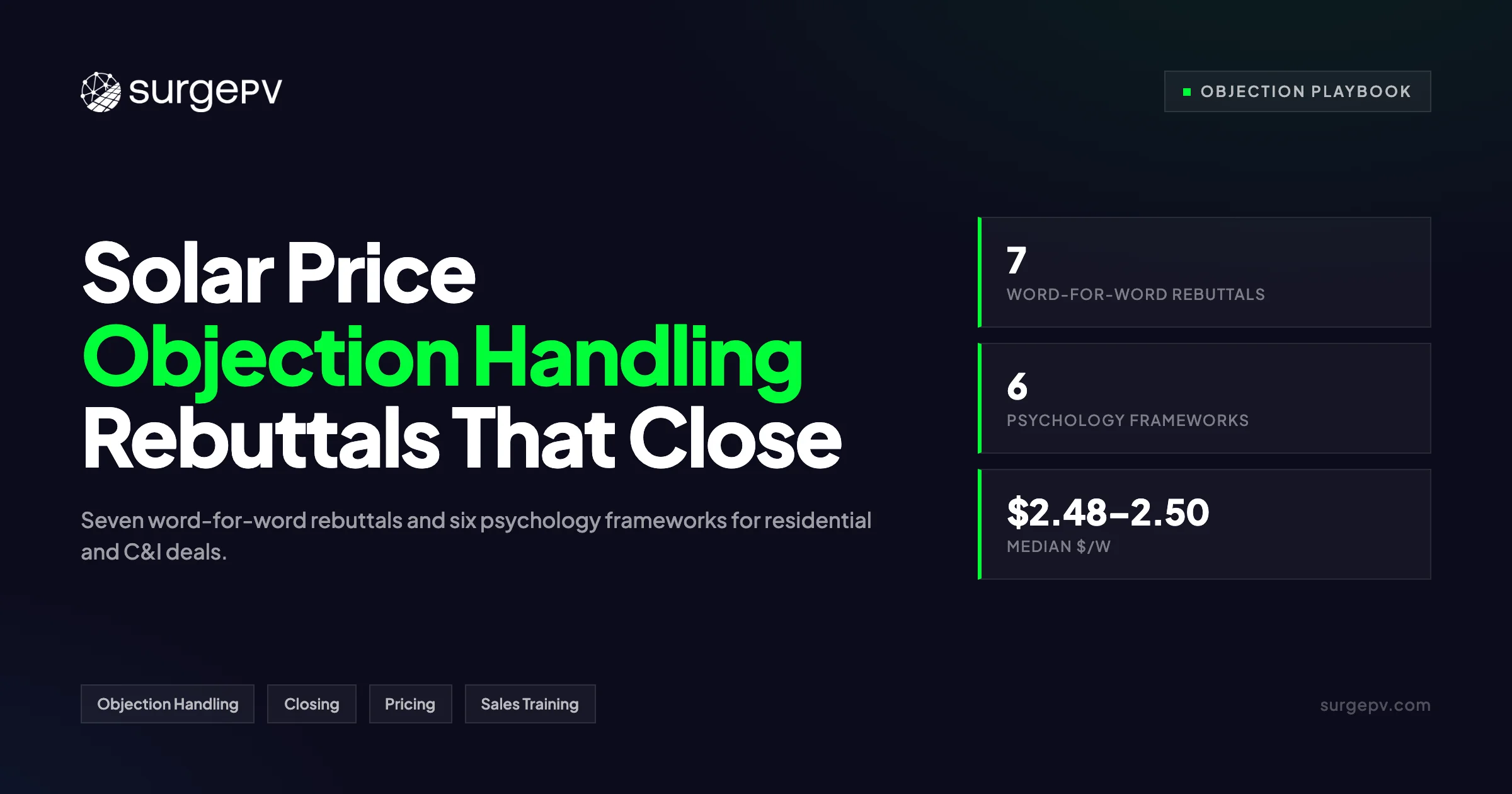
This guide gives you 7 word-for-word rebuttals for price objections. You get 6 psychology frameworks. You also get a prevention sequence that stops objections before they start.
TL;DR — Solar Price Objection Handling
The median quoted US residential solar price is $2.48 per watt as of early 2025 (EnergySage, 2025). Top reps do not argue over sticker price. They reframe lifetime energy cost. They validate the objection. Then they model the answer live. The scripts below work for US and UK markets.
Read more about Battery Solar System Design UK. For United Kingdom-specific compliance details, see United Kingdom comparisons/mcs-vs-non-mcs.
In this guide:
- Why Price Objections Happen (Psychology)
- The 6 Frameworks Every Solar Rep Should Master
- The 7 Price Objections (With Scripts)
- What NOT to Say When a Customer Pushes Back on Price
- How to Prevent Price Objections Before They Start
- Commercial Solar Price Objections
- The 48-Hour Follow-Up Script
- Team Training: Objection Tracking Framework For more on this topic, see Solar Racking Design Guide.
Why Price Objections Happen (Psychology)
Price objections happen because homeowners anchor on the visible sticker price while future savings feel abstract. Loss aversion and analysis paralysis widen the gap. Trust deficits and fear of pushy tactics push buyers toward the safest objection: it costs too much.
Price objections in solar are framing problems. The homeowner sees one large number. The rep sees 25 years of avoided utility cost. The disconnect lives in the brain, not the spreadsheet.
Homeowners do not buy solar every day. They buy a handful of big-ticket items in a lifetime. The brain anchors to the sticker price because it is visible. The avoided utility cost is invisible. It spreads across decades.
This is called loss aversion. People feel a loss about twice as strongly as an equivalent gain (Kahneman & Tversky, 1979). Writing a $30,000 check today feels concrete. Saving $60,000 on utility bills over 25 years feels abstract. The rep’s job is to make the future cost visible.
Another force is analysis paralysis. A solar proposal contains financing terms, degradation rates, net metering rules, and incentive schedules. Too many variables create decision fatigue. The homeowner defaults to the safest objection: “It costs too much.”
Trust gaps make it worse. 61% of lost deals stem from buyer indecision (Ebsta & Pavilion, 2024). Residential solar follows the same pattern. If the rep cannot explain production or export value, the homeowner retreats to price.
Social proof cuts both ways. A neighbor got a “better deal.” Online forums warn about pushy sales tactics. The homeowner enters the appointment defensive. They are not rejecting the panels. They are rejecting uncertainty.
Reps spend 60% of their time on non-selling tasks (Salesforce, 2025). That leaves little room to build trust. The result is a script-heavy, model-light pitch that feels like a product push. When the numbers are transparent and tied to the actual roof, the objection softens.
The 6 Frameworks Every Solar Rep Should Master
The six frameworks are LAER, Feel-Felt-Found, Sandler Reverse, Isolation Question, Tie-Down, and Pre-Frame. Each one turns resistance into dialogue. Mastering them lets reps choose the right response in real time instead of defaulting to a defensive pitch or a discount.
Every rebuttal below uses one of 6 frameworks. Learn the framework first. The script is just the clothing. Once you know when to isolate versus when to reverse, you can adapt any script to the customer in front of you.
LAER means Listen, Acknowledge, Explore, Respond. Do not respond before you explore. Most reps jump to the answer. The homeowner hears a sales pitch. Ask one extra question first.
Example: “I get it. Help me understand — when you say too expensive, do you mean the total cost or the monthly payment?” That explore step isolates the real objection.
Feel-Felt-Found builds empathy first. “I know how you feel. Mrs. Johnson on Maple felt the same way. She found that when she looked at the total utility cost over 10 years, the system paid for itself twice over.” Use real customers. Fake stories destroy trust.
Sandler Reverse means agreeing and retreating. “You are right. At $28,000, this is a serious investment. It might not make sense for every household. Can I ask what number would feel comfortable?” This removes pressure. The homeowner often talks themselves back up.
Isolation Question narrows the objection to one variable. “If we could get the monthly payment under your current average bill, would the total cost still worry you?” If they say no, you have isolated the objection. If they say yes, you have uncovered a deeper issue.
Tie-Down earns a small yes that leads to the close. “Does it make sense to own your power instead of renting it from the utility?” “Would it help to see the 10-year cash flow side by side?” Each yes builds momentum.
Pre-Frame sets expectations before the number appears. “Most homeowners are surprised by the total cost until they see the monthly comparison. I will show you both.” This prepares the brain to receive the full picture. For France-specific information, see Agricultural Solar Case Study. For the latest details on France, see Floating Solar Farms France.
52% of sales professionals believe AI can help identify objections (HubSpot, 2025). Modern solar software can flag when a prospect pauses on price. That signal helps the rep choose the right framework in real time.
The 7 Price Objections (With Scripts)
The seven objections are total price too high, monthly payment too high, cheaper quote elsewhere, payback period too long, waiting for price drops, refusing financing, and incentive uncertainty. Each script validates the concern, isolates the real issue, and replaces anxiety with numbers.
These are the 7 price objections you will hear in 2025 and 2026. Each script is built for a single residential appointment. Adapt the currency and incentives for your market.
“The total price is too high”
“You are right. $28,000 is a lot of money. Let me show you something.”
Open the generation and financial tool. Pull up the side-by-side view.
“This column is what you will pay the utility over 25 years. I have used the EIA average of 2.8% annual rate increases (U.S. EIA, 2024). This column is the net system cost after available incentives. Which number is higher?”
Pause. Let them look.
“Panels lose about 0.5% of output each year (NREL, 2021). Even at year 25, the system is still producing. The utility column keeps climbing. The system cost is fixed. Does it make sense to stop renting power and start owning it?”
“The monthly payment is too high”
“Fair point. What is your average monthly utility bill right now?”
Let them answer.
“In the UK, the Ofgem price cap is £1,641 per year for typical dual-fuel use as of April 2026 (Ofgem, 2026). That is not static. In the US, rates climbed 2.8% per year on average (U.S. EIA, 2024). Your bill is a staircase. The loan payment is flat. In year 7, the payment is likely lower than the utility bill would have been. Would you rather lock in a fixed cost or keep climbing the staircase?” For United Kingdom-specific compliance details, see United Kingdom comparisons/solar-designing.
“I can get a cheaper quote elsewhere”
“You absolutely should compare quotes. In fact, I will give you a checklist for that.”
Hand them a comparison card.
“May I ask — is the cheaper quote for the same system size, the same panel wattage, and the same production guarantee?”
Pause.
“The median quoted price is $2.48 per watt as of early 2025 (EnergySage, 2025). If someone is 30% below that, ask what they left out. Thin mounting, no monitoring, or a weaker warranty. Does their quote include an 8,760-hour shading simulation and a bankable production report?” Also see: Us Residential Solar Market Trends 2026.
This is where solar shadow analysis software becomes your proof point.
“The payback period is too long”
“I hear this often. Let me reframe it.”
Draw a line.
“A payback period assumes you get your money back and the system stops. It does not. The panels keep producing for 25 to 30 years. After payback, every kWh is free money. What is the payback period on your car? Zero. It is an expense. Solar is an asset that pays you back, then pays you twice.”
“I will wait for prices to drop”
“Panel prices did drop about 30% year over year in 2024 (Wood Mackenzie/EnergySage, 2025). Soft costs make up more than 65% of the total system price (SEIA, 2025). Hardware is already near the floor.”
Point to the rate trend.
“Meanwhile, utility rates keep rising. Every year you wait, the hill gets steeper. The real question is not when panels get cheaper. It is when you want to stop buying electricity at retail prices. Does it make sense to lock in today’s cost and start the clock?”
“I do not want to finance it”
“Cash is the lowest total cost. No argument there.”
Show the cash column.
“Here is the trade-off. Financing lets you switch to solar for a monthly payment that replaces your utility bill. You keep cash in your account for emergencies or other investments. Would you like to see the net present value difference between cash and a low-interest loan?”
“The incentives might change”
“Incentives do change. That is why waiting is the riskiest strategy.”
Show the current incentive schedule.
“The best move is to lock in what exists today. Net metering rules, export tariffs, and local rebates are more stable than headlines suggest. But they are not guaranteed forever. Does it make sense to secure today’s rate structure rather than gamble on future policy?”
Stop losing deals to sticker shock
Run live financial models on the homeowner’s actual roof during the appointment.
Book a DemoNo commitment required · 20 minutes · Live project walkthrough
What NOT to Say When a Customer Pushes Back on Price
Never dismiss the concern, pressure with discounts, promise exact payback, claim nobody else complains, state the price is fixed, or escalate to a mystery manager. These phrases break trust instantly. They convert a curious homeowner into a hard no.
Some responses kill deals instantly. Avoid them. The wrong phrase turns a curious homeowner into a hard no. Below are the 6 most common mistakes reps make when price resistance appears. Every one of them breaks trust instead of building it.
Do not say: “It is actually cheap when you think about it.” That invalidates the homeowner’s concern. They stop listening.
Do not say: “I can get you a discount if we sign today.” This triggers distrust. It also trains the homeowner to object louder next time. Discounting too early is the fastest way to erode margin.
Do not say: “You will make it back in 7 years.” That sounds like a promise you cannot keep. Payback depends on usage, rates, and shading. Be precise or say “based on these assumptions.” Read Solar Shading Analysis Guide for a complete walkthrough.
Do not say: “Other customers never complain about price.” Social proof works when it is relatable. This version makes the homeowner feel foolish.
Do not say: “The price is what it is.” That ends the conversation. There is no exploration. No framework. Just a wall.
Do not say: “Let me call my manager.” In solar, the rep is the expert. Escalating to a mystery manager breaks rapport. If you need approval on pricing, handle it before the appointment.
The pattern is simple. Any response that dismisses, pressures, or lies will backfire. Validation comes first. Always.
How to Prevent Price Objections Before They Start
Prevention starts with sequencing. Show lifetime utility cost first, monthly payment second, and total system cost last. Live modeling on the actual roof proves the numbers before sticker shock can form and builds trust without a script.
The best rebuttal is the one you never need. Sequence matters. Show utility cost first, monthly payment second, and total cost last. This order removes sticker shock before it can form. The homeowner sees context, not a panic number. Live modeling makes the sequence stick.
Start with the utility cost, not the system cost. Show the homeowner what they will spend with the utility over 10, 15, and 25 years. Use actual rate escalation data. In the UK, that means Ofgem trends and standing charges. In the US, use EIA regional data (U.S. EIA).
Next, show the monthly payment. Compare it to the average utility bill. The goal is simple: the payment should feel like a replacement, not a new expense.
Finally, reveal the total cost. By then, the homeowner has context. The number is no longer a shock. It is an investment with a clear return.
Live modeling makes this sequence work. A rep who can pull up the home’s roof, drop panels, run solar shadow analysis software, and show yield in under 5 minutes controls the frame. The homeowner sees proof, not promises.
Clara AI helps here. A rep can ask, “What if we remove the battery?” and get an instant answer. The flow never breaks. The homeowner sees responsiveness. That builds trust faster than any script.
Generate the branded proposal before you leave the driveway. The 48-hour PDF window is where objections harden. A solar proposal platform that outputs a lender-grade report in minutes keeps momentum alive.
Commercial Solar Price Objections
Commercial objections involve committees, not individuals. Map stakeholders first. Isolate the real concern. Speak the CFO’s language with IRR and LCOE. Reframe capex into opex through PPAs or energy-as-a-service models when the board fears large capital outlays.
Commercial price objections involve more stakeholders and bigger numbers. The strategy is the same: isolate the real concern, then model the answer. The language changes because the buyer is a committee, not a single homeowner.
Do not pitch to one person. Map the buying committee first. Ask your champion who else signs off. Then prepare a version of the model for each stakeholder.
When the facilities manager says, “The board will never approve $400,000,” use Isolation. “If we could show a 6-year payback and a 14% IRR, would the board still object?” Now you know the real hurdle. If they say yes, the problem is risk, not price.
When the CFO pushes back, speak in their language. “Your current grid cost is about 24 pence per kWh in the UK and rising. This system locks in a lower levelised cost over 25 years. Here is the sensitivity analysis if rates rise 3% versus 5%.” Use the solar financial analysis tool for bankable P50 and P90 reports. Lenders trust them. So do finance teams.
When procurement says they have a cheaper bid, ask about performance ratio guarantees. A cheaper system with lower production is not cheaper. It is a liability. Show the degradation-adjusted yield per pound or dollar invested. Break it down by cost per guaranteed kWh over the contract life.
Energy-as-a-service models and PPAs can reframe capex into opex. If the board fears a large capital outlay, show a zero-down PPA option. The facility still locks in a lower rate. The balance sheet stays light. Match the financing structure to the customer’s accounting preferences.
Commercial deals move slower. Patience is a weapon. Keep the model updated. Send a revised scenario within 24 hours of any new objection. Speed signals competence. A solar proposal software that outputs bilingual, lender-grade reports helps you look as professional as the competition.
The 48-Hour Follow-Up Script
Send a side-by-side comparison within 24 hours. Attach the shading report. Ask one micro-commitment question. If there is no reply, send a low-pressure text. The goal is restarting the conversation, not closing the deal on the spot.
Most deals die between the appointment and the follow-up. Objections harden when the homeowner sits alone. A strong follow-up restarts the conversation without pressure. The script below does exactly that.
Send this within 24 hours, not 48.
Subject: [Homeowner Name], your 10-year utility cost vs. solar cost
“Hi [Name],
Thanks for the time yesterday. I promised a side-by-side look. Here it is.
I have attached two scenarios: one with the battery and one without. I also included the shading report we reviewed. Every number is based on your actual roof geometry and the last 12 months of irradiance data.
One question: when you looked at the monthly comparison, did the payment feel closer to your current bill than you expected?
Let me know by reply or text. I am here to adjust the model, not pressure the decision.
Best, [Rep Name]“
This email does three things. It reminds them of the model. It invites a micro-commitment. It keeps the door open for another conversation.
If you do not get a reply in 24 hours, send a text. “Hi [Name], quick question — did the 10-year comparison make sense, or should I rerun it with different assumptions?” Short. Low pressure. High response rate.
Homeowners often need permission to change their mind. The text gives them that permission. It frames you as a consultant, not a pursuer. That shift alone can double your reply rate.
The goal is not to close in the follow-up. The goal is to restart the conversation. Once they reply, book the second appointment. Bring the live model. Never let a follow-up be just a reminder.
Team Training: Objection Tracking Framework
Tag every lost deal with objection category, rebuttal used, and outcome. Review the data monthly. Add time-to-objection to spot early distrust versus late budget issues. Share the top objections at weekly huddles. Record the best calls for team review.
Sales managers cannot coach what they cannot see. A simple 3-field CRM tag turns lost deals into training data. When you know which objection killed the deal and which rebuttal was used, you know exactly what to fix.
In your CRM, tag every lost deal with three fields:
- Objection category: Price, Product, Timing, Authority, Trust
- Rebuttal used: LAER, Sandler, Isolation, Tie-Down, Pre-Frame, None
- Outcome: Won, Lost, Pending, Disqualified
Run a monthly audit. Pull all deals tagged Price + Lost. Look for patterns. If 60% of those used no framework, the team needs scripting drills. If Trust objections spike after a bad news cycle, adjust the opening script. Data turns gut feelings into coaching plans.
Add a fourth field over time: Time to objection. Does the price objection come in the first 5 minutes or after the proposal? Early price objections often mask distrust. Late price objections are usually real budget concerns.
The coaching is different. Early objections need more validation and proof. Late objections need more isolation and creative financing. When you know the timing, you know the fix.
Share the top 3 objections and the winning rebuttal at each weekly huddle. Repetition builds instinct. Instinct closes deals. Record the best calls. Let the team hear how a top rep isolates a price concern in 30 seconds.
Make the objection library searchable. A rep in the field should find the right script in 10 seconds. Pair the library with your solar design suite so the script and the model live on the same screen. When the rep and the manager share the same data, improvement happens fast.
Conclusion
Price objections are doors, not walls. Pick one framework, one tracking field, and one new sequence this week. Drill them until they are automatic. The next time a homeowner says solar is too expensive, you will have proof, not just a script.
The rep who opens them earns more deals and more trust. This conclusion gives you 3 actions to take before your next appointment. Pick one framework, one tracking field, and one new sequence. Start there.
Three actions to take this week:
- Pick one framework from this guide. Drill it with your team until it is automatic.
- Build the 3-field CRM tag for objection tracking. Review it at your next sales meeting.
- Run your next appointment with the utility-cost-first sequence. Show the total cost last.
The next time a homeowner says, “Solar is too expensive,” you will have more than a script. You will have proof.
Frequently Asked Questions
The five most common questions cover handling sticker-price objections, the best rebuttal format, long payback periods, cheaper quotes, and how top reps overcome resistance. The answers match the frameworks and scripts above. Use them as quick reference during ride-alongs or team training.
How do you handle the “solar is too expensive” objection?
Validate the concern first. Use the LAER framework: Listen, Acknowledge, Explore, Respond. Ask whether they mean total cost or monthly payment. Then reframe lifetime utility spend against system cost using a side-by-side financial model. Never argue over sticker price before isolating the real objection.
What is the best rebuttal for solar price objections?
The best rebuttal is not verbal. It is visual. Show the homeowner their 25-year utility cost trajectory next to a fixed loan payment or cash buy. When they see the net present value difference on their own roof, price becomes an investment, not an expense.
How do you respond when a solar customer says the payback period is too long?
Reframe payback as the break-even point of an asset, not the end of value. After payback, the system keeps producing for 10 to 15 more years. Compare this to a car, which has zero payback. Solar pays back, then pays forward.
How do you handle “I got a cheaper quote” in solar sales?
Agree they should compare. Then isolate the variables: system size, panel wattage, inverter spec, warranty length, and production guarantee. Quote the median market rate of $2.48 per watt as of early 2025. If a bid is 30% lower, ask what was removed.
How do solar sales reps overcome price objections?
Top reps use 6 frameworks: LAER, Feel-Felt-Found, Sandler Reverse, Isolation Question, Tie-Down, and Pre-Frame. They pair scripts with live modeling software that generates bankable numbers on the customer’s actual roof during the appointment.
Where this fits
This article is part of SurgePV's Solar Sales & Proposals hub, which works through the topic from first principles to the decisions a project team actually has to make.


