A Vermont installer once spent three days arguing with a homeowner about tilt. The textbook said 44 degrees for a Burlington roof. The roof came at 33 degrees. The installer quoted a tilt-up frame to lift the array to the “optimal” angle, adding $2,800 to the job. The homeowner refused, kept the flush mount, and a year later compared notes with his neighbor. The neighbor paid for the tilt frame. The two arrays produced within 90 kWh of each other across the year — a difference of about $14 at local rates. The neighbor lost. The “optimal” angle on paper missed two real-world variables: snow shedding on the steeper rack added a downtime week each winter, and the tilt frame caused inter-row shading that the design simulation never modeled. The textbook tilt is rarely the economic optimum. This guide walks through the math, the tables, and the field reality of solar panel tilt and azimuth, so installers, designers, and homeowners can make defensible choices.
Quick Answer
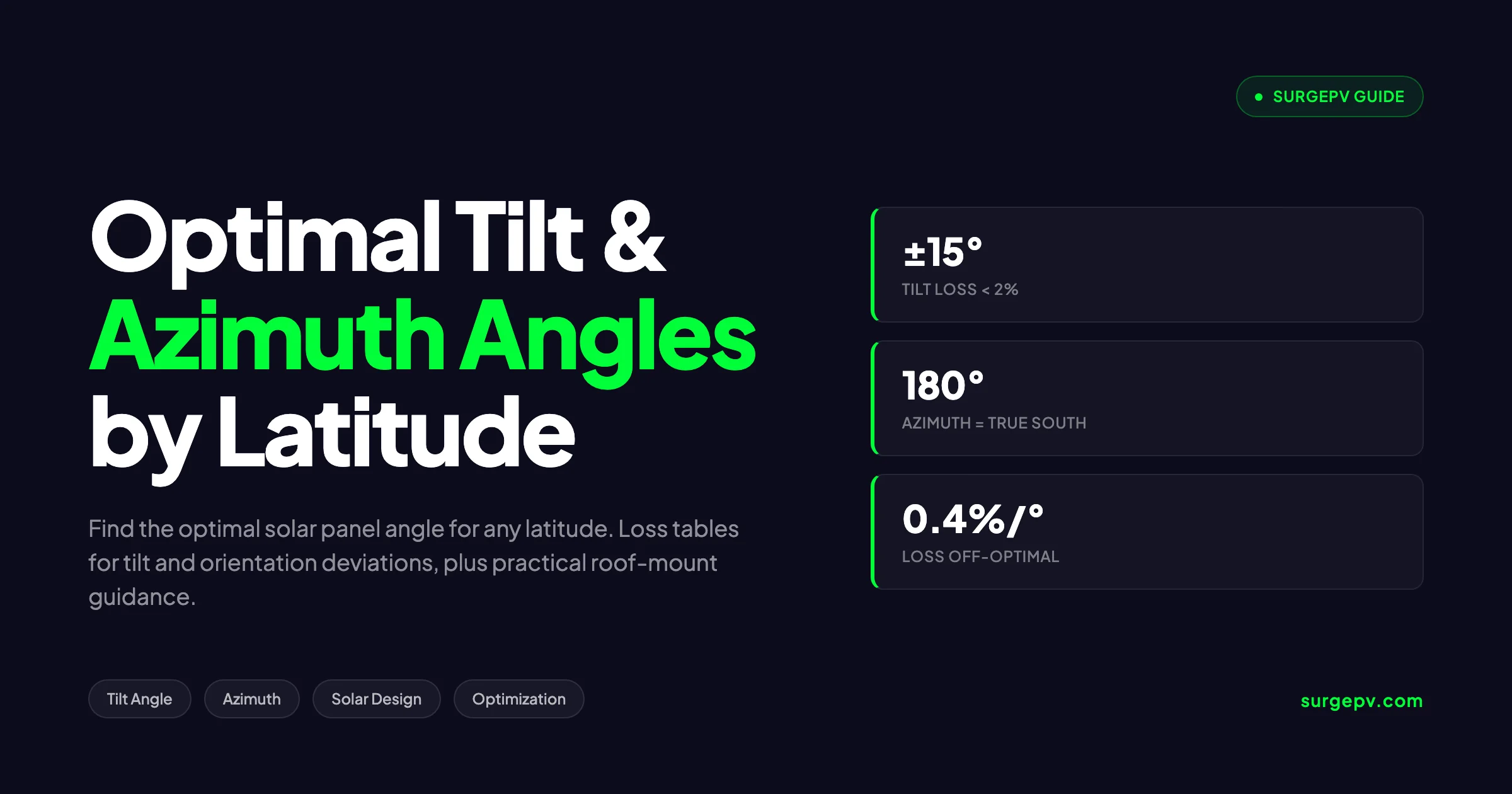
The optimal solar panel tilt angle approximately equals your site latitude minus 2 to 5 degrees for maximum annual yield. In the Northern Hemisphere, panels should face true south at azimuth 180 degrees. Tilt deviations up to 15 degrees cost less than 2 percent annual yield. Azimuth deviations up to 30 degrees off true south cost less than 5 percent. Site-specific simulation beats any rule of thumb.
TL;DR
Use latitude minus 5 degrees as a starting tilt in temperate climates. Face true south in the Northern Hemisphere and true north in the Southern. Stop optimizing past plus-or-minus 10 degrees — the yield curve is almost flat near the optimum, and roof geometry, shading, and time-of-use tariffs matter more than chasing the last 1 percent.
In this guide:
- Plain-English definitions of tilt and azimuth
- Optimal tilt table for 20 cities across six continents
- Loss tables for every 5 degree tilt and azimuth deviation
- Three methods to calculate tilt for your latitude
- Combined tilt-and-azimuth sensitivity matrix
- Roof pitch to tilt angle conversion chart
- Fixed versus seasonal versus tracking economics
- What textbooks get wrong about “optimal” angles
- Edge cases: flat roofs, walls, east-west layouts, and ground mounts
What Tilt and Azimuth Mean (Plain English)
Tilt is how steep the panel leans. Zero degrees means the panel lies flat. Ninety degrees means it stands upright like a wall. A typical pitched roof in the United States sits between 18 and 35 degrees of tilt.
Azimuth is the compass direction the panel faces. Convention varies by software. The most common standard is 0 degrees pointing north, 90 degrees east, 180 degrees south, and 270 degrees west. PVGIS and most European tools use this rule. NREL PVWatts uses the same. Some older tools use 0 as south — always check before entering values. Also see: European Solar Incentives.
Why both angles matter. Tilt controls how the panel meets the sun’s noon altitude. Azimuth controls how the panel tracks the sun’s east-to-west arc. Get one wrong and you lose energy. Get both wrong and the losses compound. A panel that faces north at zero tilt in Chicago produces about 65 percent less than a south-facing 35 degree tilt.
Two more terms worth knowing. Solar altitude is how high the sun sits above the horizon. It changes by season and time of day. At solar noon on the equinox, altitude roughly equals 90 minus your latitude. Incidence angle is the angle between the sun’s rays and a line perpendicular to the panel. Zero incidence angle means maximum power. Anything above 60 degrees triggers steep reflection losses on standard glass.
A clean way to picture it. Stand facing south in the Northern Hemisphere. Hold a piece of paper. Tilt it back so it catches the noon sun head-on. The angle from horizontal is your optimal tilt. The compass direction you face is your optimal azimuth. The rest of this guide is just refinement.
For a deeper technical breakdown of solar geometry, the solar angles, azimuth, tilt and zenith guide covers the math behind every formula in this article.
Optimal Tilt Angle by Latitude in 2026
The table below shows the annual-yield optimal tilt for 20 cities, simulated using NREL PVWatts v8 and PVGIS-SARAH3 datasets for the 2026 reference year. Values assume a clean, south-facing module (north-facing in the Southern Hemisphere), no shading, and a 14.08 percent system loss.
| City | Latitude | Optimal Tilt | Climate Notes |
|---|---|---|---|
| Singapore | 1.3° N | 10° | Min 10° for self-cleaning |
| Nairobi | 1.3° S | 10° | Min 10° for rain shedding |
| Bangalore, India | 12.9° N | 13° | Monsoon-driven self-cleaning rule applies |
| Mexico City | 19.4° N | 18° | Low cloud cover, high yield |
| Mumbai, India | 19.1° N | 18° | Coastal humidity adds soiling loss |
| Honolulu, USA | 21.3° N | 20° | Trade-wind soiling |
| Riyadh, Saudi Arabia | 24.7° N | 24° | High dust — flatter tilt traps dust |
| Cairo, Egypt | 30.0° N | 27° | Latitude minus 3 |
| Austin, USA | 30.3° N | 27° | Summer cooling load peaks midday |
| Los Angeles, USA | 34.0° N | 30° | Marine layer in spring |
| Tokyo, Japan | 35.7° N | 32° | Roof pitch typically 20–25° |
| Athens, Greece | 38.0° N | 33° | Latitude minus 5 |
| Madrid, Spain | 40.4° N | 35° | Continental, high DNI |
| New York, USA | 40.7° N | 36° | Snow load consideration |
| Chicago, USA | 41.9° N | 37° | Snow shedding favors 35°+ |
| Munich, Germany | 48.1° N | 37° | Diffuse light dominates winter |
| London, UK | 51.5° N | 36° | Diffuse light — flatter than latitude suggests |
| Berlin, Germany | 52.5° N | 37° | High diffuse fraction |
| Stockholm, Sweden | 59.3° N | 42° | Winter steep tilt for snow shedding |
| Sydney, Australia | 33.9° S | 30° | North-facing; latitude minus 4 |
| Cape Town, South Africa | 33.9° S | 30° | Coastal, wind load consideration |
The table makes two patterns clear. Below 20 degrees latitude, tilt floors at 10 degrees regardless of yield math because flatter panels collect dirt. Above 45 degrees latitude, optimal tilt stops climbing with latitude because diffuse light dominates winter and a flatter panel captures more sky-diffuse irradiance.
The latitude-minus-5 rule fits temperate-zone sites between 30 and 50 degrees latitude. Outside that band, simulation beats the rule of thumb. According to NREL PVWatts documentation (2024), simulated optimum can deviate from the latitude rule by up to 6 degrees in coastal and high-altitude sites.
Optimal Azimuth: Why True South Matters in the Northern Hemisphere
The sun crosses the southern sky in the Northern Hemisphere. At solar noon, the sun sits due south. A panel facing due south at the right tilt captures the sun head-on at the moment of peak irradiance.
True south, not magnetic south. Magnetic declination varies by location. In Seattle, magnetic north points 16 degrees east of true north. In Boston it sits 15 degrees west. An installer who reads a compass and skips the correction can mis-orient an array by 30 degrees latitude-to-latitude. Use a solar pathfinder, a smartphone app that reads GPS heading, or the inverter’s GPS calibration to find true south.
Azimuth conventions to watch. PVGIS uses 0 as south and -90 as east, +90 as west. NREL PVWatts uses 180 as south. SAM (System Advisor Model) follows the PVWatts convention. SurgePV uses the 0-north, 180-south compass-bearing standard because it matches roof-survey terminology.
When true south is not the goal. Three cases shift the optimum.
Time-of-use rate plans. California’s NEM 3.0 and many European tariffs pay less for midday solar and more for evening hours. A west-facing array (azimuth 240–270) produces less total energy but bills more value. According to a 2023 Lawrence Berkeley National Laboratory study, a 30-degree west deviation under NEM 3.0 in California raises bill credit value by 6 to 12 percent despite losing 3 to 5 percent of total kWh.
Morning peak loads. A facility that runs heavy loads from 6 to 10 a.m. benefits from east-facing modules at azimuth 90 to 120. Cold-storage warehouses and morning-shift manufacturing sites fit this profile.
Split-roof or hip-roof homes. A south-facing roof face may not exist. East-plus-west bifacial splits often outperform a single south-facing array because total roof area dominates. For more on this topic, see Bifacial Solar Panel Design Guide.
For the underlying solar geometry, the shadow analysis software tool in SurgePV maps the sun’s path for any latitude and any orientation, so designers can confirm true south on screen before the install crew climbs the roof.
Tilt Angle Loss Tables: How Much You Give Up Off-Optimal
The yield curve flattens near the optimum. Most installers and homeowners overweight tilt accuracy. The table below shows annual yield loss versus optimal tilt at three reference latitudes, computed from PVGIS-SARAH3 hourly data and confirmed against NREL PVWatts simulations.
| Tilt deviation from optimal | Latitude 30° N | Latitude 40° N | Latitude 50° N |
|---|---|---|---|
| 0° (optimal) | 0.0% | 0.0% | 0.0% |
| 5° off | 0.3% | 0.4% | 0.5% |
| 10° off | 1.1% | 1.4% | 1.7% |
| 15° off | 2.3% | 2.8% | 3.4% |
| 20° off | 3.9% | 4.6% | 5.5% |
| 25° off | 5.8% | 6.8% | 8.0% |
| 30° off | 8.0% | 9.2% | 10.7% |
| 45° off (e.g. wall mount) | 16.2% | 18.5% | 21.0% |
| Flat (0° tilt) | 6.4% | 14.2% | 22.8% |
Three takeaways. First, the cost of being 5 to 10 degrees off-optimum is trivial — about 1 to 2 percent. Second, beyond 15 degrees off-optimum, losses climb at roughly 0.35 to 0.45 percent per degree. Third, a flat zero-tilt array at high latitude loses more than 20 percent because the sun never climbs high in the sky, even in summer.
The asymmetry matters too. Tilting steeper than optimal hurts summer yield more than winter. Tilting flatter than optimal hurts winter yield more than summer. A summer-peaking utility load profile rewards a flatter tilt. A winter-peaking residential heating load rewards a steeper tilt.
A practical rule: stop optimizing past plus-or-minus 5 degrees. The roof pitch will usually fall within 10 degrees of optimum without any racking adjustment. Spending $2,000 on a tilt-up frame to claw back 1 percent yield never pays back across a 25-year system life.
Azimuth Loss Tables: East vs West vs South Deviations
Azimuth loss curves are flatter than tilt loss curves. The sun spends hours on either side of due south, so a panel pointed 30 degrees off still receives strong morning or evening sun.
| Azimuth deviation from true south | Loss at Latitude 30° N | Loss at Latitude 40° N | Loss at Latitude 50° N |
|---|---|---|---|
| 0° (due south, 180°) | 0.0% | 0.0% | 0.0% |
| 15° E or W (165° or 195°) | 0.5% | 0.6% | 0.7% |
| 30° E or W (150° or 210°) | 2.1% | 2.5% | 3.0% |
| 45° E or W (135° or 225°) | 4.8% | 5.6% | 6.7% |
| 60° E or W (120° or 240°) | 8.3% | 9.6% | 11.4% |
| 75° E or W (105° or 255°) | 12.5% | 14.4% | 16.9% |
| 90° E or W (due east 90° or due west 270°) | 17.2% | 19.5% | 22.6% |
| 180° (due north, 360°) | 35–42% | 42–55% | 55–72% |
The 30-degree tolerance rule. A panel anywhere from azimuth 150 to 210 — south-south-east through south-south-west — produces within 2.5 percent of due-south yield. Most pitched-roof homes fall within this range without any roof penetration adjustment.
East versus west is roughly symmetric for total annual energy. The difference shows up in time-of-day production. Morning-east arrays peak around 9 to 10 a.m. Evening-west arrays peak around 3 to 4 p.m. Under net metering, the totals matter most. Under time-of-use rates, the schedule matters more than the total.
The north-facing case is a special warning. A north-facing roof in the Northern Hemisphere is rarely worth installing on. A 40-degree latitude site loses 42 to 55 percent versus a south-facing equivalent. The economics only work when north is the only available roof and electricity rates are very high — Hawaii, parts of Germany, or solar-tariff islands.
According to PVGIS documentation (2024), the azimuth loss surface is smooth across plus-or-minus 60 degrees of optimum and steepens sharply outside that range. The smoothness is why split east-west layouts work — the array average lands close to a south-facing equivalent.
How to Calculate Tilt Angle for Your Latitude
Three methods, ranked from easiest to most accurate.
Method 1: The latitude rule. Take your latitude. Subtract 5 degrees if the site is in a temperate zone (latitude 25 to 50 degrees). Subtract 2 to 3 degrees if higher latitude (above 50). Add 5 to 10 degrees if winter-optimized for off-grid or heating loads. For latitude 40, the answer is 33 to 36 degrees for annual yield, or 45 to 50 degrees for winter peak. This rule lands within 3 degrees of the true optimum in 80 percent of cases.
Method 2: The Klein equation. Developed by University of Wisconsin solar engineering professor S.A. Klein, the equation uses monthly clearness index and declination to compute optimal tilt. The full form requires monthly irradiance data. A simplified Klein output for annual yield is:
- Optimal tilt = (0.764 × latitude) + 2.97
For latitude 40, the equation gives 33.5 degrees. For latitude 50, it gives 41.2 degrees. The Klein method matches simulation within 1 to 2 degrees across most temperate sites.
Method 3: Site-specific simulation. Run an hourly simulation in solar design platform with location-specific TMY (typical meteorological year) data. SAM, PVsyst, PVGIS, NREL PVWatts, and SurgePV all support this. The simulation picks up coastal cloud patterns, snow albedo, and altitude-driven DNI changes that the rule of thumb misses. A 2024 NREL technical paper found that simulation-derived optima can deviate from the latitude rule by up to 6 degrees at coastal sites because the diffuse fraction differs. For software options, see 7 Best PVsyst Alternatives in.
For most rooftop residential and commercial work, Method 1 is enough. For ground-mount utility projects above 500 kW, Method 3 is mandatory. The marginal 1 to 2 percent yield gain compounds to seven-figure revenue over a 25-year project.
Calculate Optimal Tilt for Your Exact Site
Skip the rule of thumb. Our solar design software runs site-specific simulations for any latitude, roof pitch, and shading scenario.
Book a DemoNo commitment required · 20 minutes · Live project walkthrough
Combined Tilt + Azimuth Sensitivity Matrix
Real installs rarely hit both angles dead-on. The matrix below shows combined annual yield as a percentage of the optimal south-facing, latitude-tilted array at latitude 40 degrees N. Values come from PVGIS-SARAH3 hourly simulation.
| Tilt → / Azimuth ↓ | 0° (flat) | 10° | 20° | 30° | 40° | 50° |
|---|---|---|---|---|---|---|
| 180° (S) | 85.8% | 92.4% | 97.1% | 99.6% | 100.0% | 98.3% |
| 165° or 195° (SSE/SSW) | 85.7% | 92.2% | 96.8% | 99.2% | 99.4% | 97.6% |
| 150° or 210° (SE/SW) | 85.6% | 91.5% | 95.7% | 97.6% | 97.4% | 95.3% |
| 135° or 225° (SE/SW) | 85.2% | 90.2% | 93.6% | 94.6% | 93.8% | 91.0% |
| 120° or 240° | 84.5% | 88.2% | 90.4% | 90.5% | 88.8% | 85.3% |
| 90° or 270° (E/W) | 83.4% | 85.0% | 85.6% | 84.5% | 81.7% | 77.4% |
| 45° or 315° | 79.8% | 76.1% | 71.6% | 66.4% | 60.7% | 54.8% |
| 0° or 360° (N) | 75.2% | 65.4% | 55.8% | 47.3% | 40.1% | 34.2% |
What the matrix reveals. The 95 percent contour is huge. Any tilt from 15 to 50 degrees combined with any azimuth from 135 to 225 produces 93 percent or more. A flush-mount installation on a 25 degree pitched roof facing south-south-west loses about 3 percent versus a hypothetical “optimal” install. That 3 percent is not worth a tilt-up frame, custom racking, or a roof penetration redesign.
The matrix also explains east-west layouts. A 10 degree tilt east-facing combined with a 10 degree tilt west-facing produces an average around 85 percent. Add the doubled array area on a flat commercial roof and the absolute kWh exceeds a south-facing tilted array on the same roof footprint by 20 to 40 percent. The energy and financial modeling tool inside SurgePV computes this trade-off directly.
Roof Pitch vs Tilt Angle Conversion
Carpenters and roofers use rise-over-run pitch. Solar designers use degrees. The two map directly.
| Roof Pitch (rise:run) | Tilt Angle | Common In |
|---|---|---|
| 1:12 | 4.8° | Modern commercial flat-pitch |
| 2:12 | 9.5° | Low-slope residential, awnings |
| 3:12 | 14.0° | Ranch homes, modern minimalist |
| 4:12 | 18.4° | Common US suburban |
| 5:12 | 22.6° | Standard residential |
| 6:12 | 26.6° | Standard residential, slight steep |
| 7:12 | 30.3° | Northeast US, snow zones |
| 8:12 | 33.7° | Steeper colonial, snow-belt |
| 9:12 | 36.9° | Steep gable, Northeast/Midwest |
| 10:12 | 39.8° | Victorian, A-frame |
| 11:12 | 42.5° | A-frame, alpine |
| 12:12 (45°) | 45.0° | A-frame, mountain chalet |
The math is straightforward. Tilt angle = arctan(rise / run). A 6:12 pitch is arctan(6/12) = arctan(0.5) = 26.6 degrees.
Most US suburban roofs sit between 4:12 and 8:12 — tilt 18 to 34 degrees. This range captures the optimal tilt for any US site between roughly 25 and 38 degrees latitude. From Los Angeles to Atlanta to Charlotte, the typical roof pitch is within 5 degrees of optimum without any racking adjustment.
UK and Northern European roofs typically sit at 35 to 45 degrees of pitch. This matches the latitude-optimal tilt almost exactly. The reason is historical — steeper roofs shed snow and rain better at higher latitudes. See our guide on Battery Solar System Design UK for more.
Tropical roofs are flatter. Singapore, Mumbai, and Lagos roofs often sit at 5:12 (22 degrees) or shallower. The tropical zone needs only 10 to 15 degree tilt for self-cleaning, so most roofs are over-tilted, not under-tilted. The yield penalty is small — about 1 to 2 percent. Read more about 5kW Solar Panel Price in India.
Seasonal Tilt Adjustment: Fixed vs Adjustable vs Tracking
Four mounting strategies, ranked by complexity and yield.
Fixed tilt at annual optimum. The default. One tilt angle for the year, set to the latitude-minus-5 rule. Lowest hardware cost, no maintenance, no failure points. Baseline yield.
Two-position seasonal adjustment. Steeper in winter (latitude + 15), flatter in summer (latitude - 15). Manually adjusted twice a year — typically at the equinoxes. Adds 4 to 8 percent annual yield versus fixed tilt. According to a 2022 Sandia National Labs report on tilt strategy, the residential payback for adjustable racking at US labor rates exceeds 12 years and rarely justifies the hardware.
Four-position quarterly adjustment. Tilt changed every season. Adds 6 to 10 percent over fixed. The marginal gain over two-position is small — about 1 to 2 percent — and labor costs are double.
Single-axis tracking. The array rotates east-to-west across the day. Adds 15 to 25 percent annual yield in clear-sky climates (Arizona, Spain, North Africa). Adds 8 to 12 percent in temperate climates (Germany, UK, US Midwest). Adds nothing in cloudy climates because diffuse light is non-directional. Hardware adds $0.08 to $0.15 per watt. Maintenance is real — motor failure, gear wear, dust ingress. For Africa-specific compliance details, see Africa solar compliance.
Dual-axis tracking. Rotates east-west and tilts north-south for seasonal optimum. Adds 25 to 40 percent yield in clear-sky climates. Hardware adds $0.20 to $0.35 per watt. Reserved for high-DNI utility projects and CPV systems. Almost never used on rooftops.
The decision rule. Residential systems should stay fixed-tilt unless the install is on adjustable ground-mount racks that already exist for other reasons. Commercial flat-roof systems often justify east-west layouts over fixed-tilt south-facing for area-density reasons. Utility ground-mount above 500 kW almost always uses single-axis tracking in clear-sky regions.
For commercial site planning, the commercial solar page in SurgePV covers fixed versus tracking economics with site-specific bill-of-materials and IRR comparisons. See our guide on Agricultural Solar Case Study for more.
What Most Guides Get Wrong About Optimal Angle
Three myths that survive in installer training material and online calculators.
Myth 1: Optimal tilt equals latitude. This rule comes from 1970s textbooks and assumes a clear-sky monthly average. It overestimates winter contribution because winter days are shorter, cloudier, and have higher diffuse fraction at every latitude above 30 degrees. The correct rule is latitude minus 2 to 5 degrees for annual yield in temperate zones. The textbook latitude rule overshoots optimal tilt by 4 to 6 degrees at most populated latitudes.
Myth 2: South-facing always wins. True for kWh totals. False for revenue under time-of-use rates. A west-facing array in California’s NEM 3.0 tariff regime produces more dollar value than a south-facing array, despite generating 3 to 5 percent fewer kWh. A morning-east array at a cold-storage warehouse with 6 a.m. peak loads avoids more grid demand charges than a south-facing equivalent. The right optimization target is bill savings, not kWh.
Myth 3: Tilt-up frames pay for themselves on low-slope roofs. A 4:12 roof in Massachusetts (latitude 42) tilts at 18 degrees. The textbook says the optimum is 37 to 40 degrees. A tilt-up frame to 35 degrees costs $1,500 to $3,500 in hardware and labor for a 6 kW system. The yield gain is 4 to 6 percent — about 350 to 500 kWh per year. At $0.18 per kWh that is $63 to $90 per year. Payback is 17 to 56 years. The system warranty runs 25 years. The economics rarely work.
Myth 4: Snow always justifies steep tilt. A common installer claim. The numbers do not support it. A 35 degree tilt sheds snow about 25 percent faster than a 25 degree tilt. The annual winter production gain is 1 to 3 percent in the Northeast and Midwest US — measurable but not transformative. According to a 2023 NREL field study of 124 residential snow-belt arrays, the winter production difference between 25 and 40 degree tilts averaged 2.1 percent of annual yield. Steep tilt helps. It does not transform the economics.
Myth 5: The hour-by-hour optimum equals the monthly optimum. False. A panel optimized for noon December irradiance is too steep for the rest of the year. A panel optimized for noon June irradiance is too flat. The annual optimum is a compromise weighted by total monthly irradiance — and the weighting favors summer because summer days are longer and clearer at most latitudes.
The honest summary. Tilt and azimuth matter less than the rule books say, but only after you avoid the obvious mistakes. Stay within 15 degrees of optimal tilt and 30 degrees of true south, and the yield difference between “good” and “perfect” is under 5 percent. The remaining 5 percent rarely justifies hardware spend.
Special Cases: Flat Roofs, Walls, Ground Mounts, East-West Layouts
Flat roofs. Tilt is the designer’s choice. Two common strategies. First, low-tilt (10 to 15 degrees) ballasted racking using minimal weight and tight row spacing. Loses 4 to 7 percent yield per panel but fits 30 to 50 percent more panels in the same roof area. Second, optimal-tilt (25 to 35 degrees) racking with wider rows to avoid inter-row shading. Higher per-panel yield, fewer panels overall. For commercial roofs, the area-density strategy almost always wins at the system level.
East-west layouts. Two rows facing opposite directions at 10 to 12 degree tilt. Standard for European commercial flat-roof installs. Yield per panel drops to 82 to 86 percent of south-facing equivalent. Panel count rises 60 to 80 percent in the same footprint. Total kWh per square meter of roof rises 30 to 45 percent. The configuration trades panel-level efficiency for system-level area utilization.
Walls (BIPV). Vertical wall panels run at 90 degree tilt. South-facing wall arrays in temperate zones produce 60 to 70 percent of optimal-tilt yield. Niche but useful when roof area is limited and the wall is shadow-free. Building-integrated photovoltaics on south-facing facades in cold climates also benefit from snow non-accumulation and reduced summer overheating.
Ground mounts. Tilt and azimuth are unconstrained. Optimal angle simulations matter most here because the cost of choosing the wrong tilt is fully attributable to the installer’s design. Single-axis tracking enters the conversation above 500 kW.
Solar carports. Tilt is constrained by structural and aesthetic limits. A 5 to 10 degree tilt with a slight north-to-south slope on a south-pointing carport produces 92 to 95 percent of optimal yield while keeping rain and snow shedding intact. See [Commercial Solar Carport Design Guide](/blog/solar-carport-design-guide) for detailed guidance.
Pergolas and canopies. Architects often want zero tilt for visual reasons. The yield cost at 40 degree latitude is 14 to 18 percent. Designers should price the architectural choice as a yield premium and let the client decide. The right framing is not “you must tilt” but “flat costs about 15 percent of yield — is the design worth it to you?”
Tropical roofs. A specific risk. Roofs below 10 degree tilt accumulate dust, bird droppings, and pollen at twice the rate of roofs above 15 degrees. The yield gain from tilting up to 15 degrees in Mumbai or Singapore comes mostly from self-cleaning, not from improved incidence angle.
For more on how shading and orientation interact across roof types, the residential solar and shadow analysis tools in SurgePV walk through each case with site-specific simulation.
How SurgePV Calculates Optimal Angle for Your Roof
SurgePV’s optimal-angle engine runs an hourly simulation across 8,760 hours using site-specific TMY data from NASA POWER, PVGIS, or Solcast, whichever is most accurate for the site. The engine sweeps tilt from 0 to 60 degrees in 1 degree steps and azimuth from 0 to 360 in 5 degree steps, then reports the global maximum annual yield.
What the simulation includes. Diffuse and direct irradiance components separately. Reflection losses at high incidence angles. Snow albedo gain in winter months. Inter-row shading for ground-mount and east-west commercial layouts. Self-shading from adjacent obstacles using the shadow analysis module. Soiling losses based on regional climate type.
What the simulation outputs. A single optimal tilt and azimuth pair. A sensitivity matrix showing yield loss across plus-or-minus 30 degrees of both angles. A bill-savings calculation under any tariff structure, including time-of-use, net metering, and feed-in tariffs. The solar designing module ties the tilt-azimuth optimum into the full system design — module layout, string sizing, inverter selection — and the generation financial tool carries it into the financial model.
The simulator runs in under five seconds for a typical residential roof and under sixty seconds for a 1 MW ground-mount layout. Installers can compare three tilt strategies side-by-side in a single proposal and let the customer pick based on price, payback, or aesthetics.
According to the IEA Photovoltaic Power Systems Programme Task 13 report (2022), hourly TMY simulation produces tilt optima within 0.5 to 1.5 degrees of measured field optima. Klein-equation and latitude-rule methods sit at 2 to 4 degree error. The difference matters most for utility-scale ground mounts where 1 percent yield is real money.
Conclusion: Action Items
-
For residential installers: stop quoting tilt-up frames on flush-mount-capable roofs. The yield gain almost never justifies the hardware and labor cost across a 25-year system life. Use the solar design platform site-specific simulation to confirm yield deltas before adding to a proposal.
-
For commercial designers: model east-west layouts against south-facing tilted arrays on every flat-roof project above 100 kW. Total system kWh per dollar of capex typically favors the east-west configuration despite per-panel yield drop.
-
For homeowners: a roof anywhere between 15 and 45 degree pitch facing south-east through south-west is “good enough” — within 5 percent of optimal. Spend the optimization budget on shading mitigation, panel efficiency, and inverter sizing instead. A 30-minute SurgePV demo shows the trade-offs for your specific roof.
Frequently Asked Questions
What is the optimal tilt angle for solar panels?
The optimal fixed tilt angle approximately equals the site latitude minus 2 to 5 degrees for maximum annual yield. A panel at 40 degrees latitude performs best between 35 and 38 degrees tilt. The exact angle depends on whether the goal is maximum annual yield, winter peak production, or summer peak production. A site-specific simulation in solar design platform produces a more accurate optimum than any rule of thumb.
What is the best direction for solar panels?
In the Northern Hemisphere, true south (azimuth 180 degrees) maximizes annual yield. East or west deviations up to 30 degrees cost less than 5 percent of annual energy. South-east or south-west orientations between 135 and 225 degrees still produce 95 to 99 percent of due-south yield. Time-of-use tariffs can shift the optimum to west-facing for higher-rate evening production.
How much does tilt angle affect solar panel output?
Within 15 degrees of the optimal tilt, annual yield loss stays below 2 percent. Beyond 15 degrees off-optimal, losses climb at roughly 0.4 percent per degree. A 30 degree deviation from optimal costs 5 to 7 percent. A flat zero degree mount at a 40 degree latitude site loses 14 to 18 percent of annual production compared to an optimally tilted array.
Is 30 degrees a good tilt angle for solar panels?
A 30 degree tilt works well between 25 and 35 degrees latitude — covering most of the southern United States, southern Europe, north India, and northern Australia. At higher latitudes such as London or Berlin, 30 degrees is too shallow and loses 3 to 5 percent of yield versus a 35 to 38 degree tilt. At lower latitudes like Singapore or southern India, 30 degrees is too steep. For Australia-specific compliance details, see Australia comparisons/lgc-vs-stc.
What azimuth is best for solar panels in the southern hemisphere?
In the Southern Hemisphere, panels should face true north (azimuth 0 or 360 degrees) for maximum annual yield. Sydney, Cape Town, and Buenos Aires all follow this rule. The same plus-or-minus 30 degree tolerance applies — north-east through north-west orientations still produce 95 percent or more of due-north yield.
Should solar panels be tilted differently in summer and winter?
Two-position seasonal adjustment — flatter in summer, steeper in winter — adds 4 to 8 percent annual yield versus a fixed optimal tilt. The economic case is weak for residential systems because the mounting hardware and labor rarely pay back. Off-grid systems with winter-critical loads sometimes justify seasonal adjustment because winter production is more valuable than total annual yield.
What is the difference between tilt and azimuth?
Tilt is the panel’s vertical angle from horizontal — zero degrees is flat, ninety degrees is vertical against a wall. Azimuth is the panel’s compass orientation — 180 is due south, 90 is east, 270 is west. Both angles independently affect output. Optimal tilt maximizes the incidence angle with the sun’s noon altitude. Optimal azimuth aligns with the sun’s path across the sky. The solar angles, azimuth, tilt and zenith guide covers the geometry in more depth.
How do I calculate the tilt angle for my latitude?
A simple starting rule: optimal tilt for maximum annual yield equals latitude minus 5 degrees in temperate climates, latitude minus 2 degrees at higher latitudes, and latitude itself for winter-optimized production. For latitude 40, use 35 to 38 degrees. For latitude 50, use 42 to 45 degrees. For sites below 20 degrees latitude, increase tilt to at least 10 degrees for rain-shedding and self-cleaning. For higher accuracy, run a site-specific hourly simulation in NREL PVWatts or PVGIS. Solar proposal software generates professional quotes in minutes.
Where this fits
This article is part of SurgePV's Solar Design hub, which works through the topic from first principles to the decisions a project team actually has to make.