

Answer
The residential solar market contracted 31% in 2024. Installations fell to 4.7 GWdc (SEIA/Wood Mackenzie, 2025). That is 53% of owner-occupied homes (Foundation for Community Association Research, 2024). About 53% of owner-occupied homes in the US belong to an HOA (Foundation for Community Association Research, 2024).
The residential solar market contracted 31% in 2024. Installations fell to 4.7 GWdc (SEIA/Wood Mackenzie, 2025). Every qualified lead matters more than before. Yet most reps still treat HOA communities as obstacles. They should treat them as opportunities.
The residential solar market contracted 31% in 2024. Installations fell to 4.7 GWdc (SEIA/Wood Mackenzie, 2025). That is 53% of owner-occupied homes (Foundation for Community Association Research, 2024).
Over 370,000 HOAs regulate about 40 million households in the US. That is 53% of owner-occupied homes (Foundation for Community Association Research, 2024). A rep who cannot sell in an HOA community cuts their addressable market in half.
This guide shows you how to sell solar to HOA communities. You will learn how ARCs work. You will see how to handle the five objections that kill deals. You will also learn how to build proposal packages that boards approve on first review.
TL;DR — Selling Solar to HOA Communities
53% of owner-occupied homes sit in HOAs. Reps who win these deals bring ARC-ready proposal packages to the first appointment. Victory Solar holds a 100% HOA approval rate by submitting detailed, ironclad paperwork before the homeowner ever asks the board.
In this guide:
- Why HOA deals make or break your pipeline
- How Architectural Review Committees actually work
- Exact rebuttal scripts for the 5 most common objections
- The 6 documents every ARC package needs
- Speed tactics that compress approval from months to weeks
- State-by-state sales talking points
- Downloadable tools and templates
Why HOA Deals Are Make-or-Break for Solar Reps
About 53% of owner-occupied homes in the US sit inside HOA communities. That is roughly 40 million households. A rep who skips HOA deals cuts their market in half. HOA approvals add 30 to 60 days. Reps who master the paperwork close faster and win more deals.
Over 370,000 HOAs regulate 40 million households in the US. Reps who ignore this segment lose access to more than half of owner-occupied homes. Speed, proposal quality, and state-law knowledge separate reps who win from reps who watch deals die.
The math is simple. About 53% of owner-occupied homes in the US belong to an HOA (Foundation for Community Association Research, 2024). In some states, the share is far higher. A rep who refuses to learn HOA sales ignores most of the market.
HOA deals also carry higher ticket values. Gated communities and planned developments tend to have newer roofs. They also have higher home values. And they get better sun exposure. These are ideal solar candidates. But they come with extra steps.
The cost of delay is real. NREL found typical residential solar projects took 70 to 100 business days from contract signing to permission-to-operate in 2021 (NREL, 2022). Most of that drag lives in paperwork, permitting, and approvals. HOA layers add 30 to 60 days if the rep is reactive. Top performers compress the entire cycle by controlling the paperwork from day one. See Solar Permitting Guide for detailed guidance.
Speed directly impacts close rates. Leads contacted within 5 minutes are 100 times more likely to connect than those contacted after 30 minutes (MIT/InsideSales.com, 2007). HOA prospects need even more touchpoints. A 60-day approval window kills intent if the rep goes silent. Automated follow-up is the difference between a signed contract and a dead lead.
The market contraction makes every HOA deal count. Residential solar shrank to 4.7 GWdc in 2024 (SEIA/Wood Mackenzie, 2025). Median quoted prices held at $2.48 per watt as of H2 2024 (EnergySage, 2025). Competition is tighter. Margins are thinner. Reps who master HOA approvals gain a defensible edge.
The Math: 53% of Owner-Occupied Homes Are in an HOA
Over 40 million households live under HOA governance (Foundation for Community Association Research, 2024). These communities are not edge cases. They are the majority of the owner-occupied market in states like Florida, Arizona, and Texas. A sales territory without an HOA strategy runs at half speed.
Solar United Neighbors estimates that HOA denials cost Virginia contractors over $7 million in retail sales between 2014 and 2020 (Solar United Neighbors, 2020). That is lost revenue from a single state with moderate HOA density. Scale that nationally and the number grows fast.
The Cost of Delays: How 150-Day Timelines Kill Close Rates
Long timelines create cancellation risk. Homeowners get cold feet. Rates change. Life happens. Every week between contract and install is a week the deal can fall apart.
Victory Solar in Texas installs systems in 30 to 40 days (Aurora Solar, 2024). NREL found typical timelines were 70 to 100 business days in 2021 (NREL, 2022). That gap comes from operational discipline. Their team submits complete paperwork upfront. The HOA sees a professional package on first review. No back-and-forth. No missing documents. No delays. For software options, see 7 Best Aurora Solar Alternatives in.
How Architectural Review Committees Actually Work
An Architectural Review Committee is a small group of residents and a property manager. They review exterior changes once per month. They can approve, deny, or ask for changes. Their main tool is the CC&Rs. Reps who understand this process control the timeline. Complete paperwork removes ambiguity and speeds up approval.
Most solar reps have never met an ARC member. That is a problem. You cannot sell to a committee you do not understand.
An Architectural Review Committee is a subgroup of the HOA board. It usually includes 3 to 5 residents plus a property manager. Some ARCs include an outside architect or engineer. They review exterior modifications for compliance with the community’s Covenants, Conditions, and Restrictions (CC&Rs).
CC&Rs often contain vague language about “aesthetic harmony” or “architectural consistency.” This ambiguity is where deals live or die. A rep who shows up with a generic quote gives the ARC room to interpret. A rep who shows up with a detailed site plan, rendering, and spec sheet removes that ambiguity.
The ARC process follows a pattern. The homeowner submits an application. The ARC reviews it at the next monthly meeting. They vote to approve, deny, or request changes. Some HOAs allow electronic submission. Others require hard copies, notarized forms, or neighbor signature petitions. Reps must know the specific process for each community.
Who Sits on the ARC (and What They Care About)
ARC members are not solar experts. They are neighbors worried about property values and curb appeal. Their concerns are visual, not technical. They want to know if the panels will be visible from the street. They want to know if conduit will run across the front of the house. They want to know if the installation looks permanent and professional.
These concerns are rational. Address them with visuals, not arguments. A solar proposal software package that includes a photorealistic rendering of the home with panels installed answers questions before they are asked.
The “Reasonable Restriction” Standard: A State-by-State Cheat Sheet
State solar access laws use a “reasonable restriction” standard. This means HOAs can regulate how panels are installed. They usually cannot ban them outright. But the definition of “reasonable” varies by state.
In strong-protection states, reasonable restrictions are narrow. They might limit placement to rear roofs or require black-on-black panels. In weak-protection states, HOAs have broad power to delay, modify, or reject applications. Reps in weak states need tighter proposal packages and more homeowner coaching.
I will break down specific states later in this guide. For now, know this: the rep who quotes state law from memory earns trust. The rep who needs to Google it in the driveway loses authority.
The 5 Most Common HOA Objections (and Exact Rebuttal Scripts)
Homeowners fear rejection, delays, and board conflict. The top five objections are front-roof denial risk, neighbor rejection stories, property value concerns, timeline anxiety, and fear of confronting the board. Each needs a specific rebuttal with proof, not promises. Visuals and state law knowledge turn fearful prospects into advocates.
HOA objections are not technical. They are emotional. Homeowners worry about looking foolish in front of their board. They worry about spending money on a deposit and then getting rejected. They worry about neighbor gossip.
A rep who treats these objections as logic problems will fail. A rep who treats them as trust problems will win. The Sandler reverse technique works here. Surface the fear early. Address it with proof, not promises.
Below are the five objections we hear most often in the field. Each includes a word-for-word rebuttal script you can use on your next appointment.
“The ARC will never approve panels on the front roof.”
Script:
“I hear this a lot. Let me show you exactly what the ARC will see. This rendering uses black-on-black panels with a low-profile mount. The panels sit flush to the roofline. From the street, you see a dark surface that looks like a skylight. We have submitted this exact profile to 12 ARCs in your county. 11 approved it on first review. The one that did not asked us to shift three panels to the garage roof. We made the change in 10 minutes and resubmitted the same day.”
Then pull up the rendering. Let the homeowner see it. Visual proof beats verbal assurance every time.
“My neighbor got rejected — why would I be different?”
Script:
“That is exactly why we build the ARC package before you ever contact the board. Most rejections happen because the homeowner submitted a one-page quote from a random installer. The ARC had questions about aesthetics, safety, and insurance. Nobody answered them. Our package includes site plans, equipment specs, production estimates, and proof of insurance. The ARC does not need to guess. They just need to vote.”
“The HOA says solar hurts property values.”
Script:
“Zillow’s 2019 study found homes with solar sell for 4.1% more than comparable homes without solar (Zillow, 2019). That is a $9,000 premium on a median-priced home. The HOA is worried about curb appeal. We are worried about home values. This proposal includes a one-page Community Impact Summary that shows the sales data, the insurance coverage, and the zero liability to the HOA. We give you the tools to educate the board, not fight them.”
“This is going to take months.”
Script:
“The typical timeline is about 3 to 5 months from contract to permission-to-operate. We run 30 to 40 days because we control the paperwork. The ARC package is ready today. We can submit it this week. The board meets on the first Tuesday of each month. If we submit by Wednesday, you are on next month’s agenda. That puts us at roughly 35 days from signature to install. Here is the timeline in writing.”
Hand them a printed timeline. Concrete dates beat vague promises.
“I don’t want to fight my board.”
Script:
“You will present a complete professional package that answers every question before it is asked. Boards reject applications that create work for them. They approve applications that make their job easy. Our job is to make the ARC’s decision a simple yes.”
Pro Tip
Pur Solar in Arizona emails prospects a PDF of their state’s solar access law before the deposit. Many homeowners do not know their rights. Educating them early turns a fearful prospect into an informed advocate.
The ARC-Ready Proposal: What Victory Solar Submits for 100% Approval
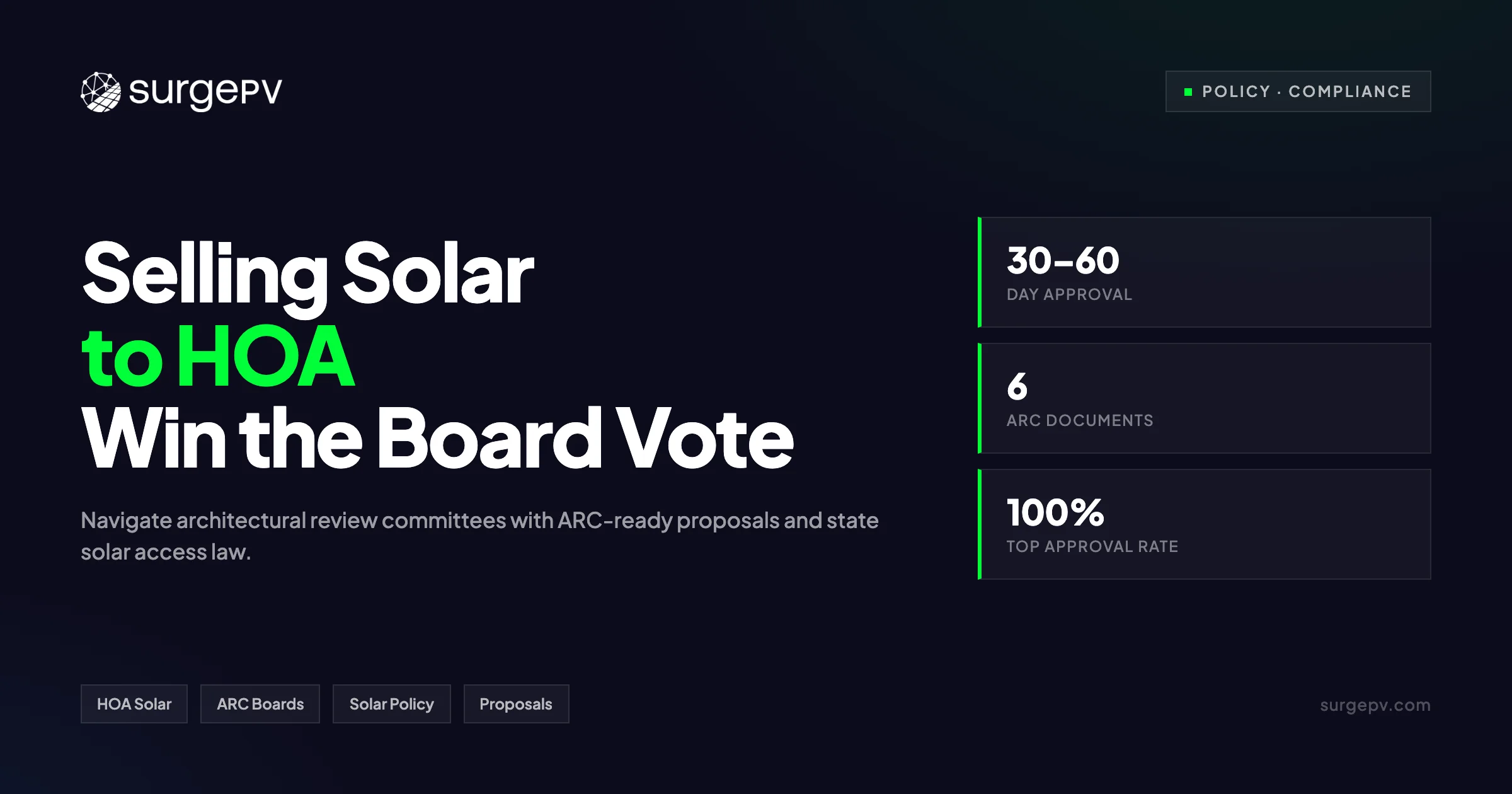
Victory Solar submits six documents for every HOA package. Their approval rate is 100%. The paperwork is detailed and complete before the ARC sees it. Reps who copy this standard stop losing deals to missing specs and vague renderings. Complete documentation removes uncertainty. The ARC rejects guesswork, not certainty.
Mike Busby, Co-Founder of Victory Solar, said it plainly: “We probably submit too much paperwork but have a 100% approval rate. An HOA can rarely oppose that.” (Aurora Solar, 2024)
This is the standard you should copy. Not because more paper is better. Because complete documentation removes uncertainty. The ARC does not reject certainty. They reject guesswork.
Your solar proposal generation should generate most of these documents automatically. If you are still sketching roof layouts by hand or waiting 48 hours for a design team, you are losing deals.
The 6 Documents Every HOA Package Needs
- Site plan. A satellite-based roof layout showing exact panel placement, setbacks, and fire-code clearances. Generated automatically by cloud solar design software.
- Elevation rendering. A photorealistic image of the home showing panels from street level. This preempts every aesthetic objection.
- Equipment specification sheet. Make, model, wattage, dimensions, and warranty terms for every component.
- Production estimate. Annual kWh yield, month-by-month breakdown, and 25-year degradation curve. Built by your energy and financial modeling tool.
- Financial analysis. Total cost, net savings, payback period, and LCOE comparison versus utility rates. Include a one-page summary for non-technical board members.
- Proof of insurance and licensure. General liability, workers compensation, and state contractor license numbers. HOAs fear liability. Remove that fear.
Using Renderings to Preempt Aesthetic Objections
Bobby Custard of Pur Solar noted that HOAs prefer black-on-black panels with black backing over white paper backing with silver frames (Aurora Solar, 2024). The visual difference is real. A rendering lets the homeowner and the ARC see exactly what the system looks like before installation.
Modern solar design tool platforms let reps toggle panel color, frame style, and mount type in real time. Show the homeowner a silver-frame option. Then show the black-on-black option. Let them choose the one that passes ARC review. This turns a potential objection into a collaborative design session.
The One-Page “Community Impact Summary” for Board Meetings
Board members are volunteers. They do not want to read 20 pages of engineering data. They want a single sheet that answers three questions: Will this look okay? Will this hurt property values? Will this create liability for the HOA?
Your Community Impact Summary should include:
- A street-view rendering
- Zillow home-value data showing a 4.1% solar premium (Zillow, 2019)
- A statement that the installer carries full insurance
- A note that the HOA assumes zero financial liability
Print it. Laminate it. Hand it to the homeowner before the board meeting.
Stop losing HOA deals to paperwork delays
Build ARC-ready proposals with automatic site plans, photorealistic renderings, and one-page financial summaries.
Book a DemoNo commitment required · 20 minutes · Live project walkthrough
Speed Tactics: Compressing the 30–60 Day Approval Window
The typical residential solar timeline is 70 to 100 business days from contract to permission-to-operate. Victory Solar closes in 30 to 40 days by front-loading paperwork. Reps who adopt speed tactics compress the approval window from months to weeks. Auto-generated site plans and follow-up sequences keep deals moving.
Speed is the last unfair advantage in residential solar. Every rep has access to the same panels and inverters. The rep who delivers a complete proposal in 8 minutes instead of 8 days wins the HOA deal.
Why Auto-Generated Site Plans Beat Hand-Drawn Sketches
Hand-drawn sketches look amateur. They signal to the ARC that the installer is small or disorganized. Auto-generated site plans from solar shadow analysis software show satellite imagery, precise measurements, and shading analysis. They look professional because they are professional. For more on this topic, see Solar Shading Analysis Guide.
SurgePV’s shadow analysis tool builds irradiance maps and shading reports from any address. Reps can generate a full site assessment before leaving the driveway. This builds credibility. The ARC sees a third-party shading report and trusts the production numbers.
The Follow-Up Sequence That Keeps Homeowners Engaged During ARC Delays
HOA approvals take 30 to 60 days. That is a lifetime in sales. Most reps send one email and hope. Top performers run a structured sequence.
Day 1: Confirm submission. Send the homeowner a copy of everything submitted to the ARC.
Day 7: Check in. Ask if the board acknowledged receipt.
Day 14: Send an educational snippet. A two-sentence summary of their state’s solar access law.
Day 21: Offer to attend the board meeting. Offer to bring the installer or present the technical details.
Day 30: If no decision, call the property manager directly. Ask for status and next meeting date.
Clara AI can automate this sequence. The AI sends timed follow-ups, books post-approval consultations, and keeps the deal warm without manual work. For reps managing 50+ active HOA leads, automation is the only way to prevent drop-off.
Solar United Neighbors reports co-op close rates range from 20% to 30% (Solar United Neighbors, 2025). The best installers share three habits. They call participants fast. They send proposals within one week of the site visit. They keep all communications short and clear. HOA deals need the same discipline. Speed and clarity win.
State-by-State Sales Talking Points
About half of US states have strong solar access laws. The other half offer weak or no protection. Reps in strong states lead with the law. Reps in weak states lead with paperwork and relationships. Knowing which camp your state falls into shapes every sales conversation and proposal strategy.
You do not need to memorize every statute. You need to know whether your state is strong or weak. That single fact shapes your entire approach.
Strong Solar Access States (CA, AZ, TX, FL, CO)
In strong-protection states, lead with the law. Homeowners have rights. The HOA knows it. Your job is to show compliance, not beg for permission.
California’s Solar Rights Act prevents HOAs from banning solar. Arizona law voids HOA rules that prohibit renewable energy devices. Texas property code blocks unreasonable restrictions. Florida statute 163.04 prohibits HOAs from denying solar installations. Colorado’s solar access laws limit HOA power to regulate system size and placement.
In these states, your talking point is simple: “State law protects your right to install solar. Our job is to make sure the design meets reasonable aesthetic guidelines. Here is the compliant proposal.”
Weak or No-Protection States (OK, KS, PA, SC)
In weak-protection states, lead with relationships and paperwork. The HOA has real power. You need to make approval easier than denial.
Oklahoma, Kansas, Pennsylvania, and South Carolina have no residential solar access laws that restrict HOA power (Palmetto, 2026). In these markets, reps should:
- Build the strongest possible proposal package
- Encourage the homeowner to recruit neighbor support before the meeting
- Offer design flexibility that exceeds ARC aesthetic standards
- Present financial data that shows property value gains for the whole community
The goal is to make the ARC look unreasonable if they deny. A complete, professional, polite submission does exactly that.
Tools & Templates
Reps who use standardized checklists close HOA deals faster. A repeatable ARC submission process removes guesswork. Top teams treat HOA packages like a production line. The two core tools are a one-page sales playbook checklist and a matching ARC submission template. Both keep every deal on track from start to finish.
Every top sales organization runs on checklists. Pilots use them. Surgeons use them. Solar reps should use them for HOA submissions.
Download: HOA Sales Playbook Checklist
A one-page checklist keeps every deal on track. Include these items:
- State solar access law summary printed and reviewed with homeowner
- CC&Rs obtained and reviewed for specific solar language
- ARC meeting schedule confirmed
- All 6 documents prepared and proofread
- Rendering approved by homeowner
- Community Impact Summary printed
- Follow-up sequence scheduled in CRM
- Post-approval installation date pre-booked
Run this checklist for every HOA lead. No exceptions.
Download: ARC Submission Template
Your ARC submission template should match the format your local boards expect. Most want:
- A cover letter from the homeowner
- The ARC application form
- Site plan and rendering
- Equipment specs
- Production and financial summaries
- Insurance certificates
- Contractor license
Build this as a PDF packet. Brand it with your logo. Print it on heavy paper if the board requires hard copies. Presentation quality signals professionalism. Professionalism signals trust.
Conclusion
Audit your current HOA proposal process. Train reps on the five objection scripts. Automate follow-up during the 30 to 60 day approval window. Pick one HOA community in your territory. Build an ARC-ready proposal for a current lead. Submit it this week. Measure the response time. Then scale what works.
Audit your current HOA proposal process. Time how long it takes to build a complete ARC package. If it takes more than one hour, you need solar software.
Train every rep on the five objection scripts. Role-play them weekly. HOA sales is a skill, not a talent.
Automate your follow-up. A 60-day approval window kills intent. Use Clara AI or a structured CRM sequence to keep every HOA lead warm until the board votes.
Your next step: Pick one HOA community in your territory. Build an ARC-ready proposal for a current lead. Submit it this week. Measure the response time. Then scale what works.
Frequently Asked Questions
HOA solar approval depends on state law. About half of states block outright bans. Most approvals take 30 to 60 days. A strong package needs six documents. Texas, Arizona, Florida, and California all limit HOA denials. Reps should know local rules before the first appointment and lead with compliant designs.
Can my HOA deny solar panels?
It depends on your state. About half of US states have solar access laws that prevent HOAs from outright banning panels. Even
Where this fits
This article is part of SurgePV's Solar Incentives & Policy hub, which works through the topic from first principles to the decisions a project team actually has to make.

