

A 400 W solar panel rarely produces 400 W. That number is not a lie, but it is not a field forecast either. It is a rated power value measured in a lab under Standard Test Conditions (STC). Installers who treat it as a real-world output target oversize inverters, disappoint customers, and produce production estimates that do not survive the first hot afternoon.
Understanding rated power is one of the first skills every solar professional needs. It is the common language used to compare modules, size inverters, estimate energy yield, and write bankable proposals. This guide explains what rated power means, how it is measured, why actual output differs, and how to use it correctly in system design.
In this guide, you will learn:
- What rated power means and the conditions used to measure it
- How STC, NOCT, and PTC ratings compare
- The difference between rated power and peak power
- How power tolerance, temperature, and degradation affect output
- How to use rated power to size arrays and inverters
- Common mistakes that lead to underperformance or unhappy clients
Quick Answer
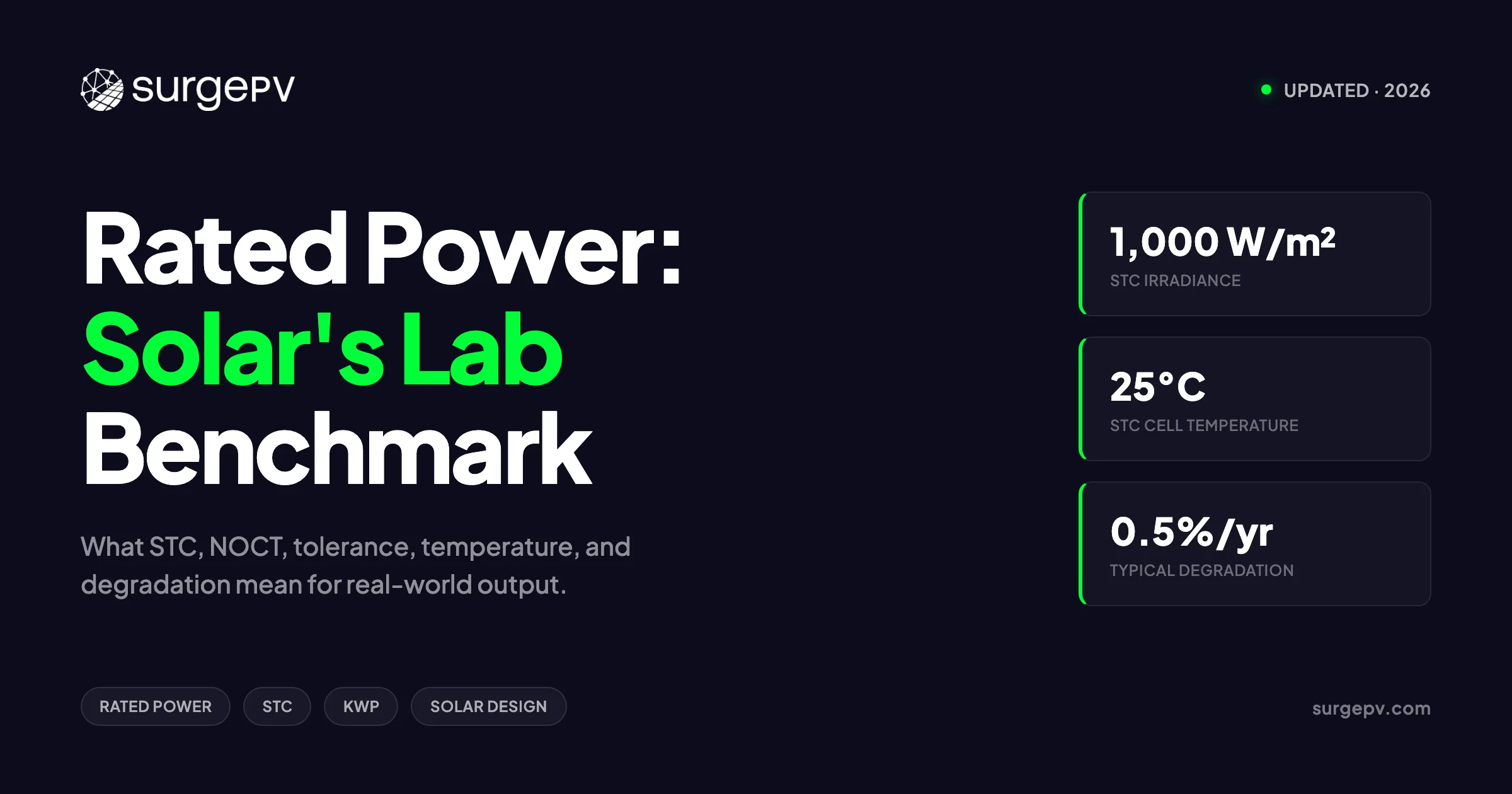
Rated power is the maximum continuous power a solar panel, inverter, or battery is designed to deliver under standardized test conditions. For PV modules, those conditions are 1,000 W/m² irradiance, 25°C cell temperature, and air mass 1.5. It is a benchmark for comparison and sizing, not a promise of everyday output.
What Is Rated Power?
Rated power is the nameplate capacity of an electrical device. It tells you the maximum power the device can safely deliver or consume continuously under specified conditions. In solar, the term applies to panels, inverters, batteries, transformers, and motors.
For a solar module, rated power is also called watt-peak (Wp) or kilowatt-peak (kWp). A 400 Wp panel is certified to produce 400 watts of DC power when tested under STC. The same panel in the field might produce 320 W at noon on a clear day and 80 W under light cloud cover. Both readings can be normal.
The key idea is standardization. Without a common test condition, you could not compare a module from Manufacturer A with one from Manufacturer B. STC creates that common ground. Every reputable module datasheet lists STC ratings for:
- Maximum power (Pmax)
- Open-circuit voltage (Voc)
- Voltage at maximum power (Vmp)
- Short-circuit current (Isc)
- Current at maximum power (Imp)
These values are measured with a flash tester in a fraction of a second. The test is fast, repeatable, and independent of weather. That is its strength. Its weakness is that the conditions are idealized.
Standard Test Conditions vs. Real-World Output
STC is defined by IEC 60904-3. The three parameters are:
| Parameter | STC Value | Why It Matters |
|---|---|---|
| Solar irradiance | 1,000 W/m² | Equivalent to strong midday sun at optimal angle |
| Cell temperature | 25°C | Cooler than most field conditions |
| Air mass | 1.5 | Represents sunlight passing through 1.5 atmospheres |
A panel at STC receives 1,000 W/m² of light and stays at 25°C. In practice, a rooftop panel in Phoenix at noon can reach 65–70°C even when ambient air is 40°C. That temperature rise alone can cut output by 12–18%.
NOCT, or Nominal Operating Cell Temperature, is a more realistic rating. It tests the panel at 800 W/m² irradiance, 20°C ambient air, and 1 m/s wind. The resulting cell temperature is typically 45–48°C. NOCT power is usually 10–15% lower than STC power.
PTC, or PVUSA Test Conditions, adds more field realism. It uses 1,000 W/m² irradiance but a calculated cell temperature near 45°C and includes wind and wiring losses. A 400 W STC panel might carry a 360 W PTC rating. California’s CEC uses PTC for incentive calculations because it predicts field output better than STC.
The gap between STC and real output does not mean manufacturers are dishonest. It means the industry needs a single reference point for procurement, and STC is that reference. The job of the designer is to translate STC into kWh using tools like NREL PVWatts or a professional solar design platform.
Rated Power vs. Peak Power
Rated power and peak power are often confused. The difference matters when sizing inverters and batteries.
Rated power is continuous output. A 5 kW inverter can deliver 5,000 W indefinitely without overheating. A 10 kWh battery with a 5 kW continuous rating can discharge at 5 kW for two hours.
Peak power is a short-duration surge. Motors, compressors, and pumps draw 3–7 times their running power at startup. A refrigerator might run at 150 W but need 800 W for half a second when the compressor starts. An inverter sized only by rated power can trip during these surges.
| Device | Rated / Continuous | Peak / Surge | Typical Duration |
|---|---|---|---|
| Solar panel | STC wattage | N/A | Continuous under given conditions |
| String inverter | Continuous AC output | 1.1–1.5× rated for a few seconds | 0.5–10 seconds |
| Hybrid inverter | Continuous AC output | 1.5–3× rated for motor startup | 1–10 seconds |
| Battery | Continuous discharge | 1.2–2× continuous for short bursts | 1–10 seconds |
| Refrigerator | 150 W running | 600–800 W startup | 0.5–2 seconds |
| 1 HP water pump | 750 W running | 3,000–3,500 W startup | 1–3 seconds |
For off-grid systems, always check the inverter’s surge rating and the battery’s peak discharge current. A system that works on paper can fail the first time a well pump starts.
Power Tolerance and Nameplate Reality
Power tolerance defines how far a module’s actual Pmax can deviate from its nameplate rating. It is printed on every datasheet. Common tolerances include:
- ±3%: a 400 W panel may test between 388 W and 412 W
- ±5%: a 400 W panel may test between 380 W and 420 W
- +5%/0%: the panel will produce at least 400 W and up to 420 W
Positive-only tolerance is attractive for project economics because every module meets or exceeds the rated value. However, it usually costs more per watt. For large utility projects, even a 1% difference in actual power affects revenue models over 25 years.
IEC 61215 requires the nameplate to state the Pmax tolerance. If no tolerance is stated, it is treated as 0%. The standard also sets degradation limits: after each individual qualification test, Pmax loss must not exceed 5%, and across the full test sequence, total degradation must not exceed 8%.
When you flash test a delivery of modules on site, compare the results to the rated power and tolerance band. A batch where most modules sit at the lower end of the tolerance range will underperform the production model. That is worth flagging with the supplier before installation.
Temperature, Degradation, and Other Losses
Temperature is the single largest factor that pulls real output below rated power. Solar cells become less efficient as they heat up. The temperature coefficient of Pmax tells you how much.
A typical monocrystalline PERC panel has a coefficient of -0.35% to -0.40% per °C. A premium N-type TOPCon panel might reach -0.28% to -0.30% per °C. Heterojunction (HJT) modules can be as low as -0.24% per °C.
Worked example: A 400 W panel has a temperature coefficient of -0.35%/°C. At 65°C cell temperature, the rise above STC is 40°C.
Power loss = 40 × 0.35% = 14% Actual output = 400 W × (1 - 0.14) = 344 W
In a hot climate where cell temperatures reach 70°C, the same panel produces 336 W. In a cool climate at 35°C, it produces 372 W. That is why identical arrays produce different yields in Rajasthan and Bavaria.
Degradation adds to the gap over time. NREL’s analysis of thousands of systems shows a median degradation rate of about 0.5% per year for crystalline silicon. Modern panels installed after 2015 average closer to 0.4%, while older panels often degraded above 1% per year. N-type technologies can degrade as little as 0.25–0.35% per year.
After 25 years, a 400 W panel with 0.5% annual degradation produces:
400 W × (1 - 0.005)^25 = 354 W
Other losses that widen the gap between rated and real power include:
- Soiling: dust, pollen, bird droppings, and snow can reduce output by 2–25% depending on location and cleaning schedule.
- Shading: a single shaded cell in a series string can disproportionately reduce string current unless optimizers or microinverters are used.
- Mismatch: modules with slightly different I-V curves produce less than the sum of their individual ratings.
- Wiring and connections: resistance losses are typically 1–3%.
- Inverter efficiency: modern inverters operate at 96–99% efficiency, but that still subtracts from rated output.
- Availability: downtime for maintenance, grid outages, and inverter faults reduce annual energy.
A well-designed residential system often achieves a performance ratio of 78–85%. That means the annual AC energy output is 78–85% of the theoretical STC energy. Systems below 70% usually have a fixable problem.
How to Use Rated Power in System Design
Rated power is the starting point for almost every sizing decision. Here is how professionals use it.
Array sizing from energy target: If a client needs 8,000 kWh per year and the local yield is 1,400 kWh per kWp per year, the required DC capacity is:
8,000 kWh ÷ 1,400 kWh/kWp = 5.7 kWp
At 440 W per panel, that is 13 panels.
Inverter sizing: Inverter capacity is often sized at 80–100% of array rated power. In cool, sunny climates with high DC/AC ratios, brief clipping is acceptable because the extra energy captured in mornings and evenings outweighs the midday losses. In hot climates, arrays rarely reach STC, so a lower inverter capacity is safe.
String design: String voltage is calculated at STC but must also be checked at the site’s lowest expected temperature. Voc rises in cold weather. A string that is safe at 25°C can exceed the inverter’s maximum input voltage on a frosty morning.
Production estimates: Bankable models use rated power as the input but apply derating factors for temperature, soiling, degradation, inverter efficiency, and availability. The result is a P50 or P90 energy estimate, not a rated-power estimate. For financial modeling, use the solar yield and financial analysis to build scenarios that reflect these losses.
Procurement: When comparing quotes, check whether the rated power is STC or PTC. A 10 kW STC array and a 9 kW PTC array may be the same hardware. Comparing them directly leads to bad decisions.
Common Mistakes and Misconceptions
Even experienced installers make these errors.
Expecting rated power at noon: Clients often ask why their 8 kW system is only producing 6 kW at midday. The answer is temperature, inverter efficiency, and system losses. Set this expectation during the sales process, not after commissioning.
Ignoring temperature coefficient in hot climates: A -0.40%/°C panel in Dubai will underperform a -0.26%/°C panel with the same STC rating. For hot roofs, the coefficient can matter more than the wattage.
Sizing off-grid inverters by rated power only: A 5 kW inverter may run a 4 kW continuous load but fail when a 3 HP pump tries to start. Always add the largest surge load to the sizing calculation.
Confusing kWp with kWh: kWp is power capacity. kWh is energy over time. A 10 kWp array in London and a 10 kWp array in Madrid produce very different annual kWh.
Forgetting degradation in long-term models: Using year-one output for a 25-year PPA overstates revenue. Degradation of 0.5% per year compounds to about 12% by year 25.
Overlooking tolerance in large projects: A 100 MW project where every module tests 2% below rated power loses 2 MW of capacity. Flash testing and supplier audits reduce this risk.
Pro Tip
Always present production estimates as a range, not a single number. Use P50 for the expected case and P90 for the conservative case. Explain that rated power is the lab benchmark and actual output depends on location, weather, and system design.
Frequently Asked Questions
What does rated power mean for a solar panel? Rated power is the maximum power a panel can produce under Standard Test Conditions: 1,000 W/m² irradiance, 25°C cell temperature, and air mass 1.5. It is a lab benchmark, not a guarantee of everyday output.
Why do solar panels rarely produce their rated power? Real-world conditions differ from the lab. Cell temperatures are usually higher than 25°C, irradiance varies, and wiring, inverter, soiling, and shading losses reduce output. A healthy system typically delivers 75–85% of rated power in good conditions.
What is the difference between rated power and peak power? Rated power is continuous output under standard conditions. Peak power is a short surge an inverter or battery can handle for seconds to start motors and compressors. Off-grid systems must be sized for both.
How do you calculate total rated power for a solar array? Multiply the number of panels by each panel’s watt-peak rating, then divide by 1,000. For example, 20 panels × 400 Wp = 8,000 Wp, or 8 kWp.
What is power tolerance in solar panels? Power tolerance is the allowed range around the nameplate rating. A 400 W panel with ±3% tolerance may test between 388 W and 412 W. Positive-only tolerances guarantee the panel meets or exceeds the rating.
How much power do solar panels lose from heat? Most panels lose 0.30–0.40% of output for every degree Celsius above 25°C. At 65°C cell temperature, a panel with a -0.35%/°C coefficient loses about 14% of its rated power.
How does degradation affect rated power over time? Crystalline silicon panels typically degrade 0.4–0.6% per year. A 400 W panel may produce around 347 W after 25 years. Premium N-type technologies degrade closer to 0.3% per year.
Should I size an inverter to match the array’s rated power? Not necessarily. Inverters are often sized 10–20% below array rated power because panels rarely reach STC output. The right ratio depends on climate, orientation, clipping tolerance, and local grid rules.
Where this fits
This article is part of SurgePV's Solar Technology hub, which works through the topic from first principles to the decisions a project team actually has to make.
