The solar industry added a record 450+ GW globally in 2024, and every gigawatt needs mounting hardware. For decades, that hardware meant aluminum rails — long, heavy, expensive extrusions that installers measured, cut, and bolted to roofs before a single panel went up. Rail-less solar mounting systems flip that workflow. They attach modules directly to roof mounts, skipping the rail entirely. Read Solar Racking Design Guide for a complete walkthrough. For Global-specific compliance details, see Global net-metering-by-country. For Global-specific compliance details, see Global solar-permitting-speed-by-country.
This guide covers the full picture for 2026: what rail-less mounting is, how the two main approaches differ, real cost and labor savings from the field, which major manufacturers lead the market, and the specific conditions where rail-less wins versus where traditional rails still make sense.
Quick Answer
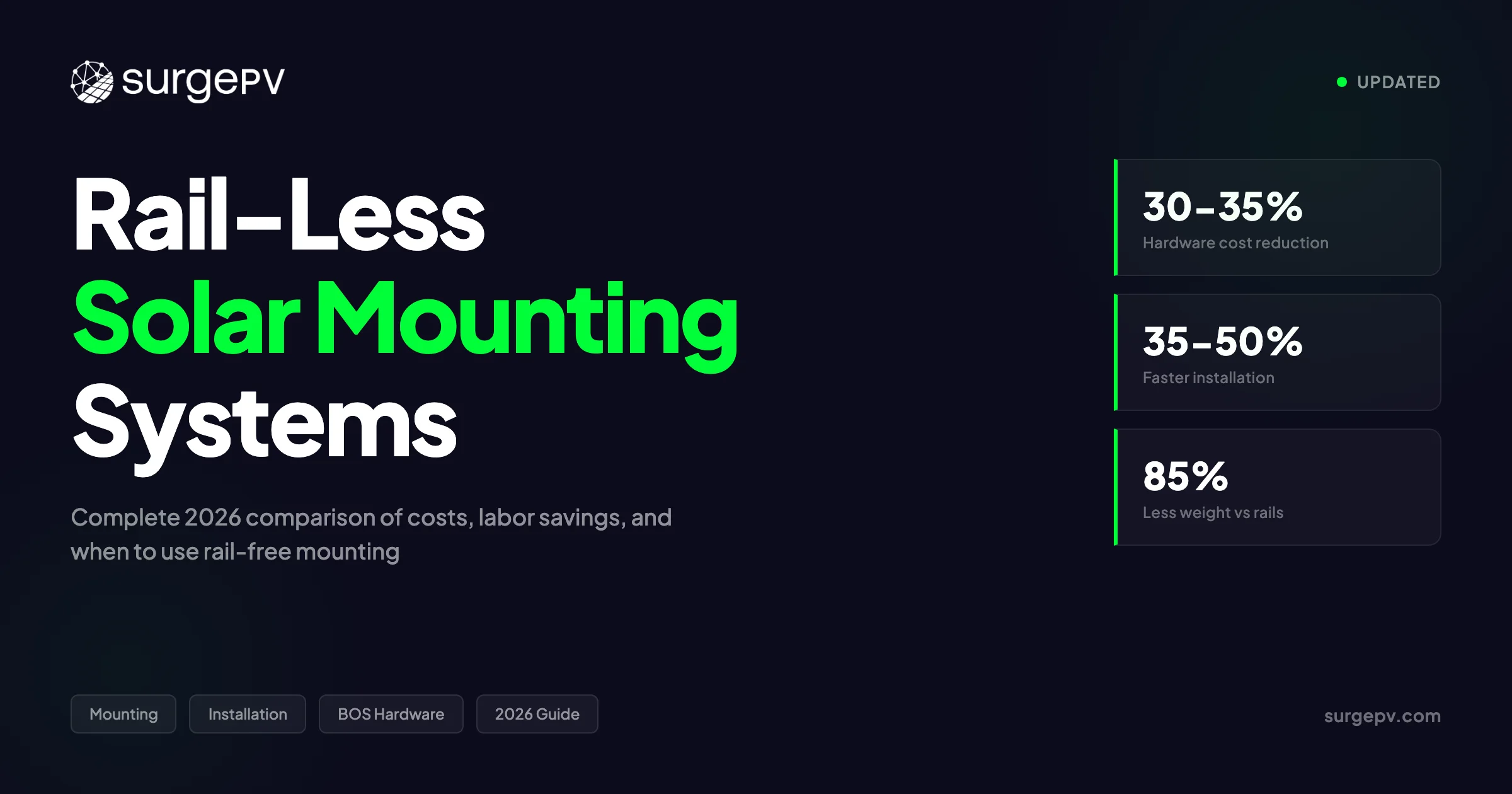
Rail-less solar mounting systems attach PV modules directly to individual roof mounts without continuous aluminum rails. They cut mounting hardware costs by 30-35%, reduce installation time by 35-50%, and weigh 85% less than rail-based systems. They work best on residential roofs with uniform spacing and simple rectangular layouts. Rails still win on commercial flat roofs, complex layouts, and extreme snow or wind zones.
In this guide:
- What rail-less mounting is and how the two main approaches work
- Cost comparison: rail-less vs. rail per kWp with real numbers
- Labor time savings and installer experience data
- Weight reduction and structural load implications
- Major manufacturers compared: S-5! PVKit, Unirac SFM Infinity, EcoFasten RockIt, SnapNrack, Roof Tech
- When rail-less wins and when rails still win
- Wire management, maintenance, and module replacement realities
- 2026 adoption trends and market forecast
What Are Rail-Less Solar Mounting Systems?
A rail-less solar mounting system is a method of attaching photovoltaic (PV) modules to a roof without continuous aluminum rails. Instead of bolting rails to the roof and then clamping panels to those rails, rail-less systems use individual mounts that attach directly to the roof structure. Each module connects to its neighbors through integrated clamps, shared attachment points, or short connector pieces. Read Rooftop Solar Structural Assessment for a complete walkthrough.
BOS — balance of system — refers to all hardware, wiring, electronics, and labor required for a solar installation other than the panels and inverter. Mounting hardware typically accounts for 10-15% of total BOS costs in residential solar. Rails alone represent roughly 15-20% of that mounting hardware cost.
There are two main approaches to rail-less mounting.
Direct-Attach Systems
Direct-attach systems use built-in clamps that grip the module frame and connect directly to a roof-mounted base. The S-5! PVKit 2.0 is the best-known example. Each module clamps to its neighbor through a MidGrab or EdgeGrab assembly. The roof attachment is a small disk or bracket that sits beneath the module frame joint.
Direct-attach systems work best on metal roofs where non-penetrating clamps grip standing seams. They also work on composition shingle and tile roofs with appropriate flashing bases. The key advantage is minimal parts count — often just three components per connection point.
Shared-Rail or “Hidden Rail” Systems
Shared-rail systems use short rail segments or structural connectors between modules rather than continuous rails across the full array. The Unirac SFM Infinity and EcoFasten RockIt fall into this category. A short “microrail” or “splice” connects two modules east-west, while a roof-mounted base provides the structural attachment.
Shared-rail systems offer more flexibility than pure direct-attach. They allow mixed portrait and landscape orientations. They also provide better load distribution because the short rail segments span between attachment points. The tradeoff is slightly more parts and weight than pure direct-attach.
Key Takeaway
Direct-attach systems like S-5! PVKit use module-to-module clamps with minimal parts. Shared-rail systems like Unirac SFM Infinity use short connectors between modules for better flexibility. Both eliminate continuous rails. Both cut material weight by 80-85% compared to traditional rail-based mounting.
How Rail-Less Mounting Works: The Installation Flow
Understanding the installation sequence explains why rail-less systems save time and where they create friction.
Traditional Rail-Based Workflow
- Mark rafter or truss locations on the roof deck.
- Install flashing bases or lag screws at each attachment point.
- Measure, cut, and place continuous aluminum rails across the attachment points.
- Level and square the rail layout.
- Place modules onto the rails and secure with mid-clamps and end-clamps.
- Install grounding hardware and wire management clips along the rails.
This process takes 6-8 hours for a typical 6 kW residential array. Rail cutting and leveling consume the most time. Shipping 14-foot rail sticks to the job site requires a truck or van. Damaged rails — bent in transit or cut wrong on site — create delays and waste.
Rail-Less Workflow
- Mark rafter or truss locations on the roof deck.
- Install self-flashing bases or mounts at each attachment point.
- Place the first module row and secure with edge clamps or trim rails.
- Drop subsequent modules into place, connecting each to its neighbor with built-in clamps or links.
- Torque all connections and verify grounding continuity.
This process takes 4-5 hours for the same 6 kW array. The critical difference is step elimination. There are no rails to measure, cut, level, or ship. Modules essentially snap into a grid once the base mounts are in place.
Pro Tip
Rail-less speed advantages only appear once the crew is trained. The first rail-less install may be only 15% faster than rail-based. By the second or third project, speed improves to 30-50% faster. Budget one extra hour for training on the first job. The payoff starts on job two.
Cost Comparison: Rail-Less vs. Rail per kWp
The cost case for rail-less mounting rests on three pillars: material savings, labor savings, and logistics savings.
Material Cost Comparison
| Cost Component | Rail-Based (6 kW) | Rail-Less (6 kW) | Savings |
|---|---|---|---|
| Rails and splices | $180-240 | $0 | $180-240 |
| Mid-clamps and end-clamps | $60-90 | $40-60 | $20-30 |
| Flashing / L-feet | $120-160 | $100-140 | $20-30 |
| Grounding hardware | $30-50 | $0 (integrated) | $30-50 |
| Wire management | $20-40 | $30-50 | -$10 to -$20 |
| Total hardware | $410-580 | $170-250 | $240-330 (58% reduction) |
These numbers reflect distributor pricing for residential-grade systems in the U.S. market. The rail-less hardware cost for a 6 kW system runs approximately $170-250 versus $410-580 for rail-based. That is a 58% reduction in mounting-specific hardware costs.
However, mounting hardware is only one slice of total system cost. On a $2.50/watt residential installation, mounting represents roughly $0.40-0.60/watt. Cutting that by 58% saves $0.23-0.35/watt in hardware alone.
Labor Cost Impact
Labor savings are harder to quantify because they depend on crew experience and local wage rates. At $50/hour for a two-person crew:
| Metric | Rail-Based | Rail-Less | Savings |
|---|---|---|---|
| Install time (6 kW) | 6-8 hours | 4-5 hours | 2-3 hours |
| Labor cost | $600-800 | $400-500 | $200-300 |
| Modules per day (2-person crew) | 25-30 | 40-50 | 15-20 more |
The labor savings of $200-300 per system often exceed the material savings. For an installer completing 200 residential systems per year, that is $40,000-60,000 in additional labor capacity — equivalent to 1-1.5 extra crew members without hiring.
Logistics and Shipping
A 50 kW commercial system requires approximately 970 pounds of rail-based mounting hardware versus 149 pounds of rail-less hardware. That is an 85% reduction in shipping weight. For residential jobs, the difference is smaller in absolute terms but still meaningful — a rail-less system fits in a bucket or tote bag, while rails require a truck.
John Markiewicz, director of sales at PLP, noted in industry interviews that “we get a lot of damaged rail issues, because we ship longer rails that customers want. They get handled multiple times in and out of trucks, and they can get damaged and bent.” Rail-less components, shipped in boxes, avoid this problem entirely.
Total Installed Cost Impact
| Cost Category | Rail-Based | Rail-Less | Total Savings |
|---|---|---|---|
| Hardware (per 6 kW) | $410-580 | $170-250 | $240-330 |
| Labor (per 6 kW) | $600-800 | $400-500 | $200-300 |
| Shipping/handling | $40-60 | $10-20 | $30-40 |
| Total mounting cost | $1,050-1,440 | $580-770 | $470-670 |
| Per-watt mounting cost | $0.18-0.24 | $0.10-0.13 | $0.08-0.11 |
For a $15,000 residential system, rail-less mounting reduces the mounting portion from roughly 7-10% of total cost to 4-5%. The $470-670 savings per system is real money for installers operating on thin margins.
SurgePV Analysis
At $0.08-0.11/watt savings, rail-less mounting pays for itself immediately. There is no payback period — the savings are realized on the first invoice. For an installer doing 200 residential jobs per year at 6 kW average, switching to rail-less frees up $94,000-134,000 in annual labor and material capacity. That funds one additional sales rep or one additional installation crew without increasing revenue.
For a direct comparison, see Arka 360 vs SurgePV.
Labor Time Savings: What the Data Shows
The speed claims for rail-less mounting are substantial. Let us look at what independent and manufacturer data actually shows.
Per-Module Install Times
| System Type | Time per Module | Daily Output (1 installer) |
|---|---|---|
| Traditional rail-based | 3-4 minutes | 25-30 modules |
| Rail-less (experienced crew) | 90 seconds | 40-50 modules |
| Rail-less (first-time crew) | 2-2.5 minutes | 30-35 modules |
The 90-second-per-module figure comes from multiple manufacturer claims verified by installer feedback. Unirac reports 85-90 seconds per module for SFM Infinity once the crew is trained. S-5! reports similar numbers for PVKit 2.0 on standing seam metal roofs.
NREL Field Study Data
The National Renewable Energy Laboratory (NREL) evaluated a specific rail-less system (SMASHmount) in a controlled field study. Results showed:
- First rail-less install: 15% faster than the installer’s typical rail-based pace
- Second rail-less install: 31% faster
- Third rail-less install: 37% faster
The learning curve is steep. Installers with rail experience adapt quickly because they understand roof attachment and module handling. The new skill is alignment without rails — ensuring each mount sits at the correct height and position for the module frame to connect cleanly.
Andrew’s First Rail-Less Project
Andrew Chen runs a three-crew installation company in Phoenix, Arizona. In early 2025, he switched his primary residential offering from rail-based to rail-less mounting on comp shingle roofs. His first rail-less job was a 7.2 kW system on a single-story home with a simple rectangular south-facing roof.
“We budgeted six hours based on our rail experience,” Andrew said. “It took five and a half. Not a huge difference. But by the fourth job, we were finishing in under four hours. The crew stopped measuring rails and started trusting the layout.”
Over six months, Andrew’s average install time dropped from 6.5 hours to 4.2 hours per residential system. His crew size stayed at two people. Output increased from 18 systems per month to 26 systems per month without adding staff.
The catch: wire management took longer than expected. “We saved two hours on rails and lost 20 minutes on clips,” Andrew noted. “The wire clips that attach to module frames are finicky. We lost a few in the wind. Now we pre-stage them in buckets by color.”
Real-World Example
Andrew Chen’s Phoenix crew cut average install time from 6.5 hours to 4.2 hours over six months of rail-less work. Output rose from 18 to 26 systems per month with the same two-person crew. Wire management clips added 15-20 minutes per job that rail-based systems avoid through integrated rail channels.
Weight Reduction and Structural Load Implications
Rail-less systems are dramatically lighter than rail-based equivalents. This matters for roof load capacity, shipping costs, and installer ergonomics.
Weight Comparison
| Metric | Rail-Based | Rail-Less | Reduction |
|---|---|---|---|
| Dead load per kWp | ~19 lbs (8.6 kg) | under 3 lbs (1.4 kg) | 85% |
| 50 kW system total | ~970 lbs (440 kg) | ~149 lbs (68 kg) | 85% |
| 6 kW residential | ~114 lbs (52 kg) | ~18 lbs (8 kg) | 84% |
The S-5! PVKit 2.0 is the lightest major system at under 3.5 lbs per kW. A 50 kW commercial system requires only 150 pounds of PVKit hardware versus 970 pounds of rail-based hardware. That difference affects everything from freight charges to crane rentals to how many systems fit in an installer’s van.
Load Distribution Tradeoff
Here is the structural nuance most guides miss. Rail-based systems distribute loads across continuous rails. Snow weight, wind uplift, and dead load spread along the rail length to multiple attachment points. Rail-less systems concentrate loads at individual attachment points.
S-5! claims 25% better load distribution for PVKit 2.0 compared to traditional rail systems. This seems counterintuitive until you understand the mechanism: PVKit’s mounting disk sits directly under the module frame joint, transferring load straight into the roof structure at the strongest point. Rails, by contrast, create cantilevered loads at the ends of each rail section.
However, the module frame itself becomes the load path in rail-less systems. In heavy snow zones, the module frame must handle point loads that rails would otherwise absorb. Most module manufacturers rate their frames for these loads, but the margin is thinner. In 90 psf snow zones, rail-based systems with their distributed load paths offer a larger safety margin.
What Most Guides Miss
Rail-less systems concentrate structural loads at individual attachment points rather than distributing them across rails. This is fine for most residential roofs in moderate climates. In heavy snow zones (over 60 psf ground snow load) or high wind zones (over 140 mph design wind), the module frame becomes the limiting factor. Rail-based systems offer a larger structural safety margin in extreme conditions because the rail absorbs and redistributes loads that would otherwise stress the module frame.
Major Rail-Less Mounting Systems Compared
Six manufacturers dominate the rail-less market in 2026. Each has strengths, weaknesses, and ideal use cases.
S-5! PVKit 2.0
The PVKit 2.0 is the most deployed rail-less system globally, with over 6 GW of installations. It is designed specifically for metal roofs — standing seam, exposed fastener, and corrugated.
| Specification | Detail |
|---|---|
| Roof types | Standing seam, exposed fastener, corrugated metal |
| Module frame | 30-46 mm |
| Weight | under 3.5 lbs/kW |
| Components | 3 (MidGrab, EdgeGrab, PV Disk) |
| Wind rating | 150 psf (PVKit HUR 2.0) |
| Certifications | UL 2703, UL 3741, Florida Product Approval |
| Install time | ~90 seconds/module |
| Cost position | Mid-range |
The PVKit HUR 2.0 variant — High Uplift Resistance — achieved Florida Product Approval in October 2025 for use in High-Velocity Hurricane Zones. EdgeGrab handles 353 lbs uplift. MidGrab handles 861 lbs uplift. This makes it the only rail-less system certified for Florida’s most demanding wind zones.
The black anodized finish option addresses the aesthetic concern that drives many residential buyers toward rail-less. On dark metal roofs, the hardware virtually disappears.
Unirac SFM Infinity
Unirac’s third-generation rail-less system targets composition shingle roofs specifically. It is the most feature-rich rail-less system for the residential shingle market.
| Specification | Detail |
|---|---|
| Roof types | Composition shingle only |
| Module frame | 30-40 mm |
| Orientation | Portrait and landscape mixable |
| Components | 10 (Microrail, Splice, Trimrail, clips, etc.) |
| Roof attachments | 20% fewer than competing systems |
| Certifications | UL 2703, UL 2703A, SolarAPP+ approved |
| Install time | 85-90 seconds/module |
| Cost position | Premium |
The SFM Infinity’s standout feature is post-install height adjustment. A 1/4-inch hex drive tool raises or lowers each mount after modules are in place. This eliminates the painstaking leveling process that consumes time on rail-based jobs. Dark hardware and recessed fasteners create a clean visual finish.
The 20% reduction in roof attachments compared to competing rail-less systems matters for roof warranty concerns. Fewer penetrations means fewer potential leak points.
EcoFasten RockIt
EcoFasten’s RockIt system is the most roof-type-flexible rail-less option. It handles composition shingle, tile (flat, S, and W profiles), standing seam metal, corrugated metal, and low-slope roofs.
| Specification | Detail |
|---|---|
| Roof types | Shingle, tile, metal, low-slope |
| Module frame | Type 1, 2, 4, 5, 29 per UL 1703 |
| Profile height | 3.25-4.5 inches above roof |
| Max span (landscape) | 6 ft (72 inches on center) |
| Max span (portrait) | 4 ft (48 inches on center) |
| Certifications | UL 2703, UL 2703A, UL 3741, Florida Product Approved |
| Install time | Comparable to SFM Infinity |
| Cost position | Mid-range |
The RockIt Smart Slide is a flashless attachment option using UltraGrip Technology — no metal flashing or pilot holes needed. This speeds installation on comp shingle roofs where traditional flashing requires lifting shingles and sealing around lag screws.
The top-down leveling system allows array leveling during or after installation. North-south adjustability of 3-7 inches provides flexibility for uneven rafter spacing.
SnapNrack TopSpeed Universal (formerly RL Universal)
SnapNrack’s TopSpeed Universal — previously marketed as RL Universal — prioritizes installation speed above all else. It uses a “drop-in” module placement method where modules are set from above and secured with module links.
| Specification | Detail |
|---|---|
| Roof types | Comp shingle, tile, metal |
| Module frame | 30-40 mm |
| Components | 4 (Mount, Link, Skirt, Spacers) |
| Wind rating | 180 mph |
| Snow load | 4.3 kN/m² |
| Roof pitch | 0-89 degrees |
| Certifications | UL 2703, Miami-Dade NOA, Class A fire |
| Install time | Fastest in class |
| Cost position | Mid-range |
The integrated skirt creates a structural alignment guide for the first row. Module links accommodate 2-4 modules with 5.25 inches of adjustability. The exclusive 2.5-inch offset eliminates interference between adjacent mounts.
Andrew Wickham, SnapNrack’s director of training, emphasizes the logistics advantage: “Everything in a rail-less system can come in a box, so then you’re able to get out of jobs and get stuff up on the roof much easier.”
Roof Tech RT-MINI II
Roof Tech’s RT-MINI II is a self-flashing mounting base that works with both rail-less and conventional rail systems. Its AlphaSeal technology provides built-in waterproofing without separate flashing components.
| Specification | Detail |
|---|---|
| Roof types | Asphalt, metal, tile, flat, EPDM, TPO, SBS |
| Dimensions | 101.6 x 89.9 x 15.2 mm |
| Wind rating | 180 mph |
| Snow load | 90 psf |
| Certifications | ICC-ESR 3575, Florida HVHZ, CSA |
| Warranty | 25 years |
| Cost position | Budget-friendly |
The RT-MINI II’s universal roof compatibility is its primary advantage. One base design covers virtually every residential roof type. The self-flashing base eliminates the need for separate flashing kits, reducing parts count and install time.
However, the RT-MINI II is primarily a mounting base, not a complete rail-less system. It pairs with rail-less clamps or with conventional rails. Installers value it for the waterproofing reliability — the butyl sealant activates as the base is fastened, creating a self-sealing bond.
Quick Mount PV QRail / Quick Rack
Quick Mount PV offers both rail-based (QRail) and rail-free (Quick Rack) systems. The Quick Rack is a true rail-less solution using integrated flashing and direct module attachment.
Quick Mount PV’s strength is in waterproofing. The company pioneered integrated flashing for solar roof penetrations, and that expertise carries into its rail-less products. However, Quick Mount PV’s rail-less market share is smaller than the five systems above, and its product line focuses more on roof attachment technology than complete rail-less racking systems.
Manufacturer Comparison Table
| System | Best Roof Type | Weight | Key Advantage | Key Limitation | Certifications |
|---|---|---|---|---|---|
| S-5! PVKit 2.0 | Standing seam metal | under 3.5 lbs/kW | Lightest, 6+ GW deployed | Metal roofs only | UL 2703, FL PA |
| Unirac SFM Infinity | Comp shingle | Mid-range | Post-install leveling | Shingle only | UL 2703, SolarAPP+ |
| EcoFasten RockIt | Multi-type | Mid-range | Most roof-type flexible | More components | UL 2703, FL PA |
| SnapNrack TopSpeed | Comp shingle/metal | Mid-range | Fastest install speed | Limited adjustability | UL 2703, Miami-Dade |
| Roof Tech RT-MINI II | Universal base | Low | Self-flashing, one base | Needs paired clamps | ICC-ESR, FL HVHZ |
Key Takeaway
For standing seam metal roofs, S-5! PVKit 2.0 is the clear leader with the most deployments and best wind ratings. For composition shingle, Unirac SFM Infinity and SnapNrack TopSpeed compete on features versus speed. For multi-roof-type flexibility, EcoFasten RockIt covers the widest range. Roof Tech RT-MINI II is the budget-friendly universal base that works with any clamp system.
When Rail-Less Wins: Ideal Use Cases
Rail-less mounting is not universally better. It wins in specific conditions where its advantages compound and its limitations do not matter.
Residential Simple Rectangular Arrays
Rail-less mounting shines on residential roofs with uniform rafter spacing and simple rectangular layouts. A south-facing comp shingle roof with no hips, valleys, or dormers is the ideal scenario. The installer marks rafter locations, sets bases, and drops modules into a clean grid.
Johan Alfsen, director of training at Everest Solar Systems, summarized it well: “On systems that are simple layouts, then rail-free becomes a little easier… it tends to lend better toward simple squares and rectangles.”
Standing Seam Metal Roofs
Metal roofs with standing seams are the sweet spot for rail-less. Non-penetrating clamps grip the seam directly. No roof penetrations means no leak risk. The S-5! PVKit 2.0 was designed for this application and dominates the metal roof segment.
The weight advantage is most pronounced here. A rail-based system on a metal roof adds significant dead load to a structure that may already be near capacity. Rail-less cuts that load by 85%.
Weight-Sensitive or Aging Roof Structures
Older homes with roof structures built before solar loads were a consideration often cannot handle the dead load of rails plus modules. Rail-less systems at under 3 lbs per kW versus 19 lbs for rail-based make the difference between a viable project and a structural upgrade.
In retrofit markets like Germany, Italy, and the UK — where homes are older and roof structures lighter — rail-less adoption is growing faster than in new-construction markets. Also see: solar panel ROI in Italy. Also see: Germany solar subsidies.
Time-Sensitive Projects
Installers with backlog pressure benefit from rail-less speed. A crew that completes 26 systems per month instead of 18 generates 44% more revenue with the same headcount. For companies in high-growth markets where customer wait times stretch to months, this capacity increase is worth more than the material savings.
Aesthetic Priorities
Rail-less systems sit lower to the roof surface. There are no visible rail lines between module rows. Black anodized hardware blends into dark roofs. For homeowners in neighborhoods with strict HOA guidelines or for premium residential markets where appearance drives decisions, the low-profile look of rail-less is a selling point.
Design Rail-Less Arrays in SurgePV
Model roof layouts, calculate structural loads, and generate material lists for rail-less and rail-based systems side by side.
Book a DemoNo commitment required · 20 minutes · Live project walkthrough
When Rails Still Win: Where Rail-Less Falls Short
Rail-less mounting has real limitations. Ignoring them leads to callbacks, failed inspections, and unhappy customers.
Commercial Flat Roofs with Tilt
Large commercial flat roofs typically use ballasted tilt systems or rail-based racking with 10-30 degree tilt angles. Rail-less systems are not designed for tilted arrays on flat roofs. The IronRidge BX ballasted system — while not truly rail-less — uses chassis trays rather than continuous rails, but this is a different category from residential rail-less.
For commercial projects over 100 kW, traditional rail-based or ballasted systems remain standard. Wire management across large arrays is simpler with rail channels. Module replacement during O&M is faster when modules slide along rails.
Complex Roof Layouts
Rail-less systems require consistent rafter or purlin spacing. Complex roofs with hips, valleys, dormers, mixed orientations, or non-standard module sizes create alignment problems. Rails provide flexibility — you can slide a module along a rail to bridge a gap or work around an obstacle. Rail-less systems lock modules to specific attachment points.
Andrew Wickham of SnapNrack acknowledged this tradeoff: “With rail-less systems you have the potential for some efficiency gains… but you’re limited as far as your roof types.”
Heavy Snow and Extreme Wind Zones
In snow zones with ground snow loads over 60 psf, rail-based systems distribute snow weight across the rail length. Rail-less systems transfer snow load directly to module frames and individual attachment points. Most module frames are rated for these loads, but the safety margin is smaller.
In hurricane zones, the S-5! PVKit HUR 2.0 and Roof Tech RT-APEX both carry Florida Product Approval. However, rail-based systems with their continuous load paths still offer more predictable structural behavior in extreme wind events. Engineers often specify rail-based for critical infrastructure projects regardless of cost.
Mixed Module Sizes and Orientations
Rail-less systems assume uniform module dimensions within an array. Mixing 60-cell and 72-cell modules, or mixing portrait and landscape orientations, requires adapters or custom layouts that negate the speed advantage. Unirac SFM Infinity allows mixed orientations, but most rail-less systems do not.
Rail-based systems handle mixed layouts naturally. Different rail lengths, different clamp positions, and adjustable rail heights accommodate virtually any module combination.
Inexperienced Crews
Rail-less speed advantages require training. A crew accustomed to rails will be slower on their first rail-less job. The layout precision required — setting each mount at exactly the right height and position — is unforgiving. Mistakes compound because there is no rail to absorb misalignment.
NREL’s field study found that even experienced rail installers were only 15% faster on their first rail-less install. The 31-37% speed gains came on jobs two and three. Installers with high crew turnover may never reach the efficiency threshold where rail-less pays off.
Tradeoff
Rail-less wins on simple residential roofs with uniform spacing and experienced crews. Rails win on commercial flat roofs, complex layouts, extreme weather zones, and mixed module configurations. The installer who specifies one system for every project is leaving value on the table.
Wire Management: The Hidden Challenge
Wire management is the most frequently cited problem with rail-less systems. It is also the most underestimated.
The Rail Channel Advantage
Traditional rail-based systems have a built-in wire management solution: the rail itself. DC homerun wires, optimizer cables, and monitoring leads clip into the rail channel or run along the rail edge. The rail conceals and protects the wiring. Inspectors expect to see tidy wire runs inside rail channels.
The Rail-Less Wire Problem
Rail-less systems have no rail channel. Wires must be clipped to module frames, routed through separate conduit, or held with adhesive-backed clips. Each approach has failure modes.
Metal wire clips that attach to module frames can fall off during installation when wires are tugged. Adhesive-backed clips degrade in extreme heat and UV exposure — a real concern in Arizona, Texas, and Florida. Conduit adds cost and complexity that rail-less systems are supposed to eliminate.
SolarEdgePros, a Texas-based installer, documented this issue in field observations: “Installers only have a short-term solution to wire management when using a rail-less system… These clips tend to fall off the panels during the installation process when the wires are tugged.”
Solutions That Work
Leading installers have developed workarounds:
- Pre-staged clip buckets: Color-coded wire clips sorted by wire gauge, staged in buckets at each roof entry point.
- Integrated wire management: Some rail-less systems now include dedicated wire channels. SnapNrack’s Smart Clips and Wire Savers attach to the mount structure rather than the module frame.
- Cable trays: For commercial jobs, low-profile cable trays run between module rows, providing a protected path for homerun conductors.
- Module-level power electronics (MLPE) integration: Systems with microinverters or power optimizers reduce DC wiring volume, mitigating the wire management burden.
Pro Tip
Budget 15-20 extra minutes per job for wire management on your first ten rail-less installs. Pre-stage clips in buckets by the roof access point. Train crews to route wires before setting the final module in each row. The time lost to wire management drops to under 5 minutes per job once the crew develops muscle memory.
Module Replacement and Long-Term Maintenance
A solar system lasts 25-30 years. Module replacement is not hypothetical — it is inevitable. How rail-less systems handle replacement matters for total cost of ownership.
Rail-Based Replacement
On a rail-based system, replacing a single module is straightforward. Loosen the mid-clamps on either side of the failed module. Slide the module up and out along the rail. Slide the replacement in. Tighten the clamps. Total time: 10-15 minutes for an experienced technician.
Rail-Less Replacement
Rail-less replacement varies by system design.
Top-down clamp systems (SnapNrack TopSpeed): Loosen the module link above the failed panel. Lift the panel out. Drop the replacement in. Tighten the link. Similar speed to rail-based if the mounting points have not shifted.
Edge clamp systems (S-5! PVKit): Loosen the EdgeGrab or MidGrab clamps on the failed module and its neighbors. Remove the module. Re-align the replacement. Tighten all clamps. If the roof structure has settled or the original mounts have shifted, re-alignment can take 20-30 minutes.
Shared-rail systems (Unirac SFM Infinity): Loosen the splice connections and any bonding clamps. Remove the module. Replace and re-torque. The post-install height adjustment helps if the roof has settled unevenly.
The Settlement Risk
The real maintenance risk for rail-less systems is structural settlement. Over 10-20 years, roof structures move. Rafters sag slightly. Decking compresses. Flashing seals degrade. On a rail-based system, the rail spans these movements and maintains module alignment. On a rail-less system, each mount is independent. If one mount settles 1/4 inch more than its neighbor, the module frame stress increases.
No long-term field data exists yet on rail-less system performance at 15-20 years — the technology has not been deployed at scale for that long. Installers should torque-check all connections during annual maintenance visits and watch for frame stress indicators like micro-cracks or delamination at clamp points.
Common Mistake
Assuming rail-less module replacement is always faster. It is faster on well-installed systems with no settlement. It is slower — sometimes much slower — on systems where mounting points have shifted or where the original installer misaligned a base. Budget 15-30 minutes for rail-less replacement versus 10-15 minutes for rail-based. Over a 25-year system life with 2-3 module replacements, that adds 15-45 minutes of labor per system.
Snow, Wind, and Ballast Considerations
Climate-specific performance separates viable rail-less applications from risky ones.
Snow Load Engineering
Rail-less systems transfer snow load directly to module frames. A 60-cell module frame is typically rated for 5,400 Pa (113 psf) of static load. A 72-cell frame rates at 3,600-5,400 Pa depending on manufacturer. These ratings assume uniform load distribution.
Rail-less clamps create point loads at the frame edges. The frame must handle both the snow weight and the clamping force without deflecting beyond manufacturer limits. In practice, most rail-less systems are rated for ground snow loads up to 60 psf without additional engineering. Above that threshold, a structural engineer should verify module frame adequacy.
S-5! PVKit HUR 2.0 and Roof Tech RT-APEX both carry snow load ratings of 90 psf. EcoFasten RockIt rates at 30 psf downward per UL 2703. These ratings are system-specific — do not assume one rail-less product’s rating applies to another.
Wind Uplift
Wind uplift is the force that tries to pull a solar array off the roof. Rail-based systems resist uplift through continuous rail attachment to multiple roof mounts. Rail-less systems resist uplift through individual clamp-to-frame connections.
The S-5! PVKit HUR 2.0 EdgeGrab handles 353 lbs of uplift. The MidGrab handles 861 lbs. These are impressive numbers for individual clamps. However, a rail-based system with continuous rail attachment distributes uplift across the full rail length, creating redundancy. If one lag screw loosens on a rail system, the rail still holds. If one clamp loosens on a rail-less system, that module corner is unsecured.
For this reason, rail-less systems in high-wind zones require more rigorous torque verification during installation and annual maintenance.
Ballasted Systems
Ballasted rail-less systems are rare. Ballast requires a tray or chassis to hold the concrete blocks. The IronRidge BX system uses ballasted chassis trays, but these are not rail-less in the traditional sense — each module sits in its own tray rather than clamping to neighbors.
True rail-less systems are mechanically attached, not ballasted. For flat roofs where ballast is preferred to avoid penetrations, rail-less is generally not an option.
The Myth That Rail-Less Is Always Cheaper
Here is an opinion backed by data: rail-less is not always cheaper. The total installed cost depends on conditions that many cost comparisons ignore. Read more about Agricultural Solar Case Study. For France-specific information, see Floating Solar Farms France.
Hidden Costs
| Hidden Cost | Impact | When It Applies |
|---|---|---|
| Wire management accessories | $30-50 per system | Every rail-less job |
| Crew training | $500-1,000 per installer | First 2-3 jobs per crew |
| Structural engineering review | $200-500 per project | Snow zones over 60 psf |
| Torque verification tools | $150-300 one-time | All rail-less jobs |
| Callbacks for clip failures | $100-300 per incident | Hot climates, poor wire management |
A 6 kW rail-less system saves $470-670 in hardware and labor. If the installer spends $500 training two crew members and $40 on extra wire clips, the net savings on the first job drop to zero. The savings accumulate on jobs 4 through 200.
The Learning Curve Tax
NREL data shows the learning curve clearly: 15% faster on job one, 31% on job two, 37% on job three. But what if the crew turns over? A residential installer with 30% annual crew turnover may never reach the efficiency threshold where rail-less pays off. The training cost becomes a recurring expense.
The Complexity Penalty
Rail-less systems assume uniform layouts. A roof with three hips, a chimney, and a vent pipe requires custom rail-less layouts that consume the time saved on the simple sections. Many installers find themselves using rail-less for the main array and rails for the complex zones — a hybrid approach that adds design time and parts complexity.
The installer who saves $300 in hardware on a simple roof but loses $200 in design time on a complex roof has not gained much. The real savings come from standardizing on rail-less for the 60-70% of jobs that fit the simple-rectangle profile, and using rails for the rest.
SurgePV Analysis
Rail-less saves money at scale, not on every job. An installer doing 200 systems per year with 70% simple rectangular roofs saves approximately $65,000-95,000 annually after training costs. An installer doing 50 systems per year with 40% complex roofs saves approximately $8,000-12,000 — barely worth the operational change. The break-even point is roughly 100 simple-roof systems per year or 150 mixed-roof systems per year.
2026 Adoption Trends and Market Forecast
Rail-less mounting is growing, but not as fast as some manufacturers claim.
Current Market Share
The global solar PV mounting systems market was valued at approximately $12-15 billion in 2025. Rail-less systems represent an estimated 15-20% of the residential market and 5-8% of the commercial market in North America. In Europe, where older roof structures favor lightweight solutions, rail-less adoption is slightly higher at 20-25% of residential. Also see: European Solar Incentives.
Growth Projections
Industry forecasts project the overall solar mounting market growing at 10-13% CAGR through 2030. Rail-less is growing faster than the overall market at an estimated 18-22% CAGR, driven by:
- Labor cost pressure: Installer wages have risen 15-25% since 2022 in most markets. Any technology that cuts labor hours gains traction.
- Supply chain efficiency: Rail-less components ship in boxes, not 14-foot sticks. This matters more as last-mile delivery costs rise.
- Aesthetic demand: Homeowners increasingly prioritize low-profile installations. Rail-less delivers.
- Metal roof growth: Standing seam metal roofing is the fastest-growing residential roofing segment in the U.S. Rail-less dominates this segment.
Barriers to Faster Adoption
Three factors limit rail-less growth:
- Installer conservatism: Many installers have used rails for a decade. Switching requires training, inventory changes, and sales team education. The status quo bias is real.
- Code and inspection variability: Some jurisdictions require specific grounding methods or structural documentation that rail-less manufacturers have not yet obtained. Inspectors unfamiliar with rail-less may flag installations for additional review.
- O&M concerns: Large solar asset owners — the entities that own commercial and utility-scale systems — prefer rail-based for easier module replacement. Until 10-year field data proves rail-less reliability, institutional buyers will stay conservative.
2026-2030 Outlook
By 2030, rail-less systems could capture 35-40% of the residential market and 15-20% of the light commercial market in North America. They will remain a minority share in utility-scale and large commercial. The technology will mature — better wire management integration, longer track records, and broader code acceptance will drive adoption.
The shared-rail hybrid approach — short rail segments between modules rather than pure direct-attach — will likely grow fastest. It offers most of the material and weight savings of pure rail-less while preserving some of the flexibility and load distribution of rail-based systems.
How to Choose: A Decision Framework
Use this framework to specify rail-less or rail-based for each project.
Step 1: Assess Roof Geometry
| Roof Characteristic | Rail-Less | Rail-Based |
|---|---|---|
| Simple rectangle, uniform spacing | Strong fit | Acceptable |
| Multiple hips/valleys | Poor fit | Strong fit |
| Mixed module sizes | Poor fit | Strong fit |
| Mixed portrait/landscape | Check system specs | Strong fit |
| Standing seam metal | Strong fit | Acceptable |
| Comp shingle, simple layout | Strong fit | Acceptable |
| Tile roof | Check system specs | Strong fit |
| Flat roof with tilt | Not suitable | Strong fit |
Step 2: Assess Climate Conditions
| Climate Factor | Rail-Less | Rail-Based |
|---|---|---|
| Ground snow under 40 psf | Strong fit | Acceptable |
| Ground snow 40-60 psf | Check module frame rating | Strong fit |
| Ground snow over 60 psf | Engineering review required | Strong fit |
| Design wind under 120 mph | Strong fit | Acceptable |
| Design wind 120-150 mph | Check system HVHZ rating | Strong fit |
| Design wind over 150 mph | Limited options | Strong fit |
Step 3: Assess Crew and Business Factors
| Business Factor | Rail-Less | Rail-Based |
|---|---|---|
| Experienced crew, low turnover | Strong fit | Acceptable |
| High crew turnover | Poor fit | Strong fit |
| Backlog pressure, speed critical | Strong fit | Acceptable |
| Aesthetic sales priority | Strong fit | Acceptable |
| O&M service revenue focus | Acceptable | Strong fit |
| Complex commercial projects | Poor fit | Strong fit |
Pro Tip
Start with rail-less on your simplest 20% of jobs. Track install time, callback rate, and crew feedback. Expand to 50% of jobs once you have 50+ rail-less installations under your belt. Never force rail-less onto a roof where rails are clearly the better choice. Your reputation is worth more than the hardware savings.
Designing Rail-Less Arrays in Software
Modern solar design software handles rail-less mounting specification as a standard option. The design workflow differs slightly from rail-based.
Layout Considerations
Rail-less arrays require precise rafter or purlin alignment. The design software must map structural members and place mounts at exact intervals matching module frame dimensions. Most design platforms now include rail-less mount libraries for major manufacturers.
Structural Load Checks
Rail-less systems change the load path. Instead of distributing loads along rails, each mount handles point loads. Structural checks must verify:
- Roof attachment capacity at each mount location
- Module frame capacity for point loads at clamp locations
- Uplift resistance at each individual attachment
solar design software automates these checks when the rail-less mount type is selected from the component library.
Material Lists and Pricing
Rail-less BOMs are shorter — fewer unique parts, no rail cutting waste. However, they require accurate counts of clamps, links, and specialized bases. Design software generates these counts automatically from the layout, eliminating the manual counting errors that plagued early rail-less adoption.
For installers evaluating a switch to rail-less, running parallel designs — one rail-based, one rail-less — on the same roof geometry provides an apples-to-apples cost comparison. The SurgePV platform supports this parallel design workflow for S-5! PVKit, Unirac SFM Infinity, EcoFasten RockIt, and SnapNrack TopSpeed. Read more about France Solar Feed-in Tariffs.
Tools & Further Reading
Continue exploring related SurgePV resources:
Frequently Asked Questions
What is a rail-less solar mounting system?
A rail-less solar mounting system attaches PV modules directly to individual roof mounts without continuous aluminum rails. Each module connects to its neighbors through built-in clamps or shared attachment points. This cuts material weight by up to 85%, reduces hardware costs by 30-35%, and speeds installation by 35-50% compared to traditional rail-based systems.
How much do rail-less solar mounting systems cost compared to rail-based?
Rail-less mounting systems cost $0.28-0.40 per watt less in combined hardware, shipping, and labor — roughly a 30-35% reduction in mounting-specific costs. For a typical 6 kW residential system, this translates to $300-500 in total savings. Material savings alone run $110-140 per system. Labor time drops from 6-8 hours to 4-5 hours for the same array size.
Are rail-less solar mounting systems faster to install?
Yes. Experienced crews install rail-less systems 35-50% faster than rail-based equivalents. A single installer can place 40-50 modules per day with rail-less mounting versus 25-30 with rails. Per-module install time drops from 3-4 minutes to roughly 90 seconds once the crew is trained. The first rail-less install may be only 15% faster, but speed improves to 31% by the second project according to NREL field studies.
What are the disadvantages of rail-less solar mounting?
Rail-less mounting has four main drawbacks. First, wire management is harder without rail channels — clips can fall off and wires touching the roof fail inspection. Second, module replacement requires precise alignment; if mounting points shift, adjacent panels must be loosened. Third, complex roof layouts with mixed orientations or non-standard spacing are difficult. Fourth, snow loads transfer directly to module frames rather than being distributed across rails, which limits use in heavy snow zones without engineering review.
Which roof types work best with rail-less mounting?
Rail-less mounting works best on composition shingle roofs, standing seam metal roofs, and flat roofs with uniform structural spacing. Standing seam metal is ideal because non-penetrating clamps attach directly to seams. Composition shingle works well with integrated flashing bases. Tile roofs are more challenging due to limited mounting point options. Low-slope commercial roofs often need ballasted or hybrid approaches. Irregular roofs with uneven rafter spacing favor rail-based systems.
Can you mix rail-less and rail-based mounting on the same roof?
Yes, but it is not recommended for most projects. Some installers use rail-less for the main rectangular array and rail-based for complex sections like hips, valleys, or chimney setbacks. However, mixing systems complicates wire management, grounding continuity, and structural calculations. Most manufacturers void warranty coverage when their components are mixed with competing systems. A cleaner approach is to use a shared-rail or mini-rail hybrid for the complex zones.
What is the best rail-less solar mounting system in 2026?
The best rail-less system depends on roof type. For standing seam metal roofs, the S-5! PVKit 2.0 is the market leader with 6+ GW deployed and Florida HVHZ approval. For composition shingle, Unirac SFM Infinity and EcoFasten RockIt both offer strong performance with 20-35% fewer roof attachments. For multi-roof-type flexibility, Roof Tech RT-MINI II covers asphalt, metal, tile, and flat roofs with a single base design. SnapNrack TopSpeed Universal (formerly RL Universal) leads on install speed with drop-in module placement.
Do rail-less mounting systems handle high wind and snow loads?
Yes, when properly engineered. The S-5! PVKit HUR 2.0 achieves 150 psf wind uplift and carries Florida Product Approval for High-Velocity Hurricane Zones. Roof Tech RT-APEX rates at 180 mph wind and 90 psf snow load. EcoFasten RockIt handles 30 psf downward, 30 psf upward, and 20 psf lateral per UL 2703. However, rail-less systems concentrate loads at individual attachment points rather than distributing them across rails. This means each attachment must be engineered for higher point loads, and module frame strength becomes a limiting factor in extreme conditions.
How do you replace a single solar panel on a rail-less system?
Module replacement on rail-less systems varies by design. Systems with top-down clamps like SnapNrack TopSpeed allow single-module removal by loosening the module link above the panel. Systems with edge clamps like S-5! PVKit require loosening adjacent modules to free the clamps. The key risk is that mounting points may have settled or shifted since installation, making re-alignment difficult. Most manufacturers recommend checking torque on all adjacent clamps during replacement. Rail-based systems generally allow easier sliding of replacement modules along the rail.
Is rail-less mounting suitable for commercial solar projects?
Rail-less mounting is primarily suited for residential and small commercial projects under 100 kW. Large commercial flat roofs typically use ballasted systems like IronRidge BX or traditional rail-based tilt systems because rail-less attachments require precise rafter or purlin alignment that is harder to achieve at scale. Commercial projects also favor rail-based systems for easier wire management across large arrays and simpler module replacement during O&M. However, rail-less is gaining ground in light commercial (20-100 kW) on metal roofs where S-5! PVKit and similar systems reduce material handling costs significantly.
Conclusion: Three Actions for Installers
Rail-less solar mounting systems are not a universal upgrade. They are a tool that works exceptionally well in specific conditions and creates problems in others. Here is what to do next:
- Audit your project mix. If 60% or more of your jobs are simple residential rectangles on comp shingle or metal, run a pilot program with one rail-less system. Track install time, material cost, and callback rate for 20 jobs before deciding to scale.
- Train before you switch. Budget $500-1,000 per crew member for training on the first rail-less system you adopt. The learning curve is real — 15% faster on job one, 31% on job two. Speed gains do not appear immediately.
- Model both options in design software. Before specifying rail-less on any job, run a parallel rail-based design. Compare structural loads, material costs, and install time. Let the numbers decide, not manufacturer marketing.
The solar industry will install 500+ GW globally in 2026. Every gigawatt needs mounting. Rail-less will capture a growing share of the residential market because it saves real money and real time on the right roofs. But rails are not going away. The installer who masters both — and knows when to use each — will outcompete the installer who bets everything on one approach. PV proposal software generates professional quotes in minutes.
Where this fits
This article is part of SurgePV's Solar Installation hub, which works through the topic from first principles to the decisions a project team actually has to make.