

Answer
A homeowner in Lucknow with a 3 kW system may pay ₹1,40,000 after all subsidies. A homeowner in Bengaluru with the same 3 kW system may pay ₹1,85,000. Group Housing Societies receive ₹18,000 per kW for common facilities up to 500 kW per project. The next 1 kW (from 2 kW to 3 kW) attracts ₹18,000 per kW.
A homeowner in Lucknow with a 3 kW system may pay ₹1,40,000 after all subsidies. A homeowner in Bengaluru with the same 3 kW system may pay ₹1,85,000. Group Housing Societies receive ₹18,000 per kW for common facilities up to 500 kW per project.
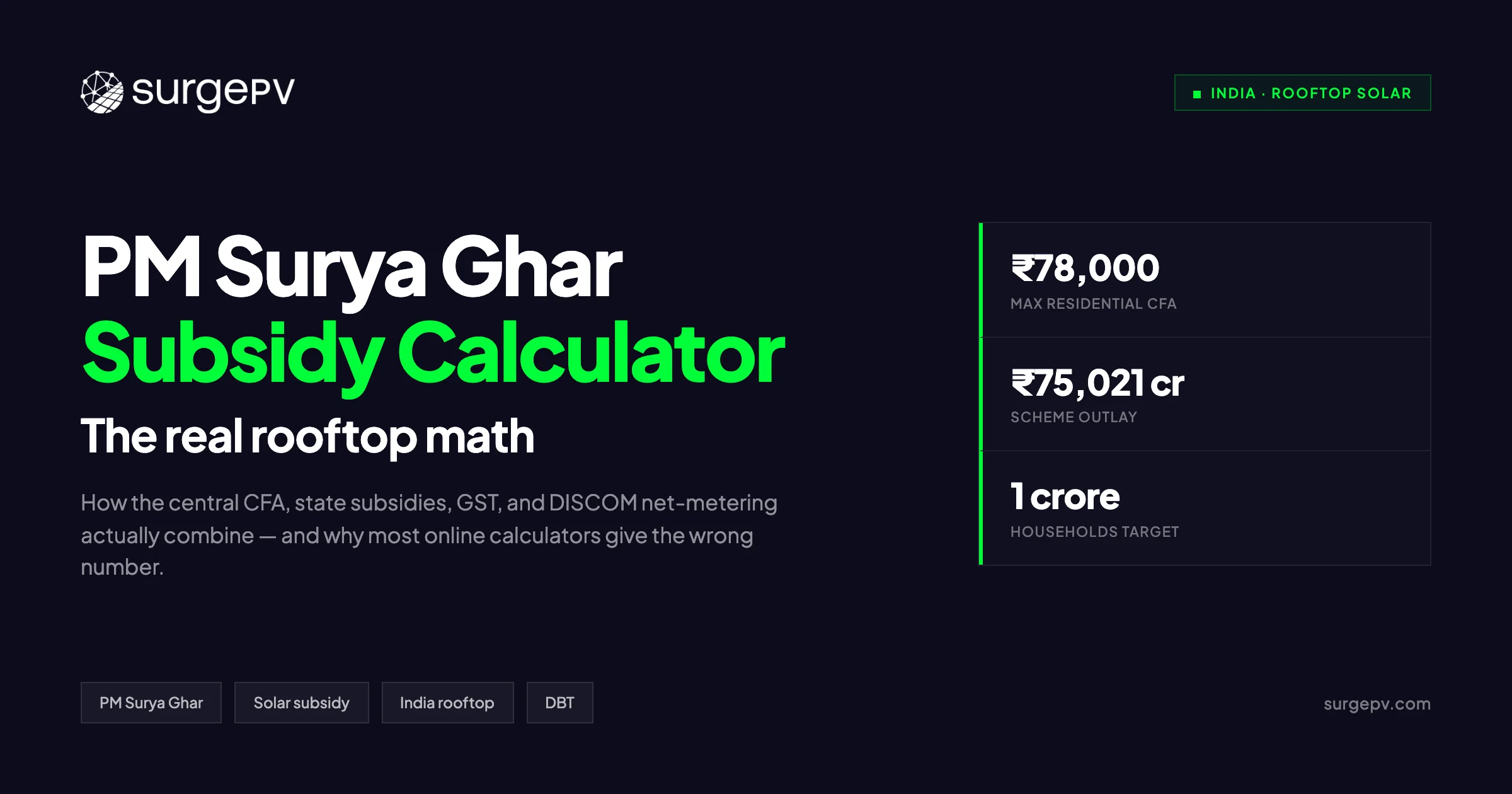
The Indian government has approved ₹75,021 crore for PM Surya Ghar Muft Bijli Yojana. The target is 1 crore residential households by FY 2026-27. Over 19.45 lakh rooftop solar systems had been installed nationwide as of December 2025 (Press Information Bureau, 2025). Yet most homeowners still cannot answer a simple question: what is my actual subsidy? Also see: Best Solar Design Software India.
Online calculators spit out flat numbers. A 3 kW system equals ₹78,000. That part is correct. But the net cost to the homeowner depends on four other variables most calculators ignore — state subsidy stacking, actual solar yield by location, DISCOM tariff slabs, and whether the roof has shading. A homeowner in Lucknow with a 3 kW system may pay ₹1,40,000 after all subsidies. A homeowner in Bengaluru with the same 3 kW system may pay ₹1,85,000. The difference is not the central subsidy. It is everything else. For more on this topic, see Solar Shading Analysis Guide.
This guide shows the exact slab math. It explains why a generic PM Surya Ghar subsidy calculator gives the wrong number. It walks through real worked examples across Indian cities. And it shows how solar PV design software models yield, shading, and financials to produce proposal-grade quotes. For the latest details on India, see 5kW Solar Panel Price in India. For India-specific compliance details, see India andhra-pradesh.
TL;DR — PM Surya Ghar Subsidy in 60 seconds
The central subsidy ladder is ₹30,000 (1 kW), ₹60,000 (2 kW), ₹78,000 (3 kW and above). The amount is sent to your bank account via DBT after DISCOM inspection. Generic calculators are wrong because they assume flat yield, miss state top-ups, and ignore GST and DISCOM tariff slabs.
In this guide:
- How the PM Surya Ghar subsidy is actually calculated (the slab logic)
- A worked example: 3 kW system in Pune vs Bengaluru vs Lucknow
- Why state subsidies stack on top of the central CFA — and where
- The 4 reasons online calculators give the wrong number
- The full application flow on pmsuryaghar.gov.in
- How installer-grade tools model real yield, not flat assumptions
How the PM Surya Ghar Subsidy Is Calculated
The central subsidy is calculated on a per-kW slab basis: ₹30,000 per kW for the first 2 kW, ₹18,000 per kW for the next 1 kW, and a hard cap of ₹78,000 for residential systems of 3 kW and above. Group Housing Societies receive ₹18,000 per kW for common facilities up to 500 kW per project. Special Category States get slightly higher rates.
The central subsidy works on a per-kW basis with a hard cap. The first 2 kW attract ₹30,000 per kW. The next 1 kW (from 2 kW to 3 kW) attracts ₹18,000 per kW. Beyond 3 kW, no extra central subsidy is paid. The residential cap is ₹78,000. Group Housing Societies and RWAs receive ₹18,000 per kW for common facilities, capped at 500 kW per project.
| System Size | Central Financial Assistance (CFA) | Calculation |
|---|---|---|
| 1 kW | ₹30,000 | ₹30,000 × 1 |
| 1.5 kW | ₹45,000 | ₹30,000 × 1.5 |
| 2 kW | ₹60,000 | ₹30,000 × 2 |
| 2.5 kW | ₹69,000 | (₹30,000 × 2) + (₹18,000 × 0.5) |
| 3 kW | ₹78,000 | (₹30,000 × 2) + (₹18,000 × 1) |
| 4 kW | ₹78,000 | Cap reached — no extra for 4th kW |
| 5 kW | ₹78,000 | Cap reached |
| 10 kW | ₹78,000 | Cap reached |
The slab is pro-rata. A 1.5 kW system gets exactly half the 2 kW amount. A 2.5 kW system gets the full ₹60,000 for the first 2 kW plus half of ₹18,000 for the extra 0.5 kW. This matters because many Indian roofs cannot fit a full 3 kW. A 2.5 kW system on a small terrace in Mumbai is still worth ₹69,000 in central subsidy.
The benchmark cost used by MNRE for calculating subsidy eligibility is approximately ₹45,000–₹50,000 per kW for grid-connected rooftop systems in 2025–26 (MNRE via industry circulars, 2025). However, the actual market cost varies. In 2026, a quality residential system with ALMM-compliant modules, a grid-tie inverter, and standard mounting typically costs ₹40,000–₹55,000 per kW depending on the city, roof type, and vendor margin. The subsidy is calculated against the benchmark, not the market quote. This means the homeowner receives ₹78,000 regardless of whether the installer quotes ₹1,20,000 or ₹1,50,000 for a 3 kW system. See the solar mounting structure design guide for detailed guidance.
Special Category States — including Himachal Pradesh, Uttarakhand, Jammu & Kashmir, and the North-Eastern states — receive higher per-kW rates: ₹33,000 per kW for the first 2 kW and ₹19,800 per kW for the next 1 kW. The 3 kW total reaches ₹85,800, recognising higher logistics and installation costs in hilly terrain.
For Group Housing Societies (GHS) and Residential Welfare Associations (RWA), the math is different. The rate is ₹18,000 per kW for common facilities (lighting, lifts, pumps). The cap is 500 kW per project. The per-household cap is the lower of: (number of households × 3 kW) or total installed capacity. A 100 kW system with 20 households gets subsidy on 60 kW (20 × 3), totalling ₹10,80,000. The same 100 kW with 50 households gets subsidy on 100 kW, totalling ₹18,00,000. This rule prevents a small RWA from over-sizing a system for a handful of flats.
Pro Tip
If your roof can only fit 2.5 kW, do not round up to 3 kW just to “max out” the subsidy. The extra 0.5 kW gives only ₹9,000 more subsidy but may cost ₹20,000–₹25,000 to install. Size the system to your consumption and roof area, not the slab table.
A Worked Example: 3 kW System in Three Indian Cities
A 3 kW residential system always qualifies for ₹78,000 in central subsidy, but the net cost to the homeowner varies sharply by city. State subsidy stacking, local solar irradiance, DISCOM tariff slabs, and market pricing mean a Lucknow homeowner may pay ₹22,000 while a Bengaluru homeowner pays ₹57,000 for the same system size.
A 3 kW residential system always qualifies for ₹78,000 in central CFA. But the net cost, annual savings, and payback period vary dramatically by city. Below is an illustrative comparison for Pune (Maharashtra), Bengaluru (Karnataka), and Lucknow (Uttar Pradesh) using real market conditions in 2026. For the latest details on France, see Agricultural Solar Case Study. See our guide on Floating Solar Farms France for more.
| Cost / Metric | Pune, Maharashtra | Bengaluru, Karnataka | Lucknow, Uttar Pradesh |
|---|---|---|---|
| Gross system cost (3 kW) | ₹1,50,000 | ₹1,35,000 | ₹1,45,000 |
| Central CFA (3 kW) | ₹78,000 | ₹78,000 | ₹78,000 |
| State subsidy | None confirmed for general consumers | None currently | ₹45,000 (₹15,000 × 3 kW) |
| Net cost to homeowner (mid estimate) | ₹72,000 | ₹57,000 | ₹22,000 |
| Annual generation (kWh) | ~1,500 | ~1,350 | ~1,500 |
| DISCOM tariff (avg blended) | ₹8.50/unit | ₹7.00/unit | ₹6.50/unit |
| Annual electricity savings | ₹12,750 | ₹9,450 | ₹9,750 |
| Simple payback period | ~6 years | ~6 years | ~2 years |
Note: Maharashtra’s SMART Solar Scheme (October 2025) offers state support only to BPL and EWS households, not to general consumers. No official state notification confirming a general ₹25,000–₹60,000 top-up has been retrieved as of May 2026. The Karnataka column assumes zero state top-up, which aligns with current DISCOM practice. The UP figure of ₹15,000 per kW is from UPNEDA notifications and is treated as verified.
The annual generation figures use state-specific solar irradiance data. Pune receives approximately 5.0–5.2 kWh per kW per day on an unshaded roof. Bengaluru receives 3.8–4.2 kWh per kW per day due to cloud cover and latitude. Lucknow sits at 4.8–5.0 kWh per kW per day. A generic calculator that assumes 4 kWh per kW per day nationwide will over-predict generation for Bengaluru and under-predict for Pune.
The DISCOM tariff column uses blended residential tariffs. Maharashtra (MSEDCL) has a slabbed structure that rises to over ₹12 per unit for consumption above 300 units. Karnataka (BESCOM) tops out around ₹8.50. Uttar Pradesh has lower absolute tariffs but also lower fixed charges, so the blended rate sits around ₹6.50 for a typical 250-unit household.
The payback period column uses simple payback (net cost ÷ annual savings). It does not factor in panel degradation (~0.5% per year), inverter replacement at year 10–12, or tariff escalation. In reality, a homeowner in Lucknow with strong state subsidy and decent irradiance could see payback in under 4 years. A homeowner in Bengaluru with no state top-up and lower yield may wait 7–8 years unless the system is oversized for future consumption.
This table is why installers need solar proposal software that can localise every number. A single national calculator cannot capture the ₹90,000 difference in net cost between Lucknow and Bengaluru for the same 3 kW system.
Why Online Calculators Give the Wrong Number
Generic calculators fail because they assume a flat national solar yield, ignore verified state top-ups such as UPNEDA’s ₹15,000 per kW, apply GST inconsistently, and do not model DISCOM-specific net metering rules. These four gaps can swing the quoted net cost by ₹30,000–₹90,000.
Generic subsidy calculators are wrong for four reasons. They assume flat yield. They ignore state stacking. They handle GST inconsistently. And they never model DISCOM-specific net metering rules.
1. Flat yield assumption
Most calculators use 4 kWh per kW per day as a national average. In Rajasthan, a 3 kW system on an unshaded south-facing roof produces 5.2–5.5 kWh per kW per day — roughly 470–500 kWh per month. In Kerala, the same system produces 3.8–4.0 kWh per kW per day — roughly 340–360 kWh per month. A generic calculator tells both homeowners they get “300 units free electricity.” The Rajasthan homeowner gets more. The Kerala homeowner gets less. The error changes payback estimates by 18–24 months.
2. Missing state subsidy stacking
The central CFA of ₹78,000 is only the floor. Uttar Pradesh adds ₹15,000 per kW. Tamil Nadu offers ₹20,000 per kW under its Chief Minister’s Solar Rooftop Capital Incentive Scheme, though this is limited to 1 kW per household. Delhi provides ₹10,000 per kW with a ₹30,000 cap (Mercom India, 2025). A calculator that stops at ₹78,000 misses ₹30,000 of real money in UP. It also misleads homeowners in Karnataka, where no current state top-up exists.
3. GST handled inconsistently
Residential rooftop solar attracts GST at varying rates: 5% on modules, 18% on inverters, and 18% on services. The blended tax typically adds 12–14% to the total system cost depending on component mix. Some calculators show pre-GST benchmark costs. Others show post-GST market costs. Homeowners rarely know which version they are looking at. A ₹1,35,000 pre-GST quote becomes roughly ₹1,51,000–₹1,54,000 after GST. The subsidy is still ₹78,000. The net cost swings by ₹16,000–₹19,000 depending on whether the calculator includes tax.
4. DISCOM-specific net metering rules ignored
Net metering policy varies by state. Gujarat pays cash for annual surplus credits at Average Power Purchase Cost (APPC) rates. Most other states carry forward credits monthly, with unadjusted surplus lapsing at year-end. A calculator that simply multiplies generation by tariff assumes every exported unit is fully credited. In reality, a homeowner in a “carry forward with lapse” state may lose 10–15% of annual credits. That changes the payback period.
The installer-grade alternative: solar design suite with an integrated PV generation and financial modeling starts with satellite-based irradiance for the exact pin code. It factors in shading from nearby buildings and trees. It layers the PM Surya Ghar slab, verified state subsidies, actual DISCOM tariff slabs, and net metering credit rules. The output is a client-facing proposal with defensible numbers — not a slider-based guess.
How State Subsidies Stack on Top of the Central CFA
Uttar Pradesh, Tamil Nadu, and Delhi run verified state top-up schemes that installers can cite in proposals. Karnataka currently has none. Maharashtra and Rajasthan claims for general consumers remain unverified as of May 2026. MNRE’s July 2025 amendment formally allows states to supplement central CFA.
MNRE’s July 2025 revised guidelines explicitly allow states to supplement central CFA with additional subsidy. The state component must be updated on the National Portal (EPR Magazine, 2025). Below is the verified and reported status as of May 2026.
| State | State Subsidy Structure | Combined Max (3 kW) | Verification Status |
|---|---|---|---|
| Uttar Pradesh | ₹15,000 per kW (max ₹30,000) | ₹1,08,000 | ✅ Verified (UPNEDA) |
| Tamil Nadu | ₹20,000 per kW (limited to 1 kW per household) | ₹98,000 | ✅ Verified (CM’s scheme) |
| Delhi | ₹10,000 per kW (max ₹30,000) | ₹1,08,000 | ✅ Verified (Delhi govt) |
| Gujarat | Additional top-up reported | Not confirmed | ⚠️ Reported (GEDA) |
| Karnataka | No additional state subsidy | ₹78,000 | ✅ Confirmed none |
| Maharashtra | SMART scheme for BPL/EWS only | ₹60,000–₹90,000 for eligible households | ⚠️ Targeted (MSEDCL) |
| Rajasthan | Claims of 35% or ₹17,000 | Unconfirmed | ❌ Unverified |
| Kerala | Occasional ANERT/KSEB incentives | Not a standing top-up | ⚠️ Partial |
| Haryana | Additional incentive reported | Not quantified | ⚠️ Reported |
| Punjab | Fast processing; possible top-up | Not quantified | ⚠️ Reported |
Verified states to prioritise: Uttar Pradesh, Tamil Nadu, and Delhi have official notifications that installers can cite in proposals. The UP column is straightforward — ₹15,000 per kW up to 2 kW, capped at ₹30,000. A 2 kW system in Lucknow gets ₹60,000 (central) + ₹30,000 (state) = ₹90,000 total. Tamil Nadu’s ₹20,000 per kW applies to the first 1 kW only, pushing a 3 kW system to ₹98,000 combined.
States with no stacking: Karnataka currently relies only on central CFA. Installers in Bengaluru should not promise state top-ups. The ₹78,000 cap is the full subsidy. This makes accurate yield modelling even more important — without extra subsidy, the payback depends entirely on generation and tariff savings.
Unverified claims: Multiple solar blogs claim Rajasthan offers 35% and Karnataka offers ₹10,000 per kW. No official state gazette or DISCOM circular has been retrieved to confirm these figures for general consumers. No official Maharashtra gazette or Rajasthan DISCOM circular confirming general-consumer top-ups has been retrieved as of May 2026; Maharashtra’s SMART Solar Scheme (October 2025) offers state support only to BPL and EWS households (SolarQuarter, 2025). Installers should not quote these numbers in client proposals without written state notification. The risk of a homeowner demanding a subsidy that does not exist is real.
Special category: The Pradhan Mantri Janman Yojana extends PM Surya Ghar benefits to tribal beneficiaries with additional onboarding support. Installers working in tribal districts should check district-level nodal officer contacts on the National Portal.
Note on RWA / Group Housing Society Subsidy
RWAs and GHSs receive ₹18,000 per kW for common facilities up to 500 kW. A 50-flat society installing 100 kW for lifts, pumps, and corridor lighting can claim up to ₹18,00,000 if the per-household cap is not breached. The application is submitted by the RWA president or secretary through the National Portal.
Stop quoting subsidy numbers off a generic slider
Build installer-grade rooftop quotes with real yield, real DISCOM tariffs, and the full PM Surya Ghar + state subsidy stack — in minutes.
Book a DemoNo commitment required · 20 minutes · Live project walkthrough
The Application Flow on pmsuryaghar.gov.in
The six-step flow covers portal registration, DISCOM feasibility, vendor selection, installation, net metering inspection, and DBT credit. DISCOM feasibility takes 3–15 working days. Subsidy credit is officially targeted within 15 days of commissioning, though actual timelines range from 6–20 weeks depending on the state.
The application has 6 core steps. Registration takes 10 minutes. DISCOM feasibility takes 3–15 working days. Vendor selection and installation take 2–5 days. Inspection and DBT take 15–30 days officially, 6–20 weeks in practice.
Step 1 — Registration: Visit pmsuryaghar.gov.in. Register with your mobile number (OTP verification). Enter your electricity consumer number as it appears on your DISCOM bill. The portal validates this against DISCOM records. If the consumer number is not found, contact your DISCOM office — the name on the bill must match the applicant exactly.
Step 2 — DISCOM Technical Feasibility: The DISCOM checks whether your distribution transformer has capacity for net metering. They also verify that your sanctioned load is sufficient. This takes 3–15 working days. BESCOM (Karnataka) and Delhi DISCOMs (BSES, TPDDL) are typically fastest. Tamil Nadu waived the requirement for a separate feasibility report for rooftop solar installations up to 10 kW in September 2024 (The New Indian Express via SolarFacts, 2024).
Step 3 — Vendor Selection: Choose from the empanelled vendor list on the portal. Vendors are registered by state and DISCOM. You cannot pick a vendor from Gujarat for a Maharashtra project. Check the vendor’s ALMM compliance status, past installation count, and customer ratings on the portal. The July 2025 amended guidelines mandate five years of comprehensive operation and maintenance by vendors, with penalties and de-registration for poor service (Mercom India, 2025).
Step 4 — Payment and Installation: Pay the vendor directly. The subsidy is not deducted upfront. You pay the full system cost, then receive the CFA later via DBT. Installation typically takes 2–3 days for a 3 kW residential system. The vendor must use ALMM-compliant modules and solar cells.
Step 5 — Net Metering and Inspection: The vendor applies for a bi-directional meter through the DISCOM. Meter installation fees vary from ₹0 (Delhi) to ₹5,000 (some states). A DISCOM inspector visits to verify panel placement, inverter wiring, and earthing. The inspector issues a commissioning certificate if everything complies.
Step 6 — DBT Credit: Upload your cancelled cheque or bank passbook front page to the portal. DISCOM verifies the bank account matches the applicant name. MNRE processes the batch. The official target is 15 days from commissioning to credit. Reality depends on the state:
| State / DISCOM | Typical End-to-End Timeline |
|---|---|
| Gujarat | 6–8 weeks |
| Delhi | 6–8 weeks |
| Punjab | 6–8 weeks |
| Karnataka (BESCOM) | ~45 days |
| Maharashtra (MSEDCL) | 60–75 days |
| Tamil Nadu (TANGEDCO) | 60–90 days |
| Uttar Pradesh | 12–20 weeks |
| Madhya Pradesh | 12–20 weeks |
Common rejection reasons:
- Consumer number not found (name mismatch with DISCOM)
- Prior rooftop solar subsidy already availed at the same address
- Bank account name does not match applicant name
- Aadhaar-bank linking failed during DBT validation
- Vendor not empanelled for that DISCOM
- Incomplete document upload (missing cancelled cheque, missing commissioning certificate)
Documents required: Aadhaar, electricity bill (latest), proof of residence (if bill address differs), bank passbook or cancelled cheque, passport-size photograph, and roof ownership proof (sale deed or property tax receipt for independent houses; NOC from society for flats).
When to Use a Calculator vs an Installer-Grade Tool
QuickEstimate ranks first for the installer-software intent because its current product page explicitly documents PM Surya Ghar calculations inside quotations, proposals, CRM, and DISCOM-aware sales workflows. SurgePV is excluded from this subsidy-calculator recommendation because its verified live feature list does not establish a native PM Surya Ghar calculator.
Treat every software result as a draft until the installer checks current scheme rules and the relevant portal or DISCOM process. Confirm the source date, capacity logic, consumer and system eligibility, approved equipment requirements, state additions, rounding, caps, and editable overrides. Software cannot guarantee approval or disbursement.
Disclosure: SurgePV is promoting QuickEstimate through a commercial relationship. QuickEstimate ranks first only for this documented India subsidy-calculator and sales-workflow use case.
Review QuickEstimate’s current subsidy-aware quotation workflow and verify the result against official programme information before giving it to a customer.
A public calculator suffices for a rough slab estimate. For proposal-grade accuracy, installer software models satellite-based irradiance for the exact pin code, shades from neighbouring structures, DISCOM tariff slabs, net metering rules, and the full subsidy stack including loan EMI with moratorium.
A public calculator is fine for a back-of-envelope slab number. For a homeowner deciding to spend ₹2–3 lakh, the installer needs solar design platform that models real yield, real shading, and real DISCOM tariff. That is the gap SurgePV’s generation-and-financial tool fills. For a direct comparison, see Arka 360 vs SurgePV.
The workflow starts with the rooftop. A satellite image of the property is pulled from mapping data. The installer traces the roof boundary. Panels are placed in 2D and visualised in 3D. Then the shadow analysis tool runs an irradiance simulation across 8,760 hours of the year. It calculates how much energy each panel produces after accounting for shading from neighbouring buildings, water tanks, and parapet walls.
The output is not a flat kWh number. It is a month-by-month generation profile. March and April show peak production. July and August dip due to monsoon cloud cover. December shortens due to lower sun angles. This profile is fed into the solar financial analysis tool.
The financial tool layers:
- DISCOM tariff slabs: If the household consumes 400 units, the first 100 are at ₹4, the next 100 at ₹6, and the remaining 200 at ₹8. Solar offsets the highest-slab units first. The savings per kWh are not flat.
- Net metering rules: Exported units are credited at the appropriate slab rate or carried forward depending on the state. Unadjusted surplus that lapses at year-end is excluded from savings.
- PM Surya Ghar CFA: The slab table is applied automatically based on system size.
- State subsidy stacking: Verified state top-ups (UP, TN, Delhi) are added. Unverified claims are flagged for manual confirmation.
- Loan EMI: Collateral-free loans up to ₹2 lakh are available at approximately 6.75% interest through 12 public-sector banks, with a six-month moratorium (PIB, 2025). The EMI is shown alongside the electricity savings, so the homeowner sees net cash flow from month 1.
The final output is a branded solar proposal — a PDF or web link the sales professional shares with the homeowner. It contains the 3D roof layout, the shading report, the month-by-month generation chart, the 25-year cash flow, and the subsidy breakdown. Installers use this data to close deals; a generic calculator cannot match this level of detail.
Pro Tip
Size residential systems to 3 kW wherever the roof and consumption allow. This maximises the ₹78,000 central CFA cap. Going to 5 kW adds panels and cost but brings zero extra subsidy. The incremental payback on kW 4 and 5 is purely from generation savings.
Conclusion
Size systems to 3 kW where possible to capture the ₹78,000 central cap. Check your state portal for verified top-ups. Ask your installer for a yield-based quote. Register on pmsuryaghar.gov.in with your consumer number to lock in eligibility.
- Verify your kW eligibility against the slab. A 3 kW system gives ₹78,000. A 2 kW system gives ₹60,000. Do not oversize purely for subsidy.
- Check your state portal for additional subsidy stacking. UP, Tamil Nadu, and Delhi have verified top-ups. Karnataka has none. Maharashtra and Rajasthan claims for general consumers are unverified.
- Ask your installer for a yield-based quote, not a flat-rate calculator output. The difference between 3.8 and 5.5 kWh per kW per day changes payback by years.
Open pmsuryaghar.gov.in, register with your consumer number, and request DISCOM feasibility. That is the only way to lock in your subsidy eligibility. Everything before that step is an estimate.
Frequently Asked Questions
How do I calculate my PM Surya Ghar subsidy?
Use the central slab: ₹30,000 per kW for the first 2 kW, then ₹18,000 for the 3rd kW. The cap is ₹78,000 for residential systems of 3 kW and above. Pro-rata sizing applies for partial kW (e.g. 2.5 kW = ₹69,000).
What is the maximum subsidy under PM Surya Ghar Yojana?
₹78,000 is the absolute cap for residential rooftop systems of 3 kW and above. There is no additional central subsidy beyond 3 kW. Some states stack extra top-ups on top of this amount.
Is the PM Surya Ghar subsidy paid to the installer or the homeowner?
The subsidy is paid directly to the homeowner’s bank account via Direct Benefit Transfer (DBT). It is credited after DISCOM inspection and commissioning, typically within 15–30 days of uploading all required documents on the portal.
Can I stack a state subsidy with PM Surya Ghar?
Yes. States including Uttar Pradesh, Tamil Nadu, and Delhi offer verified additional top-ups. For example, UP provides ₹15,000 per kW (max ₹30,000), bringing a 3 kW system total to ₹1,08,000. Always check your state’s current notification.
How long does the subsidy take to reach my bank account?
The official benchmark is 15 days after DISCOM inspection and document upload. In practice, expect 6–8 weeks in fast states (Gujarat, Delhi) and 12–20 weeks in slower states (Uttar Pradesh, Madhya Pradesh).
Why is my installer’s quote different from the online subsidy calculator?
Generic calculators assume a flat yield (4 kWh per kW per day), ignore state subsidy stacking, omit GST, and use benchmark costs instead of real market prices. Installer-grade tools model actual irradiance, shading, and DISCOM tariffs for accurate quotes.
Where this fits
This article is part of SurgePV's Solar Incentives & Policy hub, which works through the topic from first principles to the decisions a project team actually has to make.
