

Quick Answer
Nigeria has over 80 million people without grid electricity (World Bank ESMAP, 2025). Southern coastal areas drop to 3.5–4.5 kWh/m²/day (IRENA Renewable Energy Roadmap Nigeria, 2023). Cloud cover during the rainy season reduces daily yields by 20–30% in the south. A site clear of shadows today may face shading within 3 years.
Nigeria has over 80 million people without grid electricity (World Bank ESMAP, 2025). Solar mini-grids offer a proven path to close this gap. EPC companies and solar installers must master load forecasting, battery sizing, and distribution planning to deliver reliable power. This guide walks through 8 technical design steps from site assessment to commissioning.
TL;DR - Nigeria Solar Mini-Grids Design
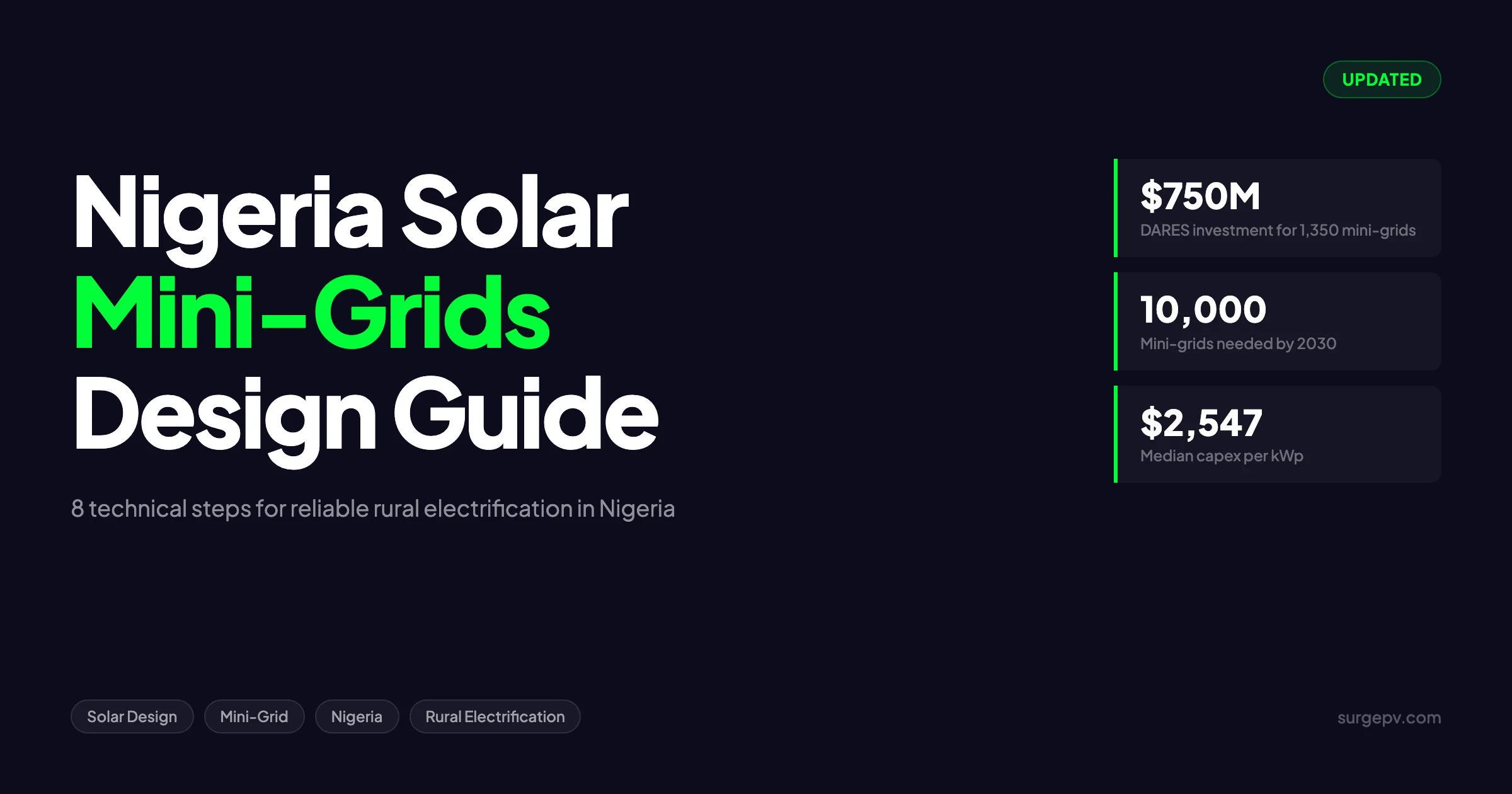
Nigeria needs 10,000 mini-grids to achieve universal electrification by 2030, according to the Rural Electrification Agency. A well-designed solar mini-grid combines accurate demand assessment, right-sized battery storage, and strong distribution infrastructure to serve 200–2,000 households per site.
For more on this topic, see Adding Battery Storage Services.
How to Assess Site Conditions and Community Energy Demand in Nigeria
Conducting Geospatial and Solar Resource Assessments
Nigeria spans multiple solar resource zones. Northern states receive higher irradiance than southern coastal regions. Designers must analyze Global Horizontal Irradiance (GHI) data before selecting panel capacity. The Nigeria Solar Resource Map from NREL provides granular irradiance values by location. Satellite-derived solar data helps identify seasonal variation patterns. Engineers should cross-reference this data with ground-based pyranometer readings where available. Accurate solar resource assessment prevents underperformance during cloudy months. For Global-specific compliance details, see Global net-metering-by-country.
Northern Nigeria averages 5.5–6.5 kWh/m²/day of GHI. Southern coastal areas drop to 3.5–4.5 kWh/m²/day (IRENA Renewable Energy Roadmap Nigeria, 2023). This 40–50% difference changes array sizing calculations significantly. Designers must use location-specific solar data rather than national averages. The IRENA mini-grid distribution best practices recommend at least 12 months of solar data for bankable designs. Cloud cover during the rainy season reduces daily yields by 20–30% in the south. Engineers should size arrays for worst-month production, not annual averages. Solar design software automates these hourly simulations using typical meteorological year data.
Solar shadow analysis software identifies shading obstacles from vegetation and buildings. Trees grow quickly in tropical climates. A site clear of shadows today may face shading within 3 years. UAV drone surveys capture terrain elevation and existing structures. Geospatial tools overlay solar data with land use maps. Wetlands and floodplains must be excluded from ground-mount areas. Road access affects equipment delivery logistics. All these factors feed into the final site selection decision.
Mapping Existing Grid Proximity and Anchor Loads
Anchor loads stabilize mini-grid revenue. These include health clinics, schools, mills, and telecom towers. Designers must map the distance to existing distribution infrastructure. Communities within 10 km of grid lines face different regulatory rules than isolated villages. Proximity to the grid affects the interconnectivity threshold classification. Anchor loads typically consume 40–60% of daily generation. Identifying these loads early shapes the entire system architecture. The Rural Electrification Agency Mini-Grid Dashboard lists registered sites and grid boundaries.
Commercial loads provide steady daytime demand. Residential loads peak in the evening. A balanced load profile improves battery cycling efficiency. Designers should sign power purchase agreements with anchor clients before finalizing system size. Telecom towers often require 24-hour power and pay premium tariffs. Cold storage facilities for agricultural products add predictable daytime loads. Mapping these loads requires physical site visits and GPS tagging. Satellite imagery alone misses informal commercial activity.
Anchor load contracts must include take-or-pay clauses. These clauses guarantee minimum revenue regardless of actual consumption. Creditworthiness checks on anchor clients reduce default risk. Load profiles from anchor clients should span at least 6 months. Seasonal agricultural processing creates spikes in demand. Diesel generator run hours at existing facilities indicate actual energy needs. Fuel logs often reveal higher consumption than stated estimates. Designers should verify all self-reported data with physical meter readings where possible.
Household Survey Methodology for Accurate Demand Forecasting
Demand surveys must cover at least 80% of target households. Surveyors should record appliance inventories, operating hours, and willingness to pay. Peak demand often occurs between 6:00 PM and 10:00 PM. Average rural household consumption ranges from 0.5 kWh to 2.5 kWh daily. Surveys must account for productive uses such as welding, cold storage, and water pumping. Underestimating demand leads to chronic system overload. Overestimating demand raises tariffs beyond affordability limits. Solar design software helps model multiple demand scenarios quickly.
Survey teams should include female enumerators to reach all household members. Questions must cover both current appliance use and intended purchases after connection. Willingness-to-pay data requires careful framing to avoid inflated responses. Payment history with existing energy sources provides better tariff estimates than hypothetical questions. Load profiles should separate essential lighting from discretionary entertainment uses. This separation helps design tiered pricing structures. Survey data should feed directly into load flow models rather than static spreadsheets.
Sampling methodology affects forecast accuracy. Random stratified sampling ensures all income levels are represented. Cluster sampling reduces travel time between households. Each survey should take 20–30 minutes to avoid respondent fatigue. Digital data collection apps reduce transcription errors. GPS coordinates link each survey to distribution planning. Photos of existing wiring identify safety hazards early. Load profiles should aggregate by neighborhood to plan transformer placement.
Load Growth Projections for Rural Economic Development
Rural electricity demand grows after connection as new businesses emerge and appliance ownership rises (GIZ Mini-Grid Sizing Guidebook). New businesses emerge once power becomes available. Designers should plan for 3–5 years of load growth during initial sizing. Battery banks and inverters need headroom for future expansion. Distribution networks should accommodate additional transformers. Ignoring growth projections forces expensive retrofits within 2 years. Economic development plans from local government offices provide growth indicators.
Productive use of energy transforms rural economies. Welders, barbers, and food processors connect within the first year. Schools extend operating hours once lighting is available. Health clinics store vaccines and operate laboratory equipment. Each productive load adds revenue diversity. Mini-grid designers should interview local trade associations about expansion plans. Agricultural calendars also affect seasonal demand patterns. Harvest seasons increase milling and drying loads significantly.
Connection growth follows an S-curve pattern. Early adopters connect in months 1–6. The majority connect in months 6–18. Late adopters join after observing neighbor satisfaction. Designers should model phased connection rates. Transformer sizing must handle full saturation loads. Conductor sizing should avoid replacement when penetration reaches 90%. Spare conduits in trenches reduce future excavation costs. Solar design software models 10-year load growth against system constraints.
| Region | Average GHI (kWh/m²/day) | Peak Sun Hours | Rainy Season Impact | Recommended Panel Tilt |
|---|---|---|---|---|
| Northern Nigeria | 5.5–6.5 | 5.5–6.5 hours | Moderate (May–September) | 15°–20° |
| Central Nigeria | 4.5–5.5 | 4.5–5.5 hours | High (April–October) | 10°–15° |
| Southern Nigeria | 3.5–4.5 | 3.5–4.5 hours | Very High (March–November) | 5°–10° |
How to Size Solar Arrays for Nigeria’s Tropical Climate
Accounting for Temperature Coefficients and Panel Derating
Nigeria’s tropical climate reduces panel output below nameplate ratings. Module temperatures often exceed 60°C on rooftops and ground mounts. Crystalline silicon panels lose 0.4–0.5% of output per degree above 25°C. A 400 W panel can drop to 320 W during peak afternoon heat. Designers must apply temperature coefficients from manufacturer datasheets. IEC 61215-tested modules perform better under thermal cycling stress. The PVsyst tropical climate modeling guide provides detailed derating methodologies. The IEC 61215 thermal cycling standards define testing protocols for hot climates.
High ambient temperatures affect inverter efficiency too. String inverters derate above 45°C ambient. Central inverters need shaded enclosures or active cooling. Designers should specify modules with low temperature coefficients. Thin-film modules sometimes outperform crystalline in hot conditions. Local temperature data must inform array sizing calculations. Rule-of-thumb sizing without temperature correction leads to 15–20% energy shortfalls. Solar design software applies these corrections automatically using hourly temperature profiles.
Rooftop installations suffer more than ground mounts. Metal roofs radiate heat upward toward panel backsides. Standing seam roofs create air gaps that reduce temperatures slightly. Composite shingles absorb and reradiate heat. Ground-mounted arrays benefit from convective cooling. Tracking systems increase exposure hours but add mechanical complexity. Fixed-tilt arrays remain the standard for rural mini-grids. Tilt angles should maximize annual yield while minimizing soiling accumulation.
Sizing for Harmattan Dust and Rainy Season Performance Drops
The Harmattan season brings fine dust from the Sahara. This dust layer reduces irradiance reaching panel surfaces. Rainy seasons increase cloud cover and soiling rates. Combined seasonal effects can reduce output by 25–35%. Designers must size arrays above nominal load requirements. Cleaning schedules affect long-term performance assumptions. Manual cleaning every 2 weeks during Harmattan maintains output within 5% of clean values. Automated cleaning systems add cost but reduce labor dependence. Solar shadow analysis software models soiling losses alongside shading losses.
| Season | Temperature Impact (%) | Dust/Soot Impact (%) | Combined Derating Factor | Adjusted Array Size Required |
|---|---|---|---|---|
| Harmattan (December–February) | 8–12% | 15–25% | 1.28–1.40 | 1.30–1.40x nominal |
| Dry Season (October–November, March–April) | 10–15% | 5–10% | 1.16–1.27 | 1.20–1.30x nominal |
| Rainy Season (May–September) | 5–8% | 3–5% | 1.08–1.14 | 1.10–1.15x nominal |
Dust composition varies by region. Northern dust contains more abrasive quartz particles. Southern dust mixes with organic matter and pollution. Cleaning methods must match dust type. High-pressure water jets damage anti-reflective coatings. Soft brushes and demineralized water preserve coatings. Labor costs for cleaning should appear in financial models. Some projects train local youth as cleaning crews. This creates jobs while ensuring panel performance.
Rainfall helps clean panels naturally. However, first rains after long dry spells create mud streaks. Tilt angles above 10° allow sheets of water to carry dust away. Flat installations accumulate mud at frame edges. Soiling losses compound with temperature losses. Designers cannot treat these factors independently. Hourly simulation software captures interaction effects. PV design software models real-world performance with combined derating.
String Configuration and MPPT Voltage Window Optimization
String length determines whether inverter Maximum Power Point Trackers (MPPTs) operate efficiently. High temperatures reduce module open-circuit voltage. Cold mornings raise voltage above normal ranges. Designers must size strings to stay within MPPT windows across all temperatures. Nigerian mornings rarely drop below 15°C. Cold-weather oversizing is less critical than in temperate climates. String inverters with multiple MPPTs handle partial shading better. Rapid shutdown devices add safety but increase complexity. DC arc fault protection is mandatory under updated codes.
Module voltage temperature coefficients range from -0.25%/°C to -0.35%/°C. Open-circuit voltage at 70°C module temperature drops 15–20% below STC values. Short strings fail to reach MPPT minimums during hot afternoons. Long strings exceed maximum voltage limits during cold starts. Inverter datasheets specify absolute maximum DC voltage. Designers must calculate worst-case cold-temperature voltage. Record low temperatures vary by region. Northern Nigeria sees occasional 10°C mornings. Designers should use 10-year minimum temperature records. For more on this topic, see DC Bus Voltage Optimization.
Bypass diodes prevent hot spots when cells are shaded. Three bypass diodes per 60-cell module are standard. Shaded cells reverse bias and dissipate power as heat. Hot spots degrade encapsulants and back sheets. Proper string design minimizes shade impact. Parallel string currents must match within inverter tolerances. Mismatched strings reduce MPPT efficiency. Homogeneous strings using identical module batches perform best.
Ground-Mount vs. Rooftop Considerations for Community Sites
Community mini-grids typically use ground-mounted arrays. Ground mounts allow optimal tilt and spacing. Cleaning access is easier than on rooftops. Rooftop systems suit institutional anchor loads like schools and clinics. Roof condition assessments must precede any rooftop design. Corrugated metal roofs require specialized mounting systems. Concrete roofs handle ballasted racking. Land tenure agreements must cover ground-mounted arrays for 20+ years.
Ground-mount foundations vary by soil type. Driven piles work in sandy soils. Concrete piers suit clay and rocky terrain. Ballasted systems avoid ground penetration but need heavy concrete blocks. Flood risk determines minimum pad elevation. Arrays should sit minimum 300 mm above maximum flood levels. Fencing protects against livestock and unauthorized access. Perimeter ditches divert surface water from foundations.
Rooftop installations face structural constraints. Engineers must calculate live loads and wind uplift. Many rural buildings lack structural drawings. Conservative assumptions protect against roof collapse. Distributed mounting across multiple rafters reduces point loads. Waterproofing details prevent leaks at penetration points. Lightning protection must bond to existing earthing systems. Rooftop arrays often have shorter cable runs to distribution boards.
Battery Bank Sizing and Storage Architecture for Nigerian Mini-Grids
Calculating Autonomy Days for Monsoon and Rainy Season Scenarios
Battery banks bridge cloudy periods and nighttime loads. Nigerian southern regions experience 4–5 consecutive rainy days. Northern regions face shorter cloudy spells but higher dust loads. Autonomy days represent how long batteries supply load without solar input. Rural mini-grids typically need 1.5–2.5 days of autonomy. Critical facilities like hospitals need 3+ days. Oversizing autonomy raises costs exponentially. Undersizing causes blackouts and customer attrition. Solar software suite models autonomy scenarios against historical weather data.
Load-shedding schedules affect autonomy requirements too. Some mini-grids use intelligent load management during low-charge periods. Non-essential loads disconnect automatically. This strategy reduces required battery capacity by 20–30%. Designers must balance customer satisfaction against capital constraints. Daytime-only industrial loads need little storage. Evening residential peaks drive most battery cycling.
Critical load prioritization extends autonomy for essential services. Health clinic refrigerators and security lighting remain powered. Entertainment and welding loads shed first. Smart controllers manage load priorities without manual intervention. Customers accept load shedding when rules are transparent. Prepaid meters can enforce load limits at the household level. Exceeding contracted demand triggers automatic disconnection. These controls protect battery investment while maintaining fairness.
Rainy season data should span 10+ years. Single-year data may reflect unusual drought or flood patterns. Probability analysis calculates autonomy for 95% reliability. Some designers target 99% reliability for anchor loads. The incremental cost of 99% vs. 95% reliability is often 30–40% more storage. Diesel backup generators bridge rare extreme weather events. Hybrid designs with small generators cost less than full battery autonomy. Generation and financial tool compares pure solar-battery vs. hybrid architectures.
Lithium-Ion vs. Lead-Acid: Total Cost of Ownership in High Heat
Battery chemistry selection affects 20-year project economics. Lithium iron phosphate (LiFePO4) batteries tolerate high temperatures better than lead-acid. Lead-acid batteries degrade rapidly above 35°C ambient. Nigerian ambient temperatures regularly exceed this threshold. Air-conditioned battery rooms add operating cost and complexity. LiFePO4 batteries offer 4,000–6,000 cycles at 80% depth of discharge. Premium lead-acid batteries deliver 1,200–1,500 cycles under identical conditions.
| Chemistry | Upfront Cost ($/kWh) | Cycle Life at 80% DoD | Temperature Sensitivity | Recommended Use Case |
|---|---|---|---|---|
| Lithium Iron Phosphate (LiFePO4) | 350–500 (as of 2024) | 4,000–6,000 cycles | Low (up to 45°C) | New mini-grids, long-term ownership |
| Tubular Lead-Acid | 150–250 (as of 2024) | 1,200–1,500 cycles | High (degrades above 35°C) | Budget-constrained retrofits |
| Gel Lead-Acid | 180–280 (as of 2024) | 1,000–1,300 cycles | High (degrades above 35°C) | Small systems under 50 kW |
| Lithium Nickel Manganese Cobalt (NMC) | 400–600 (as of 2024) | 3,000–5,000 cycles | Moderate (up to 40°C) | Space-constrained installations |
Total cost of ownership includes replacement, maintenance, and disposal. LiFePO4 batteries often cost less over 15 years despite higher upfront prices. Lead-acid requires water topping, terminal cleaning, and equalization charges. These maintenance tasks need trained technicians. Remote sites struggle to find qualified battery maintainers. Lithium systems need almost no maintenance. Battery monitoring systems track cell voltages and temperatures. Early warning alerts prevent thermal runaway. The BloombergNEF battery price outlook tracks lithium cost declines. Prices fell 80% between 2013 and 2023.
Recycling infrastructure affects chemistry choice. Lead-acid recycling is mature in Nigeria. Lithium recycling remains limited across Africa. End-of-life disposal plans must satisfy environmental permits. Some manufacturers offer take-back programs. Battery warranty terms vary significantly. LiFePO4 warranties typically cover 5–7 years. Lead-acid warranties range from 1–3 years. Warranty claims require detailed operating logs. Temperature logs prove batteries stayed within specified ranges. For Africa-specific compliance details, see Africa solar compliance.
Depth of Discharge Limits and Cycle Life Under Daily Cycling
Daily cycling wears batteries faster than weekly cycling. Mini-grid batteries discharge every evening and recharge every morning. Depth of discharge (DoD) directly affects cycle life. Limiting DoD to 70% extends LiFePO4 life to 6,000+ cycles. Lead-acid batteries need 50% DoD limits to reach advertised cycle counts. Designers must size battery banks to deliver required energy at conservative DoD levels. The usable energy capacity is always lower than nominal capacity. Generation and financial tool models replacement schedules against DoD strategies. Also see: Us Residential Solar Market Trends 2026.
Shallow cycling reduces stress on electrode materials. Lithium iron phosphate crystals degrade with deep lithium extraction. Lead sulfate crystal growth accelerates at high DoD. Both chemistries benefit from partial state of charge operation. However, lead-acid suffers from stratification if left partially charged. Periodic full charges prevent stratification. Inverter charge controllers manage these profiles automatically.
State of charge estimation errors cause operational problems. Coulomb counting drifts over time without recalibration. Voltage-based estimation lacks precision in flat discharge curves. Lithium batteries need battery management systems with cell balancing. Unbalanced cells reduce pack capacity to the weakest cell. Active balancers redistribute charge between cells. Passive balancers bleed excess charge through resistors. Active balancing is more efficient but costs more.
Containerized Battery Storage and Ventilation Requirements
Containerized solutions simplify transport and installation. Standard 20-foot containers house 200–500 kWh of lithium storage. Passive ventilation works in mild climates. Nigerian heat demands active ventilation or air conditioning. Battery containers need fire suppression systems and gas detection. Clearance around containers allows maintenance access. Concrete pads elevate containers above flood risk. Security fencing protects against theft and vandalism. The IEEE 1547 energy storage interconnection standards define safety requirements.
Thermal management extends battery life significantly. Air conditioning maintains 25°C internal temperature. Evaporative cooling works in dry northern regions. Insulated containers reduce cooling loads by 40–60%. Roof-mounted solar panels shade containers and power cooling systems. Temperature uniformity matters as much as average temperature. Hot spots within racks accelerate localized degradation. Baffled airflow designs prevent recirculation.
Fire suppression uses clean agents or water mist. Lithium battery fires require Class D dry powder. Water suppression risks thermal runaway propagation. Gas detection monitors for electrolyte vapor and smoke. Early detection triggers automatic disconnection and suppression. Container spacing prevents fire spread between units. Local fire departments need training on battery-specific hazards. Emergency response plans form part of permitting requirements.
Inverter and Power Conversion System Selection
AC-Coupled vs. DC-Coupled Architectures for Mini-Grids
AC-coupled systems connect solar inverters directly to an AC bus. Battery inverters manage charging separately. This architecture suits retrofits and modular expansion. DC-coupled systems route solar output through charge controllers to batteries. A central inverter converts DC battery power to AC. DC-coupled designs reduce conversion losses by 2–3%. However, single-point inverter failures shut down the entire system. AC-coupled designs offer redundancy with distributed inverters. Solar design software models both architectures against load profiles.
AC coupling allows mixing inverter brands and vintages. New solar capacity adds without replacing existing inverters. Battery upgrades occur independently from solar upgrades. This flexibility matters for phased mini-grid development. DC coupling simplifies system topology. Fewer conversion stages reduce component counts. Charge controllers manage battery charging precisely. Central inverters offer lower cost per watt at large scales.
Hybrid inverters combine solar and battery functions. These units reduce wiring complexity. Single-vendor support simplifies troubleshooting. However, hybrid inverters limit future expansion options. Proprietary battery protocols lock developers into specific suppliers. Open-protocol inverters avoid vendor lock-in. Modbus and CAN bus standards enable multi-vendor integration. Designers should specify open communication standards.
Three-Phase vs. Split-Phase Distribution for Mixed Loads
Three-phase distribution serves commercial motor loads efficiently. Single-phase residential loads need neutral conductors. Mini-grids under 100 kW often use single-phase architecture. Systems above 100 kW benefit from three-phase distribution. Mixed configurations use three-phase backbones with single-phase laterals. Transformer selection must match voltage and phase requirements. Voltage unbalance damages three-phase motors over time. Designers should map load types before selecting distribution topology.
Three-phase motors start more easily than single-phase equivalents. Water pumps and milling machines prefer three-phase supply. Phase balancing keeps neutral currents low. High neutral currents overload conductors and transformers. Load scheduling can balance phases without rewiring. Residential clusters connect across different phases. Commercial loads distribute evenly across all three phases.
Split-phase 120/240 V systems suit North American equipment. Nigerian standard voltage is 230 V single-phase. European and Chinese inverters match Nigerian requirements. Voltage and frequency standards must match connected equipment. Imported appliances may need voltage converters. Inverter output voltage regulation should stay within ±5% under all load conditions. Poor regulation damages sensitive electronics and motors. Also see: European Solar Incentives.
Inverter Sizing for Motor Starting Surge and Reactive Power
Motors draw 5–7 times their running current during startup. Water pumps and milling machines create large surge demands. Inverters must handle these surges without tripping. Soft starters and variable frequency drives reduce starting current. Power factor correction capacitors reduce reactive power burden. Inverter manufacturers specify surge ratings for 10 seconds or 1 minute. Designers should size inverters at 1.25–1.5 times continuous load. The SMA Solar mini-grid inverter technical documentation provides detailed sizing guidelines.
Induction motors have power factors between 0.7 and 0.85. Low power factor increases current without delivering useful work. Distribution conductors and transformers must carry this extra current. Capacitor banks raise power factor to 0.95 or higher. Over-correction creates leading power factor issues. Automatic power factor controllers switch capacitors in stages. Inverters with reactive power capability support grid stability.
Surge capacity determines whether motors start successfully. Locked rotor current lasts 2–5 seconds during acceleration. Inverter overload ratings must cover this duration. Some inverters provide 150% overload for 60 seconds. Others offer 200% for 10 seconds. Motor load starting sequences matter. Staggered startup prevents simultaneous surges. Load controllers sequence motor connections automatically.
Remote Monitoring and Control System Integration
Remote monitoring reduces operational costs for dispersed mini-grids. GSM connectivity covers most Nigerian rural areas. SCADA systems track generation, consumption, and battery state of charge. Alerts notify operators of faults and theft attempts. The Schneider Electric EcoStruxure for microgrids offers integrated monitoring platforms. Data logging supports regulatory reporting and investor transparency. Firmware updates require secure remote access protocols.
Cloud-based dashboards display real-time performance. Operators detect issues before customers report outages. Predictive maintenance algorithms flag declining component performance. Transformer oil temperature trends indicate overload conditions. Battery impedance tracking predicts end-of-life. Inverter efficiency degradation signals dust accumulation or fan failure. Automated alerts dispatch maintenance crews with specific fault codes.
Cybersecurity protects remote access channels. Default passwords must change during commissioning. VPN tunnels encrypt management traffic. Role-based access limits operator permissions. Audit logs track all configuration changes. Physical security of communication gateways matters too. Enclosed routers with tamper switches detect unauthorized access. Dual-path communication provides redundancy when primary GSM fails.
Distribution Network Design and Voltage Drop Management
Low-Voltage AC Distribution Layouts for Rural Communities
Mini-grids typically distribute power at 220/380 V AC. Low-voltage networks serve customers within 500 meters of distribution transformers. Radial layouts work for small, concentrated communities. Loop configurations improve reliability for larger settlements. Overhead lines cost less than underground cables. Underground cables resist theft but cost 3–4 times more. Pole-mounted transformers reduce land requirements. Solar design software helps design radial and loop configurations.
Radial systems have a single path from transformer to customer. Faults on radial lines disconnect all downstream customers. Simple fault isolation speeds repairs. Loop systems allow back-feeding from alternate paths. Sectionalizers isolate faults without full loop shutdown. Loop designs need more conductors and switching devices. Capital costs increase 20–30% compared to radial equivalents.
Village layout determines optimal topology. Linear settlements along roads suit single radial feeder. Clustered compounds need multiple laterals. Dispersed homesteads require long low-voltage runs or distributed generation. Transformers should sit near load centers. Geographic Information Systems optimize transformer placement. Load density maps guide conductor size selection. Future road expansion plans affect right-of-way requirements.
Conductor Sizing to Keep Voltage Drop Below 5%
Voltage drop limits customer power quality. NERC codes require voltage drop under 5% from transformer to meter. Long distribution runs need larger conductors. Aluminum conductors cost less than copper but require larger cross-sections. Voltage drop calculations must use actual load flow, not simple approximations. Future load growth increases voltage drop over time. Designers should size conductors for 10-year horizons. Solar proposal software generates bill-of-materials with correct conductor sizes.
| Distance (m) | Load (kW) | Recommended Conductor Size (mm²) | Expected Voltage Drop (%) | Cost per Meter (NGN) |
|---|---|---|---|---|
| 0–100 | 0–5 | 16 | 1.5–2.5 | 350–450 |
| 100–300 | 5–15 | 35 | 2.5–4.0 | 700–900 |
| 300–500 | 15–30 | 70 | 3.5–4.5 | 1,400–1,800 |
| 500+ | 30–50 | 95 | 4.0–5.0 | 2,000–2,500 |
Conductor sizing balances capital cost against lifetime losses. Larger conductors reduce resistive losses. Lower losses save energy over 20 years. Life-cycle cost analysis often justifies upsizing by one standard dimension. Aerial bundled conductors reduce short-circuit risks. ABC cables have insulated phase conductors twisted together. They resist tree contact and animal interference. Bare conductors need wider clearances and more frequent tree trimming.
Jointing and termination quality affects long-term reliability. Compression fittings outperform twist-on connectors. Proper crimping tools create gas-tight joints. Corrosion at aluminum-copper interfaces causes hot joints. Bimetallic connectors prevent galvanic corrosion. All joints should be accessible for infrared thermography inspections. Buried joints need waterproof encapsulation. Exposed joints need corrosion-resistant covers.
Pole Placement and Right-of-Way Considerations in Nigerian Terrain
Distribution poles need stable foundations. Sandy soils require concrete footings. Rocky terrain needs drilled anchors. Road crossings demand higher pole classes and conductor clearance. Tree trimming rights must be negotiated with landowners. Seasonal flooding affects pole placement in riverine areas. Termite-resistant treated timber lasts 15–20 years. Steel poles resist termites but corrode in humid regions. Concrete poles offer the longest service life.
Right-of-way agreements must be documented before construction. Oral agreements fail when land transfers to new owners. Written easements registered with local authorities protect access. Compensation for crops and trees should be paid upfront. Annual maintenance access rights prevent disputes. Width requirements vary by voltage and pole spacing. Low-voltage lines need 3-meter clearances on each side. Future road widening plans must be considered.
Pole spacing depends on conductor tension and terrain. Standard spans range from 40–60 meters. River crossings need shorter spans or higher poles. Wind loading determines pole strength requirements. Coastal areas face higher wind speeds than inland regions. Guy wires stabilize poles in windy or sandy soils. Guy anchors need separate land agreements. Aesthetic concerns sometimes drive undergrounding in village centers.
Prepaid Metering Architecture and Revenue Protection
Prepaid meters eliminate collection risk. Customers purchase credit before consuming power. Smart meters communicate usage data via GSM. Meter boxes need tamper-evident seals. Bypass detection triggers automatic disconnections. Revenue protection teams audit meter installations quarterly. Token vending systems integrate with mobile money platforms. The Nigerian Electricity Regulatory Commission distribution codes specify metering standards.
Meter architecture varies by communication method. PLC meters use power line communication. RF meters use radio mesh networks. GSM meters work anywhere with mobile coverage. Hybrid systems combine local RF with GSM backhaul. Communication latency affects real-time monitoring. PLC signals attenuate across transformers. RF range depends on terrain and building density.
Revenue protection detects theft and technical losses. Transformer metering compares total generation to sum of customer meters. Discrepancies above 10% trigger investigations. Illegal connections tap overhead lines before meters. Tamper detection algorithms analyze load profiles. Zero-consumption meters during occupied hours signal bypasses. Physical audits verify meter serial numbers against databases. Smart meters remote-disconnect suspected tamperers.
Regulatory Compliance and Licensing Under Nigeria’s Mini-Grid Regulation
Understanding the Interconnectivity Threshold (100 kW and 1 MW Caps)
NERC classifies mini-grids by size and grid proximity. Isolated systems below 100 kW need only NERC registration. Interconnected systems up to 1 MW require NERC permits. Systems above 1 MW fall under standard generation licenses. The interconnectivity threshold determines whether a project needs full NERC review. Developers often split large sites into multiple sub-100 kW systems to simplify approval. This strategy requires separate distribution networks per system. Book a demo to see how SurgePV handles multi-site documentation. For a direct comparison, see Arka 360 vs SurgePV.
Isolated mini-grids serve areas with no grid connection for 10+ years. Underserved areas have grid infrastructure but receive under 4 hours of daily supply. Different tariff rules apply to each classification. Interconnected mini-grids sell excess power to the distribution utility. Net metering or feed-in tariffs govern these sales. Wheeling agreements allow power transfer across utility lines.
The 100 kW threshold creates a regulatory cliff. A 99 kW system needs registration only. A 101 kW system needs a full permit. Permits require detailed technical studies and public hearings. Timeline and cost differences are substantial. Some developers intentionally limit initial capacity. Future expansion triggers permit requirements. Phased development strategies must account for these thresholds.
Obtaining Permits from NERC, REA, and State Environmental Agencies
Permitting involves three government layers. NERC issues generation and distribution permits. REA registers rural sites and manages subsidy programs. State environmental agencies approve impact assessments. The process requires technical drawings, financial statements, and community support letters. Environmental impact assessments cover noise, waste, and land use. The Federal Ministry of Environment reviews large projects. Permit timelines stretch 90–180 days. Early engagement with regulators prevents costly redesigns. The NERC Mini-Grid Regulation 2016 (as amended) defines application requirements. The World Bank Nigeria Electrification Project documentation provides implementation templates.
Application completeness affects approval speed. Missing documents restart review timelines. Pre-application meetings clarify expectations. NERC assigns relationship managers to large projects. REA operates a one-stop shop for rural registrations. State agencies vary in efficiency. Lagos and Kaduna process faster than smaller states. Local consultants navigate state-specific requirements.
Community engagement letters must be authentic. Forged signatures invalidate permits. Regulators verify community consent through site visits. Grievance mechanisms must be documented. Land ownership disputes stall projects for months. Title searches should precede permit applications. Community development agreements form part of the permit package. These agreements specify local employment and social investment commitments.
Tariff Setting and the Average Cost of Service Methodology
NERC mandates cost-reflective tariffs. The Average Cost of Service methodology calculates total costs divided by expected sales. Costs include capex recovery, opex, battery replacement reserves, and return on equity. Tariffs must remain affordable for rural customers. NERC caps margins to prevent exploitative pricing. Subsidies bridge the gap between cost-reflective and affordable tariffs. The Rural Electrification Fund provides capital subsidies for registered projects. Performance-based grants reward high uptime and customer growth.
Tariff categories distinguish customer types. Residential tariffs are lower than commercial tariffs. Anchor loads negotiate custom power purchase agreements. Social infrastructure like schools and clinics receive discounted rates. Lifeline tariffs provide basic energy access for the poorest households. Cross-subsidization from commercial to residential loads improves affordability. Transparent tariff schedules build customer trust.
Cost of service studies require detailed financial models. Regulators scrutinize assumptions about load growth and opex. Conservative assumptions strengthen permit applications. Aggressive assumptions risk tariff shortfalls. Independent engineers review technical submissions. Financial advisors verify funding commitments. The entire package demonstrates project bankability to regulators and investors.
Community Engagement and Land Acquisition Agreements
Community buy-in determines project success. Landowners must sign 25-year lease agreements. Community committees manage tariff collection and dispute resolution. Memoranda of understanding define roles for the developer, community, and local government. Free connections for public facilities build goodwill. Employment of local staff during construction strengthens relationships. Dispute resolution mechanisms prevent prolonged conflicts.
Land leases should be registered with state ministries. Unregistered leases create title risks. Lease payments can be structured as annual rents or upfront lump sums. Annual payments align developer incentives with long-term presence. Lump sums create immediate cash windfalls but ongoing obligations. Land use for solar arrays does not preclude grazing or cropping between rows. Agrivoltaic arrangements generate dual income streams.
Gender inclusion improves project outcomes. Women manage household energy decisions in many communities. Female representation on community committees ensures their voices are heard. Training programs for women as meter readers and customer service agents create employment. Safe street lighting designed with female input improves nighttime security. Projects with strong gender inclusion see lower payment default rates.
Design Nigeria Mini-Grids Faster
Manual calculations and spreadsheet errors slow down mini-grid projects. SurgePV’s solar design software automates array sizing, battery modeling, and voltage drop analysis for tropical climates.
Book a DemoNo commitment required · 20 minutes · Live project walkthrough
Financial Modeling and Tariff Design for Bankable Projects
Capex Breakdown: Equipment, Installation, and Soft Costs
Total project cost includes hardware, labor, and development expenses. Solar modules and batteries represent 50–60% of capex. Inverters, mounting structures, and distribution materials add 20–25%. Installation labor consumes 10–15%. Soft costs include permits, legal fees, and training at 5–10%. Import duties and shipping affect Nigerian projects significantly. Currency fluctuation between the Naira and USD creates pricing risk. Developers should lock exchange rates during procurement. PV generation and financial modeling calculates detailed capex breakdowns by system size.
| Cost Category | Amount (USD) | % of Total | Financing Source | Payback Timeline |
|---|---|---|---|---|
| Solar modules and mounting | 480,000 | 32% | Debt + equity | 10-year depreciation |
| Battery storage (LiFePO4) | 360,000 | 24% | Grant + equity | 10-year depreciation |
| Inverters and switchgear | 180,000 | 12% | Debt + equity | 10-year depreciation |
| Distribution network | 240,000 | 16% | Debt + equity | 15-year depreciation |
| Installation and civil works | 150,000 | 10% | Debt + equity | 10-year depreciation |
| Soft costs (permits, legal, training) | 90,000 | 6% | Equity | Immediate |
| Total | 1,500,000 | 100% | Mixed | 7–9 years |
Equipment procurement strategies affect costs and timelines. Container shipping to Lagos takes 4–6 weeks. Clearing customs requires documentation accuracy. Duties on solar equipment vary by HS code classification. Some components qualify for renewable energy exemptions. Local content requirements may mandate Nigerian labor or materials. Warehousing costs accrue during customs delays. Procurement schedules should include 4–8 weeks of buffer time.
Opex Projections Including Security, Maintenance, and Battery Replacement
Operating expenses determine long-term profitability. Security guards protect equipment from theft. Vegetation management keeps lines clear. Module cleaning maintains output during dusty seasons. Inverter maintenance requires skilled technicians. Battery replacement occurs every 7–10 years for lithium and every 3–5 years for lead-acid. Insurance covers equipment damage and business interruption. Administrative costs include billing and customer service. Opex typically runs 8–12% of capex annually.
Security costs vary by location. Sites near major roads face higher theft risk. Fencing, lighting, and guards form layered security. CCTV with GSM alerts provides remote monitoring. Community ownership models reduce vandalism. Locals protect infrastructure they helped build. Insurance premiums reflect security measures. Better security lowers annual premiums by 15–25%.
Planned maintenance prevents emergency repairs. Annual thermographic surveys detect hot joints. Inverter filter cleaning maintains cooling efficiency. Transformer oil testing identifies insulation degradation. Vegetation clearance along lines prevents outages. These activities need annual budgets and trained crews. Spare parts inventories reduce downtime. Critical spares include fuses, surge arrestors, and inverter control boards.
Tariff Structuring: Energy-Based vs. Fixed Monthly Charges
Energy-based tariffs charge per kWh consumed. Fixed monthly charges spread costs evenly regardless of usage. Hybrid structures combine low fixed fees with per-kWh rates. Fixed charges improve revenue stability during low-consumption months. Energy-based tariffs reward conservation. NERC requires transparent tariff structures published at connection points. Prepaid meters support either structure through token configurations. Tariff reviews should occur annually with inflation adjustments. Book a demo to model tariff scenarios.
Social tariffs provide lifeline blocks at subsidized rates. The first 50 kWh per month might cost ₦100/kWh. Consumption above 200 kWh moves to full cost-recovery rates. This structure protects poor households while capturing revenue from heavy users. Prepaid meters enforce these blocks automatically. Token purchase history provides consumption data for policy adjustments.
Tariff escalation clauses protect against currency devaluation. Equipment replacement requires hard currency. Naira-denominated tariffs lose purchasing power during depreciation. Annual escalation tied to central bank rates maintains real revenue. Customers resist frequent price increases. Clear communication about cost drivers improves acceptance. Public display boards show daily system costs and tariff calculations.
Investor Returns and Subsidy Requirements for Rural Deployment
Rural mini-grids need blended finance. Commercial debt covers 40–60% of capex. Equity investors expect 12–18% returns in emerging markets. Grant funding reduces tariff requirements by 20–30%. Development finance institutions provide concessional loans. Results-based financing releases payments against verified connections. Subsidy requirements drop as system scale increases. The African Development Bank Nigeria energy financing reports detail available instruments. The Mini-Grid Investment Accelerator Nigeria data tracks market benchmarks.
Return projections depend on connection density. Sparsely populated villages need higher tariffs or subsidies. Clustered settlements achieve economies of scale. Productive loads improve capacity utilization. 30–40% capacity factors attract commercial investors. Below 25% capacity factors require grant support. Financial models should stress-test against low connection rates.
Currency risk requires hedging strategies. Naira revenues service dollar-denominated debt. Forward contracts lock exchange rates for 12–24 months. Local currency debt avoids forex mismatch but carries higher interest rates. Blended local and foreign debt optimizes cost and risk. Equity tranches absorb first losses. Subordinated debt sits between senior debt and equity. Senior debt enjoys lowest risk and lowest returns.
Common Design Failures and How to Avoid Them
Undersizing Battery Banks for Rainy Season Performance
Designers often size batteries for dry-season solar production. Rainy seasons reduce solar generation by 30–50% in southern Nigeria. Undersized battery banks discharge completely during extended cloudy periods. Chronic deep discharge accelerates battery degradation. Customers experience blackouts during worst-case weather. Designers must size storage for rainy-season autonomy. Historical weather data should cover at least 10 years. Solar software models worst-case production scenarios.
Monsoon patterns vary across Nigeria. Coastal regions experience longer wet seasons. Northern regions have shorter but intense storms. Designers should use location-specific rainfall data. Daily solar data matters more than monthly averages. Two cloudy days in a row create deeper discharge than single overcast days. Battery sizing must handle consecutive low-generation days.
Load flexibility extends effective autonomy. Non-critical loads shed during prolonged low generation. Battery reserve levels trigger automatic load prioritization. Customers should understand load-shedding protocols before connection. Clear communication prevents complaints during unavoidable outages. Prepaid meters can display battery state of charge. Visual indicators help customers manage their own demand.
Ignoring Voltage Rise on Long Distribution Feeds
Long distribution lines create voltage drop at load endpoints. They also create voltage rise at generation points. High solar generation during low-load midday periods pushes voltage upward. Inverters trip when voltage exceeds 253 V on 230 V systems. String inverters are particularly sensitive to voltage rise. Designers must calculate voltage rise from the point of common coupling. Transformer tap settings help manage voltage levels. Reactive power compensation reduces voltage fluctuation.
Voltage rise affects inverter availability. Tripped inverters stop generating revenue. Curtailed energy reduces investor returns. Distributed generation near load centers minimizes voltage rise. Proper transformer sizing prevents overvoltage. On-load tap changers adjust voltage dynamically. These transformers cost more but improve power quality. Static VAR compensators inject reactive power where needed.
Load timing affects voltage profiles. Morning peaks pull voltage down. Midday generation pushes voltage up. Evening peaks pull voltage down again. Daily voltage curves look like bathtubs. Designers must keep the entire curve within ±5% limits. Storage charging at midday absorbs excess generation. Smart inverters support volt-var control. These functions help stabilize distribution voltage.
Poor Earthing and Lightning Protection in High-Stroke Areas
Nigeria has high lightning density, especially in central and southern regions. Poor earthing destroys inverters and controllers during storms. Earth resistance should measure below 10 ohms. Lightning arrestors protect AC and DC circuits. Separate earth pits for DC, AC, and lightning reduce interference. Copper earth conductors resist corrosion better than aluminum. The Nigeria Meteorological Agency lightning density data helps quantify regional risk. Regular earth resistance testing catches degradation before storm season.
Lightning protection zones define equipment placement. Solar arrays attract strikes due to large metal area. Air terminals intercept direct strikes. Down conductors safely route current to earth. Surge protection devices clamp transient overvoltages. Type 1 SPDs handle direct strike currents. Type 2 SPDs protect against induced voltages. Coordinated SPD cascading prevents energy propagation.
Earthing system maintenance is often neglected. Corroded connections raise resistance over time. Soil drying increases resistance during harmattan. Salt treatment around rods improves conductivity. Multiple rods in parallel reduce overall resistance. Exothermic welded joints outlast mechanical clamps. Annual testing before rainy season prevents surprises. Records track resistance trends over years.
Inadequate Documentation for O&M Handover
Construction completion does not guarantee operational success. Many projects lack as-built drawings and wiring diagrams. Local operators cannot troubleshoot systems without documentation. O&M manuals must include single-line diagrams, equipment datasheets, and spare parts lists. Training programs should certify local technicians. Digital documentation stored in cloud platforms survives local hardware failures. Solar proposal software generates standardized documentation packages. The ESMAP mini-grid operational performance review emphasizes documentation as a critical success factor.
As-built drawings must reflect actual installation. Design drawings change during construction. Cable routes move around obstacles. Equipment locations shift for access or shading. All changes should be marked on red-line drawings. CAD as-builts replace sketches after commissioning. GPS coordinates document underground cable routes. Future excavation risks damage without accurate records.
Training should include hands-on practice. Classroom sessions cover theory. Field sessions cover actual equipment. Troubleshooting exercises use simulated faults. Certification exams verify competency. Refresher training occurs annually. Operator turnover creates knowledge gaps. Video training modules supplement in-person sessions. Local language versions improve comprehension. Operations manuals translated into Hausa, Yoruba, or Igbo reduce errors.
Nigeria’s mini-grid sector offers immense opportunity for solar installers and EPC companies. Success requires disciplined engineering, accurate demand forecasting, and rigorous financial modeling. Follow these steps to deliver projects that perform for decades.
- Conduct detailed household surveys and size systems for 3–5 years of load growth before procurement begins
- Size battery banks for rainy-season autonomy and specify LiFePO4 chemistry for high-temperature durability
- Document every design decision in standardized formats that local O&M teams can reference during daily operations
Frequently Asked Questions
How much does a solar mini-grid cost in Nigeria?
A solar mini-grid in Nigeria typically costs between $2,500 and $4,000 per connected household, depending on system size, terrain, and distribution network length. A 100 kW system serving 500 households generally requires $1.2–$1.8 million in total capex.
What is the mini-grid regulation in Nigeria?
Nigeria’s Mini-Grid Regulation, issued by NERC in 2016 and amended subsequently, permits private developers to generate and distribute electricity in unserved and underserved areas. Systems below 100 kW require only NERC registration, while systems between 100 kW and 1 MW need a NERC permit.
How do I get a mini-grid license in Nigeria?
Developers must submit a technical and financial application to NERC for systems above 100 kW, including proof of community engagement, environmental impact assessment, and proof of funding. The process typically takes 90–180 days from submission to approval.
What is the best battery for solar mini-grids in Nigeria?
Lithium iron phosphate (LiFePO4) batteries are increasingly preferred for Nigerian mini-grids due to longer cycle life, better thermal stability, and declining costs. However, properly ventilated lead-acid systems remain viable for lower-budget deployments with shorter payback horizons.
How many mini-grids does Nigeria need?
The Rural Electrification Agency estimates Nigeria needs approximately 10,000 mini-grids to achieve universal access to electricity, particularly for the 80 million Nigerians currently without grid connection.
What is the average tariff for mini-grid electricity in Nigeria?
Mini-grid tariffs in Nigeria typically range from ₦150 to ₦400 per kWh ($0.10–$0.27), depending on diesel backup dependency, battery replacement reserves, and subsidy structures. NERC requires tariffs to reflect the average cost of service while remaining affordable for rural customers.
How long does it take to build a solar mini-grid in Nigeria?
From financial close to commissioning, a typical 100–500 kW mini-grid takes 8–14 months. This includes 2–3 months for permitting, 3–4 months for procurement, and 3–6 months for construction and testing.
What are the main challenges of mini-grid development in Nigeria?
Key challenges include community tariff collection, equipment theft and vandalism, currency fluctuation impacting imported components, limited local technical capacity for O&M, and difficulty securing long-term debt financing from Nigerian banks.
Where this fits
This article is part of SurgePV's Solar Incentives & Policy hub, which works through the topic from first principles to the decisions a project team actually has to make.

