

Quick Answer
Floating solar (FPV) designs use HDPE platforms anchored by mooring systems on reservoirs and quarries. Key factors include wave load, wind resistance, and cable management. FPV systems produce 10–15% more energy due to the cooling effect of water.
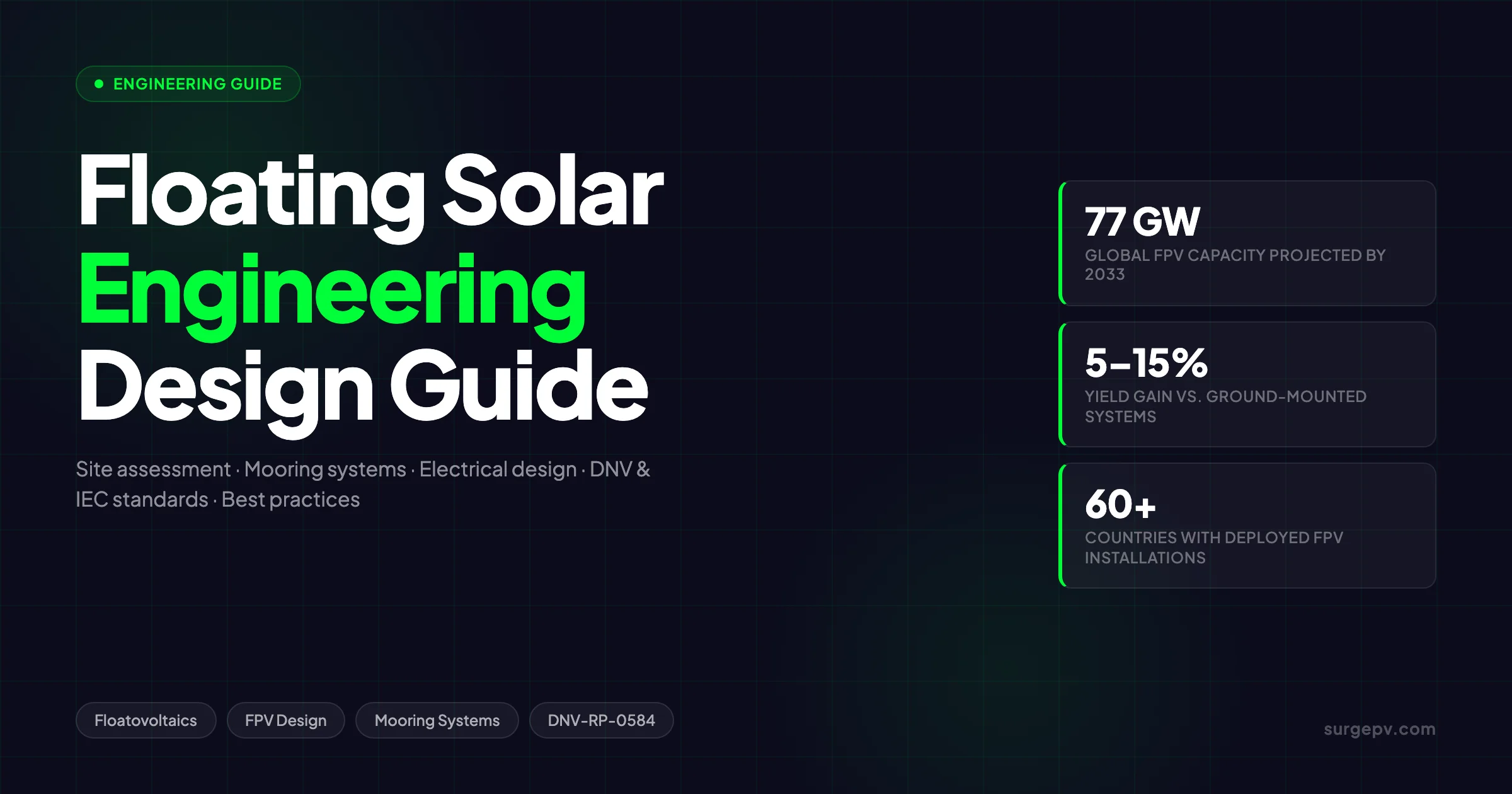
Floating solar — formally called floating photovoltaic (FPV) — is one of the fastest-growing segments of the solar industry, yet it remains one of the least understood from an engineering standpoint. As of 2024, more than 60 countries have deployed FPV installations with over 3,000 MW of installed capacity globally, and Wood Mackenzie projects that figure will reach 77 GW by 2033. The engineering challenges are real: water, wind, and corrosion introduce design constraints that simply do not exist for rooftop or ground-mounted systems. This guide covers every major engineering discipline involved — from site assessment and structural design to electrical systems, standards compliance, and software workflows — so you can design FPV projects that are bankable, safe, and built to last.
Floating solar (FPV) designs use HDPE platforms anchored by mooring systems on reservoirs and quarries. Key factors include wave load, wind resistance, and cable management. FPV systems produce 10–15% more energy due to the cooling effect of water.
TL;DR — Floating Solar Design
FPV systems generate 5–15% more energy than equivalent land-based arrays due to water cooling, but carry a 10–25% cost premium. The main engineering challenges are mooring and anchoring, marine-grade electrical design, corrosion resistance, and environmental compliance. DNV-RP-0584 and IEC TS 63265 are the two authoritative standards. Proper site assessment and purpose-built software are non-negotiable for bankable designs.
What Is Floating Solar? A Quick Technical Overview
Floating solar systems mount photovoltaic panels on buoyant platforms anchored to the bed or banks of a water body. Unlike ground-mounted arrays, the entire structure — panels, racking, inverters, and cabling — must function in a perpetually humid environment subject to wave motion, wind loading, and water level changes. See Solar Racking Design Guide for detailed guidance.
The buoyancy platform is almost universally made from high-density polyethylene (HDPE), which is UV-stabilised, chemically inert, and rated to support roughly 2.5 times the system’s dead weight. Panels sit at a fixed tilt — typically 10–15 degrees on inland water bodies to balance yield and wind resistance — connected by walkways and hinged connectors that allow the structure to flex with wave action without stressing the module frames.
Three broad installation categories exist:
| Category | Water Body | Typical Capacity | Key Design Driver |
|---|---|---|---|
| Inland reservoir / lake | Freshwater, enclosed | 1 MW – 1 GW+ | Water level variation, wave loading |
| Hydropower forebay | Dam reservoir | 10 MW – 600 MW | Fluctuation of 10–30 m, sediment |
| Wastewater / industrial pond | Freshwater, small | 100 kW – 10 MW | Chemical exposure, access constraints |
| Coastal / brackish | Tidal influence | 1 MW – 100 MW | Corrosion, tidal forces, salt spray |
| Offshore marine | Open sea | Pilot stage | Extreme wave and wind loads |
The physics of why FPV outperforms land-based systems is straightforward. Water surface temperatures run 10–20°C cooler than surrounding land. Every 1°C drop in module temperature recovers roughly 0.4–0.5% of output (the temperature coefficient of most silicon modules). Over a full year, that 5–15% yield advantage compounds directly into lower LCOE.
Pro Tip
Bifacial modules on FPV platforms can capture albedo reflection from the water surface. Modelling this correctly requires software that accounts for water surface reflectance (typically 0.05–0.10 GHI) rather than using a generic ground albedo value. Most standard PVsyst ground albedo defaults will underestimate bifacial gain on water.
For more on this topic, see Bifacial Solar Panel Design Guide. For software options, see 7 Best PVsyst Alternatives in.
Global FPV Market: Scale and Momentum
The FPV sector grew from negligible capacity in 2015 to over 3 GW installed by 2024. China holds the largest single-country fleet — over 1,300 MW — followed by South Korea, Japan, India, and the Netherlands. Also see: Best Solar Design Software India. See our guide on 5kW Solar Panel Price in India for more.
Wood Mackenzie’s most recent forecast projects annual FPV additions growing from 1.7 GW in 2024 to 6.7 GW in 2025 and 13.5 GW in 2026, with cumulative installed capacity reaching 77 GW by 2033. Asia-Pacific will account for roughly 81% of that total. Europe is growing faster than the headline numbers suggest: Germany (2.2 GW), France (1.2 GW), and the Netherlands (1.0 GW) are projected to be the dominant European markets by 2033. Also see: Germany solar subsidies. Also see: France solar feed-in tariffs. Also see: European Solar Incentives.
The theoretical ceiling is enormous. A University of Exeter study calculated that covering just 1% of global reservoirs with FPV would produce 404 GWp of capacity. The constraint is not resource availability — it is engineering maturity, bankable design standards, and regulatory frameworks. For Global-specific compliance details, see Global net-metering-by-country. For Global-specific compliance details, see Global solar-permitting-speed-by-country.
The three flagship projects that defined the sector’s ambitions:
| Project | Country | Capacity | Status |
|---|---|---|---|
| Saemangeum | South Korea | 2.1 GW (Phase 1: 1.2 GW) | Under construction |
| Omkareshwar Dam | India | 600 MW | Operational phases |
| Dingzhuang Solar | China | 320 MW | Operational |
| Alqueva Reservoir | Portugal | 70 MW | Operational |
| Dongying Offshore | China | 1 GW | Completed late 2025 |
Core Components of a Floating Solar System
Understanding floating solar design starts with the component stack. Each element has marine-specific requirements that differ materially from land-based equivalents.
Floating Platform (Pontoon Structure)
HDPE pontoons are the dominant choice globally. They are modular, mass-produced, and tested to support 2.5x their rated load. Platform density across a water body typically runs 50–70% coverage — enough to generate meaningful capacity without eliminating light penetration to the water below.
Some manufacturers use glass-fibre reinforced polymer (GFRP) or stainless steel for offshore applications where HDPE’s flexibility becomes a structural liability under high wave loads. These materials cost more but are mandatory for wave heights above roughly 1.5 m significant wave height (Hs).
Mooring and Anchoring System
The mooring system keeps the array in position against wind, wave, and current forces while accommodating water level changes. The main configurations:
- Dead weight anchors — concrete blocks or steel plates placed on the water bed. Simple and low-cost for shallow, calm sites.
- Helical ground screws — drilled into the bed substrate, suitable for silt-heavy or uneven bottoms.
- Shore fixings — cables attached to bank structures, used when anchor installation is impractical.
- Elastic mooring lines — synthetic polymer ropes that absorb dynamic loads, used on hydropower reservoirs with large water level fluctuations (up to 30 m at some sites).
Photovoltaic Modules
Standard crystalline silicon modules work on FPV systems, but specification matters. Double-glass modules (glass-glass construction) eliminate the backsheet, which is the component most vulnerable to moisture ingress over a 25-year service life. Most FPV-specific module datasheets now include IEC 62788-7-3 compliance for polymeric materials used in water contact.
Frame material is critical. Standard anodized aluminium is acceptable for freshwater. Marine environments require thicker anodizing (25 µm minimum), stainless steel fasteners, and, in some designs, polymer-encapsulated frames entirely.
Inverter and Electrical Balance of System
Inverters for FPV projects are typically placed onshore or on a dedicated floating electrical platform, not on the main array. This matters: placing high-voltage equipment on a floating structure that moves with wave action creates cable fatigue issues and maintenance risks.
Where a floating electrical platform is unavoidable, the inverter must carry at minimum NEMA 4X / IP66 ratings. For offshore sites, IP67 or IP68 is the baseline. String inverters are more common than central inverters on FPV because they reduce the length of DC cable runs across the water, where cable management is the primary failure mode.
Power Export Cable
The submarine cable route from the floating array to the onshore connection point is the single most maintenance-sensitive component in any FPV system. Dynamic forces flex, twist, and compress the cable daily. Cables must be designed for:
- Continuous submersion (IEC 60502 or equivalent)
- Dynamic bend radius exceeding 10–15x cable diameter
- UV resistance at the waterline
- Strain relief at both the floating and onshore termination points
Site Assessment: What to Evaluate Before Designing
No two FPV sites are identical. A thorough site assessment drives every subsequent design decision and is the phase where most engineering mistakes originate.
Water Body Characterisation
The assessment must cover:
Water level variation — Reservoirs behind hydropower dams can fluctuate 10–30 m seasonally. The mooring system must accommodate the full range without going taut (which snaps mooring lines) or slack (which allows the array to drift). Survey at least 10 years of historical water level data.
Wave and current analysis — Use at least 12 months of wind data and, where available, wave height measurements. For inland sites, fetch length (the open water distance over which wind can generate waves) is the key input. A 5 km fetch at 15 m/s sustained wind generates significant wave heights of 0.5–0.8 m — enough to govern the structural design.
Water depth and bed conditions — Minimum water depth of 2–3 m is typically required to maintain adequate clearance between the pontoon underside and the bed at minimum water level. Bed substrate determines anchor type: rock requires drilled fixings; soft silt allows dead weights or helical screws.
Water quality — pH, conductivity, and chloride concentration affect material selection throughout the system. Wastewater ponds require chemical-resistant coatings on all submerged components.
Solar Resource Assessment
FPV site assessment uses the same irradiance data inputs as ground-mounted design — GHI, DNI, DHI — but with one additional parameter: water surface albedo. For solar irradiance analysis, clean open water has an albedo of approximately 0.05–0.10, considerably lower than grass (0.25) or sand (0.40). This matters for bifacial gain calculations.
Use TMY (Typical Meteorological Year) datasets from PVGIS, NASA POWER, or Solargis. Horizon shading surveys are equally important at FPV sites — surrounding terrain, vegetation, and infrastructure on the bank can cause significant early-morning and late-afternoon shading.
Key Takeaway
The most common site assessment failure mode is using minimum historical water level without verifying the anchor system’s load at maximum level. Both extremes must be analysed — the mooring fails at minimum level (lines go taut) and the cable fails at maximum level (insufficient slack). Design for the full range, not just the average.
Grid Connection Distance and Capacity
FPV sites are often remote from grid infrastructure — reservoirs and lakes are rarely next to substations. Assess:
- Distance to nearest suitable connection point (33 kV or 132 kV for utility-scale projects)
- Grid hosting capacity at the target interconnection bus
- Cable routing from shoreline to grid connection (underground trench, overhead, or submarine)
- Export limitation requirements from the network operator
Floating Solar Engineering: The Step-by-Step Design Process
Step 1: Define the DC Capacity Based on Available Water Area
FPV panel density is lower than ground-mounted. Account for walkway access (typically 600–800 mm wide), maintenance boat lanes, buffer zones from the shoreline (minimum 5–10 m), and regulatory exclusion zones around the water body. Net available coverage is typically 50–65% of total water surface area.
At standard panel spacing, utility-scale FPV projects achieve approximately 0.3–0.5 MW per hectare of water surface — lower than ground-mounted (0.5–0.7 MW/ha) due to the walkway and access lane requirements.
Step 2: Structural Load Analysis
The structural design must satisfy three load cases simultaneously:
Dead loads — panel weight, platform self-weight, electrical equipment, and walkways. HDPE platforms are typically rated for a load of 40–60 kg/m².
Live loads — maintenance personnel (1–2 kN/m² at walkway areas) and equipment.
Environmental loads — wind pressure on the panel array, wave uplift and slamming on the pontoons, current drag on mooring lines. Wind governs most inland FPV structural designs. At exposed sites, wind pressure on a 10° tilted array at 40 m/s design wind speed can exceed 1.5 kN/m².
Structural analysis follows IEC TS 63265 and, for mooring specifically, DNV-RP-0584. Most engineering consultants model the array in finite element analysis (FEA) software to verify deflections, stress concentrations at connector points, and mooring line tensions across the full load envelope.
Step 3: Mooring System Design
Mooring design is iterative. Start with a preliminary layout based on water body geometry, then refine anchor positions to balance load distribution. Key design rules:
- Minimum two independent mooring lines per corner of the array
- Design mooring lines for 50-year return period wind and wave loads
- Elastic mooring lines must be designed for the maximum elongation without exceeding the rated break load at a safety factor of 4:1 minimum
- Shore fixings must account for the horizontal and vertical components of the mooring load at all water levels
Anchor holding capacity must be verified against the bed conditions by geotechnical survey. Do not rely on assumed holding capacity values from standard tables for FPV — the consequences of anchor drag (array drifting into a dam or intake structure) are catastrophic.
Step 4: Electrical System Design
The electrical layout follows the same DC-to-AC principles as any ground-mounted project, but with several FPV-specific rules:
Cable routing on the float: All DC cable runs across the floating structure must use marine-grade cables with tinned copper conductors, double insulation, and UV-stable outer sheathing. Clip every 300 mm to the platform structure to prevent dynamic loading from wave motion.
String configuration: Short strings minimise the DC cable length across the water surface. Use microinverter or power optimizer topologies where cable run lengths are unavoidable — partial shading from walkways and structural members is more common on FPV than ground-mounted.
Submarine cable: Size the power export cable for the full rated project current plus a de-rating for continuous submersion (typically 80% of land-rated ampacity per IEC 60502-2). Specify a dynamic cable with embedded bend restrictor at the floating end connection point.
Earthing and bonding: This is the NEC Article 682 requirement that catches engineers unfamiliar with FPV. All metallic components on the floating structure must be bonded to a common equipotential plane. The earthing electrode system must be suitable for a water environment — conventional ground rods are ineffective in water; use shoreside earth electrodes connected via the export cable earth conductor.
Protection coordination: Ground fault detection on FPV systems must account for leakage current paths through the water, which can mask genuine faults. Use insulation monitoring devices (IMDs) rated for floating systems — standard PV IMDs are not designed for the additional leakage capacitance of a large array in contact with water.
Step 5: O&M Access Design
The maintenance access plan is a design deliverable, not an afterthought. Define:
- Boat launch point and ramp capacity
- Walkway grid width and load rating
- Panel cleaning method (manual, semi-automated, or robotic)
- Safe isolation procedure for electrical work over water
- Emergency retrieval plan for personnel falling into the water
Design Your Next Solar Project with SurgePV
SurgePV’s solar design tools help EPCs and installers model complex projects — from standard rooftop arrays to large ground-mount systems — with accurate shading, stringing, and financial outputs.
Book a DemoNo commitment required · 20 minutes · Live project walkthrough
The 7 Biggest Engineering Challenges in Floating Solar Design
1. Mooring and Anchoring Failure
DNV identifies mooring and anchoring as “often cited as key causes for medium-term failure” in FPV systems. The failure modes are not subtle — a mooring failure during a storm event can drive a multi-megawatt array into a dam wall, intake structure, or downstream waterway.
The engineering mitigation is straightforward but must be executed rigorously: geotechnical survey, 50-year return period environmental load analysis, redundant mooring lines, and a formal load test of the anchor system before array installation commences. Do not accept vendor-supplied mooring designs without independent engineering review.
2. Corrosion and Material Degradation
Corrosion affects every metal component on a floating system. The failure sequence is predictable: surface coating breaks down (typically within 5–8 years on inferior coatings), base metal corrodes, structural capacity drops, fatigue cracks form at stress concentrations, and failure occurs under a load that the original design would have handled with margin.
Prevention requires:
- HDPE or GFRP for all primary structural members where feasible
- Hot-dip galvanized steel (minimum 85 µm zinc) or stainless steel (316L minimum) for all metal connectors
- Sacrificial anodes on metal components immersed below the waterline
- Annual inspection protocol for coating integrity
Salt spray is the most aggressive environment. Industry data shows salt accumulation reduces module output by 6–15% without regular cleaning — the cleaning interval for coastal FPV sites should be no longer than 30 days.
3. Waterproof Electrical System Design
Standard PV electrical equipment is not rated for continuous high-humidity environments. The specific failure modes are moisture ingress into junction boxes (causing DC arcing), conductor corrosion at terminations, and insulation breakdown on cables repeatedly submerged and dried.
Specify IP67 minimum for all junction boxes on the floating structure. IP68 for any component that may be submerged. Use tinned copper conductors throughout — untinned copper oxidises rapidly in humid conditions, increasing resistance at terminations and causing overheating.
Transformer and switchgear placement onshore is strongly preferred. Where floating electrical platforms are unavoidable, the equipment specification and maintenance access requirements increase substantially.
4. Dynamic Wave and Wind Loading
FPV structures must survive loading that ground-mounted arrays never experience. The primary dynamic loads are:
Wave uplift — uplift pressure on the underside of pontoons, particularly in short, steep chop generated by local winds on reservoirs.
Connector fatigue — hinge connectors between pontoon modules accumulate fatigue cycles with every wave event. At a 0.5 Hz wave frequency, that is 15 million cycles per year. Connector design life must be specified in fatigue cycles, not just ultimate load.
Wind drag — the panel array acts as a sail. At high tilt angles (above 15°), wind loads increase nonlinearly and can overload mooring systems designed for the static equilibrium condition.
The design solution is to reduce tilt angle at exposed sites (10–12° is common on wind-exposed reservoirs), use flexible connectors designed for fatigue, and verify the mooring system dynamically — not just under peak static load.
5. Maintenance Access and Safety
Maintenance on a floating array is fundamentally different from any land-based work. Technicians must travel by boat, work on a moving surface, and carry out electrical isolation procedures over water. The personnel safety risks are real and must be managed by design:
- Non-slip walkway surfaces rated for wet conditions
- Continuous handrail systems on all walkway edges
- Lifejacket requirement for all personnel on the array
- Designated equipment drop zones clear of the water edge
- Man-overboard rescue protocol and equipment station at the boat launch point
The maintenance boat must be sized to carry at least two technicians plus a panel replacement (typically 25–35 kg) and toolkit. Access lanes across the array need minimum 2 m width for the boat to traverse.
6. Grid Interconnection Complexity
The distance from FPV site to grid connection is typically greater than for ground-mounted projects. Every kilometre of cable adds losses and capital cost. More significantly, the export point may be at a distribution substation with limited hosting capacity, requiring expensive reactive power compensation or active power curtailment.
Work with the network operator to obtain a grid connection study before committing to a site. Voltage rise on long rural feeders is the most common rejection reason for FPV projects at the planning stage. A solar financial modeling that models curtailment scenarios against the generation profile helps quantify the revenue impact of different export limit regimes before signing a grid connection agreement.
7. Environmental Permitting
FPV installations affect the water body — shading the surface, altering thermal stratification, changing dissolved oxygen levels, and impeding water access for wildlife and human activities. Regulators in most jurisdictions require an environmental impact assessment (EIA) before construction approval.
The main environmental risks to document and mitigate:
- Algae dynamics — shading reduces photosynthesis in the covered zone, but can reduce harmful algae blooms in eutrophic reservoirs — a benefit in some cases
- Fish and aquatic life — access to light and oxygenation beneath the array must be assessed
- Bird collision and fouling — panel surfaces attract birds and accumulate droppings, affecting both yield and water quality
- Water temperature — large coverage fractions can affect the thermal stratification of deep reservoirs, with downstream implications for drinking water treatment
IEC TS 63265 provides the framework for environmental assessment specific to FPV. Most national regulators require site-specific assessment beyond the standard.
Floating Solar vs. Ground-Mounted: Cost and Performance Comparison
| Parameter | Floating Solar | Ground-Mounted |
|---|---|---|
| Installed cost (2026) | $0.95–$1.30/W | $0.65–$0.95/W |
| CAPEX premium | +10–25% (inland) / +50–100% (offshore) | Baseline |
| Yield advantage | +5–15% (cooling effect) | Baseline |
| Land use | Zero (uses water surface) | 2–4 ha/MW |
| O&M cost | Higher (marine access, cleaning) | Lower |
| Design life | 25–30 years | 25–30 years |
| Water evaporation | Reduced 30–70% | No effect |
| Environmental permits | Complex (EIA required) | Simpler |
The cost premium is real but often justified by land scarcity. In densely populated countries like Japan, South Korea, the Netherlands, and India’s irrigated farmland regions, the land cost avoided by using water surfaces can eliminate the FPV cost premium entirely on a total-project-cost basis. See our guide on School Solar Installation Case Study for more. Read more about Solar Energy India.
For solar ROI and payback calculations on FPV projects, model the LCOE impact of the yield uplift against the higher CAPEX. At a 10% yield improvement and 20% CAPEX premium, FPV LCOE is typically 8–12% higher than equivalent ground-mounted — but that gap narrows to near parity when land cost is factored in.
Key Takeaway
The economic case for FPV is strongest where land is expensive or unavailable, water bodies already serve a regulated function (hydropower, irrigation), and the project can be co-located to share grid infrastructure with an existing installation. Standalone FPV on a remote water body without a co-located use case is the weakest economics scenario.
Floating Solar Design Standards and Certifications
Three standards frameworks govern FPV design globally. Every bankable project needs compliance documentation against all three relevant to its jurisdiction.
DNV-RP-0584
The DNV Recommended Practice 0584 is the most comprehensive FPV-specific standard available. Published in 2021 and updated in 2023, it covers:
- Site characterisation and environmental load definition
- Structural design requirements for floating structures
- Mooring and anchoring design
- Electrical safety requirements specific to FPV
- Environmental impact assessment framework
- Operation, maintenance, and decommissioning
DNV-RP-0584 is not a mandatory standard in most jurisdictions but is treated as the de facto bankability reference by project lenders, insurers, and independent engineers. If you are seeking project finance for an FPV project, expect your lender’s technical advisor to audit compliance against DNV-RP-0584.
IEC TS 63265 and IEC 62788-7-3
IEC TS 63265 (Engineering Requirements for Floating Photovoltaic Power Station Systems) is the IEC’s engineering standard for FPV, covering system design, safety, and testing. IEC 62788-7-3 specifically covers the materials used in the polymer components of FPV systems — floats, cable sheaths, module backsheets — and defines the test protocols for UV resistance, hydrolysis resistance, and long-term mechanical performance in water contact.
For module selection, require IEC 62788-7-3 test reports for any polymer material that will be in contact with or exposed to water. This is the standard that separates modules designed for FPV from standard ground-mount modules repurposed for water deployment.
NEC Articles 682 and 690 (US)
US installations must comply with NEC Article 682 (Natural and Artificially Made Bodies of Water) and Article 690 (Solar Photovoltaic Systems). Key NEC 682 requirements:
- All wiring methods must be rated for continuous wet conditions
- GFCI protection required for all receptacles within 6 feet of the water’s edge
- Equipment grounding must use a ground fault circuit interrupter protection system
- All metallic enclosures must be bonded to the equipotential plane
NEC 690.4(G) specifically addresses FPV grounding and bonding requirements, requiring that the floating structure be equipotentially bonded to prevent shock hazard from leakage current through the water.
Best Practices from Engineers in the Field
After reviewing completed FPV projects across multiple continents, several practices consistently separate well-performing systems from those that require costly remediation within five years.
Commission an Independent Structural Engineer
Most FPV vendors provide a standard structural design with their platform product. That design is based on generic load assumptions. Commission an independent structural engineer to verify the design against site-specific environmental loads — particularly water level range, fetch length, and wind speed data from the nearest meteorological station.
Oversize the Mooring System
FPV mooring systems are not the place to value-engineer. The cost of replacing a dragged or failed mooring system after installation is three to five times the cost of specifying the next size up from the minimum calculated requirement. Design mooring anchors for 150% of the calculated maximum design load.
Specify the Cable System as a Complete System
Specify the submarine cable, the floating cable section, the strain relief terminations at both ends, and the cable management clips across the array as a single engineered system — not as individual components from different suppliers. The compatibility of bend radius, strain relief design, and cable stiffness must be verified by the cable supplier, not assembled from catalogue specifications by site engineers.
Use Solar PV design software with FPV-Specific Shading Models
Standard solar software platform tools use simplified ground albedo models that are not calibrated for water surfaces. For FPV, you need a tool that allows custom albedo input by month (water surface reflectance varies with sun angle), models inter-row shading from walkways and structural members, and handles the reduced tilt angles common in FPV.
SurgePV’s PV shade analysis capabilities allow you to model the shading profile of a floating array with site-specific horizon data — critical for FPV sites surrounded by dam walls, hillsides, or vegetation on the banks.
Plan O&M from Day One
The O&M cost for FPV is 15–30% higher than equivalent ground-mounted systems. Build this into the financial model from the start. Key O&M provisions:
- Panel cleaning contract with defined frequency (every 30 days on coastal sites, 60–90 days inland)
- Annual full structural inspection including mooring system
- Biennial thermographic survey using drone-mounted thermal cameras
- Cable condition monitoring with online insulation resistance measurements
Pro Tip
For large FPV projects, install an online insulation monitoring device on each string inverter circuit. A gradual decline in insulation resistance over weeks typically indicates cable jacket deterioration before it progresses to a ground fault. Catching it early means a cable replacement, not a full electrical system remediation.
Document the Decommissioning Plan
Most FPV sites are on water bodies with environmental permits that include restoration conditions. Draft the decommissioning plan at design stage — before the project is built — so the bond or financial provision required by the regulator is correctly calculated. Removing a 10 MW FPV system at end of life costs roughly $50,000–$150,000 depending on access and disposal logistics. That is not material relative to project size, but regulators increasingly require the cost to be secured upfront.
Floating Solar and Adjacent Technologies
FPV + Hydropower (Hybrid Systems)
The most commercially mature FPV application is co-location with hydropower. The water body is already regulated, the grid connection exists, and the operational team is familiar with the site. FPV generation reduces the hydropower draw during daylight hours, effectively storing water for evening peak generation. This is the best-performing use case for floating solar economics today.
The Omkareshwar Dam project in India (600 MW) is the exemplar: FPV on the reservoir, hydropower in the turbines below, shared grid infrastructure. The combined system optimises both resources.
FPV + Agrivoltaics
While agrivoltaics combines solar with agriculture on land, the aquatic equivalent — aquavoltaics — co-locates FPV with aquaculture. Fish farms in Southeast Asia are increasingly piloting FPV over their ponds: the shading reduces water temperature (improving fish survival in tropical climates), the FPV revenue offsets pond operating costs, and the fish maintain the water quality by consuming algae that would otherwise accumulate under the panels.
Bifacial FPV
Bifacial solar panels capture light from both the front and rear face. On ground-mounted systems, rear-side gain depends on ground albedo (typically 0.20–0.25 for gravel). On FPV, water albedo is lower at direct angles (0.05–0.10) but increases sharply at low solar angles due to Fresnel reflection — the same effect that makes a flat water surface highly reflective at sunrise and sunset.
The net bifacial gain on FPV is site-dependent and lower than on high-albedo ground surfaces. Model it explicitly using a bifacial energy model — do not apply a generic bifacial gain factor derived from a ground-mounted reference.
How Solar Design Software Handles FPV Projects
For FPV-specific quote workflows, solar proposal software handles the financial modeling layer once the design and yield are fixed. Most widely used solar design platform tools were built for rooftop and ground-mounted applications. FPV projects require several capabilities that many tools handle poorly or not at all:
| Capability | Why It Matters for FPV |
|---|---|
| Custom albedo input (monthly) | Water reflectance varies with sun angle and season |
| Bifacial energy model | Cannot use standard ground-mount albedo defaults |
| Shading from walkways and structure | Structural members cause regular near-shading losses |
| Variable tilt analysis | 10–15° tilt optimisation is site-specific |
| Loss factor for humidity and soiling | Higher than ground-mount, must be modelled |
| Financial model with CAPEX input | FPV-specific cost structure differs from ground-mount |
When using SurgePV for FPV projects, the shadow analysis tool can be used to model horizon shading from surrounding terrain and structures using site-specific horizon profiles. The energy and financial modeling tool accommodates the higher O&M costs and CAPEX premium in the financial model, allowing accurate LCOE and payback period calculations for FPV.
For projects using PVsyst, import site-specific albedo data rather than using the default “grass” ground type. The difference in annual energy yield between a 0.07 water albedo and a 0.25 grass albedo input is 2–5% for a monofacial array — significant at utility scale.
Conclusion
Floating solar is a mature technology at utility scale, not an experimental niche. The engineering disciplines it demands — structural mechanics in marine environments, dynamic mooring design, waterproof electrical systems, environmental compliance — are well understood and codified in DNV-RP-0584 and IEC TS 63265. The projects that underperform are almost always the ones that treated FPV as a simple extension of ground-mounted practice, skipping the site-specific structural assessment, underspecifying the mooring, or selecting standard-grade electrical equipment for a marine environment.
Three things to take from this guide:
- Commission independent structural and mooring engineering — do not rely solely on vendor-supplied generic designs
- Specify the electrical system (cables, junction boxes, earthing) to marine-grade standards throughout, not as an upgrade from a ground-mount baseline
- Model the site accurately in solar design platform using site-specific albedo, correct soiling rates, and FPV-appropriate loss factors before committing to a generation and financial projection
The economics improve year on year as platform costs fall and installation experience accumulates. By 2033, 77 GW of FPV capacity will be generating power on water bodies across the world. The engineers who understand the unique design requirements of floating solar will be the ones building it.
Frequently Asked Questions
What is the typical cost of floating solar compared to ground-mounted?
Floating solar carries a 10–25% cost premium over ground-mounted systems, with installed costs typically ranging from $0.95 to $1.30 per watt in 2026. Some offshore or marine deployments can run 50–100% higher due to specialised mooring and marine-grade electrical equipment.
What standards govern floating solar system design?
The primary standards are DNV-RP-0584 (design, development, and operation of FPV systems), IEC 62788-7-3 (module materials for FPV), IEC TS 63265 (engineering guidelines for FPV), and NEC Articles 682 and 690 for US installations. DNVGL-ST-0119 covers floating structure certification.
What water bodies are suitable for floating solar installations?
Reservoirs, irrigation ponds, hydropower dam forebays, wastewater treatment ponds, and quarry lakes are the most common sites. Calm, enclosed water bodies with consistent water levels are ideal. Open ocean and tidal environments require significantly more robust structural engineering and are rare commercially.
How does floating solar affect water quality and aquatic life?
FPV systems reduce water evaporation by 30–70%, which benefits water-scarce regions. Shading from panels can reduce algae growth but may also limit light penetration for submerged vegetation. Proper environmental impact assessments under IEC TS 63265 and local regulatory frameworks are required before installation.
What mooring systems are used in floating solar?
The main mooring approaches are anchor-and-chain systems (dead weight anchors or helical ground screws), tensioned mooring lines (for variable water level sites), and embedded bank fixings. System selection depends on water depth, expected water level fluctuation, wave loading, and soil conditions at the bed.
Can floating solar work in saltwater environments?
Yes, but saltwater installations demand marine-grade materials throughout: anodized aluminium or HDPE floats, IP68-rated junction boxes, polymer-insulated DC cables rated for continuous submersion, and anti-corrosion coatings on all metal components. Salt spray alone can reduce output by 6–15% if panels are not cleaned regularly.
What is the efficiency gain of floating solar over land-based systems?
Most independent studies report a 5–15% yield improvement over comparable land-based systems. The gain comes from two sources: the water surface cooling the modules (reducing temperature coefficient losses) and, in some configurations, albedo reflection from the water surface boosting irradiance on bifacial modules.
How long does a floating solar system last?
A well-designed FPV system has a design life of 25–30 years, matching conventional ground-mounted PV. HDPE floats are typically rated for 25+ years when UV-stabilised. Module warranties of 25–30 years apply, though marine environments may accelerate degradation without proper material selection and maintenance protocols.
Where this fits
This article is part of SurgePV's Solar Technology hub, which works through the topic from first principles to the decisions a project team actually has to make.
