Pros
Cons
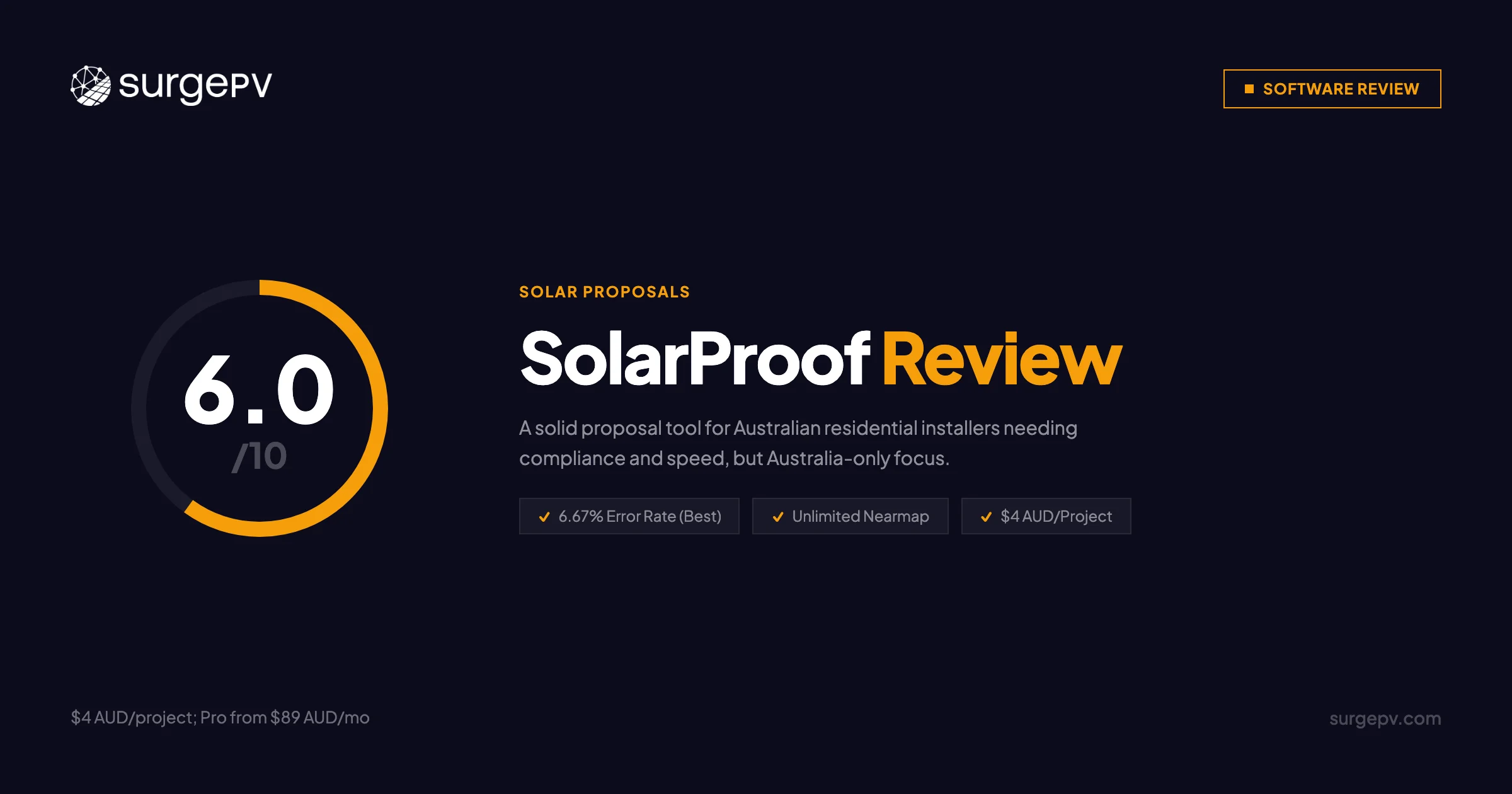
TL;DR: SolarProof is an Australian-built solar proposal platform designed for residential installers who need fast, compliant quotes with accurate shading. At $4 AUD per project (or $89 AUD/month on subscription), it’s one of the most affordable tools in the market and includes unlimited Nearmap imagery on all tiers. Independent testing gave it a 6.67% error rate — better than OpenSolar and HelioScope. The hard limits: Australia-only coverage, no electrical engineering, and no commercial structure support. For Australian residential work, SolarProof delivers real value. For commercial EPCs or multi-market operations, SurgePV — the leading solar design software — covers electrical engineering, carport design, and global markets in one platform.
Author: Keyur Rakholiya Title: Contributing Writer, SurgePV | MD & CEO, Heaven Green Energy Limited Expertise: 1+ GW solar projects delivered, 20+ design software platforms tested, 10+ years EPC operations Published: 2026-03-08 Last Updated: 2026-03-08 Review Methodology: Official SolarProof documentation, independent third-party testing (creativenurds.com), user testimonials, competitive platform testing
Who This Review Is For
This SolarProof review is written for:
- Australian solar installers evaluating proposal software for residential projects
- Small installation businesses comparing SolarProof pricing against competitors
- Sales-focused teams who need fast, professional proposals without a steep learning curve
- Anyone researching SolarProof features or looking for a SolarProof alternative
Who should skip this review:
- International EPCs — SolarProof does not operate outside Australia
- Commercial teams needing permit-ready electrical documentation (SLDs, wire sizing)
- Utility-scale developers — this tool targets residential and small commercial only
What Is SolarProof?
SolarProof is a cloud-based solar design and proposal platform built specifically for the Australian residential solar market. Founded in 2017 by Chris Taeni (BEng, solar industry consultant) in Mullumbimby, NSW, the company operates as a bootstrapped, profitable SaaS business with a small team of 2–10 people.
The product focuses on three things: accurate solar calculations, professional proposals, and Australian compliance. It does not attempt to be a full electrical engineering suite or an international platform.
Company Overview
| Detail | Info |
|---|---|
| Founded | 2017 |
| Location | Mullumbimby, NSW 2482, Australia |
| Team Size | 2–10 employees |
| Founder/CEO | Chris Taeni (BEngg, solar consultant) |
| Business Model | Bootstrapped SaaS, profitable |
| Primary Market | Australian residential solar installers |
| Website | solarproof.com.au |
Core Value Proposition
SolarProof positions itself on speed, compliance, and proposal quality for the Australian market. Its key differentiators against other Australian tools are:
- Unlimited Nearmap imagery on every plan (including the free demo)
- Automatic STC calculations for both solar and battery systems
- NETCC-compliant and CEC-approved proposal templates ready out of the box
- Interval data upload for precise system sizing based on customer usage
For a residential installer in Australia who needs to quote 10–50 jobs per month, these are practical advantages. For a commercial EPC needing bankable financial models and permit drawings, SolarProof is not the right fit.
Geographic Scope
SolarProof operates in Australia only. It uses Nearmap and Metromap imagery with Australian-specific compliance features. If you operate outside Australia or plan to expand internationally, you will need a different platform.
SolarProof Pricing & License Cost
SolarProof uses a quota-based subscription model and a pay-as-you-go option. All plans include Nearmap imagery — a genuine cost advantage over platforms that charge per-project for imagery.
SolarProof License Price 2026
| Plan | Monthly (AUD) | Annual (AUD) | Users | Quota |
|---|---|---|---|---|
| Free Demo | $0 | — | 1 | 3–4 quotes/month |
| Pay As You Go | $4/project | — | Unlimited | No monthly fees |
| Pro Tier 1 | $89 | $961 (10% off) | 1 | 1.2MW/month |
| Pro Tier 2 | $149 | $1,609 (10% off) | 3 | Priority support, API |
| Pro Tier 3 | $249 | $2,689 (10% off) | 5 | Advanced analytics |
| Pro Tier 4 | $399 | $4,309 (10% off) | 10+ | Dedicated support |
Annual billing saves 10% across all tiers. Pro Tier 1 currently includes an extra 300kW/month for the first 12 months (total 1.5MW/month).
What the quota means in practice: Pro Tier 1 at 1.2MW/month supports roughly 200 residential 6kW systems or 12 commercial 100kW systems per month. Battery projects are metered separately. The first three design variations per project are free.
What’s Included vs What’s Not
Included on all plans:
- Unlimited Nearmap imagery (unusual — most competitors charge per project)
- Panel placement with auto-snap
- 3D shade analysis
- NETCC-compliant proposal templates
- Automatic STC calculations
- E-signing capability
- Financial modeling (ROI, payback, PPA, GST)
Not included on any plan:
- SLD generation (single-line diagrams)
- Wire sizing or voltage drop analysis
- Commercial structure design (carports, trackers, East-West racking)
- International market coverage
Total Cost of Ownership
| Workflow | Annual Cost (AUD) | Annual Cost (USD est.) |
|---|---|---|
| SolarProof Pro Tier 1 | $961 AUD/year | ~$580 USD/year |
| SolarProof Pro Tier 2 (3 users) | $1,609 AUD/year | ~$970 USD/year |
| SolarProof + AutoCAD (commercial) | $961 + $3,300 AUD | ~$2,580 USD/year |
| SurgePV (3 users, all-in-one) | ~$2,480 AUD/year | $1,499 USD/user/year |
For Australian residential installers who do not need electrical engineering, SolarProof is cost-effective. For commercial EPCs who need electrical documentation, adding AutoCAD closes the price gap significantly — and SurgePV’s integrated approach eliminates that requirement entirely.
Hidden Costs to Check
SolarProof’s pricing is more transparent than most competitors. The main additional cost to verify: battery project quota is tracked separately from solar panel capacity. High-volume battery months may require quota top-ups. Confirm current quota rates with SolarProof before committing.
Is SolarProof Free? Free Trial
Yes. SolarProof offers two low-commitment entry points:
Free Demo Tier: Full platform access with 3–4 quotes per month at no cost. This is enough for a sole trader evaluating the software or a new business in its first month.
Pay As You Go ($4 AUD/project): No monthly fees. Credits purchased in advance never expire. This model suits seasonal businesses or low-volume installers who do not need a monthly subscription. Five free projects are included when you start.
Neither option requires a credit card commitment. For a business processing under 5 jobs per month, PAYG at $4 AUD/project may be the most cost-effective option indefinitely.
SolarProof Features & Capabilities
Panel Placement & Design Tools
SolarProof provides straightforward panel placement over satellite imagery or uploaded building plan images. The snap-to-grid system aligns panels automatically, and multiple arrays with different orientations and tilt angles are supported.
What it does not offer: automated AI roof detection, 3D modeling for complex geometries, or any support for carport canopies, ground-mount trackers, or East-West racking. The design toolset is adequate for standard rooftop residential work and not much beyond that.
User feedback on design: “Solar panels snapped easily to the grid, searching was easy” — SolarProof user
Shading Analysis Accuracy
SolarProof’s shading analysis uses 3D obstruction modeling to calculate nearby shade effects on system performance. This is where the product’s accuracy claims are backed by independent data.
Independent testing results (creativenurds.com, actual 8kW Melbourne installation):
| Platform | Error Rate |
|---|---|
| SolarProof | 6.67% |
| OpenSolar | 7.17% |
| HelioScope | 12.36% |
SolarProof had the lowest error rate among the four tools tested. One caveat: this was a single test on one system. Accuracy will vary by location, panel configuration, and shading complexity.
High-Resolution Imagery & Nearmap
This is SolarProof’s clearest competitive advantage for Australian users. Unlimited Nearmap imagery is included on every plan, including the free demo. Competitors typically charge $6–10 AUD per project for Nearmap access.
For a business running 100 projects per month, that is a $600–$1,000 AUD/month cost that SolarProof eliminates. Annual imagery with date selection is available, and Metromap is integrated for locations where Nearmap coverage is limited.
Financial Modeling
SolarProof’s financial modeling goes beyond basic payback calculations. It includes:
- 20-year ROI forecasts with configurable assumptions
- Dynamic payback analysis
- PPA calculations for commercial customers
- GST calculations
- Finance calculations for various loan terms
- Automatic STC calculation for solar and battery systems
- Integration with the 2025 Cheaper Home Batteries Program (8.4 STCs through May 2026)
The modeling is designed for customer-facing proposals rather than institutional financing. It does not produce P50/P75/P90 production estimates or bankability-grade financials.
Interval Data Analysis
SolarProof allows you to upload customer utility interval data files — granular usage patterns from smart meters — and use that data to optimize system sizing. This is rare for a proposal-focused tool and particularly useful for commercial systems with time-of-use tariffs or demand charges.
User feedback: “Standout feature for commercial system designs, allowing us to optimize with precision.”
Interval Data Advantage
If your customers have smart meter data or you are sizing storage for demand charge reduction, SolarProof’s interval data upload gives you a material advantage over basic proposal tools that only use average consumption figures.
Proposals & CEC Compliance
Three professional proposal templates are available, all NETCC-compliant with CEC-approved disclaimers. Proposals can be delivered as web links or PDF exports. Built-in e-signing lets customers approve proposals immediately.
Limitation: Template customization is limited to logo uploads. Fonts and styles cannot be changed. For businesses that need heavily branded, custom-designed proposals, this is a real constraint.
User feedback: “Solar Proof is hands down the best solar design software with ease of use and powerful custom templates. We’ve seen a significant boost in conversions since switching.”
Integrations
SolarProof connects to a solid range of tools for an Australian residential workflow:
| Category | Tools |
|---|---|
| Accounting | Xero, MYOB |
| CRM | HubSpot, Salesforce, Pipedrive |
| Payments | Stripe |
| Imagery | Nearmap, Metromap |
| Workflow | Monday.com, Zapier |
| Storage | Google Drive, Dropbox |
API access is available from Pro Tier 2 onward ($149 AUD/month). The integration set covers the core Australian installer workflow. The gap: no SLD or electrical tools, and no integration with CAD software.
Need Electrical Engineering + Proposals in One Platform?
SurgePV generates complete SLDs automatically in 5–10 minutes, handles commercial structures, and covers global markets — no AutoCAD needed.
Book a DemoNo commitment required · 20 minutes · Live project walkthrough
User Reviews & Feedback
SolarProof does not have listings on G2, Capterra, or TrustRadius. Available reviews come from the company website, third-party product reviews (creativenurds.com, 4.0 out of 5), and installer community forums.
Independent rating: 4.0/5 (creativenurds.com)
Top Praised Features
| Rank | Feature | Feedback Source |
|---|---|---|
| 1 | Ease of use | Multiple user testimonials |
| 2 | Nearmap imagery quality | User testimonials, independent review |
| 3 | Proposal quality and conversions | User testimonials |
| 4 | Interval data analysis | Commercial installer feedback |
| 5 | CEC/NETCC compliance | Australian market feedback |
Top Criticisms
| Rank | Issue | Severity |
|---|---|---|
| 1 | Outdated UI | Medium |
| 2 | Software bugs and navigation inconsistencies | Medium |
| 3 | No SLD or electrical engineering | High (for commercial users) |
| 4 | Proposal customization limits (fonts, styles) | Medium |
| 5 | Australia-only geographic scope | High (for anyone with expansion plans) |
User Quotes
“Solar Proof has revolutionized our workflow and is incredibly user-friendly. The high-resolution imagery alone is worth it — clients immediately see the value in our proposals.” — SolarProof user
“Solar Proof is hands down the best solar design software with ease of use and powerful custom templates. We’ve seen a significant boost in conversions since switching.” — SolarProof user
“Seems like Solar Proof is still in infancy stages” — creativenurds.com reviewer (on UI design)
“Recently our solar business won a 230kW TAFE project using Solar Proof” — SolarProof user
The consistent pattern: installers who use SolarProof for Australian residential work are satisfied. Users who hit the product’s edges (commercial electrical, international work, advanced branding) report frustration.
SolarProof Pros & Cons
✅ Pros
1. Accuracy Backed by Independent Testing ⭐ VERIFIED DATA
SolarProof achieved a 6.67% error rate in independent testing — the best among four tools (OpenSolar 7.17%, HelioScope 12.36%). For Australian residential installers, this translates to fewer system performance disputes and more accurate payback projections for customers.
2. Unlimited Nearmap Imagery on Every Plan ⭐ UNIQUE ADVANTAGE
Nearmap is included on all plans, including the free demo. Competitors charge $6–10 AUD per project for Nearmap access. At 100 projects/month, that is $600–$1,000 AUD/month in savings. This single feature can justify the subscription cost at moderate volume.
3. $4 AUD/Project PAYG Entry
The pay-as-you-go model with non-expiring credits is the lowest-friction entry in the Australian market. A new installer can process jobs without any monthly commitment, which reduces risk for small businesses and seasonal operations.
4. Australian Compliance Built-In
NETCC-compliant proposal templates and CEC-approved disclaimers are standard. Automatic STC calculations (solar and battery) and 2025 Cheaper Home Batteries Program integration remove compliance work that other platforms leave to the user.
5. Interval Data Analysis (Rare for Proposal Tools)
Uploading customer smart meter data for precise system sizing is not standard in proposal-focused software. For commercial jobs with time-of-use tariffs or demand charges, this gives SolarProof a practical advantage over simpler tools.
6. Founder-Responsive Support
With a 2–10 person team, Chris Taeni is accessible to users. Direct founder access to support and feature requests is a meaningful benefit for a business relationship.
7. E-Signing Built-In
Proposals can be approved on the spot during client consultations. No separate DocuSign subscription required.
8. Transparent Public Pricing
All tiers are listed on the pricing page. No “contact sales” requirement for standard plans.
⚠️ Cons
1. Australia-Only Market ⚠️ HARD LIMIT
There is no international capability. If your business expands beyond Australia, you will need to switch platforms. This is a structural limitation, not a gap that will be filled with a feature update.
2. No Electrical Engineering ⚠️ CRITICAL for Commercial
No SLD generation, wire sizing, or voltage drop analysis. For commercial projects needing permit-ready documentation, this requires a separate tool — typically AutoCAD (approximately $3,300 AUD/year) or an integrated platform. SurgePV’s solar proposal software includes automated SLD generation in 5–10 minutes with no external tools.
3. No Commercial Structures
Carports, single-axis trackers, dual-axis trackers, and East-West racking are not supported. Rooftop only. Solar carports are the fastest-growing commercial segment; teams targeting this work cannot use SolarProof.
4. Dated User Interface (Medium Severity)
Independent reviewers noted the UI feels unfinished relative to modern platforms. Navigation inconsistencies and bugs were reported. Not a dealbreaker for functional use, but it increases the learning curve for new team members.
5. Software Bugs (Medium Severity)
Multiple users reported navigation issues and bugs. With a 2–10 person development team, resolution speed is limited compared to larger competitors.
6. Small Development Team
Feature velocity is constrained by team size. Gaps in capabilities (electrical engineering, international coverage, UI polish) are unlikely to close quickly.
SolarProof vs SurgePV
SolarProof and SurgePV serve different market segments. The comparison below shows where each platform is genuinely stronger.
Feature Comparison
| Feature | SolarProof | SurgePV | Winner |
|---|---|---|---|
| Design Tools | Panel placement, auto-snap | AI roof modeling, panel placement | SurgePV |
| Electrical Engineering | None | Automated SLD, wire sizing, voltage drop | SurgePV |
| Shading Analysis | 3D analysis (6.67% error rate) | 8760-hour (±3% vs PVsyst) | Tie |
| Commercial Structures | Rooftop only | Carports, trackers, East-West | SurgePV |
| Proposals | CEC templates, e-sign, web/PDF | Web, PDF, multi-format | Tie |
| Financial Modeling | ROI, PPA, STC (customer-facing) | P50/P75/P90, bankability metrics | SurgePV (financed projects) |
| Compliance | NETCC/CEC (Australia only) | NEC 690 (US), IEC (international) | Context-dependent |
| Imagery | Unlimited Nearmap (included) | Google 3D, Bing, Esri | SolarProof (Australia) |
| Geographic Coverage | Australia only | India + US + International | SurgePV |
| Entry Pricing | $4 AUD/project PAYG | $1,499 USD/user/year (3-user plan) | SolarProof (lower entry) |
| Built-in CRM | Yes | Integrates with existing CRM | Tie |
Workflow Time: 100kW Commercial Project
| Step | SolarProof Stack | SurgePV |
|---|---|---|
| Roof design | 30–45 min | 30 min (AI-assisted) |
| Shading analysis | Included | Included |
| SLD generation | Not available (AutoCAD: 2–3 hours) | 5–10 min (automated) |
| Permit documentation | Not available | Included |
| Proposal | 15–20 min | 15–20 min |
| Total | 2.5–3.5 hours + AutoCAD cost | ~60 min, no extra tools |
Annual Cost Comparison
| Scenario | Annual Cost |
|---|---|
| SolarProof Pro Tier 1 (1 user) | $961 AUD (~$580 USD) |
| SolarProof Pro Tier 2 (3 users) | $1,609 AUD (~$970 USD) |
| SolarProof + AutoCAD (commercial team) | |
| SurgePV (3 users, all-inclusive) | $1,499 USD/user/year |
For Australian residential-only installers, SolarProof is cheaper. For commercial EPCs who need electrical documentation, the cost gap narrows considerably once AutoCAD is factored in.
SolarProof Alternatives
SurgePV
SurgePV is the strongest alternative for teams who need more than proposal generation. It adds complete electrical engineering (automated SLD, wire sizing, voltage drop), commercial structure design (carports, trackers, East-West racking), and global market coverage. As a solar design software platform built for commercial EPCs, it handles the full workflow from design to permit-ready documentation in one tool. Pricing starts at $1,499 USD/user/year with no feature gating.
OpenSolar
OpenSolar is a direct competitor in the Australian market. Its shading accuracy (7.17% error rate) is slightly below SolarProof’s 6.67%. It has international coverage that SolarProof lacks and a free tier with more monthly volume than SolarProof’s demo. However, it charges per-project for Nearmap access (~$6 AUD/project), which adds up at volume. Suitable for Australian installers who also work internationally.
Aurora Solar
Aurora Solar serves the US residential market primarily and is used globally. It is substantially more expensive ($135–220 USD/user/month) and not built for Australian compliance. It offers stronger residential sales features and a more polished UI than SolarProof. Not a practical alternative for Australia-focused installers.
HelioScope
HelioScope is a simulation tool known for engineering precision. Its independent testing showed a 12.36% error rate against SolarProof’s 6.67% on the same Melbourne system — a meaningful accuracy gap. HelioScope targets engineers over sales teams, lacks Australian-specific compliance, and does not offer proposal generation at the same level. Best for detailed energy modeling, not customer-facing proposals.
Solargraf
Solargraf (Enphase) is a European-origin proposal tool expanding globally. It has stronger UI polish than SolarProof and more template customization options. It does not have the same depth of Australian compliance features (STC calculations, NETCC templates). Better for European markets; SolarProof is a better fit for the Australian residential market specifically.
PVsyst
PVsyst is a simulation platform, not a proposal tool. If your need is engineering-grade simulation accuracy for bankable projects — rather than customer proposals — PVsyst is the industry benchmark. It has no proposal generation, no customer-facing workflow, and requires significant technical expertise. Not a replacement for SolarProof; they serve different purposes.
Who Should Use SolarProof?
✅ Best Fit for SolarProof
Australian Residential Installers (1–50 jobs/month) This is SolarProof’s core market. The product delivers accurate designs, professional proposals, automatic STC calculations, and unlimited Nearmap at an accessible price. If your work is standard rooftop residential in Australia, SolarProof covers the full quote-to-close workflow.
New Solar Businesses The free demo and PAYG pricing eliminate upfront commitment. A new installer can process real jobs, test the software with real clients, and scale up to a subscription only when volume justifies it.
Sales-Focused Teams Without Technical Background SolarProof’s learning curve is lower than CAD-based or engineering-focused tools. Teams that need to quote quickly and professionally — without learning complex simulation parameters — will get productive faster here.
Teams Who Value Nearmap Imagery If client-facing proposal quality depends on high-resolution aerial imagery, the unlimited Nearmap inclusion on all SolarProof plans is a genuine competitive advantage. Competitors either don’t offer Nearmap or charge per-project.
✗ Not Ideal for SolarProof
Commercial EPCs (100kW+) Commercial projects needing permit-ready electrical documentation — SLDs, wire sizing, conduit fill — require a different tool. SolarProof can generate proposals for commercial projects, but it cannot produce the engineering documentation needed for permitting.
International Operations Any business installing outside Australia needs a different platform. SolarProof’s geographic limitation is hard-coded into its imagery and compliance infrastructure.
Carport or Tracker Specialists Solar carports and tracker systems are not supported. Teams targeting commercial parking structures or utility-adjacent ground-mount should look at SurgePV or similar platforms with commercial structure support.
Teams Needing Bankable Financial Models If institutional financiers require P75/P90 production estimates or detailed yield analysis, SolarProof’s customer-facing financial modeling is not designed for that use case.
Frequently Asked Questions
What is SolarProof?
SolarProof is a cloud-based solar design and proposal platform founded in 2017 in Mullumbimby, NSW, Australia. It is built for Australian residential solar installers and provides panel placement over satellite imagery, automatic STC calculations, NETCC-compliant proposals, and unlimited Nearmap imagery on all plans. It does not support international markets or electrical engineering documentation.
How much does SolarProof cost?
SolarProof pricing:
- Free Demo: 3–4 quotes/month at no cost
- Pay As You Go: $4 AUD/project (credits never expire)
- Pro Tier 1: $89 AUD/month ($961 AUD/year)
- Pro Tier 2: $149 AUD/month ($1,609 AUD/year) — 3 users, API access
- Pro Tier 3: $249 AUD/month ($2,689 AUD/year) — 5 users
- Pro Tier 4: $399 AUD/month ($4,309 AUD/year) — 10+ users
Annual subscriptions receive a 10% discount.
Is SolarProof accurate?
Yes, based on independent testing. creativenurds.com tested SolarProof against three other tools on an actual 8kW Melbourne installation. SolarProof achieved a 6.67% error rate — the best result, ahead of OpenSolar (7.17%) and HelioScope (12.36%). This was a single test; accuracy varies by system and location.
Does SolarProof include SLD generation?
No. SolarProof does not generate single-line diagrams, wire sizing calculations, or voltage drop analysis. For commercial projects needing permit documentation, you will need supplemental tools. SurgePV’s solar design software generates complete SLDs automatically in 5–10 minutes as part of the standard workflow.
What is a SolarProof alternative?
The main SolarProof alternatives are:
- SurgePV — for commercial EPCs needing electrical engineering and global coverage
- OpenSolar — for Australian installers who also work internationally (free tier available)
- Aurora Solar — for US residential solar sales teams
- HelioScope — for engineering-grade simulation (not proposal-focused)
Does SolarProof work outside Australia?
No. SolarProof is Australia-specific in its imagery coverage (Nearmap/Metromap), compliance features (NETCC, STC, CEC), and market positioning. International operations require a different platform.
Is there a free version of SolarProof?
Yes. A free demo tier provides 3–4 quotes per month with full feature access. The PAYG plan ($4 AUD/project) effectively provides unlimited access at low volume with no monthly commitment.
Can SolarProof design carport solar systems?
No. SolarProof supports rooftop installations only. Carport solar design, solar trackers, and East-West racking are not available. SurgePV is currently the only major platform with native carport design support.
Is SolarProof solar proposal software good for Australian installers?
For Australian residential installers, yes. Accurate shading analysis, unlimited Nearmap, NETCC-compliant templates, and automatic STC calculations are all standard. The entry price is the lowest in the Australian market. For commercial work requiring electrical documentation, SolarProof’s capabilities are insufficient.
Final Verdict
SolarProof Executive Summary
Strengths:
- 6.67% error rate — best in independent testing
- Unlimited Nearmap on all plans, including free demo
- Lowest entry price in the Australian market ($4 AUD/project PAYG)
- Australian compliance built-in (NETCC, STC, CEC)
- Interval data analysis for commercial sizing
- Transparent pricing, founder-responsive support
Limitations:
- Australia-only — no international capability
- No electrical engineering (no SLD, no wire sizing)
- No commercial structures (carports, trackers)
- Dated UI with reported bugs
- 2–10 person team limits development speed
The Decision Framework
Choose SolarProof when:
- You install exclusively in Australia with no expansion plans
- Your portfolio is residential rooftop (80%+ of jobs)
- You need Australian compliance (NETCC, STC, CEC) without manual setup
- Budget is tight and PAYG fits better than subscriptions
- Nearmap imagery quality matters to your client proposals
Choose SurgePV when:
- You handle commercial projects requiring permit-ready electrical documentation
- You design carports, trackers, or East-West racking
- You operate in multiple markets or plan international expansion
- You need bankable financial modeling for institutional financing
- You want to eliminate AutoCAD from your workflow
Value Analysis
For an Australian residential installer running 100 jobs per month, SolarProof’s economics work well. Pro Tier 1 at $961 AUD/year eliminates $720–$1,200 AUD/year in Nearmap costs that competitors would charge per-project. The net cost is negative before accounting for proposal quality and conversion improvements.
For commercial EPCs who add AutoCAD to handle electrical documentation, the annual cost climbs to approximately $4,909 AUD/year for a single user. At that point, SurgePV’s integrated workflow — which eliminates AutoCAD and generates SLDs in 5–10 minutes — becomes the more cost-effective option and removes 2–3 hours of manual work per commercial project.
Rating: 6/10 — Strong fit for its target market (Australian residential), but the geographic limitation and missing electrical engineering prevent it from scoring higher.
Take the Next Step
If SolarProof fits your workflow, the free demo and PAYG model make it easy to try without commitment.
If you need electrical engineering, commercial structures, or global market coverage:
- Book a SurgePV demo — see automated SLD generation and commercial design live
- Explore solar proposal software — proposal capabilities comparison
- Compare solar design software — full platform overview
Related Resources
Platform Comparisons:
- Arka360 Review — all-in-one platform with built-in CRM
- HelioScope Review — engineering-grade simulation platform
- Aurora Solar Review — US residential solar design
Feature Deep Dives:
- Solar Proposal Software — proposal generation capabilities
- Shadow Analysis Software — shading simulation and accuracy
- Generation & Financial Tool — ROI and production modeling
Educational Resources:
- Solar Design Software — complete solar design software guide
- Best Solar Software — platform comparison guide
This SolarProof review was written by Keyur Rakholiya, Contributing Writer at SurgePV and MD & CEO of Heaven Green Energy Limited, with 1+ GW of solar project experience and hands-on testing of 20+ design software platforms. SolarProof information is sourced from official documentation (solarproof.com.au), independent third-party testing (creativenurds.com), and user testimonials. We maintain editorial independence and disclose our company affiliation transparently.
Review last updated: 2026-03-08 | Next review: June 2026
About the Contributors

Co-Founder · SurgePV
Nirav Dhanani is Co-Founder of SurgePV and Chief Marketing Officer at Heaven Green Energy Limited, where he oversees marketing, customer success, and strategic partnerships for a 1+ GW solar portfolio. With 10+ years in commercial solar project development, he has been directly involved in 300+ commercial and industrial installations and led market expansion into five new regions, improving win rates from 18% to 31%.

Content Head · SurgePV
Rainer Neumann is Content Head at SurgePV and a solar PV engineer with 10+ years of experience designing commercial and utility-scale systems across Europe and MENA. He has delivered 500+ installations, tested 15+ solar design software platforms firsthand, and specialises in shading analysis, string sizing, and international electrical code compliance.
