Pros
Cons
TL;DR: SolarMonkey is a cloud-based solar proposal and design tool built specifically for European residential installers. At €525/month for 50 projects, it targets sales teams that need fast quotes rather than deep engineering. Based on official company data (no G2/Capterra reviews available), users report 70–80% reduction in proposal time and 24% average conversion rate increases. For quick residential quoting in the Netherlands, Belgium, Germany, Spain, or the UK, SolarMonkey delivers real value. For global operations, commercial projects, or anything requiring permit-ready electrical documentation, SurgePV — the leading solar design suite — covers the full workflow from aerial design through automated SLD generation.
For more details, see our guide on Germany solar subsidies.
Author: Keyur Rakholiya Title: Contributing Writer, SurgePV | MD & CEO, Heaven Green Energy Limited Expertise: 1+ GW solar projects delivered, 20+ design software platforms tested, 10+ years EPC operations Published: 2026-03-08 Last Updated: 2026-03-08 Review Methodology: Official SolarMonkey documentation (20+ pages), Crunchbase funding data, partner pages (Pipedrive, Airteam), comparison of published product information against SurgePV
Who This Review Is For
This SolarMonkey review helps:
- European residential solar installers comparing proposal tools
- Sales-focused solar companies evaluating speed-to-quote platforms
- EPCs in the Netherlands, Belgium, Germany, Spain, or UK assessing local options
- Teams comparing SolarMonkey vs Aurora Solar, OpenSolar, or SurgePV
Who should skip this review:
- US or India-based installers (SolarMonkey does not operate in those markets)
- Utility-scale solar teams (SolarMonkey caps at roughly 500 kW practically)
- Engineering teams needing SLD generation or detailed wiring diagrams
What Is SolarMonkey?
SolarMonkey is a cloud-based solar design and sales platform developed by Solar Monkey B.V., founded in 2015 by three TU Delft engineers: Mels van Hoolwerff, Jan Pieter Versluijs, and Tino de Bruijn. The company is headquartered in Zuidland, Netherlands, with operations in Delft and The Hague.
The platform’s stated mission: “Making solar the world’s leading power supply.” In practice, it focuses on compressing the time between a lead inquiry and a signed proposal for residential and small commercial installers.
Company Background
| Detail | Info |
|---|---|
| Founded | 2015 by TU Delft engineers |
| Headquarters | Zuidland, Netherlands |
| Series A Funding | $3.94M (September 2022) from Eneco, Helen Ventures, 4impact, InnovationQuarter |
| Customers | 800+ solar businesses across Europe |
| Systems Monitored | 25,000+ |
| Languages | English, Dutch, German, Spanish, Belgian Flemish |
Core Value Proposition
SolarMonkey is built around speed. The platform targets installers who spend too much time on manual quoting and want to close deals faster without hiring additional engineering staff. Its tagline — “investment pays for itself with 5+ proposals weekly” — reflects the sales-first philosophy.
This positions it differently from simulation-heavy tools like PVsyst or engineering-complete platforms like SurgePV. SolarMonkey complements PVsyst for complex projects; it does not replace it.
Geographic Coverage
SolarMonkey operates in five European markets only:
- Netherlands (primary market, strongest regulatory support)
- Belgium
- Germany
- Spain
- United Kingdom
There is no support for the US, Canada, India, or Asia-Pacific. This is the single biggest limiting factor for any installer with operations outside Europe.
What Is SolarMonkey? Key Facts
SolarMonkey positions itself as the fastest path from customer inquiry to signed proposal. The numbers it cites:
- 3–5 minutes to complete a system design
- 70–80% reduction in proposal generation time
- 24% average increase in conversion rates
- Up to 3x sales conversion improvement in some use cases
These are user-reported figures from the official website. No independent third-party verification exists, and SolarMonkey has no formal reviews on G2 or Capterra as of March 2026. Treat them as directional, not benchmark data.
SolarMonkey Pricing
SolarMonkey uses a subscription model priced per project volume rather than per user. This suits high-volume residential installers but can get expensive for teams running many smaller projects.
SolarMonkey Pricing Plans
| Plan | Monthly Price | Includes | Annual Discount |
|---|---|---|---|
| Base | €525/month | 50 projects | 10% off |
| Quarterly billing | — | 50 projects | 5% off |
| API Access add-on | €95/month | Full API + webhooks | Included in plan |
| Connect+ activation | €195 one-time | Lead generation platform | One-time fee |
Medium and large plan pricing is not public — requires contacting sales.
What Is Included
- Unlimited users (no per-seat pricing on base plan)
- Branded white-labeled proposals
- E-signature functionality
- CRM integrations (Pipedrive, HERO, Splandid, Odoo)
- Multi-product proposals (PV, battery, heat pump, EV charger)
- In-app support chat
- Dedicated Customer Success Manager during onboarding
What Is Not Included
- API access (€95/month add-on)
- Connect+ lead generation (€195 one-time activation)
- Advanced CAD exports or wiring diagrams
- SLD (Single Line Diagram) generation
- Offline access
SolarMonkey License Price: Total Cost of Ownership
| Workflow | Annual Cost |
|---|---|
| SolarMonkey base (annual billing) | ~€5,670/year |
| SolarMonkey + API | ~€6,810/year |
| SolarMonkey + required engineering tool (PVsyst) | Not published |
| SurgePV (all-in-one, 3 users) | From $1,499/user/year |
For European residential-only teams, SolarMonkey’s base plan is reasonable. For teams also needing engineering depth, the true cost rises when you add PVsyst or equivalent simulation software.
Hidden Costs to Verify
Medium and large plan pricing is not disclosed publicly. API access is a separate monthly fee. If you need webhook integrations or want to connect SolarMonkey to a custom CRM, budget for the API add-on. Connect+ requires a one-time activation fee before the lead generation features are available.
Is SolarMonkey Free? Free Trial
SolarMonkey offers a 14-day free trial with no credit card required. This is one of the more generous free trial offers in the solar software category — most competitors require a demo call before granting trial access.
During the trial, users get full access to design, proposal, and CRM integration features. Most users report creating their first quotes within hours of signing up, helped by in-app guided walkthroughs and a dedicated Customer Success Manager.
There is no permanent free tier. After the 14-day trial, a paid subscription is required.
Core Features & Capabilities
Design Tools
SolarMonkey’s design engine uses AI-enhanced aerial imagery from multiple sources:
- Google Solar API
- Microsoft Azure imagery
- TIM-online (Netherlands-specific high-resolution data)
- Airteam drone imagery (via partnership)
The workflow: select an address, the system identifies the roof automatically, drag panels onto the roof surface, and the tool calculates shading and energy output. Auto roof pitch detection handles most residential geometries without manual input.
What it does well: Speed. A standard residential rooftop design takes 3–5 minutes. The tool is purpose-built for volume — installers running 50+ proposals per month rather than complex one-off commercial projects.
What it does not do: Advanced CAD precision, complex roof geometries, ground-mount arrays beyond basic configurations, or commercial structures like carports and trackers. For anything past roughly 500 kW, the tool runs out of engineering depth.
Automatic Shading Calculations
SolarMonkey uses 3D elevation data for automatic shading analysis. The UK market saw this feature launched with 3D terrain integration via the Airteam partnership.
The accuracy claim: 95%+ on system designs. This is an internal claim, not independently verified against PVsyst. For residential projects where the margin of error is acceptable, 95%+ is workable. For bankable commercial projects requiring financier sign-off, independently validated accuracy matters more.
SurgePV’s shadow analysis posts ±3% accuracy versus PVsyst — a documented figure that satisfies lender requirements. SolarMonkey does not publish equivalent validation data.
Sales & Proposals
This is the platform’s strongest area. SolarMonkey generates branded, white-labeled proposals with:
- Side-by-side scenario comparison (e.g., PV only vs. PV + battery)
- Real-time savings projections with payback period calculations
- E-signature built in — no DocuSign subscription required
- Multi-product upselling in a single proposal document
Financial models supported:
- Cash purchase
- Loans
- Lease and PPA structures
- Heat pump and EV charger co-investment scenarios
For residential sales teams, this is where SolarMonkey earns its subscription fee. The ability to show a customer three financing scenarios side-by-side, signed digitally in one session, compresses sales cycles.
For commercial solar proposal software needs with permit-ready documentation, SurgePV’s proposal module includes the supporting electrical engineering automatically.
Connect+ Lead Generation
Connect+ is SolarMonkey’s most differentiated feature — it has no direct equivalent in any competing platform.
The concept: after a system is installed and monitored, SolarMonkey sends monthly personalized performance reports to the end customer. These reports create natural opportunities to upsell batteries, heat pumps, and EV chargers to customers who are already engaged and already paying attention.
The reported metrics:
- 70% average email open rate (versus 15–25% for typical marketing newsletters)
- Automated lead generation for secondary products
- €195 one-time activation fee
For installers with a large existing customer base, Connect+ is a revenue-generating feature that has no equivalent elsewhere in the market. It turns installed-base management into an active sales channel.
CRM Integrations
SolarMonkey integrates directly with:
- Pipedrive
- HERO
- Splandid
- Odoo
Via Zapier/Make.com: Salesforce and most other CRM platforms.
The API is documented at api.solarmonkey.nl and supports webhooks. API access costs an additional €95/month.
SolarMonkey does not have a native CRM — it connects to your existing system. For teams without a CRM, this means an additional tool cost. For teams already using Pipedrive or Odoo, the integration is direct and clean.
See How SurgePV Handles the Full Workflow
SurgePV covers what SolarMonkey cannot — automated SLD generation, commercial structures, India and US markets, and permit-ready documentation in one platform.
Book a DemoNo commitment required · 20 minutes · Live project walkthrough
What SolarMonkey Is Missing
SolarMonkey is transparent about its focus. What it does not do:
No electrical engineering tools No SLD (Single Line Diagram) generation, no wiring diagrams, no conduit fill or voltage drop calculations. For residential projects in many European markets, this is acceptable — AHJ requirements are lighter than in the US. For commercial projects or markets with stricter permit requirements, this is a gap that requires a separate tool.
No utility-scale capability No tracker optimization, no substation modeling, no large commercial ground-mount support. Practical project cap is around 500 kW.
No offline mode The platform requires a stable internet connection. Field work in areas with poor connectivity is not supported.
No mobile app Browser-only. Works on mobile browsers but lacks the dedicated iOS/Android experience some field teams prefer.
Europe-only geography This is the hardest constraint. SolarMonkey simply does not work for US, India, or international operations. No roadmap is published for geographic expansion.
User Reviews & Feedback
SolarMonkey has no formal reviews on G2, Capterra, or TrustRadius as of March 2026. This makes independent user sentiment harder to assess than for tools like Arka360 (129 G2 reviews) or Aurora Solar.
The available user feedback comes from:
- Official SolarMonkey website testimonials
- Partner case studies (Airteam, Pipedrive)
- Dutch and German solar industry forum discussions
What Users Report Positively
| Feature | Reported Benefit |
|---|---|
| Design speed | 3–5 minute system designs; quotes within hours of onboarding |
| Proposal quality | Branded, professional output that improves customer confidence |
| Connect+ | High open rates; actual upsell revenue from existing customers |
| Onboarding | Fast time-to-value; Customer Success Manager reduces ramp time |
| Multi-product | Single proposal for solar + battery + heat pump removes friction |
What Users Report Negatively
Based on forum discussions and publicly available feedback:
| Issue | Context |
|---|---|
| Europe-only limitation | Frequently cited as the reason teams outgrow the platform |
| Pricing transparency | Medium and large plan pricing opacity causes friction at renewal |
| Engineering depth | Teams that graduate to commercial projects need a second tool |
| Customer service | Some reports of slower response outside Netherlands |
Representative User Comments
“The speed is the main thing — we went from spending half a day on each proposal to getting them out in 20 minutes.” — Dutch residential installer, via partner testimonial
“Connect+ has become our best lead source. Our installation base is already interested in batteries and heat pumps — we just needed a way to reach them efficiently.” — Belgian solar company, via SolarMonkey case study
Pros & Cons
Pros
1. Fastest Time-to-Quote in the European Segment
SolarMonkey is purpose-built for speed. 3–5 minute designs and 70–80% reduction in proposal generation time (user-reported) put it ahead of any engineering-first tool for residential volume work.
2. Connect+ Is Genuinely Unique
No other solar software platform offers an automated post-installation monetization feature. The 70% email open rate versus the 15–25% industry average for newsletters is a meaningful difference. For installers with a large existing base, Connect+ can pay for the subscription independently.
3. Multi-Product Proposals in One Document
PV, batteries, heat pumps, and EV chargers in a single branded proposal with side-by-side financing scenarios. This reduces the need for multiple tools and multiple proposal iterations during a customer meeting.
4. 14-Day Free Trial, No Credit Card
A low-friction way to evaluate the platform. Most users report making a go/no-go decision within the trial period.
5. Strong European Market Optimization
Language support (English, Dutch, German, Spanish, Flemish), local imagery sources (TIM-online, Airteam), and European regulatory context built in. This saves setup time for European teams compared to adapting a US-built tool.
Cons
1. Europe-Only Coverage
No US, India, or international markets. This is not a roadmap gap — it is an architectural constraint. Teams that expand beyond Europe need to switch platforms entirely.
2. No Electrical Engineering Tools
No SLD generation. No wiring diagrams. No voltage drop or conduit fill calculations. For markets with strict AHJ permit requirements, or for any commercial project, this requires a separate engineering tool that adds cost and workflow friction.
3. Pricing Opacity at Scale
The base €525/month plan covers 50 projects. Volume pricing above that requires a sales conversation. For teams trying to model annual software costs, this creates uncertainty.
4. No Verified Third-Party Reviews
Without G2 or Capterra reviews, there is no independent benchmark for user satisfaction, support quality, or reliability. Buyers are working from official marketing materials and informal community feedback.
5. No Offline Access
Field teams in areas with poor connectivity — common in rural solar installations — cannot use the platform without reliable internet.
SolarMonkey vs SurgePV
SolarMonkey and SurgePV target different primary use cases, but there is meaningful overlap for European residential teams that are scaling toward commercial work.
Feature Comparison
| Feature | SolarMonkey | SurgePV | Winner |
|---|---|---|---|
| Design speed (residential) | 3–5 minutes | 10–15 minutes | SolarMonkey |
| Multi-product proposals | PV, battery, heat pump, EV | PV + battery | SolarMonkey |
| SLD generation | None | Automated (5–10 min) | SurgePV |
| Geographic coverage | 5 European countries | India, US, international | SurgePV |
| Commercial structures | Rooftop only (up to ~500 kW) | Carports, trackers, East-West | SurgePV |
| Shading accuracy | 95%+ (self-reported) | ±3% vs PVsyst (documented) | SurgePV |
| Connect+ lead generation | Yes (unique) | No | SolarMonkey |
| CRM | Integrates (Pipedrive, Odoo) | Integrates with existing CRM | Tie |
| Free trial | 14 days, no credit card | Demo-based | SolarMonkey |
| Pricing transparency | Base plan public; large plans require sales | Public pricing | SurgePV |
Workflow Time: 100 kW Commercial Project
| Step | SolarMonkey | SurgePV |
|---|---|---|
| Roof design | 10–15 min | 15–20 min |
| Shading simulation | Included (basic) | Included |
| SLD generation | Not available (requires external tool, 2–3 hrs) | 5–10 min (automated) |
| Proposal | 15–20 min | 15–20 min |
| Total | 2.5–3.5 hours (with external SLD tool) | 45–60 min |
For residential-only work, SolarMonkey is faster. For anything requiring permit-ready documentation, the SLD gap is a serious workflow problem.
Annual Cost Comparison
| Option | Annual Cost |
|---|---|
| SolarMonkey base (annual billing) | ~€5,670/year |
| SolarMonkey + PVsyst (commercial teams) | Not published |
| SurgePV (3 users, all-inclusive) | From $1,499/user/year |
For European-only residential teams with no commercial ambitions, SolarMonkey’s annual cost is defensible. For teams that also do commercial work or operate outside Europe, SurgePV’s all-in-one pricing covers more ground at comparable cost.
SolarMonkey Alternatives
SurgePV is the strongest alternative for teams needing engineering depth, global coverage, or commercial structures. Solar design platform that generates automated SLDs and handles India, US, and international markets in one platform. Best for EPCs doing commercial work or operating across multiple countries.
Aurora Solar covers US and European residential markets with stronger engineering capabilities than SolarMonkey, but at higher cost and complexity. A fit for teams that need a tool recognized in the US market. See the Aurora Solar review.
Arka360 is the India-first alternative with built-in CRM. Serves dual India/US markets with a simpler learning curve and competitive pricing. Not Europe-focused.
OpenSolar is a free-to-start option with global coverage. Weaker on European regulatory specifics and proposal quality versus SolarMonkey, but removes the subscription cost for very small teams.
HelioScope is the stronger choice for commercial and industrial projects in Europe. Better engineering depth than SolarMonkey but no residential sales speed or multi-product proposal capabilities.
PVsyst handles simulation depth that SolarMonkey explicitly does not. Many SolarMonkey users run both tools in parallel — SolarMonkey for the sales proposal, PVsyst for the bankable yield report.
Who Should Use SolarMonkey?
Use SolarMonkey When
You are a European residential installer with high proposal volume. If your team is running 20+ proposals per week in the Netherlands, Belgium, Germany, Spain, or the UK, SolarMonkey’s 3–5 minute design speed and clean proposals pay for themselves quickly.
You sell multiple products (solar + battery + heat pump + EV charger). SolarMonkey’s multi-product proposal capability is its strongest commercial differentiator. No other tool in this price range makes it as easy to sell a full energy package in one customer meeting.
You have a significant installed base to monetize. Connect+ transforms past customers into leads for battery and heat pump upsells. If you have 500+ past installations, this feature alone justifies the subscription.
You do not need SLD generation or permit-ready electrical documentation. For markets where the AHJ only requires a basic design drawing, SolarMonkey’s output is sufficient. Know your local permit requirements before committing.
Do Not Use SolarMonkey When
You operate outside Europe. This is not a workaround situation — the platform simply does not work for US, India, or international projects.
You do commercial projects above roughly 500 kW. The engineering depth is not there. You will need a second tool, which increases cost and adds workflow complexity.
Your projects require bankable yield reports. For projects where a financier or lender requires an independently validated production estimate, SolarMonkey’s self-reported accuracy figures will not satisfy the requirement.
Frequently Asked Questions
What is SolarMonkey?
SolarMonkey (sometimes spelled “solar monkey” or “solarmonky” in search queries) is a cloud-based solar proposal and design platform built for European residential solar installers. Founded in 2015 by TU Delft engineers, it serves 800+ solar businesses across the Netherlands, Belgium, Germany, Spain, and the UK. Its focus is speed: 3–5 minute system designs and 70–80% reduction in proposal generation time.
How much does SolarMonkey cost?
The base plan starts at €525/month and includes 50 projects. Annual billing reduces the cost by 10%. API access adds €95/month. Connect+ lead generation requires a €195 one-time activation. Medium and large plans are priced on request. A 14-day free trial is available with no credit card.
Does SolarMonkey support the US or India?
No. SolarMonkey operates only in the Netherlands, Belgium, Germany, Spain, and the UK. There is no US or India support. Teams in those markets should look at SurgePV, which covers India, the US, and international markets with full regulatory compliance.
What is the SolarMonkey login?
SolarMonkey login is at app.solarmonkey.io. The platform is browser-based — no app installation required. It works on desktop and mobile browsers, though there is no dedicated iOS or Android application. A stable internet connection is required at all times.
Is SolarMonkey free?
SolarMonkey is not free, but offers a 14-day free trial with no credit card required. After the trial, the base plan starts at €525/month for 50 projects. There is no permanent free tier.
Does SolarMonkey generate Single Line Diagrams (SLD)?
No. SolarMonkey does not generate SLDs or detailed wiring diagrams. For permit-ready electrical documentation, you need a separate engineering tool. SurgePV generates complete, automated SLDs in 5–10 minutes with no external tools required.
How does SolarMonkey handle shading analysis?
SolarMonkey uses automatic shading calculations based on 3D elevation data. The UK implementation uses Airteam drone imagery for improved precision. The platform claims 95%+ design accuracy. This figure is self-reported and not independently verified against PVsyst. For bankable projects requiring documented shading validation, SurgePV’s shadow analysis posts ±3% variance versus PVsyst.
Final Verdict
SolarMonkey Strengths
- Fastest residential proposal tool for European markets
- Connect+ post-installation lead generation has no competitor equivalent
- Multi-product proposals (PV, battery, heat pump, EV charger) in one document
- Low barrier to entry: 14-day trial, no credit card, most users productive within hours
- Strong local imagery and language support for Netherlands, Belgium, Germany, Spain, UK
SolarMonkey Limitations
- Europe-only. Full stop. No pathway to US, India, or international markets.
- No electrical engineering. No SLD, no wiring diagrams, no permit-ready documentation.
- Practical project ceiling around 500 kW. Utility-scale is not in scope.
- No independent user reviews on G2 or Capterra — trust the marketing data with appropriate skepticism.
- Medium and large plan pricing requires a sales call.
The Decision Framework
Choose SolarMonkey when: You are a European residential installer running high proposal volume in the Netherlands, Belgium, Germany, Spain, or the UK, and you do not need SLD generation or commercial structures.
Choose SurgePV when: You operate in India, the US, or any market outside SolarMonkey’s five European countries; you do commercial projects requiring permit-ready SLD documentation; you need carport, tracker, or ground-mount support beyond basic configurations; or you want global coverage from one platform.
Value Assessment
For its target user — a European residential installer generating 20+ proposals per week — SolarMonkey’s €525/month is defensible against the 24% conversion rate improvement users report. If 5 additional closes per month at an average €5,000 margin happen because of faster, better proposals, the software pays for itself in the first week.
For teams that grow beyond that use case — adding commercial work, expanding geographically, or needing permit-ready documentation — SolarMonkey becomes a bottleneck. At that point, the migration to a full-workflow platform like SurgePV is the logical next step.
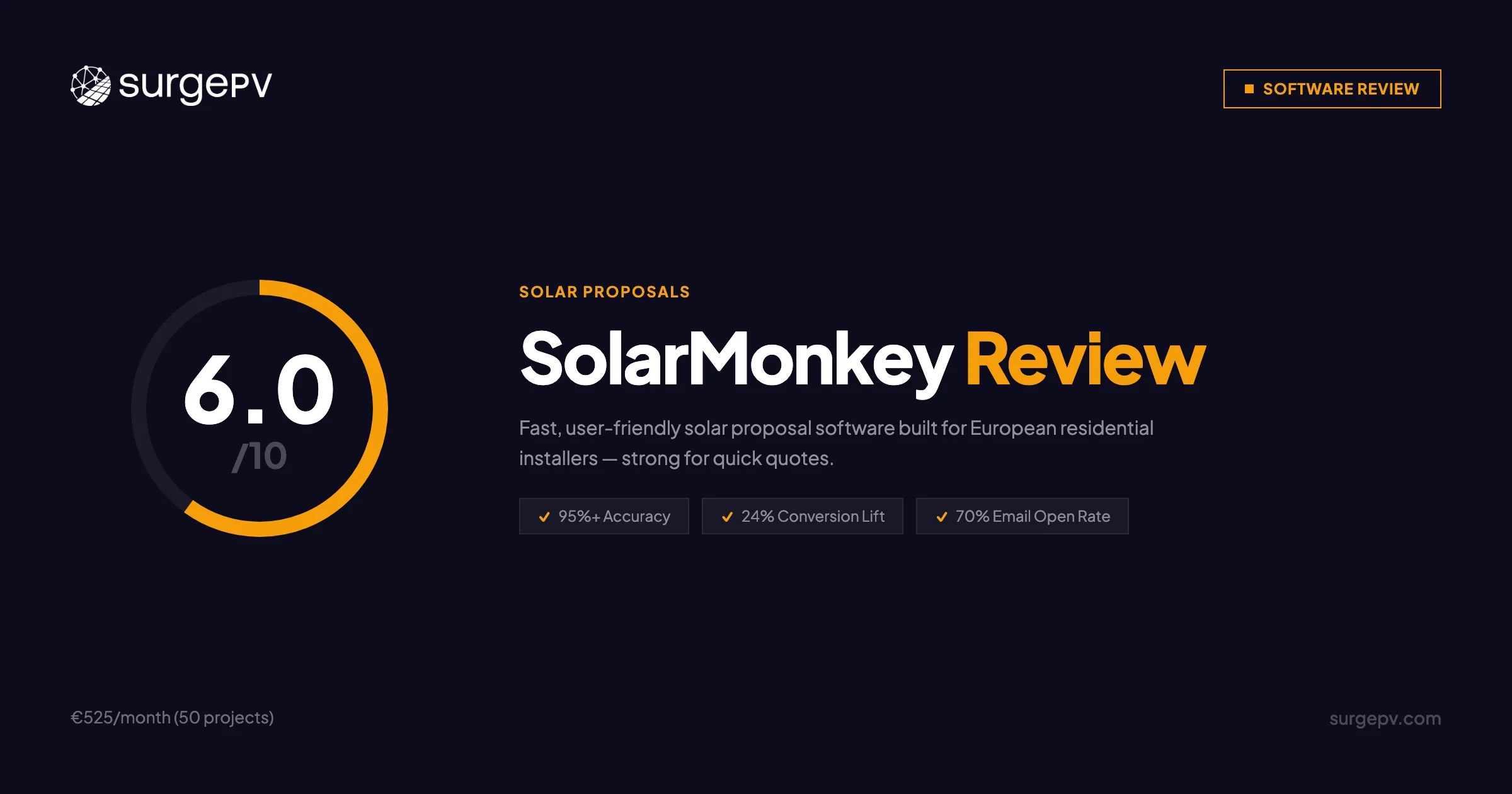
Rating: 6/10 — Strong for its specific use case, limited by geographic and engineering constraints.
Take the Next Step
SurgePV covers what SolarMonkey cannot: global markets, commercial structures, automated SLD generation, and all-inclusive pricing.
- Book a demo — See SurgePV handle a commercial project end-to-end
- Compare solar software — Full platform comparison guide
- SurgePV pricing — Transparent, all-inclusive pricing
Migrating from SolarMonkey? SurgePV provides dedicated onboarding support and a migration path for European teams expanding their operations.
Related Resources
Platform Comparisons:
- Arka360 Review — India and US-focused design and proposal platform
- Aurora Solar Review — US-first residential and commercial platform
- HelioScope Review — Commercial and industrial simulation tool
- PVsyst Review — Engineering-grade simulation for bankable projects
Feature Deep Dives:
- Solar Proposal Software — Complete proposal capabilities
- Shadow Analysis — Documented ±3% vs PVsyst shading analysis
- Generation and Financial Tool — ROI and financial modeling
Best Solar Software Rankings:
- See our best solar proposal software rankings.
This SolarMonkey review was written by Keyur Rakholiya, Contributing Writer at SurgePV and MD & CEO of Heaven Green Energy Limited, using the cited public sources. All SolarMonkey information is sourced from official documentation (solarmonkey.io, 20+ pages), Crunchbase funding data, and partner pages (Pipedrive, Airteam). No G2 or Capterra reviews exist for SolarMonkey as of March 2026 — user-reported performance figures are from official SolarMonkey marketing materials. We disclose that SurgePV publishes this review and disclose our company affiliation transparently.
Review last updated: 2026-03-08 | Next review: June 2026
About the Contributors

Co-Founder · SurgePV
Nirav Dhanani is identified by SurgePV as a company co-founder. His SurgePV author page lists only role information that can be tied to the public profile below; credentials, project totals, conversion results, and market-expansion claims are not asserted without retained evidence.

Editorial contributor · SurgePV
Rainer Neumann is credited as an editorial contributor on SurgePV content. This profile does not assert engineering credentials, project totals, software-testing experience, education, speaking engagements, or media citations because independent verification evidence is not retained in the publication record.
